
- Home
- »
- Paints, Coatings & Printing Inks
- »
-
Pigment Grade Titanium Dioxide Market Size Report, 2033GVR Report cover
![Pigment Grade Titanium Dioxide Market (2026 - 2033)Report]()
Pigment Grade Titanium Dioxide Market (2026 - 2033)
Size, Share & Trends Analysis Report By Grade (Anatase, Rutile), By Process (Sulfate, Chloride), By Application (Paints & Coatings, Plastics, Cosmetics, Inks), By Region, And Segment Forecasts
Market Size, 2025
$23.7BMarket Estimate, 2026
$23.9BMarket Forecast, 2033
$28.6BCAGR, 2026–2033
2.6%Pigment Grade Titanium Dioxide Market Summary
The global pigment grade titanium dioxide market size was valued at USD 23.7 billion in 2025 and is projected to grow from USD 23.9 billion in 2026 to reach USD 28.6 billion by 2033, growing at a CAGR of 2.6% from 2026 to 2033. Asia Pacific dominated the market, accounting for a revenue share of 60.6% in 2025. This growth is supported by rising demand from the paints & coatings, plastics, and construction industries, driven by rapid urbanization and infrastructure development in emerging economies.

Key Market Trends & Insights
- By grade: Rutile segment held the largest market share of 75.9% in 2025.
- By application: Food & beverages segment held the largest market share of 28.1% in 2025.
- By process: Chloride segment is expected to grow the fastest at a CAGR of 2.9% during the forecast period.
Regional Highlights
- Largest regional market: Asia Pacific (60.6% revenue share, 2025)
- By country: China held the largest market share in 2025.
Market Size & Forecast
- Market size in 2025: USD 23.7 Billion
- Estimated market size in 2026: USD 23.9 Billion
- Projected market size by 2033: USD 28.6 Billion
- CAGR (2026-2033): 2.6%
Increasing automotive production, expanding packaging applications, and the growing preference for high-performance and durable coatings are further strengthening market demand. The continued expansion of the global paints and coatings industry remains one of the primary factors driving demand for the pigment grade titanium dioxide market.
Pigment grade titanium dioxide is the most widely used white pigment in coating formulations owing to its exceptional opacity, brightness, whiteness, UV resistance, and weatherability. These properties enable manufacturers to produce high-performance architectural, industrial, automotive, protective, marine, and packaging coatings with enhanced durability and long-term aesthetic appeal.
Market Dynamics
The continued expansion of the global paints and coatings industry remains one of the primary factors driving demand for the pigment grade titanium dioxide market. Pigment grade titanium dioxide is the most widely used white pigment in coating formulations owing to its exceptional opacity, brightness, whiteness, UV resistance, and weatherability. These properties enable manufacturers to produce high-performance architectural, industrial, automotive, protective, marine, and packaging coatings with enhanced durability and long-term aesthetic appeal. As investments in residential construction, infrastructure development, industrial manufacturing, and automotive production continue to increase, the consumption of high-quality coating materials is also rising, directly supporting demand for pigment grade titanium dioxide.
The growing emphasis on premium coating performance and sustainability is further accelerating titanium dioxide consumption. Coating manufacturers are increasingly developing formulations that offer improved hiding power, gloss retention, abrasion resistance, color stability, and long-term weatherability while meeting evolving environmental and regulatory requirements. Pigment grade titanium dioxide plays a vital role in achieving these performance characteristics by improving light scattering, surface coverage, and ultraviolet protection, making it an indispensable raw material for high-performance coating applications.
Volatility in the prices and availability of titanium-bearing raw materials remains a significant restraint for the global pigment grade titanium dioxide market. The production of pigment grade titanium dioxide primarily depends on feedstocks such as ilmenite, rutile, synthetic rutile, and titanium slag, whose supply and pricing are influenced by mining output, ore quality, energy costs, transportation expenses, geopolitical developments, and environmental regulations. As these feedstocks constitute a substantial portion of overall manufacturing costs, fluctuations in raw material prices directly influence production economics, operating margins, and pricing strategies across the titanium dioxide value chain.
The global supply of high-grade titanium-bearing minerals is concentrated in a limited number of producing regions, making the market susceptible to supply disruptions arising from mining constraints, export regulations, logistical bottlenecks, and changing trade dynamics. In addition, rising energy prices and mineral processing costs further contribute to feedstock price volatility, increasing procurement uncertainty for manufacturers. These factors collectively challenge the industry's ability to maintain cost-efficient production and a stable supply of pigment grade titanium dioxide.
Growing preference for sustainable and high-performance pigment solutions across major end use industries is creating new opportunities for the global pigment grade titanium dioxide market. End use industries, including paint and coatings, plastics, paper, and printing inks, are increasingly seeking titanium dioxide pigments that not only deliver superior optical performance but also support evolving sustainability objectives. This transition encourages manufacturers to develop advanced pigment grades that improve opacity, brightness, durability, and processing efficiency while optimizing resource utilization.
Sustainability-driven innovation is reshaping product development across the titanium dioxide industry. Manufacturers are investing in advanced particle engineering, surface treatment technologies, and process optimization to develop pigments with enhanced dispersion, weather resistance, UV stability, and application performance. These technological advancements enable customers to reduce pigment consumption, improve production efficiency, and achieve consistent product quality, creating opportunities for manufacturers to differentiate their product portfolios.
Market Concentration & Characteristics
The pigment grade titanium dioxide market is moderately consolidated, with a handful of global manufacturers accounting for a significant share of global production capacity. Leading companies such as The Chemours Company, Tronox Holdings plc, KRONOS Worldwide Inc., LB Group, and Venator Materials PLC maintain strong competitive positions through integrated feedstock sourcing, large-scale manufacturing facilities, advanced chloride and sulfate production technologies, and well-established global distribution networks. Their operational scale, product quality, and long-term customer relationships create high barriers to entry for new participants
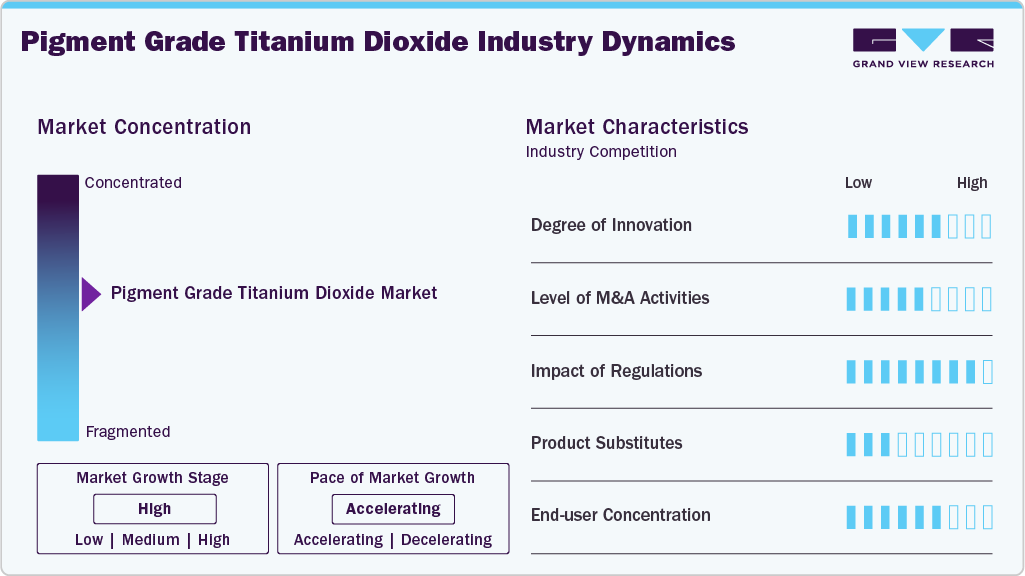
The market is driven by stable demand across paints & coatings, plastics, paper, inks, cosmetics, and construction industries, while competition increasingly focuses on product quality, process efficiency, sustainability, and cost optimization. Manufacturers are investing in capacity expansion, chloride-process technologies, energy-efficient production, and low-carbon manufacturing initiatives to strengthen their competitive position and address evolving environmental regulations and customer requirements for high-performance titanium dioxide pigments.
Analyst Perspective
The pigment-grade titanium dioxide market is expected to grow steadily, driven by demand from paints & coatings, plastics, paper, inks, and specialty applications requiring high opacity, brightness, and UV resistance. Manufacturers are increasingly adopting energy-efficient and environmentally compliant production technologies, particularly the chloride process, to enhance product quality and sustainability. Rising infrastructure development, automotive production, and packaging demand are expected to support long-term consumption. At the same time, sustainable manufacturing, premium application-specific grades, and integrated supply capabilities are expected to strengthen the competitive position of leading manufacturers amid evolving regulations and fluctuating feedstock costs.
Grade Insights
The rutile segment dominated the pigment grade titanium dioxide market and accounted for the largest revenue share of 75.9% in 2025. Rutile titanium dioxide (TiO₂) pigment is the most widely used crystalline form of titanium dioxide owing to its superior weather resistance, high opacity, excellent UV stability, and exceptional hiding power. These properties make it the preferred choice for high-performance applications, including architectural and industrial coatings, automotive paints, plastics, inks, and paper. The growing demand for durable coatings across the construction, automotive, and infrastructure sectors, along with increasing consumption of high-performance plastic products, continues to strengthen the demand for rutile-grade titanium dioxide.
The anatase segment is expected to grow at the fastest CAGR of 2.9% from 2026 to 2033 during the forecast period. The increasing demand for cosmetics and personal care products, particularly sunscreens, face powders, foundations, and skincare formulations, coupled with the expanding pharmaceutical industry where TiO₂ is used as a white pigment and opacifier in tablet and capsule coatings, is anticipated to drive the demand for anatase titanium dioxide during the forecast period.
Process Insights
The sulfate segment dominated the pigment grade titanium dioxide market and accounted for the largest revenue share of 78.8% in 2025. The sulfate process is one of the most established methods for manufacturing titanium dioxide (TiO₂) pigment and is widely adopted due to its ability to process lower-grade titanium-bearing feedstocks, particularly ilmenite. In this process, ilmenite is digested using sulfuric acid to produce titanyl sulfate, followed by impurity removal and hydrolysis to form hydrated titanium dioxide. The resulting precipitate is then calcined to produce anatase or rutile titanium dioxide pigments.
The chloride segment is expected to grow at the fastest CAGR of 2.9% from 2026 to 2033 during the forecast period. Growing demand for premium-performance pigments and environmentally efficient manufacturing processes continues to strengthen the adoption of the chloride process across the titanium dioxide industry. Its lower waste generation, efficient chlorine recovery system, and consistent pigment quality make it a preferred production route for manufacturers serving high-value applications.
Application insights
The paints & coatings segment dominated the market and accounted for the largest revenue share of 56.0% in 2025. Rising investments in residential and commercial construction, infrastructure modernization, and industrial manufacturing continue to support the consumption of titanium dioxide pigments across the global coatings industry. Growing preference for premium, long-lasting coating systems is further strengthening demand for high-quality titanium dioxide pigments. Manufacturers are increasingly focusing on developing formulations with enhanced durability, weatherability, and sustainability to comply with evolving environmental standards.

The plastics segment is expected to grow at a CAGR of 3.2% from 2026 to 2033 during the forecast period. The expanding use of lightweight and durable plastic products across packaging, construction, automotive, and consumer applications continues to support the consumption of titanium dioxide pigments. Manufacturers are also focusing on developing specialized pigment grades tailored to evolving processing and performance requirements.
Regional Insights
Asia Pacific pigment grade titanium dioxide market secured 60.6% of the market share in 2025. The region accounts for the majority of global titanium dioxide production capacity, with China serving as the largest manufacturing hub, while Japan, India, South Korea, and Australia contribute through specialty pigment production, mineral processing, and advanced material applications. Strong demand from paint and coatings, plastics, construction, packaging, automotive, and consumer goods industries continues to support regional market growth, driven by rapid urbanization, infrastructure development, and expanding industrial manufacturing activities.

For instance, in December 2025, ECHEMI reported that Chinese titanium dioxide producers continued to focus on premium rutile-grade products, production optimization, and export-oriented strategies to improve product quality and strengthen competitiveness in international markets. These developments reflect the ongoing transition of regional industry toward higher-value pigment products and improved operational efficiency.
China Pigment Grade Titanium Dioxide Market Trends
Titanium dioxide pigment grade market in China represents the largest production and consumption hub for market, supported by its extensive manufacturing capacity, integrated raw material supply chain, and strong presence across paints and coatings, plastics, paper, and industrial applications. The country hosts several leading titanium dioxide producers, including LB Group, CNNC Hua Yuan Titanium Dioxide with significant production capabilities across sulfate and chloride processes. Strong demand from construction, infrastructure, automotive, packaging, and consumer goods industries, along with China's strong export capabilities, continues to reinforce its strategic importance in the global pigment grade titanium dioxide market.
North America Pigment Grade Titanium Dioxide Market Insights
North America represents a technologically advanced and innovation-driven market, supported by its well-established paints and coatings, plastics, packaging, construction, and automotive industries. The region is home to several leading titanium dioxide manufacturers with integrated production capabilities and strong research and development initiatives focused on high-performance pigment technologies. Rising demand for durable architectural coatings, lightweight engineering plastics, sustainable packaging materials, and premium industrial products continues to support the consumption of titanium dioxide pigments across diverse end-use sectors.
For instance, in February 2025, The Chemours Company launched Ti-Pure TS-6706, a TMP- and TME-free version of its flagship Ti-Pure R-706 titanium dioxide pigment for coatings applications. Introduced under the company's Ti-Pure Sustainability Series, the new chloride-process pigment delivers the same high levels of opacity, gloss, durability, and dispersion as Ti-Pure R-706 while enabling customers to meet evolving regulatory requirements with minimal reformulation. This product launch reflects the region's continued focus on developing sustainable, high-performance pigment solutions and strengthening its leadership in advanced titanium dioxide technologies.
The U.S. represents one of the largest markets, supported by its well-established paints and coatings, plastics, packaging, construction, automotive, and industrial manufacturing sectors. The country benefits from the presence of leading titanium dioxide producers, advanced production technologies, and a robust distribution network that ensures the reliable supply of high-performance pigments across multiple industries. Growing investments in residential and non-residential construction, increasing production of lightweight plastic components, and sustained demand for premium coatings continue to drive the consumption of titanium dioxide pigments throughout the country.
For instance, in June 2025, Tilley Distribution announced a strategic partnership with LB Group to distribute the company's high-performance titanium dioxide pigments across the United States. Through this collaboration, Tilley expanded its portfolio with LB Group's Rutile and Anatase TiO₂ pigment grades, providing customers in coatings, plastics, inks, paper, and other industrial applications with enhanced access to high-quality pigment solutions. The partnership reflects the growing emphasis on strengthening domestic distribution networks and meeting the evolving performance requirements of end-use industries in the U.S. pigment grade titanium dioxide market.
Europe Pigment Grade Titanium Dioxide Market Trends
Europe remains one of the most established markets, supported by its strong paints and coatings, plastics, paper, pharmaceutical, and specialty chemicals industries. The region is characterized by stringent environmental regulations, advanced manufacturing capabilities, and a growing emphasis on sustainable, high-performance materials. However, the market has experienced increasing pressure in recent years due to subdued construction activity, weaker industrial output, elevated energy costs, and rising imports of competitively priced titanium dioxide from Asia.
For instance, in March 2025, Tronox announced its intention to idle its 90,000-metric-ton-per-year titanium dioxide pigment plant in Botlek, the Netherlands, citing a prolonged global supply-demand imbalance, increasing competition from Chinese producers, and the challenging operating environment in Europe. While production at the site is being suspended, the company confirmed that customer demand would continue to be supported through its global manufacturing network
Titanium dioxide pigment grade market in Germany is one of Europe's largest consumers product market, driven by its strong automotive, industrial coatings, plastics, construction, and specialty chemicals sectors. The country's advanced manufacturing base and emphasis on high-quality materials continue to support demand for titanium dioxide pigments with superior opacity, durability, and weather resistance. In addition, Germany's leadership in sustainable manufacturing and circular economy initiatives is encouraging manufacturers to develop innovative pigment solutions that meet evolving environmental standards while maintaining product performance.
Product innovation continues to shape the German market as manufacturers introduce specialized pigment grades for high-value applications. For instance, in October 2025, LB Group showcased its latest portfolio of high-performance titanium dioxide pigments for plastics at K2025 in Düsseldorf, Germany, the world's largest plastics trade fair. The company introduced advanced TiO₂ grades designed to enhance whiteness, dispersion, processing efficiency, and mechanical performance in engineering plastics and packaging applications. The launch reflects Germany's position as a major innovation hub for advanced materials and reinforces the growing demand for premium titanium dioxide pigments in the plastics industry.
Middle East & Africa Pigment Grade Titanium Dioxide Market Trends
The Middle East & Africa region represents a developing market, supported by increasing demand from paints and coatings, construction, plastics, packaging, and industrial applications. Infrastructure expansion, urban development, and industrial diversification initiatives across the region are driving the consumption of titanium dioxide pigments, which are widely used to enhance opacity, brightness, UV resistance, and durability in finished products.
For instance, in August 2022, Africa Finance Corporation announced its investment in Nyanza Light Metals to support the development of an 80,000 tonnes per annum titanium dioxide pigment manufacturing facility in South Africa. The project aims to advance minerals beneficiation by converting locally available titanium-bearing resources into value-added titanium dioxide pigments for applications such as paints, plastics, and industrial materials
Latin America Pigment Grade Titanium Dioxide Market Trends
Latin America represents a strategically important market for pigment grade titanium dioxide (TiO₂), supported by steady demand from paints and coatings, plastics, construction, packaging, and industrial applications. Brazil serves as the primary consumption hub for pigment grade titanium dioxide in the region, driven by its large-scale coatings industry, construction activities, automotive production, and industrial manufacturing base.
For instance, in December 2025, Brazil introduced definitive anti-dumping duties on imports of rutile-type titanium dioxide pigments originating from China for a period of five years. The measure followed an investigation into imported titanium dioxide products and was implemented to address concerns related to pricing practices and their impact on domestic market conditions. The development is expected to influence sourcing strategies, supplier diversification, and pricing structures for Brazilian industries dependent on imported pigment grade titanium dioxide.
Key Pigment Grade Titanium Dioxide Company Insights
Key players operating in the global pigment grade titanium dioxide market are actively focusing on strategic initiatives such as production capacity expansions, process optimization, product innovation, and regional expansion to strengthen their market position and enhance their global footprint. Companies including The Chemours Company, Tronox Holdings plc, LB Group, Venator Materials PLC, KRONOS Worldwide Inc., Ishihara Sangyo Kaisha, Ltd., Pangang Group Vanadium & Titanium Resources Co., Ltd., and Shandong Dongjia Group Co., Ltd. continue to invest in chloride-process technologies, sustainable manufacturing practices, and high-performance pigment development to address evolving customer requirements and improve operational efficiency. Their strong manufacturing capabilities, integrated supply chains, and extensive global distribution networks enable them to maintain a competitive position in the pigment grade titanium dioxide market
- The Chemours Company is a global specialty chemicals firm that develops and produces high-performance chemical products and advanced material solutions for various industrial sectors. The company operates through three main divisions: Titanium Technologies, Thermal & Specialized Solutions, and Advanced Performance Materials. Its product portfolio includes pigment grade titanium dioxide, refrigerants, fluoropolymers, ion-exchange membranes, dielectric fluids, industrial resins, and other specialty materials. The pigment grade titanium dioxide is marketed under the Ti-Pure brand within the Titanium Technologies division. These chloride-process TiO₂ pigments are widely used in coatings, plastics, laminates, paper, and other applications that require high opacity, brightness, and durability. Chemours has an extensive global operational footprint, consisting of more than 60 manufacturing plants, laboratories, joint ventures, and commercial offices, serving customers in approximately 110 countries. Its titanium dioxide production facilities are in the United States, Mexico, and Belgium
Key Pigment Grade Titanium Dioxide Companies:
The following key companies have been profiled for this study on the pigment grade titanium dioxide market.
-
The Chemours Company
-
Tronox Holdings plc
-
LB Group
-
Venator Materials PLC
-
KRONOS Worldwide Inc.
-
Travancore Titanium Products Limited
-
Ishihara Sangyo Kaisha, Ltd.
-
Precheza a.s. (Czech Republic)
-
The Kerala Minerals & Metals Limited
-
CATHAY INDUSTRIES
-
TOR Minerals International, Inc.
-
Shandong Dongjia Group Co., Ltd.
-
Pangang Group Vanadium & Titanium Resources Co., Ltd.
-
Lubei Chemical
-
Shandong Dawn Titanium Industry Co., Ltd.
-
Tayca Corporation
-
CINKARNA Celje d.d.
Competitive Benchmarking
Category
Operating Strategies
Competitive Edge
Weakness
Established Players (The Chemours Company, The Tronox Holdings, plc, LB Group, Venator Materials PLC, Ishihara Sangyo Kaisha, Ltd., Tayca Corporation, TOR Materials International, Inc.)
- Focus on expanding premium TiO₂ grades, sustainability initiatives, and process optimization to improve profitability.
- Leverage integrated supply chains, global production facilities, and long-term customer relationships to strengthen market position.
- Strong global distribution networks, established brands, and broad application-specific product portfolios.
- Advanced production technologies, high-quality standards, and significant R&D capabilities enable premium product offerings.
- High operating costs, stringent environmental compliance requirements, and exposure to mature market demand fluctuations.
- Large manufacturing footprints can reduce operational flexibility during periods of market oversupply.
Emerging Players (Travancor Titanium Products Limited, Precheza a.s., The Kerala Minerals & Metals Limited, Shandong Dongjia Group Co., Ltd., Pangang Group Vanadium & Titanium Resources Co., Ltd, Lubei Chemical, Shandong Dawn Titanium Industry Co., Ltd., and CINKARNA Celje d.d.)
- Prioritize capacity expansion, cost-efficient manufacturing, and increasing exports to expand market presence.
- Focus on regional market penetration and competitive pricing to attract new customers and gain market share
- Lower manufacturing costs and operational flexibility allow competitive pricing.
- Ability to respond quickly to regional demand and capitalize on growing domestic and emerging market opportunities.
- Limited global brand recognition and smaller international distribution networks.
- •Lower investment in R&D and specialty product development compared with established multinational competitors.
Recent Developments
-
In April 2025, CHTi was identified among the Chinese titanium dioxide manufacturers that added new production capacity during 2024, contributing to China's increase in TiO₂ production capacity to 6 million tonnes by the end of 2024.
-
In February 2025, Shandong Dongjia Group announced an increase in titanium dioxide prices, raising domestic prices by RMB 500/ton and export prices by USD 70/ton, joining several Chinese TiO₂ producers in adjusting prices due to market conditions.
-
In August 2024, the Chemours Company announced that PCC Group plans to construct and operate a chlor-alkali facility at Chemours' titanium dioxide plant in DeLisle, Mississippi, USA. The companies also entered into a chlorine supply agreement, subject to customary closing conditions. The new facility is expected to use advanced energy-efficient technology and likely to have an annual nameplate production capacity of up to 340,000 metric tons once operational.
Pigment Grade Titanium Dioxide Market Report Scope
Report Attribute
Details
Market size in 2025
USD 23.7 billion
Estimated market size in 2026
USD 23.9 billion
Projected market size by 2033
USD 28.6 billion
Growth rate
CAGR of 2.6% from 2026 to 2033
Base year for estimation
2025
Historical data
2021 - 2024
Forecast period
2026 - 2033
Quantitative units
Volume in kilotons; revenue in USD million/billion, and CAGR from 2026 to 2033
Report coverage
Volume & revenue forecast, company ranking, competitive landscape, growth factors, and trends
Segments covered
Grade, process, application, region
Regional scope
North America; Europe; Asia Pacific; Latin America; Middle East & Africa
Country scope
U.S.; Canada; Mexico; UK; Germany; France; UK; Italy; Spain; China; Japan; India; South Korea; Brazil; Argentina; Saudi Arabia; South Africa
Key companies profiled
The Chemours Company; Tronox Holdings plc; LB Group; Venator Materials PLC; KRONOS Worldwide Inc.; Travancore Titanium Products Limited; Ishihara Sangyo Kaisha, Ltd.; Precheza a.s. (Czech Republic); The Kerala Minerals & Metals Limited; CATHAY INDUSTRIES; TOR Minerals International, Inc.; Shandong Dongjia Group Co., Ltd.; Pangang Group; Vanadium & Titanium Resources Co., Ltd.; Lubei Chemical; Shandong Dawn Titanium Industry Co., Ltd.; Tayca Corporation; CINKARNA Celje d.d.
Customization scope
Free report customization (equivalent to up to 8 analysts’ working days) with purchase. Addition or alteration to country, regional & segment scope.
Pricing and purchase options
Avail customized purchase options to meet your exact research needs. Explore purchase options
Global Pigment Grade Titanium Dioxide Market Report Segmentation
This report forecasts volume & revenue growth at global, regional, and country levels and provides an analysis of the latest industry trends in each of the sub-segments from 2021 to 2033. For this study, Grand View Research has segmented the global pigment grade titanium dioxide market report based on grade, process, application, and region:

-
Grade Outlook (Volume, Kilotons, Revenue, USD Million, 2021 - 2033)
-
Anatase
-
Rutile
-
-
Process Material Outlook (Volume, Kilotons, Revenue, USD Million, 2021 - 2033)
-
Sulfate
-
Chloride
-
-
Application Outlook (Volume, Kilotons, Revenue, USD Million, 2021 - 2033)
-
Paints & coatings
-
Plastics
-
Inks
-
Paper and Pulp
-
Cosmetics
-
Food & Beverage
-
Pharmaceuticals
-
Other Applications
-
-
Regional Outlook (Volume, Kilotons, Revenue, USD Million, 2021 - 2033)
-
North America
-
U.S.
-
Canada
-
Mexico
-
-
Europe
-
Germany
-
France
-
UK
-
Italy
-
Spain
-
-
Asia Pacific
-
China
-
Japan
-
India
-
South Korea
-
-
Latin America
-
Brazil
-
Argentina
-
-
Middle East & Africa
-
Saudi Arabia
-
South Africa
-
-
Research Methodology
The pigment grade titanium dioxide market figures in this report are based on a proven research process that combines executive interviews with secondary research from proprietary databases, company filings, and recognized regulatory and institutional sources. Market size is built through value-chain sizing—reconciling supply-side and demand-side estimates—and triangulated with bottom-up and top-down approaches. Every estimate passes multiple levels of expert validation before publication, with each pigment grade titanium dioxide segment quantified using the revenue-capture definitions in the table below.
Segment Definition
Segment - Grade Revenue capture definition
Anatase
Revenue generated from the production and sale of anatase-grade pigment titanium dioxide utilized across paper, plastics, inks, cosmetics, fibers, and specialty applications requiring high brightness, excellent whiteness, and good dispersibility. Demand is supported by its cost-effectiveness and suitability for indoor applications where weather resistance is less critical.
Rutile
Revenue generated from the production and commercialization of rutile-grade pigment titanium dioxide used extensively in architectural and industrial paints & coatings, plastics, paper, inks, construction materials, and high-performance applications. Demand is driven by its superior opacity, UV resistance, durability, weatherability, and long-term color retention
Segment - Process
Revenue capture definition
Sulfate
Revenue generated from pigment titanium dioxide manufactured using the sulfate process, which utilizes ilmenite or titanium slag as feedstock. The process is widely adopted due to broad raw material availability and cost-effective production, supporting large-scale manufacturing of both anatase and rutile pigment grades for paints, plastics, paper, inks, and other industrial applications.
Chloride
Revenue generated from pigment titanium dioxide produced using the chloride process, which employs rutile ore or synthetic rutile feedstocks to manufacture high-purity TiO₂ pigments. Demand is driven by superior product quality, higher brightness, improved durability, lower environmental emissions, and increasing adoption in premium paints & coatings, engineering plastics, automotive coatings, and specialty applications
Segment - End Use
Revenue capture definition
Paints & Coatings
Revenue generated from pigment titanium dioxide supplied to architectural, decorative, industrial, automotive, protective, marine, and powder coating manufacturers. Demand is driven by the need for high opacity, whiteness, UV protection, weather resistance, and durability in coating formulations.
Plastics
Revenue generated from PFAS treatment systems and services utilized by commercial establishments such as office complexes, educational institutions, healthcare facilities, hospitality properties, retail centers, and private water utilities seeking to ensure safe water quality and regulatory compliance
Inks
Revenue generated from pigment titanium dioxide utilized in thermoplastics, thermosets, masterbatches, packaging materials, consumer goods, automotive components, and construction plastics. Demand is supported by its ability to improve whiteness, brightness, UV stability, heat resistance, and product durability.
Paper & Pulp
Revenue generated from pigment titanium dioxide supplied to printing inks used in packaging, commercial printing, publication printing, labels, and specialty printing applications requiring excellent opacity, color consistency, and print quality.
Cosmetics
Revenue generated from pigment titanium dioxide utilized in sunscreens, facial powders, foundations, skincare products, personal care formulations, and color cosmetics. Demand is supported by its whitening properties, UV protection capability, and regulatory acceptance as a safe mineral pigment.
Food & Beverage
Revenue generated from pigment titanium dioxide used in approved food contact materials, packaging applications, and other limited food-related industrial applications where permitted under regional regulations. Demand is influenced by evolving regulatory frameworks governing TiO₂ usage in food applications.
Pharmaceuticals
Revenue generated from pigment titanium dioxide supplied for tablet coatings, capsule shells, pharmaceutical formulations, and medical products requiring opacity, color consistency, and product stability, subject to regional regulatory approvals.
Other Applications
Revenue generated from pigment titanium dioxide utilized across textiles, ceramics, rubber, catalysts, electronics, construction materials, and other specialty industrial applications requiring high-performance white pigments and UV-resistant materials.
Estimation Model
Each layer progressively refines the addressable demand base, applies industry consumption assumptions, and quantifies revenue generation across solution, technology, and application.
Layer Name
Key Question
Description
End-Use Industry Demand Layer
What forms the demand base?
Identify global demand across major end-use industries including paints & coatings, plastics, paper & pulp, printing inks, cosmetics, pharmaceuticals, construction, and other industrial applications. This layer establishes the addressable demand base by evaluating production volumes, manufacturing output, consumption trends, and regional demand for white pigments across downstream industries.
Pigment Grade Titanium Dioxide Adoption Layer
Pigment Grade Titanium Dioxide Adoption Layer
Estimate the penetration of pigment grade titanium dioxide across major applications including paints & coatings, plastics, paper, inks, cosmetics, pharmaceuticals, food-contact materials (where permitted), and other specialty applications. Assess adoption levels of anatase and rutile grades, as well as sulfate and chloride process pigments across regions, end-use industries, and product performance requirements.
Consumption Intensity Layer
How much pigment grade titanium dioxide is used?
Analyze titanium dioxide consumption intensity based on formulation requirements, pigment loading levels, opacity requirements, end-product specifications, production technologies, and application-specific inclusion rates. Consumption intensity varies according to product performance requirements, regulatory standards, formulation practices, and regional manufacturing trends across end-use industries.
Revenue Layer
How is market revenue generated?
Market revenue is generated through the production and sale of pigment grade titanium dioxide supplied to manufacturers of paints & coatings, plastics, paper, inks, cosmetics, pharmaceuticals, construction materials, and other industrial products. Revenue is influenced by pigment grade (rutile or anatase), manufacturing process (chloride or sulfate), feedstock costs, production capacities, pricing trends, regional supply-demand dynamics, and long-term procurement agreements across global value chains.
Delivered Customization
This report has been delivered with the following In-depth customizations
Client Request
Customization Delivered
Value Adds
Additional Forecast Year and Historic Year
The study can be extended to incorporate additional historical and forecast years beyond the standard scope. Market estimates and forecasts (Revenue & Volume) will be provided across product, process, application, and regional segments while maintaining consistency in methodology and forecasting assumptions
Enables long-term trend analysis, historical benchmarking, and improved forecasting accuracy to support strategic planning, investment evaluation, and market outlook assessments.
Additional Countries
Country-level analysis can be expanded to include additional markets beyond the standard scope. The assessment will include market size, production and consumption trends, import-export analysis, pricing trends, competitive landscape, and demand outlook for the selected countries.
Provides deeper regional insights, enabling identification of high-growth markets, localized demand patterns, competitive dynamics, and country-specific investment opportunities.
Competitive Benchmarking
Comprehensive benchmarking of pigment grade titanium dioxide manufacturers based on production capacity, manufacturing process (chloride vs. sulfate), product portfolio, regional manufacturing footprint, application focus, sustainability initiatives, technology capabilities, pricing strategy, distribution network, strategic developments, and innovation pipeline. The assessment also evaluates competitive positioning across major end-use industries including paints & coatings, plastics, paper, inks, cosmetics, and other applications.
Assists stakeholders in evaluating competitor capabilities, production strengths, market positioning, and strategic initiatives. Provides actionable intelligence to support supplier selection, partnership opportunities, competitive differentiation, capacity planning, and long-term business strategy development.
Frequently Asked Questions About This Report
The global pigment grade titanium dioxide market size was estimated at USD 23.7 billion in 2025 and is expected to reach USD 23.9 billion in 2026.
The global pigment grade titanium dioxide market is expected to grow at a compound annual growth rate of 2.6% from 2026 to 2033 to reach USD 28.6 billion by 2033.
Rutile segment held the largest market share of 75.9% in 2025, while anatase segment is fastest growing grade.
Asia Pacific dominated the pigment grade titanium dioxide market with a share of 60.6% in 2025.
This growth is supported by rising demand from the paints & coatings, plastics, and construction industries, driven by rapid urbanization and infrastructure development in emerging economies. Increasing automotive production, expanding packaging applications, and the growing preference for high-performance and durable coatings are further strengthening market demand
Some of the key market players in the pigment grade titanium dioxide market are The Chemours Company, Tronox Holdings plc, LB Group, Venator Materials PLC, KRONOS Worldwide Inc., Travancore Titanium Products Limited, Ishihara Sangyo Kaisha, Ltd., Precheza a.s. (Czech Republic), The Kerala Minerals & Metals Limited, CATHAY INDUSTRIES, TOR Minerals International, Inc., Shandong Dongjia Group Co., Ltd., Pangang Group, Vanadium & Titanium Resources Co., Ltd., Lubei Chemical, Shandong Dawn Titanium Industry Co., Ltd., Tayca Corporation, and CINKARNA Celje d.d.
The sulfate segment led with a revenue share of 78.8% in 2025, while chloride segment is the fastest-growing process.
The paints & coatings segment held the largest revenue share of 56.0% in 2025, while plastics segment is the fastest-growing application.
About the Author(s)
Paints, Coatings & Printing Inks Research Team
Bulk Chemicals · Paints, Coatings & Printing InksThis report was authored by the paints, coatings & printing inks research team at Grand View Research - comprising two research analysts, one senior research analyst, and one industry expert - with specialized expertise in the paints, coatings & printing inks segment of the bulk chemicals industry. All findings are based on proprietary bulk chemicals databases, executive interviews, and regulatory analysis, subject to internal peer review prior to publication.
Last Updated:
Speak to Analyst


Customize this report to your needs — add regions, segments, or data points, with 20% free customization.
Or view our licence options:


ISO 9001:2015 & 27001:2022 Certified
We are GDPR and CCPA compliant! Your transaction & personal information is safe and secure. For more details, please read our privacy policy.


