
- Home
- »
- Plastics, Polymers & Resins
- »
-
Plastic Compounds Market Size & Share Report, 2026-2033GVR Report cover
![Plastic Compounds Market (2026 - 2033)Report]()
Plastic Compounds Market (2026 - 2033)
Size, Share & Trends Analysis Report By Compound (Polypropylene (PP), Bioplastic (Excluding PBT)), By Application (Automotive, Electrical), By Technology, By Filler (Unfilled, Carbon Fiber Reinforced), By Region, And Segment Forecasts
Market Size, 2025
$217.1BMarket Estimate, 2026
$231.9BMarket Forecast, 2033
$371.4BCAGR, 2026–2033
7.0%Plastic Compounds Market Summary
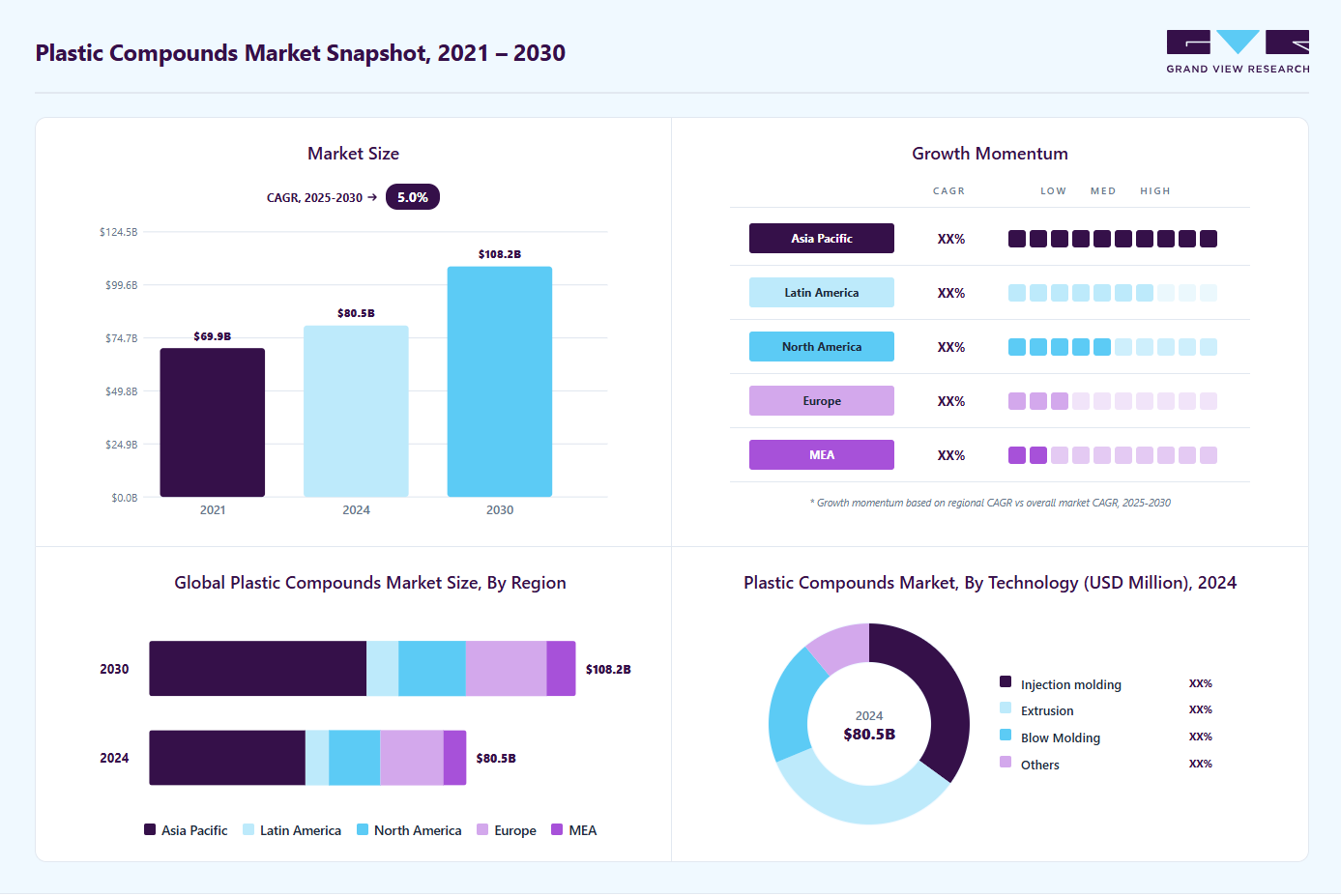
The global plastic compounds market size was valued at USD 217.1 billion in 2025 and is projected to grow from USD 231.9 billion in 2026 to USD 371.4 billion by 2033, at a CAGR of 7.0% from 2026 to 2033. Asia Pacific dominated the market, accounting for a revenue share of 53.4% in 2025. The market growth is driven by expanding automotive production and growing demand for advanced plastic compounds across lightweight vehicle components, packaging, and electronics.
Key Market Trends & Insights
- By compound: Bioplastic (excluding PBT) segment is expected to grow at a CAGR of 9.6% from 2026 to 2033
- By application: Automotive segment led the plastic compounds industry, accounting for a revenue share of 18.9% in 2025.
- By technology: Extrusion segment is expected to grow at a CAGR of 7.5% from 2026 to 2033, in terms of revenue.
- By filler: Carbon fiber reinforced segment is expected to grow at a CAGR of 8.5% 2026 to 2033, in terms of revenue.
Regional Highlights
- Largest regional market: Asia Pacific (53.4% revenue share 2025)
- By country: India is expected to grow at a CAGR of 8.0% from 2026 to 2033
Market Size & Forecast
- Market Size in 2025: USD 217.1 Billion
- Estimated Market Size in 2026: USD 231.9 Billion
- Projected Market Size by 2033: USD 371.4 Billion
- CAGR (2026-2033): 7.0%
Plastic compounds offer enhanced mechanical strength, durability, heat and impact resistance, and improved processability, supporting fuel-efficient vehicles and electric mobility. Advancements in compounding technologies and bio-based formulations are improving material performance, while increasing emphasis on sustainability, biodegradable plastics, and lightweight solutions accelerates global adoption.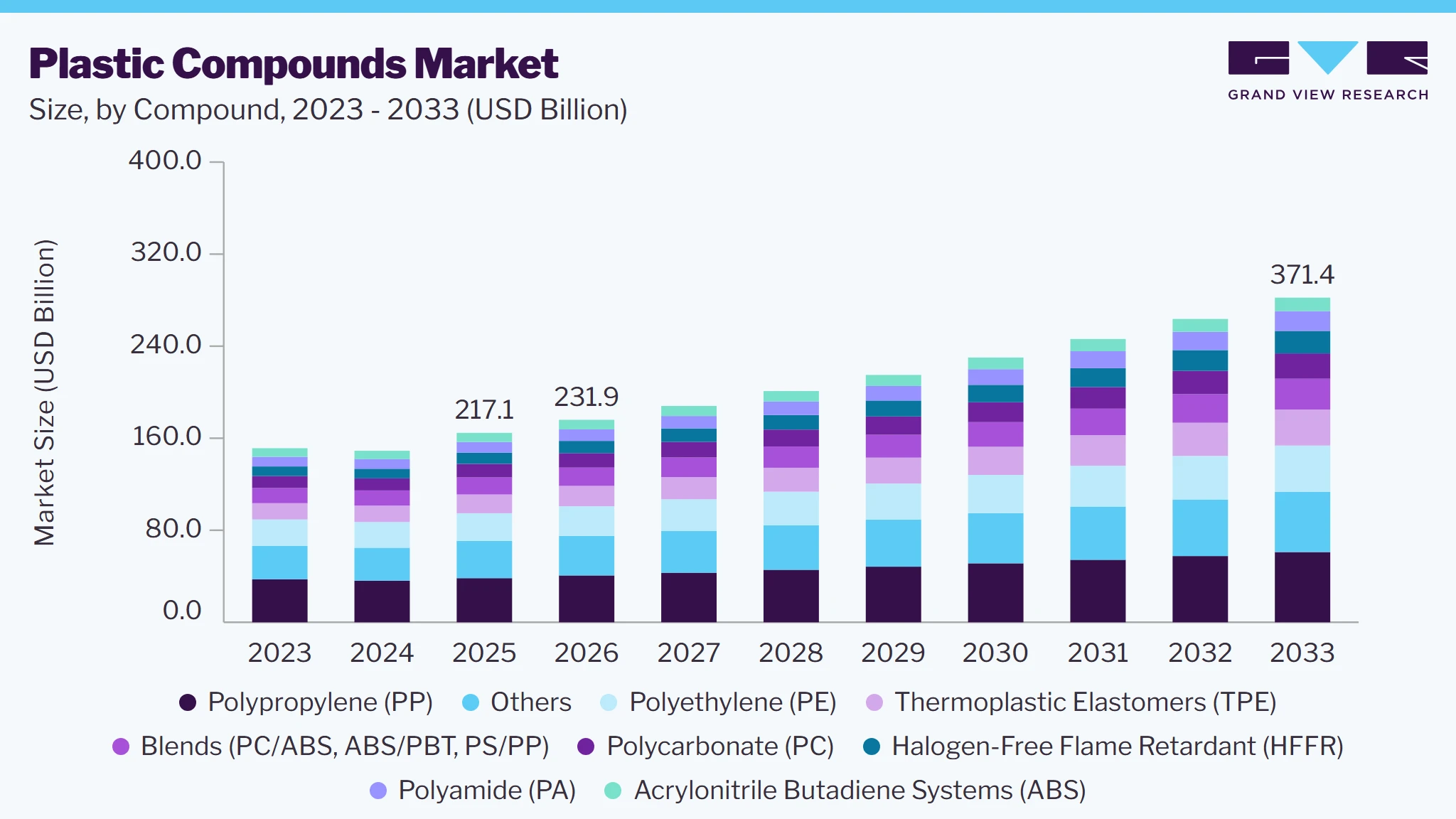
Technological advancements in polymer compounding, reinforcement technologies, lightweight formulations, and sustainable material development are emerging as a key trend in the plastic compounds market. Manufacturers are increasingly developing advanced compounds that improve mechanical strength, durability, heat resistance, impact performance, and processing efficiency. Innovations in material engineering are further expanding suitability across automotive components, including bumpers, dashboards, interior systems, under-the-hood parts, and electric vehicle applications.
The growing demand for lightweight, fuel-efficient, and electric vehicles is a major driver for the plastic compounds industry. These materials enable weight reduction while maintaining strength, durability, thermal stability, and safety performance, supporting a wide range of automotive applications. Increasing vehicle electrification and stricter efficiency requirements are further accelerating market development by encouraging automakers to replace conventional materials with high-performance compounds that improve vehicle efficiency and overall operating performance.
Expanding adoption of biodegradable, bio-based, and lightweight materials presents a significant opportunity for the plastic compounds market. Increasing focus on sustainability, reduced environmental impact, and resource-efficient manufacturing is creating opportunities for specialized compound formulations. Manufacturers are developing materials that combine durability, strength, lightweight properties, and improved environmental performance, supporting broader adoption across automotive, packaging, electronics, and other applications while responding to growing demand for sustainable material solutions.
Market Dynamics
The continued expansion of global automotive manufacturing is supporting demand for plastic compounds, as vehicle manufacturers increasingly adopt lightweight, high-performance materials that can replace conventional metals while maintaining structural integrity, durability, thermal stability, and dimensional performance.
Automotive production remains strong across Asia Pacific, Europe, and North America, with India recording total vehicle production of 34,708,984 units in FY 2025-26, according to SIAM. This production scale is increasing the consumption of compounded polypropylene (PP), polyamide (PA), polycarbonate (PC), acrylonitrile butadiene styrene (ABS), thermoplastic polyolefins (TPO), and other engineered compounds across OEM and Tier-1 supply chains, particularly for instrument panels, front-end modules, interior components, under-the-hood systems, exterior parts, structural components, and electrical housings.
The growing emphasis on automotive lightweighting is accelerating the substitution of metals with reinforced and modified plastic compounds, as these materials can deliver high stiffness-to-weight ratios, impact resistance, thermal stability, and design flexibility.
The tightening regulatory landscape surrounding plastics, packaging waste, PFAS, and other substances of environmental concern is emerging as a significant restraint for the Plastic Compounds Market. Although plastic compounds remain essential across automotive, electrical and electronics, packaging, construction, healthcare, and consumer goods applications, increasingly stringent requirements for material composition, recyclability, recycled content, chemical disclosure, and waste management are raising compliance complexity across the value chain.
Compound manufacturers are facing higher costs associated with formulation reformulation, regulatory testing, certification, recycled-content validation, traceability, and process modifications. At the same time, downstream customers are demanding greater transparency regarding additives, restricted substances, recycled content, and end-of-life performance before approving new materials or suppliers. These requirements are increasing qualification timelines and raising the overall cost of developing and commercializing compliant plastic compounds.
Europe remains the most influential region shaping environmental and circularity requirements for the global Plastic Compounds Market. The EU Packaging and Packaging Waste Regulation (PPWR), which began application in August 2026, establishes requirements covering packaging composition, recyclability, recycled content, substances of concern, and waste management, with stricter recyclability obligations being phased in over time. The regulation also requires plastic packaging to incorporate minimum levels of recycled content and emphasizes design for material recycling. In parallel, the broader PFAS regulatory agenda is increasing scrutiny of fluorinated substances used in certain high-performance plastics, additives, processing aids, and surface-treatment applications.
The expanding use of plastic compounds in building and construction applications is creating significant growth opportunities for the plastic compounds market. The increasing adoption of glass-fiber-reinforced compounds in façade panels, roofing systems, and durable urban infrastructure is driving demand due to their exceptional strength-to-weight ratio, corrosion resistance, and long-term durability. These materials provide tensile strength comparable to conventional metals while significantly reducing structural weight, supporting modern construction requirements. Market growth is further fueled by rising infrastructure development projects in emerging economies, ongoing renovation investments across developed nations, and increasing demand for residential properties, commercial offices, data centers, and green smart buildings. As the construction industry prioritizes sustainable, high-performance, and resource-efficient materials, plastic compounds are gaining importance in next-generation infrastructure development globally.
Market Concentration & Characteristics
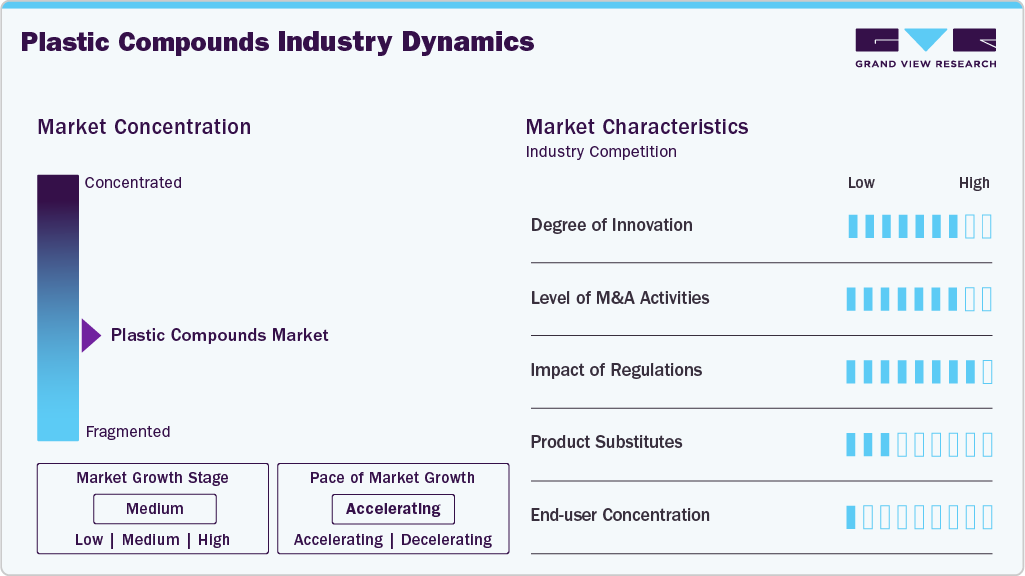
The market growth stage is medium, and the pace of growth is accelerating. The market exhibits fragmentation, with key players dominating the industry landscape. Major companies such as Adell Plastics Inc.; Asahi Kasei Corporation; BASF; Chevron Phillips Chemical Company LLC; China XD Plastics Company Limited; Covestro AG; Dow; DuPont; Qingdao Gon Plastics Co., Ltd.; and Foster, LLC play a significant role in shaping the market dynamics. These leading players often drive innovation in the plastic compounds market by introducing new products, technologies, and materials to meet the industry's evolving demands.
The degree of innovation in the plastic compounds industry is moderate to high, driven by advances in polymer compounding, reinforcement technologies, lightweight formulations, and sustainable material development. Manufacturers are developing compounds with improved mechanical strength, heat resistance, impact performance, durability, and processing efficiency. Product development increasingly targets application-specific requirements across automotive, packaging, and electronics, enabling manufacturers to enhance material functionality while supporting vehicle light weighting, efficient production, and broader substitution of conventional materials.
Product differentiation and performance-enhancement initiatives are shaping competitive positioning, with manufacturers focusing on specialized formulations that combine lightweight properties with durability, thermal stability, and environmental performance. Advanced compounds are increasingly designed for automotive components such as dashboards, bumpers, and under-the-hood systems, while sustainable, recycled, and bio-based materials are expanding product diversity. These developments support fuel efficiency, electrification, circularity, and evolving consumer demand across automotive, packaging, electronics, and other end-use applications.
Analyst Perspective
The plastic compounds market is shifting toward value-driven, innovative, and sustainable solutions focused on performance and application-specific requirements. Demand will remain strong across automotive, electronics, construction, packaging, healthcare, consumer goods, and industrial sectors, driven by lightweighting, electrification, and circular economy goals. Advancements in polymer engineering, reinforced compounds, flame-retardant formulations, recycled-content materials, bioplastics, and specialty blends will create growth opportunities. Stricter requirements for emissions, recyclability, and environmental compliance will accelerate sustainable material innovation. Leading companies will compete through advanced compounding, proprietary formulations, integrated supply chains, and customized solutions. However, raw material volatility, pricing pressures, regulatory complexity, supply disruptions, and material substitution may constrain profitability. Companies balancing sustainability, performance, and customization will be best positioned for long-term growth.
Compound Insights
The polypropylene (PP) dominated the plastic compounds market, accounting for a revenue share of 17.7% in 2025, and is forecast to grow at a 6.0% CAGR from 2026 to 2033. The segment growth is driven by the versatility, cost-effectiveness, and broad application scope of polypropylene across automotive, packaging, textiles, and other end-use industries. Its chemical resistance, durability, lightweight characteristics, and ease of processing support its suitability for diverse plastic compound formulations. Increasing emphasis on recyclability, material efficiency, and high-performance applications is further supporting demand, while advancements in compounding and sustainable formulations are expanding polypropylene adoption across specialized and environmentally conscious applications.
The bioplastic (excluding PBT) segment is expected to grow at a 9.6% CAGR over the forecast period. Segment growth is driven by rising environmental concerns and the growing adoption of sustainable material solutions across packaging, automotive, consumer goods, and other applications. Bioplastics derived from renewable resources offer reduced dependence on fossil-based feedstocks, biodegradability, and lower carbon footprints. Advances in polymer modification, compounding, and bio-based formulations are improving mechanical performance, durability, and processability, expanding the suitability of bioplastics for demanding applications and supporting continued market growth.
Technology Insights
The injection molding segment led the plastic compounds industry, accounting for a revenue share of 48.3% in 2025, and is projected to grow at a 6.8% CAGR from 2026 to 2033. Segment growth is driven by the increasing adoption of efficient, cost-effective, and versatile manufacturing processes across automotive, packaging, consumer goods, and other applications. Injection molding enables high-volume production of complex plastic components with consistent dimensions, intricate designs, and superior surface finishes. Its ability to process diverse plastic compounds, reduce production costs, and support design flexibility is further strengthening adoption, while technological advancements continue to expand its application potential across industries.
The extrusion segment is expected to grow at the fastest CAGR of 7.5% over the forecast period. Segment growth is driven by the increasing adoption of continuous, efficient processing technologies for manufacturing plastic compounds into pipes, profiles, films, sheets, and other products. Extrusion enables consistent production of complex shapes, customized dimensions, and high-quality components, supporting applications across construction, packaging, automotive, and other industries. Growing demand for specialized plastic products is further supporting adoption, while advancements in extrusion equipment and processing technologies are expanding application potential across diverse end-use sectors.
Filler Insights
The unfilled segment led the plastic compounds market, accounting for a revenue share of 33.5% in 2025, and is projected to grow at a 6.5% CAGR from 2026 to 2033. The segment growth is driven by growing demand for plastic compounds that offer inherent material properties, processing flexibility, and cost efficiency across automotive, electrical and electronics, packaging, and consumer applications. Unfilled compounds offer consistent mechanical performance, lightweight properties, and ease of processing without reinforcement additives, supporting applications that require balanced performance and design flexibility. The increasing demand for efficient manufacturing and application-specific material solutions is further driving adoption across diverse end-use industries.
The carbon fiber reinforced segment is expected to grow at the fastest CAGR of 8.5% over the forecast period. The segment growth is driven by increasing adoption of plastic compounds requiring high strength, stiffness, lightweight characteristics, and dimensional stability across automotive, electrical, electronics, and other demanding applications. Carbon fiber reinforcement enhances mechanical and thermal performance while enabling weight reduction and design flexibility. Growing vehicle electrification and demand for high-performance components are further supporting adoption, while advances in carbon fiber thermoplastic formulations and processing technologies are expanding the potential for applications.
Application Insights
The automotive segment led the plastic compounds industry, accounting for a revenue share of 18.9% in 2025, and is projected to grow at a 7.5% CAGR from 2026 to 2033. The segment growth is driven by the growing demand for lightweight, durable, and cost-effective materials in vehicle manufacturing. Plastic compounds enable weight reduction while supporting fuel efficiency, performance, safety, comfort, and design flexibility across automotive components. Increasing adoption of electric vehicles and the need for sustainable material solutions are further supporting demand. Advances in high-performance formulations and compounding technologies are expanding the applications of plastic compounds, strengthening their role in modern vehicle production.
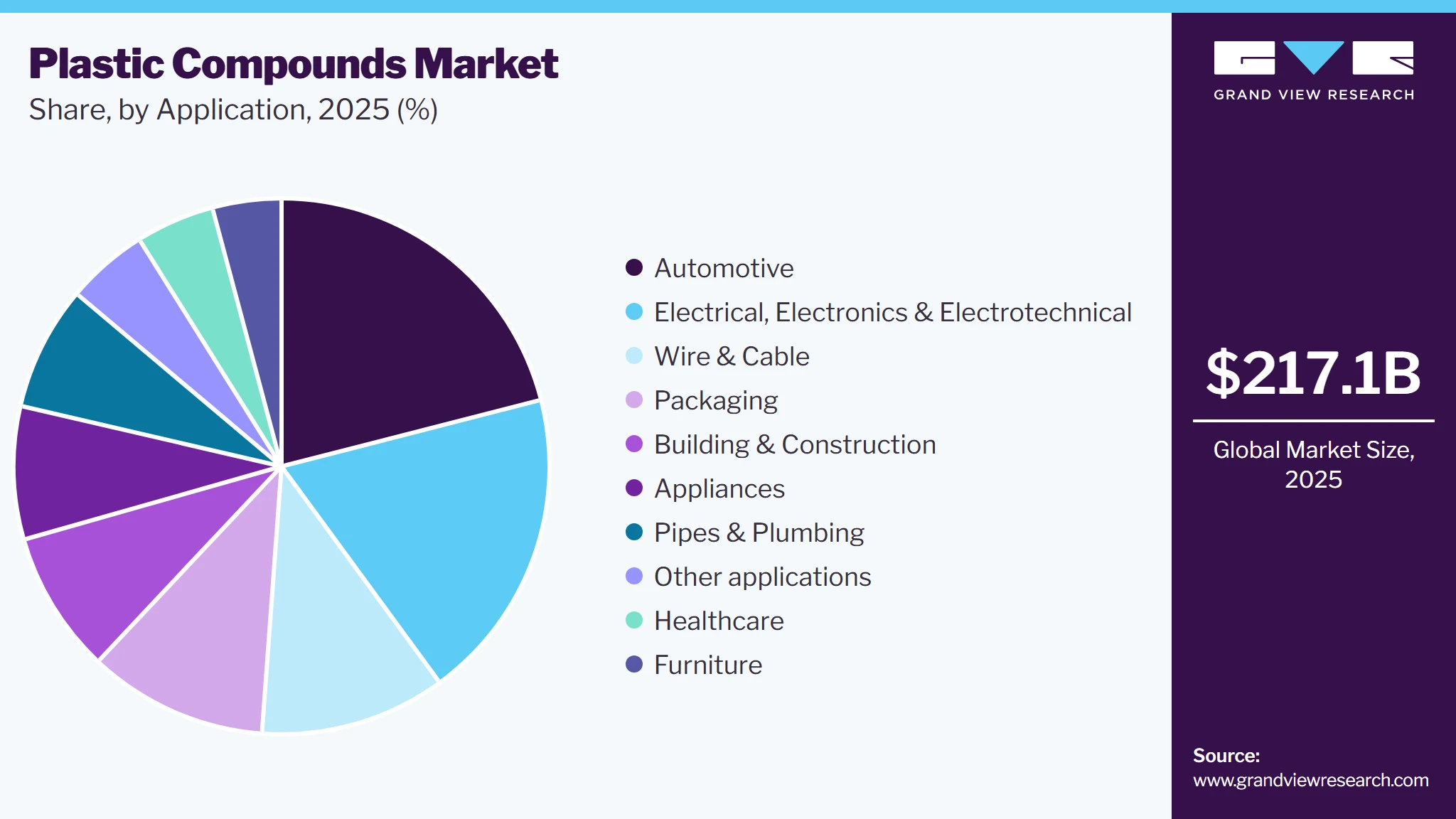
The electrical, electronics & electrotechnical segment is expected to grow at the fastest CAGR of 8.1% over the forecast period. Segment growth is driven by the increasing adoption of plastic compounds for electrical insulation, thermal management, component protection, and durable equipment housings. These materials offer excellent dielectric properties, heat resistance, dimensional stability, and ease of molding, supporting applications across consumer electronics and industrial equipment. The growing deployment of smart devices, electronic systems, and electrification technologies is further supporting demand, while advances in specialized formulations are expanding the application potential across high-performance electrical and electronic systems.
Regional Insights
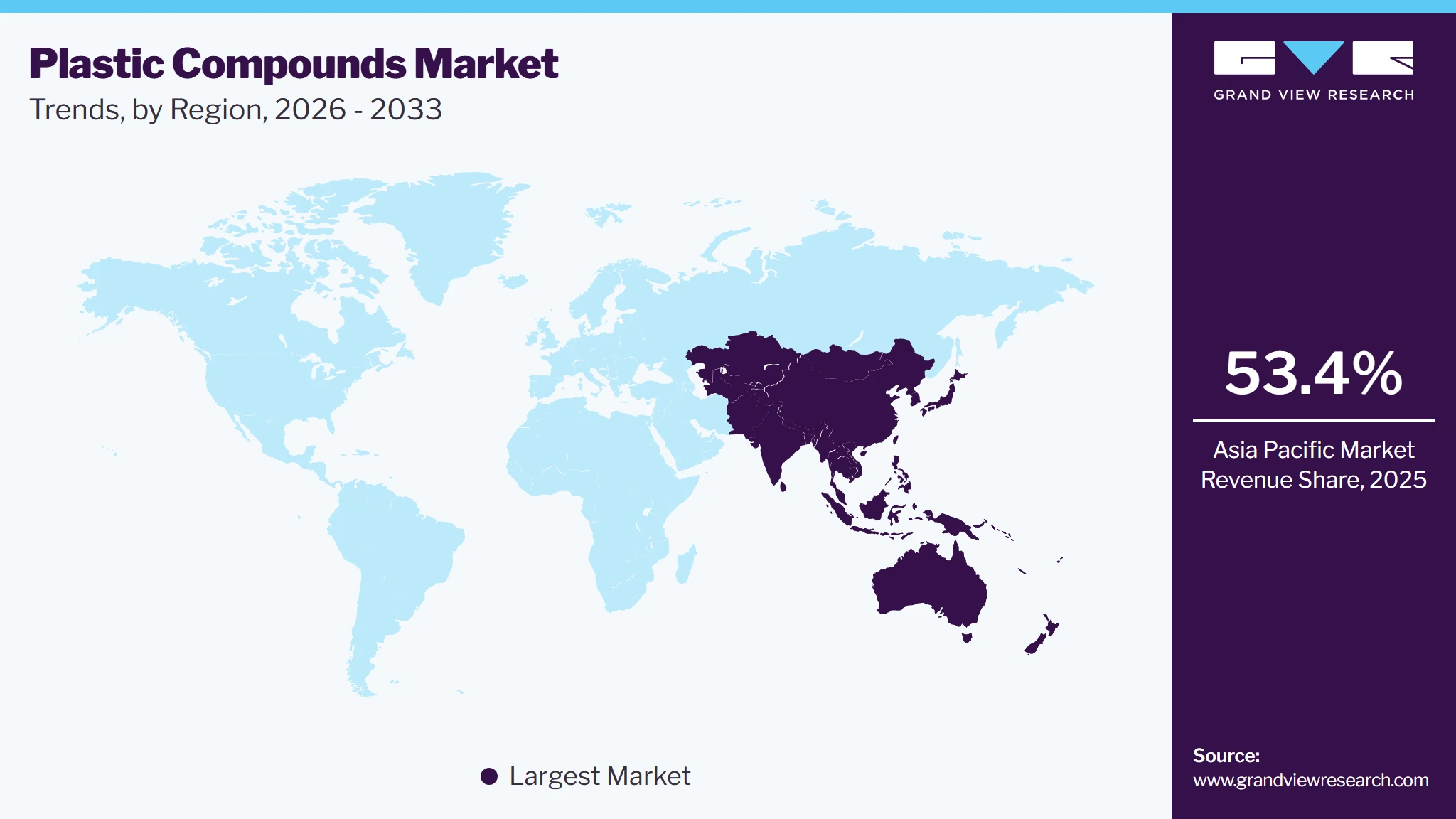
The Asia Pacific plastic compounds market held the largest revenue share of 53.4% in 2025. The region is expected to grow at a CAGR of 7.5% over the forecast period. The Asia Pacific market is driven by increasing demand for lightweight, high-performance, and sustainable plastic compounds across automotive, packaging, electronics, and other industries. Growing emphasis on vehicle efficiency, emissions reduction, and material performance is driving the adoption of lightweight compounds, while rising environmental awareness is accelerating the use of recyclable and bio-based formulations. Strengthening circular economy initiatives, sustainability measures, and technological advancements are further expanding demand for eco-friendly plastic compounds across the region.
India Plastic Compounds Market Trends
India’s plastic compounds market is expanding steadily, supported by rapid industrialization, automotive manufacturing, packaging demand, and increasing adoption across electrical and electronics applications. Growing investments in manufacturing and polymer-processing infrastructure are driving demand for high-performance compounds, while PP remains a leading product segment. Rising emphasis on lightweight materials, electrification, recycling, and circular economy practices is further supporting market development, with advances in compounding technologies expanding application potential across diverse end-use industries.
North America Plastic Compounds Market Trends
The North America plastic compounds industry’s growth is driven by rising demand for lightweight, durable, and high-performance materials across automotive, packaging, electrical and electronics, and construction applications. The growing emphasis on vehicle weight reduction and fuel efficiency is driving compound adoption, while packaging manufacturers increasingly seek materials that offer strength, flexibility, and sustainability. Advances in compounding technologies are enhancing material properties and processing efficiency, further expanding demand for specialized plastic compounds across the region.
The U.S. plastic compounds industry is supported by strong automotive, packaging, electronics, healthcare, and industrial manufacturing activity. Growing demand for lightweight materials, electric vehicles, durable components, and sustainable packaging is encouraging wider adoption of advanced plastic compounds. Established manufacturing capabilities and continued investments in material development are enhancing formulation performance and processing efficiency, while increasing the use of recycled and high-performance compounds is further expanding applications across diverse end-use industries.
Europe Plastic Compounds Market Trends
The Europe plastic compounds industry is expanding due to increasing adoption across electrical and electronics, automotive, packaging, and consumer applications. The growing integration of electronics and smart manufacturing technologies is driving demand for compounds offering electrical insulation, heat resistance, lightweight properties, and design flexibility. Strong industrial capabilities and continued investments in material innovation are further strengthening regional demand, while sustainability initiatives and advances in recyclable formulations are expanding application potential across European end-use industries.
Latin America Plastic Compounds Market Trends
Latin America’s plastic compounds industry is expanding steadily, supported by growing automotive production, packaging demand, consumer goods manufacturing, and industrialization. Brazil remains a key regional market, supported by its established manufacturing base and investments in advanced polymer technologies. Increasing adoption of lightweight and high-performance materials, alongside growing investments in local production capacity and sustainable formulations, is further strengthening regional market development and application potential.
Middle East & Africa Plastic Compounds Market Trends
The Middle East and Africa plastic compounds market is expanding due to growing industrialization, infrastructure development, and demand from automotive, construction, packaging, and electrical and electronics applications. Saudi Arabia, the UAE, and South Africa are emerging as key markets, supported by manufacturing investments and petrochemical integration. Increasing demand for lightweight, durable, and high-performance compounds, alongside rising emphasis on recyclable materials and circular economy practices, is further strengthening regional market development.
Key Plastic Compounds Company Insights
Some of the key market players include BASF and Chevron Phillips Chemical Company LLC
-
BASF is a Germany-based global chemical company with a strong presence in the plastic compounds market through its advanced engineering plastics portfolio. The company leverages proprietary polymer technologies, material expertise, and R&D capabilities to serve automotive, electrical, electronics, industrial, consumer goods, and medical applications. Its broad portfolio includes Ultramid, Ultradur, and Ultraform compounds.
-
Chevron Phillips Chemical Company LLC is a global petrochemical company with a strong position in the plastic compounds industry through its extensive polyethylene portfolio. The company leverages proprietary MarTECH™ technology, advanced polymer research, and integrated manufacturing capabilities to serve packaging, automotive, industrial, consumer, and infrastructure applications. Its broad portfolio includes HDPE, LDPE, LLDPE, MDPE, and metallocene PE.
China XD Plastics Company Limited and Adell Plastics Inc. are some of the emerging participants in the plastic compounds market.
-
Adell Plastics Inc. is a U.S.-based independent compounder specializing in commodity and engineering-grade resin compounds. The company also produces adhesive and rubber compounds, supporting customized material solutions for demanding applications. Its products serve the medical, automotive, film, fiber, and electronics industries, backed by advanced compounding expertise, testing capabilities, and decades of processing experience.
-
China XD Plastics Company Limited is a leading Chinese polymer materials manufacturer with a strong presence in the plastic compounds industry through modified plastics and polymer composites for automotive applications. The company develops high-performance PP, ABS, PA, POM, PPO, PPS, PEEK, PE, and plastic alloy compounds, supported by proprietary technologies, R&D capabilities, and extensive automotive certifications.
Key Plastic Compounds Companies
The following key companies have been profiled for this study of the plastic compounds market.
-
Adell Plastics Inc.
-
Asahi Kasei Corporation
-
BASF
-
Chevron Phillips Chemical Company LLC
-
China XD Plastics Company Limited
-
Covestro AG
-
Dow
-
DuPont
-
Qingdao Gon Plastics Co., Ltd
-
Foster, LLC (Geon Performance Solutions)
Competitive Benchmarking
Operating Strategies
Competitive Edge
Weaknesses
Mature Players: Asahi Kasei; BASF; Chevron Phillips Chemical; Covestro; Dow; DuPont
- Focus on high-performance engineering compounds and application-specific formulations.
- Expand into automotive, EV, electrical & electronics, industrial, and high-value applications.
- Invest in sustainable materials, recycled-content solutions, process efficiency, and advanced compounding technologies.
- Strong global brands and broad polymer portfolios across engineering and specialty compounds.
- Deep R&D capabilities and application-development expertise.
- Established relationships with global OEMs and processors.
- Higher exposure to raw material price volatility and energy costs.
- Large operating bases can increase cost and organizational complexity.
- Broad portfolios can reduce flexibility in highly customized niche applications.
Emerging Players: Adell Plastics; China XD Plastics; Qingdao GON Plastics; Foster / GEON
- Build capacity selectively and target high-value application segments.
- Focus on customized formulations, modified plastics, and application-specific compounds.
- Prioritize automotive, medical, electronics, and industrial demand.
- More flexible operating structures and customized formulation capabilities.
- Faster response to customer-specific requirements and niche applications.
- Strong specialization in selected compound families and end-use markets.
- Smaller scale and narrower global production footprint.
- Lower global brand recognition compared with major multinational compounders.
- Greater dependence on selected application segments and regional demand.
Recent Developments
-
In July 2026, Sirmax Group/Autotech-Sirmax India commissioned a new 20,000 tons/year compounding plant in Hosur, Tamil Nadu, to strengthen local production of thermoplastic compounds for automotive and adjacent applications. The facility expands domestic supply capabilities, improves customer responsiveness, reduces reliance on imported compounds, and supports growing demand for high-performance plastic compounds across India’s automotive and industrial sectors
-
In July 2026, Sirmax Group/Autotech-Sirmax India commissioned a new 20,000 tons/year compounding plant in Hosur, Tamil Nadu, to strengthen local production of thermoplastic compounds for automotive and adjacent applications. The facility expands domestic supply capabilities, improves customer responsiveness, reduces reliance on imported compounds, and supports growing demand for high-performance plastic compounds across India’s automotive and industrial sectors
Plastic Compounds Market Report Scope
Report Attribute
Details
Market size in 2025
USD 217.1 billion
Market size value in 2026
USD 231.9 billion
Revenue forecast in 2033
USD 371.4 billion
Growth rate
CAGR of 7.0% from 2026 to 2033
Historical data
2021 - 2025
Forecast period
2026 - 2033
Quantitative units
Revenue in USD million/billion, volume in tons, and CAGR from 2026 to 2033
Report coverage
Revenue & volume forecast, competitive landscape, growth factors, and trends
Segments covered
Compound, application, technology, filler, region
Regional scope
North America; Europe; Asia Pacific; Latin America; Middle East & Africa
Country Scope
U.S.; Canada; Mexico; Europe; Germany; UK; France; Italy; Spain; China; India; Japan; South Korea; Australia; Brazil; Argentina; Saudi Arabia; UAE; South Africa
Key companies profiled
Adell Plastics Inc; Asahi Kasei Corporation; BASF; Chevron Phillips Chemical Company LLC; China XD Plastics Company Limited; Covestro AG; Dow; DuPont; Qingdao Gon Plastics Co.,Ltd; Foster, LLC (Geon Performance Solutions)
Customization scope
Free report customization (equivalent to up to 8 analyst working days) with purchase. Addition or alteration to country, regional & segment scope
Pricing and purchase options
Avail customized purchase options to meet your exact research needs. Explore purchase options
Global Plastic Compounds Market Report Segmentation
This report forecasts volume & revenue growth at the global, regional, and country levels and provides an analysis of the latest industry trends across sub-segments from 2021 to 2033. For this study, Grand View Research has segmented the global plastic compounds market report based on compound, application, technology, filler, and region:
-
Compound Outlook (Volume, Kilotons; Revenue, USD Million/Billion, 2021 - 2033)
-
Polypropylene (PP)
-
Polyethylene (PE)
-
Cross-linked Polyethylene (XLPE)- Wire & Cable
-
Cross-linked Polyethylene (PEX) & PE-RT- Pipes
-
PEX-A
-
PEX-B
-
PEX-C
-
PE-RT
-
-
Other PE Compounds
-
-
Thermoplastic Elastomers (TPE)
-
TPS
-
Saturated
-
Unsaturated
-
-
Thermoplastic Polyolefins (TPO)
-
Thermoplastic Vulcanizates (TPV)
-
-
Thermoplastic Polyurethane (TPU)
-
Maleic Anhydride (MAH)-Functionalized Polyolefins
-
Polyvinyl Chloride (PVC)
-
Rigid PVC
-
Flexible PVC
-
-
Ethylene Vinyl Acetate (EVA) & Polyolefin Compounds
-
Ethylene Vinyl Acetate (EVA)
-
Expandable Polyolefin Compounds
-
Crosslinkable Polyolefin Compounds
-
-
Halogen-Free Flame Retardant (HFFR)
-
Polystyrene (PS)
-
Polybutylene Terephthalate (PBT)
-
Polyamide (PA)
-
Polycarbonate (PC)
-
Acrylonitrile Butadiene Systems (ABS)
-
Bioplastic (excluding PBT)
-
Acrylonitrile Styrene Acrylate (ASA)
-
Styrene Acrylonitrile (SAN)
-
Polymethyl Methacrylate (PMMA)
-
Polyoxymethylene (POM)
-
Blends (PC/ABS, ABS/PBT, PS/PP)
-
Others
-
-
Application Outlook (Volume, Kilotons; Revenue, USD Million/Billion, 2021 - 2033)
-
Automotive
-
Electrical, Electronics & Electrotechnical
-
Wire & Cable
-
Packaging
-
Building & Construction
-
Appliances
-
Pipes & Plumbing
-
Healthcare
-
Furniture
-
Agriculture
-
Power Tools
-
Sport & Leisure
-
Footwear
-
Other applications
-
-
Technology Outlook (Volume, Kilotons; Revenue, USD Million/Billion, 2021 - 2033)
-
Injection Molding
-
Extrusion
-
Blow Molding
-
Other Technologies
-
-
Filler Outlook (Volume, Kilotons; Revenue, USD Million/Billion, 2021 - 2033)
-
Unfilled
-
Carbon Fiber Reinforced
-
Flame Retardant
-
Glass Fiber Reinforced
-
Long Glass Fiber Filled
-
Calcium Carbonate Filled
-
Talcum Filled
-
-
Regional Outlook (Volume, Kilotons; Revenue, USD Million/Billion, 2021 - 2033)
-
North America
-
U.S.
-
Canada
-
Mexico
-
-
Europe
-
Germany
-
UK
-
France
-
Italy
-
Spain
-
-
Asia Pacific
-
China
-
India
-
Japan
-
South Korea
-
Australia
-
-
Latin America
-
Brazil
-
Argentina
-
-
Middle East & Africa
-
Saudi Arabia
-
UAE
-
South Africa
-
-
Research Methodology
The plastic compounds market figures in this report are based on a proven research process that combines executive interviews with secondary research from proprietary databases, company filings, and recognized regulatory and institutional sources. Market size is built through value-chain sizing-reconciling supply-side and demand-side estimates-and triangulated with bottom-up and top-down approaches. Every estimate passes multiple levels of expert validation before publication, with each plastic compounds segment quantified using the revenue-capture definitions in the table below.
Segment Definition
Segment - Compound
Revenue capture definition
Polypropylene (PP)
Revenue is captured through PP compounds used in automotive components, packaging, appliances, consumer goods, and industrial applications, supported by lightweight performance and cost efficiency.
Polyethylene (PE)
Revenue is generated through PE compounds used in packaging, pipes, agriculture, consumer products, and construction, driven by durability, chemical resistance, and processing versatility.
Thermoplastic Elastomers (TPE)
Revenue is captured through TPE compounds used in automotive seals, soft-touch components, footwear, medical devices, and consumer products, supported by flexibility and thermoplastic processability.
Thermoplastic Polyurethane (TPU)
Revenue is captured through TPU compounds used in footwear, automotive components, cables, medical devices, and industrial products, driven by elasticity, abrasion resistance, and durability.
Maleic Anhydride (MAH)-Functionalized Polyolefins
Revenue is captured through MAH-functionalized polyolefin compounds used as compatibilizers, coupling agents, and adhesion promoters across automotive, packaging, and composite applications.
Polyvinyl Chloride (PVC)
Revenue is captured through PVC compounds used in pipes, wire and cable, construction products, flooring, and consumer applications, supported by durability and flame resistance.
EVA & Polyolefin Compounds
Revenue is captured through EVA and polyolefin compounds used in footwear, flexible packaging, automotive components, adhesives, films, and consumer products, driven by flexibility and processability.
Halogen-Free Flame Retardant (HFFR)
Revenue is captured through HFFR compounds used in wire and cable, electrical, electronics, transportation, and construction applications, driven by fire-safety and low-smoke requirements.
Polystyrene (PS)
Revenue is captured through PS compounds used in packaging, appliances, electronics, consumer products, and insulation, supported by lightweight characteristics, rigidity, and processing efficiency.
Polybutylene Terephthalate (PBT)
Revenue is captured through PBT compounds used in automotive electrical components, connectors, appliances, and electronics, driven by thermal stability, electrical insulation, and dimensional performance.
Polyamide (PA)
Revenue is captured through PA compounds used in automotive, electrical, industrial, and engineering applications, supported by mechanical strength, thermal resistance, and wear performance.
Polycarbonate (PC)
Revenue is captured through PC compounds used in automotive, electronics, healthcare, construction, and consumer products, driven by impact resistance, dimensional stability, and optical performance.
Acrylonitrile Butadiene Systems (ABS)
Revenue is captured through ABS compounds used in automotive interiors, appliances, electronics housings, consumer goods, and industrial products, supported by toughness and surface finish.
Bioplastic (excluding PBT)
Revenue is generated from bioplastic compounds used in packaging, consumer goods, agriculture, healthcare, and disposable products, driven by sustainability requirements and the adoption of renewable feedstocks.
Acrylonitrile Styrene Acrylate (ASA)
Revenue is captured through ASA compounds used in automotive exteriors, construction, outdoor products, and appliances, supported by UV resistance, weatherability, and color retention.
Styrene Acrylonitrile (SAN)
Revenue is captured through SAN compounds used in appliances, packaging, consumer products, and electrical applications, driven by rigidity, transparency, chemical resistance, and aesthetic performance.
Polymethyl Methacrylate (PMMA)
Revenue is captured through PMMA compounds used in automotive lighting, displays, construction glazing, signage, and consumer products, supported by optical clarity and weather resistance.
Polyoxymethylene (POM)
Revenue is captured through POM compounds used in automotive systems, gears, bearings, electrical components, and precision parts, driven by stiffness, low friction, and dimensional stability.
Blends (PC/ABS, ABS/PBT, PS/PP)
Revenue is captured through polymer blends used in automotive, electronics, appliances, and industrial applications, supported by combined properties, improved performance, and application-specific customization.
Others
Revenue is captured through specialty plastic compounds serving aerospace, defense, industrial, medical, consumer, and other applications requiring customized performance characteristics.
Segment - Application
Revenue capture definition
Automotive
Revenue is captured through compounds used in interiors, exteriors, under-the-hood components, electrical systems, and lightweight vehicle structures, driven by performance and weight reduction requirements.
Appliances
Revenue is captured through compounds used in refrigerators, washing machines, kitchen equipment, and household products, supported by durability, aesthetics, insulation, and cost-efficient processing.
Electrical, Electronics & Electrotechnical
Revenue is captured through compounds used in housings, connectors, switches, sensors, and electrotechnical components, driven by insulation, flame resistance, dimensional stability, and miniaturization.
Wire & Cable
Revenue is captured through compounds used for cable insulation, jacketing, connectors, and accessories, supported by electrical insulation, flexibility, flame resistance, and safety requirements.
Building & Construction
Revenue is captured through compounds used in profiles, panels, roofing, insulation, and infrastructure components, driven by durability, weather resistance, lightweight construction, and energy efficiency.
Pipes & Plumbing
Revenue is captured through compounds used in water pipes, fittings, drainage systems, and plumbing components, supported by chemical resistance, durability, pressure performance, and corrosion resistance.
Furniture
Revenue is captured through compounds used in indoor, commercial, and outdoor furniture, driven by durability, lightweight construction, design flexibility, and weather resistance.
Power Tools
Revenue is captured through compounds used in housings, handles, gears, and protective components, supported by impact resistance, ergonomics, durability, and lightweight performance.
Packaging
Revenue is captured through compounds used in films, containers, closures, rigid packaging, and specialty formats, driven by lightweighting, product protection, processing efficiency, and sustainability.
Agriculture
Revenue is captured through compounds used in irrigation systems, greenhouse products, agricultural equipment, films, and storage solutions, supported by durability and resource efficiency.
Sport & Leisure
Revenue is captured through compounds used in sports equipment, footwear, recreational products, fitness accessories, and outdoor gear, driven by lightweight performance and durability.
Healthcare
Revenue is captured through compounds used in medical devices, diagnostic equipment, laboratory products, and healthcare packaging, supported by hygiene, biocompatibility, and regulatory requirements.
Footwear
Revenue is captured through compounds used in soles, midsoles, uppers, cushioning, and footwear components, driven by flexibility, abrasion resistance, comfort, and lightweight performance.
Other Applications
Revenue is captured through compounds used in aerospace, defense, industrial machinery, logistics, and specialty applications requiring customized material performance.
Segment - Technology
Revenue capture definition
Injection Molding
Revenue is captured through compounds designed for injection molding automotive, electronics, healthcare, appliance, and consumer components, driven by high-volume production and dimensional precision.
Extrusion
Revenue is captured through compounds processed into pipes, films, sheets, profiles, and cables, supported by continuous production, material versatility, and infrastructure demand.
Blow Molding
Revenue is captured through compounds used in bottles, containers, tanks, ducts, and packaging, driven by lightweight designs, manufacturing efficiency, and high-volume production.
Other Technologies
Revenue is generated from compounds processed using thermoforming, rotational molding, compression molding, additive manufacturing, and specialized technologies for customized applications.
Segment - Filler
Revenue capture definition
Unfilled
Revenue is captured through unfilled compounds used where inherent polymer properties provide the required performance, supporting lightweight construction, processing efficiency, and cost optimization.
Carbon Fiber Reinforced
Revenue is generated from carbon fiber-reinforced compounds used in automotive, aerospace, sports, and engineering applications, driven by their high stiffness and strength-to-weight performance.
Flame Retardant
Revenue is captured through flame-retardant compounds used in electrical, electronics, construction, transportation, and industrial applications, driven by stringent fire-safety requirements.
Glass Fiber Reinforced
Revenue is captured through glass fiber reinforced compounds used in automotive, electrical, construction, and industrial components, supported by enhanced strength, stiffness, and dimensional stability.
Long Glass Fiber Filled
Revenue is captured through long glass fiber filled compounds used in structural automotive and industrial components, driven by high impact resistance and load-bearing performance.
Calcium Carbonate Filled
Revenue is captured through calcium carbonate filled compounds used in packaging, construction, consumer, and industrial applications, supported by cost optimization, stiffness, and material efficiency.
Talcum Filled
Revenue is captured through talcum-filled compounds used in automotive, appliances, packaging, and industrial products, driven by improved rigidity, dimensional stability, and heat resistance.
Estimation Model
Layer No.
Layer Name
Key Question
Description
1
Top-Down Plastic Compounds Demand Scan Layer
What defines market boundaries?
This layer begins with the global demand for plastic compounds used across automotive, appliances, electrical systems, electronics, building & construction, furniture, packaging, healthcare, agriculture, power tools, sports equipment, and industrial manufacturing. Demand is filtered based on polymer consumption trends, industrial production growth, automotive manufacturing volumes, infrastructure development activity, packaging demand, electrical and electronics output, consumer goods production, sustainability initiatives, and investments in advanced material technologies across major end-use sectors.
2
End-Use Industry Validation Layer
Where is demand generated?
This layer evaluates demand distribution across automotive, appliances, electrical, electronics & electrotechnical, building & construction, furniture, power tools, packaging, agriculture, sport & leisure, healthcare, and other industrial applications. Market revenue is aligned with key material performance requirements, including lightweight characteristics, impact resistance, thermal stability, flame retardancy, chemical resistance, dimensional stability, electrical insulation, durability, processability, and compliance with industry-specific performance and regulatory standards.
3
Resin, Filler & Processing Technology Conversion Layer
Who captures market revenue?
This layer converts end-use consumption into plastic compounds revenue by applying resin, filler, and processing technology mix ratios across polypropylene (PP), polyethylene (PE), polyamide (PA), polycarbonate (PC), ABS, TPE, bioplastics, engineering polymers, and specialty blends. The analysis incorporates filler technologies, including glass fiber reinforced, carbon fiber reinforced, flame retardant, talc-filled, calcium carbonate-filled, and long glass fiber compounds, along with injection molding, extrusion, blow molding, and other processing technologies. Revenue allocation considers material pricing structures, formulation complexity, processing efficiency, application-specific performance requirements, and supplier positioning throughout the plastic compounds value chain.
4
Regional Commercial Cross-Check Layer
How are assumptions validated?
This layer validates demand concentration by comparing Asia Pacific’s leadership in automotive manufacturing, electronics production, infrastructure development, and industrial expansion; North America’s strong demand for advanced engineering plastics, healthcare applications, and sustainable material solutions; and Europe’s emphasis on lightweight automotive materials, circular economy initiatives, and stringent environmental regulations. It also evaluates emerging opportunities in Latin America, the Middle East, and Africa, driven by increasing industrialization, infrastructure investments, packaging demand, expanding consumer goods production, growth in electrical and electronics manufacturing, and rising adoption of high-performance plastic compounds across developing economies.
Delivered Customizations
This report has been delivered with the following In-depth customizations
Client Request
Customization Delivered
Value Adds
Cross-Segmentation
Delivered comprehensive cross-analysis of resin types (PP, PE, PA, PC, ABS, TPE, Bioplastics, PBT, PMMA, POM, ASA, SAN, and blends) across end-use industries, processing technologies (Injection Molding, Extrusion, Blow Molding, Others), and filler categories (Glass Fiber Reinforced, Carbon Fiber Reinforced, Flame Retardant, Talc Filled, Calcium Carbonate Filled, Long Glass Fiber Filled, and Unfilled)..
Provided deeper visibility into high-value revenue pockets, product positioning opportunities, demand concentration areas, and evolving customer preferences across multiple market dimensions.
Competitive Benchmarking
Conducted benchmarking of leading plastic compound manufacturers based on product portfolio strength, resin specialization, production capacity, geographic footprint, technology capabilities, sustainability initiatives, strategic partnerships, M&A activities, and innovation focus.
Supported competitive intelligence, market positioning assessments, differentiation strategy development, and identification of potential partnership or acquisition opportunities.
Opportunity Assessment
Delivered detailed opportunity mapping across automotive, electrical & electronics, healthcare, packaging, building & construction, agriculture, appliances, and emerging sustainability-focused applications. Included evaluation of high-growth resin categories, advanced filler technologies, lightweight material trends, electric vehicle adoption, infrastructure development, and circular economy initiatives.
Enabled prioritization of investment opportunities, product development strategies, expansion planning, revenue diversification initiatives, and long-term growth roadmap development.
Frequently Asked Questions About This Report
Some key players operating in the plastic compounds include BASF SE; SABIC; Dow Inc; DuPont; LyondellBasell Industries Holdings B.V; RTP Company; Asahi Kasei Corporation; and Covestro AG among others.
Key factors that are driving the plastic compounds market growth include rising demand from automotive and food & beverage packaging applications.
Calcium carbonate-filled segment held the largest market share of 24.7% in 2025.
The plastic compounds market was estimated at around USD 84.7 billion in the year 2025 and is expected to reach around USD 89.2 billion in 2026.
The plastic compounds market is expected to grow at a compound annual growth rate of 4.6% from 2026 to 2033 to reach around USD 121.9 billion by 2033.
The Injection molding led the plastic compounds market in 2025 with a 35.7% share. Growing demand for high-volume, cost-efficient, and precision-manufactured plastic components across automotive, packaging, healthcare, consumer goods, electrical, and industrial applications is driving the adoption of injection molding technology due to its ability to deliver excellent dimensional accuracy, repeatability, and production efficiency.
The Asia Pacific Plastic Compounds market accounted for the largest share of 49.6% market size in 2025.
Based on end use, the automotive segment led the market with the largest revenue share of 22.9% in 2025.
Based on resin, the polypropylene (PP) segment led the market with the largest revenue share of 27.8% in 2025.
About the Author(s)
Plastics, Polymers & Resins Research Team
Bulk Chemicals · Plastics, Polymers & ResinsThis report was authored by the plastics, polymers & resins research team at Grand View Research - comprising two research analysts, one senior research analyst, and one industry expert - with specialized expertise in the plastics, polymers & resins segment of the bulk chemicals industry. All findings are based on proprietary bulk chemicals databases, executive interviews, and regulatory analysis, subject to internal peer review prior to publication.
Last Updated:
Speak to Analyst


Customize this report to your needs — add regions, segments, or data points, with 20% free customization.
Or view our licence options:


ISO 9001:2015 & 27001:2022 Certified
We are GDPR and CCPA compliant! Your transaction & personal information is safe and secure. For more details, please read our privacy policy.


