
- Home
- »
- Plastics, Polymers & Resins
- »
-
Polystyrene Packaging Market Size, Share Report 2026-2033GVR Report cover

Polystyrene Packaging Market (2026 - 2033)
Size, Share & Trends Analysis Report By Material (Expanded Polystyrene, General-Purpose Polystyrene, High-Impact Polystyrene, Extruded Polystyrene), By Packaging Product, By Application, By End-use, By Region, And Segment Forecasts
Market Size, 2025
$30.2BMarket Estimate, 2026
$31.7BMarket Forecast, 2033
$46.9BCAGR, 2026–2033
5.8%Polystyrene Packaging Market Summary
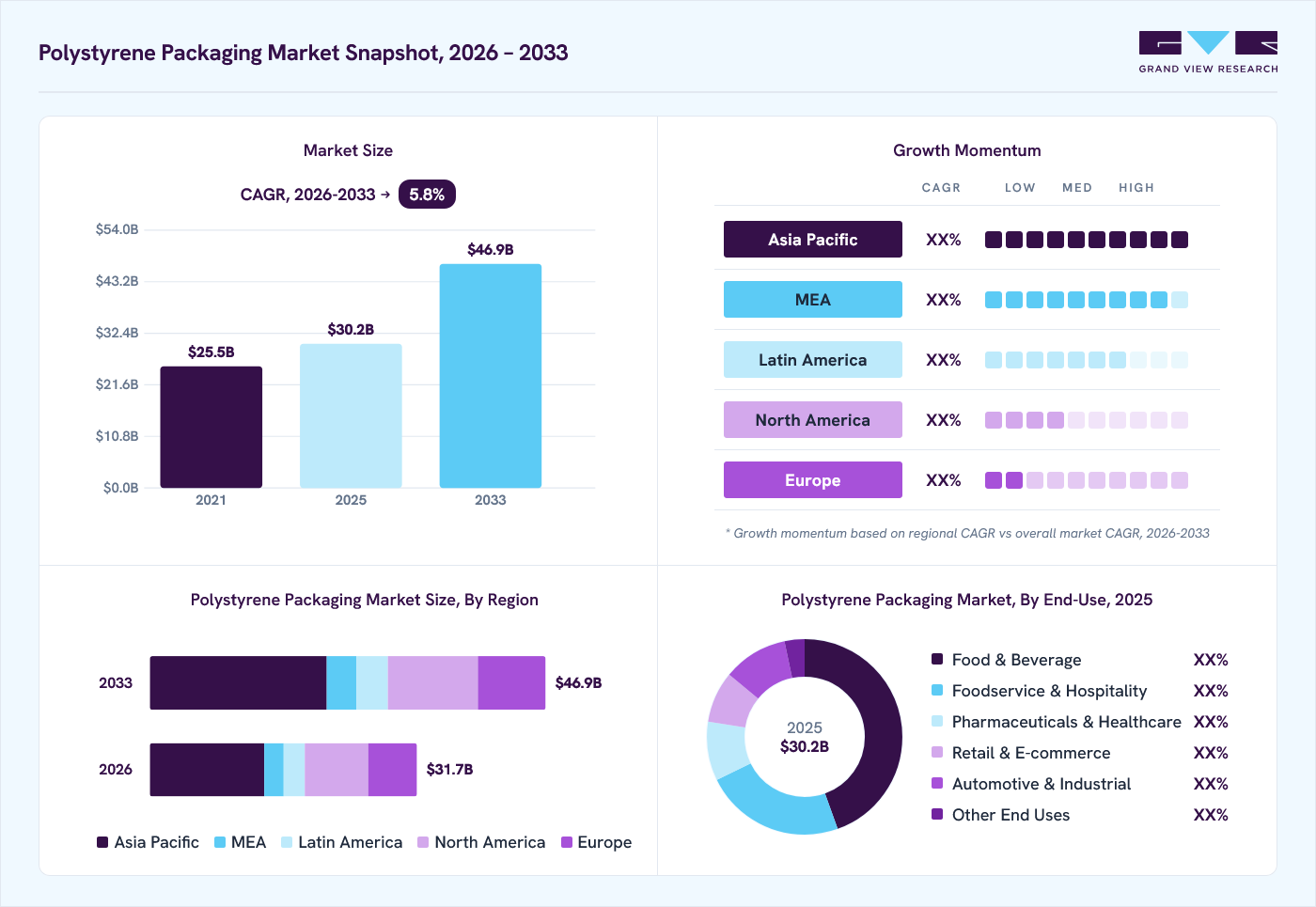
The global polystyrene packaging market size was valued at USD 30.2 billion in 2025 and is projected to grow from USD 31.7 billion in 2026 to USD 46.9 billion by 2033, at a CAGR of 5.8% from 2026 to 2033. Asia Pacific dominated the market, accounting for a revenue share of 42.6% in 2025. The global market is primarily driven by the expanding food & beverage, pharmaceuticals, consumer goods, e-commerce, and retail sectors, which rely on lightweight, cost-effective, impact-resistant, and protective polystyrene packaging solutions for food containers, protective packaging, trays, cups, and transportation applications.
 Source: Grand View Research, IR Documents, Primary Interviews, Paid DatabasesTo learn more about this report,
 Download Free Sample Report
 Key Market Trends & Insights
- By material: Expanded Polystyrene (EPS) led the market with a revenue share of 57.8% in 2025.
- By packaging product: Insulated & temperature-controlled packaging segment is forecast to grow at the fastest CAGR of 6.8% from 2026 to 2033.
- By application: Containment & Serving led the market with a revenue share of 47.2% in 2025.
- By end use: Pharmaceuticals & healthcare segment is anticipated to grow at a CAGR of 6.6% from 2026 to 2033.
Regional Highlights
- Largest regional market: Asia Pacific (42.6% revenue share, 2025)
- By country: China held the largest market share in 2025.
Market Size & Forecast
- Market size in 2025: USD 30.2 Billion
- Estimated market size in 2026: USD 31.7 Billion
- Projected market size by 2033: USD 46.9 Billion
- CAGR (2026-2033): 5.8%
Three ways to get this report
Buy it, customize it, or ask a question.Ask an Analyst
A direct answer, usually in 1 working day
- AccessReport author, directly
- Reply timeWithin 1 working day
- No sales callDirect answer only
- FormatEmail reply
- CostFree, no cost
Get the Full Report
What the study covers
- FormatsPDF · Excel · Dashboard
- Timeline2026–2033 annual, 2025 base
- Coverage20+ countries, 5 regions
- Companies10+ key players profiled
Customize the Report
20% free customization
- IncludeCountries, segments, points
- TailorTo your product definition
- ExtendDeeper competitor detail
- OrA fully bespoke study
- Turnaround5–10 working days
The market is driven by the expanding demand for lightweight, cost-effective, and protective packaging solutions across food & beverage, foodservice, electronics, healthcare, and industrial applications. As manufacturers and retailers increasingly require packaging that provides cushioning, thermal insulation, dimensional stability, and ease of handling, polystyrene materials such as expanded polystyrene (EPS) and high-impact polystyrene (HIPS) continue to gain adoption. EPS accounted for the largest material share of 57.8% in 2025, supported by its lightweight structure, cushioning properties, and strong suitability for food containers, protective packaging, and temperature-sensitive applications. The growth of e-commerce, consumer electronics distribution, and organized foodservice is further accelerating demand for polystyrene-based protective and containment packaging.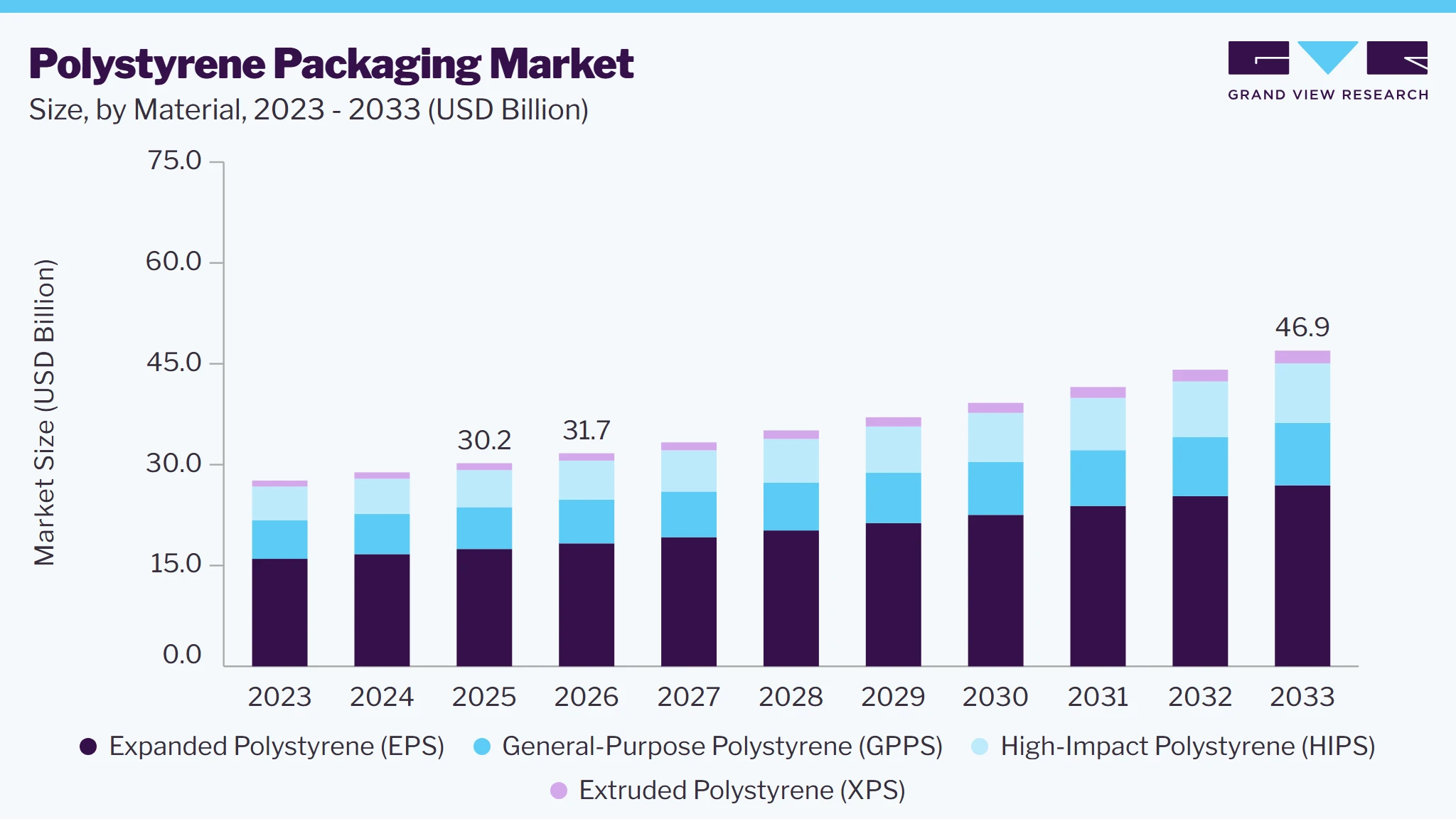 To learn more about this report, Download Free Sample Report
 The increasing focus on temperature control, product protection, and safe transportation across sensitive supply chains is expected to support market growth in the coming years. Applications such as pharmaceuticals & healthcare, food & beverage, and consumer electronics are increasingly utilizing polystyrene packaging because of its low thermal conductivity, shock-absorption capability, moisture resistance, and lightweight characteristics. Rising requirements for cold-chain transportation, meal delivery, pharmaceutical distribution, and protection of temperature-sensitive products are therefore creating additional opportunities for polystyrene packaging solutions.
Sustainability initiatives and the transition toward more resource-efficient packaging systems are also influencing the development of the polystyrene packaging industry. A defining trend in the market is the increasing focus on material efficiency, lightweight packaging designs, and improved recovery and recycling pathways for polystyrene products. Manufacturers are exploring technologies and packaging designs that reduce material consumption while maintaining required protective and insulation performance. At the same time, the relatively high growth of Extruded Polystyrene (XPS) reflects increasing demand for high-performance insulation and temperature-control applications. These developments are expected to support the continued evolution of polystyrene packaging toward more efficient and application-specific solutions.
Market Dynamics
The market is experiencing steady growth, driven by rising demand for lightweight protective packaging, thermal insulation, foodservice solutions, and cost-efficient packaging formats across the food & beverage, healthcare, electronics, retail, and industrial sectors. Manufacturers are increasingly utilizing EPS, GPPS, HIPS, and XPS to address requirements for cushioning, temperature control, product protection, and ease of transportation. Expanding e-commerce distribution, food delivery services, cold-chain logistics, and consumer electronics shipments are supporting market expansion, while environmental concerns surrounding polystyrene waste are encouraging improvements in material efficiency, recycling, and packaging design.
The growing demand for lightweight, protective packaging across food, electronics, healthcare, and industrial supply chains is a key driver of the market. Polystyrene offers a favorable combination of low weight, cushioning, rigidity, moisture resistance, and thermal insulation, making it suitable for applications where products require protection against impact, temperature variation, and handling damage.
The growing adoption of temperature-sensitive logistics is further strengthening demand for polystyrene-based solutions. Pharmaceutical products, fresh foods, seafood, meal-delivery products, and other temperature-sensitive goods require packaging that maintains stable conditions during transportation. Meanwhile, the expansion of e-commerce and electronics distribution is increasing the need for lightweight cushioning solutions to reduce product damage during shipping, thereby supporting broader adoption of polystyrene protective packaging.
A significant restraint for the market is the growing environmental concern over polystyrene waste and the increasing pressure to reduce the use of difficult-to-recover packaging materials. Restrictions on certain disposable foodservice and packaging products, together with limited collection and recycling infrastructure in some regions, can reduce the use of conventional polystyrene formats. Manufacturers are therefore required to invest in improved material efficiency, recovery systems, and alternative packaging designs, which can increase production and compliance costs and influence adoption in selected applications.
A major opportunity for the market lies in the development of more recyclable, resource-efficient, and application-specific packaging solutions. Manufacturers are focusing on lightweight designs, improved recovery technologies, utilization of recycled content, and material optimization to meet sustainability requirements while retaining the cushioning, insulation, and protective properties of polystyrene. Growing demand for temperature-controlled packaging in food, healthcare, and specialized logistics also creates opportunities for higher-performance EPS and XPS solutions, particularly where thermal protection and lightweight construction are critical.
Market Concentration & Characteristics
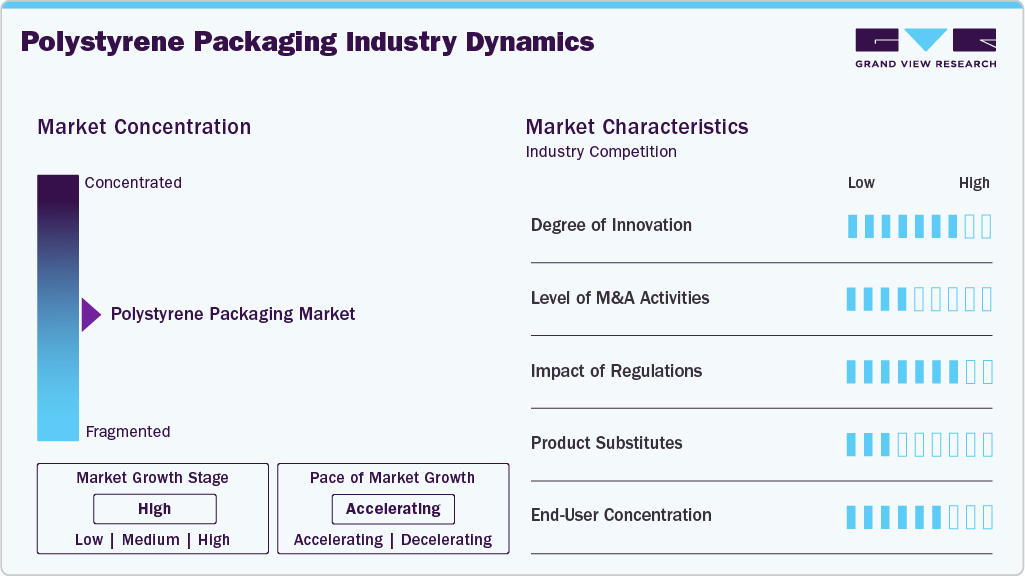
The market is characterized by its broad application base, lightweight construction, and strong dependence on high-volume manufacturing processes. The industry relies heavily on scalable production technologies such as foam molding, extrusion, thermoforming, and injection molding to manufacture EPS, GPPS, HIPS, and XPS packaging formats. Manufacturers prioritize material efficiency, dimensional consistency, cushioning performance, and cost optimization to serve diverse applications including food containers, protective packaging, insulated packaging, and industrial component protection. Leading players such as Sealed Air, Sonoco Products Company, and Berry Global have developed extensive capabilities in engineered protective and food packaging solutions.
 To learn more about this report, Download Free Sample Report
 A defining feature of the industry is the extensive use of expanded polystyrene (EPS) because of its low density, cushioning properties, thermal insulation, moisture resistance, and suitability for molded packaging applications. EPS remains particularly important for food containers, protective packaging, and temperature-controlled distribution, while HIPS and GPPS are utilized where greater rigidity, surface quality, and impact performance are required. At the same time, environmental concerns surrounding polystyrene waste are influencing product development and manufacturing strategies, encouraging greater emphasis on lightweighting, material recovery, recycling technologies, and improved packaging efficiency. The growing requirement for temperature-sensitive logistics across food, pharmaceutical, and healthcare applications is also supporting the development of higher-performance polystyrene packaging formats, particularly insulated solutions based on EPS and XPS.
Analyst Perspective
The market has evolved from conventional foodservice and protective packaging toward specialized solutions for food, electronics, e-commerce, healthcare, and cold-chain logistics. EPS remains central due to its lightweight, cushioning, and thermal insulation properties, while GPPS and HIPS support rigid packaging applications. Going forward, growth will be shaped by lightweighting, recyclability, recycled content, circular-economy practices, and material-efficient designs, as manufacturers balance polystyrene’s functional advantages with growing sustainability and regulatory requirements.
Material Insights
Based on material, the expanded polystyrene (EPS) segment led the market with the largest revenue share of 57.8% in 2025. EPS is the most widely used polystyrene material in packaging due to its lightweight structure, cushioning performance, thermal insulation, moisture resistance, and cost efficiency. It is extensively used in food containers and trays, protective packaging, and insulated packaging for temperature-sensitive products. The material’s ability to absorb impact while remaining lightweight makes it particularly suitable for protecting consumer electronics, appliances, food products, and industrial components during transportation. Its scalable molding process and low material consumption further support widespread adoption across high-volume packaging applications.
The Extruded Polystyrene (XPS) segment is expected to grow at the fastest CAGR of 8.2% during the forecast period. XPS is increasingly used in specialized packaging applications requiring enhanced thermal insulation, moisture resistance, structural stability, and consistent performance under temperature-controlled conditions. Its closed-cell structure provides effective insulation and dimensional strength, making it suitable for insulated packaging and applications involving temperature-sensitive food, pharmaceuticals, and healthcare products. The growth of XPS packaging is supported by increasing demand for reliable thermal protection in cold-chain logistics and the need for higher-performance packaging solutions for sensitive products.
Packaging Product Insights
Based on packaging product, the food containers & trays segment led the market with the largest revenue share of 30.5% in 2025. Food containers and trays are widely used because polystyrene offers lightweight construction, rigidity, moisture resistance, and cost-efficient manufacturing. These packaging formats are commonly used for ready-to-eat meals, fresh foods, meat, seafood, bakery products, and takeaway applications, where protection and convenient handling are important. The segment benefits from the extensive use of EPS and GPPS in molded and thermoformed food packaging, supported by the large-scale food processing, retail, and foodservice industries.
The insulated & temperature-controlled packaging segment is expected to grow at the fastest CAGR of 6.8% during the forecast period. Polystyrene-based insulated packaging is increasingly used to maintain product temperatures during storage and transportation, particularly for perishable foods, pharmaceuticals, healthcare products, and other temperature-sensitive goods. EPS and XPS provide thermal insulation, lightweight construction, and moisture resistance, making them suitable for cold-chain applications. Growth is supported by the expansion of temperature-controlled logistics, increasing demand for fresh and frozen food distribution, and the need for reliable thermal protection during transportation.
Application Insights
Based on application, the containment & serving segment led the market with the largest revenue share of 47.2% in 2025. This application represents a major use area for polystyrene packaging because the material can be efficiently molded into lightweight containers, trays, cups, and other formats designed for direct product handling and serving. EPS and GPPS are widely used in food packaging and foodservice applications, where properties such as low weight, moisture resistance, rigidity, and cost-effective production support large-volume use. Demand is further sustained by packaged food distribution, takeaway services, and convenience-oriented consumption patterns.
The insulation & temperature control segment is expected to grow at the fastest CAGR of 6.6% during the forecast period. Polystyrene’s cellular structure and low thermal conductivity make it well-suited for applications requiring protection from temperature fluctuations during storage and transportation. EPS and XPS are increasingly applied in insulated food packaging, cold-chain containers, and temperature-sensitive pharmaceutical and healthcare shipments. The segment is gaining momentum as supply chains place greater emphasis on maintaining product integrity throughout distribution, creating demand for packaging that combines thermal protection, low weight, and resistance to moisture and handling stresses.
End Use Insights
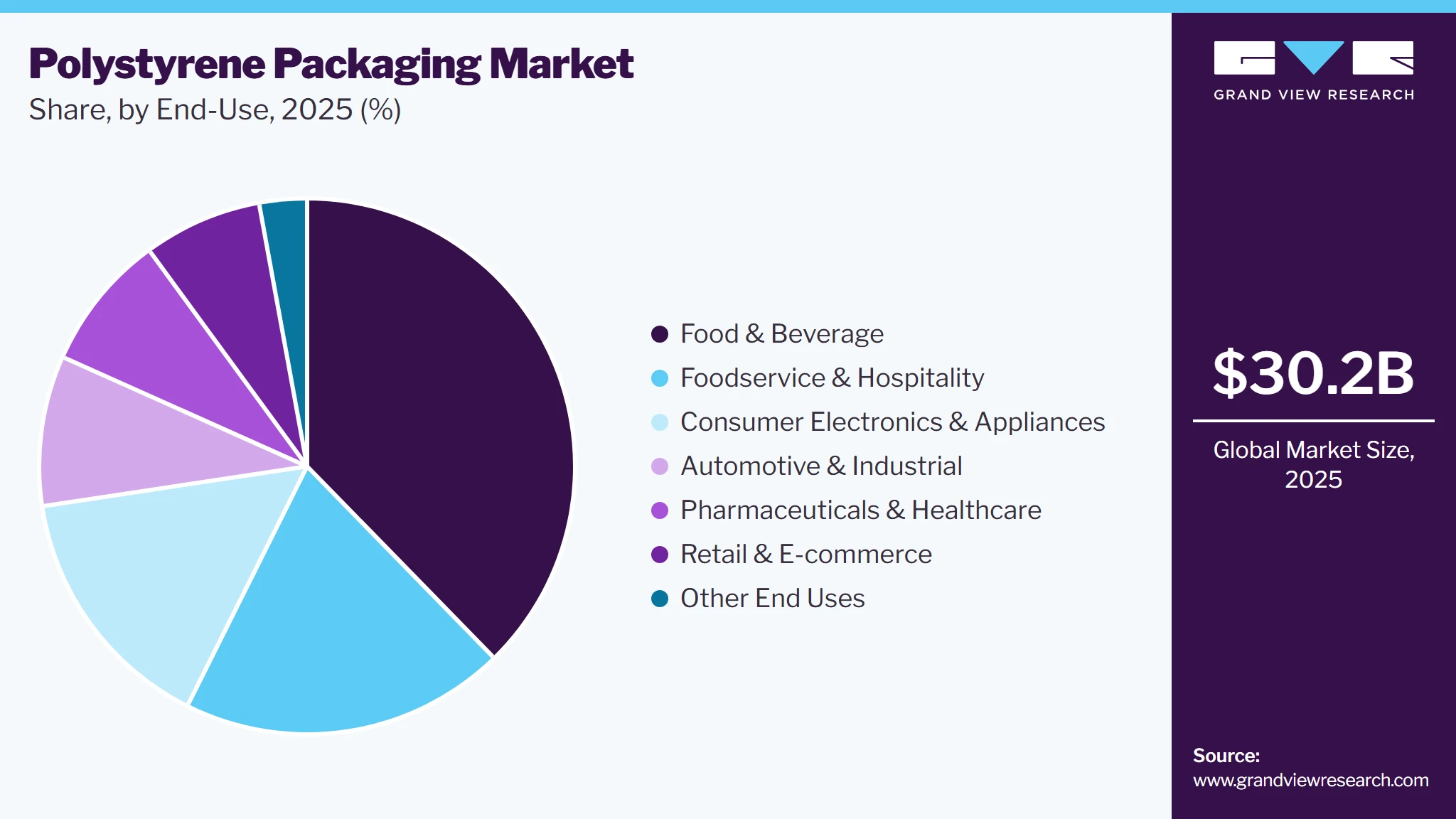
Based on end use, the food & beverage segment led the market with the largest revenue share of 37.7% in 2025. The segment benefits from extensive use of polystyrene containers, trays, protective formats, and insulated solutions across fresh foods, prepared meals, meat, seafood, dairy, and beverages. EPS and GPPS are particularly suited to these applications because they provide lightweight construction, moisture resistance, cushioning, and efficient high-volume production. Continued demand for convenient food formats, packaged and ready-to-eat products, and temperature-sensitive food distribution supports the segment’s leading position.
 To learn more about this report, Download Free Sample Report
 The pharmaceuticals & healthcare segment is expected to grow at the fastest CAGR of 6.6% during the forecast period. Polystyrene packaging is increasingly utilized for protective and temperature-sensitive packaging requirements where lightweight cushioning, thermal insulation, and resistance to handling stresses are important. EPS and XPS-based formats can support the safe movement of medicines, biological products, diagnostic materials, and other healthcare goods through distribution networks. Growth is further supported by the expansion of healthcare supply chains and increasing requirements for reliable protective and insulated packaging during transportation.
Regional Insights
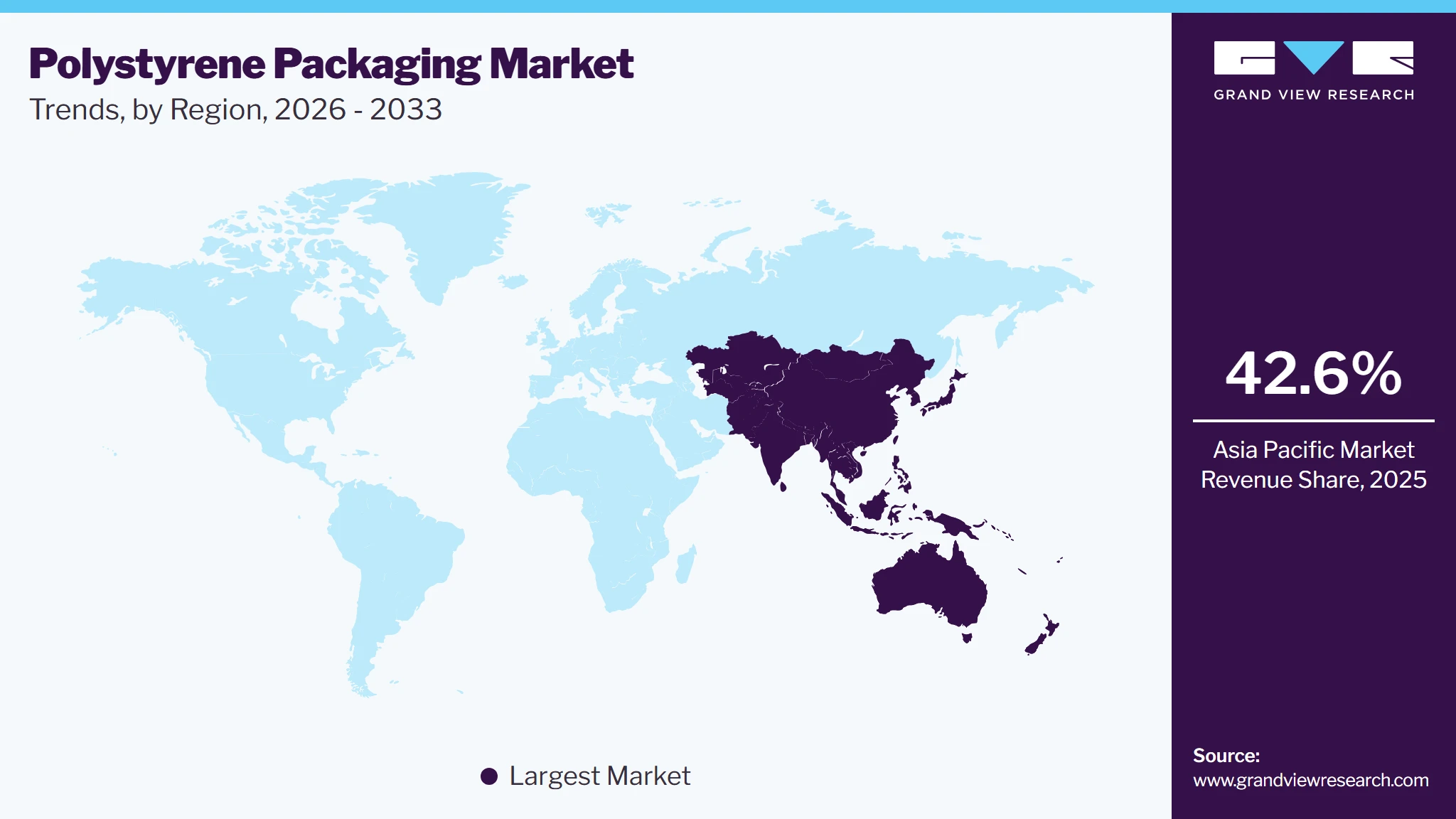
The polystyrene packaging industry in Asia Pacific dominated the global market with a 42.6% revenue share in 2025, and it is expected to register the fastest CAGR of 6.4% during the forecast period. The growth is supported by rapid industrialization, urbanization, rising consumption of packaged food, and expanding manufacturing and e-commerce activities. Regional leadership is underpinned by expanding food processing and foodservice industries, rising consumer goods production, electronics manufacturing, e-commerce activity, and growing logistics networks. The region's large manufacturing base also supports high-volume production of EPS, GPPS, HIPS, and XPS packaging, while increasing cold-chain requirements are creating additional demand for insulated polystyrene solutions.
 To learn more about this report, Download Free Sample Report
 China Polystyrene Packaging Market Trends
China polystyrene packaging industry represents a major contributor to the Asia Pacific market, benefiting from its extensive manufacturing base and high consumption of packaged food, consumer electronics, appliances, and industrial products. EPS protective packaging is particularly relevant to electronics and appliance supply chains, while food-related applications benefit from the country's large-scale processing and distribution networks. Expansion of domestic consumption and logistics infrastructure continues to sustain demand for polystyrene-based packaging.
The polystyrene packaging industry in India is emerging as an important growth market, supported by expanding food processing, organized retail, e-commerce, electronics manufacturing, and pharmaceutical distribution. Increasing urban consumption and the development of modern cold-chain infrastructure are creating opportunities for food containers, protective formats, and insulated packaging. Growing domestic manufacturing activity is also strengthening demand for lightweight packaging capable of protecting products throughout transportation and storage.
North America Polystyrene Packaging Market Trends
The polystyrene packaging industry in North America accounted for a 23.9% revenue share in 2025 and is projected to grow at a 5.1% CAGR during the forecast period. The market is supported by established food processing, foodservice, healthcare, electronics, and industrial sectors that utilize polystyrene for lightweight containers, trays, protective packaging, and insulated formats. Demand is increasingly shaped by requirements for efficient material use, product protection, and temperature-controlled distribution, while manufacturers are also adapting packaging designs to evolving sustainability expectations.
The U.S. polystyrene packaging industry represents the major contributor to the North American market, supported by its large-scale food and beverage industry, extensive e-commerce infrastructure, healthcare distribution networks, and mature consumer goods sector. Polystyrene packaging remains relevant for protective cushioning, food containers, and insulated shipping solutions, particularly where low weight and thermal performance are important. Growing emphasis on material recovery and packaging efficiency is encouraging suppliers to improve designs and production processes.
Europe Polystyrene Packaging Market Trends
The polystyrene packaging industry in Europe represented an 18.4% revenue share in 2025 and is projected to grow at a 4.8% CAGR over the forecast period. Regional demand is sustained by food packaging, consumer products, electronics, healthcare, and industrial applications requiring lightweight protection and insulation. The market is increasingly influenced by circular-economy initiatives and packaging sustainability requirements, encouraging greater attention toward recyclability, material reduction, and improved recovery of polystyrene packaging.
Germany polystyrene packaging industry holds an important position within the European market, supported by its strong food processing, automotive, electronics, chemical, and manufacturing industries. Demand is concentrated in protective packaging, food containers, industrial component protection, and temperature-sensitive applications. The country's advanced manufacturing ecosystem is also supporting the development of more resource-efficient polystyrene packaging formats and improved processing technologies.
The polystyrene packaging industry in the UK is supported by demand from foodservice, retail, e-commerce, healthcare, and logistics applications. Lightweight protective packaging remains important for goods transported through increasingly complex distribution networks, while insulated formats serve food and temperature-sensitive products. Market participants are placing greater emphasis on packaging optimization and alternative recovery approaches in response to changing sustainability priorities.
Latin America Polystyrene Packaging Market Trends
The Latin America polystyrene packaging industry accounted for a 7.9% revenue share in 2025 and is projected to grow at a 5.9% CAGR. Growth is supported by food and beverage processing, retail distribution, foodservice, and expanding manufacturing activities. Polystyrene continues to be utilized where economical, lightweight, and protective packaging is required, while increasing modern retail and packaged-food consumption is broadening the addressable application base.
The polystyrene packaging industry in Brazil represents a key market within Latin America, supported by its sizeable food and beverage processing industry, retail network, manufacturing sector, and expanding distribution infrastructure. Polystyrene packaging is used across food containers, trays, protective formats, and insulated applications. Growth in processed-food consumption and improvements in logistics and cold-chain capabilities are creating additional demand for packaging that combines protection with cost-efficient transportation.
Argentina's polystyrene packaging is primarily supported by food processing, foodservice, retail, and industrial packaging requirements. Demand for lightweight food containers and protective packaging remains relevant across domestic supply chains, while insulated solutions can benefit from requirements associated with perishable food distribution. Gradual modernization of retail and food distribution systems is expected to create further opportunities for polystyrene packaging suppliers.
Middle East & Africa Polystyrene Packaging Market Trends
The polystyrene packaging industry in the Middle East & Africa represented a 7.2% revenue share in 2025 and is expected to expand at a 6.2% CAGR, making it the second-fastest-growing regional market. Expansion is linked to increasing food consumption, hospitality activity, retail development, construction-related industrial activity, and improvements in logistics infrastructure. Demand for insulated packaging is also gaining relevance as food distribution networks expand and temperature protection becomes increasingly important in regions characterized by challenging climatic conditions.
Key Polystyrene Packaging Company Insights
Some key companies in the market include Novolex, Dart Container Corporation, BEWI, Storopack Hans Reichenecker GmbH, among others. The market is characterized by high-volume production of EPS, XPS, GPPS, and HIPS-based packaging, with strong demand for food containers, meat and produce trays, protective packaging, insulated packaging, and temperature-controlled solutions. Key participants are focusing on lightweight packaging design, customized molded solutions, improved material efficiency, recyclable EPS systems, and packaging formats that provide cushioning and thermal protection while meeting evolving sustainability requirements. Novolex, for example, offers PS foam supermarket and processor meat trays, while BEWI provides EPS packaging for food, pharmaceuticals, diagnostics, and temperature-sensitive products.
-
Novolex is a major packaging manufacturer with a broad portfolio of food, beverage, retail, and specialty packaging solutions. Its polystyrene packaging portfolio includes PS foam supermarket and processor meat trays, which are designed for applications such as fresh meat and food processing. The company serves high-volume food packaging requirements where lightweight construction, product presentation, moisture resistance, and cost-efficient manufacturing are important.
-
Dart Container Corporation specializes in foodservice packaging and offers a wide range of EPS and XPS foam containers, cups, bowls, plates, and hinged-lid packaging. Its polystyrene products are designed to provide insulation for hot and cold foods while maintaining lightweight construction and resistance to leakage and deformation. The company's portfolio directly supports the foodservice and insulated packaging segments of the polystyrene packaging industry.
Key Polystyrene Packaging Companies
The following key companies have been profiled for this study on the polystyrene packaging market.
-
Novolex
-
Dart Container Corporation
-
BEWI
-
Storopack Hans Reichenecker GmbH
-
Epack India
-
East India Group
-
KR Thermopack
-
Coastal Polymers
-
Kamaksha Thermocol
-
POLYFAB FOAMS INDIA PVT. LTD
-
Shree Insupac
-
Shri Srinivasa Polymers
Competitive Benchmarking
Category
Operating Strategies
Competitive Edge
Weakness
Established Players (Novolex; Dart Container Corporation; BEWI; Storopack Hans Reichenecker GmbH)
- Focus on high-volume EPS/XPS food packaging, protective packaging, molded packaging, and insulated solutions, supported by customized designs and efficient manufacturing.
- Strong EPS/XPS processing capabilities, broad product portfolios, established customers, customized molding, and large-scale production provide a strong market position. BEWI and Storopack also emphasize recyclable EPS solutions.
- Exposure to single-use plastic restrictions, recycling requirements, material substitution, and sustainability pressures can increase both compliance and product development costs.
Emerging & Regional Players (EPACK India; East India Group; KR Thermopack; Coastal Polymers; Kamaksha Thermocol; Polyfab Foams India Pvt. Ltd.; Shree Insupac; Shri Srinivasa Polymers)
- Focus on customized EPS/thermocol packaging, molded protective components, food and seafood boxes, insulated packaging, and packaging for electronics, healthcare, and industrial products.
- Strong customization, regional customer proximity, cost-effective EPS molding, cushioning, thermal insulation, and application-specific packaging capabilities support competitiveness.
- Smaller manufacturing scale, limited international distribution, lower brand visibility, and higher exposure to raw-material price fluctuations and alternative packaging materials can restrict expansion.
Recent Developments
-
In August 2026, BEWI reported strong growth in its Packaging & Components segment, with second-quarter sales increasing 15.7% year over year to EUR 97.9 million. Food packaging grew 14%, with fish boxes being the largest contributor to volume growth, highlighting continued demand for EPS packaging in seafood and temperature-sensitive food distribution. BEWI also collected 13,719 tonnes of used EPS for recycling during the quarter, up 68% year over year, strengthening its circular EPS packaging strategy.
Polystyrene Packaging Market Report Scope
Report Attribute
Details
Market size in 2025
USD 30.2 billion
Estimated market size in 2026
USD 31.7 billion
Projected market size by 2033
USD 46.9 billion
Growth rate
CAGR of 5.8%from 2026 to 2033
Base year for estimation
2025
Historical data
2021 - 2024
Forecast period
2026 - 2033
Quantitative units
Revenue in USD million/billion and CAGR from 2026 to 2033
Report coverage
Revenue forecast, company ranking, competitive landscape, growth factors, and trends
Segments covered
Material, packaging product, application, end use, region
Regional Scope
North America; Europe; Asia Pacific; Latin America; Middle East & Africa
Country Scope
U.S.; Canada; Mexico; Germany; UK; France; Italy; Spain; China; India; Japan; South Korea; Australia; Brazil; Argentina; Saudi Arabia; UAE; South Africa
Key companies profiled
Novolex; Dart Container Corporation; BEWI; Storopack Hans Reichenecker GmbH; Epack India; East India Group; KR Thermopack; Coastal Polymers; Kamaksha Thermocol; POLYFAB FOAMS INDIA PVT. LTD; Shree Insupac; Shri Srinivasa Polymers
Customization scope
Free report customization (equivalent up to 8 analysts working days) with purchase. Addition or alteration to country, regional & segment scope.
Pricing and purchase options
Avail of customized purchase options to meet your exact research needs. Explore purchase options
Global Polystyrene Packaging Market Report Segmentation
This report forecasts revenue growth at the regional and country levels and provides an analysis on the latest industry trends and opportunities in each of the sub-segments from 2021 to 2033. For this study, Grand View Research has segmented the global polystyrene packaging market report based on material, packaging product, application, end use, and region:
-
Material Outlook (Revenue, USD Billion, 2021 - 2033)
-
Expanded Polystyrene (EPS)
-
General-Purpose Polystyrene (GPPS)
-
High-Impact Polystyrene (HIPS)
-
Extruded Polystyrene (XPS)
-
-
Packaging Product Outlook (Revenue, USD Billion, 2021 - 2033)
-
Food Containers & Trays
-
Foodservice Packaging
-
Protective Packaging
-
Insulated & Temperature-Controlled Packaging
-
Retail & Consumer Packaging
-
Industrial Packaging
-
-
Application Outlook (Revenue, USD Billion, 2021 - 2033)
-
Containment & Serving
-
Protection & Cushioning
-
Insulation & Temperature Control
-
Retail Presentation
-
Industrial Component Packaging
-
-
End Use Outlook (Revenue, USD Billion, 2021 - 2033)
-
Food & Beverage
-
Foodservice & Hospitality
-
Consumer Electronics & Appliances
-
Pharmaceuticals & Healthcare
-
Retail & E-commerce
-
Automotive & Industrial
-
Other End Uses
-
-
Regional Outlook (Revenue, USD Billion, 2021 - 2033)
-
North America
-
U.S.
-
Canada
-
Mexico
-
-
Europe
-
Germany
-
France
-
UK
-
Italy
-
Spain
-
-
Asia Pacific
-
China
-
India
-
Japan
-
South Korea
-
Australia
-
-
Latin America
-
Brazil
-
Argentina
-
-
Middle East & Africa
-
Saudi Arabia
-
UAE
-
South Africa
-
-
Research Methodology
The polystyrene packaging market figures in this report are based on a proven research process that combines executive interviews with secondary research from proprietary databases, company filings, and recognized regulatory and institutional sources. Market size is built through value-chain sizing - reconciling supply-side and demand-side estimates - and triangulated with bottom-up and top-down approaches. Every estimate passes multiple levels of expert validation before publication, with each polystyrene packaging segment quantified using the revenue-capture definitions in the table below.
Segment Definition
Segment - Material Type
Revenue capture definition
Expanded Polystyrene (EPS)
Revenue generated from the sale of expanded polystyrene packaging products, including molded trays, boxes, protective inserts, food containers, seafood boxes, and insulated packaging. Includes EPS packaging used for cushioning, thermal insulation, food protection, and temperature-controlled transportation.
General-Purpose Polystyrene (GPPS)
Revenue generated from the sale of GPPS-based packaging products, primarily used in rigid and transparent food containers, trays, cups, lids, and other packaging formats requiring clarity, rigidity, and cost-effective processing.
High-Impact Polystyrene (HIPS)
Revenue generated from the sale of HIPS-based packaging products designed for applications requiring improved impact resistance and rigidity. Includes trays, containers, protective packaging, and other formed packaging products used across food, retail, consumer goods, and industrial applications.
Extruded Polystyrene (XPS)
Revenue generated from the sale of extruded polystyrene packaging products used for insulated foodservice containers, trays, protective packaging, and temperature-sensitive applications. Includes XPS formats providing lightweight construction, thermal insulation, moisture resistance, and structural stability.
Segment - Packaging Product
Revenue capture definition
Food Containers & Trays
Revenue generated from polystyrene food containers and trays used for meat, seafood, poultry, fruits, vegetables, dairy products, prepared foods, and other fresh or packaged foods. Includes EPS, GPPS, HIPS, and XPS-based trays and containers.
Foodservice Packaging
Revenue generated from polystyrene packaging products used by restaurants, cafeterias, catering services, and takeaway businesses, including cups, bowls, plates, clamshells, and takeaway containers.
Protective Packaging
Revenue generated from polystyrene packaging designed to protect products against impact, vibration, and handling damage, including molded EPS inserts, cushioning components, corner protectors, and protective cases for electronics, appliances, and industrial goods.
Insulated & Temperature-Controlled Packaging
Revenue generated from polystyrene-based packaging providing thermal insulation for temperature-sensitive food, pharmaceuticals, healthcare products, and other goods during storage and transportation. Includes insulated boxes, containers, liners, and molded EPS/XPS solutions.
Retail & Consumer Packaging
Revenue generated from polystyrene packaging used for consumer-facing products, including retail containers, display-oriented packs, clamshells, lids, trays, and packaging for household, personal-care, and consumer goods applications. GPPS and HIPS are commonly used where rigidity, appearance, or impact resistance is required.
Industrial Packaging
Revenue generated from polystyrene packaging used for industrial components, machinery parts, appliances, automotive components, and other manufactured goods, including molded protective inserts, trays, containers, and custom cushioning solutions.
Segment - Application
Revenue capture definition
Containment & Serving
Revenue generated from polystyrene packaging products used to contain, hold, and serve food and beverages, including cups, bowls, plates, clamshells, containers, and food trays.
Protection & Cushioning
Revenue generated from polystyrene packaging designed to absorb impact, vibration, and handling stresses, including molded inserts, cushioning components, protective blocks, and packaging for electronics, appliances, and fragile goods.
Insulation & Temperature Control
Revenue generated from polystyrene packaging used to provide thermal insulation and maintain required temperature conditions for food, seafood, pharmaceuticals, healthcare products, and other temperature-sensitive goods during storage and transportation.
Retail Presentation
Revenue generated from polystyrene packaging used for consumer-facing product presentation, including display trays, transparent containers, clamshells, and other formats where product visibility, rigidity, and appearance are important.
Industrial Component Packaging
Revenue generated from polystyrene packaging used to protect industrial components, machinery parts, automotive components, appliances, and electronic equipment during manufacturing, storage, and transportation.
Containment & Serving
Revenue generated from polystyrene packaging products used to contain, hold, and serve food and beverages, including cups, bowls, plates, clamshells, containers, and food trays.
Segment - End Use
Revenue capture definition
Food & Beverage
Revenue generated from polystyrene packaging used for fresh, processed, frozen, meat, seafood, dairy, beverage, and ready-to-eat food products, including trays, containers, cups, boxes, and insulated formats.
Foodservice & Hospitality
Revenue generated from polystyrene packaging supplied to restaurants, cafés, catering businesses, hotels, and other foodservice operators, including takeaway containers, cups, bowls, plates, clamshells, and serving products.
Consumer Electronics & Appliances
Revenue generated from polystyrene protective packaging used for televisions, computers, home appliances, electronics, and other consumer devices, including molded inserts, cushioning components, and protective packaging. EPS is particularly suited to these applications because of its shock-absorption and lightweight properties.
Pharmaceuticals & Healthcare
Revenue generated from polystyrene packaging used for pharmaceuticals, medical products, diagnostic materials, healthcare equipment, and temperature-sensitive products, including protective inserts, trays, containers, and insulated shipping solutions.
Retail & E-commerce
Revenue generated from polystyrene packaging used for retail and online-distributed consumer products, including protective inserts, trays, containers, and cushioning formats designed to reduce product damage during storage, handling, and delivery.
Automotive & Industrial
Revenue generated from polystyrene packaging used to protect automotive components, machinery parts, industrial equipment, and manufactured products during production, warehousing, and transportation.
Other End Uses
Revenue generated from polystyrene packaging used in other applications not covered above, including specialized commercial, institutional, laboratory, and miscellaneous packaging requirements.
Estimation Model
Layer Name
Key Question
Description
End Use Industry Layer
Which industries generate packaging demand?
Estimate demand originating from food & beverage, foodservice, consumer electronics, appliances, pharmaceuticals & healthcare, retail, e-commerce, automotive, and industrial sectors that require polystyrene-based packaging for containment, product protection, distribution, and temperature-sensitive handling.
Application Adoption Layer
How is polystyrene utilized across packaging applications?
Assess the adoption of polystyrene across containment & serving, protection & cushioning, insulation & temperature control, retail presentation, and industrial component packaging based on requirements such as rigidity, shock absorption, low weight, moisture resistance, and thermal insulation.
Packaging Product Consumption Layer
Which packaging formats drive material consumption?
Evaluate consumption of EPS, GPPS, HIPS, and XPS across food containers & trays, foodservice packaging, protective packaging, insulated & temperature-controlled packaging, retail & consumer packaging, and industrial packaging.
Revenue Layer
How is market revenue captured?
Revenue is captured from the sale of finished polystyrene packaging products, including molded EPS packaging, rigid PS containers and trays, foodservice formats, protective inserts, insulated boxes, and specialized industrial packaging supplied to end use industries.
Delivered Customizations
We have successfully delivered the following deep-dive customizations
Client Request
Customization Delivered
Value Adds
Regional Analysis
Detailed assessment of the Polystyrene Packaging Market across North America, Europe, Asia Pacific, Latin America, and Middle East & Africa, covering EPS, GPPS, HIPS, and XPS demand, packaging applications, end use industries, sustainability requirements, and regional growth patterns.
Identifies high-growth regions, regional demand variations, regulatory influences, and expansion opportunities for polystyrene packaging suppliers across food & beverage, foodservice, electronics, healthcare, e-commerce, and industrial applications.
Pricing Analysis
Analysis of polystyrene packaging pricing based on EPS, GPPS, HIPS, and XPS resin costs, styrene feedstock prices, product specifications, packaging format, customization, production scale, and regional supply conditions. Current PS pricing is influenced by changes in styrene costs, downstream packaging demand, imports, and supply availability.
Provides insights into cost structures, regional price variations, material premiums, production economics, and competitive pricing strategies to support supplier positioning and procurement decisions.
Opportunity Assessment
Assessment of opportunities across protective packaging, food containers & trays, insulated packaging, temperature-controlled logistics, healthcare packaging, e-commerce cushioning, and recyclable polystyrene solutions.
Identifies high-potential applications, emerging regional demand pockets, lightweighting opportunities, recycling and circularity potential, and growth areas for polystyrene packaging manufacturers.
Frequently Asked Questions About This Report
The global polystyrene packaging market size was valued at USD 30.2 billion in 2025 and is estimated at USD 31.7 billion in 2026.
The global polystyrene packaging market is expected to grow at a CAGR of 5.8% from 2026 to 2033, reaching approximately USD 46.9 billion by 2033.
The polystyrene packaging market is primarily driven by the growing demand for lightweight protection and temperature-controlled packaging, particularly across food and beverage, e-commerce, consumer electronics, pharmaceuticals, and industrial applications. The material’s low weight, cushioning performance, thermal insulation, and cost efficiency support its increasing use in protective, insulated, and temperature-sensitive packaging solutions.
Asia Pacific dominated the polystyrene packaging market with a 42.6% revenue share in 2025.
Asia Pacific is the fastest-growing region in the polystyrene packaging market, with a CAGR of 6.4% over the forecast period.
The Extruded Polystyrene (XPS) segment is the fastest-growing material segment in the polystyrene packaging market, with a CAGR of 8.2% over the forecast period.
Key players in the polystyrene packaging market include Novolex, Dart Container Corporation, BEWI, Storopack Hans Reichenecker GmbH, Epack India, East India Group, KR Thermopack, Coastal Polymers, Kamaksha Thermocol, POLYFAB FOAMS INDIA PVT. LTD, Shree Insupac, and Shri Srinivasa Polymers.
The Food Containers & Trays segment led the polystyrene packaging market with a 30.5% revenue share in 2025.
The Expanded Polystyrene (EPS) segment led the polystyrene packaging market with a 57.8% revenue share in 2025.
About the Author(s)
Plastics, Polymers & Resins Research Team
Bulk Chemicals · Plastics, Polymers & ResinsThis report was authored by the plastics, polymers & resins research team at Grand View Research - comprising two research analysts, one senior research analyst, and one industry expert - with specialized expertise in the plastics, polymers & resins segment of the bulk chemicals industry. All findings are based on proprietary bulk chemicals databases, executive interviews, and regulatory analysis, subject to internal peer review prior to publication.
Last Updated:
Speak to Analyst

Customize this report to your needs - add regions, segments, or data points, with 20% free customization.
Or view our licence options:


ISO 9001:2015 & 27001:2022 Certified
We are GDPR and CCPA compliant! Your transaction & personal information is safe and secure. For more details, please read our privacy policy.


