
- Home
- »
- Biotechnology
- »
-
Precision Fermentation Bioreactors Market Size Report, 2033GVR Report cover

Precision Fermentation Bioreactors Market (2026 - 2033)
Size, Share & Trends Analysis Report By Product Type (Single-Use Bioreactors, Stainless-Steel Bioreactors), By Scale of Operation, By Bioreactor Technology (Stirred-Tank Bioreactors), By Application, By Region, And Segment Forecasts
Market Size, 2025
$743.6MMarket Estimate, 2026
$957.2MMarket Forecast, 2033
$5,922.5MCAGR, 2026–2033
29.7%Precision Fermentation Bioreactors Market Summary
The global precision fermentation bioreactors market size was valued at USD 743.6 million in 2025 and is projected to grow from USD 957.2 million in 2026 to USD 5,922.5 million by 2033, at a CAGR of 29.7% from 2026 to 2033. North America dominated the market, accounting for the largest share of 41.0% in 2025. Market growth is driven by increasing adoption of precision fermentation for sustainable production of proteins, enzymes, specialty ingredients, and biomolecules, along with advancements in bioreactor automation, process monitoring, and scalable fermentation technologies.
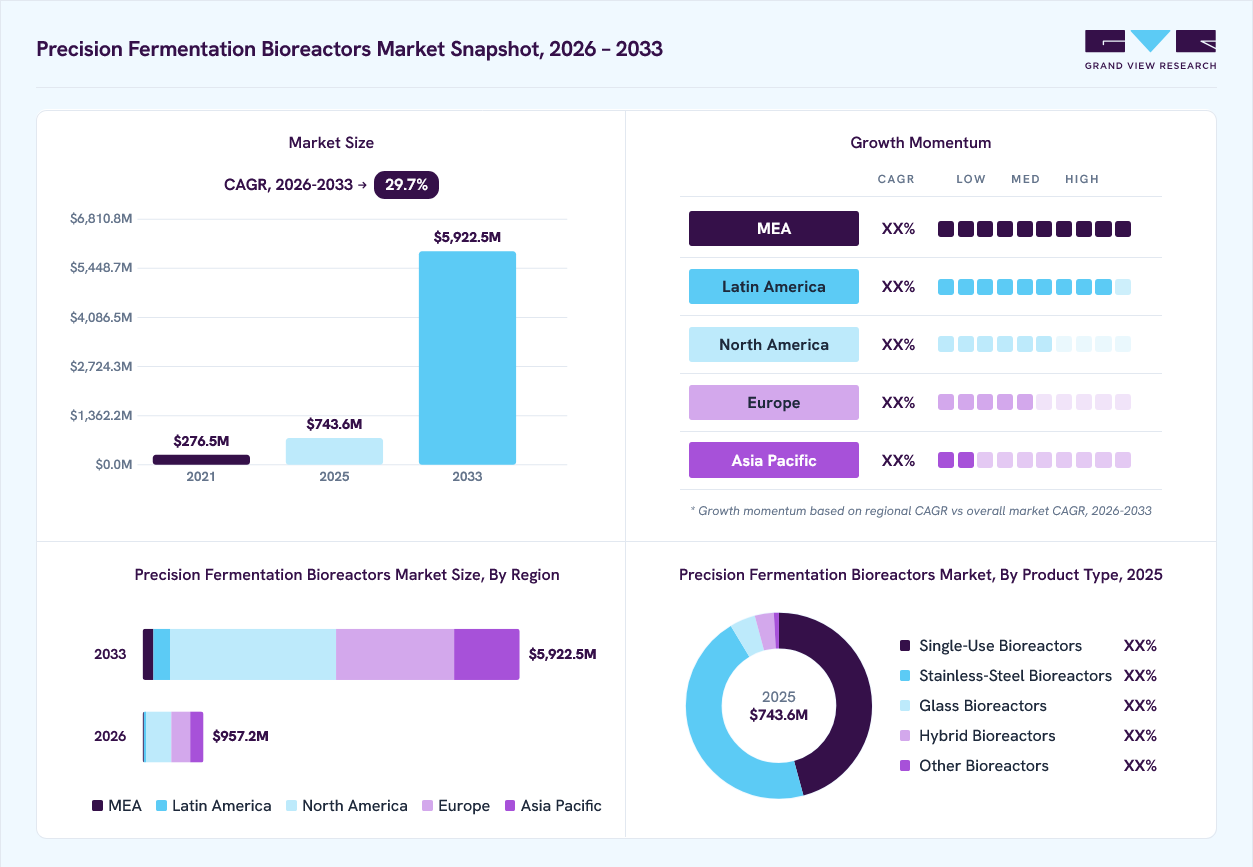 Source: Grand View Research, IR Documents, Primary Interviews, Paid DatabasesTo learn more about this report,
 Download Free Sample Report
Key Market Trends & Insights
- By product type: Single-use bioreactors segment held the highest market share of 45.7% in 2025.
- By scale of operation: Commercial scale (>2,000 L) segment held the highest market share of 45.4% in 2025.
- By bioreactor technology: Stirred-tank bioreactors segment held the highest market revenue share of 59.1% in 2025.
- By application: Food & beverage segment held the highest market share of 40.3% in 2025.
Regional Highlights
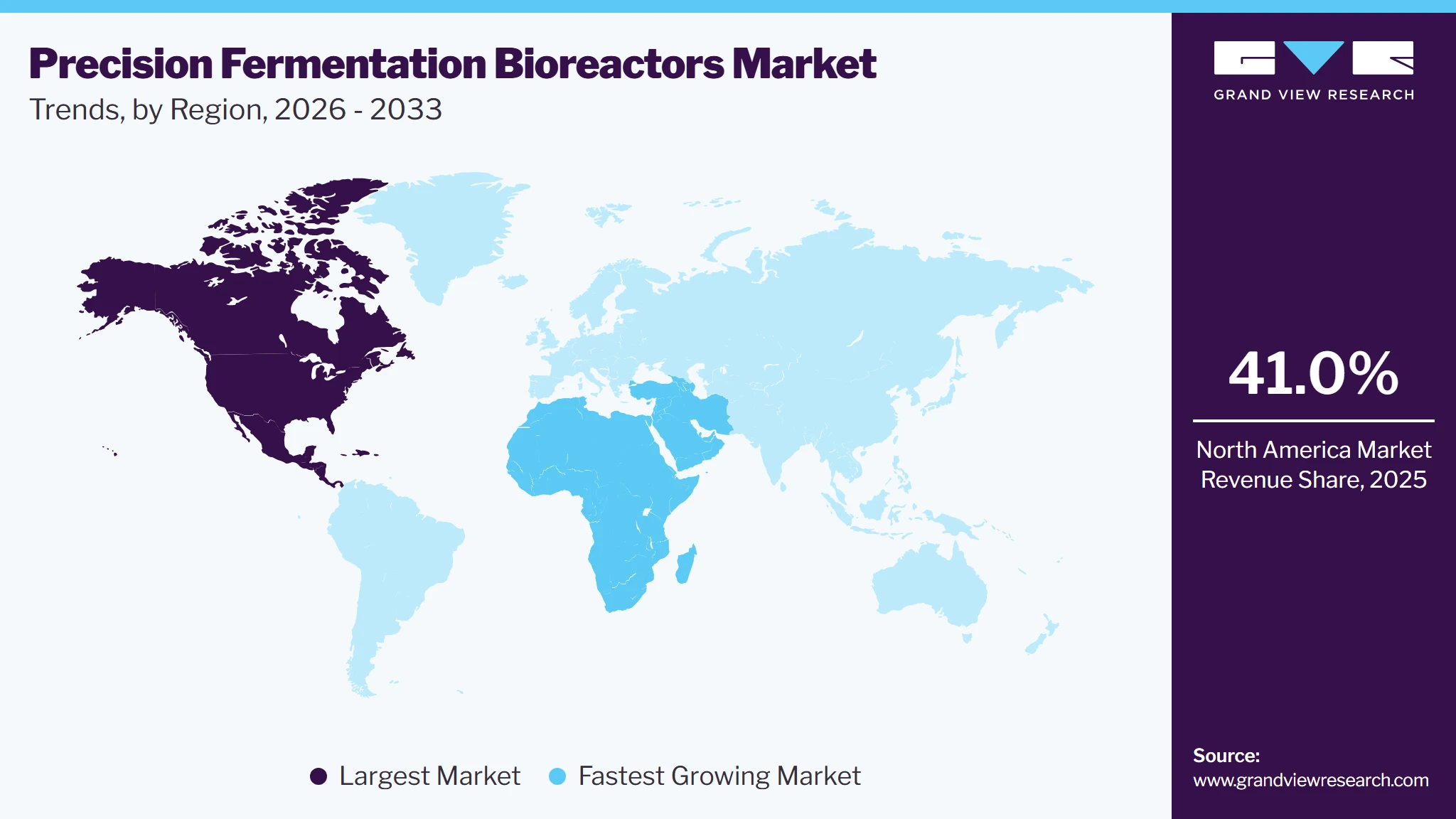
- Largest regional market: North America (41.0% revenue share, 2025)
- Fastest-growing regional market: Middle East & Africa (highest CAGR, 2026-2033)
- By country: The U.S. held the largest market share in 2025
Market Size & Forecast
- Market Size in 2025: USD 743.6 Million
- Estimated Market Size in 2026: USD 957.2 Million
- Projected Market Size by 2033: USD 5,922.5 Million
- CAGR (2026-2033): 29.7%
Prism AI by Grand View Research Free to tryAsk a question about the precision fermentation bioreactors marketTry asking✓Every figure cited from GVR research Prefer the report? Download free sample →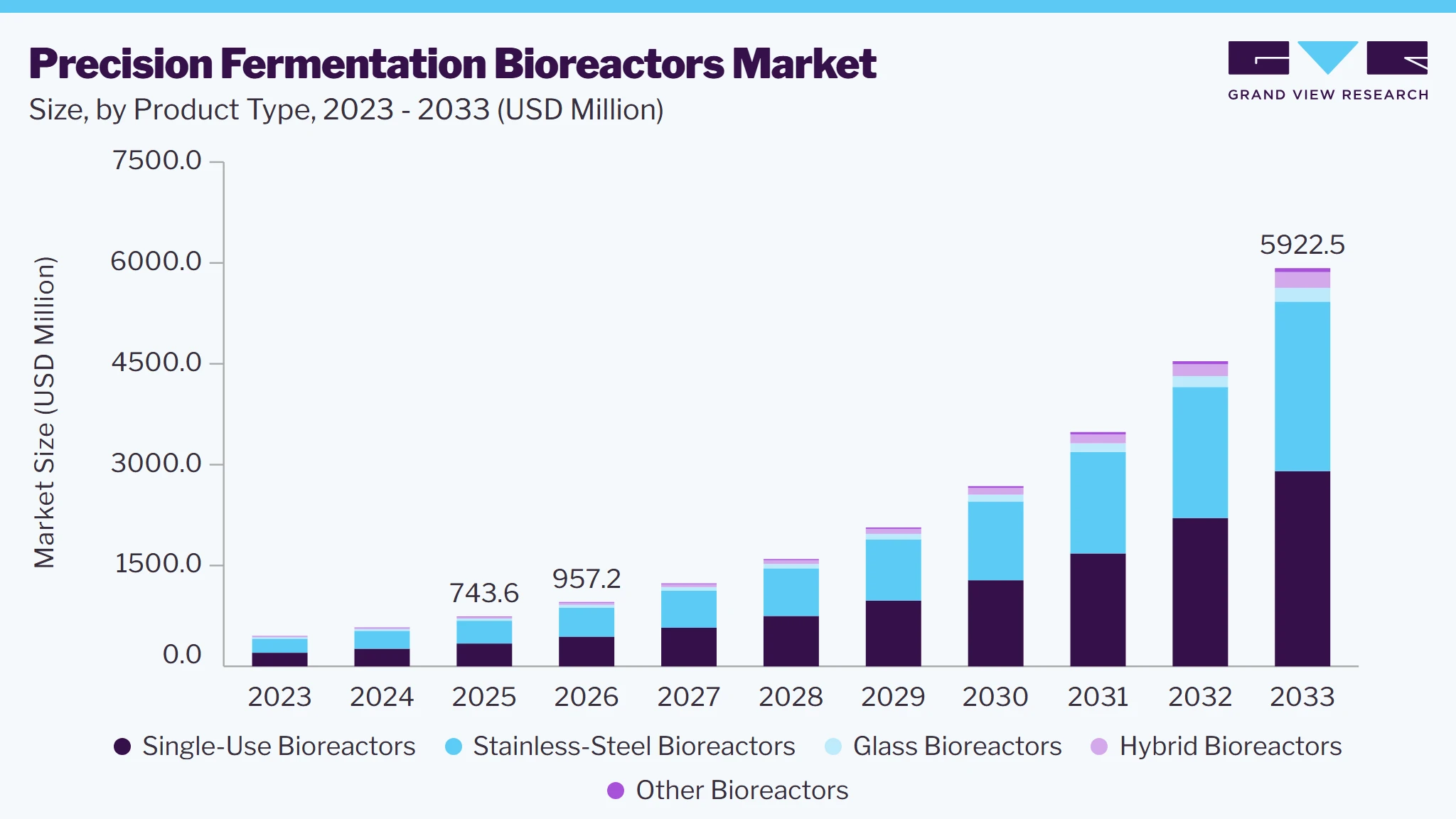 To learn more about this report, Download Free Sample Report
Market Dynamics
The precision fermentation bioreactors market is witnessing strong growth, supported by increasing investments in synthetic biology and fermentation-based biotechnology, advancements in bioreactor automation and real-time process monitoring, and rising demand for efficient and scalable bioprocessing systems. Growing development of pilot- and commercial-scale fermentation infrastructure, coupled with the integration of artificial intelligence, digital process control, and advanced analytics, is expected to improve process efficiency, reproducibility, and scalability, thereby creating new opportunities for market growth.
The growing adoption of precision fermentation is increasing demand for specialized bioreactors capable of providing precise control over temperature, pH, dissolved oxygen, agitation, and nutrient feeding. Precision fermentation enables engineered microorganisms to produce targeted proteins, enzymes, fats, flavors, vitamins, and other specialty ingredients with greater consistency and resource efficiency than conventional production methods. The expanding use of these ingredients in alternative proteins, animal-free dairy and egg products, nutraceuticals, and functional foods is therefore driving demand for scalable fermentation infrastructure.
For instance, in January 2026, GEA announced that it would deliver and commission a precision-fermentation upscaling line for Biotechnology Fermentation Factory (BFF) at the NIZO Food Innovation Campus in the Netherlands. The facility will include 1,000-liter and 10,000-liter fermentation systems and support the scale-up of animal-free dairy proteins, egg-white proteins, specialty enzymes, flavors, and other functional biomolecules. This development highlights the increasing investment in scalable precision fermentation infrastructure and is expected to support demand for advanced bioreactors as companies transition from laboratory development to commercial production.
“Open-access capacity is the critical development link many innovators have been missing. By delivering BFF’s line, we help teams validate their processes faster under food-grade conditions - and as the logical next step from our GEA New Food Application & Technology Center (proof-of-concept) this pilot environment enables application-ready material and decision-grade data sets that de-risk the move toward commercial manufacturing. It also advances Mission 30, where biotechnology meets scalable industrial production.”
- Frederieke Reiners, Vice President New Food, GEA
The complexity of large-scale fermentation and scale-up constrains the precision fermentation bioreactors market, as maintaining consistent process conditions becomes increasingly challenging at larger volumes. Variations in oxygen transfer, mixing, temperature, pH, and nutrient distribution can affect microbial growth, productivity, and product quality, requiring advanced bioreactor designs and extensive process optimization.
According to an article published by FoodNavigator in March 2026, industry experts highlighted substantial capital requirements, supply bottlenecks, and limited large-scale infrastructure as key barriers to scaling precision fermentation. The article noted that facilities producing fermentation-derived ingredients can require hundreds of millions of dollars in investment, increasing the financial and technical complexity of transitioning from pilot-scale to commercial production.
The growing demand for modular and scalable bioreactor systems presents a significant opportunity for the precision fermentation bioreactors market, as manufacturers increasingly seek flexible equipment that can support the transition from laboratory and pilot-scale development to commercial production. Modular systems enable companies to expand fermentation capacity according to production requirements while reducing infrastructure complexity and upfront investment. This flexibility is particularly valuable for producers developing alternative proteins, dairy proteins, specialty enzymes, fats, and other precision-fermented ingredients.
The increasing shift toward commercial-scale production is expected to further support adoption of modular bioreactor designs. Such systems can accommodate different production volumes and enable manufacturers to scale processes incrementally, improving flexibility and reducing the risks associated with large upfront capacity investments. Consequently, the growing need for adaptable fermentation infrastructure is expected to create opportunities for bioreactor manufacturers offering scalable and customizable systems.
Market Concentration & Characteristics
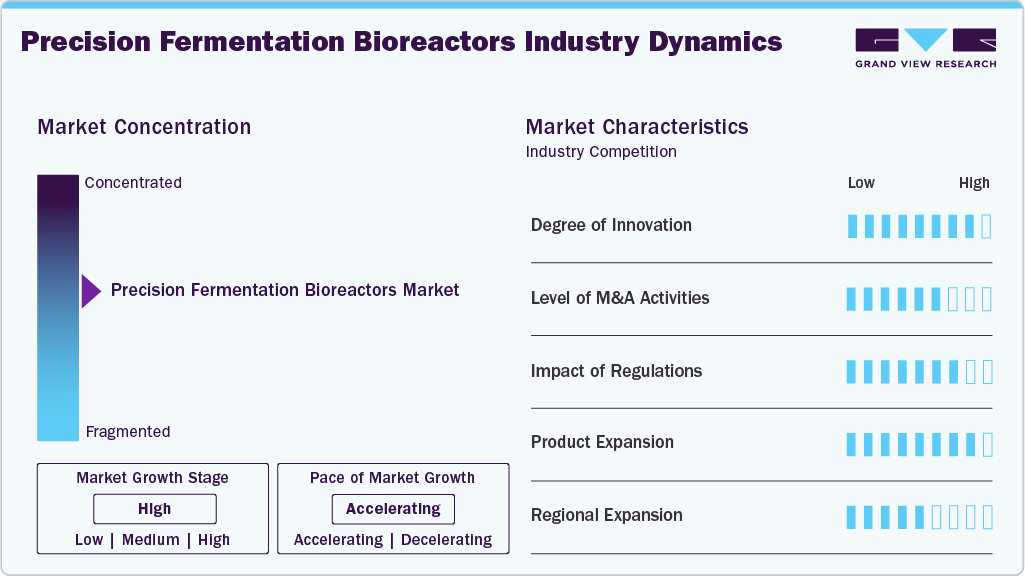
The precision fermentation bioreactors industry is characterized by a high degree of innovation, driven by advancements in bioreactor design, automation, continuous fermentation, and process-control technologies. Companies are increasingly developing systems that improve productivity, scalability, and process efficiency while reducing production costs. For instance, in December 2025, Bühler Group and Pow.Bio collaborated to commercialize an AI-enabled continuous precision fermentation platform that integrates continuous fermentation with model-driven control software.
“Precision fermentation has the potential to impact the food, feed, and specialty ingredients industries. Companies are already using it to produce dairy, meat, and egg substitutes, alternative oils and fats, and even novel pet food - and we are only at the beginning of what this technology can unlock.”
- Thierry Duvanel, Bühler’s North American Director of Innovation
The precision fermentation bioreactors industry is experiencing moderate M&A activity, with acquisitions aimed at strengthening bioreactor design and fermentation capabilities. For instance, in December 2025, Tetra Pak acquired Bioreactors.net, a manufacturer specializing in biomass and precision fermentation bioreactor systems, expanding Tetra Pak’s capabilities in New Food and fermentation equipment.
“The addition of Bioreactors.net complements our existing upstream and downstream processing portfolio with fermentation capabilities. Together, we will deploy their full portfolio of bioreactor solutions under the Tetra Pak brand - offering advanced food production systems.”
- Rafael Barros, Director of the New Food Business Stream at Tetra Pak
 To learn more about this report, Download Free Sample Report
The precision fermentation bioreactors industry is influenced by food safety, biotechnology, and manufacturing regulations, particularly for bioreactors used to produce food ingredients and other products intended for human consumption. Compliance requirements related to hygienic design, process control, contamination prevention, and product safety increase the need for validated and standardized bioreactor systems. The development of food-grade fermentation infrastructure is therefore becoming increasingly important as precision-fermented products move toward commercialization.
The precision fermentation bioreactors industry is witnessing high product expansion, supported by the introduction of bioreactors designed for different production scales and fermentation approaches. Manufacturers are expanding offerings across laboratory, pilot, and commercial systems while incorporating automation and advanced process-control capabilities. For instance, in July 2026, Tetra Pak launched its Bioreactor RF, its first industrial bioreactor, designed to provide scalable fermentation from pilot to full production.
The precision fermentation bioreactors industry is witnessing a moderate to high regional expansion, supported by increasing investments in precision fermentation infrastructure across emerging markets. Emerging biotechnology hubs are developing local fermentation capacity to support commercialization and reduce reliance on external manufacturing infrastructure. For instance, in June 2026, StrainX Bioworks raised USD 13 million to expand its precision fermentation platform and manufacturing capacity, highlighting the increasing development of fermentation infrastructure in emerging markets.
Analyst Perspective
The precision fermentation bioreactors market is expected to witness strong growth, driven by the increasing adoption of precision fermentation to produce proteins, enzymes, food ingredients, pharmaceuticals, and other bio-based products. Growing investments in alternative proteins and sustainable biomanufacturing, coupled with advancements in fermentation process optimization and bioreactor technologies, are fueling demand for scalable and high-performance systems. Increasing transition from laboratory-scale research to pilot- and commercial-scale production is expected to further support market expansion, encouraging manufacturers to focus on automation, process control, scalability, and flexible bioreactor solutions.
Product Type Insights
The single-use bioreactors segment accounted for the largest revenue share, over 45.7% in 2025, driven by reduced contamination risks, faster turnaround times, lower cleaning and sterilization requirements, and greater operational flexibility. For instance, in April 2025, Thermo Fisher Scientific introduced the 5-L DynaDrive Single-Use Bioreactor, designed to support scalable process development from laboratory to commercial production, further highlighting the growing adoption of single-use systems.
The hybrid bioreactors segment is expected to register the fastest CAGR over the forecast period, driven by increasing demand for flexible systems that combine the scalability and durability of stainless steel with the flexibility and lower contamination risk of single-use technologies. Their ability to support efficient scale-up, multi-product operations, and optimized process control is expected to accelerate adoption in precision fermentation applications.
Scale of Operation Insights
The commercial-scale (>2,000 L) segment dominated the market with a 45.4% share in 2025 and is expected to grow at fastest CAGR during the forecast period, driven by the increasing commercialization of precision-fermented products, growing demand for high-volume production, and economies of scale. For instance, in June 2025, Liberation Bioindustries announced plans for a 600,000-liter commercial-scale precision fermentation facility in Richmond, Indiana, highlighting the growing development of large-scale fermentation infrastructure for the production of food, chemical, and industrial ingredients.
The pilot scale (50-2,000 L) segment is expected to register a significant CAGR over the forecast period, driven by the increasing need for process optimization, validation, and risk reduction prior to commercial-scale production. Pilot-scale bioreactors enable manufacturers to evaluate fermentation performance, optimize critical parameters, and improve process reproducibility while minimizing the technical and financial risks associated with large-scale deployment.
Bioreactor Technology Insights
The stirred-tank bioreactors segment dominated the market with a 59.1% share in 2025, driven by their efficient mixing, high oxygen-transfer capability, precise process control, and proven scalability across laboratory, pilot, and commercial fermentation processes. Their established use in microbial fermentation, compatibility with diverse microorganisms, and availability in both single-use and stainless-steel configurations further support their global adoption in precision fermentation.
The wave/rocking bioreactors segment is expected to register the fastest CAGR over the forecast period, driven by their low-shear mixing, reduced contamination risk, operational flexibility, and suitability for single-use applications. Their ability to support gentle cultivation, rapid changeovers, and efficient process development is expected to increase adoption in precision fermentation and other emerging bioprocessing applications.
Application Insights
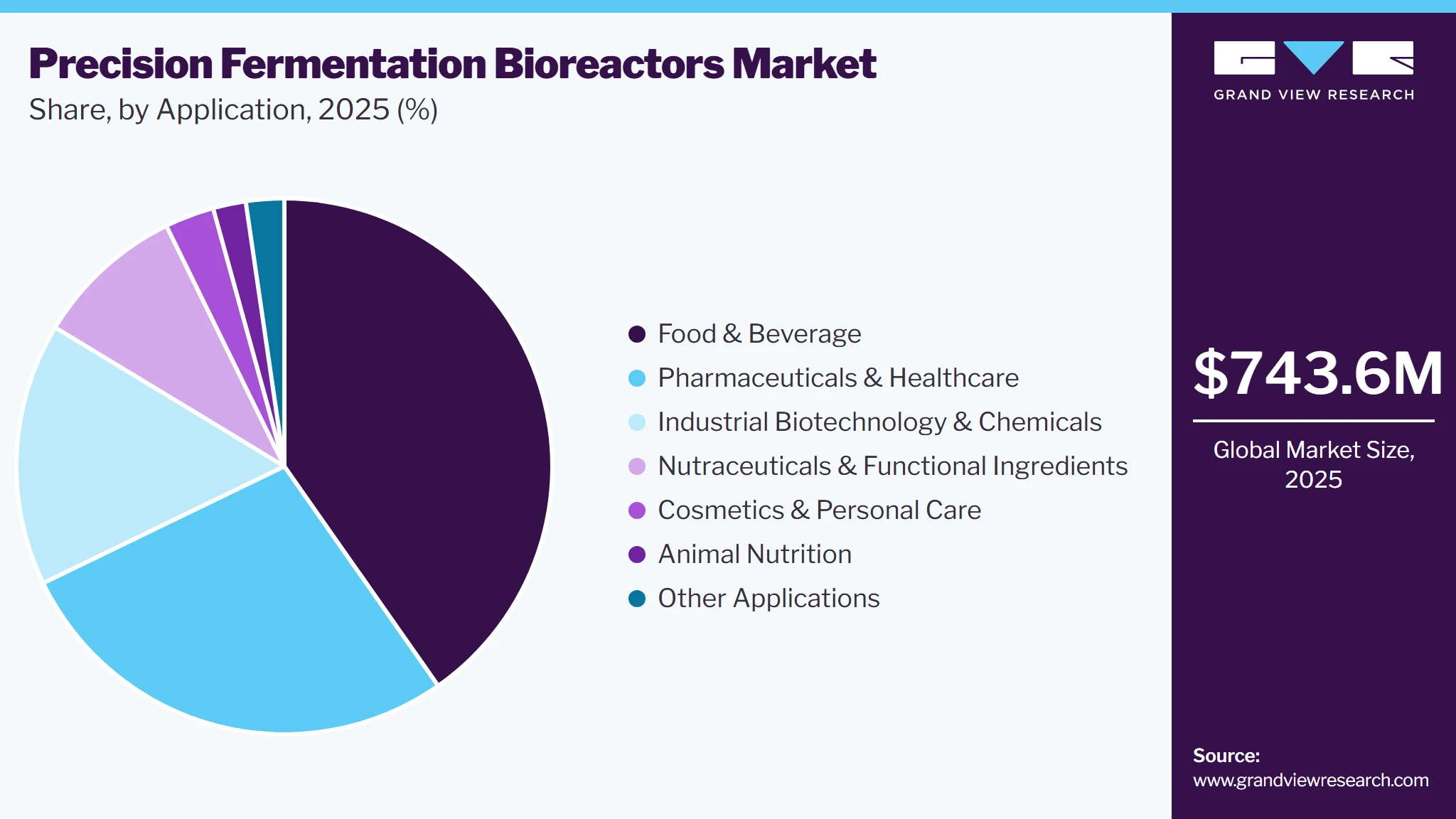
The food & beverage segment dominated the market with a share of 40.3% in 2025, driven by the increasing use of precision fermentation to produce animal-free dairy and egg proteins, alternative protein ingredients, enzymes, flavors, and sweeteners. Growing demand for sustainable, functional, and high-quality food ingredients, along with expanding commercialization of precision-fermented products, is further supporting the adoption of bioreactors in the food and beverage industry.
 To learn more about this report, Download Free Sample Report
The industrial biotechnology & chemicals segment is projected to witness the fastest CAGR, driven by the increasing use of precision fermentation for producing bio-based chemicals, enzymes, organic acids, specialty materials, and other industrial biomolecules. Growing demand for sustainable alternatives to petrochemical-based production, coupled with advancements in microbial engineering and fermentation process optimization, is further supporting the adoption of precision fermentation bioreactors across industrial applications.
Regional Insights
North America dominated the precision fermentation bioreactors industry, accounting for the largest revenue share of 41.0% in 2025, supported by expanding biomanufacturing infrastructure, government-backed investments, and increasing development of commercial-scale fermentation capacity. For instance, in March 2025, the Government of Canada announced CAD 5 million in funding for Neptune BioInnovation Centre in Nova Scotia, which is being developed to provide precision fermentation capacity of up to 100,000 L and support the scale-up of food ingredients, green chemicals, therapeutics, and alternative proteins.
 To learn more about this report, Download Free Sample Report
U.S. Precision Fermentation Bioreactors Market Trends
Precision Fermentation Bioreactors industry in the U.S. is expected to grow over the forecast period, supported by expanding biomanufacturing infrastructure, increasing investments in fermentation-based production, and growing demand for scalable systems for food, industrial biotechnology, and specialty ingredients. The availability of advanced process-development facilities and increasing commercialization of precision-fermented products are further supporting demand for flexible and scalable bioreactor systems.
Europe Precision Fermentation Bioreactors Market Trends
The precision fermentation bioreactors market in Europe was identified as a lucrative region in this industry, supported by established biotechnology infrastructure, strong industrial fermentation capabilities, and increasing focus on scaling sustainable biomanufacturing. According to an article published by the European Council on Foreign Relations (ECFR) in July 2026, Europe has 479 demonstration, semi-industrial, and pilot plants and accounts for 47% of global protein and enzyme fermentation capacity for industrial applications, highlighting the region’s strong fermentation ecosystem and potential for further adoption of precision fermentation bioreactors.
The UK precision fermentation bioreactors market is supported by expanding pilot-scale bioprocessing infrastructure and regulatory initiatives for precision-fermented foods. For instance, in April 2026, CPI expanded its Novel Food Innovation Centre in Wilton to include pilot-scale fermentation capabilities up to 750 L, supporting scale-up of ingredients developed through engineering biology and precision fermentation.
“A major challenge in novel food innovation is demonstrating that a process will operate reliably beyond the laboratory. Pilot-scale validation provides the evidence organisations need before committing to manufacturing investment.”
- Kris Wadrop, Managing Director - Materials at CPI
The precision fermentation bioreactors market in Germany is anticipated to grow significantly over the forecast period, supported by its established biotechnology ecosystem, industrial fermentation capabilities, and increasing commercialization of precision-fermented products. The country’s strong research and manufacturing base is creating demand for scalable bioreactor systems across food, ingredients, and industrial biotechnology applications.
Asia Pacific Precision Fermentation Bioreactors Market Trends
Asia Pacific is expected to witness significant growth in the precision fermentation bioreactors market, supported by expanding food-tech infrastructure, increasing commercialization of sustainable food technologies, and growing investment in fermentation-based production. According to an article published by the Singapore Economic Development Board (EDB) in April 2024, Nurasa’s Food Tech Innovation Centre in Singapore includes a precision fermentation laboratory equipped with bioreactors with production capacities of up to 100 L, enabling companies to scale beyond developmental capacities and accelerate commercialization. This development highlights the expansion of precision fermentation infrastructure in the Asia Pacific region and supports demand for scalable bioreactor systems.
China is developing capabilities in precision fermentation and alternative protein production, supported by its large food-processing and biotechnology ecosystem. Increasing participation of domestic biotechnology companies in engineered-microbe production is expected to support demand for scalable fermentation systems and associated bioprocessing infrastructure.
The precision fermentation bioreactors market in Japan is expected to grow steadily, supported by the country’s established fermentation expertise, advanced biotechnology ecosystem, and increasing focus on sustainable biomanufacturing. Growing government and industry interest in precision fermentation, alternative proteins, and bio-based production is expected to drive demand for scalable, technologically advanced bioreactor systems.
Latin America Precision Fermentation Bioreactors Market Trends
The Latin America precision fermentation bioreactors market is expected to grow gradually, supported by expanding fermentation infrastructure, increasing biotechnology investments, and growing adoption of microbial-based production technologies. For instance, in February 2026, Rovensa Next inaugurated a new pilot fermentation plant at its Monte Mor site in Brazil, equipped with a 150-L bioreactor to support microbial process scale-up from laboratory to industrial production. This development highlights the expansion of pilot-scale fermentation infrastructure in the region and supports demand for scalable bioreactor systems.
MEA Precision Fermentation Bioreactors Market Trends
MEA is expected to grow at the fastest CAGR of 35.9% during the forecast period, supported by increasing investments in biotechnology, sustainable food production, and regional biomanufacturing capabilities. According to an article published by the Saudi Press Agency, NEOM Investment Fund invested in Liberation Labs to support the development of precision fermentation infrastructure in Saudi Arabia, highlighting the region’s growing focus on advanced fermentation-based manufacturing and creating opportunities for scalable bioreactor systems.
Key Precision Fermentation Bioreactors Company Insights
Several well-established companies operate in the precision fermentation bioreactors market, supported by their portfolios of single-use, stainless-steel, glass, and scalable fermentation systems. Leading players such as Sartorius AG, Thermo Fisher Scientific Inc., Merck KGaA, Eppendorf SE, GEA Group, Bühler Group, ABEC, Inc., Getinge AB, bbi-biotech GmbH, and Cellexus maintain a strong market presence through product innovation, bioreactor technology advancements, capacity expansion, and strategic initiatives focused on improving fermentation efficiency, scalability, process control, and commercialization.
Key Precision Fermentation Bioreactors Companies:
The following key companies have been profiled for this study on the precision fermentation bioreactors market.
-
Sartorius AG
-
Thermo Fisher Scientific Inc.
-
Merck KGaA
-
Eppendorf SE
-
GEA Group
-
Bühler Group
-
ABEC, Inc.
-
Getinge AB
-
bbi-biotech GmbH
-
Cellexus
Competitive Benchmarking
Category
Operating Strategies
Competitive Edge
Weakness
Established Players (Sartorius AG, Thermo Fisher Scientific Inc., Merck KGaA, GEA Group, Bühler Group, ABEC, Inc., Getinge AB, etc.)
Focus on developing scalable precision fermentation bioreactors and integrated process solutions for food, pharmaceutical, industrial biotechnology, and alternative protein applications.
Broad portfolios covering bioreactors, process equipment, automation, and downstream processing, enabling end-to-end fermentation solutions.
Dependence on the relatively emerging precision fermentation industry, with uncertain commercialization rates and evolving regulatory frameworks.
Emerging Players (Eppendorf SE, bbi-biotech GmbH, Cellexus)
Emphasize flexible, modular, and application-specific bioreactor solutions to address the requirements of emerging precision fermentation applications.
Greater agility in developing customized solutions for novel microbial strains and the emerging fermentation processes.
Limited global scale, manufacturing capacity, and financial resources compared with major bioprocessing companies.
Recent Developments
- In July 2026, GEA opened its Application and Technology Center for New Food and Biotechnology in Sarstedt, Germany, following a EUR 4 million investment. The center features 50-500 L bioreactors for developing and testing precision fermentation processes, supporting companies in transitioning from laboratory research to pilot-scale production.
"A good lab result creates interest. A solid process creates confidence. And sometimes the most valuable outcome of a test run is a clear no - because a process isn't stable enough yet, or the cost structure simply doesn't hold up. Learning that early can save a company a lot of time and capital."
- Frederieke Reiners, Vice President New Food & Biotech, GEA
- In March 2024, GEA unveiled its Axenic-line bioreactors and Kytero single-use separator-based perfusion platform at Anuga FoodTec in Germany, designed to improve productivity and cost efficiency in precision fermentation and new-food applications. The platform includes a 50-L bioreactor for pilot processes, highlighting advancements in scalable bioreactor technologies for precision fermentation.
Precision Fermentation Bioreactors Market Report Scope Table
Report Attribute
Details
Market size in 2025
USD 743.6 million
Estimated market size in 2026
USD 957.2 million
Projected market size by 2033
USD 5,922.5 million
Growth rate
CAGR of 29.7% from 2026 to 2033
Historical data
2021 - 2025
Forecast period
2026 - 2033
Quantitative units
Revenue in USD million, and CAGR from 2026 to 2033
Report coverage
Revenue forecast, company ranking, competitive landscape, growth factors, and trends
Segments covered
Product type, scale of operation, bioreactor technology, application, and region
Regional scope
North America; Europe; Asia Pacific; Latin America; MEA
Country scope
U.S., Canada, Mexico, UK, Germany, France, Italy, Spain, Norway, Denmark, Sweden, China, Japan, India, South Korea, Australia, Thailand, Brazil, Argentina, Saudi Arabia, South Africa, UAE, and Kuwait
Key companies profiled
Sartorius AG, Thermo Fisher Scientific Inc., Merck KGaA, Eppendorf SE, GEA Group, Bühler Group, ABEC, Inc., Getinge AB, bbi-biotech GmbH, Cellexus
Customization scope
Free report customization (equivalent up to 8 analysts' working days) with purchase. Addition or alteration to country, regional & segment scope.
Pricing and purchase options
Avail customized purchase options to meet your exact research needs. Explore purchase options
Global Precision Fermentation Bioreactors Market Report Segmentation
This report forecasts revenue growth and provides an analysis on the latest trends in each of the sub-segments from 2021 to 2033. For this report, Grand View Research has segmented the global precision fermentation bioreactors market on the basis of product type, scale of operation, bioreactor technology, application, and region.
-
Product Type Outlook (Revenue, USD Million, 2021 - 2033)
-
Single-Use Bioreactors
-
Stainless-Steel Bioreactors
-
Glass Bioreactors
-
Hybrid Bioreactors
-
Other Bioreactors
-
-
Scale of Operation Outlook (Revenue, USD Million, 2021 - 2033)
-
Laboratory Scale (<50 L)
-
Pilot Scale (50-2,000 L)
-
Commercial Scale (>2,000 L)
-
-
Bioreactor Technology Outlook (Revenue, USD Million, 2021 - 2033)
-
Stirred-Tank Bioreactors
-
Wave/Rocking Bioreactors
-
Bubble-Column/Gas-Lift Bioreactors
-
Other Specialized Bioreactors
-
-
Application Outlook (Revenue, USD Million, 2021 - 2033)
-
Food & Beverage
-
Pharmaceuticals & Healthcare
-
Industrial Biotechnology & Chemicals
-
Nutraceuticals & Functional Ingredients
-
Cosmetics & Personal Care
-
Animal Nutrition
-
Other Applications
-
-
Regional Outlook (Revenue, USD Million, 2021 - 2033)
-
North America
-
U.S.
-
Canada
-
Mexico
-
-
Europe
-
UK
-
Germany
-
France
-
Italy
-
Spain
-
Denmark
-
Sweden
-
Norway
-
-
Asia Pacific
-
Japan
-
China
-
India
-
Australia
-
Thailand
-
South Korea
-
-
Latin America
-
Brazil
-
Argentina
-
-
Middle East and Africa (MEA)
-
South Africa
-
Saudi Arabia
-
UAE
-
Kuwait
-
-
Research Methodology
The precision fermentation bioreactors market figures in this report are based on a proven research process that combines executive interviews with secondary research from proprietary databases, company filings, and recognized regulatory and institutional sources. Market size is built through value-chain sizing-reconciling supply-side and demand-side estimates-and triangulated with bottom-up and top-down approaches. Every estimate passes multiple levels of expert validation before publication, with each precision fermentation bioreactors segment quantified using the revenue-capture definitions in the table below.
Segment Definition
Segment - Product Type
Revenue Capture Definition
Single-Use Bioreactors
Revenue generated from disposable bioreactor systems designed for precision fermentation processes, where the product-contact vessel and associated components are used for a single production cycle. These systems support rapid changeovers, reduced cleaning and sterilization requirements, and flexible production of proteins, enzymes, food ingredients, and other bio-based products.
Stainless-Steel Bioreactors
This segment captures income from reusable stainless-steel bioreactor systems employed for precision fermentation at laboratory, pilot, and commercial scales. These systems are suited to repeated production cycles and high-volume manufacturing where durability, process control, and long-term operational efficiency are priorities.
Glass Bioreactors
Market value in this category stems from glass-based bioreactor systems used for precision fermentation development, experimentation, and process optimization. Their transparency and chemical resistance make them particularly suitable for laboratory-scale applications requiring direct observation and controlled process conditions.
Hybrid Bioreactors
Revenue originates from bioreactor systems combining features or components of single-use and reusable platforms to provide greater flexibility across precision fermentation workflows. These systems can support organizations seeking a balance between disposable processing advantages and the durability or scalability of conventional equipment.
Other Bioreactors
Includes revenue from specialized bioreactor configurations that do not fall within single-use, stainless-steel, glass, or hybrid categories, including customized and emerging systems developed for specific precision fermentation processes.
Segment - Scale of Operation
Revenue Capture Definition
Laboratory Scale (<50 L)
Revenue generated from compact bioreactor systems used for strain development, media optimization, screening, process characterization, and early-stage precision fermentation experiments at volumes below 50 liters.
Pilot Scale (50–2,000 L)
This segment reflects income from bioreactors used to translate laboratory-developed fermentation processes into larger controlled production environments ranging from 50 to 2,000 liters. These systems facilitate process scale-up, optimization, reproducibility assessment, and generation of material for downstream testing.
Commercial Scale (>2,000 L)
Market value in this category arises from large-capacity bioreactor systems exceeding 2,000 liters and designed for commercial production of precision-fermented ingredients and products. These platforms emphasize high-volume output, process consistency, automation, and manufacturing efficiency.
Segment - Bioreactor Technology
Revenue Capture Definition
Stirred-Tank Bioreactors
Revenue generated from mechanically agitated bioreactor systems that use impellers to provide uniform mixing, nutrient distribution, gas transfer, and temperature control during precision fermentation. These platforms are widely applicable across laboratory, pilot, and commercial production processes.
Wave/Rocking Bioreactors
This segment captures income from flexible bioreactor systems that use rocking motion to facilitate mixing and gas exchange within disposable cultivation vessels. They provide a scalable and relatively low-shear environment for specialized fermentation and cell-based production workflows.
Bubble-Column/Gas-Lift Bioreactors
Market value stems from bioreactors that rely on gas flow to circulate and mix the fermentation medium rather than mechanical agitation. These configurations support efficient oxygen transfer and reduced mechanical complexity for selected microbial and precision fermentation processes.
Other Specialized Bioreactors
Revenue originates from alternative or customized bioreactor technologies developed for specific precision fermentation requirements, including emerging configurations designed to improve mass transfer, process control, scalability, or production efficiency.
Segment - Application
Revenue Capture Definition
Food & Beverage
Revenue generated from precision fermentation bioreactors used to produce food and beverage ingredients such as alternative proteins, dairy and egg proteins, flavor compounds, enzymes, sweeteners, and other functional ingredients.
Pharmaceuticals & Healthcare
This segment captures income from bioreactor systems employed to manufacture recombinant proteins, therapeutic proteins, enzymes, vaccines, and other healthcare-related biomolecules through precision fermentation.
Industrial Biotechnology & Chemicals
Market value in this category stems from bioreactors used to produce bio-based chemicals, industrial enzymes, specialty materials, organic acids, and other platform products that can replace or supplement conventional petrochemical-derived inputs.
Nutraceuticals & Functional Ingredients
Revenue reflects the use of precision fermentation bioreactors to manufacture vitamins, amino acids, probiotics, bioactive compounds, and other ingredients incorporated into nutritional and functional health products.
Cosmetics & Personal Care
This segment represents income from bioreactor applications producing fermentation-derived active ingredients, proteins, enzymes, and other bio-based compounds used in skincare, haircare, and personal care formulations.
Animal Nutrition
Revenue is generated from precision fermentation systems used to produce feed additives, enzymes, proteins, amino acids, vitamins, and other nutritional ingredients intended to improve animal health, growth, and feed efficiency.
Other Applications
Includes revenue from precision fermentation bioreactors deployed in emerging or specialized applications not covered above, including bio-based materials, environmental biotechnology, and other novel fermentation-derived products.
Delivered Customizations
This report has been delivered with the following In-depth customizations
Client Request
Customization Delivered
Value Adds
Precision Fermentation Process & Scale-Up Assessment
Evaluation of precision fermentation bioreactor requirements across laboratory, pilot, and commercial scales, including process scalability, volumetric productivity, fermentation cycle times, oxygen transfer, agitation, and process-control requirements for different fermentation applications.
Helps clients identify scale-up bottlenecks, optimize bioreactor selection, assess commercial production readiness, and prioritize investments in scalable fermentation infrastructure.
Bioreactor Technology & Manufacturing Economics Assessment
Comparative assessment of single-use, stainless-steel, glass, hybrid, stirred-tank, wave/rocking, bubble-column/gas-lift, and specialized bioreactors based on capital requirements, operating costs, throughput, flexibility, cleaning requirements, contamination risk, and suitability for precision fermentation processes.
Enables clients to evaluate total cost of ownership, identify cost-efficient technologies, optimize facility design, and select bioreactor configurations aligned with production requirements.
Precision Fermentation Capacity & Facility Expansion Analysis
Assessment of global and regional precision fermentation production capacity, facility investments, planned capacity additions, contract manufacturing activity, and infrastructure development across food & beverage, pharmaceuticals, industrial biotechnology, nutraceuticals, cosmetics, and animal nutrition applications.
Helps clients identify capacity gaps and emerging production hubs, assess outsourcing opportunities, plan facility expansion, and prioritize geographic investments based on future fermentation demand.
Frequently Asked Questions About This Report
The global precision fermentation bioreactors market size was valued at USD 743.6 million in 2025 and is estimated at USD 957.2 million for 2026.
The global precision fermentation bioreactors market is expected to grow at a CAGR of 29.7% from 2026 to 2033, reaching USD 5,922.5 million by 2033.
The single-use bioreactors segment led with a 45.7% revenue share in 2025.
North America dominated with a 41.0% revenue share in 2025.
Market growth is driven by increasing adoption of precision fermentation for sustainable production of proteins, enzymes, specialty ingredients, and biomolecules, along with advancements in bioreactor automation, process monitoring, and scalable fermentation technologies.
Key players include Sartorius AG, Thermo Fisher Scientific Inc., Merck KGaA, Eppendorf SE, GEA Group, Bühler Group, ABEC, Inc., Getinge AB, bbi-biotech GmbH, and Cellexus.
The commercial scale (>2,000 L) segment led with a 45.4% revenue share in 2025.
The stirred-tank bioreactors segment led with a 59.1% revenue share in 2025.
Which application segment accounted for the largest precision fermentation bioreactors market share?The food & beverage segment led with a 40.3% revenue share in 2025.
About the Author(s)
Biotechnology Research Team
Healthcare · BiotechnologyThis report was authored by the biotechnology research team at Grand View Research - comprising two research analysts, one senior research analyst, and one industry expert - with specialized expertise in the biotechnology segment of the healthcare industry. All findings are based on proprietary healthcare databases, executive interviews, and regulatory analysis, subject to internal peer review prior to publication.
Last Updated:
Speak to Analyst

Customize this report to your needs - add regions, segments, or data points, with 20% free customization.
Or view our licence options:


ISO 9001:2015 & 27001:2022 Certified
We are GDPR and CCPA compliant! Your transaction & personal information is safe and secure. For more details, please read our privacy policy.


