
- Home
- »
- Renewable Energy
- »
-
Smart Solar Market Size, Share & Trends Report, 2026-2033GVR Report cover
![Smart Solar Market (2026 - 2033)Report]()
Smart Solar Market (2026 - 2033)
Size, Share & Trends Analysis Report By Component (Hardware, Software, Services), By Deployment (On-grid, Off-grid, Hybrid Systems), By Region (North America, Europe, Asia Pacific, Latin America, MEA), And Segment Forecasts
Market Size, 2025
$18.4BMarket Estimate, 2026
$19.0BMarket Forecast, 2033
$44.4BCAGR, 2026–2033
12.9%Smart Solar Market Summary
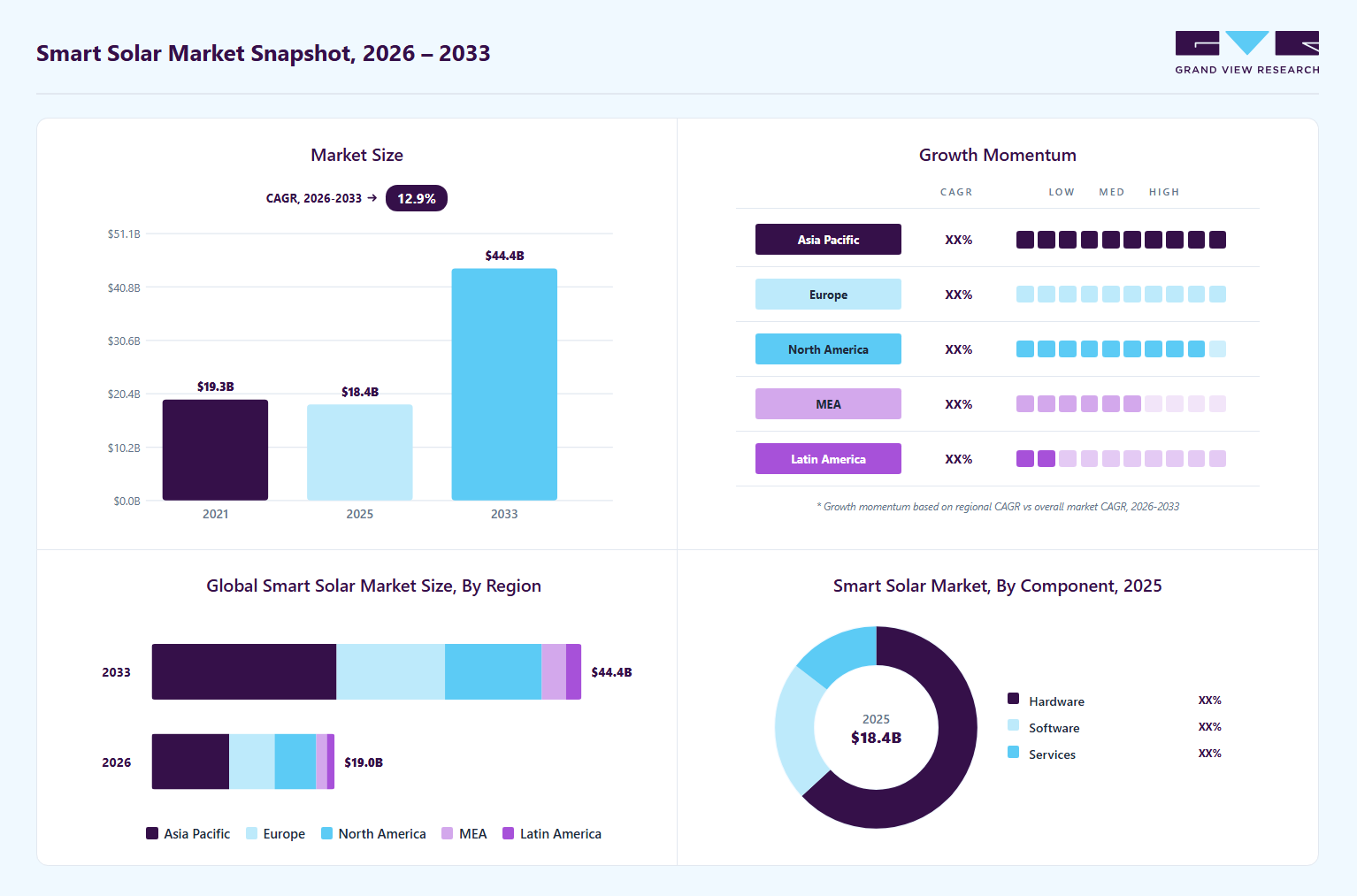
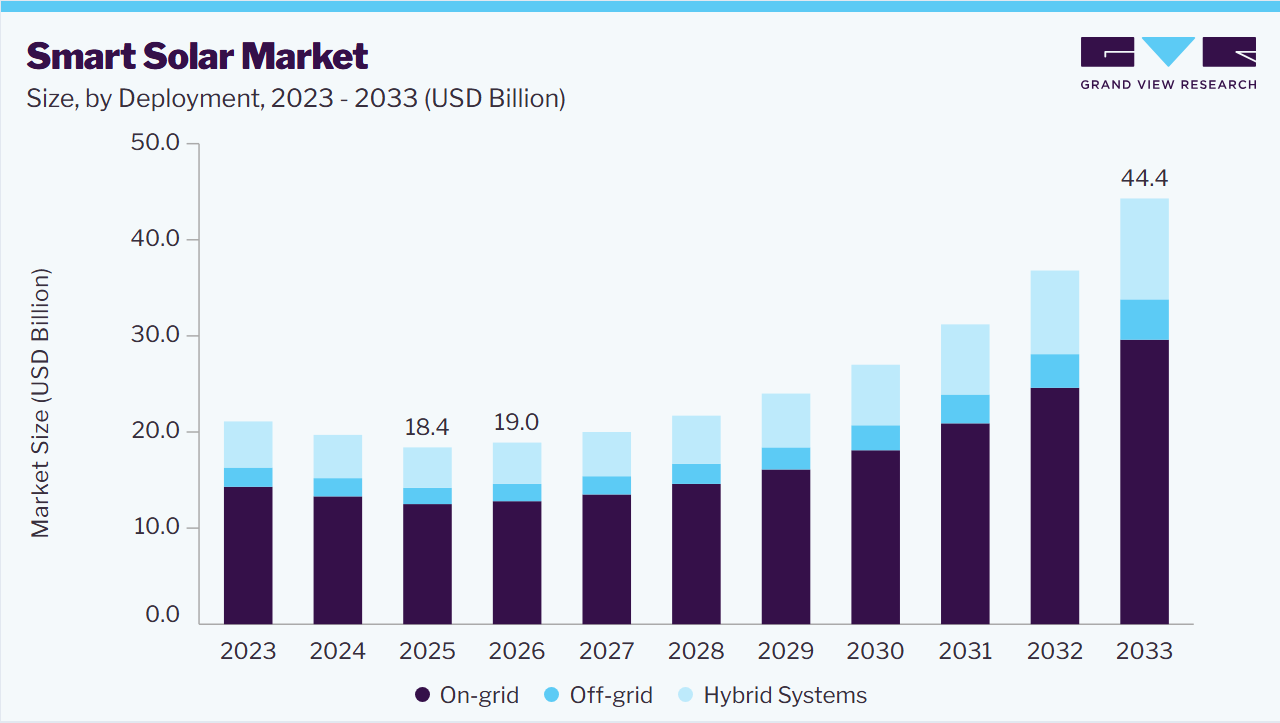
The global smart solar market size was valued at USD 18.4 billion in 2025 and is projected to grow from USD 19.0 billion in 2026 to USD 44.4 billion by 2033, at a CAGR of 12.9% from 2026 to 2033. Asia Pacific held the largest global share of 42.3% in 2025. The market is expanding as smart solar systems enhance the efficiency, monitoring, and management of solar power generation while enabling better integration with modern energy networks.
Key Market Trends & Insights
- The China smart solar industry is expected to grow at a CAGR of 13.3% from 2026 to 2033.
- In 2025, the hardware segment accounted for the largest revenue share of 63.0%.
- The on-grid segment held the largest revenue share of 67.7% in 2025.
Market Size & Forecast
- 2025 Market Size: USD 18.4 Billion
- 2026 Market Size: USD 19.0 Billion
- 2033 Projected Market Size: USD 44.4 Billion
- CAGR (2026-2033): 12.9%
- Asia Pacific: Largest market in 2025
Compared to conventional solar installations, smart solar solutions improve energy yield, operational performance, and grid interaction, making them increasingly attractive for residential, commercial, industrial, and utility-scale applications.The market is growing due to the strong long-term economic advantages of intelligent, digitally connected solar energy systems. Smart solar technologies enable optimized power generation, real-time monitoring, predictive maintenance, and efficient energy management, improving overall system performance and reducing operational costs compared to conventional solar installations. In March 2026, Tata Power partnered with Salesforce to launch an AI-driven digital ecosystem for rooftop solar, EV charging, and smart energy solutions, highlighting the growing industry focus on intelligent solar infrastructure.
Economic considerations are further supporting investments in the smart solar market as countries focus on expanding renewable energy capacity, modernizing power infrastructure, and achieving decarbonization targets. Smart solar systems improve energy efficiency, support grid integration, enable more effective demand response management, and enhance the reliability of distributed energy resources, thereby increasing their long-term economic value. Growing investments in AI-enabled energy platforms, smart grid technologies, advanced monitoring systems, and digital energy management solutions are positioning smart solar as a key component of future energy systems.
Market Dynamics
The rapid transition from centralized power generation to decentralized energy systems is significantly driving the growth of the smart solar market. Increasing deployment of rooftop solar, distributed energy resources, battery storage systems, and microgrids is creating the need for advanced solar platforms capable of real-time monitoring, energy optimization, and seamless communication with the grid. Smart solar technologies help utilities and consumers manage bidirectional power flows, improve energy efficiency, and maintain grid reliability as renewable energy penetration continues to increase.
Grid modernization initiatives across developed and emerging economies are further accelerating demand for smart solar solutions. Utilities are increasingly investing in digital energy infrastructure, AI-enabled energy management systems, smart meters, and virtual power plant technologies to balance fluctuating renewable power generation and peak electricity demand. In March 2025, Schneider Electric launched its AI-powered One Digital Grid Platform to support grid modernization, improve energy resilience, and enable greater integration of distributed renewable energy resources, highlighting the growing industry focus on intelligent grid-connected solar ecosystems.
The increasing digitalization of solar energy systems is creating new cybersecurity challenges for the smart solar industry. Modern smart solar installations rely on interconnected devices, cloud-based monitoring platforms, IoT sensors, smart inverters, and AI-driven energy management systems that continuously exchange operational data. While these technologies improve system performance and grid integration, they also expand the potential attack surface for cybercriminals. Unauthorized access to energy management networks can disrupt power generation, manipulate operational data, compromise customer information, and affect the reliability of distributed energy resources.
Privacy concerns and evolving cybersecurity regulations further restrain market growth, particularly in critical infrastructure applications. Utilities, commercial operators, and residential users are increasingly demanding stronger data protection measures and secure communication protocols before deploying advanced smart solar systems at scale. The need for continuous software updates, cybersecurity investments, and compliance with emerging grid security standards can increase deployment costs and implementation complexity. Supporting this concern, in March 2025, cybersecurity firm Forescout identified 46 new vulnerabilities across solar power systems from major inverter manufacturers, including Sungrow, Growatt, and SMA. The study further revealed that 80% of solar system vulnerabilities disclosed over the previous three years were classified as high or critical severity, while nearly 32% carried CVSS scores between 9.8 and 10, indicating the potential for attackers to gain full control of affected systems and threaten grid stability.
Component Insights
The hardware segment dominated the smart solar market, accounting for the largest revenue share of 63.0% in 2025, primarily due to the significant cost contribution of physical components such as intelligent inverters, smart meters, sensors, communication devices, and battery energy storage systems, which collectively represent the majority of total smart solar system expenditures. The growing adoption of advanced hardware for panel-level optimization, real-time monitoring, and enhanced energy management has further strengthened the segment's market dominance.
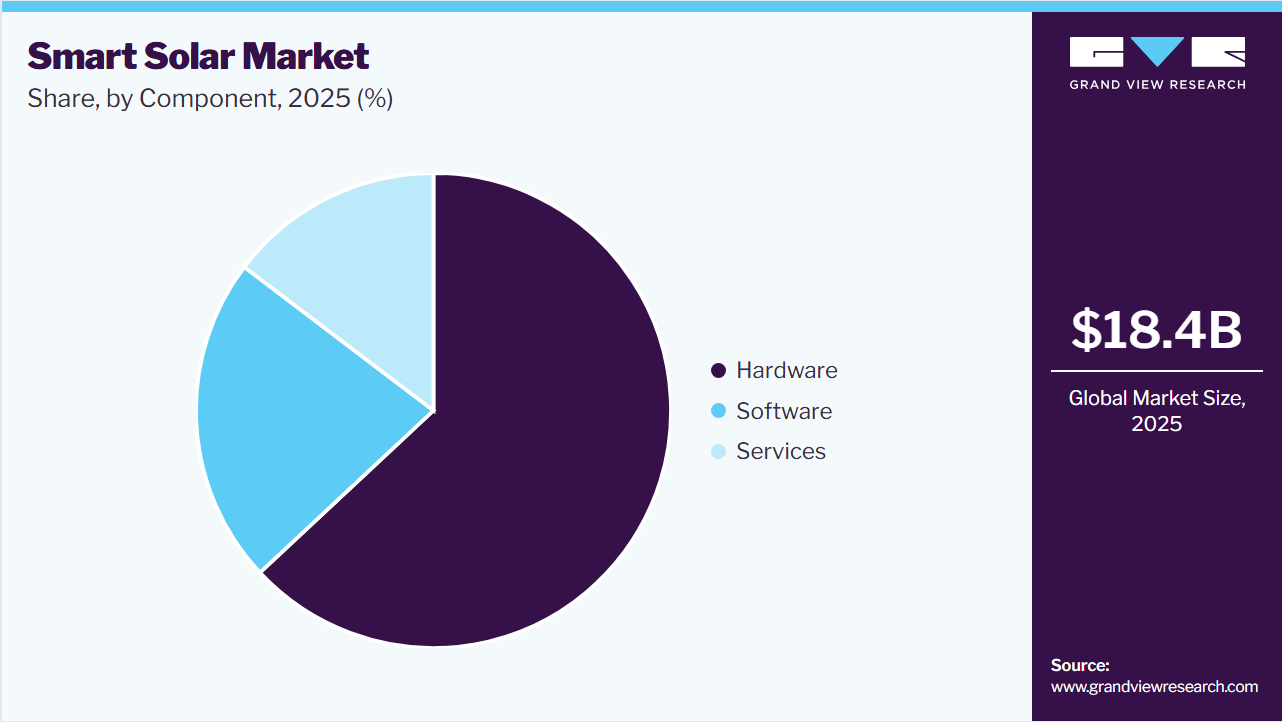
The software segment is expected to register the fastest CAGR of 13.3% during the forecast period, driven by the increasing adoption of AI-powered predictive maintenance and advanced analytics solutions. Software platforms can process real-time telemetry data from IoT-enabled sensors to identify micro-faults, inverter performance degradation, panel shading issues, and other operational anomalies well before physical failures occur. This proactive approach helps reduce unexpected downtime, optimize system performance, extend asset lifespans, and significantly lower operation and maintenance costs, making software an increasingly critical component of smart solar deployments.
Deployment Insights
The on-grid segment dominated the smart solar industry, accounting for the largest revenue share of 67.7% in 2025, due to its ability to seamlessly integrate with existing electricity networks while enabling real-time energy monitoring, demand-response management, and efficient power distribution. The modernization of power grids, the expansion of distributed energy resources, and the increasing adoption of net metering and smart grid technologies have further accelerated the deployment of on-grid smart solar systems across residential, commercial, industrial, and utility-scale applications.
The hybrid systems segment is expected to register the fastest CAGR of 13.4% during the forecast period, driven by the growing demand for reliable, flexible, and resilient energy solutions that combine grid connectivity with battery energy storage. Hybrid smart solar systems enable optimized energy consumption, backup power during grid outages, peak-load management, and greater utilization of self-generated solar electricity. Their ability to enhance energy security, reduce electricity costs, and support the integration of distributed renewable energy resources is accelerating adoption across residential, commercial, industrial, and remote applications.
Regional Insights
The Asia Pacific smart solar market held the largest revenue share of 42.3% in 2025. This was largely driven by strong government support for renewable energy deployment, ambitious net-zero emission targets, and favorable policy frameworks promoting solar adoption. National incentives, subsidies, feed-in tariffs, and smart grid modernization initiatives across countries such as China, Japan, India, South Korea, and Australia have accelerated investments in intelligent solar infrastructure, making smart solar systems increasingly attractive for residential, commercial, industrial, and utility-scale applications. Reflecting the region's growing focus on advanced solar technologies, Huawei launched its FusionSolar 9.0 Smart PV Solution for the Asia-Pacific market in April 2026, introducing next-generation intelligent solar solutions designed to optimize lifecycle costs and enhance the efficiency of renewable energy projects across the region.

China Smart Solar Market Trends
China's smart solar market is shaped by its dominant domestic solar manufacturing ecosystem, widespread deployment of digital power plants, and the integration of AI-driven monitoring and predictive analytics into large-scale photovoltaic projects. The country's focus on maximizing solar asset performance across vast desert-based renewable energy bases and ultra-high-voltage transmission networks is driving demand for intelligent solar management platforms that can optimize generation efficiency, reduce curtailment, and support real-time coordination between solar farms, energy storage systems, and transmission infrastructure.
Europe Smart Solar Market Trends
The Europe smart solar industry is expected to grow at the second-fastest CAGR of 13.1% over the forecast period. The market growth is driven by stringent regulatory mandates aimed at accelerating renewable energy adoption and decarbonization across the region. Policies such as the European Union’s Renewable Energy Directive are encouraging the deployment of advanced solar energy systems capable of real-time monitoring, energy optimization, and grid interaction, thereby accelerating the transition from passive solar installations to actively managed energy networks. In addition, growing investments in smart grids, digital energy infrastructure, and building energy management systems are further supporting the adoption of smart solar technologies across residential, commercial, and industrial sectors.
North America Smart Solar Market Trends
The North America smart solar industry’s growth is supported by rising investments in distributed energy infrastructure, virtual power plants, and utility-led grid modernization programs aimed at improving energy resilience and managing growing electricity demand. The region is witnessing strong adoption of intelligent solar systems integrated with battery storage, demand-response platforms, and advanced energy management software that enable real-time grid balancing and decentralized power generation. Supporting this trend, the U.S. Energy Information Administration (EIA) reported that developers planned to add 64 GW of new utility-scale power capacity in 2025, highlighting the increasing role of smart, grid-connected solar infrastructure in North America’s evolving energy landscape.
The U.S. smart solar industry is supported by the rapid adoption of distributed energy resources, increasing deployment of solar-plus-storage systems, and growing demand for advanced energy management solutions that enhance grid flexibility and resilience. The country's mature solar ecosystem, strong investment in digital energy technologies, and widespread adoption of smart inverters, real-time monitoring platforms, and predictive analytics are accelerating the transition toward more intelligent, interconnected solar energy networks across residential, commercial, and utility-scale applications.
Latin America Smart Solar Market Trends
The smart solar industry in Latin America is driven by favorable government policies, renewable energy incentive programs, and expanding regional energy integration initiatives that support the deployment of advanced solar technologies. Net-metering schemes, distributed generation regulations, and investments in grid modernization are encouraging the adoption of smart solar systems across sectors. Regional frameworks such as the SIEPAC are strengthening cross-border electricity trade and grid connectivity, creating opportunities for intelligent solar solutions that enhance energy management, improve grid stability, and facilitate greater integration of renewable energy resources.
Middle East & Africa Smart Solar Market Trends
The MEA smart solar industry’s growth is driven by the need for advanced solar technologies capable of operating efficiently in harsh environmental conditions characterized by extreme temperatures, high solar irradiance, dust accumulation, and water scarcity. These challenges are increasing demand for ruggedized smart inverters, intelligent monitoring systems, and AI-enabled predictive maintenance solutions that can optimize performance, minimize downtime, and reduce maintenance requirements. The growing deployment of utility-scale solar projects across desert regions is further accelerating the adoption of smart solar technologies equipped with advanced thermal management, dust-resistant designs, and remote diagnostics capabilities to ensure reliable and efficient energy generation.
Key Smart Solar Company Insights
Some of the key players operating in the global smart solar market include Huawei Technologies Co., Ltd. and SUNGROW, among others.
-
Huawei Technologies Co., Ltd. is a leading player in the global smart solar market, known for its smart PV solutions, intelligent string inverters, and AI-driven energy management platforms. The company provides integrated solar and energy storage solutions that enable real-time monitoring, predictive maintenance, and enhanced power generation efficiency. Huawei focuses on digitalizing solar infrastructure through cloud computing, artificial intelligence, and smart grid technologies. Its strong global presence and extensive utility-scale project portfolio have positioned it as one of the world's leading smart solar technology providers.
-
SUNGROW is a prominent participant in the global smart solar industry, recognized for its comprehensive portfolio of solar inverters, energy storage systems, and digital energy solutions. The company develops smart solar technologies that optimize system performance, improve grid integration, and support large-scale renewable energy deployment. The company’s strategy emphasizes innovation in solar-plus-storage systems, intelligent monitoring platforms, and advanced power conversion technologies. Its extensive global project base and strong manufacturing capabilities have established it as one of the largest suppliers of smart solar solutions worldwide.
Key Smart Solar Companies
The following key companies have been profiled for this study on the smart solar market.
-
Canadian Solar
-
Enphase Energy
-
GOODWE
-
Huawei Technologies Co., Ltd.
-
JA SOLAR Technology Co., Ltd.
-
LONGi
-
RISEN ENERGY CO., LTD.
-
SolarEdge Technologies Inc.
-
SUNGROW
-
Trinasolar
Competitive Benchmarking
Operating Strategies
Competitive Edge
Weaknesses
Mature Players: Canadian Solar; Enphase Energy; Huawei Technologies Co., Ltd.; JA SOLAR Technology Co., Ltd.; LONGi; SolarEdge Technologies Inc.; SUNGROW; Trinasolar.
- Focus on expanding integrated smart solar ecosystems combining solar modules, inverters, energy storage, AI-based monitoring, and energy management software.
- Invest heavily in R&D, digitalization, global manufacturing networks, strategic partnerships, and utility-scale project development.
- Strong brand recognition, extensive global distribution networks, large installed base, advanced technology portfolios, economies of scale, robust financial resources, and comprehensive product offerings spanning hardware and software.
- Higher operational complexity, exposure to trade restrictions and regulatory scrutiny, slower adaptation due to large organizational structures, and increasing pressure to maintain margins amid intense competition and price erosion.
Emerging Players: GOODWE; RISEN ENERGY CO., LTD.
- Focus on expanding market share through cost-competitive products, targeted regional expansion, investments in smart inverter technologies, energy storage integration, and strategic partnerships with distributors and project developers.
- Greater operational flexibility, competitive pricing, faster product commercialization, strong growth potential in emerging markets, and the ability to address niche customer requirements.
- Smaller global presence, lower brand recognition, limited financial resources compared to market leaders, narrower product ecosystems, and greater vulnerability to supply chain disruptions and pricing pressure from larger competitors.
Recent Developments
-
In April 2026, Huawei Technologies Co., Ltd. launched its FusionSolar 9.0 Smart PV Solution across the Asia-Pacific region, introducing the industry's first 1000V AC photovoltaic system, advanced grid-forming string inverter technology, and AI-powered lifecycle optimization capabilities. The new platform is designed to improve energy yield, enhance grid stability, and reduce the levelized cost of electricity (LCOE) across utility-scale solar projects. This launch strengthens Huawei’s position in the smart solar market and supports the deployment of more intelligent, efficient, and resilient renewable energy infrastructure.
Smart Solar Market Report Scope
Report Attribute
Details
Market definition
The global Smart Solar market refers to the revenue generated from the deployment of digitally enabled solar energy systems that optimize power generation, management, and distribution across various end-use sectors.
Market size value in 2025
USD 18.4 billion
Market size value in 2026
USD 19.0 billion
Revenue forecast in 2033
USD 44.4 billion
Growth rate
CAGR of 12.9% from 2026 to 2033
Base year for estimation
2025
Historical data
2021 - 2024
Forecast period
2026 - 2033
Quantitative units
Revenue in USD billion, and CAGR from 2026 to 2033
Report coverage
Revenue forecast, competitive landscape, growth factors, and trends
Segments covered
Component, deployment, region
Regional scope
North America; Europe; Asia Pacific; Latin America; Middle East & Africa
Country scope
U.S.; Canada; Mexico; Germany; UK; France; Italy; Spain; China; India;Japan; South Korea; Australia; Brazil; Argentina; Saudi Arabia; UAE; South Africa
Key companies profiled
Canadian Solar; Enphase Energy; GOODWE; Huawei Technologies Co., Ltd.; JA SOLAR Technology Co., Ltd.; LONGi; RISEN ENERGY CO., LTD.; SolarEdge Technologies Inc.; SUNGROW; Trinasolar
Customization scope
Free report customization (equivalent up to 8 analysts working days) with purchase. Addition or alteration to country, regional & segment scope.
Pricing and purchase options
Avail customized purchase options to meet your exact research needs. Explore purchase options
Global Smart Solar Market Report Segmentation
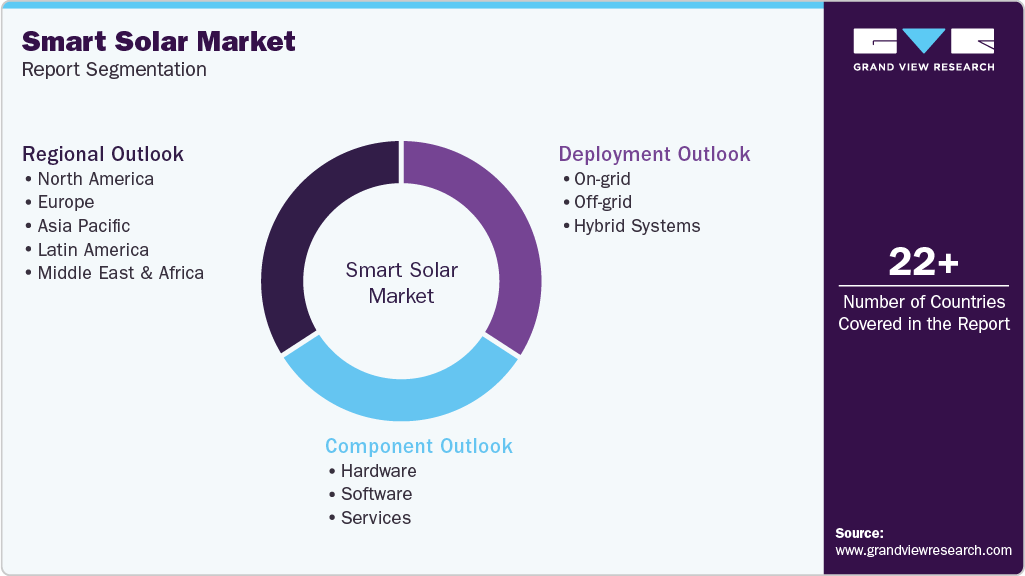
This report forecasts revenue growth at the global, regional & country levels and provides an analysis of the latest industry trends in each of the sub-segments from 2021 to 2033. For this study, Grand View Research has segmented the global smart solar market report based on component, deployment, and region:
-
Component Outlook (Revenue, USD Billion, 2021 - 2033)
-
Hardware
-
Software
-
Services
-
-
Deployment Outlook (Revenue, USD Billion, 2021 - 2033)
-
On-grid
-
Off-grid
-
Hybrid Systems
-
-
Regional Outlook (Revenue, USD Billion, 2021 - 2033)
-
North America
-
U.S.
-
Canada
-
Mexico
-
-
Europe
-
Germany
-
UK
-
Spain
-
Italy
-
France
-
-
Asia Pacific
-
China
-
Japan
-
South Korea
-
India
-
Australia
-
-
Latin America
-
Brazil
-
Argentina
-
-
Middle East & Africa
-
Saudi Arabia
-
UAE
-
South Africa
-
-
Delivered Customizations
This report has been delivered with the following In-depth customizations
Client Request
Customization Delivered
Value Adds
Regional Opportunity Assessment
Country-level analysis was conducted to evaluate smart solar adoption trends based on renewable energy deployment, smart grid modernization initiatives, digital energy infrastructure investments, distributed energy resource expansion, and government clean energy policies across major regions.
Identified high-growth countries and regions with strong demand potential for smart solar solutions, supported by increasing solar capacity additions, grid digitalization programs, energy storage deployment, and investments in intelligent energy management technologies.
Cross-Segmentation Analysis
A detailed assessment was conducted for hardware, software, and services across hybrid system deployments to evaluate adoption trends, operational requirements, technology integration, performance optimization, and deployment suitability across different end-use environments.
Helped identify the most attractive component categories within hybrid smart solar systems based on revenue potential, technology adoption, system efficiency improvements, and long-term market opportunities, supporting strategic investment and product development decisions.
Company Profiling
Apart from the companies profiled in the standard report, additional companies were analyzed. Each profile covered company overview, smart solar technology portfolio, product innovations, digital energy management capabilities, regional presence, strategic partnerships, project developments, and competitive positioning in the smart solar market.
Helped benchmark key market participants and evaluate strategies related to smart inverter deployment, AI-powered energy management, solar-plus-storage integration, grid modernization initiatives, digital monitoring platforms, and expansion of intelligent solar energy ecosystems.
About the Author(s)
Renewable Energy Research Team
Energy & Power · Renewable EnergyThis report was authored by the renewable energy research team at Grand View Research - comprising two research analysts, one senior research analyst, and one industry expert - with specialized expertise in the renewable energy segment of the energy & power industry. All findings are based on proprietary energy & power databases, executive interviews, and regulatory analysis, subject to internal peer review prior to publication.
Last Updated:
Speak to Analyst

Need a Tailored Report?
Customize this report to your needs — add regions, segments, or data points, with 20% free customization.
Or view our licence options:


ISO 9001:2015 & 27001:2022 Certified
We are GDPR and CCPA compliant! Your transaction & personal information is safe and secure. For more details, please read our privacy policy.












