
- Home
- »
- Next Generation Technologies
- »
-
Sovereign AI Market Size, Share & Growth Report, 2026-2033GVR Report cover

Sovereign AI Market (2026 - 2033)
Size, Share & Trends Analysis Report By Component (Hardware, Software, Services), By Deployment Model (Cloud, On premises, Hybrid), By Technology, By End-use, By Region, And Segment Forecasts
Market Size, 2025
$41.3BMarket Estimate, 2026
$48.9BMarket Forecast, 2033
$180.5BCAGR, 2026–2033
20.5%Sovereign AI Market Summary
The global sovereign AI market size was valued at USD 41.3 billion in 2025 and is projected to grow from USD 48.9 billion in 2026 to USD 180.5 billion by 2033, at a CAGR of 20.5% from 2026 to 2033. North America dominated the market, accounting for the largest revenue share of 38.9% in 2025. The market is driven by rising government investments in sovereign AI infrastructure and national AI computing capabilities, increasing demand for data sovereignty and digital sovereignty across critical sectors, expanding deployment of sovereign cloud and secure AI platforms for sensitive workloads, growing focus on AI sovereignty through domestic foundation models and trusted AI ecosystems, and strengthening regulatory frameworks promoting localized AI development, sovereign data centers, and strategic technological independence.
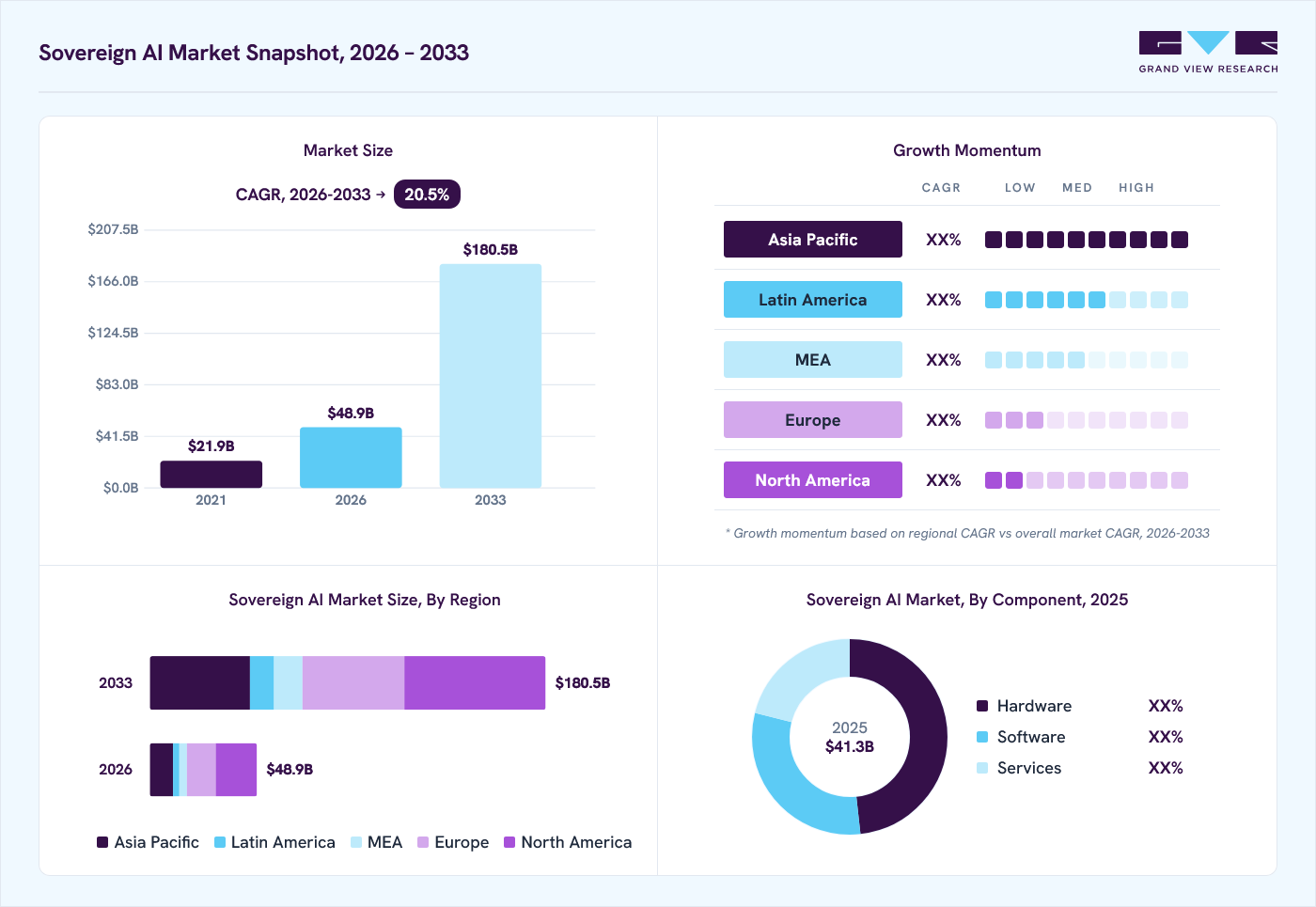 Source: Grand View Research, IR Documents, Primary Interviews, Paid DatabasesTo learn more about this report,
 Download Free Sample Report
Key Market Trends & Insights
- By component: Hardware segment dominated the market, with a revenue share of over 48.0% in 2025.
- By deployment model: On premises segment dominated the market, with a revenue share of over 42% in 2025.
- By technology: Machine learning segment held the largest revenue share in 2025.
- By end use: Government & public sector segment held the largest revenue share in 2025.
Regional Highlights
- Largest regional market: North America (38.9% revenue share, 2025)
- Fastest growing regional market: Asia Pacific (highest CAGR, 2026-2033)
- By country: The U.S. held the largest market share in 2025.
Market Size & Forecast
- Market size in 2025: USD 41.3 Billion
- Estimated market size in 2026: USD 48.9 Billion
- Projected market size by 2033: USD 180.5 Billion
- CAGR (2026-2033): 20.5%
Prism AI by Grand View Research Free to tryAsk a question about the sovereign AI marketTry asking✓Every figure cited from GVR research Prefer the report? Download free sample →
The growing adoption of sovereign cloud platforms is driving secure deployment of AI workloads that require complete jurisdictional control over sensitive information. Organizations are increasingly implementing confidential computing, trusted execution environments, and secure AI platforms to strengthen cybersecurity and operational resilience. Rising demand for protected digital environments is accelerating investment in trusted AI deployment architectures. These capabilities are improving compliance with national data governance requirements while safeguarding critical workloads. The integration of sovereign cloud with advanced AI capabilities is significantly expanding the sovereign AI market.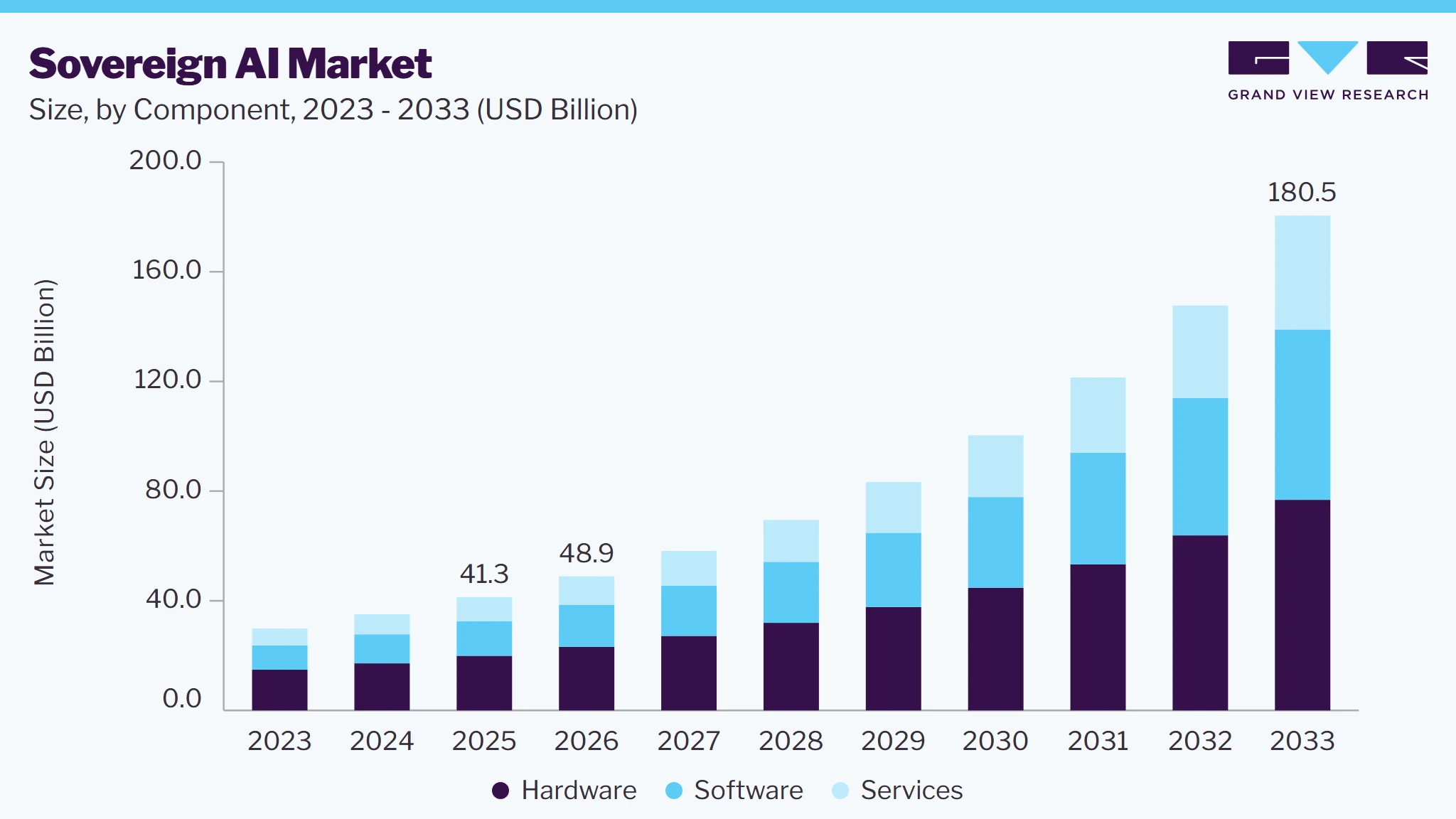 To learn more about this report, Download Free Sample Report
Increasing public-private partnerships are accelerating the commercialization of national AI ecosystems through collaborative investments in infrastructure, research, and advanced technologies. Governments are partnering with domestic technology companies, semiconductor manufacturers, and research institutions to strengthen local AI capabilities. These collaborations are supporting AI chip development, innovation hubs, and next-generation computing resources. Enhanced cooperation is improving technology self-sufficiency while expanding domestic AI value chains. Stronger national collaboration is becoming a major growth engine for the sovereign AI industry.
Increasing deployment of Edge AI is transforming critical infrastructure by enabling secure, real-time intelligence across defense, energy, telecommunications, transportation, and public safety. Governments are investing in distributed AI architectures to support low-latency processing without transferring sensitive information outside national borders. Greater adoption of edge computing is strengthening operational resilience while improving response capabilities for mission-critical environments. The convergence of intelligent edge systems with sovereign computing is expanding high-value AI applications across strategic sectors. This rapid deployment is creating new growth opportunities throughout the sovereign AI market.
Market Dynamics
The sovereign AI market is expanding rapidly as governments prioritize AI sovereignty, digital sovereignty, and secure national AI capabilities to strengthen technological independence and economic resilience. Rising investments in AI infrastructure, sovereign cloud, AI supercomputers, and high-performance computing (HPC) are accelerating the deployment of trusted AI ecosystems across strategic sectors. Evolving data sovereignty regulations, cybersecurity requirements, and AI governance frameworks are encouraging organizations to adopt domestically controlled AI platforms that ensure compliance and operational security. Increasing development of foundation models, large language models (LLMs), AI accelerators, and indigenous semiconductor technologies is strengthening national AI innovation while reducing dependence on external technology providers. As countries continue to integrate secure AI across defense, public administration, healthcare, telecommunications, and critical infrastructure, the sovereign AI market is expected to witness sustained long-term growth.
Governments worldwide are substantially increasing investments in sovereign AI infrastructure to strengthen AI sovereignty, enhance technological independence, and secure critical digital assets. Public funding is expanding AI supercomputers, high-performance computing (HPC) clusters, sovereign data centers, and advanced AI computing facilities to support national AI strategies. Growing emphasis on data sovereignty and secure processing of sensitive government information is accelerating the deployment of domestically controlled AI environments. Strategic investments are also supporting the development of AI accelerators, indigenous semiconductor capabilities, and trusted AI platforms across defense and public administration. These initiatives are establishing sovereign AI infrastructure as a critical pillar of long-term national competitiveness.
Increasing government support is encouraging public-private partnerships that accelerate innovation across the sovereign AI ecosystem. National AI initiatives are expanding research collaborations focused on foundation models, large language models (LLMs), and advanced AI software development. Strong investment pipelines are improving domestic AI manufacturing capabilities while reducing dependence on foreign technology providers. The rapid expansion of secure computing infrastructure is enabling wider adoption across healthcare, telecommunications, financial services, and critical infrastructure. Consequently, sustained public investment continues to represent the primary growth driver for the sovereign AI market.
The deployment of sovereign AI requires significant capital investment in AI infrastructure, advanced computing hardware, and secure digital ecosystems, creating substantial financial barriers for many countries. Establishing high-performance computing (HPC) facilities, sovereign cloud environments, and AI data centers requires extensive funding and long implementation timelines. The high cost of GPUs, AI accelerators, networking equipment, and energy infrastructure further increases project complexity. Limited domestic manufacturing capacity for advanced semiconductors also increases dependence on global supply chains. These financial and technological challenges are slowing large-scale sovereign AI deployment in several emerging economies.
Many organizations also face shortages of specialized AI engineers, semiconductor experts, and cybersecurity professionals required to build and manage sovereign AI environments. Complex integration with legacy IT infrastructure increases deployment costs and extends implementation timelines. Dependence on imported advanced chips exposes national AI programs to geopolitical risks and supply chain disruptions. Maintaining secure AI platforms while complying with evolving regulatory requirements further adds operational complexity. These combined challenges continue to restrain the pace of adoption across the sovereign AI market.
Growing investment in domestic foundation models, large language models (LLMs), and sovereign cloud platforms is creating substantial opportunities across the sovereign AI market. Governments are prioritizing localized AI development to support national languages, regulatory requirements, and culturally relevant AI applications. Rising adoption of trusted AI platforms is expanding opportunities across defense, healthcare, education, financial services, and public administration. Increasing demand for secure AI deployment is encouraging technology providers to develop country-specific AI solutions with stronger governance capabilities. These developments are significantly expanding the commercial potential of sovereign AI technologies.
Rapid advancements in multimodal AI, edge AI, and secure AI software are enabling new applications across mission-critical industries. Public-private collaborations are accelerating innovation in AI infrastructure, AI chips, and sovereign digital platforms. Growing investments in regional AI ecosystems are creating opportunities for domestic software developers, cloud providers, semiconductor companies, and system integrators. The expansion of national AI innovation programs is supporting the commercialization of next-generation sovereign AI solutions. As countries continue strengthening technological self-reliance, these initiatives are expected to unlock significant long-term growth opportunities across the sovereign AI market.
Market Concentration & Characteristics
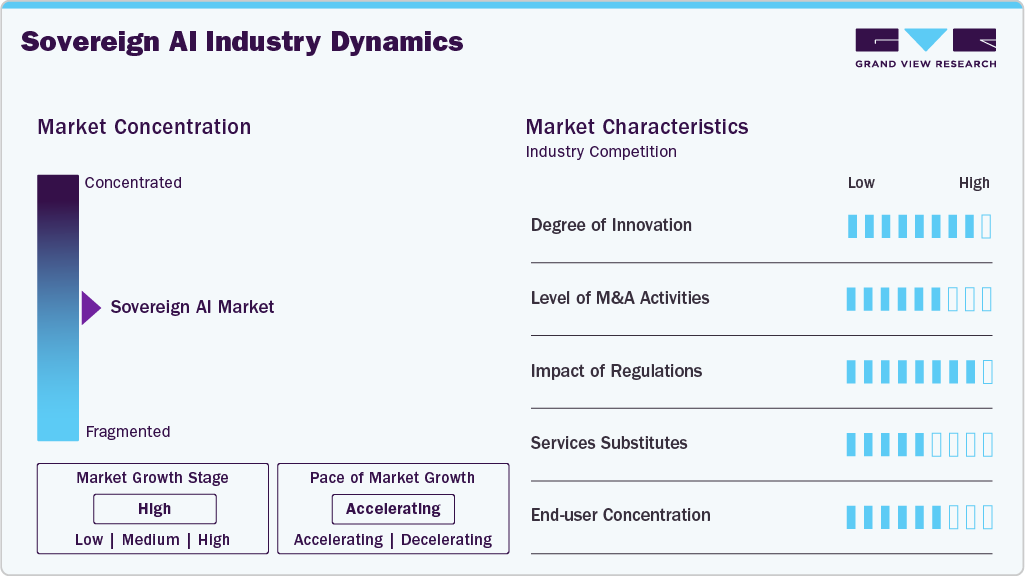
The sovereign AI market is moderately concentrated, with leading technology companies, cloud providers, semiconductor manufacturers, and national AI infrastructure providers competing through integrated AI infrastructure, sovereign cloud, and high-performance computing (HPC) capabilities. Market participants are differentiating their offerings by investing in foundation models, AI accelerators, secure AI software, and end-to-end sovereign AI platforms tailored for government and regulated industries. Strong barriers to entry, including high capital requirements, advanced computing expertise, and semiconductor capabilities, favor established global technology leaders. Strategic collaborations between governments and private technology companies continue to strengthen market concentration while accelerating innovation.
 To learn more about this report, Download Free Sample Report
The market is characterized by rapid technological advancement, increasing AI sovereignty initiatives, and expanding investments in data sovereignty, trusted AI, and secure digital infrastructure. Vendors are prioritizing localized AI development, indigenous semiconductor innovation, and scalable sovereign computing environments to meet evolving regulatory requirements. Growing adoption across defense, public administration, healthcare, telecommunications, and critical infrastructure is expanding the addressable market for sovereign AI solutions. Continuous investment in national AI ecosystems and secure AI deployment frameworks is expected to intensify competition and support long-term market growth.
Analyst Perspective
The sovereign AI market is entering a transformative growth phase as countries increasingly prioritize AI resilience, strategic autonomy, and secure digital innovation to strengthen national competitiveness. Accelerating investments in AI factories, sovereign compute, trusted AI, and confidential computing are reshaping the development of next-generation national AI ecosystems. The growing convergence of edge AI, federated learning, AI orchestration, and secure inference platforms is enabling scalable deployment across mission-critical environments while maintaining jurisdictional control. Increasing emphasis on AI governance, digital public infrastructure, and domestic innovation ecosystems is creating new opportunities for technology providers, semiconductor vendors, and cloud infrastructure companies. As sovereign AI becomes a strategic pillar of economic security and technological leadership, sustained investments in localized AI capabilities are expected to accelerate long-term market expansion and competitive differentiation
Component Insights
Based on component, the hardware segment dominated the market, accounting for over 48% of global revenue in 2025, driven by rising investments in AI supercomputers, high-performance computing (HPC) infrastructure, and sovereign AI data centers. Governments are accelerating the procurement of GPUs, AI accelerators, and advanced computing systems to strengthen national AI capabilities and reduce reliance on foreign technology providers. Growing emphasis on domestic semiconductor manufacturing and secure computing infrastructure is further supporting hardware demand across strategic industries. The increasing deployment of dedicated AI infrastructure across defense, public administration, healthcare, and research institutions is reinforcing market expansion. As countries continue to prioritize technological sovereignty and secure AI ecosystems, the hardware segment is expected to maintain its leading position throughout the forecast period.
The software segment is expected to see significant growth over the forecast period, owing to the increasing adoption of sovereign AI platforms, foundation models, and AI orchestration software across government and regulated industries. Rising demand for secure AI applications, model governance, and AI lifecycle management is accelerating software deployments within national AI ecosystems. Governments are investing in domestically developed large language models (LLMs), multimodal AI, and AI development frameworks to strengthen technological independence and regulatory compliance. Growing emphasis on AI security, data sovereignty, and responsible AI governance is further driving demand for advanced software solutions. As countries continue to expand indigenous AI capabilities, the software segment is expected to register the fastest growth throughout the forecast period.
Deployment Model Insights
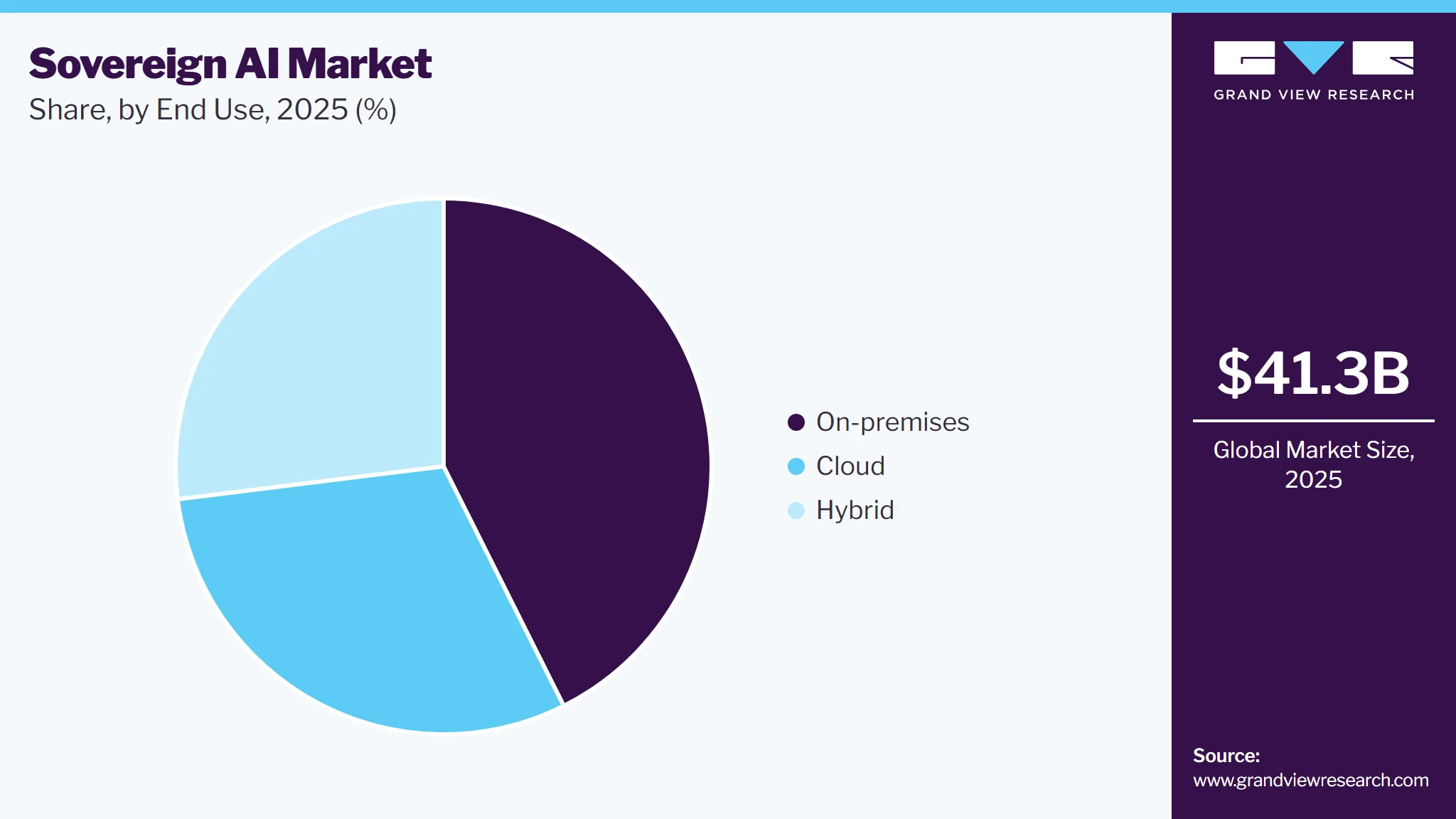
Based on the deployment model, the on-premises segment accounted for over 42% of market revenue in 2025, driven by the growing need for complete data control, national security, and regulatory compliance across government and critical infrastructure organizations. Organizations are prioritizing dedicated AI environments to protect classified information and maintain full ownership of sensitive datasets and AI models. The growing deployment of private computing environments is enabling the secure processing of mission-critical workloads without relying on external cloud providers. Growing investments in sovereign digital infrastructure are further strengthening adoption across defense, intelligence, and public sector institutions. The ability to ensure operational resilience, privacy, and jurisdictional control is expected to sustain the segment's leadership over the forecast period.
The cloud segment is projected to witness significant growth over the forecast period, driven by the increasing adoption of sovereign cloud platforms that enable scalable and secure AI deployment while maintaining jurisdictional control over sensitive data. Growing demand for AI-as-a-Service (AIaaS), hybrid cloud architectures, and cloud-native AI development environments is accelerating adoption among enterprises and governments. Organizations are leveraging cloud-based AI platforms to improve operational agility, optimize infrastructure costs, and accelerate model development and deployment. Continuous advancements in confidential computing, zero-trust security, and sovereign cloud frameworks are enhancing trust in cloud-hosted AI workloads. As governments and enterprises expand their secure digital transformation initiatives, cloud deployment is expected to become the fastest-growing segment in the sovereign AI market.
Technology Insights
Based on technology, the machine learning segment accounted for a significant market revenue share of over 28% in 2025, driven by the accelerating adoption of machine learning algorithms for high-value government and enterprise applications. Growing investments in predictive analytics, intelligent automation, and advanced decision intelligence are strengthening the deployment of ML across defense, public administration, healthcare, and financial services. The increasing availability of sovereign datasets and the expansion of domestic AI development capabilities are enhancing model accuracy and operational performance. Organizations are prioritizing ML-powered solutions to improve resource optimization, risk assessment, and mission-critical decision-making while maintaining regulatory compliance. Technology’s maturity, scalability, and broad applicability continue to position machine learning as the leading technology segment within the sovereign AI market.
The generative AI segment is projected to experience substantial growth, owing to the increasing development of sovereign large language models (LLMs), foundation models, and domain-specific AI solutions tailored to national priorities. Governments are accelerating investments in indigenous generative AI capabilities to strengthen AI sovereignty, protect strategic intellectual property, and reduce dependence on foreign AI platforms. Rising demand for secure content generation, multilingual AI assistants, code generation, and public-sector automation is driving adoption across regulated industries. Continuous advancements in multimodal AI, model fine-tuning, and sovereign AI infrastructure are enabling more accurate, secure, and compliant AI deployments. The growing emphasis on localized AI innovation and trusted generative AI ecosystems is expected to accelerate the segment's growth throughout the forecast period.
End Use Insights
Based on end use, the government and public segment accounted for the largest market revenue share of over 35% in 2025, driven by the increasing adoption of sovereign AI for national security, public administration, defense modernization, and digital governance initiatives. Rising investments in AI infrastructure, secure data platforms, and mission-critical intelligence systems are accelerating deployment across government agencies. Public institutions are prioritizing data sovereignty, regulatory compliance, and trusted AI environments to safeguard sensitive national information and strengthen operational resilience. Expanding implementation of AI-powered services for citizen engagement, policy planning, cybersecurity, and emergency response is further supporting market growth. Sustained government funding and long-term national AI strategies continue to position the public sector as the leading end-use segment in the sovereign AI market.
 To learn more about this report, Download Free Sample Report
The telecommunications segment is expected to experience substantial growth during the forecast period, primarily due to the increasing integration of sovereign AI into 5G networks, network automation, and telecommunications infrastructure. Telecom operators are investing in AI-powered network optimization, predictive maintenance, and cybersecurity solutions to improve service reliability and operational efficiency while maintaining national control over critical communications infrastructure. Rising demand for secure processing of network data and compliance with data localization regulations is accelerating the adoption of domestically hosted AI platforms. Continuous expansion of edge computing and intelligent network management is further strengthening AI deployment across the telecom sector. The growing emphasis on resilient digital infrastructure and secure connectivity is expected to position telecommunications as one of the fastest-growing end-use segments in the sovereign AI market.
Regional Insights
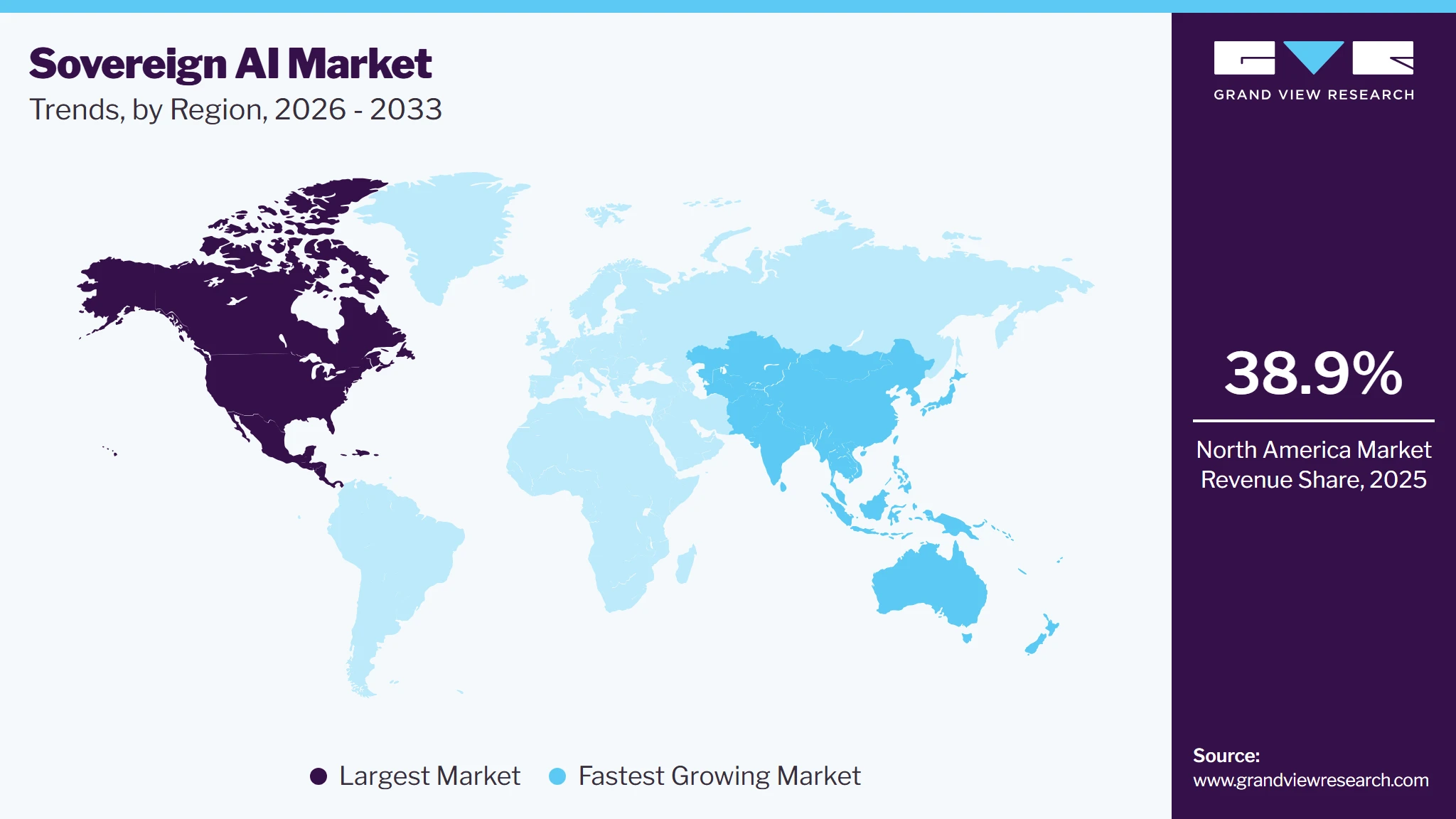
North America sovereign AI market accounted for the largest revenue share of 38.9% in 2025, driven by significant investments in AI infrastructure, sovereign cloud, and high-performance computing (HPC) to strengthen national AI capabilities. Strong government support for AI sovereignty, expanding data sovereignty regulations, and the presence of leading AI technology providers are accelerating the deployment of secure AI solutions across defense, public administration, and critical infrastructure. Continuous innovation, advanced digital infrastructure, and sustained funding for domestic AI development continue to reinforce North America's leadership in the sovereign AI market.
 To learn more about this report, Download Free Sample Report
U.S. Sovereign AI Market Trends
The U.S. Sovereign AI market is gaining momentum, driven by increasing federal investments in AI infrastructure, sovereign cloud, and high-performance computing (HPC) to strengthen national technological leadership. Growing emphasis on AI sovereignty, data sovereignty, and secure AI deployment across defense, intelligence, and critical infrastructure is accelerating the adoption of domestically controlled AI platforms. Continuous advancements in semiconductor manufacturing, foundation models, and public-private AI partnerships are further reinforcing the country's position as a global leader in the sovereign AI market.
Europe Sovereign AI Market Trends
The Europe Sovereign AI market is witnessing robust growth, driven by increasing investments in digital sovereignty, sovereign cloud, and trusted AI infrastructure to strengthen regional technological independence. Expanding implementation of the EU AI Act, growing emphasis on data sovereignty, and rising demand for secure AI deployment across government, healthcare, and critical infrastructure are accelerating market adoption. Continuous investments in indigenous foundation models, advanced computing capabilities, and cross-border AI collaborations are reinforcing Europe's position as a key growth region in the sovereign AI market.
Asia Pacific Sovereign AI Market Trends
The Asia Pacific Sovereign AI market is growing rapidly, driven by increasing government investments in national AI strategies, AI infrastructure, and sovereign data centers to accelerate domestic AI capabilities. Rising demand for data sovereignty, localized foundation models, and secure AI deployment across government, defense, telecommunications, and smart city initiatives is fueling market expansion. Continuous advancements in high-performance computing (HPC), semiconductor manufacturing, and public-private collaborations are strengthening the region's position as one of the fastest-growing markets for sovereign AI.
Key Sovereign AI Market Company Insights
Some key companies in the sovereign AI industry are NVIDIA, Microsoft, Amazon Web Services (AWS), Alphabet (Google), IBM, and Oracle, and among others.
-
Microsoft operates in the sovereign AI market through Azure Sovereign Cloud, Azure AI services, and secure cloud infrastructure designed for governments and regulated industries. The company specializes in sovereign cloud environments, trusted AI services, data residency, compliance, and enterprise AI deployments that meet national regulatory requirements.
-
Amazon Web Services (AWS) provides sovereign AI capabilities through AWS Sovereign Cloud, dedicated cloud regions, AI and machine learning services, and secure computing infrastructure for public sector and regulated organizations. The company specializes in scalable cloud-based AI infrastructure, sovereign data hosting, secure AI workloads, and compliance-driven AI deployments.
Key Sovereign AI Market Companies
The following key companies have been profiled for this study on the sovereign AI market
-
NVIDIA
-
Microsoft
-
Amazon Web Services (AWS)
-
Alphabet (Google)
-
IBM
-
Oracle
-
Hewlett Packard Enterprise (HPE)
-
Dell Technologies
-
Cisco Systems
-
Intel
-
AMD
-
Lenovo
Competitive Benchmarking
Operating Strategies
Competitive Edge
Weaknesses
Mature Players: Microsoft, Amazon Web Services (AWS), Alphabet (Google), IBM, Oracle
- Mature players focus on expanding sovereign AI infrastructure, sovereign cloud, AI platforms, high-performance computing (HPC), and foundation model capabilities through strategic government partnerships and enterprise AI deployments.
- Their competitive advantage lies in established cloud ecosystems, advanced AI research, large-scale computing infrastructure, extensive enterprise customer bases, and comprehensive AI software portfolios.
- These companies face challenges related to data residency regulations, complex government procurement processes, high infrastructure investment requirements, and increasing geopolitical and regulatory scrutiny.
Emerging Players: NVIDIA, Hewlett Packard Enterprise (HPE), Dell Technologies, Cisco Systems, Lenovo
- Emerging players focus on delivering AI servers, AI accelerators, GPU infrastructure, sovereign data center solutions, edge AI platforms, and integrated AI hardware for national AI initiatives.
- Their strength comes from specialized infrastructure expertise, strong hardware innovation, strategic technology partnerships, flexible deployment capabilities, and expanding sovereign AI solution portfolios.
- Limited end-to-end sovereign AI software capabilities, dependence on enterprise and government procurement cycles, and increasing competition from integrated cloud providers may constrain broader market expansion.
Recent Developments
-
In July 2026, Cognizant and Domyn announced a strategic partnership to deliver sovereign AI solutions across the EMEA region for organizations operating in highly regulated industries. The collaboration combines Domyn's end-to-end sovereign AI infrastructure with Cognizant's enterprise integration and AI implementation expertise to enable secure, compliant AI deployments in on-premises and sovereign cloud environments. The partnership is designed to help enterprises maintain data sovereignty while meeting European regulatory requirements through governed AI models and infrastructure. This initiative is expected to accelerate the adoption of sovereign AI across government, financial services, and other regulated sectors throughout the EMEA region.
-
In May 2026, Sunrise and PHOENIQS announced an exclusive strategic partnership to deliver sovereign AI solutions developed, hosted, and operated entirely within Switzerland for business customers. The collaboration combines PHOENIQS' sovereign AI infrastructure with Sunrise's enterprise network to provide secure, compliant AI services without relying on foreign cloud providers. The offering is tailored for regulated industries, including finance, healthcare, public administration, and energy, ensuring data sovereignty and compliance with Swiss legal requirements. Through this partnership, the companies aim to accelerate the adoption of sovereign AI across Switzerland by enabling enterprises to deploy trusted AI solutions while retaining full control over their data and infrastructure.
-
In March 2026, VEON and MeetKai expanded their strategic collaboration to explore sovereign AI infrastructure partnerships across VEON's operating markets through a memorandum of understanding signed at Mobile World Congress. The partnership combines VEON's regional digital infrastructure and data center capabilities with MeetKai's sovereign AI platform, local language models, and AI applications to enable secure, locally governed AI deployments. The initiative focuses on supporting data residency, regulatory compliance, and culturally relevant AI services for both enterprise and consumer applications across emerging markets. Through this collaboration, the companies aim to accelerate the deployment of sovereign AI ecosystems while strengthening national AI capabilities and localized digital innovation.
Sovereign AI Market Report Scope
Report Attribute
Details
Market size in 2025
USD 41.3 billion
Estimated market size in 2026
USD 48.9 billion
Projected market size by 2033
USD 180.5 billion
Growth rate
CAGR of 20.5% from 2026 to 2033
Base year for estimation
2025
Actual data
2021 - 2024
Forecast period
2026 - 2033
Quantitative units
Revenue in USD million/million and CAGR from 2026 to 2033
Report coverage
Revenue forecast, company ranking, competitive landscape, growth factors, and trends
Segments covered
Component, deployment model, technology, end use, region
Regional scope
North America; Europe; Asia Pacific; Latin America; MEA
Country scope
U.S.; Canada; Mexico; UK; Germany; France; China; Japan; India; South Korea; Australia; Brazil; KSA; UAE; South Africa
Key companies profiled
NVIDIA; Microsoft; Amazon Web Services (AWS); Alphabet (Google); IBM; Oracle; Hewlett Packard Enterprise (HPE); Dell Technologies; Cisco Systems; Intel; AMD; Lenovo
Customization scope
Free report customization (equivalent up to 8 analysts working days) with purchase. Addition or alteration to country, regional & segment scope.
Pricing and purchase options
Avail customized purchase options to meet your exact research needs. Explore purchase options
Global Sovereign AI Market Report Segmentation
This report forecasts revenue growth at global, regional, and country levels and provides an analysis of the latest industry trends in each of the sub-segments from 2021 to 2033. For this study, Grand View Research has segmented the global sovereign AI market report based on component, deployment model, technology, end use, and region.
-
Component Outlook (Revenue, USD Million, 2021 - 2033)
-
Hardware
-
Software
-
Services
-
-
Deployment Model Outlook (Revenue, USD Million, 2021 - 2033)
-
Cloud
-
On premises
-
Hybrid
-
-
Technology Outlook (Revenue, USD Million, 2021 - 2033)
-
Generative AI
-
Multimodal AI
-
Machine Learning
-
Computer Vision
-
Natural Language Processing (NLP)
-
Others
-
-
End Use Outlook (Revenue, USD Million, 2021 - 2033)
-
Government & Public Sector
-
Defense & Intelligence
-
Healthcare & Life Sciences
-
BFSI
-
Telecommunications
-
Manufacturing & Industrial
-
Energy & Utilities
-
Others
-
-
Regional Outlook (Revenue, USD Million, 2021 - 2033)
-
North America
-
U.S.
-
Canada
-
Mexico
-
-
Europe
-
UK
-
Germany
-
France
-
-
Asia Pacific
-
China
-
Japan
-
India
-
South Korea
-
Australia
-
-
Latin America
-
Brazil
-
-
Middle East and Africa (MEA)
-
KSA
-
UAE
-
South Africa
-
-
Research Methodology
The sovereign AI market figures in this report are based on a proven research process that combines executive interviews with secondary research from proprietary databases, company filings, and recognized regulatory and institutional sources. Market size is built through value-chain sizing - reconciling supply-side and demand-side estimates - and triangulated with bottom-up and top-down approaches. Every estimate passes multiple levels of expert validation before publication, with each sovereign AI segment quantified using the revenue-capture definitions in the table below.
Segment Definition
Segment - Component
Revenue capture definition
Hardware
The hardware segment comprises physical computing infrastructure such as AI accelerators, GPUs, CPUs, AI servers, networking equipment, storage systems, and high-performance computing (HPC) resources used to develop and deploy sovereign AI. It includes dedicated infrastructure that enables secure AI training, inference, and data processing within national jurisdictions.
Software
This segment includes sovereign AI platforms, foundation models, AI development frameworks, orchestration software, analytics tools, and AI governance solutions. It covers software applications that enable secure AI development, deployment, management, and compliance across sovereign environments.
Services
Services include consulting, system integration, deployment, managed services, maintenance, training, and technical support associated with sovereign AI implementations. These services assist organizations in designing, operating, and optimizing secure AI ecosystems throughout their lifecycle.
Segment - Deployment Model
Revenue capture definition
Cloud
The cloud segment consists of sovereign cloud environments that provide scalable AI computing, storage, and application hosting while ensuring compliance with national data regulations. It enables secure access to AI capabilities through cloud-based infrastructure managed within approved jurisdictions.
On-premises
This on-premises segment covers AI infrastructure deployed within an organization's own facilities or government-controlled data centers. It provides maximum control over sensitive data, AI models, and computing resources for highly regulated environments.
Hybrid
Hybrid segment combines on-premises infrastructure with sovereign cloud resources to balance security, scalability, and operational flexibility. It enables organizations to distribute AI workloads according to performance, compliance, and data sensitivity requirements.
Segment - Technology
Revenue capture definition
Generative AI
The generative AI segment includes AI technologies capable of generating text, images, code, audio, video, and other digital content using foundation models and large language models (LLMs). It supports content creation, automation, simulation, and knowledge generation within sovereign AI environments.
Multimodal AI
This multimodal AI segment encompasses AI systems capable of processing and integrating multiple data formats, including text, images, audio, video, and sensor data. It enables richer contextual understanding and more advanced decision-making across complex sovereign AI applications.
Machine Learning
Machine learning refers to AI algorithms that learn from structured and unstructured data to generate predictions, classifications, recommendations, and automated decisions. It forms the core analytical technology supporting intelligent automation and data-driven operations.
Computer Vision
The computer vision segment includes AI technologies that analyze and interpret images, videos, and visual information captured from cameras and sensors. It supports applications such as surveillance, defense, industrial inspection, healthcare imaging, and autonomous systems.
Natural Language Processing (NLP)
This Natural Language Processing (NLP) segment comprises AI technologies that enable machines to understand, interpret, generate, and respond to human language. It supports multilingual communication, document analysis, conversational AI, and intelligent search capabilities.
Others
The others segment includes emerging AI technologies such as reinforcement learning, knowledge graphs, symbolic AI, federated learning, explainable AI, and other specialized AI techniques. These technologies complement core AI capabilities across diverse sovereign AI use cases.
Segment - End Use
Revenue capture definition
Government and Public Sector
The government and public sector segment comprise sovereign AI solutions deployed by government agencies, public institutions, and regulatory bodies to improve public services, digital governance, cybersecurity, and administrative operations. It supports secure AI adoption while maintaining national control over sensitive information.
Defense and Intelligence
This defense and intelligence segment includes AI applications used for military operations, intelligence analysis, surveillance, cybersecurity, command systems, and national security missions. It focuses on highly secure AI capabilities that support strategic defense objectives.
Healthcare and Life Sciences
Healthcare and life sciences cover sovereign AI applications used for medical diagnostics, clinical decision support, biomedical research, drug discovery, healthcare administration, and population health management. The segment emphasizes secure handling of sensitive health and research data.
BFSI
The BFSI segment includes banks, financial institutions, insurers, and payment service providers utilizing sovereign AI for fraud detection, risk management, compliance, customer intelligence, and operational automation. It prioritizes regulatory compliance, financial data protection, and secure AI deployment.
Telecommunications
This telecommunications segment encompasses telecom operators and communication service providers deploying sovereign AI for network optimization, predictive maintenance, cybersecurity, customer service, and intelligent network management. It supports secure digital communication infrastructure and resilient network operations.
Manufacturing and Industrial
Manufacturing and industrial includes sovereign AI solutions used for production optimization, predictive maintenance, quality inspection, supply chain management, robotics, and industrial automation. The segment focuses on improving operational efficiency while protecting industrial data and intellectual property.
Energy & Utilities
The Energy & Utilities segment consists of AI deployments across electricity, oil & gas, renewable energy, water, and utility operations to optimize asset performance, grid management, predictive maintenance, and energy forecasting. It supports secure management of critical national infrastructure.
Others
This others segment includes sovereign AI deployments across sectors such as retail, education, transportation, agriculture, media, logistics, aerospace, and other industries adopting secure AI technologies. It captures emerging commercial applications beyond the primary end-use industries.
Estimation Model
Layer Name
Key Questions
Description
National AI Readiness & Sovereignty Demand Layer
Who creates demand for sovereign AI?
Identify governments, defense organizations, public agencies, regulated industries, and critical infrastructure operators driving demand for sovereign AI. This layer evaluates AI sovereignty initiatives, data sovereignty regulations, national AI strategies, digital transformation programs, and cybersecurity priorities that establish the market demand base.
Sovereign AI Infrastructure & Compute Investment Layer
Who invests in sovereign AI infrastructure?
Assess investments in AI supercomputers, high-performance computing (HPC), AI data centers, sovereign cloud, AI accelerators, networking infrastructure, and domestic semiconductor capabilities. This layer measures infrastructure spending that enables secure and scalable sovereign AI deployment.
AI Platform, Model & Solution Adoption Layer
Who deploys sovereign AI platforms and technologies?
Measure the adoption of foundation models, large language models (LLMs), machine learning, generative AI, AI governance software, and secure AI platforms across government, defense, healthcare, BFSI, telecommunications, manufacturing, and energy sectors. This layer captures enterprise and public sector implementation of sovereign AI technologies.
Sovereign AI Market Revenue Realization Layer
How much revenue is generated through sovereign AI adoption?
Estimate market revenue generated from hardware, software, services, sovereign cloud platforms, AI infrastructure, AI platform licensing, implementation services, managed services, and maintenance contracts. This layer quantifies revenue across all deployment models, technologies, and end-use industries within the sovereign AI market.
Customization Table
This report has been delivered with the following In-depth customizations
Client Request
Customization Delivered
Value Adds
Sovereign AI Infrastructure & National AI Capability Assessment
Analyzed sovereign AI infrastructure, AI supercomputers, high-performance computing (HPC), sovereign cloud, AI data centers, AI accelerators, and domestic semiconductor developments across key markets.
Helps identify infrastructure investment priorities, national AI readiness, technology gaps, and long-term growth opportunities within the sovereign AI market.
Industry-Specific Sovereign AI Adoption Analysis
Assessed the deployment of sovereign AI across government & public sector, defense & intelligence, healthcare, BFSI, telecommunications, manufacturing, energy & utilities, and other regulated industries.
Provides insights into sector-wise adoption trends, investment potential, regulatory requirements, and commercialization opportunities to support strategic market expansion.
Foundation Models, Sovereign Cloud & Next-Generation AI Opportunity Assessment
Evaluated adoption of foundation models, large language models (LLMs), generative AI, sovereign cloud platforms, AI governance solutions, and secure AI deployment technologies across national AI ecosystems.
Supports technology roadmap development, product innovation, partnership strategies, and investment decisions in high-growth sovereign AI segments.
Frequently Asked Questions About This Report
The global sovereign AI market size was estimated at USD 41.3 billion in 2025 and is expected to reach USD 48.9 billion in 2026
The global sovereign AI market is expected to grow at a compound annual growth rate of 20.5% from 2026 to 2033, reaching USD 180.5 billion by 2033.
The hardware segment led with a 48.0% revenue share in 2025, while software is the fastest-growing segment.
North America dominated the sovereign AI market, with a 38.9% share in 2025, driven by substantial government investments in national AI infrastructure, the rapid deployment of sovereign cloud and secure data centers, strong public-private collaborations, and the presence of leading AI technology providers.
Key factors that are driving the market growth include increasing government investments in sovereign AI infrastructure, rising demand for data sovereignty and regulatory compliance, expansion of secure cloud and AI data center infrastructure, growing public-private partnerships for AI innovation, and increasing adoption of AI across defense and public sector applications.
Some key players operating in the sovereign AI market include NVIDIA, Microsoft, Amazon Web Services (AWS), Alphabet (Google), IBM, Oracle, Hewlett Packard Enterprise (HPE), Dell Technologies, Cisco Systems, Intel, AMD, and Lenovo.
Asia Pacific is the fastest-growing region over the forecast period.
The On-premises segment led with over 42.0% revenue share in 2025, while the cloud segment is the fastest-growing.
The machine learning segment led with over 28.0% revenue share in 2025, while generative AI is the fastest-growing segment.
About the Author(s)
Next Generation Technologies Research Team
Technology · Next Generation TechnologiesThis report was authored by the next generation technologies research team at Grand View Research - comprising two research analysts, one senior research analyst, and one industry expert - with specialized expertise in the next generation technologies segment of the technology industry. All findings are based on proprietary technology databases, executive interviews, and regulatory analysis, subject to internal peer review prior to publication.
Last Updated:
Speak to Analyst

Customize this report to your needs - add regions, segments, or data points, with 20% free customization.
Or view our licence options:


ISO 9001:2015 & 27001:2022 Certified
We are GDPR and CCPA compliant! Your transaction & personal information is safe and secure. For more details, please read our privacy policy.


