
- Home
- »
- Advanced Interior Materials
- »
-
Technical Textiles Market Size, Share Report, 2026-2033GVR Report cover
![Technical Textile Market (2026 - 2033)Report]()
Technical Textile Market (2026 - 2033)
Size, Share & Trends Analysis Report By Manufacturing (3D Weaving, Thermo-forming, 3D Knitting), By End Use (Agro Textiles, Hometech Textiles), By Region (North America, Europe, Asia Pacific, Middle East & Africa), and Segment Forecasts
Market Size, 2025
$215.6BMarket Estimate, 2026
$225.6BMarket Forecast, 2033
$315.8BCAGR, 2026–2033
4.9%Technical Textile Market Summary
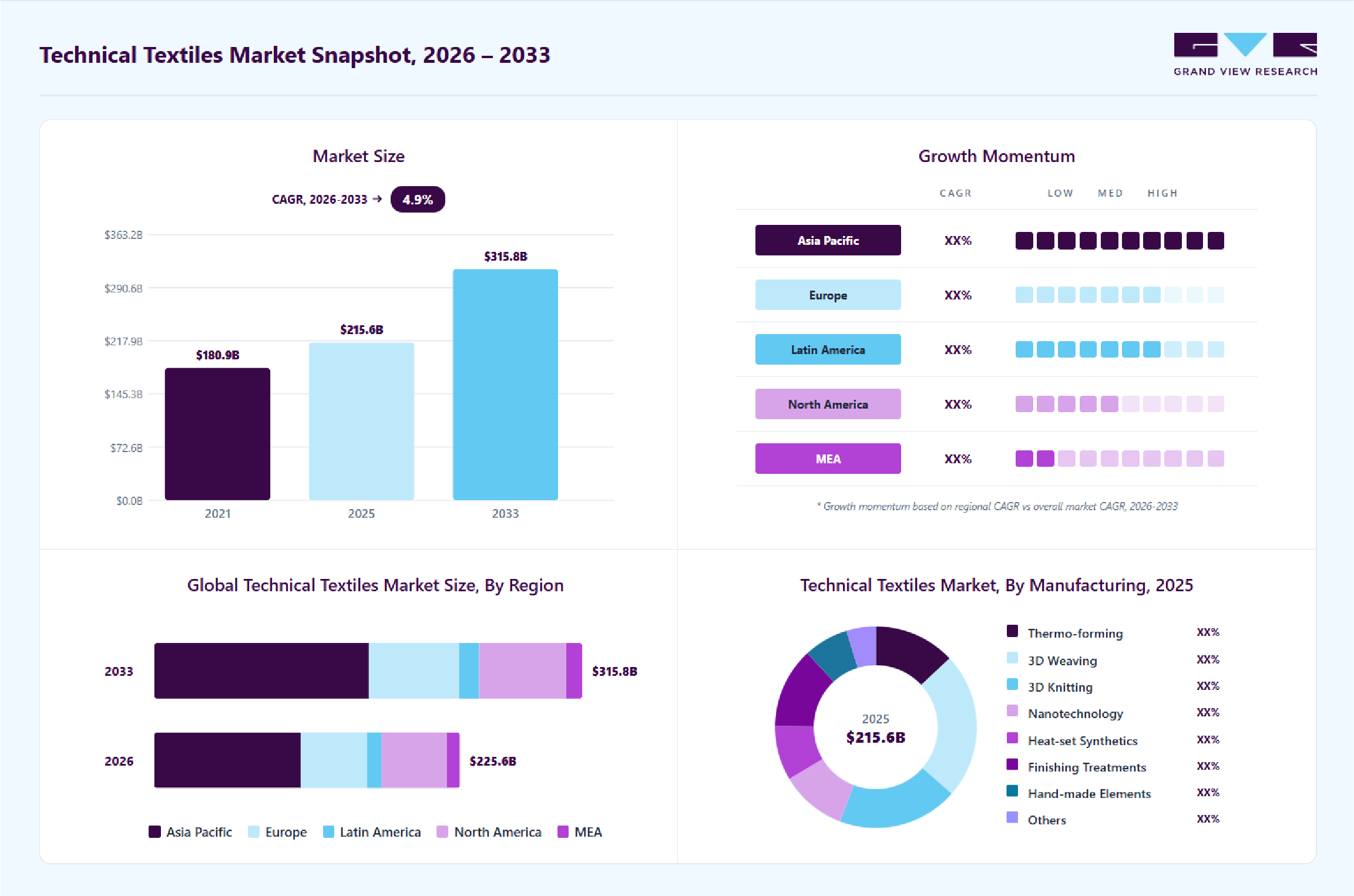
The global technical textiles market size was valued at USD 215.6 billion in 2025 and is projected to grow from USD 225.6 billion in 2026 to USD 315.8 billion by 2033, at a CAGR of 4.9% from 2026 to 2033. Asia Pacific dominated the global market with the largest revenue share of 47.6% in 2025. The demand for technical textiles is increasing as they expand across industries such as automotive, healthcare, construction, agriculture, defense, packaging, and industrial manufacturing.
Key Market Trends & Insights
- By manufacturing: 3D Weaving segment held the largest market share of 23.4% in 2025.
- By end use: Hometech Textile segment dominated the market and accounted for 20.0% of the revenue share in 2025.
Regional Highlights
- Largest regional market: Asia Pacific (47.6% revenue share, 2025)
- By country: The China held the largest market share in 2025.
Market Size & Forecast
- Market size in 2025: USD 215.6 Billion
- Estimated market size in 2026: USD 225.6 Billion
- Projected market size by 2033: USD 315.8 Billion
- CAGR (2026-2033): 4.9%
These textiles offer superior performance characteristics, including durability, lightweight structure, flame resistance, chemical resistance, and enhanced tensile strength compared to conventional textiles. Rapid industrialization and infrastructure development globally are accelerating the adoption of geotextiles, protective textiles, and construction fabrics. In the healthcare sector, rising demand for medical disposables, surgical gowns, PPE kits, wound care materials, and hygiene products is significantly supporting market growth. In addition, increasing awareness of worker safety and industrial protection standards is driving the utilization of protective technical textiles across hazardous industrial environments.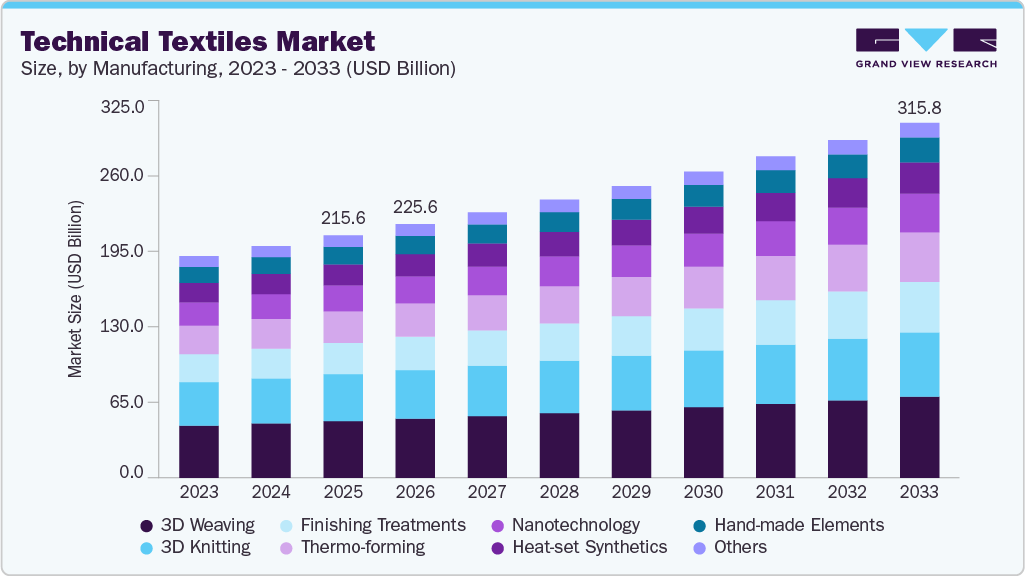
The automotive industry is another major contributor to market growth, as manufacturers increasingly incorporate technical textiles into airbags, seat belts, insulation materials, upholstery, tire cords, and lightweight composites to improve fuel efficiency and passenger safety. Growing electric vehicle production is further stimulating the use of advanced textile composites and thermal insulation materials.
Rising urbanization and smart city projects are also increasing the demand for construction-related technical textiles such as roofing membranes, tarpaulins, geotextiles, and reinforced fabrics. In parallel, sustainability concerns are encouraging industries to adopt recyclable, bio-based, and energy-efficient textile solutions, further boosting market expansion globally.
The technical textiles market is witnessing significant innovation with the development of smart textiles textiles and intelligent fabric systems integrated with sensors, conductive fibers, and electronic components. These smart textiles are increasingly used in healthcare monitoring, sportswear, military uniforms, and wearable technology applications.
Advancements in nanotechnology are enabling the production of fabrics with enhanced antibacterial, UV-resistant, water-repellent, and self-cleaning properties. Additionally, the increasing adoption of lightweight composite textiles in automotive and aerospace industries is improving fuel efficiency and structural performance. Manufacturers are also investing heavily in automation and digital textile manufacturing technologies to improve productivity and product customization.
Market Dynamics
The technical textiles market is experiencing significant growth due to increasing demand for high-performance, functional, and application-specific textile materials across industries such as automotive, construction, healthcare, agriculture, industrial manufacturing, defense, and transportation. Unlike conventional textiles, technical textiles are engineered to deliver specific performance characteristics including durability, strength, protection, filtration efficiency, thermal resistance, and lightweight properties. Growing infrastructure development, rising industrialization, increasing adoption of advanced materials, and stringent safety regulations are further supporting market growth. Additionally, advancements in smart textiles, sustainable fiber technologies, nonwoven manufacturing processes, and high-performance composites are expanding the application scope of technical textiles across multiple end-use industries.
The increasing use of technical textiles across industrial and infrastructure applications is a major factor driving market growth. Industries such as construction, transportation, automotive, healthcare, and industrial manufacturing are increasingly adopting technical textiles due to their superior performance characteristics, including high tensile strength, durability, lightweight properties, and resistance to harsh operating environments. Products such as geotextiles, industrial textiles, protective clothing, filtration media, and automotive textiles have become essential components in improving operational efficiency, safety, and product performance.
Furthermore, rising investments in infrastructure development, urbanization projects, transportation networks, and industrial facilities are creating sustained demand for technical textile products. Government initiatives promoting modern construction practices, road development, water management systems, and workplace safety standards continue to support market expansion across both developed and emerging economies.
The technical textiles market faces challenges due to the relatively high cost of advanced raw materials, specialized manufacturing processes, and performance testing requirements. The production of technical textiles often involves high-performance fibers, specialty polymers, coatings, and composite materials, which can significantly increase manufacturing costs compared to conventional textile products. Additionally, fluctuations in the prices of synthetic fibers, petrochemical-based materials, and specialty additives can impact profitability and pricing competitiveness. The need for continuous product innovation, compliance with stringent industry standards, and significant capital investment in manufacturing technologies may further limit market penetration, particularly in price-sensitive regions and applications.
The increasing focus on sustainability, resource efficiency, and advanced material performance is creating significant growth opportunities for the technical textiles market. Manufacturers are investing in recyclable fibers, bio-based materials, lightweight composites, and environmentally friendly production technologies to meet evolving regulatory requirements and customer preferences. Growing demand for sustainable construction materials, eco-friendly automotive components, energy-efficient filtration solutions, and recyclable industrial products is accelerating the adoption of next-generation technical textiles.
In addition, advancements in smart textiles, functional fabrics, nanotechnology-based materials, and high-performance nonwoven products are expanding application opportunities across healthcare, defense, transportation, and industrial sectors. As industries continue to seek materials that offer enhanced performance, durability, safety, and sustainability, technical textiles are expected to play an increasingly important role in future product development and industrial innovation.
Market Concentration & Characteristics
The technical textiles market is moderately fragmented with the presence of several multinational corporations, regional manufacturers, and specialized textile producers competing across different application segments. Large companies dominate high-performance textile categories through extensive R&D capabilities, integrated manufacturing facilities, and strong global distribution networks. However, regional players maintain a strong presence in commodity technical textile products and application-specific solutions.
Strategic partnerships, acquisitions, and investments in sustainable textile innovation are increasingly shaping the competitive landscape. Companies are focusing on product diversification, advanced fiber technologies, and capacity expansion to strengthen market positioning. The market also experiences strong competition from low-cost manufacturing hubs in Asia Pacific, particularly China and India, where industrial textile production capabilities continue to expand rapidly.
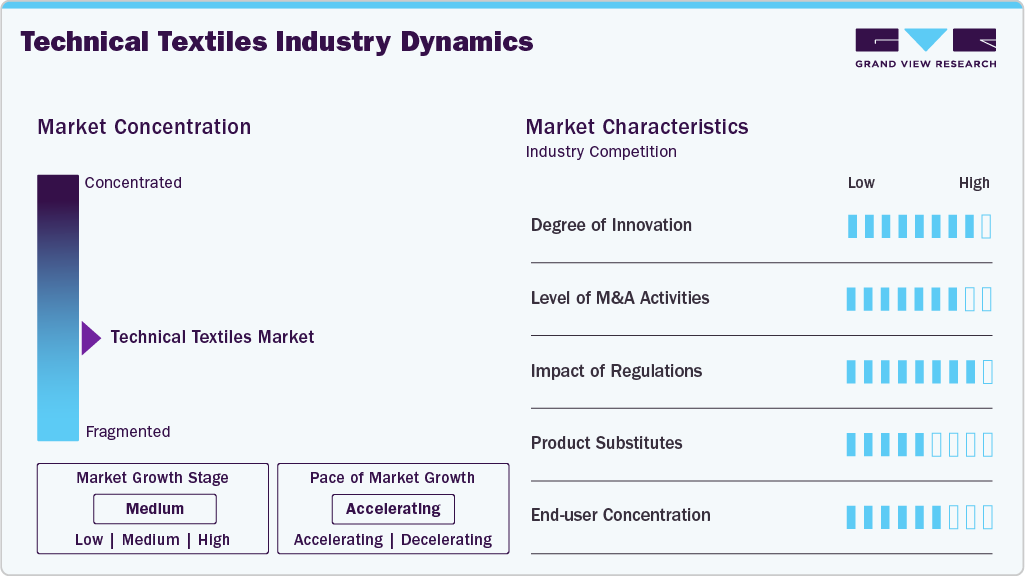
The threat of substitutes in the technical textiles market remains moderate, as technical textile materials offer specialized performance properties. Alternative materials such as metals, plastics, rubber composites, fiberglass, and advanced polymers can replace technical textiles in certain industrial applications. For example, plastic-based construction materials and metal reinforcements may compete with geotextiles and industrial fabrics in infrastructure projects. Similarly, conventional materials can sometimes substitute protective textiles in lower-cost applications where high-performance functionality is not essential.
Analyst Perspective
The technical textiles market’s next phase of growth will be driven less by volume expansion and more by the industry's ability to deliver application-specific, performance-engineered solutions that meet increasingly stringent regulatory, safety, and sustainability requirements. Demand is accelerating across transportation, construction, healthcare, industrial, agriculture, and protective clothing applications; however, long-term value creation will depend on continuous material innovation, manufacturing sophistication, compliance with technical standards, and the ability to offer customized solutions for end-use industries. Companies with strong R&D capabilities, advanced manufacturing technologies, diversified application portfolios, and established relationships with OEMs and industrial customers are expected to strengthen their market position. In contrast, smaller manufacturers may face challenges related to technological limitations, certification requirements, pricing pressures, and competition from integrated global suppliers capable of delivering consistent quality at scale.
Manufacturing Insights
Based on manufacturing, the 3D weaving segment led the market with the largest revenue share of 23.4% in 2025 and is expected to grow at a CAGR of 4.6% over the forecast period. The 3D weaving segment of the technical textile market is driven by advancements in manufacturing technologies and the rising demand for high-performance materials across industries. The ability of 3D weaving to create complex, seamless, and highly durable structures has made it a preferred choice in aerospace, automotive, and defense applications. This process allows for the production of textiles with enhanced mechanical properties, such as superior strength-to-weight ratios, which are critical for high-stress environments.
The finishing treatments segment is expected to grow at the fastest CAGR of 6.1% over the forecast period. The finishing treatments segment in the technical textile market plays a pivotal role in enhancing the functionality and performance of textiles, driving its demand across various industries. Finishing treatments include processes such as coating, laminating, dyeing, and adding chemical finishes, which imbue textiles with properties like water resistance, flame retardancy, antibacterial effects, and UV protection. The increase in demand for high-performance textiles in sectors such as automotive, healthcare, construction, and protective clothing significantly fuels the adoption of advanced finishing treatments.
End Use Insights
Based on end use, the hometech textile segment led the market with the largest revenue share of 20.0% in 2025 and is expected to grow at a CAGR of 5.8% over the forecast period. The Hometech textile segment has experienced significant growth, driven by increasing demand for advanced home furnishings and decor materials that prioritize functionality, durability, and aesthetics. The growing consumer preference for textiles with enhanced properties such as fire resistance, moisture management, and antibacterial characteristics has significantly boosted the adoption of technical textiles in residential and commercial spaces. As urbanization accelerates, especially in emerging markets, there is a heightened demand for innovative and sustainable home textile solutions, further fueling this segment's expansion.
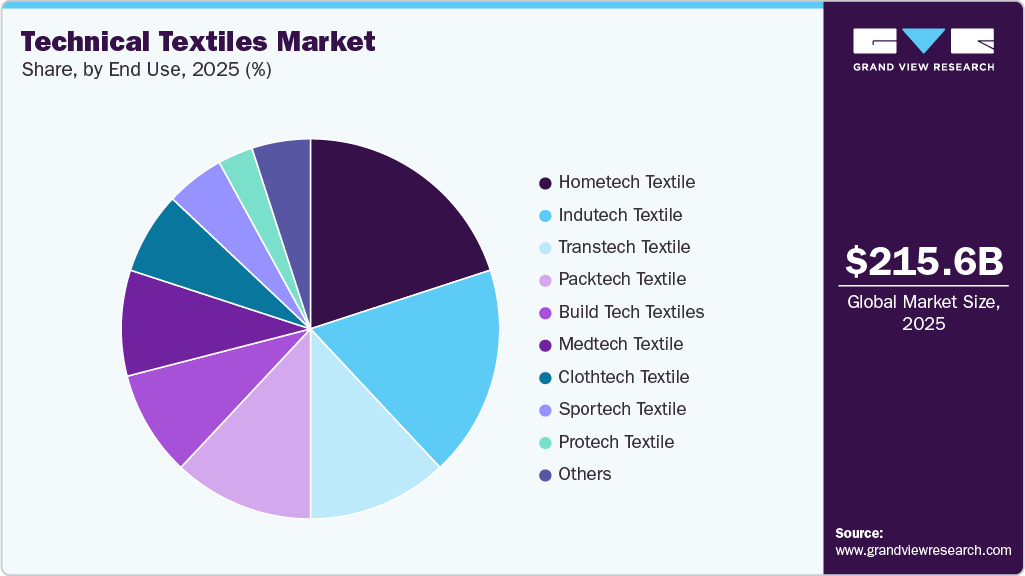
The Packtech Textile segment is expected to grow at the fastest CAGR of 6.4% over the forecast period. The Packtech textile segment in the technical textile market is witnessing robust growth driven by its diverse applications and evolving industry needs. These textiles are primarily used in packaging solutions across various sectors, including agriculture, food & beverage, pharmaceuticals, and industrial products. The increasing demand for flexible, durable, and lightweight packaging materials has been a major driver for the adoption of Packtech textiles. Their ability to provide superior protection against environmental factors such as moisture, UV rays, and chemicals makes them a preferred choice over conventional materials.
Regional Insights
Asia Pacific dominated the technical textiles with the largest revenue share of 47.6% in 2025, due to strong manufacturing capabilities, low production costs, expanding industrialization, and rising infrastructure investments across countries such as China, India, Japan, and South Korea. The region benefits from a large textile manufacturing base and increasing government support for industrial modernization and export-oriented production.
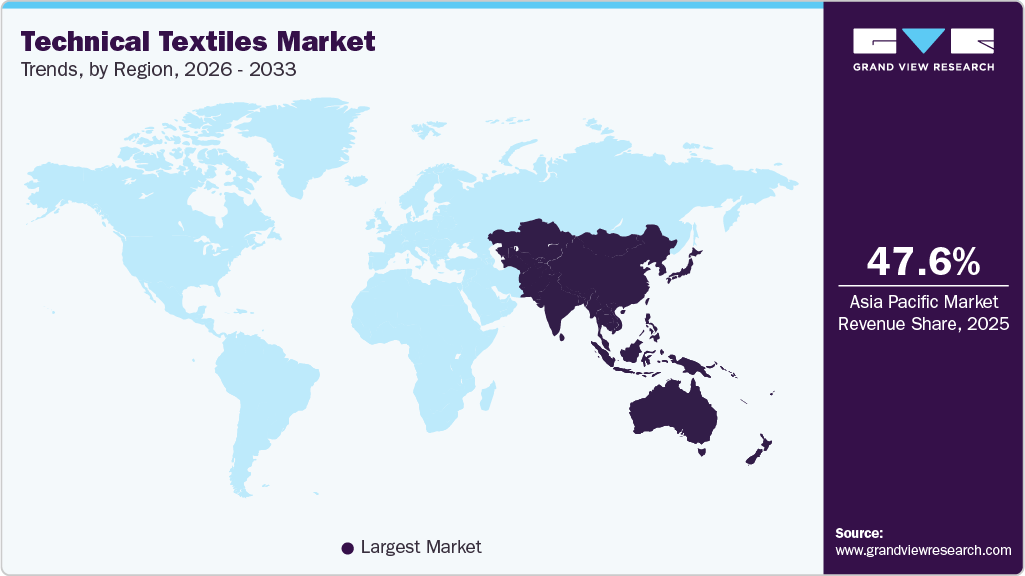
The technical textiles market in China held the largest share in the Asia Pacific region in 2025. Rapid growth in automotive, construction, healthcare, agriculture, and electronics sectors is driving demand for high-performance textile materials. China remains a major global production hub for nonwoven fabrics, industrial textiles, and protective textiles, while India is emerging as a key growth market through policy initiatives supporting domestic technical textile manufacturing. Increasing investments in smart cities, transportation infrastructure, and healthcare expansion are further strengthening regional market growth.
Technical textiles market in China holds a leading position in the global market due to its massive industrial manufacturing ecosystem, integrated supply chain infrastructure, and strong export capabilities. The country is witnessing significant demand for technical textiles across automotive, healthcare, construction, filtration, and defense applications. Government support for advanced manufacturing technologies and industrial modernization is accelerating investments in high-performance textile production. China is also heavily investing in smart textiles, industrial automation, and sustainable textile technologies to enhance global competitiveness.
North America Technical Textiles Market Trends
Asia Pacific dominated the technical textiles market, accounting for the largest revenue share of 47.6% in 2025. North America represents a technologically advanced market for technical textiles, supported by strong demand from healthcare, aerospace, automotive, defense, and industrial sectors. The region is witnessing increasing investments in protective textiles, medical textiles, filtration systems, and smart wearable fabrics. Stringent occupational safety regulations and environmental standards are encouraging the adoption of advanced industrial textile solutions. The U.S. remains a major center for innovation in high-performance fibers, smart textiles, and military-grade protective materials.
U.S. Technical Textiles Market Trends
The U.S. technical textiles market is driven by strong demand from defense, aerospace, medical, automotive, and industrial manufacturing sectors. Increasing government defense spending is creating opportunities for ballistic fabrics, flame-resistant apparel, and advanced military textile systems. The country is also witnessing significant growth in medical textiles due to rising healthcare expenditure and demand for disposable hygiene products. Advancements in nanotechnology, smart fabrics, and wearable medical devices are accelerating innovation across the market.
Europe Technical Textiles Market Trends
Europe is experiencing steady growth in the technical textiles market due to strong regulatory standards, sustainability initiatives, and technological innovation across industrial sectors. Countries such as Germany, France, Italy, and the UK are investing heavily in advanced textile engineering, automotive composites, filtration textiles, and protective clothing applications. The region’s strong focus on environmental sustainability is encouraging the development of recyclable fibers, biodegradable textiles, and low-emission manufacturing technologies.
Technical textiles market in Germanyis a major innovation hub for technical textiles, supported by its advanced automotive, industrial manufacturing, and engineering sectors. The country has strong expertise in industrial textiles, automotive composites, filtration fabrics, and protective clothing materials. Increasing adoption of lightweight textile composites in automotive manufacturing is driving demand for high-performance technical fabrics. Germany is also investing in smart textile technologies, Industry 4.0 manufacturing systems, and sustainable fiber development. Moreover, stringent environmental and industrial safety regulations are supporting the adoption of advanced technical textile products across various industrial applications.
Central and South America Technical Textiles Market Trends
The Central and South America technical textiles market is gradually expanding due to increasing industrialization, infrastructure development, and healthcare investments across countries such as Brazil and Mexico. Growing demand for geotextiles in road construction, erosion control, and water management projects is supporting market growth in the region. The healthcare sector is also increasing the consumption of medical textiles and hygiene products.
Middle East & Africa Technical Textiles Market Trends
The Middle East & Africa technical textiles market is witnessing steady growth due to rising infrastructure investments, industrial expansion, and increasing demand for protective textiles in oil & gas and construction sectors. Countries in the Gulf region are investing heavily in smart infrastructure projects, transportation networks, and industrial diversification initiatives, which is supporting demand for geotextiles, industrial fabrics, and construction textiles. The healthcare sector is also contributing to market growth through increasing demand for medical textiles and hygiene products.
Key Technical Textiles Company Insights
Some of the key players operating in the market include Low & Bonar PLC, Berry Global Group, Inc., and others.
-
Low & Bonar PLC is a global manufacturer of technical textiles, specializing in the design, production, and innovation of advanced materials for a variety of industries, including construction, automotive, agriculture, and infrastructure. The company offers a broad range of high-performance products, such as geosynthetics, filtration media, coated fabrics, and nonwoven textiles. These products are designed to enhance durability, efficiency, and sustainability in various applications.
-
Berry Global Group, Inc. is a global manufacturer of engineered materials and consumer packaging solutions. The company specializes in providing a wide range of products, including sustainable packaging, nonwoven fabrics, and specialty films, primarily serving markets such as healthcare, personal care, agriculture, and industrial sectors. In the technical textile space, Berry Global offers products such as protective fabrics, filtration media, geotextiles, and automotive textiles.
Key Technical Textiles Companies
The following key companies have been profiled for this study on the technical textiles market.
-
Low & Bonar PLC
-
Freudenberg Group
-
Ahlstrom-Munksjo
-
Asahi Kasei Advance Corp.
-
Kimberly-Clark Corp.
-
Mitsui Chemicals, Inc.
-
Huntsman International LLC
-
Berry Global Group, Inc.
-
Toray Industries, Inc.
Competitive Benchmarking
Category
Operating Strategies
Competitive Edge
Weakness
Established Players (Kimberly-Clark Corporation, Mitsui Chemicals, Inc., Huntsman International, LLC, 3M)
- Diverse and strong global presence
- Integration across the value chain
- Focus on strategic expansion to grow technological aspects
- High investment in R&D
- Large production capacity with multiple manufacturing facilities
- Long-term contracts with product suppliers and end users
- Limited market share growth owing to strong competition
Emerging Players (Sioen Industries NV, SETEX-Textil-GmbH, Heathcoat Fabrics Limited, Ludvig Svensson , Diatex)
- Focus on innovation and launch of new products to increase product offerings
- May experience market entry barrier due to end users’ preference towards brand
- Limited production capacity and product portfolio
Recent Developments
-
In October 2025, Freudenberg Group expanded its Chennai, India manufacturing facility by adding 20,000 sq. ft. production space and new interlining production lines to strengthen local technical textile manufacturing for the South Asian apparel market.
-
In May 2025, Berry Global Group, Inc. completed the spin-off and merger of its Health, Hygiene & Specialties Global Nonwovens and Films business with Glatfelter Corporation, creating Magnera Corporation, one of the world’s largest nonwovens companies.
Technical Textiles Market Report Scope
Report Attribute
Details
Market size in 2025
USD 215.6 billion
Estimated market size in 2026
USD 225.6 billion
Projected market size by 2033
USD 315.8 billion
Growth rate
CAGR of 4.9% from 2026 to 2033
Base year for estimation
2025
Historical data
2021 - 2024
Forecast period
2026 - 2033
Quantitative units
Revenue in USD million/billion and CAGR from 2026 to 2033
Report coverage
Revenue forecast, company ranking, competitive landscape, growth factors, and trends
Segments covered
Manufacturing, end use, region
Regional scope
North America; Europe; Asia Pacific; Latin America; MEA
Country scope
U.S.; Canada; Mexico; UK; Germany; France; Italy; Spain; Greece; China; India; Brazil
Key companies profiled
Low & Bonar PLC; Freudenberg Group; Berry Global Group, Inc.; Ahlstrom-Munksjo; Asahi Kasei Advance Corp.; Kimberly-Clark Corp.; Mitsui Chemicals, Inc; Huntsman International LLC
Customization scope
Free report customization (equivalent up to 8 analysts' working days) with purchase. Addition or alteration to country, regional & segment scope.
Pricing and purchase options
Avail customized purchase options to meet your exact research needs. Explore purchase options
Global Technical Textiles Market Report Segmentation
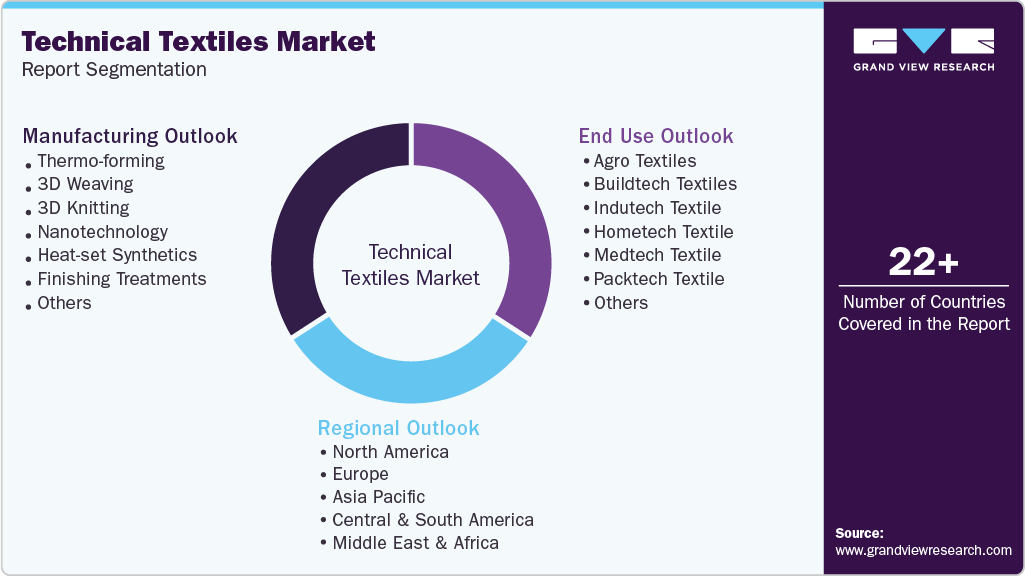
This report forecasts revenue growth at country levels and provides an analysis of the industry trends in each of the sub-segments from 2021 to 2033. For this study, Grand View Research has segmented the global technical textiles market on the basis of manufacturing, end use, and region:
-
Manufacturing Outlook (Volume, Kilotons; Revenue, USD Million, 2021 - 2033)
-
Thermo-forming
-
3D Weaving
-
3D Knitting
-
Nanotechnology
-
Heat-set Synthetics
-
Finishing Treatments
-
Hand-made Elements
-
Others
-
-
End Use Outlook (Volume, Kilotons; Revenue, USD Million, 2021 - 2033)
-
Agro Textiles
-
Buildtech Textiles
-
Indutech Textile
-
Hometech Textile
-
Medtech Textile
-
Packtech Textile
-
Protech Textile
-
Transtech Textile
-
Sportech Textile
-
Clothtech Textile
-
Others
-
-
Regional Outlook (Volume, Kilotons; Revenue, USD Million, 2021 - 2033)
-
North America
-
U.S.
-
Canada
-
Mexico
-
-
Europe
-
Germany
-
UK
-
France
-
Italy
-
Spain
-
Greece
-
-
Asia Pacific
-
China
-
India
-
-
Central & South America
-
Brazil
-
-
Middle East & Africa
-
Research Methodology
Segment Definition
Manufacturing Segment
Revenue Capture Definition
Thermo-forming
Revenue generated from technical textile products manufactured using thermo-forming processes, where textile materials are shaped and molded using heat and pressure to achieve desired structural and functional properties. This segment captures revenues from applications in automotive interiors, composites, protective components, and industrial products.
3D Weaving
Revenue generated from technical textile products manufactured through 3D weaving technologies that create multi-layered and integrated textile structures. This segment captures revenues from high-performance applications requiring enhanced strength, impact resistance, and structural integrity, including aerospace, automotive, defense, and composite reinforcement applications.
3D Knitting
Revenue generated from technical textile products manufactured using 3D knitting technologies that enable seamless and customized textile structures. This segment captures revenues from applications in medical textiles, sports textiles, footwear, automotive interiors, and advanced engineered textile solutions.
Nanotechnology
Revenue generated from technical textile products incorporating nanotechnology-based materials, coatings, and functional treatments. This segment captures revenues from textiles offering advanced properties such as antimicrobial protection, self-cleaning capabilities, enhanced filtration efficiency, UV resistance, conductivity, and moisture management.
Heat-set Synthetics
Revenue generated from technical textile products manufactured using heat-setting processes to improve dimensional stability, durability, strength, and performance characteristics of synthetic fibers. This segment captures revenues from industrial, automotive, filtration, geotextile, and protective textile applications.
Finishing Treatments
Revenue generated from technical textile products subjected to chemical, mechanical, or functional finishing treatments designed to enhance performance characteristics such as flame retardancy, water repellency, antimicrobial protection, UV resistance, conductivity, and durability. This segment captures revenues from value-added technical textile applications across multiple industries.
Hand-made Elements
Revenue generated from technical textile products incorporating manual fabrication, assembly, stitching, reinforcement, or finishing processes. This segment captures revenues from specialized, customized, and niche technical textile applications requiring skilled craftsmanship and application-specific modifications.
Others
Revenue generated from technical textile products manufactured using alternative and emerging production technologies not classified under the above categories. This segment captures revenues from innovative manufacturing approaches and specialized technical textile production processes.
End Use Segment
Revenue Capture Definition
Agro Textiles
Revenue generated from technical textile products used in agriculture, horticulture, aquaculture, and forestry applications, including shade nets, crop covers, mulch mats, anti-hail nets, fishing nets, and protective agricultural fabrics. This segment captures revenues from products designed to improve crop productivity, resource efficiency, and environmental protection.
Buildtech Textiles
Revenue generated from technical textile products used in construction and infrastructure applications, including roofing membranes, scaffolding nets, concrete reinforcement textiles, architectural fabrics, insulation materials, and geosynthetic solutions. This segment captures revenues from products supporting structural performance, safety, and construction efficiency.
Indutech Textiles
Revenue generated from technical textile products used in industrial applications, including filtration media, conveyor belts, abrasive substrates, insulation materials, industrial fabrics, and reinforcement textiles. This segment captures revenues from products designed to improve industrial processes, operational efficiency, and equipment performance.
Hometech Textiles
Revenue generated from technical textile products used in residential and commercial interior applications, including furniture fabrics, floor coverings, mattresses, curtains, blinds, upholstery materials, and home furnishing textiles. This segment captures revenues from functional textile solutions designed for comfort, durability, and aesthetics.
Medtech Textiles
Revenue generated from technical textile products used in healthcare and medical applications, including surgical gowns, drapes, wound care materials, implants, hygiene products, face masks, and medical protective textiles. This segment captures revenues from products designed to support patient care, infection control, and medical procedures.
Packtech Textiles
Revenue generated from technical textile products used in packaging applications, including flexible intermediate bulk containers (FIBCs), woven sacks, packaging fabrics, protective packaging materials, and industrial packaging solutions. This segment captures revenues from products designed for storage, transportation, and product protection.
Protech Textiles
Revenue generated from technical textile products used for personal and industrial protection, including flame-resistant clothing, chemical protective suits, ballistic protection materials, high-visibility garments, and occupational safety textiles. This segment captures revenues from products designed to enhance safety and protection in hazardous environments.
Transtech Textiles
Revenue generated from technical textile products used in transportation applications, including automotive textiles, aircraft interiors, railway fabrics, marine textiles, seat coverings, insulation materials, airbags, and reinforcement components. This segment captures revenues from products designed to improve vehicle performance, comfort, safety, and weight reduction.
Sportech Textiles
Revenue generated from technical textile products used in sports, fitness, outdoor recreation, and performance apparel applications, including sportswear, artificial turf, parachutes, sails, protective sports equipment, and high-performance fabrics. This segment captures revenues from products designed to improve athletic performance, durability, and user comfort.
Clothtech Textiles
Revenue generated from technical textile products used as functional components in apparel and footwear manufacturing, including interlinings, sewing threads, insulation materials, labels, zippers, reinforcements, and shoe components. This segment captures revenues from products designed to enhance garment functionality, durability, and comfort.
Others
Revenue generated from technical textile products used in niche, emerging, and specialized applications not classified under the above categories. This segment captures revenues from application-specific textile solutions across diverse industrial and commercial sectors.
Estimation Model
Layer Name
Key Question
Description
Demand Generation Layer
Who creates technical textiles demand?
Assess the addressable demand across major end-use industries including construction, automotive, healthcare, industrial manufacturing, agriculture, packaging, sports, protective equipment, transportation, and home furnishings to establish the technical textile demand universe.
Technical Textile Adoption Layer
Which industries use technical textiles?
Apply technical textile penetration rates across end-use sectors to determine the share of applications utilizing engineered textile solutions instead of conventional materials.
Consumption Layer
How much technical textile is consumed?
base into technical textile demand using average material consumption rates across Agrotech, Buildtech, Indutech, Medtech, Packtech, Protech, Transtech, Sportech, Clothtech, and other technical textile segments..
Revenue Layer
How much revenue is generated?
Multiply technical textile consumption volumes by average selling prices, adjusted for fiber type, manufacturing technology, application segment, performance characteristics, and regional pricing differences.
Delivered Customizations
This report has been delivered with the following In-depth customizations
Client Request
Customization Delivered
Value Adds
Opportunity Assessment
Evaluated growth opportunities across key technical textile segments including Mobiltech, Meditech, Buildtech, Indutech, Agrotech, Geotech, Protech, and Sportech, with assessment of emerging applications, end-user demand patterns, and high-growth regional markets.
Supports strategic investment and expansion decisions by identifying the most attractive application segments, emerging technology-driven opportunities, and areas with strong long-term demand potential.
Pricing Analysis
Analyzed pricing trends across major technical textile materials and products, including polyester, polypropylene, aramid, carbon fiber, glass fiber, nonwoven fabrics, coated textiles, and specialty engineered fabrics, along with raw material cost fluctuations and regional pricing variations.
Enables manufacturers and investors to understand margin dynamics, optimize pricing strategies, benchmark product competitiveness, and assess the impact of raw material volatility on profitability.
Technology & Innovation Assessment
Assessed advancements in manufacturing technologies such as nonwoven production, 3D knitting, smart textiles, nanotechnology-enabled fabrics, functional finishing treatments, recyclable materials, and high-performance fiber innovations.
Helps stakeholders identify emerging technology trends, evaluate innovation-led competitive advantages, and prioritize R&D investments aligned with future market requirements.
Frequently Asked Questions About This Report
The global technical textile market size was estimated at USD 215.6 billion in 2025 and is expected to reach USD 225.6 billion in 2026.
The global technical textile market is expected to grow at a compound annual growth rate of 4.9% from 2026 to 2033 to reach USD 315.8 billion by 2033.
Asia Pacific dominated the global technical textile market with a revenue share of 47.6% in 2025.
The hometech textile segment led the market with the largest revenue share of 20.0% in 2025.
3D Weaving dominated the technical textile market with a revenue share of 23.4% in 2025, owing to its wide on automotive, aerospace, military, medical & healthcare industries.
Some of the key players operating in the technical textile market include Low & Bonar PLC, Freudenberg Group, Berry Global Group, Inc., Ahlstrom-Munksjo, Asahi Kasei Advance Corporation, Kimberly-Clark Corporation, Mitsui Chemicals, Inc., Huntsman International LLC, among others
The key factors that are driving the technical textile market include growing product demand for agro textiles products, rising product use for production of indutech textiles, and an increase in demand for technical textiles for disposable protective gears for medical end-uses.
Packtech textile is expected to grow at the fastest CAGR of 6.4% over the forecast period.
About the Author(s)
Advanced Interior Materials Research Team
Advanced Materials · Advanced Interior MaterialsThis report was authored by the advanced interior materials research team at Grand View Research - comprising two research analysts, one senior research analyst, and one industry expert - with specialized expertise in the advanced interior materials segment of the advanced materials industry. All findings are based on proprietary advanced materials databases, executive interviews, and regulatory analysis, subject to internal peer review prior to publication.
Last Updated:
Speak to Analyst

Need a Tailored Report?
Customize this report to your needs — add regions, segments, or data points, with 20% free customization.
Or view our licence options:


ISO 9001:2015 & 27001:2022 Certified
We are GDPR and CCPA compliant! Your transaction & personal information is safe and secure. For more details, please read our privacy policy.












