
- Home
- »
- Medical Devices
- »
-
Therapeutic Device Contract Manufacturing Market Report, 2033GVR Report cover

Therapeutic Device Contract Manufacturing Market (2026 - 2033)
Size, Share & Trends Analysis Report By Product (Class I, Class II, Class III), By Services (Accessories Manufacturing, Assembly Manufacturing), By Therapeutic Area, By End-use, By Region, And Segment Forecasts
Market Size, 2025
$59.5BMarket Estimate, 2026
$66.5BMarket Forecast, 2033
$159.8BCAGR, 2026–2033
13.4%Therapeutic Device Contract Manufacturing Market Summary
The global therapeutic device contract manufacturing market size was valued at USD 59.5 billion in 2025 and is projected to grow from USD 66.5 billion in 2026 to USD 159.8 billion by 2033, at a CAGR of 13.4% from 2026 to 2033. Asia Pacific market dominated, with a revenue share of 38.2% in 2025. The market is driven by the increasing demand for advanced therapeutic devices, the rising trend of manufacturing outsourcing by medical device companies to reduce costs and accelerate time-to-market, and the growing prevalence of chronic diseases requiring innovative treatment solutions.
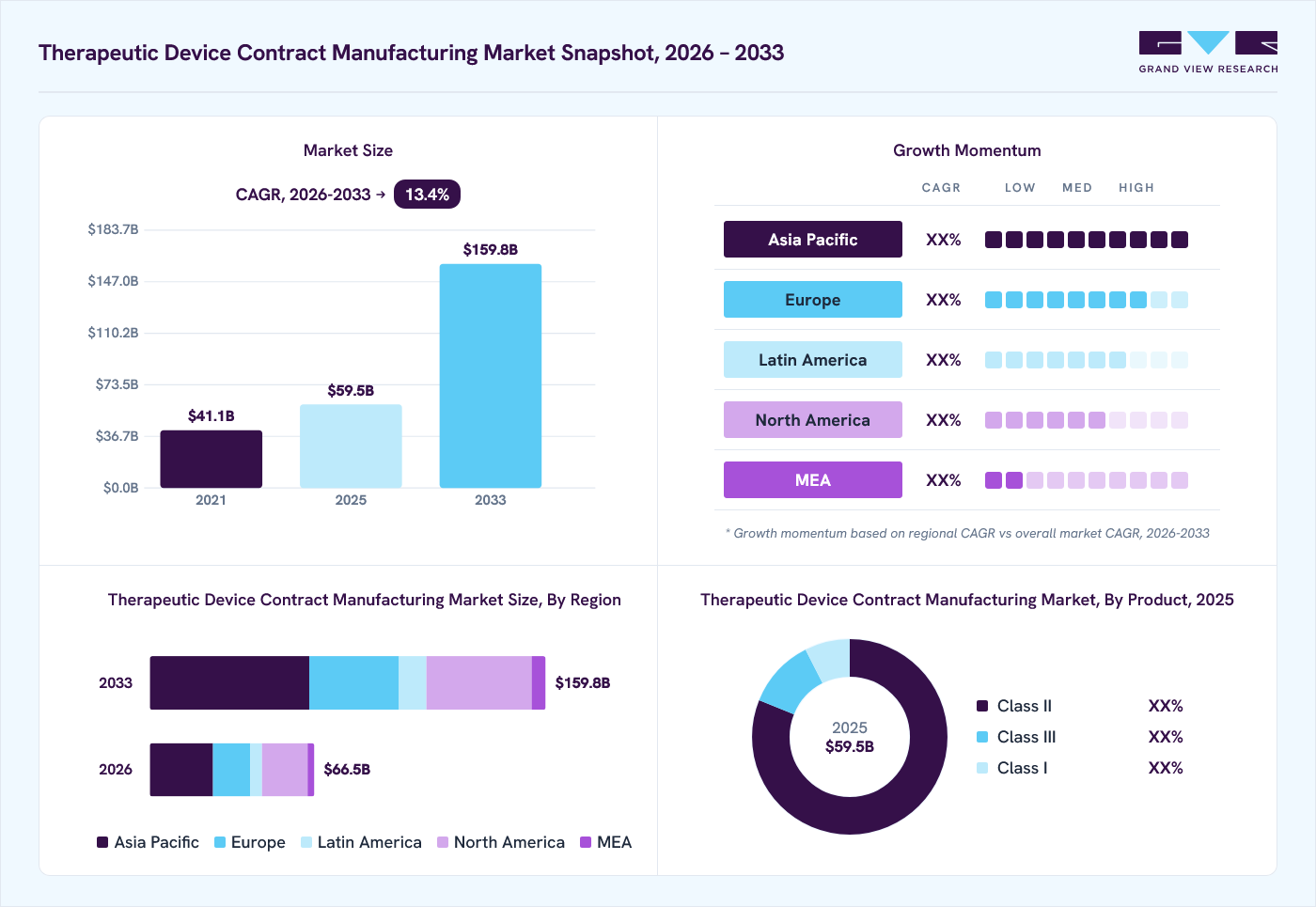 Source: Grand View Research, IR Documents, Primary Interviews, Paid DatabasesTo learn more about this report,
 Download Free Sample Report
Key Market Trends & Insights
- By product: Class II segment led the market with the largest revenue share of 81.1% in 2025.
- By services: Accessories manufacturing segment led the market with the largest revenue share of 48.1% in 2025.
- By therapeutic area: Oncology segment led the market with the largest revenue share of 26.7% in 2025.
- By end-use: Original equipment manufacturers (OEMs) segment led the market with the largest revenue share of 49.3% in 2025.
Regional Highlights
- Largest regional market: Asia Pacific (38.2% revenue share, 2025)
- By country: Japan held the largest market share in 2025.
Market Size & Forecast
- Market size in 2025: USD 59.5 Billion
- Estimated market size in 2026: USD 66.5 Billion
- Projected market size by 2033: USD 159.8 Billion
- CAGR (2026–2033): 13.4%
Prism AI by Grand View Research Free to tryAsk a question about the therapeutic device contract manufacturing marketTry asking✓Every figure cited from GVR research Prefer the report? Download free sample → To learn more about this report, Download Free Sample Report
 To learn more about this report, Download Free Sample Report
Market Dynamics
The therapeutic device contract manufacturing market is experiencing steady growth driven by the increasing outsourcing of medical device design, engineering, component manufacturing, assembly, sterilization, packaging, and regulatory support by medical device companies. Rising demand for minimally invasive devices, implantable products, drug delivery systems, cardiovascular devices, orthopedic implants, and diagnostic equipment has accelerated the need for specialized contract manufacturing partners with advanced production capabilities and quality management systems. Original equipment manufacturers (OEMs) are increasingly relying on contract manufacturers to reduce production costs, optimize supply chains, shorten product development timelines, and expand manufacturing capacity without significant capital investments. In addition, stringent regulatory requirements, increasing product complexity, and the growing adoption of automation, precision machining, additive manufacturing, and digital manufacturing technologies are encouraging outsourcing to experienced manufacturing partners capable of supporting both clinical and commercial production. Expanding demand for therapeutic devices across hospitals, ambulatory care centers, and home healthcare settings continues to support long-term market growth.
The increasing outsourcing of manufacturing activities by medical device original equipment manufacturers (OEMs) is a key driver of the therapeutic device contract manufacturing market. Medical device companies are increasingly partnering with contract manufacturers to reduce production costs, improve operational flexibility, and accelerate product commercialization while focusing internal resources on research, product innovation, and commercialization. Contract manufacturers offer specialized capabilities across design for manufacturability, precision machining, injection molding, electronic assembly, cleanroom manufacturing, sterilization, packaging, and quality assurance, enabling OEMs to efficiently manage complex production requirements. As therapeutic devices become more technologically advanced and regulatory expectations continue to evolve, outsourcing manufacturing operations to experienced partners with established regulatory expertise and scalable production infrastructure has become an important strategy for both established manufacturers and emerging medical device companies.
Stringent regulatory and quality compliance requirements remain a significant restraint for the therapeutic device contract manufacturing market. Contract manufacturers must comply with rigorous quality management standards, Good Manufacturing Practice (GMP) requirements where applicable, ISO 13485 certification, product traceability requirements, process validation, sterilization validation, and comprehensive documentation throughout the manufacturing lifecycle. Regulatory inspections, changing compliance requirements across different countries, and extensive quality assurance processes increase operational complexity and manufacturing costs. In addition, maintaining consistent product quality while meeting customer-specific specifications requires continuous investment in quality systems, workforce training, and validation activities. These compliance requirements can extend production timelines and create operational challenges, particularly for smaller contract manufacturers seeking to expand their capabilities.
The growing adoption of advanced and minimally invasive therapeutic devices presents a significant opportunity for the therapeutic device contract manufacturing market. Increasing demand for catheter-based devices, robotic-assisted surgical instruments, implantable devices, neuromodulation systems, and wearable therapeutic technologies is creating substantial opportunities for specialized manufacturing partners with expertise in precision engineering and complex device assembly. Medical device innovators are increasingly seeking contract manufacturers capable of supporting rapid prototyping, design transfer, pilot production, and commercial-scale manufacturing for technologically advanced products. Continued investments in next-generation manufacturing technologies, including automation, additive manufacturing, digital quality management, and smart manufacturing systems, are enabling contract manufacturers to expand their service capabilities and support the commercialization of increasingly sophisticated therapeutic devices across global healthcare markets.
Analyst Perspective
The therapeutic device contract manufacturing market is witnessing sustained growth driven by increasing outsourcing by medical device original equipment manufacturers (OEMs), rising demand for technologically advanced therapeutic devices, and the growing need for cost-efficient manufacturing solutions. The increasing adoption of minimally invasive devices, implantable products, cardiovascular devices, orthopedic implants, respiratory devices, surgical instruments, and drug delivery systems is driving demand for specialized contract manufacturing services, including precision component manufacturing, assembly, testing, sterilization, packaging, labeling, and commercial-scale production. The increasing complexity of therapeutic devices and evolving regulatory requirements are encouraging medical device companies to collaborate with contract manufacturers possessing advanced manufacturing capabilities, cleanroom infrastructure, and established quality management systems. Stringent regulatory requirements for product quality, process validation, traceability, sterilization, and quality management are driving investments in manufacturing automation, digital production systems, advanced inspection technologies, precision machining, additive manufacturing, and smart factory capabilities. The growing commercialization of innovative therapeutic devices and increasing demand for combination products are further supporting the need for scalable manufacturing capacity. The continued expansion of home healthcare and minimally invasive treatment technologies is also supporting demand for specialized manufacturing solutions. Ongoing investments in manufacturing facility expansion across North America, Europe, and the Asia Pacific are strengthening global production capabilities and enabling contract manufacturers to support increasing outsourcing requirements. Companies with diversified manufacturing capabilities, integrated production services, established regulatory compliance, and geographically distributed manufacturing networks are expected to strengthen their competitive position. Such factors are expected to drive market growth.
Technological Advancements
The industry is witnessing rapid growth driven by significant technological advancements in manufacturing processes. Innovations such as additive manufacturing (3D printing), precision CNC machining, microfabrication, and advanced molding techniques are enabling CMOs to produce highly complex and patient-specific devices with greater accuracy and shorter lead times. The integration of electronic components, sensors, and wearable technologies into therapeutic devices has further increased the demand for sophisticated assembly and quality control processes. In addition, automation, AI-driven process monitoring, and real-time data analytics are improving production efficiency, reducing defects, and ensuring compliance with stringent regulatory standards like ISO 13485 and FDA requirements. These technological developments not only enhance product quality but also enable CMOs to offer customized, high-value solutions, creating a competitive advantage and opening new growth opportunities in both developed and emerging markets.
Product Insights
Based on product, the Class II segment led the market with the largest revenue share of 81.1% in 2025. The growth is primarily attributable to the increasing prevalence of moderately complex therapeutic devices such as infusion pumps, diagnostic imaging equipment, and orthopedic devices, which typically fall under Class II classification. These devices require moderate regulatory oversight, making them easier to manufacture and bring to market while offering substantial revenue opportunities for contract manufacturers.
On the other hand, the Class I segment is expected to witness considerable growth owing to the increasing demand for low-risk, essential therapeutic devices such as surgical instruments, bandages, and basic medical disposables. These devices have simpler regulatory requirements and lower manufacturing complexity, making them highly attractive for contract manufacturing, especially for startups and small- to mid-sized medical device companies.
Services Insights
Based on services, the accessories manufacturing segment led the market with the largest revenue share of 48.1% in 2025. The market dominance is due to the high demand for complementary components and add-on devices that support therapeutic devices, such as catheters, tubing sets, connectors, and sensor attachments. These accessories are essential for the proper functioning and usability of primary therapeutic devices, making them a recurring revenue source for contract manufacturers. Additionally, the production of accessories often involves standardized processes with moderate regulatory oversight, enabling CMOs to achieve high-volume production efficiently.
Moreover, device manufacturing segments are anticipated to grow at the highest CAGR during the forecast period. The segment's growth is due to the rising demand for fully assembled, high-value therapeutic devices, including implantable, infusion pumps, and wearable medical devices, which require specialized manufacturing expertise. Increasing outsourcing of end-to-end device production by OEMs to contract manufacturers allows companies to reduce capital expenditure, accelerate time-to-market, and leverage advanced manufacturing technologies.
Therapeutic Area Insights
Based on therapeutic area, the oncology segment led the market with the largest revenue share of 26.7% in 2025. The cardiovascular devices segment captured the largest revenue share in the global therapeutic device contract manufacturing market. The dominance is due to the high prevalence of cardiovascular diseases worldwide, including heart failure, coronary artery disease, and arrhythmia, which is driving the demand for devices such as stents, pacemakers, heart valves, and catheters.
On the other hand, the ophthalmic devices segment is expected to experience significant growth during the forecast period. The growth of the market is due to the rising prevalence of eye-related disorders, including cataracts, glaucoma, macular degeneration, and diabetic retinopathy, particularly in aging populations. Increasing demand for advanced corrective and surgical devices, such as intraocular lenses, ophthalmic surgical instruments, and diagnostic imaging tools, is further fueling market expansion.
End-use Insight
Based on end-use, the original equipment manufacturers (OEMs) segment led the market with the largest revenue share of 49.3% in 2025. The growth of the segment is due to the high reliance of medical device companies on contract manufacturing for cost-efficient and scalable production. OEMs often outsource manufacturing to leverage the advanced technological capabilities, regulatory expertise, and quality assurance processes offered by specialized CMOs. This allows them to focus on core activities such as research, development, and marketing, while ensuring timely product launch and market expansion.
 To learn more about this report, Download Free Sample Report
Furthermore, the pharmaceutical & biopharmaceutical companies’ segment is expected to grow at a significant CAGR during the forecast period. The segment is driven by the increasing integration of therapeutic devices with drug delivery systems, such as infusion pumps, insulin pens, and combination products, which require specialized manufacturing capabilities. Moreover, rising R&D activities and product pipelines in the pharmaceutical and biopharmaceutical sectors are creating demand for contract manufacturers to produce high-quality, compliant therapeutic devices at scale.
Regional Insights
North America therapeutic device contract manufacturing market is projected to register a significant CAGR during the forecast period. This can be attributed to technological advancements, growing demand for cutting-edge medical devices, presence of established healthcare, and increasing requirements for outsourcing among medical device companies to reduce operational costs, which is expected to drive efficiency, innovation and save cost for R&D. Moreover, there is increasing adoption of technology such as 3D printing, automation, robotics, and AI-driven processes for high maintenance and efficient systems has led rise in the need for therapeutic device contract manufacturing services.
U.S. Therapeutic Device Contract Manufacturing Market Trends
The therapeutic device contract manufacturing market in the U.S. held the largest share in 2024. In the U.S., the medical device industry makes a range of medical device products. It plays a crucial role in developing new medical technologies that can improve the ability to diagnose and treat various diseases. The growing number of OEMs outsourcing medical device manufacturing, the increasing need for innovative drug options, escalating disease prevalence, the surge in partnerships, and the presence of diversified companies that are mainly engaged in the research and development of new devices for specific therapeutic areas have led to a rise in requirements for services.
Europe Therapeutic Device Contract Manufacturing Market Trends
The therapeutic device contract manufacturing market in Europe is expected to grow significantly due to the rising demand for biopharmaceutical products and the increasing focus on optimizing resources & costs, facilitating a greater emphasis on innovation capabilities, further fueling medical device production. Moreover, most contract manufacturers adopt advanced technologies for medical device production, assembly, and related development, benefiting from the latest technology.
Germany therapeutic device contract manufacturing market held the largest share in 2024. The market in Germany is driven by medical technology and the presence of established, small, and medium-sized companies or sub-groups of larger companies. In addition, stringent regulations and evolving standards require contract manufacturers to adopt quality management systems that adhere to proper manufacturing practices, ensuring compliance and patient safety.
The therapeutic device contract manufacturing market in the UK is anticipated to grow over the forecast period. This growth is primarily due to the growing need for contract manufacturing for efficient and effective medical device production to reduce the time to market, further fueling the market. Besides, these CMOs mostly offer regulated services for medical devices, further providing quality assurance, maintaining production costs, and ensuring quality and patient safety. Such factors are anticipated to drive the market.
Asia Pacific Therapeutic Device Contract Manufacturing Market Trends
Asia Pacific dominated the therapeutic device contract manufacturing market with the largest revenue share of 38.2% in 2025. This growth can be attributed to various factors, such as rising healthcare expenditure and the availability of several opportunities in this region, especially in Japan, China, and India. In Asia Pacific, the market is expected to grow as it is one of the best options for the medical device industry. The region is emerging as a hub for outsourcing drug discovery activities owing to the lower costs and favorable regulatory environment.
 To learn more about this report, Download Free Sample Report
China's therapeutic device contract manufacturing market held the largest share in 2024. The country is one of the major hubs for medical device outsourcing as it supports cost-efficient manufacturing, and the availability of a skilled workforce endorses the production of complex medical devices. Hence, outsourcing services has become one of the most favored strategies in the country.
The therapeutic device contract manufacturing market in Japan held the largest share in the Asia Pacific region in 2025. The country has an aging population and a growing incidence of various diseases, which has led to a rise in the demand for market services. Furthermore, the dependence on CMO industry players is expected to propel the demand for medical device contract manufacturing. In addition, government healthcare programs and policies to control pricing are anticipated to increase the demand for therapeutic device contract manufacturing in this region.
Key Therapeutic Device Contract Manufacturing Companies Insights
Key players operating in the therapeutic device contract manufacturing market are undertaking various initiatives to strengthen their presence and increase the reach of their products and services. Strategies such as expansion activities and partnerships are key in propelling the market growth.
Key Therapeutic Device Contract Manufacturing Companies:
The following key companies have been profiled for this study on the therapeutic device contract manufacturing market.
- Thermo Fisher Scientific Inc.
- Integer Holdings Corporation
- FLEX LTD.
- Celestica Inc.
- Phillips-Medisize
- Plexus Corp.
- Nipro Corporation
- Viant Technology LLC
- West Pharmaceutical Services, Inc.
- Synecco Ltd
Competitive Benchmarking
Category
Operating Strategies
Competitive Edge
Weakness
Established Players (Thermo Fisher Scientific Inc., Integer Holdings Corporation)
- Established players focus on providing end-to-end contract manufacturing services for therapeutic devices, including design transfer, precision component manufacturing, assembly, testing, sterilization management, packaging, labeling, and commercial-scale production. They continuously invest in manufacturing automation, cleanroom expansion, advanced quality systems, digital manufacturing technologies, and global production facilities to support high-volume and complex therapeutic device programs across multiple medical specialties.
- Established players benefit from extensive global manufacturing footprints, diversified production capabilities, established regulatory compliance systems, and long-standing relationships with leading medical device original equipment manufacturers (OEMs). Their ability to support projects from product development through commercial production, combined with scalable manufacturing capacity and comprehensive quality management systems, enables them to secure large multi-year manufacturing agreements.
- Established players face challenges associated with high capital expenditure for manufacturing infrastructure, automation, cleanroom facilities, and regulatory compliance. Large organizational structures may reduce operational flexibility, while managing complex global supply chains and manufacturing networks can increase operating costs and extend implementation timelines for customized projects.
Emerging Players (Synecco Ltd.)
- Emerging players primarily focus on specialized therapeutic device manufacturing, precision component production, low- to medium-volume manufacturing, customized assembly, and engineering support for niche therapeutic applications. Many expand their market presence through investments in advanced manufacturing technologies, cleanroom capabilities, strategic partnerships, and customer-specific production programs targeting innovative medical device developers.
- Emerging players gain competitive advantages through flexible manufacturing operations, shorter production lead times, customized engineering support, and close collaboration with customers during product development and commercialization. Their focused manufacturing capabilities enable rapid adaptation to changing customer requirements while supporting specialized therapeutic device programs with greater operational responsiveness.
- Emerging players often have limited commercial-scale manufacturing capacity, narrower geographic presence, and fewer financial resources for large infrastructure investments. Dependence on a relatively smaller customer base, limited production scalability, and increasing competition from global contract manufacturers may restrict expansion into large-volume manufacturing programs and multinational supply agreements.
Recent Developments
-
In August 2025, Thermo Fisher Scientific announced it to open a 375,000-square-foot manufacturing center of excellence in Mebane, North Carolina. This facility is expected to produce at least 40 million laboratory pipette tips per week, enhancing the company's ability to support U.S.-based pharmaceutical and biotech customers.
-
In April 2025, FLEX LTD. announced to significantly increased in production capacity for data center power products at its advanced manufacturing facility in Columbia, South Carolina. This expansion aims to meet the rising power infrastructure demands of the AI era.
Therapeutic Device Contract Manufacturing Market Report Scope
Report Attribute
Details
Market size in 2025
USD 59.5 billion
Estimated market size in 2026
USD 66.5 billion
Projected market size by 2033
USD 159.8 billion
Growth rate
CAGR of 13.4% from 2026 to 2033
Historical data
2021 - 2025
Forecast period
2026 - 2033
Quantitative units
Revenue in USD million/billion and CAGR from 2026 to 2033
Report coverage
Revenue forecast, company ranking, competitive landscape, growth factors, and trends
Segments covered
Product, services, therapeutic area, end-use, region
Regional scope
North America; Europe; Asia Pacific; Latin America; MEA
Country scope
U.S.; Canada; Mexico; Germany; UK; France; Italy; Spain; Norway; Denmark; Sweden; China; Japan; India; South Korea; Australia; Thailand; Brazil; Argentina; Saudi Arabia; South Africa; UAE; Kuwait; Oman; Qatar.
Key companies profiled
Thermo Fisher Scientific Inc.; Integer Holdings Corporation; FLEX LTD.; Celestica Inc.; Phillips-Medisize; Plexus Corp; Nipro Corporation; Viant Technology LLC; West Pharmaceutical Services, Inc.; Synecco Ltd
Customization scope
Free report customization (equivalent up to 8 analysts' working days) with purchase. Addition or alteration to country, regional & segment scope.
Pricing and purchase options
Avail customized purchase options to meet your exact research needs. Explore purchase options
Global Therapeutic Device Contract Manufacturing Market Report Segmentation
This report forecasts revenue growth at global, regional, and country levels and provides an analysis of the latest industry trends in each of the sub-segments from 2021 to 2033. For this study, Grand View Research has segmented the global therapeutic device contract manufacturing market report based on product, services, therapeutic area, end-use, and region.
-
Product Outlook (Revenue, USD Million, 2021 - 2033)
-
Class I
-
Class II
-
Class III
-
-
Services Outlook (Revenue, USD Million, 2021 - 2033)
-
Accessories Manufacturing
-
Assembly Manufacturing
-
Component Manufacturing
-
Device Manufacturing
-
Packaging and Labeling
-
Others
-
-
Therapeutic Area Outlook (Revenue, USD Million, 2021 - 2033)
-
Cardiovascular Devices
-
Orthopedic Devices
-
Ophthalmic Devices
-
Respiratory Devices
-
Surgical Instruments
-
Dental
-
Others
-
-
End-use Outlook (Revenue, USD Million, 2021 - 2033)
-
Original Equipment Manufacturers (OEMs)
-
Pharmaceutical & Biopharmaceutical Companies
-
Others
-
-
Regional Outlook (Revenue, USD Million, 2021 - 2033)
-
North America
-
U.S.
-
Canada
-
Mexico
-
-
Europe
-
UK
-
Germany
-
France
-
Italy
-
Spain
-
Denmark
-
Sweden
-
Norway
-
-
Asia Pacific
-
Japan
-
China
-
India
-
Thailand
-
South Korea
-
Australia
-
-
Latin America
-
Brazil
-
Argentina
-
-
Middle East & Africa
-
South Africa
-
Saudi Arabia
-
UAE
-
Kuwait
-
-
Research Methodology
The therapeutic device contract manufacturing market figures in this report are based on a proven research process that combines executive interviews with secondary research from proprietary databases, company filings, and recognized regulatory and institutional sources. Market size is built through value-chain sizing-reconciling supply-side and demand-side estimates-and triangulated with bottom-up and top-down approaches. Every estimate passes multiple levels of expert validation before publication, with each therapeutic device contract manufacturing segment quantified using the revenue-capture definitions in the table below.
Segment Definition
Segment - Product
Revenue capture definition
Class I
The segment captures revenue generated by contract manufacturing services provided for Class I therapeutic medical devices, which are subject to general regulatory controls and typically present low risk to patients. Services include component manufacturing, device fabrication, assembly, packaging, labeling, quality inspection, sterilization, and regulatory documentation for products such as basic surgical tools, manual therapeutic devices, and other low-risk medical devices.
Class II
The segment captures revenue generated by contract manufacturing services provided for Class II therapeutic medical devices that require additional regulatory controls to ensure safety and effectiveness. Services include design transfer, precision component manufacturing, cleanroom assembly, testing, sterilization, packaging, labeling, process validation, and commercial production for devices such as infusion pumps, orthopedic implants, cardiovascular devices, and respiratory equipment.
Class III
The segment captures revenue generated by contract manufacturing services provided for Class III therapeutic medical devices that support or sustain life or present a higher patient risk. Services include precision manufacturing, cleanroom production, advanced assembly, validation, sterilization, packaging, regulatory compliance, and commercial manufacturing for implantable devices, cardiovascular implants, neurostimulation systems, and other high-risk therapeutic devices.
Segment -Services
Revenue capture definition
Accessories Manufacturing
The segment captures revenue generated by contract manufacturing services provided for accessories used with therapeutic medical devices. Services include precision component fabrication, molding, machining, assembly, testing, packaging, labeling, and quality assurance for connectors, cables, adapters, disposable accessories, and other supporting device components.
Assembly Manufacturing
The segment captures revenue generated by contract manufacturing services involving the assembly of therapeutic medical devices and their subassemblies. Services include manual and automated assembly, cleanroom assembly, integration of electronic and mechanical components, functional testing, validation, sterilization preparation, and final product inspection.
Component Manufacturing
The segment captures revenue generated by contract manufacturing services provided for individual components used in therapeutic medical devices. Services include precision machining, injection molding, metal fabrication, extrusion, electronics manufacturing, surface finishing, component testing, and quality control for critical device parts.
Device Manufacturing
The segment captures revenue generated by end-to-end contract manufacturing services for finished therapeutic medical devices. Services include process development, component integration, device fabrication, cleanroom manufacturing, functional testing, sterilization, validation, packaging, labeling, and commercial-scale production.
Packaging and Labeling
The segment captures revenue generated by contract manufacturing services related to the packaging and labeling of therapeutic medical devices. Services include sterile barrier packaging, labeling, serialization, product identification, regulatory-compliant packaging design, final inspection, and distribution-ready packaging solutions.
Others
The segment captures revenue generated by additional contract manufacturing services supporting therapeutic medical device production. These services include sterilization management, supply chain support, logistics coordination, inventory management, quality assurance, regulatory documentation, testing, and other value-added manufacturing services not included under the specified categories.
Segment -Therapeutic Area
Revenue capture definition
Cardiovascular Devices
The segment captures revenue generated by contract manufacturing services provided for therapeutic cardiovascular devices. Services include component manufacturing, precision machining, assembly, testing, sterilization, packaging, and commercial production for products such as stents, catheters, heart valves, vascular grafts, and cardiac rhythm management devices.
Orthopedic Devices
The segment captures revenue generated by contract manufacturing services provided for therapeutic orthopedic devices. Services include implant machining, precision manufacturing, surface treatment, assembly, sterilization, packaging, validation, and commercial production for joint replacement implants, trauma fixation devices, spinal implants, and bone repair systems.
Ophthalmic Devices
The segment captures revenue generated by contract manufacturing services provided for therapeutic ophthalmic devices. Services include precision component manufacturing, cleanroom assembly, testing, sterilization, packaging, and commercial production for intraocular lenses, glaucoma treatment devices, retinal implants, and other ophthalmic therapeutic products.
Respiratory Devices
The segment captures revenue generated by contract manufacturing services provided for therapeutic respiratory devices. Services include device fabrication, assembly, component manufacturing, functional testing, sterilization, packaging, and commercial production for inhalers, nebulizers, oxygen therapy devices, ventilator components, and airway management devices.
Surgical Instruments
The segment captures revenue generated by contract manufacturing services provided for therapeutic surgical instruments. Services include precision machining, forging, finishing, assembly, sterilization, packaging, validation, and commercial production for reusable and single-use surgical instruments used across multiple therapeutic procedures.
Dental
The segment captures revenue generated by contract manufacturing services provided for therapeutic dental devices. Services include precision manufacturing, implant fabrication, component machining, assembly, sterilization, packaging, and commercial production for dental implants, orthodontic devices, prosthetic components, and restorative dental products.
Others
The segment captures revenue generated by contract manufacturing services provided for therapeutic medical devices used across additional clinical specialties not included under the specified categories. Services include component manufacturing, assembly, testing, sterilization, packaging, validation, and commercial production for a broad range of therapeutic devices.
Segment -End-use
Revenue capture definition
Original Equipment Manufacturers (OEMs)
The segment captures revenue generated from contract manufacturing services provided to original equipment manufacturers (OEMs) developing and commercializing therapeutic medical devices. Services include design transfer, component manufacturing, device assembly, testing, sterilization, packaging, labeling, regulatory support, and commercial-scale manufacturing.
Pharmaceutical & Biopharmaceutical Companies
The segment captures revenue generated from contract manufacturing services provided to pharmaceutical and biopharmaceutical companies developing combination products and therapeutic drug delivery devices. Services include device manufacturing, assembly, packaging, sterilization, quality testing, validation, and regulatory support for products such as injectable delivery systems, inhalation devices, and other drug-device combination products.
Others
The segment captures revenue generated from contract manufacturing services provided to other end users, including research organizations, healthcare institutions, startups, and emerging medical technology companies. Services include prototype manufacturing, pilot production, component fabrication, assembly, testing, packaging, validation, and commercial manufacturing support for therapeutic medical devices.
Estimation Model
ESTIMATION MODEL
METHODOLOGY
BOTTOM-UP REVENUE MODEL
Market size is estimated by identifying major and emerging contract manufacturers providing design support, component manufacturing, device manufacturing, assembly, sterilization management, packaging, labeling, and related manufacturing services for therapeutic medical devices.
Revenue attributable to therapeutic device contract manufacturing is derived from annual reports, investor presentations, regulatory filings, company websites, manufacturing facility disclosures, customer announcements, and management commentary.
Company-level revenues associated with therapeutic device contract manufacturing are aggregated and validated by assessing manufacturing capabilities, production footprint, customer portfolio, service offerings, and industry benchmarks to estimate the overall market value.
MANUFACTURING CAPACITY-BASED MODEL
Market value is estimated using the available manufacturing capacity across facilities dedicated to therapeutic medical device production.
Key parameters evaluated include the number of manufacturing facilities, cleanroom capacity, production lines, automation levels, annual production output, facility utilization rates, and average contract manufacturing pricing across different device categories.
Total effective manufacturing capacity is translated into potential annual revenue and validated against reported utilization rates, facility expansion announcements, production contracts, and customer supply agreements.
MEDICAL DEVICE PIPELINE DEMAND MODEL
Market size is derived by evaluating the number of therapeutic medical devices progressing through product development, verification and validation, regulatory approval, commercialization, and lifecycle management.
Average outsourced manufacturing expenditure is assigned to each stage for services including prototype manufacturing, engineering transfer, component manufacturing, assembly, testing, sterilization, packaging, labeling, and commercial production.
The number of device programs is multiplied by the estimated outsourced manufacturing expenditure, and the result is aggregated across cardiovascular devices, orthopedic devices, ophthalmic devices, respiratory devices, surgical instruments, dental devices, and other therapeutic device categories.
OUTSOURCING PENETRATION MODEL
Market size is estimated by assessing the proportion of medical device original equipment manufacturers (OEMs), pharmaceutical companies, and biopharmaceutical companies that outsource therapeutic device manufacturing rather than establish in-house production facilities.
Outsourcing rates are determined through primary interviews, industry publications, manufacturing partnership announcements, company disclosures, and investment trends across the medical device industry.
The addressable market is calculated by applying outsourcing penetration rates to total spending on therapeutic device engineering, component manufacturing, assembly, testing, sterilization, packaging, labeling, and commercial manufacturing services to estimate the overall contract manufacturing opportunity.
This estimation framework enhances market visibility by integrating contract manufacturer revenues, medical device outsourcing activity, therapeutic device development pipelines, and manufacturing demand indicators, resulting in a comprehensive understanding of the therapeutic device contract manufacturing market. The triangulated methodology improves forecast reliability by capturing evolving therapeutic device manufacturing requirements, increasing regulatory and quality compliance standards, and growing outsourcing adoption among medical device original equipment manufacturers (OEMs), pharmaceutical companies, and biopharmaceutical companies. This approach enables accurate identification of growth opportunities, competitive positioning, manufacturing capacity expansion priorities, and investment potential while reducing dependence on any single estimation methodology.
Delivered Customizations
This report has been delivered with the following In-depth customizations
Client Request
Customization Delivered
Value Adds
Industry Outlook,
Value Chain, and
Business Model
AssessmentConducted a comprehensive evaluation of the therapeutic device contract manufacturing ecosystem, covering raw material suppliers, component manufacturers, electronics suppliers, precision machining providers, cleanroom assembly service providers, sterilization partners, packaging and labeling providers, logistics companies, medical device OEMs, and pharmaceutical & biopharmaceutical companies. Assessed prevailing business models, outsourcing trends, revenue streams, pricing structures, supply chain dependencies, and value creation opportunities across engineering support, component manufacturing, device assembly, testing, sterilization, packaging, and commercial manufacturing.
Provides a comprehensive understanding of the industry structure, outsourcing landscape, revenue generation opportunities, supply chain dynamics, and critical success factors, enabling stakeholders to identify high-value opportunities across the therapeutic device contract manufacturing value chain while supporting strategic investment and business expansion decisions.
Competitive
Benchmarking and
Manufacturing
Capability AnalysisPerformed in-depth benchmarking of leading therapeutic device contract manufacturers based on manufacturing capabilities, cleanroom infrastructure, precision engineering expertise, production capacity, quality management systems, regulatory compliance, automation capabilities, geographic footprint, therapeutic device specialization, and strategic manufacturing partnerships. Included comparative positioning of global contract manufacturers supporting cardiovascular, orthopedic, ophthalmic, respiratory, surgical, and other therapeutic devices.
Enables identification of competitive gaps, manufacturing capability differentiation, strategic partnership opportunities, acquisition targets, and best-in-class production capabilities, supporting long-term competitive positioning and informed strategic planning.
Global Regulatory
Landscape and
Compliance
AssessmentConducted a comprehensive assessment of regulatory requirements governing therapeutic device contract manufacturing across North America, Europe, Asia Pacific, and other key markets. The analysis covered Quality Management Systems (QMS) requirements, ISO 13485 certification, Good Manufacturing Practice (GMP) requirements where applicable, sterilization validation, product traceability, process validation, labeling regulations, and inspection requirements from major regulatory authorities. Regional variation in compliance requirements and their impact on manufacturing operations and outsourcing decisions were also evaluated.
Enables manufacturers, OEMs, and investors to understand evolving regulatory requirements, strengthen compliance strategies, reduce operational risks, prepare for regulatory inspections, and develop market entry and expansion plans aligned with regional regulatory frameworks.
Frequently Asked Questions About This Report
The global therapeutic device contract manufacturing market size was valued at 59.5 billion in 2025 and is estimated at USD 66.5 billion for 2026.
Asia Pacific market dominated, with a revenue share of 38.2% in 2025.
Some key players operating in the therapeutic device contract manufacturing market include Thermo Fisher Scientific Inc., Integer Holdings Corporation, FLEX LTD., Celestica Inc., Phillips-Medisize, Plexus Corp, Nipro Corporation, Viant Technology LLC, West Pharmaceutical Services, Inc., Synecco Ltd
Key factors that are driving the market growth include the increasing demand for advanced therapeutic devices, the rising trend of manufacturing outsourcing by medical device companies to reduce costs and accelerate time-to-market, and the growing prevalence of chronic diseases requiring innovative treatment solutions.
Class II segment led the market with the largest revenue share of 81.1% in 2025.
Accessories manufacturing segment led the market with the largest revenue share of 48.1% in 2025.
Oncology segment led the market with the largest revenue share of 26.7% in 2025.
Original equipment manufacturers (OEMs) segment led the market with the largest revenue share of 49.3% in 2025.
The global therapeutic device contract manufacturing market is expected to grow at a CAGR of 13.4% from 2026 to 2033, reaching USD 159.8 billion by 2033.
About the Author(s)
Medical Devices Research Team
Healthcare · Medical DevicesThis report was authored by the medical devices research team at Grand View Research - comprising two research analysts, one senior research analyst, and one industry expert - with specialized expertise in the medical devices segment of the healthcare industry. All findings are based on proprietary healthcare databases, executive interviews, and regulatory analysis, subject to internal peer review prior to publication.
Last Updated:
Speak to Analyst

Customize this report to your needs - add regions, segments, or data points, with 20% free customization.
Or view our licence options:


ISO 9001:2015 & 27001:2022 Certified
We are GDPR and CCPA compliant! Your transaction & personal information is safe and secure. For more details, please read our privacy policy.


