
- Home
- »
- Beauty & Personal Care
- »
-
U.S. Body Scrub Market Size And Share Report, 2026-2033GVR Report cover

U.S. Body Scrub Market (2026 - 2033)
Size, Share & Trends Analysis Report By Product, By Product by End Use, By Product by Exfoliant Type, By Product by Ingredient Type, By Product by Price Tier, By Product by Distribution Channel, By Price Tier by Distribution Channel, and Segment Forecasts
Market Size, 2025
$1.8BMarket Estimate, 2026
$1.9BMarket Forecast, 2033
$2.6BCAGR, 2026–2033
4.7%U.S. Body Scrub Market Summary
The U.S. body scrub market size was valued at USD 1.8 billion in 2025 and is projected to grow from USD 1.9 billion in 2026 to USD 2.6 billion by 2033, at a CAGR of 4.7% from 2026 to 2033. The growth is driven by increasing consumer focus on full-body skincare, rising demand for exfoliation products targeting rough and uneven skin texture, growing preference for ingredient-focused and naturally derived formulations, increasing adoption of at-home self-care routines, and continued product innovation across sugar, salt, acid-based, and multifunctional body scrubs.
Key Market Trends & Insights
- By product: Face scrub accounted for the largest revenue share of 59.1% in 2025.
- By product by ingredient type: Natural & organic face scrub accounted for the largest revenue share of 62.8% in 2025.
- By product by price tier: Mass (below USD 10) for body scrub accounted for the largest revenue share of 46.7% in 2025.
- By product by distribution channel: Supermarkets & hypermarkets for body scrub accounted for the largest revenue share of 32.1% in 2025.
Market Size & Forecast
- Market size in 2025: USD 1.8 Billion
- Estimated market size in 2026: USD 1.9 Billion
- Projected market size by 2033: USD 2.6 Billion
- CAGR (2026-2033): 4.7%
Three ways to get this report
Buy it, customize it, or ask a question.Ask an Analyst
Analyst response in 1 business day
- AccessReport author, directly
- Reply timeWithin 1 working day
- No sales callDirect answer only
- FormatEmail reply
- CostFree, no cost
Get the Full Report
What the study covers
- FormatsPDF · Excel · Dashboard
- Timeline2026–2033 annual, 2025 base
- Coverage20+ countries, 5 regions
- Companies10+ key players profiled
Customize the Report
20% free customization
- IncludeCountries, segments, points
- TailorTo your product definition
- ExtendDeeper competitor detail
- OrA fully bespoke study
- Turnaround5–10 working days
The increasing emphasis on skin-specific solutions in the U.S. body scrub market is encouraging brands to develop exfoliating products that address specific body-skin concerns rather than providing only general cleansing or smoothing benefits. Consumers seeking solutions for roughness, keratosis pilaris (KP), uneven texture, dullness, and body breakouts are creating demand for body scrubs that combine physical exfoliation with functional skincare ingredients. For instance, Differin’s Acne-Clearing Body Scrub contains 2% salicylic acid for acne treatment, while its formulation also includes glycolic acid for exfoliation and smoothing and vitamin E to nourish and soothe the skin. The product is positioned to help clear body breakouts, demonstrating how brands are extending the U.S. body scrub market toward targeted skin concerns by combining exfoliation with specific skin benefits.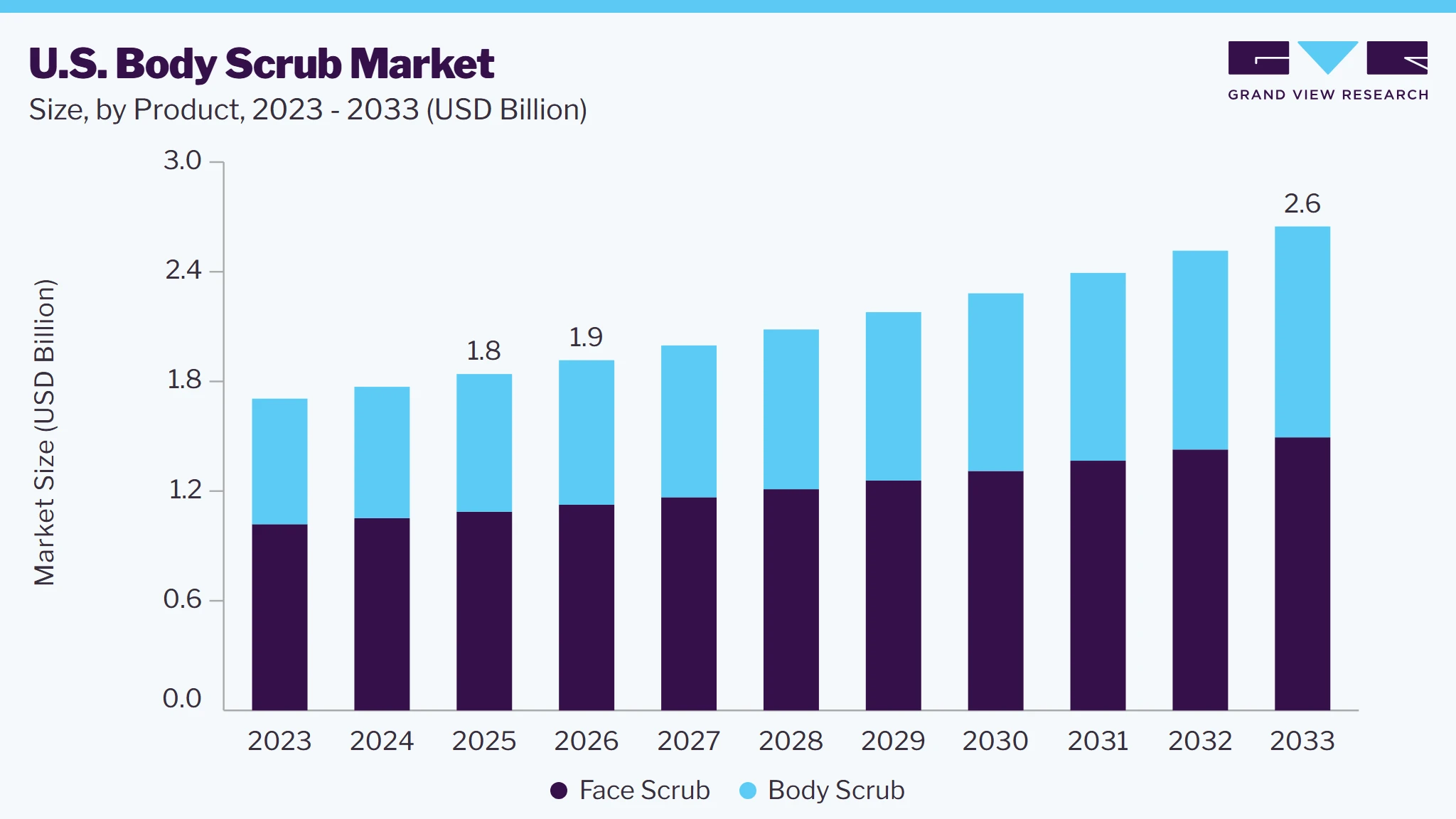 Source: Grand View Research, IR Documents, Primary Interviews, Paid DatabasesTo learn more about this report,
 Download Free Sample Report
The growing preference for sensory and self-care-oriented body-care routines is driving the U.S. body scrub industry as consumers increasingly seek exfoliation products that combine skin benefits with enjoyable fragrances, textures, and shower experiences. Brands are responding by expanding scent portfolios and introducing seasonal and complementary body-care formats to encourage consumers to incorporate exfoliation into broader self-care routines. In July 2025, Tree Hut expanded its signature exfoliating scrub portfolio with new Lychee Kiss and Flower Milk scents while extending existing fragrances into additional product formats. The launches were distributed through Target, Walmart, and Ulta, increasing accessibility across major U.S. retail channels. Tree Hut also positioned the products around sensorial experiences, self-care, and skin-loving formulations.
Market Dynamics
Growing consumer focus on full-body skincare and targeted skin concerns is driving the U.S. body scrub market as consumers increasingly incorporate exfoliation into regular body-care routines to address rough texture, dryness, dullness, body bumps, and ingrown hairs. The shift from basic cleansing toward multi-step body-care routines is increasing the role of exfoliation as a regular skin-maintenance step, while the adoption of facial-skincare actives in body care is encouraging demand for formulations containing AHAs, BHAs, glycolic acid, salicylic acid, and other functional ingredients. This trend is also prompting brands to develop scrubs for specific body-skin concerns; for instance, First Aid Beauty’s KP Bump Eraser Body Scrub combines 10% glycolic and lactic acids with pumice to target rough and bumpy skin, while Sol de Janeiro’s Bom Dia Body Scrub combines AHA/BHA ingredients with crushed maracujá seeds to improve roughness and uneven texture. Such targeted product development is expanding the functional applications of body scrubs and strengthening innovation across the body scrub industry.
The risk of skin irritation and over-exfoliation is restraining the U.S. body scrub market, as consumers may experience dryness, redness, sensitivity, or discomfort when exfoliating products are used too frequently or with excessive pressure. The increasing availability of formulations combining physical exfoliating particles with potent acids can further heighten concerns among consumers with sensitive skin, potentially reducing usage frequency and encouraging a shift toward gentler body-care alternatives. This concern can limit regular product use and affect repeat purchases, creating a restraint for the body scrub industry. The American Academy of Dermatology recommends that consumers with dry, sensitive, or acne-prone skin avoid harsh mechanical exfoliation and notes that more aggressive exfoliation can worsen redness or acne, highlighting the need for consumers to carefully select exfoliation methods based on their skin type.
The growing demand for targeted body-care solutions presents an opportunity for the U.S. body scrub market as consumers increasingly seek products that provide exfoliation alongside benefits such as hydration, brightening, smoothing, and skin renewal. Brands can capitalize on this demand by developing multifunctional body scrubs that combine physical exfoliants with skin-beneficial ingredients such as AHAs, BHAs, vitamin C, ceramides, hyaluronic acid, and botanical oils. The expansion of concern-specific formulations can broaden applications across different body-care needs, while premium, clean-label, sensitive-skin, and ingredient-focused offerings can create opportunities for differentiation and support innovation across the body scrub industry. For instance, in February 2025, Nativa SPA introduced its Acerola Cherry Collection in the U.S., including a Renewing Body Scrub formulated with quartz powder, lactic acid (AHA), acerola extract, fermented fruit enzymes, and quinoa oil to combine exfoliation with skin renewal, hydration, and antioxidant benefits.
Consumer Insights
 To learn more about this report, Download Free Sample Report
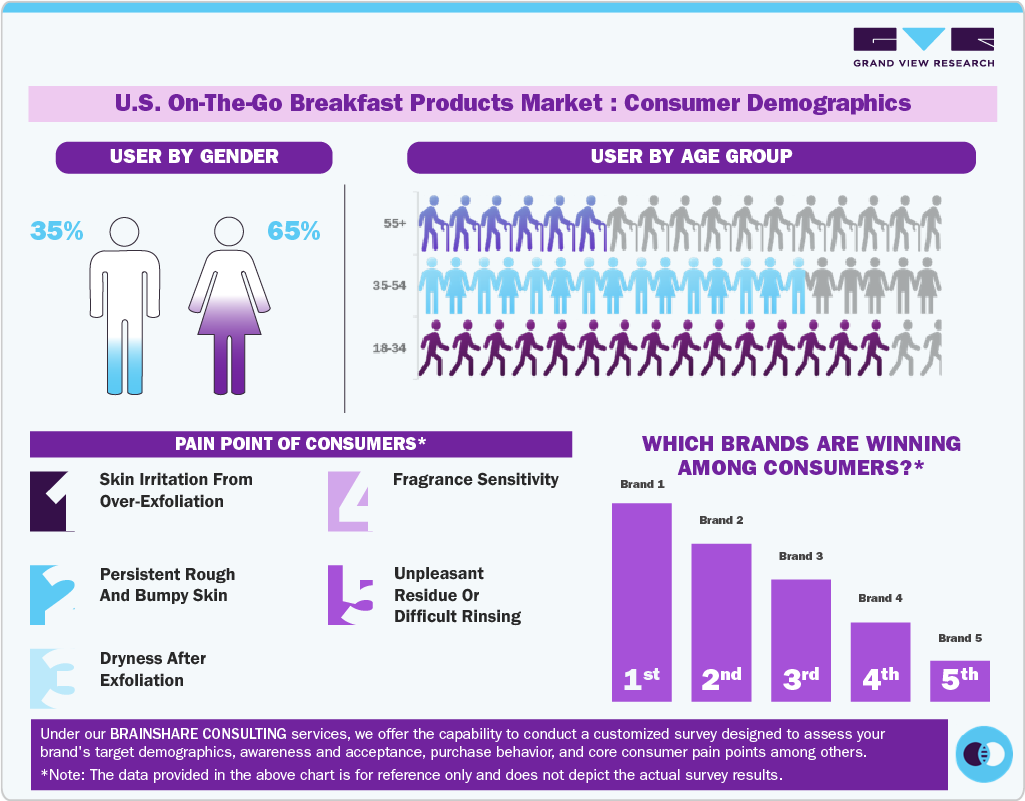
The U.S. body scrub market serves consumers across different genders and age groups who use body exfoliation products as part of their personal-care and skincare routines. Demand is influenced by consumers’ skin concerns, exfoliation preferences, sensitivity to ingredients and fragrances, and interest in maintaining smoother and healthier-looking skin.
Users by Gender:
-
Female consumers account for the estimated 65% share, reflecting their strong participation in body-care and exfoliation routines. Women are increasingly incorporating body scrubs into regular skincare regimens to address rough texture, dryness, dullness, body bumps, and ingrown hairs, supporting their dominant position in the U.S. body scrub category.
-
Male consumers account for 35%, supported by the expanding adoption of personal-care and grooming routines among men. Increasing attention to skin smoothness, body odor management, shaving-related concerns, and overall body skincare is encouraging greater participation in the body scrub market.
Users by Age Group:
Consumers aged 18–34 represent a major user group in the body scrub industry, comprising younger adults, beauty-conscious consumers, and individuals who actively incorporate multi-step skincare and self-care routines. This group is more inclined toward experimenting with new exfoliating formats, ingredient-led formulations, fragrances, and multifunctional body-care products. Consumers aged 35–54 include established skincare users who seek effective solutions for dryness, roughness, uneven texture, and other body-skin concerns, with greater emphasis on product efficacy, skin compatibility, and functional ingredients. Consumers aged 55 and above primarily seek gentle exfoliation and products that support smoother, hydrated, and comfortable skin, creating demand for formulations designed for mature or sensitive skin and emphasizing moisturizing and skin-conditioning benefits.
Consumers in the U.S. body scrub market commonly face several challenges when selecting and using body exfoliation products.
-
Skin irritation from over-exfoliation remains a concern, particularly when consumers use abrasive particles or active exfoliating ingredients too frequently, which can make the skin feel sensitive, dry, or uncomfortable.
-
Persistent rough and bumpy skin can make it difficult for consumers to achieve the desired smoothness, particularly when conventional body scrubs do not adequately address concerns such as keratosis pilaris and uneven texture.
-
Dryness after exfoliation can reduce product satisfaction when body scrubs remove surface buildup without providing sufficient moisturizing or conditioning benefits.
-
Fragrance sensitivity can limit product choices for consumers who experience discomfort with heavily fragranced formulations, particularly within a category where fragrance is commonly incorporated to enhance the sensory experience.
-
Unpleasant residue or difficult rinsing can reduce convenience and repeat use, particularly for oil-rich or heavily textured body scrubs that leave residue on the skin, shower surfaces, or bathtub.
Analyst Perspective
The U.S. body scrub market is evolving toward more targeted, ingredient-focused, and experience-led body care, with consumers increasingly incorporating exfoliation into regular skincare routines. Demand is supported by growing interest in smoother skin texture, dead skin cell removal, and concern-specific body care, while brands are expanding offerings across sugar, salt, cream, and exfoliating scrub formats. Manufacturers are also emphasizing natural ingredients, skin-benefiting actives, and premium formulations, while retailers are broadening body scrub availability across mass-market, specialty, and online channels.
Product Insights
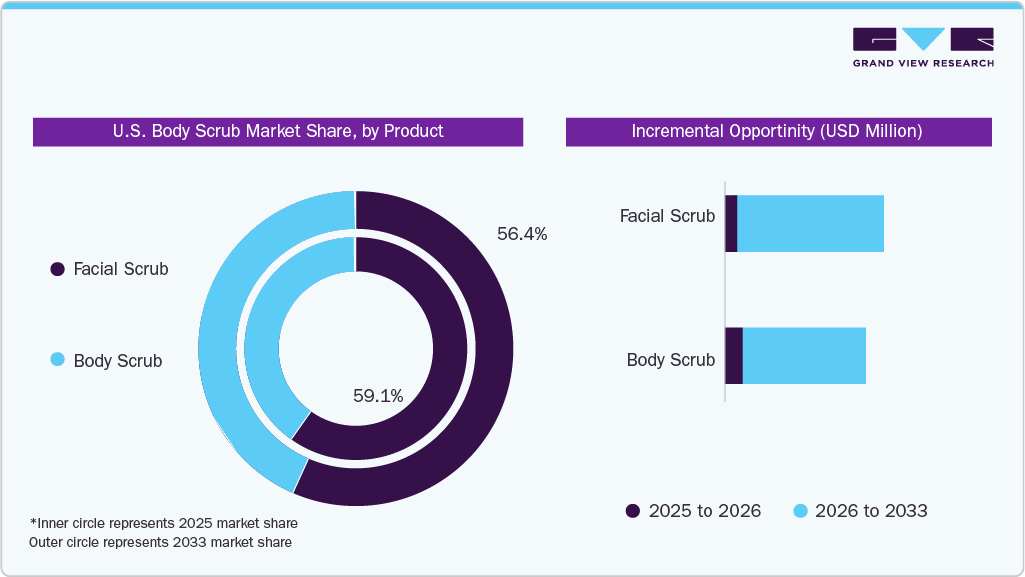
The face scrub segment accounted for the largest revenue share of 59.1% in 2025, reflecting the established role of facial exfoliation within consumers’ skincare routines. The U.S. body scrub market is also seeing the face scrub segment shift from conventional dead-skin removal toward targeted, multifunctional, and hybrid exfoliation, as consumers seek products that address specific concerns such as blackheads, clogged pores, excess oil, and uneven texture. Brands are responding by combining physical exfoliants with active skincare ingredients, allowing a single product to provide both exfoliation and targeted skin benefits. For instance, Origins’ Clear Improvement Blackhead Clearing Mask-to-Scrub with Salicylic Acid combines 1% salicylic acid with physical exfoliants derived from konjac root, mineral silica, and bamboo, while charcoal and mineral-infused clays help absorb excess oil. The product functions as both a mask and a scrub and is positioned for blackheads, oily and acne-prone skin, and pore refinement. In clinical testing of 32 participants, Origins reported that 97% experienced reduced blackheads, while the same proportion reported improved skin texture after one use.
 To learn more about this report, Download Free Sample Report
The body scrub segment is expected to grow at a CAGR of 5.5% from 2026 to 2033, driven by increasing demand for skincare-infused exfoliation and products offering multiple body-care benefits. Consumers are increasingly seeking formulations that combine exfoliation with brightening, hydration, and skin-smoothing properties, encouraging brands to incorporate active ingredients and nourishing components into body scrubs. Saltair’s Vitamin C Oil-Infused Body Scrub, launched in July 2026, combines salt and sugar crystals with two forms of vitamin C, a multi-oil complex, and shea butter, targeting exfoliation, brightening, and hydration in a single product. Available in Santal Bloom, Saltwater Vanilla, and Coral Coast, the launch also incorporates fragrance variety, demonstrating how the U.S. body scrub market is expanding toward ingredient-led and sensorial products that provide broader skincare benefits beyond basic exfoliation.
Product by End Use Insights
In the face scrub segment, women accounted for the largest revenue share of 65.6% in 2025, reflecting their strong engagement with facial skincare and regular exfoliation routines. YouGov’s April 2024 survey found that 60% of U.S. women reported having a very or somewhat consistent skincare routine, indicating a substantial consumer base incorporating recurring facial-care practices. This routine-oriented behavior is creating demand for face scrubs that deliver targeted benefits such as removing dead skin cells, improving skin texture, unclogging pores, and enhancing skin smoothness. In response, brands are increasingly developing face scrub formulations around specific skincare concerns and multifunctional benefits, reinforcing women’s contribution to the face scrub segment.
In the body scrub segment, the men category is expected to grow at a CAGR of 6.2% from 2026 to 2033, driven by the expanding adoption of body-care products within male grooming routines. Men are increasingly seeking products that go beyond basic cleansing to address rough texture, excess oil, clogged pores, and ingrown hairs, creating greater demand for dedicated exfoliation products. In February 2025, Dove Men+Care launched a new range of body and face scrubs in variants including Eucalyptus + Cedar Oil, Coastal Cedar + Bergamot, and Charcoal + Clove Oil, combining exfoliation with cleansing and moisturizing benefits. The launch reflects the expansion of male grooming portfolios into body exfoliation and the growing availability of products designed specifically for men.
Product by Exfoliant Type Insights
In the exfoliant type, chemical exfoliants for face scrub accounted for the largest revenue share of 48.8% in 2025, reflecting growing interest in acid-based formulations that provide targeted skin resurfacing benefits. The body scrub industry is seeing exfoliation products increasingly incorporate skincare actives that address concerns such as dullness, uneven texture, and clogged pores. For instance, OLEHENRIKSEN’s Lemonade Smoothing Scrub combines 10% AHAs from glycolic and lactic acids with ultra-fine sugar exfoliants to chemically resurface and physically polish the skin. The formulation demonstrates how the U.S. body scrub and facial exfoliation categories are moving toward active-led products that combine chemical exfoliation with additional skin-smoothing benefits.
The combination/hybrid body scrub is expected to grow at a CAGR of 6.5% from 2026 to 2033, driven by increasing consumer preference for multifunctional body-care formulations that combine physical exfoliation with chemical actives. For instance, Follain’s Body Scrub combines mineral-based physical exfoliation with AHA- and BHA-based chemical exfoliation, positioning the product to address dry, dull, and uneven skin through dual-action exfoliation. The availability of such formulations is supporting demand for body scrubs that provide both immediate physical exfoliation and targeted skin-resurfacing benefits.
Product by Ingredient Type Insights
In the ingredient type, natural & organic face scrub accounted for the largest revenue share of 62.8% in 2025, reflecting growing preference for naturally derived exfoliating and skin-conditioning ingredients in the U.S. face scrub category. For instance, Herbal Choice Mari Organic Facial Scrub is USDA Certified Organic and contains organic brown sugar, sea salt, grape-seed powder, olive oil, shea butter, and kaolin clay, providing a concrete example of naturally derived formulations available in the face scrub market. The increasing availability of certified organic products is strengthening natural ingredient positioning within the face scrub industry, particularly among consumers seeking plant-based and gentle exfoliation options.
In the ingredient type, natural & organic body scrub is expected to grow at a CAGR of 6.8% from 2026 to 2033, driven by the availability of formulations using naturally derived exfoliants and organic botanical ingredients. For instance, SABON’s Body Scrub combines mineral-rich Dead Sea salts with organic sweet almond, argan, and jojoba oils, offering simultaneous exfoliation and skin nourishment. The availability of such formulations is strengthening natural and organic positioning in the U.S. body scrub category and supporting product differentiation in the body scrub market.
Product by Price Tier Insights
In the price tier, the mass (below USD 10) for body scrub accounted for the largest revenue share of 46.7% in 2025, reflecting strong consumer access to affordable exfoliating products through mass-market personal-care retailers. For instance, Dove offers its Exfoliating Body Scrub range through Target in the U.S., including Brown Sugar & Coconut Butter, Crushed Macadamia & Rice Milk, and Pomegranate Seeds & Shea Butter variants. The availability of multiple exfoliating formulations from an established mass-market brand at accessible price points supports the penetration of affordable products within the U.S. body scrub market.
In the price tier, luxury (above USD 60) for face scrub is expected to grow at a CAGR of 5.3% from 2026 to 2033, driven by demand for premium exfoliation products that offer sophisticated formulations and specialized skincare benefits. For instance, La Prairie offers its Cellular Mineral Face Exfoliator, a prestige facial exfoliator formulated with mineral-rich ingredients and fine crystals to gently polish the skin. The availability of such premium facial exfoliators reflects premiumization, as consumers increasingly seek high-end products that combine exfoliation with an elevated skincare experience.
Product by Distribution Channel Insights
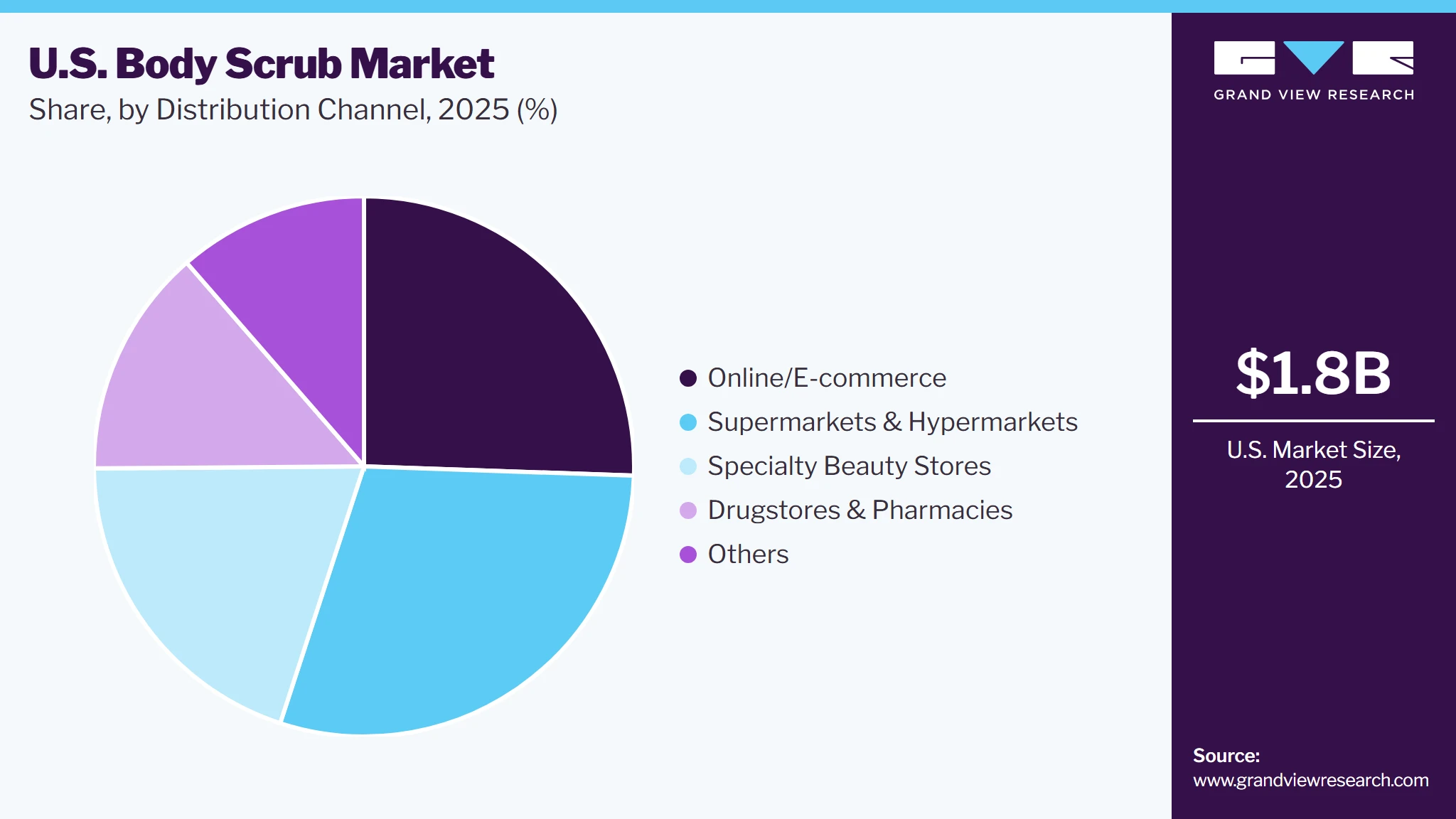
In the distribution channel, the supermarkets & hypermarkets for body scrub accounted for the largest revenue share of 32.1% in 2025, supported by the broad availability of body scrub products from established brands and the convenience of purchasing personal-care products through large-format retail stores. For instance, Walmart offers a broad assortment of Tree Hut body scrubs, including Vanilla Shea Butter, Moroccan Rose, Tropic Glow, Watermelon, and Sunlit Glow variants, with products available through its U.S. retail and online channels. The availability of multiple fragrances and exfoliating formulations through Walmart demonstrates the role of large-format retailers in improving consumer access to products within the body scrub market and strengthening the body scrub industry through mass-market distribution.
 To learn more about this report, Download Free Sample Report
Online/e-commerce for face scrub is expected to grow at a CAGR of 5.3% from 2026 to 2033, driven by the convenience of online purchasing, broader product availability, and consumers’ ability to compare formulations and reviews before purchase. For instance, in May 2026, OLIVE YOUNG launched its U.S. online store alongside its U.S. market debut, enabling consumers nationwide to purchase Korean beauty and skincare products through its digital platform. The expansion of its U.S. e-commerce presence provides consumers with broader access to specialized skincare products and supports the growth of online channels in the U.S. body scrub market.
Price Tier By Distribution Channel
In the supermarkets & hypermarkets channel, the mass (below USD 10) accounted for the largest revenue share of 69.3% in 2025, supported by the broad availability of affordable exfoliation products through major mass-retail outlets. For instance, Dr Teal’s Shea Sugar Body Scrub with Coconut Oil and Essential Oils is listed at USD 7.33 for a 19-oz pack at Walmart, combining sugar-based exfoliation with shea butter, coconut oil, and avocado oil for moisturizing benefits. The availability of large-volume body scrubs at accessible price points enhances value perception and supports routine use among price-conscious consumers, thereby contributing to the demand for the body scrub market and reinforcing the accessibility of the body scrub industry in the U.S.
In the online/e-commerce channel, the luxury (above USD 60) is expected to grow at a CAGR of 8.0% from 2026 to 2033, supported by consumers’ increasing access to premium body-care products and specialized exfoliation formulations through digital retail platforms. For instance, Fresh’s Brown Sugar Body Polish Exfoliator is listed at USD 69 on Sephora, placing it within the luxury price tier and offering a premium exfoliation experience based on brown sugar and conditioning ingredients. The availability of such high-priced body exfoliators through established e-commerce platforms expands consumer access to prestige brands and supports premiumization within the U.S. body scrub market.
Key U.S. Body Scrub Company Insights
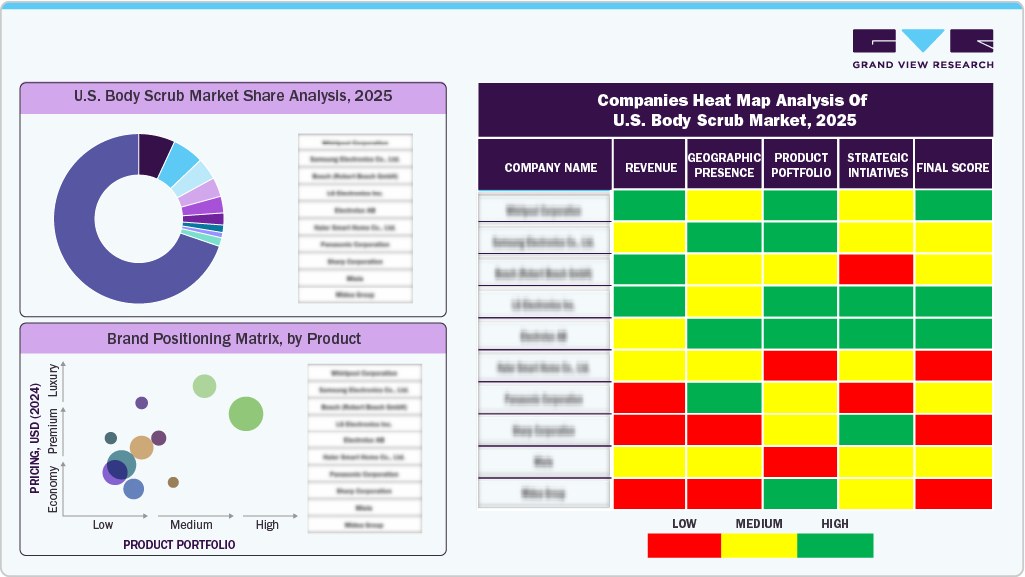
The U.S. body scrub market is characterized by competition among mass-market personal-care companies, specialized skincare brands, and premium body-care players. Competition is shaped by product variety, exfoliation efficacy, ingredient positioning, fragrance offerings, price points, retail distribution, and the ability to address specific body-skin concerns. Leading brands are expanding their body-scrub portfolios across sugar, salt, acid, and botanical-based formulations, while maintaining broad availability through mass retailers, drugstores, beauty retailers, and direct-to-consumer channels.
-
Mass-Market & High-Volume Body-Care Brands: Tree Hut, Dove, Dr Teal’s, Olay, and Neutrogena compete through broad retail distribution, accessible pricing, extensive product assortments, and established consumer recognition. Tree Hut has a particularly strong position in body scrubs, with multiple Shea Sugar Body Scrub variants identified as best sellers across Target and Walmart, including Vanilla, Moroccan Rose, Tropic Glow, and Coco Colada. Dove competes through moisturizing exfoliation, offering body scrubs that combine exfoliating ingredients with its signature moisturizing positioning and multiple fragrance variants. These brands benefit from established distribution networks and the ability to reach consumers seeking affordable, routine-oriented body exfoliation.
-
Specialty Skincare & Ingredient-Focused Brands: First Aid Beauty, Naturium, and Native compete by emphasizing targeted skin benefits, ingredient transparency, and formulations designed around specific consumer concerns. First Aid Beauty positions its body exfoliation products around rough and bumpy skin, while Naturium and Native extend ingredient-led skincare positioning into body-care formats. Native maintains a dedicated body-scrub portfolio, including Coconut & Vanilla and Sweet Peach & Nectar Detoxifying body scrubs. These companies differentiate within the body scrub industry through functional ingredients, skin-benefit claims, and more specialized product positioning.
-
Premium & Experiential Body-Care Brands: Sol de Janeiro and Soap & Glory compete through distinctive fragrances, sensory product experiences, premium packaging, and lifestyle-oriented brand positioning. Sol de Janeiro combines exfoliation with its fragrance-led body-care proposition, while Soap & Glory uses playful branding and accessible-premium positioning to attract consumers seeking body-care products that combine functional and experiential benefits. Their positioning supports premiumization within the U.S. body scrub category and creates differentiation beyond basic exfoliation.
 To learn more about this report, Download Free Sample Report
Key U.S. Body Scrub Companies
-
Tree Hut
-
Dove
-
Dr Teal’s
-
First Aid Beauty
-
Naturium
-
Native
-
Sol de Janeiro
-
Olay
-
Neutrogena
-
Soap & Glory
Competitive Benchmarking
Category
Operating Strategies
Competitive Edge
Key Challenges
Established Players (Tree Hut, Dove, Dr Teal’s, Olay, Neutrogena, Sol de Janeiro)
Offer broad body-care portfolios spanning sugar scrubs, exfoliating body washes, moisturizing scrubs, acne-focused exfoliators, and premium body treatments. Strategies emphasize frequent product and fragrance variations, mass and specialty retail distribution, ingredient-led formulations, and integration of exfoliation into broader body-care routines. Tree Hut emphasizes sugar-based scrubs with shea butter, oils, and fragrance-led variants, while Dove combines exfoliation with moisturizing benefits.
Strong brand recognition established retail distribution, broad consumer reach, and differentiated product positioning. Tree Hut benefits from a large assortment of fragrance and ingredient combinations; Dove leverages moisturizing credentials; Neutrogena differentiates through dermatologist-oriented, concern-specific exfoliation such as salicylic-acid body scrubs; and Sol de Janeiro competes through premium Brazilian-inspired body care and distinctive fragrance experiences.
Large portfolios can make differentiation within the crowded body exfoliation segment difficult, particularly as niche brands introduce targeted, clean-label, and active-ingredient formulations. Mass-market brands also face pressure from premium and digitally native competitors offering more specialized body-care experiences.
Emerging Players (First Aid Beauty, Naturium, Native, Soap & Glory)
Target specific consumer needs through clinically positioned, ingredient-focused, clean-label, and sensorial body-care formulations. First Aid Beauty focuses on rough, bumpy skin and keratosis pilaris through chemical and physical exfoliation; Naturium combines AHA/BHA/PHA actives and skincare ingredients with body treatments; Native emphasize gentle exfoliation, clean formulations, and fragrance-led variants; Soap & Glory builds differentiation around sensorial body care and accessible premium positioning.
Strong specialization and clearer product propositions enable these brands to target specific body-skin concerns and consumer preferences. First Aid Beauty has a strong KP-focused proposition, Naturium benefits from its skincare-ingredient expertise, while Native combines vegan/cruelty-free positioning with fragrance-driven body care and recently expanded into body scrubs.
Smaller portfolios and comparatively narrower category penetration can limit scale versus mass-market leaders. Dependence on differentiated ingredients, clean-label claims, niche positioning, and digital or specialty retail visibility can increase the need for continued product innovation and marketing investment to maintain consumer attention.
Recent Developments
-
In June 2026, Native launched its Detoxifying Body Scrub Collection, offering gentle exfoliation in three scents: Coconut & Vanilla, Sweet Peach & Nectar, and Eucalyptus & Mint. The body scrubs are formulated with plant-based and naturally derived ingredients and are free from parabens, phthalates, sulfated surfactants, and dyes, while being vegan, cruelty-free, and dermatologist-tested. Priced at USD 15, the collection is available through Native’s website and major U.S. retailers.
-
In July 2026, Humanrace launched its Smoothing Body Scrub alongside its Recovery Body Lotion, expanding the brand into performance-focused body care. The Smoothing Body Scrub combines physical and chemical exfoliants, including rice particles, mandelic acid, and salicylic acid, with ceramides and botanical ingredients to refine skin texture, brighten the appearance of skin, and support the skin barrier.
-
In October 2025, Soap & Glory launched a new fragrance-forward body care collection exclusively at Walgreens in the U.S., featuring five scents: Orchid Bliss, Tropical Sunrise, Watermelon Spritz, Vanilla-Licious, and Radiant Rose. Each fragrance range includes a gentle sugar-based Body Scrub priced at USD 14.99, formulated to exfoliate and remove dead skin cells and impurities without drying the skin.
U.S. Body Scrub Market Report Scope
Report Attribute
Details
Market size in 2025
USD 1.8 billion
Estimated market size in 2026
USD 1.9 billion
Projected market size by 2033
USD 2.6 billion
Growth rate
CAGR of 4.7% from 2026 to 2033
Base Year
2025
Actuals
2021 - 2025
Forecast period
2026 - 2033
Quantitative units
Revenue in USD billion and CAGR from 2026 to 2033
Report coverage
Revenue forecast, company ranking, competitive landscape, growth factors, and trends
Segments covered
Product, product by end use, product by exfoliant type, product by ingredient type, product by price tier, product by distribution channel, price tier by distribution channel
Key companies profiled
Tree Hut; Dove; Dr Teal’s; First Aid Beauty; Naturium; Native; Sol de Janeiro; Olay; Neutrogena; Soap & Glory
Customization scope
Free report customization (equivalent up to 8 analysts’ working days) with purchase. Addition or alteration to country, regional & segment scope.
Pricing and purchase options
Avail customized purchase options to meet your exact research needs. Explore purchase options
U.S. Body Scrub Market Report Segmentation
This report forecasts revenue growth at country levels and provides an analysis of the latest trends and opportunities in each of the sub-segments from 2026 to 2033. For this study, Grand View Research has segmented the U.S. body scrub market report on the basis of product, product by end use, product by exfoliant type, product by ingredient type, product by price tier, product by distribution channel, price tier by distribution channel.
-
Product Outlook (Revenue, USD Billion, 2021 - 2033)
-
Face Scrub
-
Body Scrub
-
-
Product by End Use Outlook (Revenue, USD Billion, 2021 - 2033)
-
Face Scrub
-
Men
-
Women
-
-
Body Scrub
-
Men
-
Women
-
-
-
Product by Exfoliant Type Outlook (Revenue, USD Billion, 2021 - 2033)
-
Face Scrub
-
Chemical Exfoliants
-
Combination/Hybrid
-
Physical Exfoliants
-
-
Body Scrub
-
Chemical Exfoliants
-
Combination/Hybrid
-
Physical Exfoliants
-
-
-
Product by Ingredient Type Outlook (Revenue, USD Billion, 2021 - 2033)
-
Face Scrub
-
Hybrid (Natural-Synthetic Blends)
-
Natural & Organic
-
Synthetic
-
-
Body Scrub
-
Hybrid (Natural-Synthetic Blends)
-
Natural & Organic
-
Synthetic
-
-
-
Product by Price Tier Outlook (Revenue, USD Billion, 2021 - 2033)
-
Face Scrub
-
Mass (Below USD 10)
-
Masstige (USD 10 to USD 25)
-
Premium (USD 25 to USD 60)
-
Luxury (Above USD 60)
-
-
Body Scrub
-
Mass (Below USD 10)
-
Masstige (USD 10 to USD 25)
-
Premium (USD 25 to USD 60)
-
Luxury (Above USD 60)
-
-
-
Product by Distribution Channel Outlook (Revenue, USD Billion, 2021 - 2033)
-
Face Scrub
-
Supermarkets & Hypermarkets
-
Drugstores & Pharmacies
-
Specialty Beauty Stores
-
Online/E-commerce
-
Others
-
-
Body Scrub
-
Supermarkets & Hypermarkets
-
Drugstores & Pharmacies
-
Specialty Beauty Stores
-
Online/E-commerce
-
Others
-
-
-
Price Tier By Distribution Channel Outlook (Revenue, USD Billion, 2021 - 2033)
-
Supermarkets & Hypermarkets
-
Mass (Below USD 10)
-
Masstige (USD 10 to USD 25)
-
Premium (USD 25 to USD 60)
-
Luxury (Above USD 60)
-
-
Drugstores & Pharmacies
-
Mass (Below USD 10)
-
Masstige (USD 10 to USD 25)
-
Premium (USD 25 to USD 60)
-
Luxury (Above USD 60)
-
-
Specialty Beauty Stores
-
Mass (Below USD 10)
-
Masstige (USD 10 to USD 25)
-
Premium (USD 25 to USD 60)
-
Luxury (Above USD 60)
-
-
Online/E-commerce
-
Mass (Below USD 10)
-
Masstige (USD 10 to USD 25)
-
Premium (USD 25 to USD 60)
-
Luxury (Above USD 60)
-
-
Other
-
Mass (Below USD 10)
-
Masstige (USD 10 to USD 25)
-
Premium (USD 25 to USD 60)
-
Luxury (Above USD 60)
-
-
Research Methodology
The U.S. body scrub marketfigures in this report are based on a proven research process that combines executive interviews with secondary research from proprietary databases, company filings, and recognized regulatory and institutional sources. Market size is built through value-chain sizing—reconciling supply-side and demand-side estimates—and triangulated with bottom-up and top-down approaches. Every estimate passes multiple levels of expert validation before publication, with eachU.S. body scrubsegment quantified using the revenue-capture definitions in the table below.
Segment Definition
Segment – End Use
Revenue capture definition
Face Scrub
Revenue is generated from face scrub products purchased and used for facial exfoliation and skin care, including products formulated to remove dead skin cells, unclog pores, address dullness, uneven skin texture, excess oil, blackheads, and other facial skin concerns.
Body Scrub
Revenue is generated from body scrub products purchased and used for body exfoliation and skin care, including products formulated to remove dead skin cells, improve rough or dry skin, address uneven texture, ingrown hairs, body acne, and other body-skin concerns.
Estimation Model
Each layer progressively narrows the population pool and applies a conversion rate to arrive at addressable revenue.
01
02
03
04
Consumer Base Layer
Body Care Demand Layer
Body Scrub Purchase Layer
Monetization Layer
Who is the potential consumer base?
Who has a need for body exfoliation?
Who actively purchases body scrubs?
How much revenue is generated?
Identifies the U.S. population with potential demand for personal care and body care products. Includes consumers across age groups and genders who use products for cleansing, exfoliation, moisturization, and skin maintenance.
Captures consumers seeking body exfoliation, smoother skin, removal of dead skin cells, and targeted body-care benefits. Focuses on consumers incorporating body scrubs into regular shower, bathing, and skincare routines.
Segments consumers who purchase and use body scrubs through mass-market, premium, specialty, and online channels. Considers purchasing frequency, product format, skin concerns, ingredient preferences, and usage occasions.
Converts active body scrub purchases into market revenue using product prices, purchase frequency, pack sizes, and sales channels. Revenue capture includes spending on physical body scrub products across online and offline retail channels.
Delivered Customizations
This report has been delivered with the following In-depth customizations
CLIENT REQUEST
CUSTOMIZATION DELIVERED
VALUE ADDS
Assessment of Body Scrub Product Formulations and Exfoliation Technologies
Evaluated body scrub formulations across physical, chemical, and combination exfoliants, including sugar, salt, pumice, AHAs, BHAs, and other skin-smoothing ingredients, along with moisturizing and nourishing components.
Identified formulation-level differentiation, exfoliation approaches, ingredient trends, and opportunities for brands to address specific concerns such as roughness, dullness, body acne, and uneven skin texture.
Benchmarking Body Scrub Products Across Price Tiers
Compared mass-market, mid-range, and premium body scrubs based on formulation complexity, ingredient quality, fragrance, sensory attributes, packaging, product size, and consumer positioning.
Identified price-positioning differences and premiumization opportunities, supporting product pricing, portfolio development, and competitive benchmarking.
Mapping Body Scrub Demand by Consumer Skin Concerns and Usage Occasions
Assessed body scrub demand across key use cases, including exfoliation, rough and bumpy skin, dullness, dryness, body acne, ingrown hairs, and self-care routines, while evaluating fragrance, texture, and sensory experience as purchase considerations.
Identified high-potential consumer needs and product attributes, supporting targeted product development, marketing strategies, and consumer-segment prioritization.
About the Author(s)
Beauty & Personal Care Research Team
Consumer Goods · Beauty & Personal CareThis report was authored by the beauty & personal care research team at Grand View Research - comprising two research analysts, one senior research analyst, and one industry expert - with specialized expertise in the beauty & personal care segment of the consumer goods industry. All findings are based on proprietary consumer goods databases, executive interviews, and regulatory analysis, subject to internal peer review prior to publication.
Last Updated:
Speak to Analyst

Customize this report to your needs - add regions, segments, or data points, with 20% free customization.
Or view our licence options:


ISO 9001:2015 & 27001:2022 Certified
We are GDPR and CCPA compliant! Your transaction & personal information is safe and secure. For more details, please read our privacy policy.


