
- Home
- »
- Advanced Interior Materials
- »
-
U.S. Industrial Hemp Market Size, Industry Report, 2030GVR Report cover

U.S. Industrial Hemp Market (2024 - 2030) Size, Share & Trends Analysis Report By Application (Animal Care, Textiles, Food & Beverages), By Product (Seeds, Fiber, Shivs), And Segment Forecasts
U.S. Industrial Hemp Market Size & Trends
The U.S. industrial hemp market size was estimated at USD 1.63 billion in 2023 and is expected to grow at a CAGR of 21.1% from 2024 to 2030. Industrial hemp is used in over 25,000 products across automotive, construction, personal care, cosmetics, food and beverages, food supplements, textiles, paper, and many other industries. Hemp is a strong fiber, and is highly durable, biodegradable, lightweight, and has low production costs. The product is increasingly being utilized in several end-use industries in the U.S. owing to the flourishing domestic manufacturing sector and high standards of living.
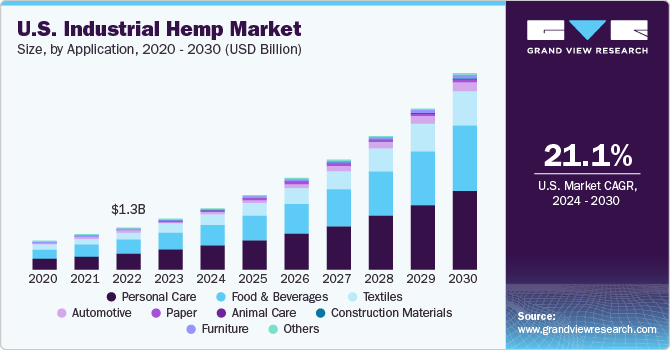 Source: Grand View Research, IR Documents, Primary Interviews, Paid DatabasesTo learn more about this report,
 Download Free Sample Report
 The growing preference for eco-friendly products in construction materials, thermal insulation, fiberglass alternatives, and automotive products is expected to drive the market over the forecast period. Furthermore, the growing demand for technical products including solvents, oil paints, printing inks, putty, varnishes, fuelchain-saw lubricants, and coatings is expected to have a major impact on the market’s growth.
The cultivation, manufacturing, and distribution processes of hemp-based products are governed by stringent regulations. Players in the global industrial hemp market aim to supply high-quality hemp products at minimum prices. Distributors work directly with the farmers and manufacturers to ensure immediate delivery of the products.
Industrial hemp production has massively increased in recent years, accredited to changes in legislation and growing awareness about the plant's various uses. According to the World Population Review, Utah, Kentucky, Oregon, Colorado, and California were the leading hemp-producing states in 2022.
In the U.S., hemp production is managed under drug enforcement laws. United States Department of Agriculture (USDA) published its final regulations in 2021 after the 2018 farm bill was passed, making provisions for farmers to produce hemp for agricultural research programs and industrial purposes. To manufacture industrial hemp in the country a producer must obtain a license from the Drug Enforcement Agency (DEA). Distributors/wholesalers usually have contracts with entrepreneurs who utilize hemp products.
Market Concentration & Characteristics
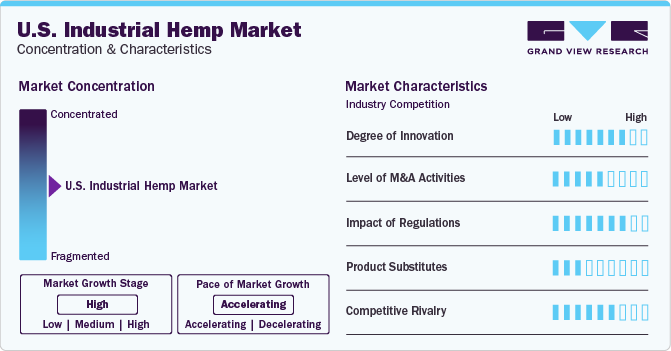
The market growth is high and is accelerating at a significant pace owing to a moderately fragmented market. U.S. industrial hemp producers are actively implementing challenging strategic initiatives such as mergers & acquisitions, innovation, and production expansion, among others.
 To learn more about this report, Download Free Sample Report
 The level of innovation is high owing to increasing research & development initiatives by the state and federal governments to develop agronomy and new genetics of industrial hemp. For instance, the ongoing Industrial Hemp Agricultural Research Pilot Program by the NYS Department of Agriculture promotes and accepts future research applications in the areas of fiber, grain, and Cannabidiol (CBD).
The market is driven by investments in R&D activities. In September 2022, Oregon State University received a USD 50.0 million grant from the U.S. Department of Agriculture to collaborate with Native American Tribes on framing practices that can improve soil health and manage the carbon footprint. The collaboration was aimed at incorporating climate-smart practices such as rotation of hemp, grains, alfalfa, corn, and onions. Furthermore, in September 2021, Cornell University received a grant of USD 2.3 million to study and research electric weed control in perennial fruit crops. Such ongoing R&D investments are factoring the market growth.
Threat of substitutes is moderate in this market owing to the unavailability of products with exactly similar characteristics. Products such as Kenaf and Flax are close to cotton and okra contains two types of fiber, bast, and core, similar to hemp fibers, and are used to make burlap, carpet padding, pulp, animal bedding, and packaging materials. However, the market for these products is very niche with a few processing facilities. In terms of food & beverage applications, flax seeds and chia seeds also have similar nutritional profiles available easily and at affordable prices in grocery stores. The aforementioned products are a potential threat to industrial hemp in the food & beverage industry.
Application Insights
Food & beverage accounted for the largest revenue share of 32.6% in 2023 owing to hemp’s high nutritional content, including proteins, fatty acids, and several other ingredients. Hemp seeds and oilcakes are used in salads, cooking oil, hemp dairy alternatives, granola bars, hemp flour, and a range of other food products. These products have high acceptance amongst consumers, thereby driving the segment growth.
Textiles is projected to emerge as the fastest growing segment during the forecast period. Fabrics made from hemp have better physical attributes and properties. For instance, they are hypo-allergic, naturally resistant to mold, UV light, and mildew, and stronger than their traditional counterparts. Applications of hemp in textiles include twine, rope, nets, canvas bags, tarps, carpets, and geotextiles.
Product Insights
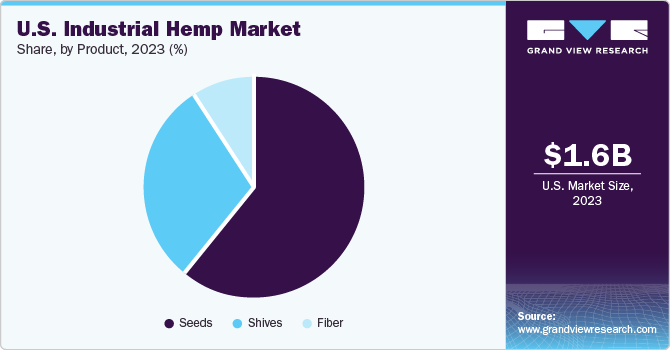
The seeds segment dominated the market, accounting for a revenue share of 76.3% in 2023. Hemp seeds have a high nutritional value, which helps in building healthy body cells and maintaining brain and nerve function. Three tablespoons of hempseed contain 11 grams of protein comprised of 67% edestin, which supports a healthy immune system and 33% globulin. Furthermore, they are a good source of zinc and magnesium. Seeds are majorly used to produce hemp oil which is consumed in food and beverages, personal care, and animal feed industries.
 To learn more about this report, Download Free Sample Report
 The fiber segment is expected to expand at the fastest CAGR during the forecast period. Hemp biocomposites are extensively used for automotive molding applications. Hemp fibers contain a high amount of hemicellulose, are robust, and have a high absorbent capacity which makes hemp a useful substitute for cotton in the textile industry.
Key U.S. Industrial Hemp Company Insights
American drug and controlled substance laws and the Food & Drug Administration regulate the market; only hemp with a tetrahydrocannabinol (THC) concentration of less than 0.3% is allowed for cultivation and consumption. Furthermore, industrial hemp production in the U.S. faces various barriers such as stringent U.S. government drug policies and the DEA’s concerns regarding the ramifications and commercialization of hemp products.
Furthermore, the U.S. industrial hemp cultivators face competition from other global suppliers including China and Canada. To sustain in the competitive market, the existing players are focusing on optimizing their manufacturing processes and investing in R&D activities.
Key U.S. Industrial Hemp Companies:
- Marijuana Company of America Inc.
- HempMeds Brasil
- Terra Tech Corp
- American Cannabis Company, Inc.
- Industrial Hemp Manufacturing, LLC
- American Hemp
- Hemp, Inc.
- Boring Hemp Company
- Toyoshima
- Panda Biotech
Three ways to get this report
Buy it, customize it, or ask a question.Ask an Analyst
Analyst response in 1 business day
- AccessReport author, directly
- Reply timeWithin 1 working day
- No sales callDirect answer only
- FormatEmail reply
- CostFree, no cost
Get the Full Report
What the study covers
- FormatsPDF · Excel · Dashboard
- Timeline2024–2030 annual, 2023 base
- Coverage20+ countries, 5 regions
- Companies10+ key players profiled
Customize the Report
20% free customization
- IncludeCountries, segments, points
- TailorTo your product definition
- ExtendDeeper competitor detail
- OrA fully bespoke study
- Turnaround5–10 working days
Recent Developments
-
In April 2023, Panda Biotech entered into a strategic collaboration with Ute Growth Fund to develop industrial hemp processing facilities, diversify its business portfolio, and promote sustainable textile fibers.
-
In March 2023, Toyoshima & Co., Ltd. made an investment in FyberX to co-create regenerative hemp fiber that will benefit farmers, rebuild rural communities, repair soil health, and provide better alternatives to several industries, including textiles.
U.S. Industrial Hemp Market Report Scope
Report Attribute
Details
Market size value in 2024
USD 1.96 billion
Revenue forecast in 2030
USD 6.22 billion
Growth rate
CAGR of 21.1% from 2024 to 2030
Actual data
2018 - 2023
Forecast period
2024 - 2030
Quantitative units
Volume in tons, revenue in USD million/billion, and CAGR from 2024 to 2030
Report coverage
Volume forecast, revenue forecast, competitive landscape, growth factors and trends
Segments covered
Product, application
Country Scope
U.S.
Key companies profiled
Marijuana Company of America Inc.; HempMeds Brasil; Terra Tech Corp; American Cannabis Company, Inc.; Industrial Hemp Manufacturing, LLC; American Hemp; Hemp, Inc.; Boring Hemp Company; Toyoshima;
Panda Biotech
Customization scope
Free report customization (equivalent up to 8 analyst’s working days) with purchase. Addition or alteration to country, regional & segment scope
Pricing and purchase options
Avail customized purchase options to meet your exact research needs. Explore purchase options
U.S. Industrial Hemp Market Report Segmentation
This report forecasts volume & revenue growth at country levels and provides an analysis of the latest trends in each of the sub-segments from 2018 to 2030. For this study, Grand View Research has segmented the U.S. industrial hemp market report based on product, and application:
-
Product Outlook (Volume, Tons; Revenue, USD Million, 2018 - 2030)
-
Seeds
-
Fiber
-
Shives
-
-
Application Outlook (Volume, Tons; Revenue, USD Million, 2018 - 2030)
-
Animal Care
-
Textiles
-
Automotive
-
Furniture
-
Food & Beverages
-
Paper
-
Construction Materials
-
Personal Care
-
Others
-
Frequently Asked Questions About This Report
The U.S. industrial hemp market was valued at USD 1.63 billion in the year 2023 and is expected to reach USD 1.96 billion in 2024.
The U.S. industrial hemp market is expected to grow at a compound annual growth rate of 21.1% from 2024 to 2030 to reach USD 6.22 billion by 2030.
Based on product, seeds segment dominated the market, accounting for a revenue share of 76.3% in 2023 owing to its adoption in food and beverages, personal care, and animal feed industries.
The key market players in the U.S. industrial hemp market include Marijuana Company of America Inc.; HempMeds Brasil; Terra Tech Corp; American Cannabis Company, Inc.; Industrial Hemp Manufacturing, LLC; American Hemp; Hemp, Inc.; Boring Hemp Company; Toyoshima; Panda Biotech.
The key factors that are driving the U.S. industrial hemp market include growing continuous innovations and R&D investments regarding industrial hemp seeds, fiber, and shivs.
About the Author(s)
Advanced Interior Materials Research Team
Advanced Materials · Advanced Interior MaterialsThis report was authored by the advanced interior materials research team at Grand View Research - comprising two research analysts, one senior research analyst, and one industry expert - with specialized expertise in the advanced interior materials segment of the advanced materials industry. All findings are based on proprietary advanced materials databases, executive interviews, and regulatory analysis, subject to internal peer review prior to publication.
Last Updated:
Speak to Analyst

Customize this report to your needs - add regions, segments, or data points, with 20% free customization.
Or view our licence options:


ISO 9001:2015 & 27001:2022 Certified
We are GDPR and CCPA compliant! Your transaction & personal information is safe and secure. For more details, please read our privacy policy.


