
- Home
- »
- Petrochemicals
- »
-
Aluminum Hydroxide Market Size & Share Report 2026-2033GVR Report cover

Aluminum Hydroxide Market (2026 - 2033)
Size, Share & Trends Analysis Report By Grade (Industrial Grade, Pharma Grade), By End Use (Construction, Pharmaceuticals, Automotive, Electronics), By Region (North America, Europe, Asia Pacific), And Segment Forecasts
Market Size, 2025
$12.5BMarket Estimate, 2026
$13.0BMarket Forecast, 2033
$17.5BCAGR, 2026–2033
4.3%Aluminum Hydroxide Market Summary
The global aluminum hydroxide market size was valued at USD 12.5 billion in 2025 and is projected to grow from USD 13.0 billion in 2026 to USD 17.5 billion by 2033, at a CAGR of 4.3% from 2026 to 2033. The market in Asia Pacific dominated with a revenue share of 36.9% in 2025. The increasing demand for products is mainly driven by their uses in pharmaceuticals, water treatment, and flame retardants.
 Source: Grand View Research, IR Documents, Primary Interviews, Paid DatabasesTo learn more about this report,
 Download Free Sample Report
 Key Market Trends & Insights
- By grade: Industrial grade segment held the largest market share of 59.1% in 2025.
- By end use: Construction segment held the largest market share of 42.0% in 2025.
Regional Highlights
- Largest regional market: Asia Pacific (36.9% revenue share, 2025)
- By country: China held the largest market share in 2025
Market Size & Forecast
- Market size in 2025: USD 12.5 Billion
- Estimated market size in 2026: USD 13.0 Billion
- Projected market size by 2033: USD 17.5 Billion
- CAGR (2026-2033): 4.3%
Three ways to get this report
Buy it, customize it, or ask a question.Ask an Analyst
Analyst response in 1 business day
- AccessReport author, directly
- Reply timeWithin 1 working day
- No sales callDirect answer only
- FormatEmail reply
- CostFree, no cost
Get the Full Report
What the study covers
- FormatsPDF · Excel · Dashboard
- Timeline2026–2033 annual, 2025 base
- Coverage20+ countries, 5 regions
- Companies10+ key players profiled
Customize the Report
20% free customization
- IncludeCountries, segments, points
- TailorTo your product definition
- ExtendDeeper competitor detail
- OrA fully bespoke study
- Turnaround5–10 working days
Furthermore, the market presents opportunities in producing energy storage solutions, lightweight materials, and emerging technologies like electric vehicles and 5G. The growing demand for medical applications is driving the global industry. Additionally, its use as a flame retardant and the increasing safety standards in building construction are contributing factors. Aluminum hydroxide is widely available and primarily utilized in polymer applications. The rise in polymer production activities in the Asia-Pacific region and Europe is expected to boost growth further. Furthermore, the increasing demand for fire-resistant and lightweight products in the automotive industry, which allows for greater design flexibility, is projected to enhance growth. To learn more about this report, Download Free Sample Report
 Due to its cost-effectiveness, the growing demand for products in the painting and coating industries is driving market growth. However, the increasing adoption of alternative products, such as magnesium hydroxide, may hinder market expansion on a global scale. Additionally, the rising use of products in batteries and chemicals is expected to create favorable growth opportunities. Nonetheless, challenges such as fluctuating raw material prices and heightened health risks associated with exposure to aluminum hydroxide pose significant concerns for the industry.
Market Dynamics
The aluminum hydroxide market is witnessing steady growth driven by increasing demand for environmentally friendly flame retardants, expanding construction activities, and rising consumption of plastics and polymer-based materials across various industries. Aluminum hydroxide is widely used as a flame retardant, smoke suppressant, filler, and raw material in chemical manufacturing due to its excellent thermal decomposition properties and non-toxic nature. Growing regulatory focus on fire safety standards and the gradual shift away from halogen-based flame retardants are further supporting market expansion. Additionally, increasing applications in water treatment, pharmaceuticals, and advanced industrial materials are creating new growth opportunities for the aluminum hydroxide market.
The growing adoption of halogen-free flame-retardant materials is a major factor driving the aluminum hydroxide market. Aluminum hydroxide is extensively used in cables, wires, construction materials, automotive components, and electronic products because it releases water vapor during thermal decomposition, helping suppress flames and reduce smoke generation.
Increasing fire safety regulations across residential, commercial, and industrial sectors are encouraging manufacturers to incorporate safer flame-retardant additives into their products. The expansion of infrastructure projects, rising production of electrical and electronic devices, and growing demand for lightweight polymer materials are further contributing to market growth. As industries continue to prioritize safety, sustainability, and regulatory compliance, demand for aluminum hydroxide is expected to increase steadily.
One of the key challenges facing the aluminum hydroxide market is the relatively high loading level required to achieve effective flame-retardant performance. The addition of large quantities of aluminum hydroxide can negatively impact the mechanical properties, flexibility, and processing characteristics of polymers and composite materials.
Competition from alternative flame retardants such as magnesium hydroxide, phosphorus-based compounds, and advanced specialty additives may limit market penetration in high-performance applications. Fluctuating raw material costs and energy-intensive production processes can also affect manufacturing expenses and overall profitability. These factors may pose challenges for market participants, particularly in cost-sensitive industries.
The increasing focus on sustainability and environmental protection is creating significant opportunities for the aluminum hydroxide market. As manufacturers seek eco-friendly alternatives to traditional flame retardants, aluminum hydroxide is gaining wider acceptance due to its low toxicity, recyclability, and compliance with stringent environmental regulations.
Beyond flame retardancy, growing use of aluminum hydroxide in water treatment processes, pharmaceutical formulations, ceramics, and specialty chemicals is expanding its market potential. Advancements in surface-modified and ultra-fine aluminum hydroxide grades are improving product performance and enabling applications in advanced polymers and high-value industrial products. Companies investing in innovative technologies, high-purity products, and sustainable manufacturing practices are expected to benefit from emerging opportunities in the global aluminum hydroxide market.
Analyst Perspective
The aluminum hydroxide market is positioned for stable long-term growth, supported by increasing demand for halogen-free flame retardants, tightening fire safety regulations, and expanding applications across construction, electronics, automotive, and industrial sectors. Market participants are increasingly focusing on high-purity and surface-treated aluminum hydroxide grades that offer improved compatibility with advanced polymers and enhanced performance characteristics. Sustainability trends are further accelerating the adoption of aluminum hydroxide as an environmentally friendly alternative to traditional flame-retardant additives. While challenges related to energy costs, raw material price volatility, and competition from alternative mineral-based flame retardants remain, ongoing investments in production efficiency, product innovation, and specialty-grade development are expected to strengthen market competitiveness.
Grade Insights
The industrial grade dominated the grade segment at a revenue share of 59.1% in 2025 and is expected to continue to dominate the industry over the forecast period. Industrial-grade products are high-purity chemical compounds widely used as flame retardants, fillers, and precursors in ceramics, glass, and water treatment applications. It is valued for its ability to release water molecules when heated, reducing fire hazards in polymers, adhesives, and coatings. The market for industrial-grade is driven by increasing fire safety regulations in the construction and automotive industries, which require non-toxic and halogen-free flame retardants.
Pharma-grade is a high-purity product primarily used as an active pharmaceutical ingredient (API) in antacids and vaccine adjuvants. It neutralizes stomach acid, relieving conditions such as acid reflux and indigestion. In vaccines, it enhances immune responses by serving as an adjuvant, thereby improving efficacy. A key market driver for pharma-grade is the rising prevalence of gastrointestinal disorders and the increasing demand for vaccines, especially in global immunization programs.
End-use Insights
The construction segment accounted for the largest revenue share of 42.0% in 2025, during the forecast period. In the construction industry, aluminum hydroxide is primarily used as a flame retardant and smoke suppressant in building materials such as plastics, coatings, and insulation. Its ability to release water molecules when exposed to high temperatures helps slow the spread of fire, making it a crucial additive for fire-resistant structures. Additionally, it enhances the durability and weather resistance of construction composites. A key market driver is the rising adoption of stringent fire safety regulations in residential and commercial buildings, driving demand for non-toxic, eco-friendly flame retardants like aluminum hydroxide.
 To learn more about this report, Download Free Sample Report
 In the automotive industry, aluminum hydroxide is widely used as a flame retardant in vehicle components such as interior panels, wiring, and plastic parts to enhance fire safety. Its non-toxic and halogen-free properties make it a preferred choice for lightweight, heat-resistant materials in electric and conventional vehicles. Additionally, it contributes to improving insulation and durability in automotive coatings and composites. A key market driver is the growing emphasis on vehicle safety standards and the rising adoption of electric vehicles (EVs), which require advanced flame-retardant materials to meet stringent regulatory requirements.
Regional Insights
The North American aluminum hydroxide market is experiencing growth. The demand for aluminum hydroxide is anticipated to increase due to increasing construction activity in the region. The demand for the product market is also expected to grow substantially due to increased automotive production in the region.
Asia Pacific Aluminum Hydroxide Market Trends
Asia Pacific accounted for 36.9% of the aluminum hydroxide market revenue in 2025, making it the largest regional market. Rapid industrialization in the region is anticipated to increase the demand for aluminum hydroxide throughout the forecast period. Additionally, government initiatives to enhance the manufacturing sector in countries like China, India, and South Korea are expected to drive further the need for mercury removal solutions and automotive. These factors contribute to the growing demand for coal-based activated carbon.
 To learn more about this report, Download Free Sample Report
 China held the highest market revenue share in Asia Pacific in 2025. This growth is attributed to the increasing awareness among consumers about the grade market and led to increased demand for grades in the region.
Europe Aluminum Hydroxide Market Trends
The aluminum hydroxide market in Europe is witnessing significant growth, primarily driven by its application as a flame retardant in construction materials, adhering to stringent fire safety regulations. A recent report by European Aluminum highlights a 5% reduction in carbon emissions per kilogram of aluminum produced since 2015, with 78% of the electricity used in production coming from renewable sources. This environmental progress underscores the industry's commitment to sustainability, further bolstering the market's expansion.
Latin America Aluminum Hydroxide Market Trends
The Latin American aluminum hydroxide market is expected to experience significant growth, fueled by rising consumer demand for automotive, construction, and pharmaceuticals. Key contributors to this growth include Brazil and Argentina, where increasing disposable incomes and a heightened interest in personal grooming are noticeable. The market is expected to grow due to a rise in construction activity, automotive production, and pharmaceutical production in the region.
Middle East & Africa Aluminum Hydroxide Market Trends
The market in the Middle East and Africa is set for growth. This expansion is fueled by an increasing demand for pharmaceuticals and medical and the rising production of automotive in the region. Key markets in the region include Saudi Arabia and South Africa, where construction and automotive activity is increasing annually.
Key Aluminum Hydroxide Company Insights
Some key players operating in the industry include BASF SE and Sumitomo Chemical Co. Ltd..
-
Huber Materials is a significant player in the global market for industrial chemicals, specializing in advanced materials like alumina trihydrate (ATH), magnesium hydroxide (MDH), specialty aluminas, and calcium carbonate. These materials are used in a wide array of applications, from paints and coatings to food and pharmaceuticals. The company has a presence globally.
-
Sumitomo Chemical Co Ltd. is a chemical manufacturer that provides various products across several sectors, including functional and energy materials, health and crop science, petrochemicals, materials and chemicals, and pharmaceuticals. Its portfolio features a range of organic and inorganic industrial alumina products, chemicals, optical materials, polymer alloys, dyestuffs, thermoplastic elastomers, agricultural insecticides, polymer additives, and various petrochemical products. The company has a global presence.
Key Aluminum Hydroxide Companies
The following key companies have been profiled for this study on the aluminum hydroxide market.
-
Almatis
-
Alteo
-
ALUMINA - CHEMICALS & CASTABLES
-
Aluminum Corporation of China Ltd (Chalco)
-
MAL - Magyar Aluminum
-
Sumitomo Chemical Co. Ltd.
-
Huber Materials.
-
Sibelco
-
LKAB Minerals AB
-
Donau Carbon GmbH
-
TOR Minerals International, Inc.
-
Hindalco (Aditya Birla Management Corporation Pvt. Ltd)
Market Participant Categorization
Category
Operating Strategies
Competitive Edge
Weakness
Established Players (Almatis, Alteo, Aluminum Corporation of China Ltd., Sumitomo Chemical Co. Ltd., Huber Materials, Sibelco, LKAB Minerals AB, Hindalco Industries Ltd.)
- Expand production capacity for industrial-grade, flame-retardant-grade, and high-purity aluminum hydroxide products.
- Invest in advanced refining, precipitation, and surface-treatment technologies to enhance product performance.
- Strengthen supply chain integration through access to bauxite mining and alumina refining operations.
- Focus on long-term contracts with construction, electronics, automotive, cable, and chemical manufacturers.
- Develop environmentally compliant and high-performance flame-retardant solutions.
- Strong manufacturing scale and global distribution networks.
- Integrated raw material sourcing and processing capabilities.
- Extensive technical expertise in alumina and specialty mineral products.
- Established relationships with major industrial customers worldwide.
- Ability to consistently meet quality, regulatory, and performance requirements across diverse end-use industries.
- Exposure to fluctuations in bauxite, alumina, and energy costs.
- High capital requirements for production expansion and modernization.
- Dependence on cyclical industries such as construction, automotive, and electronics.
- Increasing environmental and sustainability compliance obligations.
- Competition from alternative flame-retardant and filler materials.
Emerging & Specialized Players (NutriScience Innovations LLC, Hefei TNJ Chemical Industry Co., Ltd., Guangzhou FONCIU Cosmetics Limited, Shaanxi Qinland Bio-Tech Co., Ltd., Wellgreen Technology Co., Ltd., Greentech Biochemicals Co., Limited, MakingCosmetics Inc., Keratin Express, Scherdiva)
- Focus on specialty, ultra-fine, precipitated, and surface-treated aluminum hydroxide grades.
- Target niche applications in high-performance polymers, specialty chemicals, coatings, and advanced industrial materials.
- Offer customized formulations and technical support for specific customer requirements.
- Expand presence through regional partnerships and application-focused product development.
- Differentiate through innovation in flame-retardant and functional filler technologies.
- Greater flexibility in serving specialized applications and customer needs.
- Faster product customization and development cycles.
- Strong expertise in niche industrial and specialty material markets.
- Ability to address emerging performance and sustainability requirements.
- Closer engagement with regional customers and application-specific markets.
- Limited production capacity compared with multinational producers.
- Smaller geographic footprint and distribution reach.
- Lower bargaining power in raw material procurement.
- Greater sensitivity to price competition from large integrated manufacturers.
- Resource constraints may limit large-scale R&D and expansion initiatives.
Recent Developments
-
In April 2024, Finolex Cables launched a range of eco-friendly wires under the FinoGreen brand, expected to represent approximately 5% of the company's wire business. The FinoGreen industrial cables are flame-retardant and halogen-free, designed to prevent accidental fires and reduce risks in electrical installations.
-
In July 2023, Hindustan Unilever Limited (HUL) launched its new Pureit Revito Series of water purifiers. These purifiers utilize DURAViva, a cutting-edge filtration technology certified with a WQA gold seal. This technology effectively removes heavy metals and can provide up to 8,000 liters of purified water. Additionally, the water purifier conserves up to 70% of water and enriches the purified water with essential minerals, including calcium and magnesium.
Aluminum Hydroxide Market Report Scope
Report Attribute
Details
Market size in 2025
USD 12.5 billion
Estimated market size in 2026
USD 13.0 billion
Projected market size by 2033
USD 17.5 billion
Growth rate
CAGR of 4.3% from 2026 to 2033
Base year for estimation
2025
Historical data
2021 - 2024
Forecast period
2026 - 2033
Quantitative units
Revenue in USD million/billion, volume in kilotons and CAGR from 2026 to 2033
Report coverage
Revenue forecast, company ranking, competitive landscape, growth factors, and trends
Segments covered
Grade, end use & region
Regional scope
North America; Europe; Asia Pacific; Latin America; MEA
Country scope
U.S.; Canada; Mexico; Germany; UK; France; Italy; Spain; China; India; Japan; South Korea; Brazil; Argentina; Saudi Arabia; South Africa.
Key companies profiled
Almatis; Alteo; ALUMINA - CHEMICALS & CASTABLES; Aluminum Corporation of China Ltd (Chalco); MAL - Magyar Alumnium; Sumitomo Chemical Co. Ltd.; Huber Materials.; Sibelco; LKAB Minerals AB; Donau Carbon GmbH; TOR Minerals International, Inc.; Hindalco (Aditya Birla Management Corporation Pvt. LTd).
Customization scope
Free report customization (equivalent up to 8 analysts' working days) with purchase. Addition or alteration to country, regional & segment scope.
Pricing and purchase options
Avail customized purchase options to meet your exact research needs. Explore purchase options
Global Aluminum Hydroxide Market Report Segmentation
This report forecasts revenue and volume growth at global, regional, and country levels and provides an analysis of the latest industry trends in each of the sub-segments from 2021 to 2033. For this study, Grand View Research has segmented the global aluminum hydroxide market report based on the grade, end-use, and region.
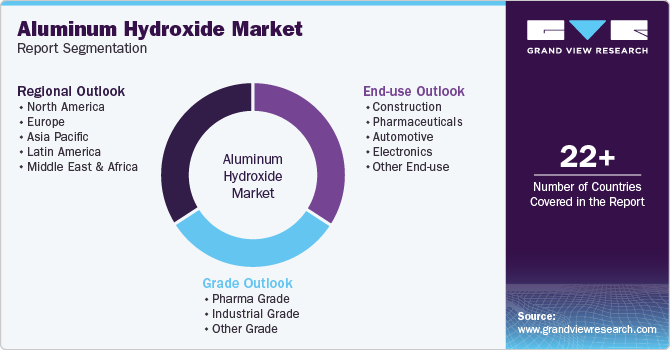 To learn more about this report, Download Free Sample Report
 -
Grade Outlook (Volume, Kilotons; Revenue, USD Million, 2021 - 2033)
-
Pharma Grade
-
Industrial Grade
-
Other Grade
-
-
End-use Outlook (Volume, Kilotons; Revenue, USD Million, 2021 - 2033)
-
Construction
-
Pharmaceuticals
-
Automotive
-
Electronics
-
Other End Uses
-
-
Regional Outlook (Volume, Kilotons; Revenue, USD Million, 2021 - 2033)
-
North America
-
U.S.
-
Canada
-
Mexico
-
-
Europe
-
Germany
-
UK
-
France
-
Italy
-
Spain
-
-
Asia Pacific
-
China
-
India
-
Japan
-
South Korea
-
-
Latin America
-
Brazil
-
Argentina
-
-
Middle East & Africa
-
Saudi Arabia
-
South Africa
-
-
Research Methodology
The aluminum hydroxide market figures in this report are based on a proven research process that combines executive interviews with secondary research from proprietary databases, company filings, and recognized regulatory and institutional sources. Market size is built through value-chain sizing - reconciling supply-side and demand-side estimates - and triangulated with bottom-up and top-down approaches. Every estimate passes multiple levels of expert validation before publication, with each aluminum hydroxide segment quantified using the revenue-capture definitions in the table below.
Segment Definition
Segment - Grade
Revenue capture definition
Industrial Grade
Revenue contribution stems from the widespread use of aluminum hydroxide in flame-retardant compounds, fillers, water treatment chemicals, plastics, rubber, ceramics, and other high-volume industrial processes.
Pharma Grade
Market earnings are linked to the supply of high-purity aluminum hydroxide for pharmaceutical formulations, vaccine adjuvants, antacids, and healthcare products requiring stringent quality specifications.
Other Grade
Commercial value is derived from specialty and customized aluminum hydroxide grades designed for advanced materials, specialty chemicals, coatings, laboratory applications, and niche industrial uses.
Segment - End Use
Revenue capture definition
Construction
Demand from construction activities drives revenue through the incorporation of aluminum hydroxide into cables, insulation materials, roofing products, sealants, coatings, and other fire-resistant building materials.
Pharmaceuticals
Revenue is supported by the consumption of pharmaceutical-grade aluminum hydroxide in medical formulations, antacid products, vaccine manufacturing, and healthcare applications.
Automotive
Financial value originates from the integration of aluminum hydroxide into automotive components, wire harnesses, cable insulation, engineering plastics, and lightweight materials requiring enhanced fire performance.
Electronics
Sales within this segment are generated using aluminum hydroxide in electrical cables, electronic enclosures, connectors, insulation systems, and flame-retardant electronic components.
Other End Use
Economic value is created through utilization across water treatment, ceramics, glass production, paper processing, chemical manufacturing, and various specialty industrial applications.
Estimation Model
Layer Name
Key Question
Description
Aluminum Hydroxide Production Layer
What forms is the supply base?
Identify global aluminum hydroxide production capacity based on the availability of bauxite reserves, alumina refining operations, precipitation technologies, processing facilities, purity grades, and manufacturing capabilities. This layer establishes the foundational supply base serving flame retardants, fillers, water treatment, pharmaceuticals, and specialty chemical applications worldwide.
Application Adoption Layer
Where is aluminum hydroxide utilized?
Estimate the proportion of aluminum hydroxide consumed across flame retardants, fillers, water treatment chemicals, pharmaceuticals, ceramics, glass manufacturing, and other industrial applications based on production volumes, regulatory requirements, technological developments, and regional demand patterns.
Consumption Intensity Layer
How much aluminum hydroxide is used?
Analyze application-specific consumption rates, polymer and cable manufacturing volumes, water treatment requirements, pharmaceutical production, industrial processing activities, and end-use industry adoption trends to determine annual aluminum hydroxide demand across major sectors and geographic markets.
Revenue Layer
How is market revenue generated?
Market revenue is generated through the sale of standard-grade, flame-retardant-grade, precipitated, ultra-fine, and high-purity aluminum hydroxide products supplied to plastics manufacturers, cable producers, construction material companies, water treatment operators, pharmaceutical manufacturers, and specialty chemical producers worldwide.
Delivered Customizations
This report has been delivered with the following In-depth customizations
Client Request
Customization Delivered
Value Adds
Cross-Segmentation Analysis
Detailed cross-segmentation assessment evaluating the relationship between aluminum hydroxide grades, end-use industries, and consumption patterns. Analysis identifies usage intensity, purity requirements, flame-retardant performance needs, filler functionality, regulatory considerations, and value contribution across intersecting segments such as industrial-grade aluminum hydroxide in construction materials, pharma-grade aluminum hydroxide in healthcare applications, and specialty grades in electronics and advanced industrial products.
Supports product portfolio optimization and market prioritization by identifying the most attractive grade-application combinations, enabling improved resource allocation, customer targeting, product development strategies, and long-term growth planning across the aluminum hydroxide value chain.
Competitive Benchmarking
Comparative evaluation of leading aluminum hydroxide manufacturers based on production capacity, product portfolio breadth, raw material integration, processing technologies, geographic footprint, distribution networks, sustainability initiatives, end-use specialization, customer relationships, and strategic developments across major regional markets.
Assists competitive intelligence, supplier evaluation, and partnership assessment by providing deeper visibility into market positioning, operational strengths, technological capabilities, differentiation strategies, cost competitiveness, and areas of sustainable competitive advantage.
Opportunity Assessment
Comprehensive assessment of emerging opportunities associated with halogen-free flame retardants, sustainable construction materials, electric vehicle components, advanced cable and wire applications, water treatment chemicals, pharmaceutical-grade products, and high-performance polymer formulations. Analysis also evaluates the impact of evolving environmental regulations and technological advancements on future demand.
Helps identify high-growth investment areas, emerging application segments, innovation priorities, and expansion opportunities, supporting revenue growth, market diversification, and long-term strategic positioning across the aluminum hydroxide value chain.
Frequently Asked Questions About This Report
Aluminum hydroxide contributes to sustainability by serving as a halogen-free and environmentally friendly flame retardant, helping manufacturers reduce reliance on hazardous flame-retardant chemicals. It produces low smoke emissions during combustion, supports compliance with stringent environmental regulations, and is increasingly used in green building materials, sustainable infrastructure projects, and eco-conscious industrial applications.
The global aluminum hydroxide market is expected to grow at a CAGR of 4.3% from 2026 to 2033, reaching USD 17.5 billion by 2033.
Asia Pacific dominated the aluminum hydroxide market with a share of 36.9% in 2025. This is attributable to increasing construction activity in the region
The global aluminum hydroxide market size was valued at USD 12.5 billion in 2025 and is estimated at USD 13.0 billion for 2026.
Some key players operating in the aluminum hydroxide market include Almatis, Alteo, ALUMINA - CHEMICALS & CASTABLES, Aluminum Corporation of China Ltd (Chalco), MAL - Magyar Alumnium, Sumitomo Chemical Co. Ltd., Huber Materials., Sibelco, LKAB Minerals AB, Donau Carbon GmbH,
Key factors that are driving the market growth include the increasing use of pharmaceuticals, water treatment, and flame retardants.
The industrial grade segment dominated the aluminum hydroxide market in 2025, accounting for 59.1% of the total market share.
The construction segment held the largest market share of 42.0% in 2025.
The automotive segment is projected to register the fastest growth, with a CAGR of 4.9% during the forecast period.
About the Author(s)
Petrochemicals Research Team
Bulk Chemicals · PetrochemicalsThis report was authored by the petrochemicals research team at Grand View Research - comprising two research analysts, one senior research analyst, and one industry expert - with specialized expertise in the petrochemicals segment of the bulk chemicals industry. All findings are based on proprietary bulk chemicals databases, executive interviews, and regulatory analysis, subject to internal peer review prior to publication.
Last Updated:
Speak to Analyst

Customize this report to your needs - add regions, segments, or data points, with 20% free customization.
Or view our licence options:


ISO 9001:2015 & 27001:2022 Certified
We are GDPR and CCPA compliant! Your transaction & personal information is safe and secure. For more details, please read our privacy policy.


