
- Home
- »
- Next Generation Technologies
- »
-
Audio AI Market Size, Share & Trends Report, 2026-2033GVR Report cover

Audio AI Market (2026 - 2033)
Size, Share & Trends Analysis Report By Deployment (Cloud, On-premises, Edge), By Technology (Speech & Voice Recognition, AI Voice Generation), By End-use (BFSI, Retail & E-commerce, IT & Telecommunication), By Region, And Segment Forecasts
Market Size, 2025
$28.9BMarket Estimate, 2026
$34.2BMarket Forecast, 2033
$117.5BCAGR, 2026–2033
19.3%Audio AI Market Summary
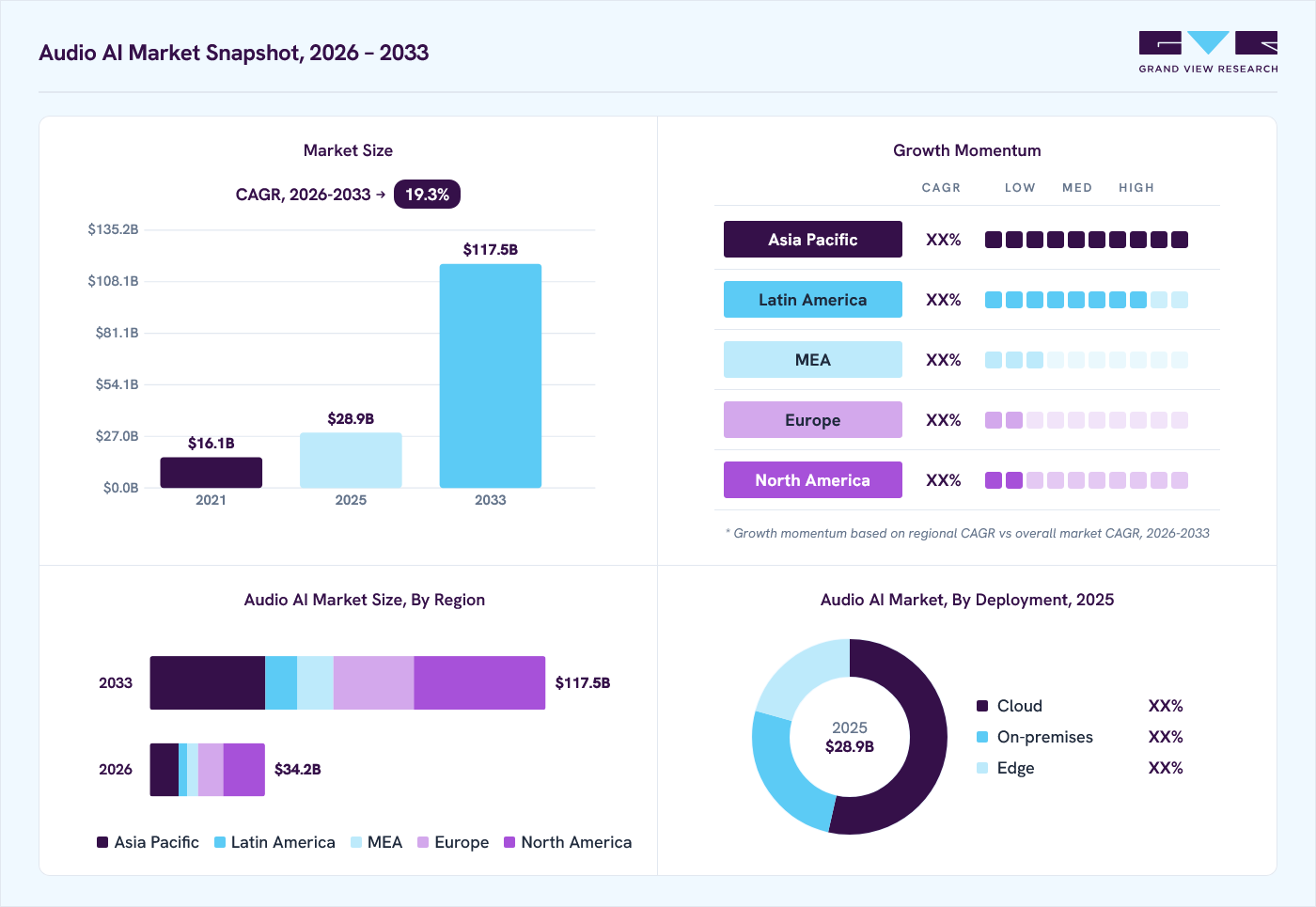
The global audio AI market size was valued at USD 28.9 billion in 2025 and is projected to grow from USD 34.2 billion in 2026 to USD 117.5 billion by 2033, at a CAGR of 19.3% from 2026 to 2033. North America dominated the market, accounting for the largest revenue share of 36.7% in 2025. The audio AI industry is shifting from individual speech recognition solutions to multimodal, generative AI-powered voice platforms that enable real-time, multilingual, and context-aware interactions across consumer, enterprise, and industrial applications.
 Source: Grand View Research, IR Documents, Primary Interviews, Paid DatabasesTo learn more about this report,
 Download Free Sample Report
 Key Market Trends & Insights
- By deployment: The cloud segment dominated the market, with a revenue share of 53.5% in 2025.
- By technology: The speech & voice recognition segment held the largest market share of 32.5% in 2025.
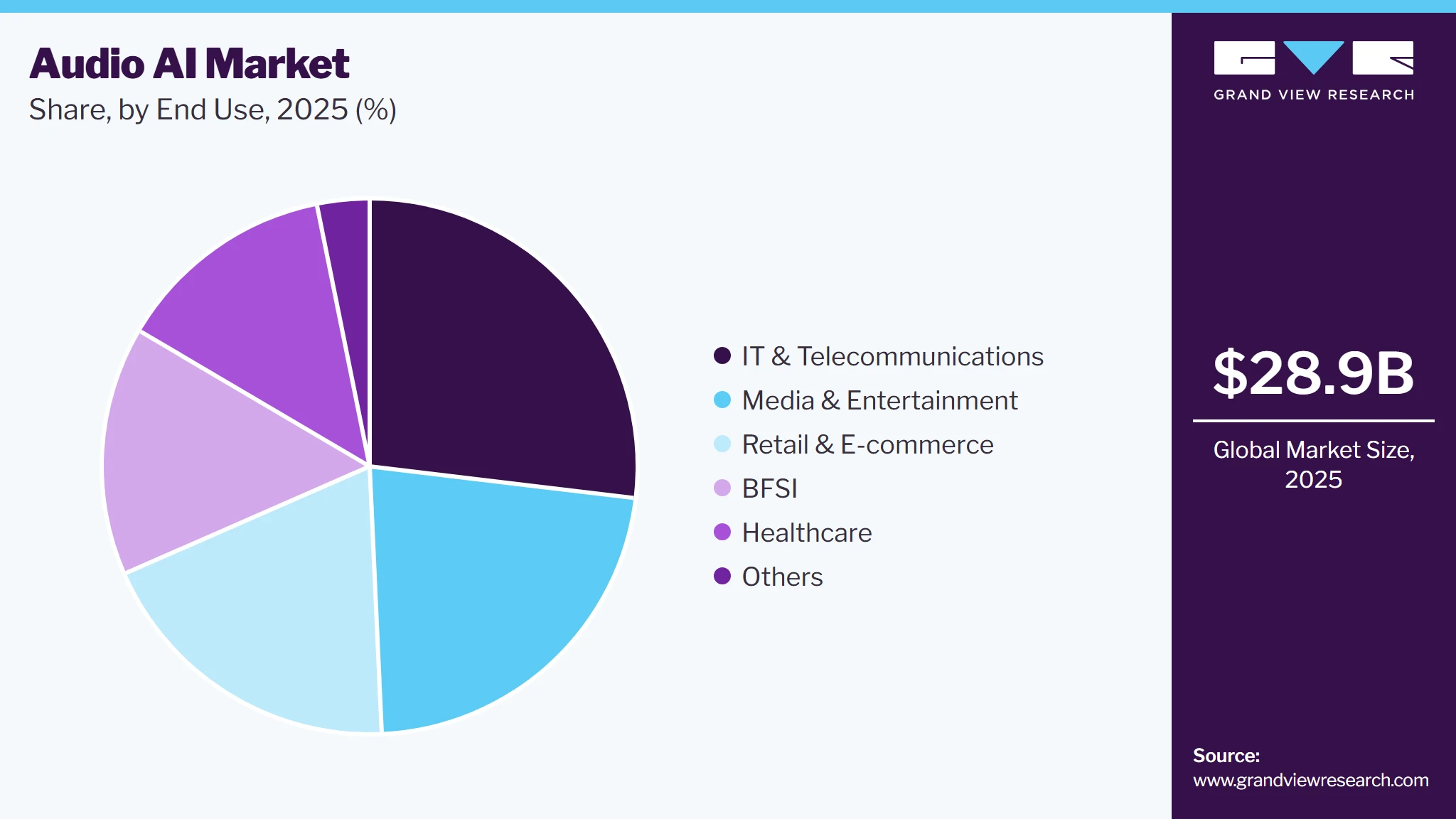
- By end-use: The IT & telecommunications segment held the largest market share of 26.9% in 2025.
Regional Highlights
- Largest regional market: North America (36.7% revenue share, 2025)
- Fastest-growing regional market: Asia Pacific (highest CAGR, 2026-2033)
- By country: The U.S. held the largest market share in 2025.
Market Size & Forecast
- Market size in 2025: USD 28.9 Billion
- Estimated market size in 2026: USD 34.2 Billion
- Projected market size by 2033: USD 117.5 Billion
- CAGR (2026-2033): 19.3%
Three ways to get this report
Buy it, customize it, or ask a question.Ask an Analyst
Analyst response in 1 business day
- AccessReport author, directly
- Reply timeWithin 1 working day
- No sales callDirect answer only
- FormatEmail reply
- CostFree, no cost
Get the Full Report
What the study covers
- FormatsPDF · Excel · Dashboard
- Timeline2026–2033 annual, 2025 base
- Coverage20+ countries, 5 regions
- Companies10+ key players profiled
Customize the Report
20% free customization
- IncludeCountries, segments, points
- TailorTo your product definition
- ExtendDeeper competitor detail
- OrA fully bespoke study
- Turnaround5–10 working days
The growing use of voice-enabled devices and applications is a major factor supporting the audio AI market. Smart speakers, smartphones, connected vehicles, wearable devices, and enterprise collaboration platforms are increasingly integrating AI-based voice capabilities to enable faster, more natural user interactions. Businesses are also adopting voice interfaces to simplify customer engagement and improve employee productivity. As consumers become more comfortable with voice-based communication, organizations continue to expand the use of Audio AI across digital services. This steady increase in voice-first experiences is driving demand for advanced speech recognition and voice processing technologies.The other factor that is driving the market is the organizations that are increasingly using audio AI to improve customer service and gain deeper insights from voice conversations. AI-powered speech analytics enables businesses to transcribe calls, identify customer sentiment, detect keywords, and monitor agent performance in real time. Contact centers are adopting intelligent virtual agents and voice assistants to manage routine queries, reduce response times, and improve service efficiency. These capabilities help organizations lower operational costs while enhancing customer experience, and as enterprises continue to digitize customer interactions, the demand for Audio AI solutions is expanding across multiple industries.
 To learn more about this report, Download Free Sample Report
 Furthermore, the continuous innovation in generative AI and speech models is improving the accuracy and capabilities of Audio AI solutions. Modern AI models support high-quality speech recognition, natural voice synthesis, voice translation, and multilingual communication with improved understanding of different accents and dialects. These advancements enable organizations to create localized voice experiences and expand services across global markets. Industries such as media, education, healthcare, and enterprise communications are using these capabilities to deliver more personalized and accessible audio experiences, as AI models become more efficient and cost-effective, audio AI adoption continues to grow across a wider range of applications.
Market Dynamics
The rapid growth of digital content across streaming platforms, social media, podcasts, gaming, and online education is increasing the demand for AI-powered audio production tools. Content creators and media companies are adopting audio AI to automate voice generation, audio editing, dubbing, transcription, and sound enhancement, reducing production time and operational costs. Advancements in synthetic voice technology and AI-based audio processing also enable organizations to produce high-quality, multilingual content at scale while maintaining consistency. As businesses continue to expand their digital media strategies and personalized content offerings, the adoption of audio AI solutions for content creation and production is growing across global markets.
Although Audio AI has advanced significantly, maintaining consistent speech recognition accuracy across different languages, regional accents, dialects, and speaking styles remains a challenge. Background noise, overlapping conversations, and poor audio quality can further reduce the performance of speech recognition and voice analysis systems. This limitation can result in incorrect transcriptions, misunderstanding of user intent, and inconsistent customer experiences in real-world environments. Organizations often need additional model training, localization, and continuous performance tuning to improve accuracy, increasing deployment complexity and operational costs.
The healthcare sector is creating significant opportunities for the audio AI market through the growing adoption of AI-powered speech technologies in clinical and administrative workflows. Hospitals, clinics, and telehealth providers are using speech recognition and voice assistants to document patient interactions, generate clinical notes, and support hands-free access to medical information. These capabilities help reduce administrative workload, improve documentation accuracy, and allow healthcare professionals to spend more time on patient care. Moreover, advancements in medical speech recognition and secure voice processing are expanding the use of audio AI across diagnostics, remote patient monitoring, and virtual healthcare services. Support for multiple languages and medical terminologies enables healthcare organizations to serve diverse patient populations more effectively. As healthcare providers continue investing in digital transformation, the demand for audio AI solutions across clinical environments continues to grow.
Market Concentration & Characteristics
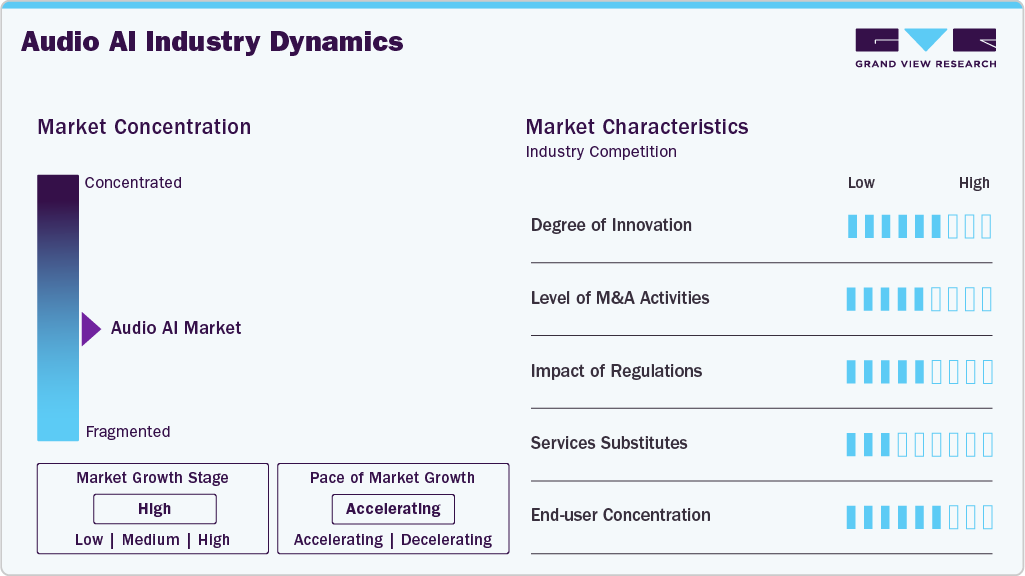
The market demonstrates a high level of innovation driven by rapid advancements in generative AI, large audio models, speech synthesis, and real-time voice processing. Companies are continuously introducing new capabilities such as multilingual speech recognition, voice cloning, emotion detection, and low-latency conversational AI, with ongoing investments in AI model development and edge AI, are expanding the range of commercial applications. This continuous innovation supports broader adoption across enterprise and consumer markets.
 To learn more about this report, Download Free Sample Report
 Regulations have a moderate influence on the audio AI market, particularly in areas related to data privacy, AI governance, voice authentication, and responsible AI deployment. Organizations are adopting secure data processing and transparent AI practices to comply with regional regulations. Requirements for user consent, biometric data protection, and AI accountability are shaping product development and deployment strategies. As regulatory frameworks continue to evolve, vendors are placing greater emphasis on compliance and security.
Analyst Perspective
The audio AI market is moving beyond individual speech recognition into a foundational enterprise technology that powers customer engagement, content creation, healthcare documentation, enterprise collaboration, and intelligent automation. The market's long-term value lies in combining speech recognition, voice synthesis, multilingual translation, and conversational intelligence within a unified AI platform that supports real-time, context-aware interactions across industries. As enterprises integrate generative AI into business workflows, competitive differentiation increasingly depends on model accuracy, multilingual performance, low-latency processing, and seamless integration with cloud ecosystems and enterprise applications. Vendors capable of delivering secure, scalable, and industry-specific audio AI platforms across the entire voice lifecycle are positioned to capture sustained enterprise spending and establish long-term customer relationships.
Deployment Insights
The cloud segment led the market in 2025, accounting for 53.5% of global revenue, due to its ability to support large-scale AI model training, real-time speech processing, and enterprise-wide accessibility. Cloud platforms enable organizations to deploy voice assistants, speech analytics, transcription, and multilingual AI services without extensive on-premises infrastructure. Integration with AI platforms and GPU-based computing improves processing efficiency for complex audio workloads. For instance, in February 2026, ElevenLabs collaborated with Google Cloud to expand its AI voice platform using Google Cloud's AI infrastructure and NVIDIA Blackwell GPU-powered G4 virtual machines.
The edge segment is the fastest-growing segment during the forecast period, as organizations require low-latency audio processing, improved privacy, and uninterrupted performance in connected environments. Running AI models directly on devices enables faster speech recognition and voice interactions without relying on continuous internet connectivity. This deployment model is gaining adoption in automotive systems, smart devices, industrial equipment, and healthcare applications, where real-time responses are essential, with continuous improvements in edge AI chips and on-device processing capabilities increasing the adoption of edge-based audio AI solutions.
Technology Insights
The speech & voice recognition segment led the market with the largest revenue share of 32.5% in 2025, driven by widespread adoption across organizations integrating speech recognition to automate transcription, enable voice-based commands, and improve customer interactions through faster, more accurate responses. For instance, in August 2026, Speech Processing Solutions introduced the Philips SpeechLive Legal AI Assistant, enabling legal professionals to convert voice recordings, dictation, and supporting documents into structured legal drafts using AI-powered speech recognition tailored for legal terminology. The growing use of voice-enabled applications in smart devices and digital workplaces continues to support demand for this technology.
The AI voice generation segment is expected to grow at the fastest CAGR during the forecast period, as enterprises adopt synthetic voice technologies for content creation, virtual assistants, customer engagement, and media production. Businesses are investing in using AI-generated voices to produce localized content, automate voiceovers, and deliver consistent brand communication across multiple channels. For instance, in August 2026, Smallest.ai secured USD 21 million in total funding following a Series A round and introduced its Voice 4.0 platform, alongside the Hydra asynchronous AI architecture, for enterprise voice applications. Rising demand for scalable, multilingual, and personalized voice experiences continues to support the growth of this segment.
End-use Insights
The IT & telecommunications segment led the market with the largest revenue share of 26.9% in 2025, due to the growing demand for intelligent customer interactions and network support automation. Telecom providers are integrating AI-powered voice assistants, interactive voice response (IVR) systems, and speech analytics to improve customer service efficiency and reduce call handling time. Audio AI also supports real-time multilingual communication and automated technical assistance across digital service channels. For instance, in May 2026, Krisp introduced VIVA 2.0, a voice infrastructure platform designed for voice AI agents, IVRs, and conversational AI applications, including real-time audio intelligence capabilities such as turn prediction, interruption detection, and speech signal analysis, as well as multilingual interactions and synthetic speech detection.
 To learn more about this report, Download Free Sample Report
 The healthcare segment is anticipated to exhibit the fastest CAGR over the forecast period. This segment is driven by the need to improve clinical documentation, patient engagement, and administrative efficiency. AI-powered speech recognition enables healthcare professionals to generate medical notes, update electronic health records, and reduce manual documentation efforts. Hospitals and telehealth providers are also using voice-enabled virtual assistants to support appointment scheduling, patient inquiries, and remote consultations. For instance, in May 2025, SoundHound AI and Allina Health introduced Alli, an AI-powered patient engagement agent designed to support healthcare customer service. The solution integrates with the health system's electronic medical records to verify patient identity, schedule appointments, and handle routine inquiries through automated voice interactions.
Regional Insights
North America dominated the audio AI market, with the largest revenue share at 36.7% in 2025, driven by the early commercialization of generative AI and strong investments in enterprise AI infrastructure. Organizations across customer service, media, automotive, and financial services are integrating advanced speech technologies into digital operations. The presence of major AI developers and cloud service providers supports continuous product innovation and large-scale deployments.
 To learn more about this report, Download Free Sample Report
 U.S. Audio AI Market Trends
The audio AI market in the U.S. is supported by the rapid adoption of audio AI across healthcare, enterprise software, contact centers, and content creation platforms. Companies are investing in large audio models, real-time speech processing, and AI-driven voice generation to enhance business productivity and digital experiences. Strong collaboration between AI software developers, semiconductor companies, and cloud infrastructure providers enables faster commercialization of advanced audio technologies.
Europe Audio AI Market Trends
The audio AI market in Europe is driven by increasing focus on multilingual communication and regulatory-compliant AI solutions. Enterprises are adopting speech recognition and voice analytics to serve customers across diverse languages while meeting data privacy and governance requirements. Growing digitalization across public services, banking, and manufacturing is expanding the use of AI-powered voice applications. The region also benefits from increasing investments in responsible AI and secure speech processing technologies.
Asia Pacific Audio AI Market Trends
The audio AI market in the Asia Pacific is experiencing rapid audio AI adoption due to expanding digital economies, rising smartphone penetration, and growing demand for localized voice technologies. Businesses are introducing AI-powered voice assistants and speech interfaces that support regional languages and dialects to improve accessibility for customers. The expansion of e-commerce, digital banking, and online education is creating additional demand for voice-enabled applications.
Key Audio AI Company Insights
Some key players in the Audio AI market, such as ElevenLabs, Google LLC, Microsoft Corporation, and others.
-
ElevenLabs develops AI-powered voice technologies focused on speech synthesis, voice cloning, multilingual dubbing, and conversational AI. Its platform enables enterprises, developers, publishers, and media companies to create realistic digital voices for content production and customer engagement. The company supports voice generation across multiple languages with an emphasis on natural speech quality and scalability. Its solutions are used in media localization, audiobooks, gaming, education, and enterprise communication.
-
Google LLC develops artificial intelligence technologies that support speech recognition, voice synthesis, conversational AI, and multilingual language processing across consumer and enterprise applications. Its AI ecosystem integrates advanced audio capabilities into cloud services, productivity platforms, mobile devices, and digital assistants. The company continues to expand generative AI models that improve voice interactions and real-time speech understanding. Its broad AI portfolio supports organizations across healthcare, retail, media, financial services, and telecommunications.
Key Audio AI Companies:
The following key companies have been profiled for this study on the audio AI market:
-
Google LLC
-
Microsoft Corporation
-
Amazon Web Services, Inc.
-
NVIDIA Corporation
-
IBM Corporation
-
SoundHound AI, Inc.
-
ElevenLabs
-
Deepgram, Inc.
-
Speechmatics
-
Cerence Inc.
Competitive Benchmarking
Category
Operating Strategies
Competitive Edge
Weakness
Established Players (Google LLC; Microsoft Corporation; Amazon Web Services, Inc.; NVIDIA Corporation; IBM Corporation; Cerence Inc.)
- Focus on expanding enterprise-grade Audio AI platforms through continuous AI model development and cloud ecosystem integration.
- Strengthen market presence through strategic partnerships, industry-specific solutions, and investment in multilingual and generative voice technologies.
- Broad AI portfolios, extensive computing infrastructure, and established enterprise customer networks support large-scale deployments.
- Strong R&D capabilities and integrated software ecosystems enable comprehensive Audio AI offerings across multiple industries.
- Large product portfolios can increase implementation complexity and extend deployment timelines for customers.
- Premium pricing and enterprise-focused solutions may limit adoption among small and medium-sized organizations.
Emerging Players (SoundHound AI, Inc.; ElevenLabs; Deepgram, Inc.; Speechmatics)
- Focus on specialized Audio AI capabilities, including voice synthesis, speech recognition, speech analytics, and conversational intelligence.
- Expand through API-based platforms, developer ecosystems, and collaborations with cloud providers and enterprise software vendors.
- Agile product development enables faster innovation and the rapid introduction of advanced voice technologies.
- High specialization delivers superior performance in niche applications such as voice generation, transcription, and multilingual speech processing.
- Limited global sales reach and smaller customer bases compared with diversified technology companies.
- Dependence on external cloud infrastructure and competitive pricing pressure can affect long-term market expansion.
Recent Developments
-
In June 2026, Microsoft AI introduced MAI-Voice-2, a multilingual text-to-speech model featuring expressive speech synthesis, emotion control, and zero-shot voice adaptation using short reference audio. The model supports 15 languages, maintains consistent speaker identity across long-form content, and incorporates consent-based safeguards for responsible voice generation.
-
In May 2026, Yellow.ai launched Nexus Vox, an enterprise voice AI platform that integrates speech recognition, conversational AI, voice synthesis, and telephony into a single system, reducing latency and simplifying voice automation deployment. It supports voice cloning from a 10-second audio sample and enables deployment across more than 500 languages and dialects for multilingual voice experiences.
-
In August 2025, SoundHound AI launched Vision AI, an advanced visual understanding engine integrated with its conversational AI platform, combining voice and camera-based perception for real-time, context-aware interactions. The platform enables enterprises to deploy multimodal AI across automotive, retail, industrial, kiosk, and embedded environments, supporting applications such as equipment troubleshooting, retail inventory intelligence, and in-car assistants.
Audio AI Market Report Scope
Report Attribute
Details
Market size in 2025
USD 28.9 billion
Estimated market size in 2026
USD 34.2 billion
Projected market size by 2033
USD 117.5 billion
Growth rate
CAGR of 19.3% from 2026 to 2033
Base Year
2025
Actual data
2021 - 2024
Forecast period
2026 - 2033
Quantitative units
Revenue in USD billion and CAGR from 2026 to 2033
Report coverage
Revenue forecast, company ranking, competitive landscape, growth factors, and trends
Segments covered
Deployment, technology, end-use, region
Regional scope
North America; Europe; Asia Pacific; Latin America; MEA
Country scope
U.S.; Canada; Mexico; UK; Germany; France; China; India; Japan; South Korea; Australia; Brazil; Saudi Arabia; South Africa; UAE
Key companies profiled
Google LLC; Microsoft Corporation; Amazon Web Services, Inc.; NVIDIA Corporation; IBM Corporation; SoundHound AI, Inc.; ElevenLabs; Deepgram, Inc.; Speechmatics; Cerence Inc.
Customization scope
Free report customization (equivalent up to 8 analysts working days) with purchase. Addition or alteration to country, regional & segment scope.
Pricing and purchase options
Avail customized purchase options to meet your exact research needs. Explore purchase options
Global Audio AI Market Report Segmentation
This report forecasts revenue growth at global, regional, and country levels and provides an analysis of the latest industry trends in each of the sub-segments from 2021 to 2033. For this study, Grand View Research has segmented the global audio AI market report based on deployment, technology, end-use, and region:
 To learn more about this report, Download Free Sample Report
 -
Deployment Outlook (Revenue, USD Billion, 2021 - 2033)
-
Cloud
-
On-premises
-
Edge
-
-
Technology Outlook (Revenue, USD Billion, 2021 - 2033)
-
Speech & Voice Recognition
-
AI Voice Generation
-
Audio Processing & Enhancement
-
Speech Understanding & Analytics
-
Audio AI Platforms & Infrastructure
-
-
End-use Outlook (Revenue, USD Billion, 2021 - 2033)
-
BFSI
-
Retail & E-commerce
-
IT & Telecommunication
-
Healthcare
-
Media & Entertainment
-
Others
-
-
Regional Outlook (Revenue, USD Billion, 2021 - 2033)
-
North America
-
U.S.
-
Canada
-
Mexico
-
-
Europe
-
UK
-
Germany
-
France
-
-
Asia Pacific
-
China
-
India
-
Japan
-
Australia
-
South Korea
-
-
Latin America
-
Brazil
-
-
MEA
-
UAE
-
South Africa
-
KSA
-
-
Research Methodology
The audio AI market figures in this report are based on a proven research process that combines executive interviews with secondary research from proprietary databases, company filings, and recognized regulatory and institutional sources. Market size is built through value-chain sizing-reconciling supply-side and demand-side estimates-and triangulated with bottom-up and top-down approaches. Every estimate passes multiple levels of expert validation before publication, with each audio AI segment quantified using the revenue-capture definitions in the table below.
Segment Definition
Segment - Deployment
Revenue capture definition
Cloud
Revenue is captured from subscription-based Software-as-a-Service (SaaS), API usage, cloud-hosted voice processing, and managed AI services. Growth is supported by enterprise demand for scalable deployment, remote access, and continuous model updates.
On-premises
Revenue is generated through software licensing, infrastructure deployment, implementation services, and long-term maintenance contracts. Adoption remains strong among organizations requiring complete control over sensitive voice data and system environments.
Edge
Revenue is derived from AI software deployed directly on devices, embedded voice processing platforms, and edge-enabled hardware solutions. Increasing use of low-latency voice applications in automotive, consumer electronics, and industrial systems supports this segment's expansion.
Segment - Technology
Revenue capture definition
Speech & Voice Recognition
Revenue is generated from software and cloud services that convert spoken language into text or executable commands for enterprise and consumer applications. Adoption is driven by contact centers, virtual assistants, healthcare documentation, and automotive voice interfaces.
AI Voice Generation
This segment captures revenue from AI solutions that generate natural-sounding synthetic speech for digital content, customer engagement, and virtual assistants. Demand comes from media production, audiobooks, gaming, education, and multilingual content creation.
Audio Processing & Enhancement
Revenue includes AI technologies that improve audio quality through noise reduction, speech enhancement, echo cancellation, and sound optimization. These solutions are widely used in communication platforms, hearing devices, conferencing systems, and broadcasting.
Speech Understanding & Analytics
This segment generates revenue from AI platforms that analyze spoken conversations to identify sentiment, intent, keywords, speaker characteristics, and compliance insights. Enterprises deploy these solutions across contact centers, financial services, healthcare, and customer experience management.
Audio AI Platforms & Infrastructure
Revenue is derived from AI platforms, cloud infrastructure, APIs, and development frameworks that support the training, deployment, and management of audio AI applications. These platforms enable developers and enterprises to build scalable voice-enabled solutions across diverse industries.
Segment - End Use
Revenue capture definition
Media & Entertainment
Revenue is generated from AI-powered voice synthesis, dubbing, audiobooks, podcasts, voiceovers, and content localization services. Growing demand for multilingual digital content and automated media production supports spending in this segment.
BFSI
Revenue comes from speech analytics, voice biometrics, conversational banking, and AI-enabled customer support solutions. Financial institutions invest in audio AI to improve service efficiency, fraud detection, and customer authentication.
Healthcare
Revenue is driven by clinical documentation, medical transcription, telehealth interactions, and AI-powered virtual assistants. Healthcare providers adopt audio AI to improve workflow efficiency and patient communication.
IT & Telecommunications
Revenue is derived from intelligent virtual agents, speech analytics, voice-enabled collaboration platforms, and technical support automation. Enterprises integrate audio AI to enhance customer interactions and streamline communication services.
Retail & E-commerce
Revenue is supported by AI-powered shopping assistants, voice commerce, customer service automation, and personalized product recommendations. Retailers use audio AI to improve customer engagement across digital sales channels.
Others
Revenue is generated through voice-enabled navigation, digital learning, citizen services, industrial automation, travel assistance, legal transcription, and smart consumer devices. Expanding voice-enabled applications across these industries contributes to steady market demand.
Estimation Model
Layer Name
Key Questions
Description
Adoption Layer
Who uses Audio AI solutions?
Identify enterprises, developers, content creators, and public organizations adopting Audio AI across industries. This establishes the addressable customer base for Audio AI software, platforms, and services.
Deployment Layer
How widely is audio AI implemented?
Apply enterprise AI adoption rates and deployment across cloud and on-premises environments to estimate the number of active Audio AI implementations. This converts the addressable customer base into active solution deployments.
Application Layer
Where is audio AI used?
Measure the distribution of Audio AI across speech recognition, voice assistants, speech analytics, content creation, healthcare documentation, customer service, and other enterprise applications. This reflects solution penetration across end-use industries and use cases.
Monetization Layer
How much revenue is generated?
Apply average spending on Audio AI software, cloud subscriptions, APIs, platform licensing, professional services, and support contracts to estimate total market revenue across all deployment models and industries.
Delivered Customizations
This report has been delivered with the following In-depth customizations
Client Request
Customization Delivered
Value Adds
Market Entry & Expansion Assessment
Regional demand sizing and forecasting
Customer segmentation and buying behavior analysis
Competitive landscape benchmarking
Regulatory and distribution channel assessment
Identified high-growth market opportunities
Supported go-to-market strategy development
Highlighted investment priorities and risks
Enabled data-driven expansion planning
Technology & Innovation Assessment
Emerging technology trend analysis
Innovation pipeline
Technology adoption readiness assessment
Ecosystem and partnership mapping
Identified future growth areas
Supported innovation roadmap planning
Evaluated commercialization potential
Strengthened strategic partnership decisions
Customer & End-User Insights Study
Consumer awareness and adoption analysis
Purchase decision journey mapping
Satisfaction and loyalty assessment
Usage pattern and pain-point evaluation
Revealed key adoption drivers and barriers
Supported customer-centric product development
Improved targeting and engagement strategy
Identified opportunities for retention and upselling
Frequently Asked Questions About This Report
The global audio AI market is expected to grow at a CAGR of 19.3% from 2026 to 2033 to reach USD 117.5 billion by 2033.
Cloud held the largest revenue share of 53.5% in 2025, while Edge is the fastest growing segment.
North America dominated the audio AI market with a share of 36.7% in 2025.
Some key players operating in the Audio AI market include Google LLC; Microsoft Corporation; Amazon Web Services, Inc.; NVIDIA Corporation; IBM Corporation; SoundHound AI, Inc.; ElevenLabs; Deepgram, Inc.; Speechmatics; Cerence Inc.
The global audio AI market size was estimated at USD 28.9 billion in 2025 and is projected to grow from USD 34.2 billion in 2026.
The audio AI market is shifting from individual speech recognition solutions to multimodal, generative AI-powered voice platforms that enable real-time, multilingual, and context-aware interactions across consumer, enterprise, and industrial applications.
Asia Pacific is the fastest-growing region over the forecast period.
The speech & voice recognition segment led with a 32.5% revenue share in 2025, while AI voice generation is the fastest growing segment.
IT & Telecommunications held the largest revenue share of 26.9% in 2025, while healthcare is the fastest growing segment.
About the Author(s)
Next Generation Technologies Research Team
Technology · Next Generation TechnologiesThis report was authored by the next generation technologies research team at Grand View Research - comprising two research analysts, one senior research analyst, and one industry expert - with specialized expertise in the next generation technologies segment of the technology industry. All findings are based on proprietary technology databases, executive interviews, and regulatory analysis, subject to internal peer review prior to publication.
Last Updated:
Speak to Analyst

Customize this report to your needs - add regions, segments, or data points, with 20% free customization.
Or view our licence options:


ISO 9001:2015 & 27001:2022 Certified
We are GDPR and CCPA compliant! Your transaction & personal information is safe and secure. For more details, please read our privacy policy.


