
- Home
- »
- Automotive & Transportation
- »
-
Automotive Control Panel Market Size Report, 2026-2033GVR Report cover

Automotive Control Panel Market (2026 - 2033)
Size, Share & Trends Analysis Report By Type (Manual, Push Button), By Application (Passenger Cars, Heavy Commercial Vehicle), By Region (North America; Europe; Asia Pacific; Latin America; Middle East & Africa), And Segment Forecasts
Market Size, 2025
$124.5BMarket Estimate, 2026
$131.8BMarket Forecast, 2033
$208.6BCAGR, 2026–2033
6.8%Automotive Control Panel Market Summary
The global automotive control panel market size was valued at USD 124.5 billion in 2025 and is projected to grow from USD 131.8 billion in 2026 to USD 208.6 billion by 2033, at a CAGR of 6.8% from 2026 to 2033. Asia Pacific dominated the global market with the largest revenue share of 35.9% in 2025. An automotive control panel is a central interface within a vehicle that allows drivers and passengers to interact with various vehicle systems and functions.
 Source: Grand View Research, IR Documents, Primary Interviews, Paid DatabasesTo learn more about this report,
 Download Free Sample Report
 Key Market Trends & Insights
- By type: Manual control panel segment dominated the market, with a revenue share of 37.4% in 2025
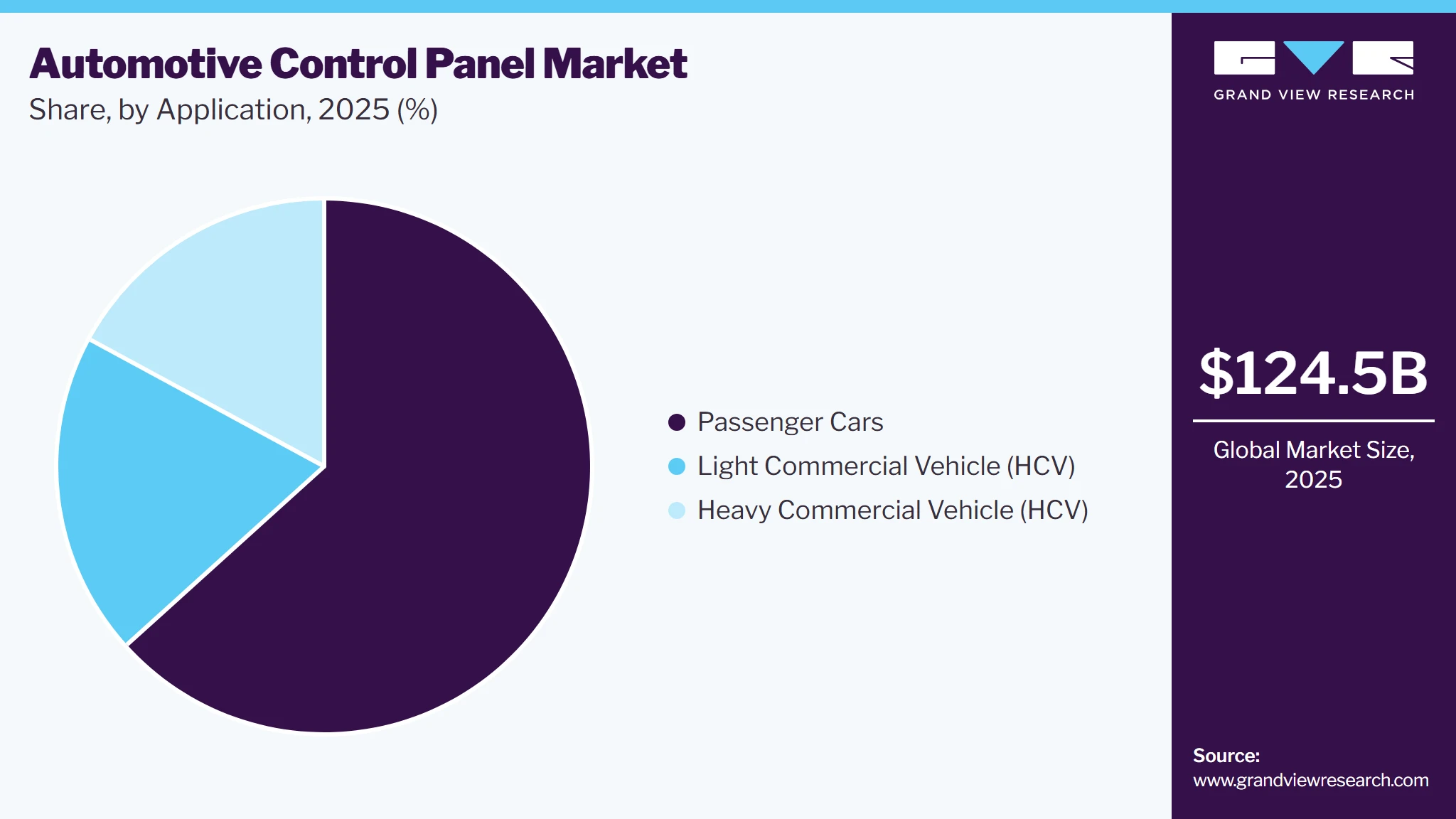
- By application: Passenger cars segment held the largest revenue share of 63.3% in 2025
Regional Highlights
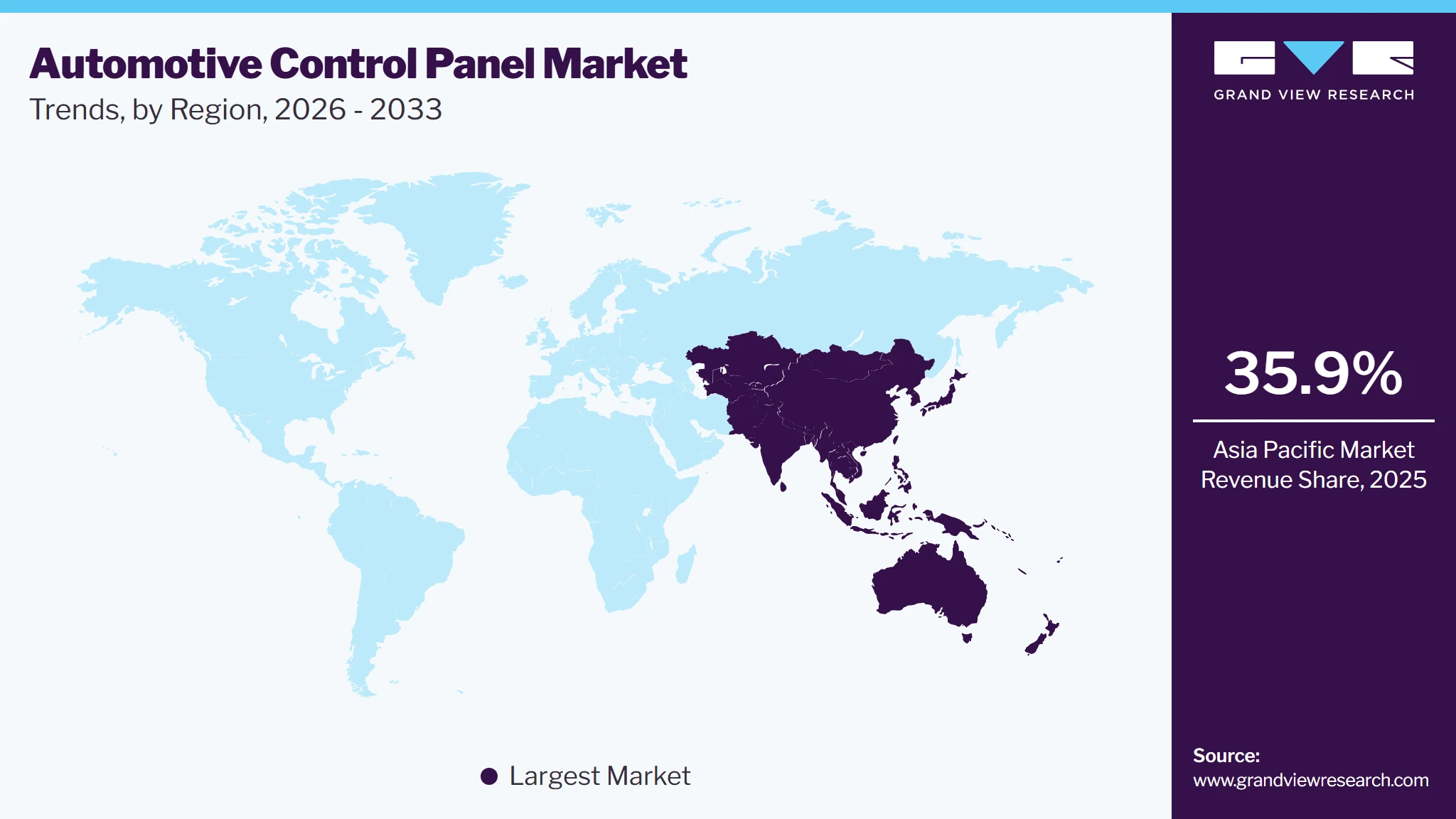
- Largest regional market: Asia Pacific (35.9% revenue share, 2025)
- By country: China held the largest market share in 2025.
Market Size & Forecast
- Market size in 2025: USD 124.5 Billion
- Estimated market size in 2026: USD 131.8 Billion
- Projected market size by 2033: USD 208.6 Billion
- CAGR (2026-2033): 6.8%
Three ways to get this report
Buy it, customize it, or ask a question.Ask an Analyst
A direct answer, usually in 1 working day
- AccessReport author, directly
- Reply timeWithin 1 working day
- No sales callDirect answer only
- FormatEmail reply
- CostFree, no cost
Get the Full Report
What the study covers
- FormatsPDF · Excel · Dashboard
- Timeline2026–2033 annual, 2025 base
- Coverage20+ countries, 5 regions
- Companies10+ key players profiled
Customize the Report
20% free customization
- IncludeCountries, segments, points
- TailorTo your product definition
- ExtendDeeper competitor detail
- OrA fully bespoke study
- Turnaround5–10 working days
It typically includes a range of controls and displays for managing essential functions, providing information, and enhancing the overall driving experience. Technological advancements and evolving consumer preferences drive market growth. In addition, the increasing integration of digital and touchscreen interfaces, which provides a streamlined and interactive user experience, is also driving the market’s growth.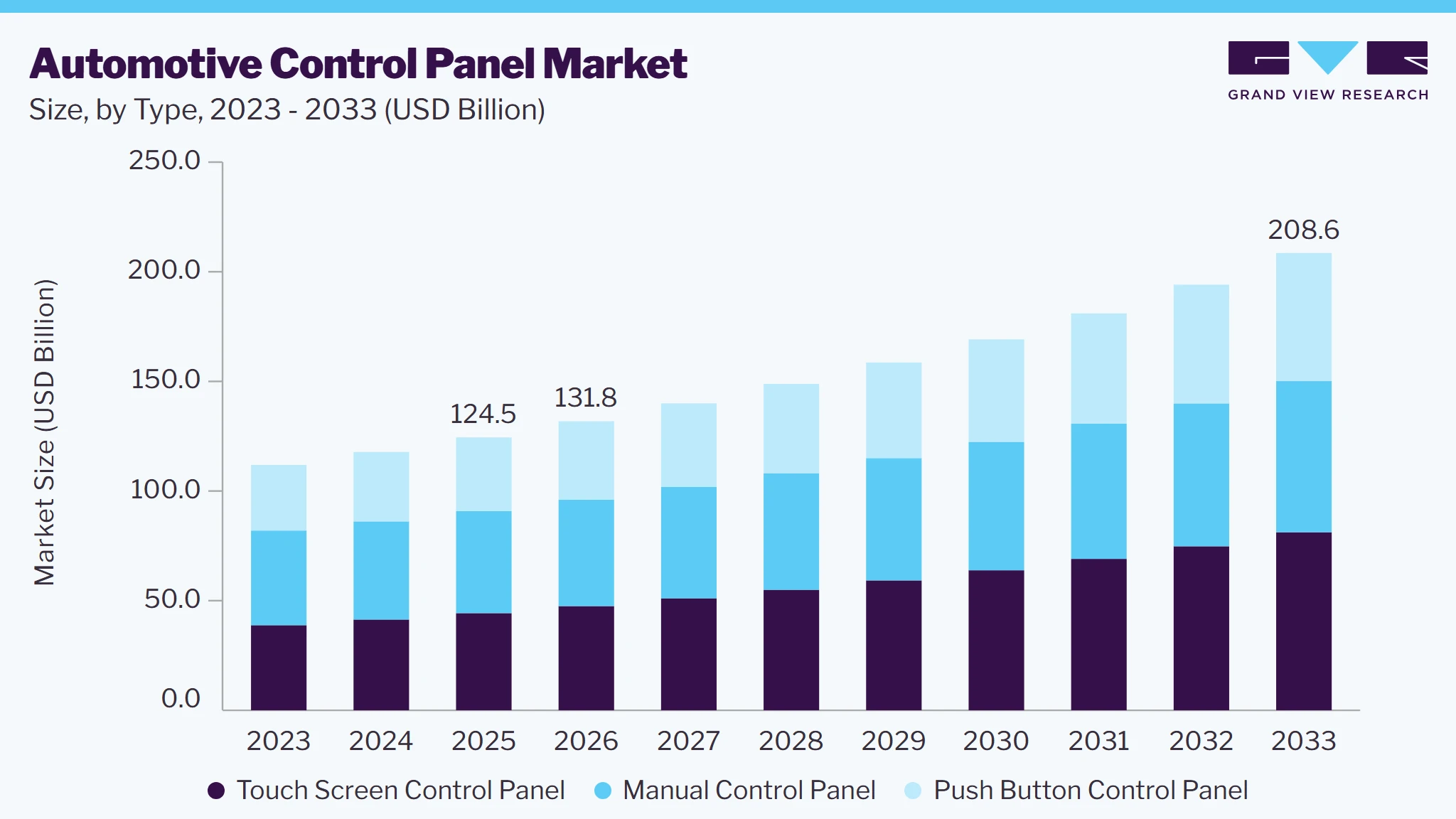 To learn more about this report, Download Free Sample Report
 The transition to electric vehicles (EVs) is transforming the automotive industry, increasing demand for specialized equipment such as control panels. The adoption of EVs significantly drives the demand for automotive control panels, as they require specialized interfaces to manage battery status, charging processes, and energy efficiency. Control panels in EVs often feature unique displays and controls tailored to these needs, such as real-time battery life indicators, charging station locators, and energy consumption analytics. Furthermore, the growing production and sales of EVs, rising emphasis on cabin comfort and convenience, and the increasing need for application-based improvements further propel market growth.
Capacitive touch technology can be easily integrated into automotive dashboards and control panels. These touch screens offer a user interface familiar to drivers and passengers, representing the touch gestures on everyday devices such as smartphones. This familiarity enhances the user experience and simplifies the operation of various vehicle functions. In addition, capacitive touch screens are versatile and can display various information and controls, including infotainment, navigation systems, climate control, and vehicle settings. Modern capacitive touch screens are built to endure the demands of daily use, featuring scratch-resistant and shatterproof surfaces, which ensures durability and minimizes maintenance costs for vehicle manufacturers. Thus, the rising integration of capacitive touch screen technology in automotive control panels owing to its benefits, such as intuitive interface, multi-functionality, improved durability, and sleek and modern design, is fueling the market’s growth.
Furthermore, enhanced connectivity and infotainment systems are a major trend in automotive control panels, driven by consumer demand for seamless integration with mobile devices and internet-based services. Modern control panels are increasingly equipped with platforms such as Apple CarPlay and Android Auto and built-in connectivity features that allow drivers to access navigation, music, and communication apps directly from the panel. This trend highlights a growing demand for a connected driving experience, allowing users to seamlessly sync their smartphones and other devices with the vehicle's systems. As connectivity technologies advance, automotive control panels are poised to offer even more sophisticated features, such as over-the-air updates, cloud-based services, and expanded app ecosystems, driving the market's growth.
Despite their advancements, automotive control panels face several challenges that could hamper the market’s growth. One major drawback is their complexity, particularly with digital touchscreens that provide drivers with multiple menus and options, leading to potential distractions and decreased focus on driving. Reliability can also be a concern, as digital systems are prone to software glitches and touch sensitivity problems, which can impair functionality and safety if the system malfunctions. Moreover, the cost of these advanced control panels is higher regarding initial production and potential repairs, making vehicles more expensive to own and maintain.
Market Dynamics
The automotive control panel market is shaped by rapid vehicle electrification, increasing cockpit digitization, and evolving human machine interface (HMI) requirements across passenger and commercial vehicles. OEMs are increasingly integrating multifunctional control panels to enhance safety, comfort, and infotainment while reducing dashboard complexity. Advancements in display technologies, software-defined vehicles, and regulatory emphasis on driver distraction mitigation are collectively influencing product design and adoption patterns. As vehicles transition toward connected and semi-autonomous architectures, control panels are becoming central command interfaces, positioning the market for sustained structural growth.
The increasing penetration of advanced electronic systems in modern vehicles is driving the growth of the automotive control panel market. Features such as climate automation, infotainment systems, advanced driver assistance systems (ADAS), and vehicle personalization require centralized and intuitive control architectures. OEMs are under pressure to accommodate a growing number of electronic functions without overcrowding the cockpit, creating demand for integrated control panel solutions that consolidate multiple functions into a single interface.
Automotive control panels address this requirement by enabling centralized command through optimized layouts, multifunction switches, and digital interfaces. Touch-enabled and push-button control panels reduce wiring complexity and improve ergonomics, supporting OEM goals of weight reduction and modular vehicle design. As electronic content per vehicle continues to rise, control panels are a critical enabler of seamless interaction, directly accelerating market adoption across mid-range and premium vehicle segments.
The development of advanced automotive control panels entails high costs for hardware design, software integration, validation, and regulatory compliance. Touchscreen and electronic control panels require robust testing for temperature tolerance, vibration resistance, and long-term reliability, increasing overall system costs. For cost-sensitive vehicle segments, particularly in emerging markets, these higher upfront costs limit widespread adoption.
This restraint disproportionately affects entry-level passenger cars and commercial vehicles operating on thin margins, where OEMs prioritize cost optimization over advanced cockpit features. Small and mid-sized manufacturers face challenges in absorbing integration costs, slowing penetration in price-sensitive regions such as parts of Asia, Africa, and Latin America. As a result, the market experiences uneven growth, with advanced control panels concentrated in premium and technologically mature markets.
The automotive industry’s transition toward software-defined vehicle architecture is creating a substantial growth avenue for the automotive control panel market. OEM investments in digital cockpits, over-the-air (OTA) updates, and connected vehicle platforms enabling flexible, upgradeable control interfaces. This transition is supported by advancements in display technologies, capacitive touch systems, and embedded software platforms.
Control panel manufacturers offering modular, software-integrated solutions are well positioned to capture this opportunity. Touchscreen and hybrid control panels that support reconfigurable interfaces and future software upgrades are expected to see strong demand, particularly from premium passenger car OEMs and electric vehicle manufacturers. Vendors with strong HMI design capabilities and software partnerships are likely to benefit most from this structural shift.
Analyst Perspective
The automotive control panel market is transitioning from mechanically driven interfaces toward software-centric, digital control architectures. Growth is being supported by increasing electronic content per vehicle and OEM investments in next-generation cockpit platforms. Touchscreen and hybrid control panels are reshaping user interaction while enabling long-term software monetization strategies. Moreover, investment is expected to concentrate on HMI software, display integration, and modular architectures aligned with software-defined vehicles. Competitive dynamics are shifting toward suppliers with strong capabilities in electronics, software, and system integration.
Type Insights
Based on type, the manual control panel segment led the market with the largest revenue share of 37.4% in 2025. Manual control panels, which rely on physical buttons, knobs, and switches, offer several benefits despite the growing popularity of touchscreen interfaces. Manual controls are often simpler and more intuitive than digital interfaces, especially for essential functions such as climate control and audio settings. In addition, these control panels generally cost less to produce and maintain compared to advanced touchscreen systems. The simpler design and fewer electronic components reduce manufacturing and repair costs. This cost-effectiveness, simplicity, and ease of use of manual control panels can be attributed to the segment’s growth.
The touchscreen control panel segment is projected to grow significantly from 2024 to 2030. Touch screens rapidly replace traditional mechanical buttons and manual control panels across various industries. The automotive industry is at the forefront of innovation, continuously pushing the boundaries of user interface technology to improve the driving experience. Most of the new-model vehicles now feature touch screens, replacing certain components of their center consoles. Thus, the rising adoption of touchscreen control panels in vehicles, providing benefits such as a convenient and intuitive user experience and quick access to information such as fuel levels and engine diagnostics, is propelling the segment’s growth.
Application Insights
Based on application, the passenger cars segment led the market with the largest revenue share of 63.3% in 2025. Increasing adoption of passenger cars such as luxury cars, SUVs, sedans, and electric cars across the globe is a major factor driving the segment’s growth. The evolution of user interfaces in luxury cars transforms the driving experience, enhancing its intuitiveness, safety, and satisfaction. Advanced systems such as touchscreens, voice control, and augmented reality are setting new standards in automotive control panel technology in passenger cars. On the other hand, multi-function control knobs or manual controls located on the center console enable drivers to navigate menus and make selections without needing to touch the screen. Thus, the surged adoption of manual, push buttons, and touchscreen control panels in passenger cars, owing to their benefits, is driving the segment's growth.
 To learn more about this report, Download Free Sample Report
 The Light Commercial Vehicle (LCV) segment is projected to grow significantly from 2024 to 2030. In LCVs, control panels are designed with a focus on durability and functionality to withstand the demanding conditions of commercial use. These vehicles often operate in rugged environments and high-mileage conditions, so control panels are built to be robust and reliable. Thus, increasing demand for control panels with features such as enhanced resistance to dust, moisture, and wear-and-tear to ensure long-term performance and reduce maintenance costs of commercial vehicles is propelling the segment’s growth.
Regional Insights
The automotive control panel market in North America is expected to witness moderate growth from 2024 to 2030. Growing technological advancements and rising consumer preference for high-tech features and convenience in premium vehicles are driving market growth in the region. Furthermore, the shift towards EVs and government initiatives to promote the adoption of EVs further drive the demand for automotive control panels in the region.
U.S. Automotive Control Panel Market Trends
The automotive control panel market in the U.S. is expected to grow significantly from 2024 to 2030. The segment's growth can be attributed to the growing trend toward integrating large touchscreen interfaces, customizable displays, and advanced driver assistance technologies in high-end and mainstream vehicles.
Asia Pacific Automotive Control Panel Market Trends
Asia Pacific dominated the global automotive control panel market with the largest revenue share of 35.9% in 2025. Increasing vehicle production and rising integration of advanced infotainment systems, touchscreens, and connectivity features into vehicles are the major driving factors behind the market's growth in the region. Furthermore, the growing population and improving economic conditions further boost the demand for advanced vehicle systems, driving the market's growth.
 To learn more about this report, Download Free Sample Report
 China Automotive Control Panel Market Trends
The automotive control panel market in the China held the largest share in the Asia Pacific region in 2025.
Europe Automotive Control Panel Market Trends
The automotive control panel market in Europe is expected to grow at a notable CAGR from 2024 to 2030. The rapid growth of the automotive industry across countries such as Germany, the UK, and Italy and the increasing adoption rate of automotive cars are boosting the market's growth. In addition, the shift towards stricter environmental regulations and the growing popularity of electric and hybrid vehicles drive the development of specialized control panels that integrate with these technologies, fueling the market's growth.
Key Automotive Control Panel Company Insights
Key players operating in the market include Continental AG, MinebeaMitsumi Inc., ZF Friedrichshafen AG, Faurecia Clarion, GX Group Limited, Valeo S.A., Assembly Solutions Ltd, SIC Ltd, BCS Automotive Interface Solutions, Toyota Motor Sales, U.S.A. Companies are focusing on various strategic initiatives, including new product development, partnerships and collaborations, and agreements, to gain a competitive advantage over their rivals.
Key Automotive Control Panel Companies:
The following key companies have been profiled for this automotive control panel market.
-
Continental AG
-
MinebeaMitsumi Inc.
-
ZF Friedrichshafen AG
-
Faurecia Clarion
-
GX Group Limited
-
Valeo S.A.
-
Assembly Solutions Ltd
-
SIC Ltd
-
BCS Automotive Interface Solutions
-
Toyota Motor Sales, U.S.A.
Competitive Benchmarking
Category
Operating Strategies
Competitive Edge
Weakness
Established Players (Continental AG, ZF Friedrichshafen AG, Valeo S.A., Faurecia Clarion, MinebeaMitsumi Inc., Toyota Motor Sales, U.S.A.)
- These players are focused on long-term OEM partnerships, vertically integrated product development, and global manufacturing footprints.
- These players have strong R&D capabilities, broad automotive electronics portfolios, and system-level integration expertise.
- Higher cost structures and slower customization cycles for niche applications
Emerging Players (GX Group Limited, Assembly Solutions Ltd, SIC Ltd, BCS Automotive Interface Solutions)
- These players are focused on product offerings, cost-competitive manufacturing, regional OEM engagement
- Flexibility, faster design cycles, and competitive pricing
Limited global reach, narrower portfolios, and lower brand recognition
Recent Developments
-
In December 2023, Antolin developed a touch control panel for Tata Harrier and Safari SUVs that integrates multiple functions to enhance the driving experience. This panel features a capacitive touch interface for operating the FATC-HVAC system and other vehicle functions. It features a sophisticated piano black trim that extends across the entire instrument panel, offers direct ambient light with RGB customization, and includes sophisticated electronics for a seamless user experience.
Automotive Control Panel Market Report Scope
Report Attribute
Details
Market size in 2025
USD 124.5 billion
Estimated market size in 2026
USD 131.8 billion
Projected market size by 2033
USD 208.6 billion
Growth rate
CAGR of 6.8% from 2026 to 2033
Base year for estimation
2025
Historical data
2021 - 2024
Forecast period
2026 - 2033
Quantitative units
Revenue in USD billion and CAGR from 2026 to 2033
Report coverage
Revenue forecast, company market share, competitive landscape, growth factors, and trends
Segments covered
Type, application, region
Regional scope
North America; Europe; Asia Pacific; Latin America; Middle East & Africa
Country scope
U.S.; Canada; Mexico; Germany; U.K.; France; Italy; China; Japan; India; South Korea; Australia; Brazil; Saudi Arabia; UAE; South Africa
Key companies profiled
Continental AG; MinebeaMitsumi Inc.; ZF Friedrichshafen AG; Faurecia Clarion; GX Group Limited, Valeo S.A.; Assembly Solutions Ltd; SIC Ltd; BCS Automotive Interface Solutions; Toyota Motor Sales, U.S.A.
Customization scope
Free report customization (equivalent up to 8 analysts' working days) with purchase. Addition or alteration to country, regional & segment scope.
Pricing and purchase options
Avail customized purchase options to meet your exact research needs. Explore purchase options
Global Automotive Control Panel Market Report Segmentation
The report forecasts revenue growth at global, regional, and country levels and provides an analysis of the latest industry trends in each of the sub-segments from 2021 to 2033. For this study, Grand View Research has segmented the automotive control panel market based on type, application, and region.
-
Type Outlook (Revenue, USD Billion, 2021 - 2033)
-
Manual Control Panel
-
Push Button Control Panel
-
Touch Screen Control Panel
-
-
Application Outlook (Revenue, USD Billion, 2021 - 2033)
-
Passenger Cars
-
Light Commercial Vehicle (LCV)
-
Heavy Commercial Vehicle (HCV)
-
-
Regional Outlook (Revenue, USD Billion, 2021 - 2033)
-
North America
-
U.S.
-
Canada
-
Mexico
-
-
Europe
-
Germany
-
UK
-
France
-
-
Asia Pacific
-
China
-
India
-
Japan
-
Australia
-
South Korea
-
-
Latin America
-
Brazil
-
-
Middle East & Africa
-
UAE
-
Kingdom of Saudi Arabia
-
South Africa
-
-
Research Methodology
The automotive control panel market figures in this report are based on a proven research process that combines executive interviews with secondary research from proprietary databases, company filings, and recognized regulatory and institutional sources. Market size is built through value-chain sizing - reconciling supply-side and demand-side estimates - and triangulated with bottom-up and top-down approaches. Every estimate passes multiple levels of expert validation before publication, with each automotive control panel segment quantified using the revenue-capture definitions in the table below.
Segment Definition
Segment - Type
Revenue capture definition
Manual Control Panel
Revenue from mechanically operated control panels, including knobs, levers, and rotary switches, is supplied as standalone units or integrated dashboard assemblies.
Push Button Control Panel
Revenue generated from electronic push-button modules, including capacitive and electromechanical buttons used for climate, infotainment, and vehicle function control.
Touch Screen Control Panel
Revenue from integrated touchscreen-based control panels, including display hardware, embedded software, and associated HMI components supplied to OEMs.
Segment - Application
Revenue capture definition
Passenger Cars
Control panels are installed in sedans, hatchbacks, SUVs, and electric passenger vehicles to manage infotainment, climate, and vehicle functions.
Light Commercial Vehicle (LCV)
Control panels for vans and light-duty commercial vehicles, emphasizing durability, basic infotainment, and operational controls.
Heavy Commercial Vehicle (HCV)
Control panels designed for trucks and buses emphasize robustness, simplified interfaces, and fleet-oriented control functions.
Estimation Model
Layer Name
Key Question
Description
Vehicle Production Base
How many vehicles are produced by segment and region?
This layer assesses global and regional vehicle production volumes across passenger cars, LCVs, and HCVs. It establishes an addressable installation base for automotive control panels. OEM production trends and electrification penetration are factored into the baseline.
Control Panel Penetration
What proportion of vehicles use each control panel type?
This layer estimates penetration rates of manual, push-button, and touchscreen control panels by vehicle class. Technology adoption differences between premium and mass-market vehicles are incorporated.
ASP and Content Value
What is the average value of control panels per vehicle?
This layer calculates average selling prices based on panel complexity, integration level, and software content. Variations by region and OEM specification levels are considered.
Revenue Consolidation
What is the total market revenue?
This layer aggregates unit volumes and ASPs to derive total market size. It validates estimates against supplier revenues and OEM sourcing patterns.
Delivered Customizations
This report has been delivered with the following In-depth customizations
Client Request
Customization Delivered
Value Adds
Regional Automotive Control Panel Market Opportunity Assessment
Country/region-wise market sizing and forecasts
Analysis of demand, adoption trends, and regulatory landscape
Identification of high-growth regions and investment hotspots
Identified region-specific growth opportunities
Supported expansion and go-to-market strategy
Enabled informed regional investment decisions
Cross-Segmentation Analysis for the Automotive Control Panel Market
Criss-cross market analysis by type and application
Demand and adoption assessment across key segments
Segment attractiveness and growth potential benchmarking
Identified high-potential market segments
Supported targeted product positioning and marketing strategy
Improved customer and segment prioritization
Competitive Benchmarking and Strategic Positioning in the Automotive Control Panel Market
Benchmarking of key competitors across products, pricing, partnerships, and innovation
Comparative assessment of market share, capabilities, and strategies
Analysis of competitive strengths, gaps, and differentiation areas
Identified competitive white spaces and growth gaps
Supported strategic positioning and differentiation
Enabled data-driven competitive strategy development
Frequently Asked Questions About This Report
The global automotive control panel market size was estimated at USD 124.5 billion in 2025 and is expected to reach USD 131.8 billion in 2026.
Asia Pacific dominated the market with the largest revenue share of 35.9% in 2025.
Passenger cars segment held the largest revenue share of 63.3% in 2025, while light commercial vehicle (HCV) is the fastest growing segment
The global automotive control panel market is expected to grow at a compound annual growth rate of 6.8% from 2026 to 2033, reaching USD 208.6 billion by 2033.
Manual Control Panel segment dominated the market, with a revenue share of 37.4% in 2025. Manual control panels, which rely on physical buttons, knobs, and switches, offer several benefits despite the growing popularity of touchscreen interfaces.
Some of the players operating in the automotive control panel market include Continental AG; MinebeaMitsumi Inc.; ZF Friedrichshafen AG; Faurecia Clarion; GX Group Limited, Valeo S.A.; Assembly Solutions Ltd; SIC Ltd; BCS Automotive Interface Solutions; Toyota Motor Sales, U.S.A.
The transition to electric vehicles (EVs) is transforming the automotive industry, increasing demand for specialized equipment such as control panels.
About the Author(s)
Automotive & Transportation Research Team
Technology · Automotive & TransportationThis report was authored by the automotive & transportation research team at Grand View Research - comprising two research analysts, one senior research analyst, and one industry expert - with specialized expertise in the automotive & transportation segment of the technology industry. All findings are based on proprietary technology databases, executive interviews, and regulatory analysis, subject to internal peer review prior to publication.
Last Updated:
Speak to Analyst

Customize this report to your needs - add regions, segments, or data points, with 20% free customization.
Or view our licence options:


ISO 9001:2015 & 27001:2022 Certified
We are GDPR and CCPA compliant! Your transaction & personal information is safe and secure. For more details, please read our privacy policy.


