
- Home
- »
- Plastics, Polymers & Resins
- »
-
Biodegradable Electronics Polymers Market Report, 2025-2033GVR Report cover

Biodegradable Electronics Polymers Market (2025 - 2033)
Size, Share & Trends Analysis Report By Polymer (Polylactic Acid (PLA), Polycaprolactone (PCL)), By Application (Flexible Electronics, Printed Electronics), By Region, And Segment Forecasts
Market Size, 2024
$126.5MMarket Estimate, 2026
$145.6MMarket Forecast, 2033
$246.1MCAGR, 2025–2033
7.7%Biodegradable Electronics Polymers Market Summary
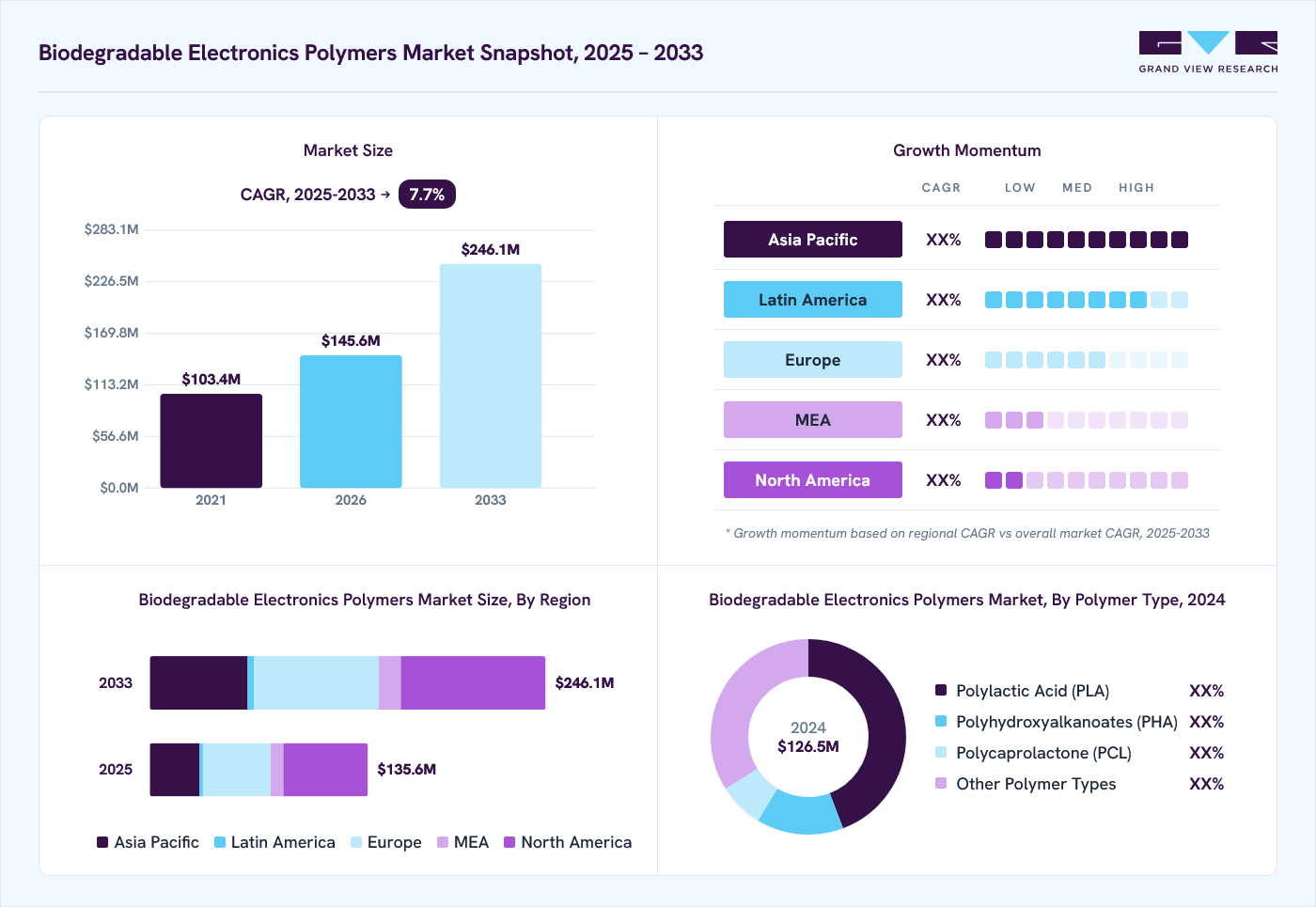
The global biodegradable electronics polymers market size was valued at USD 126.5 million in 2024 and is projected to grow from USD 145.6 million in 2026 to USD 246.1 million by 2033, at a CAGR of 7.7% from 2025 to 2033. North America dominated the market, accounting for a revenue share of 38.9% in 2024. The market for biodegradable electronics polymers is projected to experience significant growth in the coming ten years, fueled by rising environmental issues and strict worldwide regulations focused on minimizing electronic waste.
 Source: Grand View Research, IR Documents, Primary Interviews, Paid DatabasesTo learn more about this report,
 Download Free Sample Report
 Key Market Trends & Insights
- The biodegradable electronics polymers industry in Canada is expected to grow at the fastest CAGR of 7.9% from 2025 to 2033.
- By polymer, the polyhydroxyalkanoates (PHA) segment is expected to grow in revenue at a considerable CAGR of 8.8% from 2025 to 2033.
- By application, the flexible electronics segment is expected to grow at a considerable revenue CAGR of 8.2% from 2025 to 2033.
Market Size & Forecast
- 2024 Market Size: USD 126.5 Million
- 2033 Projected Market Size: USD 246.1 Million
- CAGR (2025-2033): 7.7%
- North America: Largest market in 2024
Three ways to get this report
Buy it, customize it, or ask a question.Ask an Analyst
Analyst response in 1 business day
- AccessReport author, directly
- Reply timeWithin 1 working day
- No sales callDirect answer only
- FormatEmail reply
- CostFree, no cost
Get the Full Report
What the study covers
- FormatsPDF · Excel · Dashboard
- Timeline2025–2033 annual, 2024 base
- Coverage20+ countries, 5 regions
- Companies10+ key players profiled
Customize the Report
20% free customization
- IncludeCountries, segments, points
- TailorTo your product definition
- ExtendDeeper competitor detail
- OrA fully bespoke study
- Turnaround5–10 working days
As manufacturers and OEMs transition to sustainable materials, the market is gaining momentum in the creation of transient, flexible, and environmentally friendly electronic components. The global biodegradable electronics polymers industry includes various materials aimed at replacing traditional non-degradable polymers in electronic applications, categorized by polymer. Key polymers consist of polylactic acid (PLA), polycaprolactone (PCL), polyhydroxyalkanoates (PHA), along with other biodegradable conductive polymers like polyaniline (PANI), polybutylene succinate (PBS), and polypyrrole (PPy). These materials are progressively utilized in flexible circuits, sensors, and transient devices where controlled degradation and environmental safety are essential.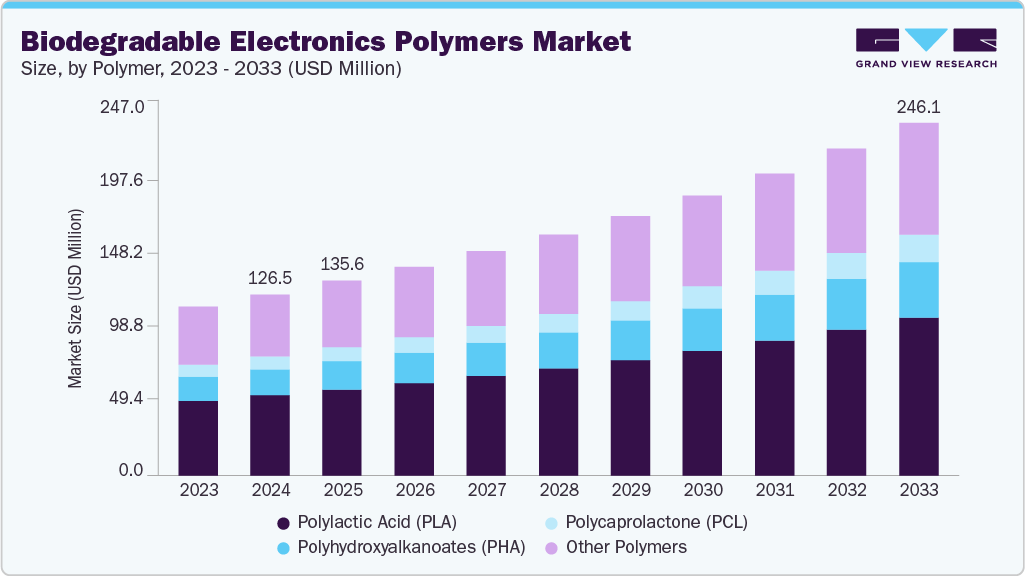 To learn more about this report, Download Free Sample Report
 Drivers, Opportunities & Restraints
The growth of the global market for biodegradable electronic polymers is fueled by heightened concerns for the environment and strict regulatory measures focused on reducing electronic waste. Governments and industry standards are promoting the use of sustainable materials in electronic components, especially in areas with robust e-waste management policies. In addition, the increasing need for flexible, disposable, and wearable electronics, such as medical devices and environmental sensors, is driving the demand for polymers that are both biodegradable and compatible with biological systems. Innovations in bio-based conductive polymers and eco-friendly manufacturing technologies are improving material performance, thus facilitating wider commercial adoption.
The market offers considerable opportunities in creating transient electronics, implantable medical devices, and environmentally friendly consumer electronics. The expansion of the Internet of Things (IoT) landscape is increasing the need for single-use or short-lifespan sensors that can safely break down after use. Partnerships between research organizations and electronics producers are accelerating the introduction of advanced biodegradable conductive polymers to the market. Furthermore, emerging markets in the Asia-Pacific region and Europe, bolstered by supportive sustainability policies and R&D incentives, present significant growth opportunities for businesses emphasizing material innovation and scalable manufacturing solutions.
Even with favorable growth potential, the market faces limitations due to elevated production expenses and a lack of extensive manufacturing capabilities. Biodegradable polymers generally show lower electrical conductivity, diminished mechanical stability, and are prone to environmental influences, which limit their use in high-performance or long-lasting electronic applications. In addition, the lack of standardized testing protocols for biodegradability and insufficient recycling infrastructure presents obstacles to widespread use. Overcoming these technical and economic hurdles is essential for boosting market presence and facilitating the sustainable, large-scale implementation of biodegradable electronic polymers.
Market Concentration & Characteristics
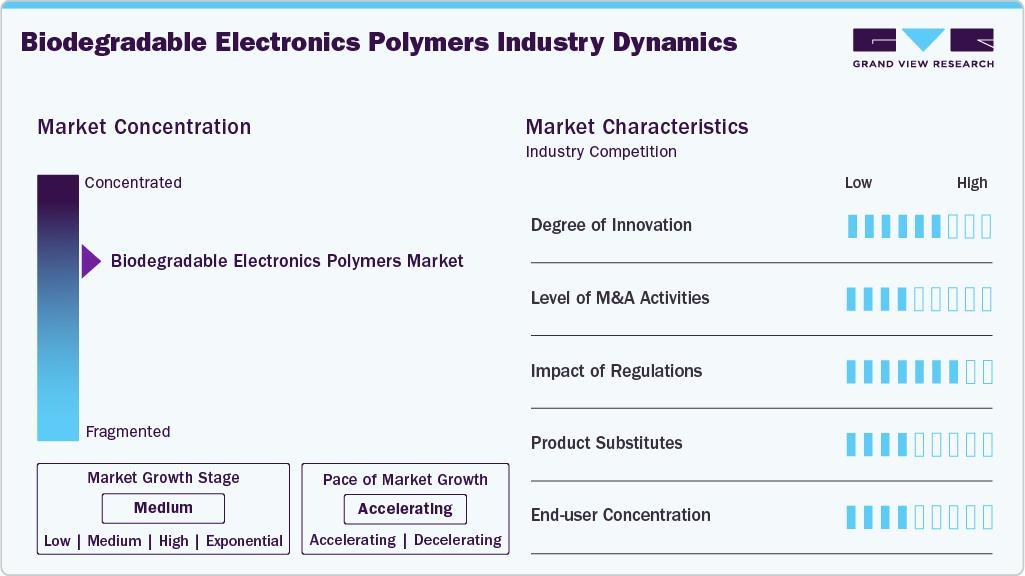
The market growth stage is moderate, and at an accelerated rate of growth. The market shows slight fragmentation, with key players holding significant influence. Major companies such as BASF SE, NatureWorks LLC, Mitsubishi Chemical Corporation, and others, play a crucial role in shaping market trends. These leading firms often drive innovation, launching new products, technologies, and applications to meet changing industry needs.
The market for biodegradable electronics polymers is very innovative, as firms are creating bio-derived conductive polymers, temporary materials, and adaptable composites intended for wearable and medical electronic applications. M&A activity is at a moderate level, with well-established companies collaborating with startups to leverage specialized polymers and speed up the commercialization process. Moreover, strict e-waste and sustainability laws in North America, Europe, and the Asia-Pacific region are propelling the use of biodegradable polymers. Regulatory backing promotes environmentally friendly product design and stimulates research and development in sustainable materials.
 To learn more about this report, Download Free Sample Report
 The market contends with competition from traditional non-biodegradable polymers, recycled plastics, and hybrid materials that deliver some sustainability advantages. Although these alternatives often achieve better mechanical and electrical properties at lower prices, they fall short of the necessary degradability and biocompatibility standards essential for transient electronics, implantable devices, or short-lifespan sensors. The end-user base is fairly varied, with significant demand originating from manufacturers of medical devices, developers of wearable technology, companies in the consumer electronics sector, and providers of environmental sensors. Applications in healthcare and the Internet of Things are becoming increasingly prominent as they depend on biodegradable materials, which guarantee a consistent and rising demand across various industries.
Polymer Insights
Polylactic Acid (PLA) dominated the market across the polymer segmentation in terms of revenue, accounting for a market share of 44.19% in 2024, and is forecasted to grow at a 7.1% CAGR from 2025 to 2033. The growth of the PLA-based electronics polymers segment is fueled by increasing regulatory pressures to minimize electronic waste, a rising demand for sustainable and bioresorbable devices, and continuous advancements in PLA composites that improve thermal stability and electrical performance. Its adaptability, along with its growing use in medical, consumer electronics, and IoT sectors, positions PLA as a crucial material in the shift toward sustainable electronics.
The Polyhydroxyalkanoates (PHA) segment is anticipated to grow at a substantial CAGR of 8.8% through the forecast period. The expansion of the market for PHA-based electronics polymers is fueled by increasing environmental regulations, a growing need for sustainable electronic components, and progress in PHA processing that enhances electrical performance and thermal stability. The distinctive blend of biodegradability and functional flexibility makes PHA the material of choice for specific electronic applications where sustainability and device safety are paramount.
Application Insights
Flexible electronics dominated the market across the application segmentation in terms of revenue, accounting for a market share of 36.63% in 2024, and is forecasted to grow at the fastest CAGR of 8.2% from 2025 to 2033. Flexible electronics are a major application area for biodegradable electronic polymers, including wearable gadgets, foldable screens, flexible sensors, and transient circuits. Biodegradable polymers like PLA and PHA are gaining traction in this field due to their suitability for printing and thin-film manufacturing methods. The expansion of wearable technology, health monitoring devices, and IoT-connected sensors is fueling the need for flexible, lightweight, and environmentally sustainable electronic materials, positioning biodegradable polymers as essential components for the next generation of flexible electronics.
 To learn more about this report, Download Free Sample Report
 The printed electronics segment is projected to grow at a substantial CAGR of 7.9% throughout the forecast period. Printed electronics represents a developing field for biodegradable electronic polymers, which involves creating circuits, sensors, and electronic components through additive printing methods on flexible materials. Utilizing biodegradable materials in printed electronics promotes the creation of lightweight, flexible, and environmentally responsible devices while helping to minimize electronic waste.
Regional Insights
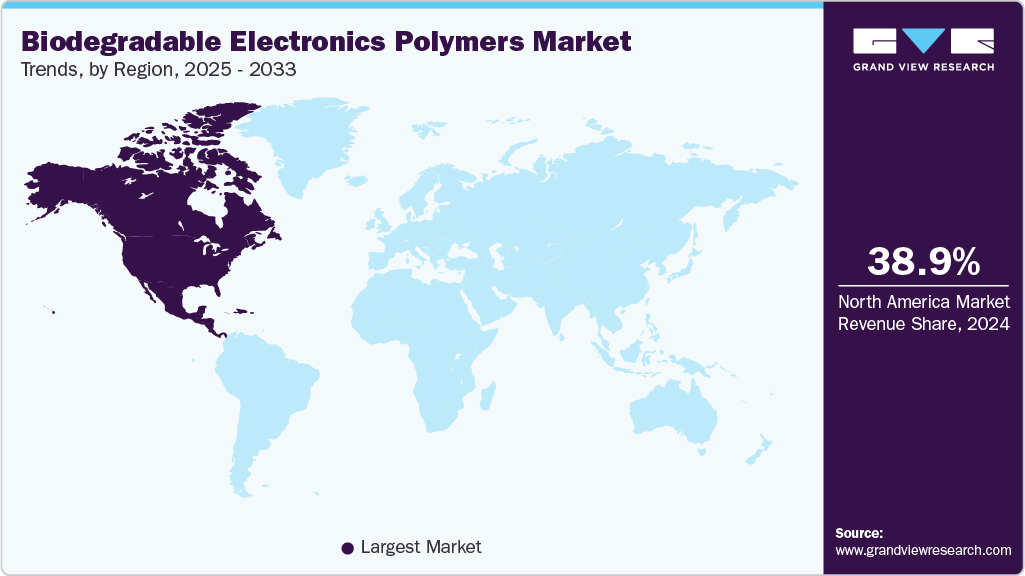
North America biodegradable electronics polymers market held the largest revenue share of 38.99% in 2024 and is expected to grow at the fastest CAGR of 7.0% over the forecast period. The market for biodegradable electronics polymers in North America is experiencing consistent growth, fueled by strict e-waste regulations, heightened environmental awareness, and the increased use of sustainable materials in the manufacturing of electronics. The region boasts a strong presence of wearable technology, IoT devices, and medical electronics, which are progressively incorporating biodegradable polymers like PLA and PHA for temporary and flexible uses. The market is supported by advanced research and development facilities, favorable government initiatives, and the proactive adoption of green materials by original equipment manufacturers, positioning North America as a vital area for innovation and commercialization in biodegradable electronics polymers.
 To learn more about this report, Download Free Sample Report
 U.S. Biodegradable Electronics Polymers Market Trends
The U.S. biodegradable electronics polymers industry stages a proactive approach to using biodegradable polymers in sectors like wearable electronics, IoT devices, and medical applications. Robust regulatory policies on electronic waste, along with a well-established research infrastructure and sustainability-driven efforts by original equipment manufacturers, are fostering the expansion of biodegradable electronic polymers in the nation.
Asia Pacific Biodegradable Electronics Polymers Market Trends
The market for biodegradable electronic polymers in the Asia-Pacific region is growing swiftly, driven by the emergence of electronics manufacturing centers, heightened environmental regulations, and a rising need for sustainable and wearable electronic products. Nations like China, Japan, and South Korea are committing resources to research and development as well as large-scale production of bio-based polymers such as PLA and PHA, establishing the area as a crucial contributor to the advancement of sustainable electronics.
Europe Biodegradable Electronics Polymers Market Trends
Europe biodegradable electronics polymers industry is at the forefront of regulating and implementing sustainability-focused biodegradable electronic polymers. Countries such as Germany, France, and the UK actively support green electronics, leading to a rise in the use of biodegradable polymers in applications such as flexible circuits, printed electronics, and transient devices. The region's commitment to circular economy principles and environmentally conscious innovation is consistently propelling market growth.
Key Biodegradable Electronics Polymers Company Insights
The biodegradable electronics polymers industry is moderately competitive, with several key global players dominating the landscape. Major companies include BASF SE, NatureWorks LLC, Mitsubishi Chemical Corporation, among others. The market is characterized by a competitive landscape with several key players driving innovation and market growth. Major companies in this sector are investing heavily in research and development to enhance the performance, cost-effectiveness, and sustainability of their products.
Key Biodegradable Electronics Polymers Companies:
The following are the leading companies in the biodegradable electronics polymers market. These companies collectively hold the largest market share and dictate industry trends.
- BASF SE
- NatureWorks LLC
- Mitsubishi Chemical Corporation
- Novamont S.p.A.
- Total Corbion PLA
- Biodegradable Electronics Polymers
- Daicel ChemTech
- Polysciences, Inc.
- Lubrizol
- CD Bioparticles
Recent Developments
-
In July 2025, Balrampur Chini Mills Limited introduced its "Bioyug" PLA brand in India, with the goal of increasing the adoption of biodegradable polymers in multiple applications. The company intends to create downstream applications in Printed Electronics and other industries, with potential avenues in electronics, showcasing a strategic commitment to sustainable and versatile PLA-based solutions.
-
In March 2025, TotalEnergies Corbion and Benvic announced a strategic alliance aimed at creating low-carbon, PLA-based compounds for long-lasting applications, such as electric and electronic goods. The partnership is centered on utilizing sustainable polymer solutions to minimize the carbon emissions of electronic components while fulfilling the increasing need for environmentally friendly and high-performance materials in the electronics industry.
Biodegradable Electronics Polymers Market Report Scope
Report Attribute
Details
Market size in 2024
USD 126.5 million
Estimated market size in 2026
USD 145.6 million
Projected market size by 2033
USD 246.1 million
Growth rate
CAGR of 7.7% from 2025 to 2033
Historical data
2021 - 2023
Forecast period
2025 - 2033
Quantitative units
Revenue in USD thousand/million, volume in tons, and CAGR from 2025 to 2033
Report coverage
Revenue forecast, competitive landscape, growth factors, and trends
Segments covered
Polymer, application, region
Regional scope
North America; Europe; Asia Pacific; Latin America; Middle East & Africa
Country Scope
U.S.; Canada; Mexico; Germany; France; UK; Spain; Italy; China; Japan; India; South Korea; Brazil; Argentina; Saudi Arabia; South Africa; UAE
Key companies profiled
BASF SE; NatureWorks LLC; Mitsubishi Chemical Corporation; Novamont S.p.A.; Total Corbion PLA; Biodegradable Electronics Polymers; Daicel ChemTech; Polysciences, Inc.; Lubrizol; CD Bioparticles
Customization scope
Free report customization (equivalent up to 8 analyst’s working days) with purchase. Addition or alteration to country, regional & segment scope
Pricing and purchase options
Avail customized purchase options to meet your exact research needs. Explore purchase options
Global Biodegradable Electronics Polymers Market Report Segmentation
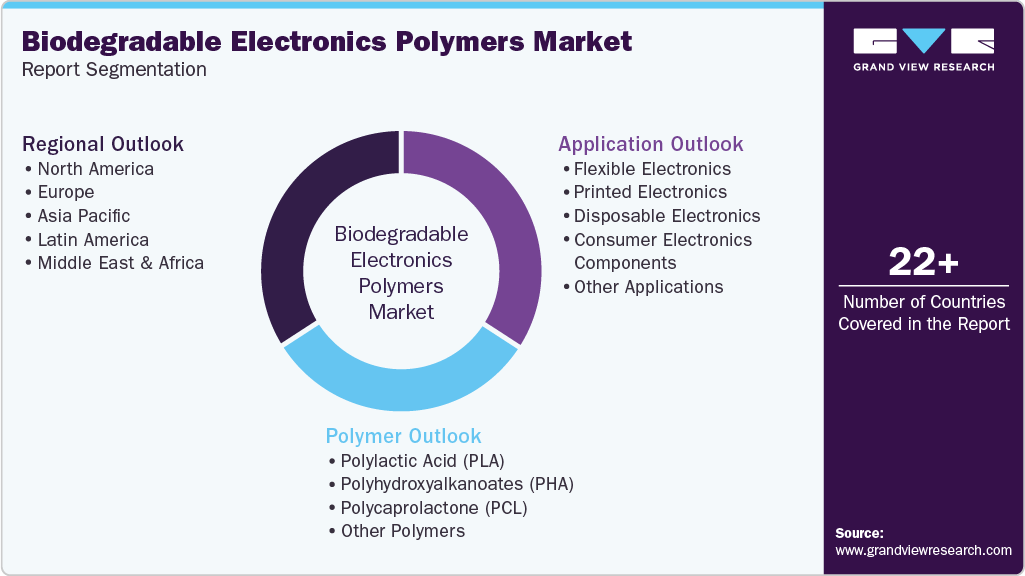
This report forecasts revenue growth at the global, regional, and country levels and provides an analysis of the latest industry trends in each of the sub-segments from 2021 to 2033. For this study, Grand View Research has segmented the global biodegradable electronics polymers market report based on polymer, application, and region:
 To learn more about this report, Download Free Sample Report
 -
Polymer Outlook (Volume, Tons; Revenue, USD Thousand, 2021 - 2033)
-
Polylactic Acid (PLA)
-
Polyhydroxyalkanoates (PHA)
-
Polycaprolactone (PCL)
-
Other Polymers
-
-
Application Outlook (Volume, Tons; Revenue, USD Thousand, 2021 - 2033)
-
Flexible Electronics
-
Printed Electronics
-
Disposable Electronics
-
Consumer Electronics Components
-
Other applications
-
-
Regional Outlook (Volume, Tons; Revenue, USD Thousand, 2021 - 2033)
-
North America
-
U.S.
-
Canada
-
Mexico
-
-
Europe
-
Germany
-
UK
-
France
-
Italy
-
Spain
-
-
Asia Pacific
-
China
-
India
-
Japan
-
South Korea
-
-
Latin America
-
Brazil
-
Argentina
-
-
Middle East & Africa
-
Saudi Arabia
-
South Africa
-
UAE
-
-
Frequently Asked Questions About This Report
The global biodegradable electronics polymers market size was valued at USD 126.5 million in 2024 and is estimated at USD 145.6 million for 2026.
The global biodegradable electronics polymers market is expected to grow at a CAGR of 7.7% from 2025 to 2033, reaching USD 246.1 million by 2033.
The market for biodegradable electronics polymers is projected to experience significant growth over the forecast years, fueled by rising environmental issues and strict worldwide regulations focused on minimizing electronic waste.
Polylactic Acid (PLA) dominated the biodegradable electronics polymers market across the polymer type segmentation in terms of revenue, accounting for a market share of 44.19% in 2024 and is forecasted to grow at 7.1% CAGR from 2025 to 2033.
Some key players operating in the biodegradable electronics polymers market include BASF SE, NatureWorks LLC, Mitsubishi Chemical Corporation, Novamont S.p.A., Total Corbion PLA, Biodegradable Electronics Polymers, Daicel ChemTech, Polysciences, Inc., Lubrizol, CD Bioparticles.
About the Author(s)
Plastics, Polymers & Resins Research Team
Bulk Chemicals · Plastics, Polymers & ResinsThis report was authored by the plastics, polymers & resins research team at Grand View Research - comprising two research analysts, one senior research analyst, and one industry expert - with specialized expertise in the plastics, polymers & resins segment of the bulk chemicals industry. All findings are based on proprietary bulk chemicals databases, executive interviews, and regulatory analysis, subject to internal peer review prior to publication.
Last Updated:
Speak to Analyst

Customize this report to your needs - add regions, segments, or data points, with 20% free customization.
Or view our licence options:


ISO 9001:2015 & 27001:2022 Certified
We are GDPR and CCPA compliant! Your transaction & personal information is safe and secure. For more details, please read our privacy policy.


