
- Home
- »
- Medical Devices
- »
-
Buccal Cavity Devices Market Size & Share Report, 2033GVR Report cover
![Buccal Cavity Devices Market (2026 - 2033)Report]()
Buccal Cavity Devices Market (2026 - 2033)
Size, Share & Trends Analysis Report By Product (Oral Drug Delivery Devices, Airway & Bite Management Devices), By Application, By Patient Group (Pediatric, Adult), By End-use, By Distribution Channel, By Region, And Segment Forecasts
Market Size, 2025
$3.2BMarket Estimate, 2026
$3.3BMarket Forecast, 2033
$4.9BCAGR, 2026–2033
5.7%Buccal Cavity Devices Market Summary
The global buccal cavity devices market size was valued at USD 3.2 billion in 2025 and is projected to grow from USD 3.3 billion in 2026 to USD 4.9 billion by 2033, at a CAGR of 5.7% from 2026 to 2033. North America dominated the market, accounting for the largest revenue share of 33.6% in 2025. The growth is driven by the rising prevalence of oral diseases, increasing demand for preventive and restorative dental care, expanding adoption of oral drug delivery devices, and growing utilization of oral diagnostic, surgical, airway management, and saliva management devices across healthcare settings.

Key Market Trends & Insights
- By product: The oral moisture & saliva management devices segment led the market with the largest revenue share of 25.7% in 2025.
- By application: The surgical & dental procedures segment led the market with the largest revenue share of 38.1% in 2025.
- By patient group: The adult segment led the market with the largest revenue share of 56.6% in 2025.
- By distribution channel: The dental clinics segment led the market with the largest revenue share of 46.0% in 2025.
- By end-use: The medical device distributors segment led the market with the largest revenue share of 46.5% in 2025.
Regional Highlights
- Largest market: North America (33.6% revenue share, 2025)
- Fastest growing market: Asia Pacific (highest CAGR, 2026-2033)
- By country: The U.S. held the largest market share in 2025.
Market Size & Forecast
- 2025 Market Size: USD 3.2 billion
- 2026 Market Size: USD 3.3 billion
- 2033 Projected Market Size: USD 4.9 billion
- CAGR (2026-2033): 5.7%
In addition, advancements in devices such as intraoral cameras are significantly contributing to the growth of the buccal cavity devices market by improving diagnostic accuracy, patient communication, and clinical workflow efficiency. Modern intraoral cameras provide high-resolution imaging, real-time visualization, LED illumination, autofocus capabilities, and seamless integration with digital dental records and treatment planning software. These technologies enable clinicians to detect dental caries, periodontal diseases, cracks, and other oral abnormalities at earlier stages while enhancing patient understanding through chairside image display. For instance, in March 2025, ACTEON launched the C20 Full HD intraoral camera at IDS 2025 to enhance dental diagnostics and clinical workflow efficiency. The camera features Full HD imaging, AIS 5.5 software integration, and compatibility with Windows, Mac, and TWAIN systems for seamless practice integration.
Kristel Rolland, Chief Marketing Officer of ACTEON, stated, “Our OPUS solution is our masterpiece of design and engineering. Developed for all dental professionals, ultra-intuitive, extremely precise, compact and versatile, it is so comfortable that patients barely even notice they’re being treated.”
Rising burden of oral diseases driving demand for buccal cavity devices:
The high global burden of oral diseases continues to drive demand for buccal cavity devices used in diagnosis, treatment, prevention, and patient care. The widespread occurrence of dental caries, periodontal diseases, oral cancer, and tooth loss has increased the need for routine dental examinations, restorative procedures, oral surgeries, and preventive interventions. This supports the adoption of oral diagnostic and examination devices, saliva management systems, oral surgical instruments, oral drug delivery devices, and oral protection products across hospitals, dental clinics, and ambulatory surgical centers.
In 2026, according to the Oral Health Foundation, oral diseases remain among the most common health conditions globally, affecting billions of people and creating a substantial demand for preventive, diagnostic, and therapeutic oral healthcare services.
Key statistics include:
-
Around 3.5 billion people worldwide are affected by oral diseases.
-
Untreated dental caries (tooth decay) is the most common health condition globally.
-
Approximately 2 billion people suffer from caries of permanent teeth.
-
Around 514 million children are affected by caries of primary (baby) teeth.
-
Severe periodontal (gum) disease affects about 19% of adults, representing more than 1 billion cases globally.
-
Oral cancer accounts for approximately 390,000 new cases annually worldwide.
Growing dental tourism is driving demand for buccal cavity devices:
The industry is benefiting from the expansion of dental tourism and the availability of cost-effective dental treatments, particularly in emerging countries. Rising volumes of international patients undergoing dental implants, cosmetic dentistry, orthodontic procedures, root canal treatments, and oral surgeries are increasing the utilization of oral diagnostic and examination devices (mouth mirrors, cheek retractors, intraoral cameras), oral surgical devices (tissue retractors and surgical mouth props), and oral moisture and saliva management devices (saliva ejectors and oral suction tips). For instance, in February 2026, according to Dentzz Dental, dental implant treatment in India typically costs USD 800–1,500 per implant, compared with USD 3,000–5,000 per implant in the U.S., representing savings of approximately 60–85%. The combination of affordable treatment, internationally recognized implant systems, digital dentistry technologies, and established sterilization protocols continues to attract patients from the U.S., UK, and Australia, thereby supporting demand for buccal cavity devices across dental clinics and specialty centers.
Cost Comparison of Dental Procedures: India vs. U.S. (2026):
Procedure
India (Approx.)
U.S. (Approx.)
Estimated Cost Savings
Dental Implant (Per Implant)
USD 800–1,500
USD 3,000–5,000
60–85%
Root Canal Treatment
USD 100–250
USD 800–1,500
75–90%
Dental Crown
USD 120–300
USD 1,000–2,500
70–90%
Full Mouth Rehabilitation
USD 3,500–10,000
USD 25,000–60,000
70–85%
Smile Makeover / Cosmetic Dentistry
USD 2,000–6,000
USD 10,000–30,000
70–80%
Source: Dentzz Dental
Market Dynamics
The industry is experiencing steady growth due to the increasing prevalence of oral diseases, rising dental procedure volumes, and growing emphasis on preventive and minimally invasive oral healthcare. Demand is increasing for oral drug delivery devices, oral diagnostic and examination instruments, airway management devices, oral surgical instruments, saliva management products, and oral protection devices across hospitals, dental clinics, ambulatory surgical centers, and home healthcare settings. The market is further supported by advancements in ergonomic and disposable device designs, the expansion of digital dentistry, increasing adoption of home-based oral care solutions, and growing awareness of pediatric and geriatric oral health. In addition, expanding dental infrastructure, rising healthcare expenditure, and continuous product innovation focused on patient safety, infection control, and clinical efficiency are expected to support sustained market growth throughout the forecast period.
The growing shift toward home-based healthcare is increasing demand for buccal cavity devices that enable safe and convenient self-care outside clinical settings. Products such as oral dispensers and medication applicators are used for accurate administration of liquid medications, nutritional supplements, and oral gels among pediatric, geriatric, and chronically ill patients. The expansion of telehealth services, home nursing, and chronic disease management programs is encouraging the use of user-friendly oral drug delivery devices that reduce hospital visits while improving treatment adherence. This trend is creating sustained demand for home-use buccal cavity devices globally.
Limited reimbursement for many dental procedures and associated devices remains a key barrier to market growth. In several countries, products such as oral examination instruments, mouth guards, oral splints, and preventive oral care devices are often paid for out-of-pocket by patients, particularly when used for routine or elective dental care. This increases the financial burden on patients and may discourage the adoption of advanced or premium buccal cavity devices, especially in price-sensitive markets and among uninsured populations.
Rapid growth in e-commerce platforms is creating new opportunities for manufacturers to expand the availability of home-use buccal cavity devices directly to consumers. Products such as oral moisture and saliva management devices, including saliva collection devices and oral suction accessories for home care, are becoming accessible through online pharmacies and digital healthcare retailers. Direct-to-consumer channels enable manufacturers to reach broader customer populations, improve product visibility, and offer educational resources, while consumers benefit from greater convenience, competitive pricing, and access to specialized oral healthcare products without relying solely on traditional healthcare distribution channels.
Market Concentration & Characteristics
The industry is characterized by continuous innovation focused on improving clinical efficiency, patient safety, and ease of use across oral healthcare applications. Manufacturers are developing advanced solutions such as ergonomic oral surgical instruments, disposable oral care devices, improved saliva management systems, pediatric-friendly drug delivery devices, and digitally integrated oral diagnostic tools. Innovations are also focused on infection control, single-use device adoption, and enhanced visualization technologies for dental procedures.
The industry has witnessed moderate merger and acquisition activity, driven by companies seeking to expand their dental technology portfolios, strengthen distribution capabilities, and enhance product offerings across oral care, surgical, and diagnostic applications. Strategic acquisitions are focused on expanding capabilities in digital dentistry, dental instruments, specialty oral care products, and healthcare consumables. These activities allow manufacturers to provide broader product portfolios and integrated solutions across dental clinics, hospitals, and specialty care centers.
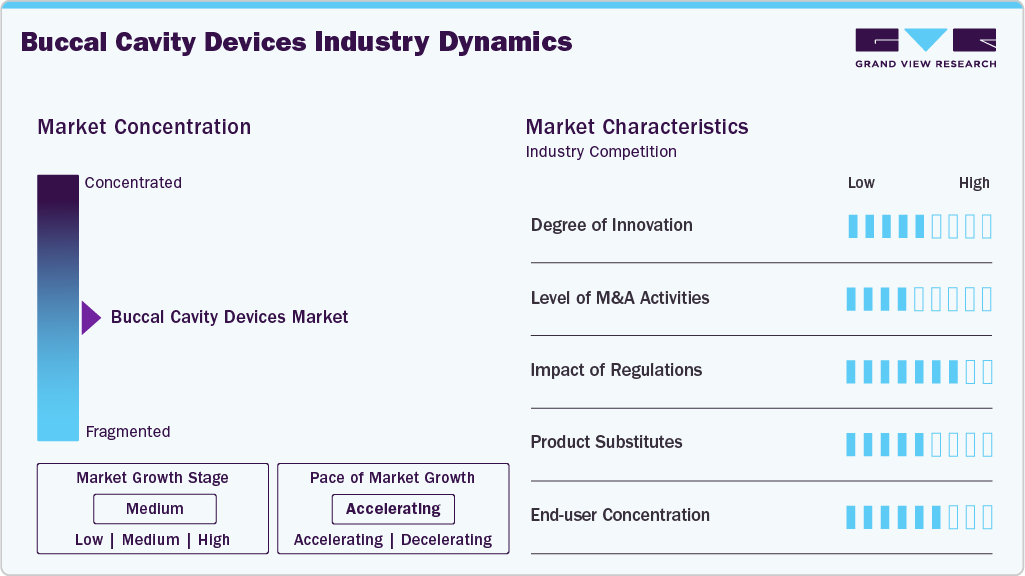
Regulatory compliance plays an important role in the development and commercialization of buccal cavity devices, particularly for oral drug delivery devices, surgical instruments, airway management products, and diagnostic technologies. Manufacturers must comply with requirements related to material safety, biocompatibility, sterilization validation, infection prevention, and quality management systems. In major markets, devices must meet regulatory requirements such as U.S. FDA medical device regulations and European Medical Device Regulation (EU MDR 2017/745) before market approval.
The industry faces competition from alternative approaches and conventional dental instruments, depending on the application. For example, traditional oral examination tools may substitute advanced digital diagnostic devices in routine dental assessments, while manual oral care products may compete with specialized oral protection and saliva management solutions. However, advanced buccal cavity devices remain preferred for complex dental procedures, surgical applications, pediatric medication administration, and specialized oral care due to improved accuracy, safety, and procedural efficiency.
Demand for buccal cavity devices is concentrated among dental clinics, hospitals, ambulatory surgical centers, specialty oral care centers, and home healthcare settings. Dental clinics and specialty centers represent major users due to high utilization of oral diagnostic devices, surgical instruments, orthodontic devices, and preventive oral care products. Hospitals and ambulatory surgical centers contribute significantly through the adoption of airway management devices, oral surgical instruments, and saliva management products.
Analyst Perspective
The industry is driven by increasing oral healthcare needs, rising dental procedure volumes, growing adoption of minimally invasive treatments, and innovations such as disposable device designs, ergonomic instruments, digital dentistry integration, and improved patient-centric solutions. Demand for intraoral cameras, saliva management devices, oral surgical instruments, airway management products, and pediatric oral administration devices is supported by expanding dental infrastructure and increasing focus on preventive care. Companies focusing on product innovation, regulatory compliance, cost-effective solutions, and strong distribution networks are expected to gain a competitive advantage. Future growth will depend on expanding access to advanced oral healthcare technologies across developed and emerging markets.
Product Insights
The oral moisture & saliva management devices segment dominated the market, accounting for 25.7% of the global revenue in 2025. This dominance is supported by the widespread use of saliva ejectors, oral suction tips, and saliva collection devices during routine dental examinations, restorative procedures, oral surgeries, endodontic treatments, and orthodontic procedures. These devices are essential for maintaining a dry operating field, improving visibility, reducing contamination, and enhancing procedural efficiency. Rising dental procedure volumes, increasing emphasis on infection prevention, and the growing adoption of disposable saliva management products across hospitals and dental clinics have further strengthened segment demand.
The oral diagnostic & examination devices segment is expected to grow at the fastest rate during the forecast period due to the increasing adoption of digital dentistry, growing emphasis on early detection of oral diseases, and rising demand for accurate chairside diagnostics. The expanding use of intraoral cameras, mouth mirrors, cheek retractors, and tongue depressors in preventive dentistry, restorative procedures, orthodontics, and oral surgery is supporting segment growth. For instance, in May 2024, according to the Centers for Disease Control and Prevention (CDC), oral health conditions such as untreated dental caries remain highly prevalent, with approximately 21% of adults aged 20–64 years in the U.S. having at least one untreated cavity, highlighting the continued need for routine oral examination and early diagnostic procedures.
Application Insights
The surgical & dental procedures segment dominated the market, accounting for 38.1% of the global revenue in 2025. This dominance is supported by the widespread preference for oral surgical instruments, tissue retractors, surgical mouth props, saliva ejectors, and oral examination devices during dental implants, tooth extractions, periodontal procedures, endodontic treatments, and oral surgeries. The increasing volume of complex dental procedures, rising adoption of minimally invasive techniques, and growing demand for improved procedural visibility and infection control are driving the utilization of buccal cavity devices in clinical settings.
The orthodontic procedures segment is expected to grow at the fastest rate during the forecast period due to the rising demand for orthodontic treatments, increasing adoption of clear aligners and fixed orthodontic systems, and growing awareness regarding aesthetic dental correction. The increasing use of intraoral cameras, cheek retractors, mouth mirrors, bite guards, and oral examination devices during orthodontic diagnosis, treatment planning, and follow-up procedures is supporting segment growth. For instance, according to the American Association of Orthodontists (AAO) 2025 Economics of Orthodontics and Patient Census Survey, the number of patients in active orthodontic treatment per AAO member increased from 574 in 2022 to 696 in 2024, representing the highest patient count recorded in the survey's history. The total estimated number of patients undergoing active orthodontic treatment among AAO members in the U.S. and Canada reached approximately 6.66 million.
Patient Group Insights
The adult segment dominated the market, accounting for 56.6% of the global revenue in 2025. This dominance is supported by the higher utilization of oral diagnostic and examination devices, oral surgical devices, and oral moisture & saliva management devices among adult patients undergoing routine dental check-ups, restorative procedures, dental implants, periodontal treatments, and oral surgeries. Adults represent the primary patient group for procedures requiring intraoral cameras, mouth mirrors, cheek retractors, saliva ejectors, oral suction tips, tissue retractors, and surgical mouth props due to the greater incidence of dental caries, gum diseases, tooth loss, and complex dental conditions with increasing age.
The geriatric segment is expected to grow at the fastest rate during the forecast period due to the increasing prevalence of age-related oral health conditions, rising demand for restorative dental procedures, and greater need for oral examination and supportive care devices among elderly patients. The growing elderly population is increasing the incidence of tooth loss, periodontal diseases, dry mouth, and other oral conditions, driving the adoption of oral diagnostic & examination devices, oral moisture & saliva management devices, and oral surgical devices. For instance, according to the WHO, the global population aged 60 years and older is expected to increase from 1 billion in 2020 to 1.4 billion by 2030 and reach 2.1 billion by 2050. This demographic shift is expected to increase the demand for dental assessments, preventive oral care, and restorative procedures, supporting the utilization of buccal cavity devices in geriatric populations.
Distribution Channel Insights
The dental clinics segment dominated the devices market, accounting for 46.0% of the global revenue in 2025. This dominance is supported by the continuous expansion of private dental clinics, specialty dental centers, and organized dental care networks worldwide. The growing number of dental facilities is increasing the demand for oral diagnostic & examination devices, oral moisture & saliva management devices, oral surgical devices, and oral protection devices used in routine examinations, restorative procedures, orthodontic treatments, and minor oral surgeries. For instance, in February 2026, Clove Dental launched 48 new clinics in a single day, expanding its network to 715 centres across 26 cities. The expansion marked the company’s continued growth in organized dentistry in India, supported by technology-driven operations and standardized dental care services.
The home healthcare segment is expected to grow at the fastest rate during the forecast period due to the increasing preference for home-based oral care, rising geriatric population, and growing adoption of self-care and supportive oral hygiene devices. The segment benefits from the increasing use of oral moisture management devices, saliva collection devices, oral dispensers, and medication applicators that enable patients with chronic conditions, elderly individuals, and those requiring long-term care to manage oral health outside traditional healthcare settings.
End-use Insights
The medical device distributors segment dominated the market, accounting for 46.5% of the global revenue in 2025. This dominance is driven by the established distribution networks, strong relationships with dental clinics and hospitals, and their ability to provide product availability, installation support, training, and after-sales services for advanced dental equipment such as intraoral scanners and imaging devices. Distributors also enable manufacturers to expand market reach across diverse healthcare settings by reducing logistical barriers and improving access to specialized dental technologies.

The E-commerce segment is expected to grow at the fastest rate during the forecast period. Growth is driven by the increasing adoption of online purchasing platforms, improved digital accessibility of dental products, rising preference for convenient procurement, and expanding availability of dental devices through manufacturer and third-party e-commerce channels. The growth of digital healthcare ecosystems and the increasing acceptance of online ordering among dental professionals and clinics are further supporting segment expansion.
Regional Insights
North America dominated the market, accounting for the largest revenue share of 33.6% in 2025. The North America buccal cavity devices market is supported by advanced oral healthcare infrastructure, high dental care expenditure, increasing adoption of digital dentistry, and the strong presence of dental clinics, hospitals, and ambulatory surgical centers. Also, the availability of a large dental professional base and continuous investments in advanced dental technologies are encouraging the adoption of innovative buccal cavity solutions across clinical settings. For instance, according to the American Dental Association Health Policy Institute, the U.S. had 202,485 professionally active dentists in 2024, reflecting a strong clinical workforce capable of adopting advanced oral healthcare technologies. This extensive provider base, along with increasing investments in digital dentistry and modern dental infrastructure, is supporting the sustained growth of the North American market.


U.S. Buccal Cavity Devices Market Trends
The buccal cavity devices market in the U.S. is experiencing steady growth due to high dental healthcare expenditure, increasing demand for advanced oral care solutions, growing adoption of preventive dentistry, and the expansion of dental clinics and specialty care facilities. The country’s strong healthcare infrastructure and focus on improving oral health outcomes are supporting the adoption of oral diagnostic devices, surgical instruments, saliva management products, airway management devices, and oral drug delivery systems. For instance, according to the American Dental Association (ADA), U.S. dental spending reached approximately USD 189 billion in 2024, reflecting continued investment in oral healthcare services and dental infrastructure. Dental expenditures increased by nearly USD 7 billion compared with 2023, representing around 4% annual growth. The sustained rise in dental spending supports demand for advanced buccal cavity devices used across dental clinics, hospitals, and specialty care facilities.
Europe Buccal Cavity Devices Market Trends
The buccal cavity devices market in Europe is witnessing steady growth due to increasing oral healthcare awareness, rising adoption of advanced dental procedures, and strong healthcare infrastructure across major economies, including Germany, France, the UK, Italy, and Spain. The region benefits from well-established dental practices, high adoption of minimally invasive procedures, and increasing demand for oral diagnostic, surgical, and preventive care devices. Regulatory standards, technological innovation, and investments in modern dental facilities are supporting the adoption of advanced buccal cavity devices across hospitals, dental clinics, and specialty centers.
The UK buccal cavity devices market is supported by increasing demand for oral examination devices, preventive dental solutions, and advanced treatment-supporting instruments. Rising cases of dental diseases, particularly among children and elderly populations, are increasing the need for early diagnosis and effective oral care management. For instance, in September 2025, according to NHS England, 21,162 children aged 5–9 years were admitted to hospitals in England due to tooth decay during 2024/2025, highlighting the continued burden of oral health conditions and the need for improved diagnostic and preventive approaches. This growing oral healthcare demand is expected to support the adoption of buccal cavity devices across NHS facilities and private dental practices.
Asia Pacific Buccal Cavity Devices Market Trends
The buccal cavity devices market in Asia Pacific is expected to witness the fastest growth during the forecast period, supported by expanding dental infrastructure, increasing oral healthcare awareness, rising dental procedure volumes, and growing adoption of advanced oral diagnostic and treatment technologies. Countries such as India, China, Japan, and South Korea are witnessing rapid expansion of private dental clinics, specialty oral care centers, and hospital-based dental departments, increasing demand for oral diagnostic devices, surgical instruments, saliva management systems, airway management devices, and oral drug delivery products. For instance, in April 2026, Eka Dental Care announced plans to expand its network to more than 25 self-owned clinics by FY2027, strengthening its presence across the Mumbai Metropolitan Region and expanding into Tier 1 cities such as Pune and Bengaluru to improve access to standardized and affordable dental care. This expansion of organized dental care networks and investments in modern dental infrastructure is expected to support the adoption of buccal cavity devices across Asia Pacific.
The China buccal cavity devices market is witnessing significant growth due to increasing dental healthcare investments, expansion of private dental clinics, and adoption of advanced dental technologies. The country is experiencing increased utilization of oral examination devices, intraoral diagnostic systems, orthodontic devices, oral surgical instruments, and saliva management products as dental providers focus on improving clinical efficiency and treatment outcomes. Growing adoption of digital dentistry, artificial intelligence-based diagnostic solutions, and integrated dental workflows is further supporting market expansion. In addition, the presence of domestic medical device manufacturers and government initiatives aimed at improving healthcare accessibility are strengthening the availability and adoption of buccal cavity devices across urban and emerging regions in China.
Latin America Buccal Cavity Devices Market Trends
The buccal cavity devices market in Latin America is expected to witness steady growth during the forecast period, driven by rising demand for cosmetic dentistry, expanding private dental networks, and improving access to advanced oral healthcare services. Countries such as Brazil and Argentina are witnessing increased demand for oral diagnostic devices, oral surgical instruments, orthodontic support devices, and preventive oral care solutions due to growing patient preference for aesthetic dental procedures and minimally invasive treatments. Brazil’s strong dental professional base and growing reputation as a destination for affordable dental procedures are supporting the adoption of advanced buccal cavity devices across specialty clinics.
MEA Buccal Cavity Devices Market Trends
The buccal cavity devices market in the Middle East & Africa is witnessing growth due to increasing medical tourism, healthcare infrastructure modernization, and rising demand for premium dental care services. Countries such as the UAE, Saudi Arabia, and Kuwait are emerging as dental tourism destinations, attracting international patients seeking cosmetic dentistry, implant procedures, and advanced oral treatments, which is increasing demand for oral diagnostic devices, surgical instruments, and treatment-supporting oral care products. Additionally, government-led healthcare transformation programs and investments in private specialty clinics are encouraging the adoption of advanced dental technologies. For instance, Saudi Arabia’s Vision 2030 healthcare initiatives are promoting private sector participation and modernization of healthcare services, including expansion of specialized care facilities. These developments are expected to support the adoption of buccal cavity devices across hospitals and dental clinics in the region.
Key Buccal Cavity Devices Company Insights
Some of the key companies in the buccal cavity devices market include Medtronic, Teleflex Incorporated, Ambu A/S, ICU Medical, Inc., Becton, Dickinson and Company (BD), SGH Medical Pharma, Aptar Pharma, Ivoclar, Karl Storz SE & Co. KG, B. Braun SE, Integra LifeSciences, Aesculap (B. Braun), Henry Schein Inc. Organizations are focusing on increasing customer base to gain a competitive edge in the industry. Therefore, key players are taking several strategic initiatives, such as product launches and partnerships with other major companies.
Key Buccal Cavity Devices Companies:
Some prominent players in the global buccal cavity devices market include:
-
Medtronic
-
Teleflex Incorporated
-
Ambu A/S
-
ICU Medical, Inc.
-
Becton, Dickinson and Company (BD)
-
SGH Medical Pharma
-
Aptar Pharma
-
Ivoclar
-
Karl Storz SE & Co. KG
-
B. Braun SE
-
Integra LifeSciences
-
Aesculap (B. Braun)
-
Sklar Surgical Instruments
-
Hu-Friedy (a Cantel/Mölnlycke company)
-
Henry Schein Inc.
Competitive Benchmarking
Category
Operating Strategies
Competitive Edge
Weakness
Established Players (Medtronic, Teleflex Incorporated, Becton, Dickinson and Company (BD))
- Focus on expanding comprehensive buccal cavity device portfolios covering oral drug delivery devices, airway management products, surgical oral instruments, and oral examination solutions.
- These companies emphasize product innovation, disposable device development, ergonomic designs, regulatory compliance, and integration of advanced technologies.
- Strong global brand presence, broad distribution channels, and strong relationships with hospitals and dental professionals.
- Advanced manufacturing capabilities and diversified product offerings enable leadership across multiple buccal cavity device applications.
- High product development costs, complex regulatory requirements, and premium pricing may limit adoption among smaller dental clinics and cost-sensitive healthcare facilities.
- Large organizational structures may also result in slower product innovation compared with smaller specialized manufacturers.
Emerging Players (Ambu A/S, ICU Medical Inc., SGH Medical Pharma, Aptar Pharma)
- Focus on niche product development, including disposable oral devices, medication delivery systems, and specialized surgical solutions.
- These companies strengthen market presence through product customization, innovation in single-use devices, partnerships with healthcare providers, and expansion into emerging markets.
- Strong expertise in specific product segments, flexible product development capabilities, and specialized clinical applications,
- Also, competitive pricing, and ability to address growing demand for disposable, ergonomic, and procedure-specific oral devices.
- Limited global presence compared with multinational healthcare companies, smaller product portfolios, and dependence on distributors in certain regions.
- Lower brand visibility among large hospital networks and challenges in scaling manufacturing capacity may restrict market expansion.
Recent Developments:
-
In March 2026, Carestream Dental launched the CS 1300 intraoral camera, a high-definition imaging solution designed to capture clearer clinical images, improve patient communication, and integrate seamlessly with existing digital workflows. The device supports efficient documentation and helps patients better understand their oral health and treatment options.
“The CS 1300 reflects our commitment to providing technology that fits naturally into the way dental teams work every day,” Stephane Varlet, director, global business line management, Carestream Dental, said. “By delivering clear, detailed images and seamless integration, we’re helping practices communicate more effectively with patients while maintaining an efficient, connected workflow.”
-
In March 2025, OMNIVISION and Biotech Dental announced a partnership to integrate OMNIVISION’s miniature medical-grade camera modules into Biotech Dental’s Scan4All Iris by Starck 3D intraoral scanners. The collaboration aimed to enhance dental visualization and improve digital dental care through advanced imaging technology.
“We partnered with OMNIVISION due to the wide range of imaging solutions they offer for dental applications. Most importantly, OMNIVISION’s camera modules are developed and tested specifically for the medical and dental markets and have a long lifetime, which in turn, ensures that our intraoral scanners retain their value and remain a high-quality solution for our customers,” said Philippe VERAN, CEO, Biotech Dental.
Buccal Cavity Devices Market Report Scope
Report Attribute
Details
Market size value in 2025
USD 3.2 billion
Market size value in 2026
USD 3.3 billion
Revenue forecast in 2033
USD 4.9 billion
Growth rate
CAGR of 5.7% from 2026 to 2033
Base year for estimation
2025
Actual estimates/historical data
2021 – 2024
Forecast period
2026 – 2033
Quantitative units
Revenue in USD billion and CAGR from 2026 to 2033
Report coverage
Revenue forecast, company ranking, competitive landscape, growth factors, and trends
Segments covered
Product, application, patient group, end-use, distribution channel, region
Regional scope
North America; Europe; Asia Pacific; Latin America; Middle East & Africa
Country scope
U.S.; Canada; Mexico; UK; Germany; France; Italy; Spain; Denmark; Sweden; Norway; Japan; China; India; Thailand; Australia; South Korea; Brazil; Argentina; South Africa; Saudi Arabia; UAE; Kuwait
Key companies profiled
Medtronic; Teleflex Incorporated; Ambu A/S; ICU Medical, Inc.; Becton, Dickinson and Company (BD); SGH Medical Pharma; Aptar Pharma; Ivoclar; Karl Storz SE & Co. KG; B. Braun SE; Integra LifeSciences; Aesculap (B. Braun); Sklar Surgical Instruments; Hu-Friedy (a Cantel/Mölnlycke company); Henry Schein Inc.
Customization scope
Free report customization (equivalent up to 8 analyst’s working days) with purchase. Addition or alteration to country, regional & segment scope
Pricing and purchase options
Avail customized purchase options to meet your exact research needs. Explore purchase options
Buccal Cavity Devices Market Report Segmentation
This report forecasts revenue growth at global, regional & country levels and provides an analysis of the latest industry trends in each of the sub-segments from 2021 to 2033. For this study, Grand View Research has segmented the global buccal cavity devices market report based on product, application, patient group, end-use, distribution channel, and region:
-
Product Outlook (Revenue, USD Billion, 2021 - 2033)
-
Oral Drug Delivery Devices
-
Buccal Syringes
-
Oral Dispensers
-
Medication Applicators
-
Airway & Bite Management Devices
-
Oropharyngeal Airways
-
Mouth Gags
-
Bite Guards
-
Oral Protection Devices
-
Mouth Guards
-
Oral Splints
-
Oral Diagnostic & Examination Devices
-
Mouth Mirrors
-
Cheek Retractors
-
Tongue Depressors
-
Intraoral Cameras
-
Oral Surgical Devices
-
Tissue Retractors
-
Surgical Mouth Props
-
Oral Moisture & Saliva Management Devices
-
Saliva Ejectors
-
Saliva Collection Devices
-
Oral Suction tips
-
Others Buccal Cavity Devices
-
-
Application Outlook (Revenue, USD Billion, 2021 - 2033)
-
Drug Administration
-
Surgical & Dental Procedures
-
Airway Management
-
Oral Hygiene & Preventive Care
-
Diagnostic & Examination
-
Orthodontic Procedures
-
-
Patient Group Outlook (Revenue, USD Billion, 2021 - 2033)
-
Pediatric
-
Adult
-
Geriatric
-
-
End-use Outlook (Revenue, USD Billion, 2021 - 2033)
-
Hospitals
-
Dental Clinics
-
Ambulatory Surgical Centers
-
Home Healthcare
-
-
Distribution Channel Outlook (Revenue, USD Billion, 2021 - 2033)
-
Direct Sales
-
Medical Device Distributors
-
Retail Pharmacies
-
Hospital Pharmacies
-
E-Commerce
-
-
Regional Outlook (Revenue, USD Billion, 2021-2033)
-
North America
-
U.S.
-
Canada
-
Mexico
-
-
Europe
-
UK
-
Germany
-
France
-
Italy
-
Spain
-
Denmark
-
Sweden
-
Norway
-
-
Asia Pacific
-
Japan
-
China
-
India
-
Thailand
-
Australia
-
South Korea
-
-
Latin America
-
Brazil
-
Argentina
-
-
Middle East & Africa
-
South Africa
-
Saudi Arabia
-
UAE
-
Kuwait
-
-
Research Methodology
The buccal cavity devices market figures in this report are based on a proven research process that combines executive interviews with secondary research from proprietary databases, company filings, and recognized regulatory and institutional sources. Market size is built through value-chain sizing—reconciling supply-side and demand-side estimates—and triangulated with bottom-up and top-down approaches. Every estimate passes multiple levels of expert validation before publication, with each buccal cavity device segment quantified using the revenue-capture definitions in the table below.
Segment Definition
Segment – Product Type
Revenue capture definition
Pediatric
Revenue generated from buccal cavity devices used for children and infants, including oral dispensers, buccal syringes, medication applicators, pediatric airway devices, and oral care products designed for safe drug administration, examination, and preventive oral healthcare.
Adult
Revenue generated from buccal cavity devices used among adult patients, including oral diagnostic devices, surgical oral instruments, airway management devices, oral protection products, and drug delivery systems utilized across dental procedures, medical treatments, and oral care applications.
Geriatric
Revenue generated from buccal cavity devices used for elderly patients, including saliva management devices, oral hygiene devices, oral examination tools, drug administration devices, and supportive oral care products addressing age-related oral health conditions and chronic care requirements.
Estimation Model
#
Approach
Description
01
Bottom-Up Estimation
The market is estimated by analyzing the annual volume of buccal cavity device utilization across hospitals, dental clinics, ambulatory surgical centers, and home healthcare settings at country, regional, and global levels. The assessment incorporates product categories such as oral drug delivery devices, airway and bite management devices, oral protection devices, diagnostic and examination devices, oral surgical devices, and saliva management devices.
02
Top-Down Approach
The market estimation begins with an assessment of the broader dental devices, oral care devices, and medical consumables markets, followed by evaluating the contribution of buccal cavity devices through secondary research and expert validation. The analysis considers key market indicators such as increasing prevalence of oral diseases, growth in dental procedures, rising demand for pediatric oral drug delivery systems, and expansion of home healthcare services.
03
Supply-Side Analysis
The analysis evaluates manufacturers' production capacity, annual device shipments, product portfolio offerings, regulatory clearances, manufacturing facilities, pricing structures, and distribution networks. Factors such as product launches, technological advancements in intraoral diagnostic devices, partnerships with dental clinics and hospitals, and regional sales contribution are assessed to estimate market supply potential and overall revenue generation.
Delivered Customizations
This report has been delivered with the following In-depth customizations
Client Request
Customization Delivered
Value Adds
Buccal Cavity Devices Product Portfolio & Application Analysis
Conducted a comprehensive assessment of the buccal cavity devices portfolio, including oral drug delivery devices, airway and bite management devices, oral protection devices, oral diagnostic and examination devices, oral surgical devices, and oral moisture & saliva management devices. Evaluated product adoption across key applications such as drug administration, dental procedures, airway management, oral hygiene, preventive care, diagnostic examination, and orthodontic procedures.
Helps stakeholders identify high-growth product categories, understand application-wise demand patterns, assess evolving clinical requirements, and optimize product strategies according to healthcare provider needs and emerging oral care trends.
End-user Adoption & Procurement Landscape Analysis
Analyzed adoption patterns of buccal cavity devices across hospitals, dental clinics, ambulatory surgical centers, and home healthcare settings. Assessed procurement factors including device cost, product reliability, replacement frequency, sterilization requirements, disposable versus reusable preferences, and purchasing priorities among dental professionals, surgeons, and healthcare providers. The analysis also evaluated regional variations influenced by dental infrastructure, oral healthcare accessibility, and healthcare expenditure trends.
Enables manufacturers to identify key purchasing segments, improve distribution strategies, understand end-user preferences, and develop targeted approaches to expand adoption across hospitals, dental practices, and emerging healthcare markets.
Product Positioning & Manufacturer Competitiveness Assessment
Evaluated major buccal cavity device manufacturers based on product portfolio diversity, device innovation, ergonomic design, disposable product development, digital integration capabilities, regulatory compliance, manufacturing capabilities, and global distribution presence. The assessment covered advancements in intraoral diagnostic technologies, pediatric medication delivery solutions, saliva management systems, and surgical oral access devices, along with product launches, partnerships, and strategic expansion initiatives.
Supports competitive benchmarking, identifies innovation opportunities, assists in product differentiation, strengthens market positioning, and helps companies align product development strategies with changing clinical applications and end-user requirements.
Frequently Asked Questions About This Report
Key factors include the rising prevalence of oral diseases, increasing demand for preventive and restorative dental care, expanding adoption of oral drug delivery devices, and growing utilization of oral diagnostic, surgical, airway management, and saliva management devices across healthcare settings.
Asia Pacific is the fastest-growing region over the forecast period.
The adult held the largest share of 56.6% in 2025, while geriatric is the fastest growing segment.
Key players include Medtronic, Teleflex Incorporated, Ambu A/S, ICU Medical, Inc., Becton, Dickinson and Company (BD), SGH Medical Pharma, Aptar Pharma, Ivoclar, Karl Storz SE & Co. KG, B. Braun SE, Integra LifeSciences, Aesculap (B. Braun), Sklar Surgical Instruments, Hu-Friedy (a Cantel/Mölnlycke company), Henry Schein Inc.
The global buccal cavity devices market size was valued at USD 3.2 billion in 2025 and is projected to grow at USD 3.3 billion for 2026.
The global buccal cavity devices market is expected to grow at a CAGR of 5.7% from 2026 to 2033, reaching USD 4.9 billion by 2033.
North America dominated the market, accounting for the largest revenue share of 33.6% in 2025.
The oral moisture & saliva management devices segment held the largest share of 25.7% in 2025, while oral diagnostic & examination devices is the fastest-growing segment.
The surgical & dental procedures held the largest share of 38.1% in 2025, while orthodontic procedures is the fastest growing segment.
About the Author(s)
Medical Devices Research Team
Healthcare · Medical DevicesThis report was authored by the medical devices research team at Grand View Research - comprising two research analysts, one senior research analyst, and one industry expert - with specialized expertise in the medical devices segment of the healthcare industry. All findings are based on proprietary healthcare databases, executive interviews, and regulatory analysis, subject to internal peer review prior to publication.
Last Updated:
Speak to Analyst


Customize this report to your needs — add regions, segments, or data points, with 20% free customization.
Or view our licence options:


ISO 9001:2015 & 27001:2022 Certified
We are GDPR and CCPA compliant! Your transaction & personal information is safe and secure. For more details, please read our privacy policy.


