
- Home
- »
- Advanced Interior Materials
- »
-
Cooling Tower Market Size, Share, Trends Report 2026-2033GVR Report cover
![Cooling Tower Market (2026 - 2033)Report]()
Cooling Tower Market (2026 - 2033)
Size, Share & Trends Analysis Report By Material (FRP, Steel, Concrete, Wood, HDPE), By Type (Open Circuit, Closed Circuit, Hybrid), By Application (HVAC, Power Generation, Oil & Gas, Industrial), By Region, And Segment Forecasts
Market Size, 2025
$4.5BMarket Estimate, 2026
$4.8BMarket Forecast, 2033
$7.5BCAGR, 2026–2033
6.6%Cooling Tower Market Summary
The global cooling tower market size was valued at USD 4.5 billion in 2025 and is projected to grow from USD 4.8 billion in 2026 to USD 7.5 billion by 2033, at a CAGR of 6.6% from 2026 to 2033. The market in Asia Pacific dominated with a revenue share of 31.8% in 2025. The growing demand for energy-efficient HVAC systems across commercial and industrial sectors is a major factor driving the global cooling tower market.

Key Market Trends & Insights
- By type: Open circuit segment held the largest market share of 42.4% in 2025.
- By material: FRP segment held the largest market share of 29.1% in 2025.
- By application: Industrial segment held the largest market share of 29.1% in 2025.
Regional Highlights
- Largest regional market: Asia Pacific (31.8% revenue share, 2025)
- By country: China held the largest market share in 2025.
Market Size & Forecast
- Market size in 2025: USD 4.5 Billion
- Estimated market size in 2026: USD 4.8 Billion
- Projected market size by 2033: USD 7.5 Billion
- CAGR (2026-2033): 6.6%
Increasing urbanization and rapid infrastructure development in emerging economies have led to a surge in the construction of commercial buildings, data centers, and manufacturing facilities. In addition, the expansion of power generation capacity, especially thermal and nuclear power plants, is significantly driving the growth of cooling towers installations. These plants rely heavily on cooling towers for heat dissipation and maintaining optimal turbine efficiency. Government regulations promoting water conservation and energy efficiency are further propelling innovation in hybrid and dry cooling technologies. The integration of IoT and automation in cooling towers for performance optimization and maintenance prediction also enhances their demand globally.
Market Dynamics
The cooling tower market is experiencing steady growth driven by increasing industrialization, rising electricity demand, expansion of commercial infrastructure, and growing investments in process cooling systems across manufacturing, power generation, petrochemicals, and HVAC applications. Industries are increasingly adopting energy-efficient and water-optimized cooling solutions to comply with environmental regulations and reduce operational costs.
The expansion of thermal power plants, combined-cycle gas plants, nuclear facilities, and large industrial complexes is a major factor driving the cooling tower market. These facilities generate significant amounts of heat during operations and require efficient cooling systems to maintain equipment performance, process stability, and operational reliability. Cooling towers remain a critical component of heat rejection systems, making them indispensable in power and industrial applications.
Furthermore, increasing electricity consumption, particularly in emerging economies, is encouraging investments in new power generation capacity and the refurbishment of existing plants. Simultaneously, industries such as chemicals, refineries, steel, food processing, and pharmaceuticals are expanding production capacities, resulting in greater demand for efficient cooling infrastructure. This trend continues to support long-term market growth across both developed and developing regions.
Cooling towers, particularly open-circuit systems, consume substantial amounts of water through evaporation and blowdown processes. Growing concerns regarding water scarcity, stricter environmental regulations, and increasing costs associated with water treatment and wastewater management are creating challenges for end users. Industries operating in water-stressed regions are increasingly evaluating alternative cooling technologies, which may limit the adoption of conventional cooling tower systems in certain applications.
The growing emphasis on sustainability and operational efficiency presents significant opportunities for cooling tower manufacturers. End users are increasingly seeking advanced cooling solutions equipped with intelligent monitoring systems, automated controls, predictive maintenance capabilities, and water-saving technologies. These innovations help reduce energy consumption, optimize water usage, and improve overall system performance.
In addition, the rapid growth of data centers, district cooling projects, renewable energy facilities, and green building developments is creating new avenues for advanced cooling tower installations. Manufacturers that focus on high-efficiency designs, environmentally friendly materials, and digitalized cooling solutions are well-positioned to capitalize on emerging market opportunities over the coming years.
Market Concentration & Characteristics
The global cooling tower market is moderately concentrated, with a few major players holding a significant market share. These companies focus on technological advancements, strategic partnerships, and capacity expansions to maintain their competitive edge. However, regional and niche players also contribute notably, especially in developing markets. This mix of global dominance and local presence creates a balanced competitive landscape.
Innovation in the cooling tower market is driven by the need for energy efficiency, water conservation, and reduced environmental impact. Manufacturers are investing in smart technologies, such as IoT-enabled systems, for real-time monitoring and performance optimization. Advanced materials and modular designs are being introduced to improve durability and reduce maintenance. Continuous R&D is essential to meet evolving industry standards and sustainability goals.

The cooling tower market has seen a steady level of mergers and acquisitions, as key players seek to strengthen their market position and expand global reach. Acquisitions are often aimed at entering new geographic markets or enhancing product portfolios. Strategic collaborations also assist companies gain access to new technologies and customer bases. This trend supports consolidation in a moderately competitive landscape.
Regulations play a significant role in shaping the cooling tower industry, particularly concerning energy efficiency, water usage, and environmental compliance. Governments and environmental agencies are enforcing stricter standards to reduce carbon emissions and water waste. Compliance with these regulations drives companies to innovate and adopt eco-friendly technologies. Non-compliance can result in penalties, influencing investment, and operational decisions.
Analyst Perspective
The cooling tower market is positioned for sustained growth, supported by rising industrial activity, expanding power generation capacity, and increasing demand for energy-efficient cooling infrastructure across commercial and industrial sectors. The market is witnessing a gradual shift toward advanced FRP and hybrid cooling tower systems that offer improved durability, lower maintenance requirements, and enhanced water efficiency. While water scarcity concerns and stringent environmental regulations may pose challenges for conventional cooling technologies, ongoing investments in smart monitoring systems, sustainable cooling solutions, data centers, and industrial modernization projects are expected to create significant opportunities for market participants over the forecast period.
Material Insights
Based on material, FRP segment led the market with the largest revenue share of 29.1% in 2025. The segment growth is driven by its high strength, corrosion resistance, and long service life. It is particularly favored in industrial environments with harsh chemical exposure. FRP requires low maintenance, reducing long-term operational costs. Its lightweight nature also makes installation easier and more cost-effective.
High Density Polyethylene (HDPE) segment is expected to grow at a considerable CAGR of 8.0% from 2025 to 2033 in terms of revenue. High Density Polyethylene (HDPE) is the fastest growing material segment, driven by its durability and resistance to biological fouling. It is increasingly preferred for applications where water quality is a concern. HDPE cooling towers are also lightweight, recyclable, and offer cost-efficient installation. The growing demand for sustainable and low-maintenance systems supports its rapid adoption.
Type Insights
Based on type, open circuit segment led the market with the largest revenue share of 42.4% in 2025, due to their simple design, cost-effectiveness, and efficient cooling capabilities. They are widely used in industrial processes where large volumes of heat need to be dissipated quickly. These towers use the direct contact method, where water and air interact to remove heat. Their lower initial investment and widespread availability make them a preferred choice across industries.
Hybrid cooling towers segment is expected to grow at a significant CAGR of 7.8% from 2025 to 2033 in terms of revenue. Hybrid cooling towers are the fastest-growing segment, driven by their ability to combine the benefits of both wet and dry cooling systems. They offer improved water efficiency and reduced plume emissions, making them ideal for areas with water scarcity or strict environmental regulations. Hybrid systems are gaining traction in urban and environmentally sensitive zones. Their energy-saving features and compliance with green building standards boost their adoption.
Application Insights
Based on application, industrial segment led the market with the largest revenue share of 29.1% in 2025, owing to its extensive use in power plants, chemical facilities, oil refineries, and manufacturing units. These operations require large-scale heat dissipation systems for efficient and continuous functioning. Cooling towers help manage thermal loads, ensuring operational stability and equipment longevity. Their critical role in process cooling makes them indispensable in industrial settings.
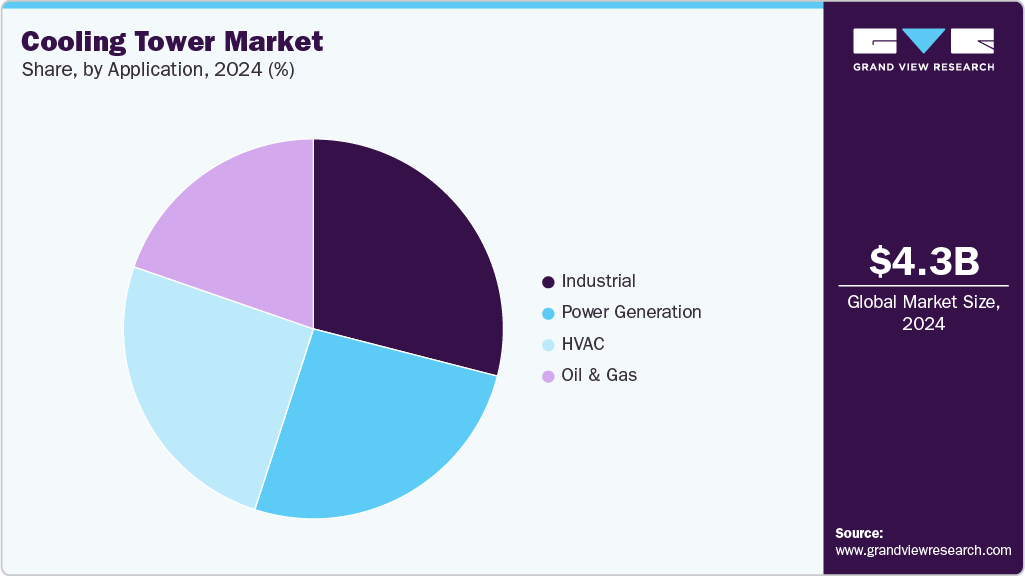
The HVAC segment is expected to grow at a considerable CAGR of 8.2% from 2025 to 2033 in terms of revenue. The HVAC segment is the fastest-growing application, driven by rising demand for air conditioning in commercial buildings, data centers, and urban infrastructure. Increased focus on indoor climate control and energy-efficient systems is boosting cooling tower adoption. Growth in the construction of malls, hospitals, and office spaces further fuels demand. In addition, sustainability initiatives in building design support the integration of efficient cooling systems.
Regional Insights
North America cooling tower market is growing at significant CAGR of 7.0% over the forecast period. The growth is attributed to its advanced industrial base and stringent environmental regulations. The presence of major players and ongoing upgrades in power and HVAC infrastructure further support market growth. The U.S. leads the region with high adoption across oil & gas, chemical, and data center sectors. Technological innovation and a focus on energy efficiency also drive the market forward.
U.S. Cooling Tower Market Trends
The U.S. dominates the North American cooling tower market and accounted for 77.4% share, due to its large-scale industrial base and extensive energy infrastructure. High demand from sectors such as power generation, oil & gas, and data centers drives consistent growth. Strict environmental regulations promote the use of energy-efficient and low-emission cooling systems. Continuous technological innovation and retrofitting of existing facilities also support market leadership.
Cooling tower market in Canada is experiencing steady growth, supported by expanding commercial construction and clean energy initiatives. Increasing focus on sustainable building practices is driving demand for efficient HVAC systems. Government support for industrial modernization and emission control boosts adoption. Growth in sectors such as mining, healthcare, and infrastructure further contributes to market expansion.
Europe Cooling Tower Market Trends
Europe maintains a strong market share, supported by growing demand for sustainable cooling systems and strict regulatory frameworks on emissions and energy use. Countries such as Germany, France, and the UK are leading adopters due to investments in green building projects and industrial automation. The shift toward renewable energy and district cooling systems also fuels demand. Strong environmental policies continue to encourage adoption of efficient cooling technologies.
Cooling tower market in Germany is a key growth market in Europe due to its strong industrial base and commitment to energy efficiency. The country’s focus on sustainable manufacturing and green building standards which are driving the adoption of advanced cooling technologies. Growth in sectors such as automotive, chemicals, and power generation supports increasing demand. Government incentives for low-emission and water-efficient systems further accelerate market expansion.
The UK cooling tower market is growing steadily, driven by rising investments in commercial infrastructure and data centers. The country's increased focus on energy-efficient HVAC systems aligns with its carbon reduction goals. The modernization of aging industrial facilities also fuels demand for upgraded cooling technologies. Supportive policies around sustainability and environmental compliance enhance market opportunities.
Asia Pacific Cooling Tower Market Trends
Asia Pacific dominated the cooling tower market with the largest revenue share of 31.8% in 2025, owing to rapid industrialization, urbanization, and expanding energy infrastructure, especially in China and India. The region's strong manufacturing and power generation sectors significantly drive demand for cooling towers. Government initiatives supporting infrastructure development and energy efficiency further enhance growth. Rising population and climate-driven cooling needs also contribute to market expansion.
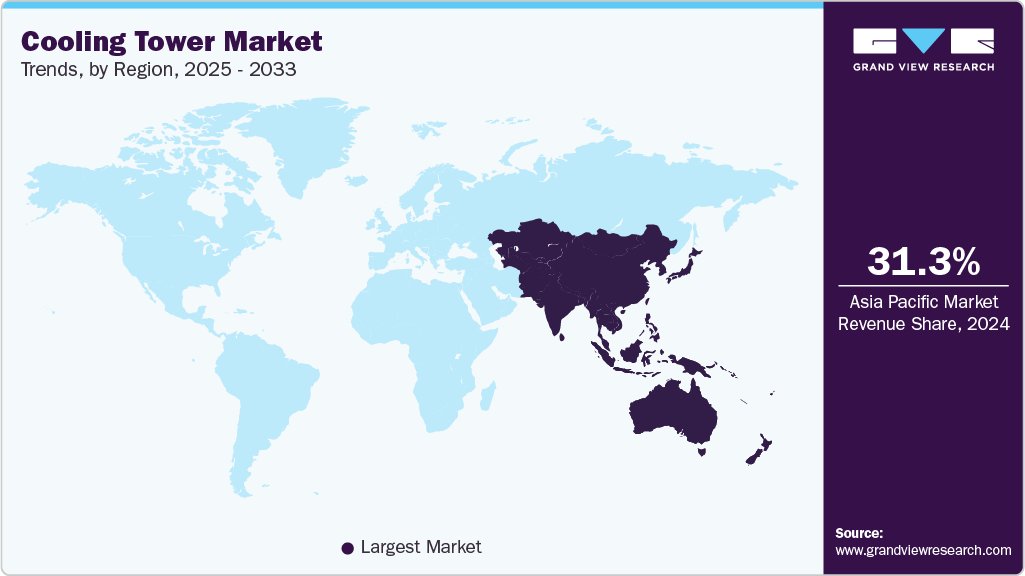
The cooling tower market in the China held the largest share in the Asia Pacific region in 2025. China cooling tower market is witnessing strong growth due to rapid industrialization and large-scale power generation activities. Expanding manufacturing, petrochemical, and steel industries create consistent demand for high-capacity cooling systems. Government initiatives promoting energy efficiency and environmental compliance are accelerating the adoption of advanced cooling technologies. In addition, urban development and data center expansion further support the market growth.
Cooling tower market in India is growing rapidly, driven by increased infrastructure development and rising electricity demand. The expansion of thermal power plants and industrial zones fuels a significant uptake of cooling systems. Government programs like “Make in India” and smart city projects are promoting industrial growth and modern HVAC adoption. Rising temperatures and urbanization are also contributing to greater demand in the commercial and residential sectors.
Middle East & Africa Cooling Tower Market Trends
The Middle East and Africa are emerging markets, driven by expanding construction, oil & gas, and energy sectors. High temperatures and growing demand for HVAC systems are key factors fueling adoption. Governments are investing in desalination, power generation, and infrastructure, creating new opportunities. Adoption of energy-efficient and water-conserving systems is gaining traction amid resource constraints.
Cooling tower market in Saudi Arabia is experiencing notable growth, driven by its expanding power generation and petrochemical industries. The country’s harsh climate and high cooling demand in industrial and commercial sectors fuel the need for efficient cooling solutions. Large-scale infrastructure projects under Vision 2030 are further boosting market opportunities. Additionally, a strong focus on water conservation and energy efficiency supports the adoption of advanced cooling tower technologies.
Latin America Cooling Tower Market Trends
Latin America is witnessing steady growth in the cooling tower market, fueled by development in industrial and commercial sectors. Countries like Brazil and Mexico are investing in energy and water-efficient infrastructure. Growing awareness of environmental sustainability is encouraging adoption of modern cooling technologies. The region's economic diversification is also boosting demand across various applications.
Brazil cooling tower market is growing steadily, supported by rising investments in industrial facilities and energy infrastructure. The country’s expanding manufacturing, chemical, and power generation sectors drive demand for reliable cooling solutions. Growth in commercial construction and HVAC installations also contributes to market expansion. Environmental regulations promoting energy and water efficiency further encourage the adoption of modern cooling technologies.
Key Cooling Tower Company Insights
Some of the key players operating in the market include Babcock & Wilcox Enterprises, Inc., Baltimore Aircoil Company, Cenk Endüstri Tesisleri Imalat Ve Taahhüt A.Åž.
-
Babcock & Wilcox specializes in energy and environmental technologies, with a strong presence in industrial cooling and thermal systems. The company provides modular cooling tower solutions tailored for power plants and process industries. Its focus on decarbonization and waste-to-energy technologies supports sustainability-driven projects. B&W also integrates emissions control and thermal efficiency enhancements in its cooling systems.
-
Baltimore Aircoil Company (BAC) is known for its advanced evaporative cooling and heat rejection solutions across HVAC, industrial, and refrigeration markets. It offers a range of hybrid, closed-circuit, and modular cooling towers designed for energy efficiency and low water usage. BAC emphasizes smart technology integration, such as intelligent controls for performance optimization. The company also focuses on corrosion-resistant materials and low-sound solutions for urban and industrial applications.
Key Cooling Tower Companies
The following key companies have been profiled for this study on the cooling tower market.
-
Babcock & Wilcox Enterprises, Inc.
-
Baltimore Aircoil Company
-
Cenk Endüstri Tesisleri Imalat Ve Taahhüt A.Åž.
-
Cooling Tower Systems, Inc.
-
Delta Cooling Towers Inc.
-
Engie Refrigeration GmbH
-
EVAPCO, Inc.
-
S.A. Hamon
-
Johnson Controls International Plc.
-
Kelvion Holdings GmbH
-
Liang Chi Industry Co. Ltd.
-
Mesan Group
-
Paharpur Cooling Towers Ltd.
-
SPX Corporation
-
Torraval Cooling S.L.
Competitive Benchmarking
Category
Operating Strategies
Competitive Edge
Weakness
Established Players (e.g., Baltimore Aircoil Company; Babcock & Wilcox Enterprises, Inc.; EVAPCO, Inc.; SPX Corporation; Johnson Controls International Plc.; Kelvion Holdings GmbH; Paharpur Cooling Towers Ltd.)
- Mature companies focus on securing long-term contracts from power plants, refineries, HVAC infrastructure projects, and large manufacturing facilities.
- These players continuously invest in advanced cooling technologies such as hybrid cooling towers, water-efficient systems, and automated monitoring solutions to meet evolving environmental regulations and sustainability requirements across global markets.
- Mature players possess strong global distribution and service networks, enabling them to handle large-scale industrial projects across multiple regions efficiently. Their established industry relationships and engineering expertise provide a significant advantage in complex cooling infrastructure projects.
- They also benefit from diversified product portfolios covering open-circuit, closed-circuit, and hybrid cooling towers for multiple end-use industries.
- These companies often face high operational, labor, and compliance costs due to their large manufacturing footprints and global operations.
- Their dependence on capital-intensive industries such as power generation, oil & gas, and heavy industrial manufacturing makes them vulnerable to economic slowdowns, delayed infrastructure investments, and fluctuations in industrial spending.
Emerging & Regional Players (e.g. Cenk Endüstri Tesisleri Imalat Ve Taahhüt A.S.; Cooling Tower Systems, Inc.; Delta Cooling Towers Inc.; Engie Refrigeration GmbH; Torraval Cooling S.L.)
- Emerging companies primarily focus on regional expansion and cost-competitive cooling tower solutions tailored to small and medium-scale industrial applications.
- These players are increasingly forming partnerships with local EPC contractors, distributors, and industrial solution providers to improve market penetration and strengthen their presence in developing economies.
- Emerging players offer greater operational flexibility and faster customization capabilities, allowing them to address specific customer requirements more efficiently than larger competitors.
- Competitive pricing and growing focus on lightweight, corrosion-resistant materials such as HDPE and FRP enable these companies to attract customers seeking economical and low-maintenance cooling solutions.
- Emerging companies generally have limited international presence and lower brand visibility, which can restrict their ability to secure large utility-scale or multinational industrial projects.
- Compared to established players, they often have lower R&D budgets, smaller service networks, and limited manufacturing capacity.
Recent Developments
-
In June 2025, SPX Cooling Technologies expanded its Marley® OlympusV™ Adiabatic Fluid Cooler line by introducing higher-capacity models. This strategic move aims to offer more flexible and efficient cooling solutions for operators and engineers across commercial HVAC, industrial process, and data center applications, reinforcing SPX’s leadership in advanced evaporative cooling technologies.
-
In January 2025, Delta Cooling Towers introduced the TMX Series, its largest HDPE cooling tower line, ranging from 300 to 3,250 cooling tons. Built with a seamless 20-foot sump, it reduces leak risks and simplifies maintenance. The launch includes a new West Virginia facility to support production. The TMX Series offers energy efficiency, durability, and a 20-year shell warranty.
-
In August 2024, Baltimore Aircoil Company introduced the Loop™ Platform, an AI-based system that enhances cooling tower performance. It uses real-time data to optimize efficiency, reduce energy and water usage, and support predictive maintenance. The compact platform integrates easily with existing systems. This innovation aligns with BAC’s focus on sustainability and system longevity.
Cooling Tower Market Report Scope
Report Attribute
Details
Market value in 2025
USD 4.5 billion
Estimated market size in 2026
USD 4.8 billion
Projected market size by 2033
USD 7.5 billion
Growth rate
CAGR of 6.5% from 2026 to 2033
Base year for estimation
2025
Historical data
2021 - 2024
Forecast period
2026 - 2033
Quantitative units
Revenue in USD million/billion and CAGR from 2026 to 2033
Report coverage
Revenue forecast, company ranking, competitive landscape, growth factors, and trends
Segments covered
Material, type, application, region
Regional scope
North America; Europe; Asia Pacific; Latin America; Middle East & Africa
Country scope
U.S.; Canada; Mexico; UK; Germany; France; Spain; Italy; China; Japan; India; Australia; South Korea; Brazil; Argentina; Saudi Arabia; South Africa; UAE
Key companies profiled
Babcock & Wilcox Enterprises, Inc.; Baltimore Aircoil Company; Cenk Endüstri Tesisleri Imalat Ve Taahhüt A.Åž.; Cooling Tower Systems, Inc.; Delta Cooling Towers Inc.; Engie Refrigeration GmbH; EVAPCO, Inc.; S.A. Hamon; Johnson Controls International Plc.; Kelvion Holdings GmbH; Liang Chi Industry Co. Ltd.; Mesan Group; Paharpur Cooling Towers Ltd.; SPX Corporation; Torraval Cooling S.L.
Customization scope
Free report customization (equivalent up to 8 analysts' working days) with purchase. Addition or alteration to country, regional & segment scope.
Pricing and purchase options
Avail customized purchase options to meet your exact research needs. Explore purchase options
Global Cooling Tower Market Report Segmentation
This report forecasts revenue growth at global, regional, and country levels and provides an analysis of the latest industry trends in each of the sub-segments from 2021 to 2033. For this study, Grand View Research has segmented the global cooling tower market report based on material,type, application and region:

-
Material Outlook (Revenue, USD Million, 2021 - 2033)
-
FRP
-
Steel
-
Concrete
-
Wood
-
HDPE
-
-
Type Outlook (Revenue, USD Million, 2021 - 2033)
-
Open Circuit
-
Closed Circuit
-
Hybrid
-
-
Application Outlook (Revenue, USD Million, 2021 - 2033)
-
HVAC
-
Power Generation
-
Oil & Gas
-
Industrial
-
-
Regional Outlook (Revenue, USD Million, 2021 - 2033)
-
North America
-
U.S.
-
Canada
-
Mexico
-
-
Europe
-
Germany
-
France
-
Italy
-
Spain
-
UK
-
-
Asia Pacific
-
China
-
India
-
Japan
-
South Korea
-
Australia
-
-
Latin America
-
Brazil
-
Argentina
-
-
Middle East and Africa
-
Saudi Arabia
-
UAE
-
South Africa
-
-
Research Methodology
The cooling tower market figures in this report are based on a proven research process that combines executive interviews with secondary research from proprietary databases, company filings, and recognized regulatory and institutional sources. Market size is built through value-chain sizing - reconciling supply-side and demand-side estimates - and triangulated with bottom-up and top-down approaches. Every estimate passes multiple levels of expert validation before publication, with each cooling tower segment quantified using the revenue-capture definitions in the table below.
Segment Definition
Type
Revenue Capture Definition
Open circuit
Revenue is captured through the sale of open-circuit cooling towers used for direct heat rejection. The segment benefits from widespread adoption across industrial plants, commercial buildings, and power generation facilities due to cost-effective operation.
Closed circuit
Revenue is generated from closed-circuit cooling systems that protect process fluids from external contamination. Demand from data centers, pharmaceuticals, food processing, and advanced manufacturing industries contributes significantly to segment growth.
Hybrid
This segment captures revenue from hybrid cooling towers that combine wet and dry cooling technologies to improve water and energy efficiency. Increasing environmental regulations and sustainability initiatives are driving adoption across industrial and utility applications.
Material
Revenue Capture Definition
FRP
Revenue is generated from the sale of corrosion-resistant FRP cooling towers used across power generation, HVAC, and industrial facilities. The segment captures value through new installations, replacement demand, and customized tower solutions designed for harsh operating environments.
Steel
Revenue is derived from galvanized and stainless-steel cooling towers deployed in commercial and industrial applications requiring high structural strength. Growth is supported by demand for durable cooling systems in manufacturing plants, refineries, and large infrastructure projects.
Concrete
This segment captures revenue from large-capacity concrete cooling towers primarily utilized in utility-scale power plants and heavy industrial facilities. Revenue is influenced by major infrastructure investments, plant expansions, and long-term cooling system projects.
Wood
Revenue is generated through wooden cooling tower installations and replacement components used in select industrial applications. The segment mainly benefits from retrofit projects and facilities where traditional wood-based designs remain operational.
HDPE
Revenue stems from lightweight, corrosion-resistant HDPE cooling towers increasingly adopted in chemical processing, water treatment, and commercial facilities. Market growth is driven by lower maintenance requirements and extended operational lifespan.
Application
Revenue Capture Definition
HVAC
Revenue is generated from cooling tower installations supporting commercial buildings, hospitals, airports, shopping centers, and institutional facilities. Growth is linked to urbanization, commercial construction activity, and rising demand for energy-efficient cooling systems.
Power Generation
This segment captures revenue from cooling towers installed in thermal, nuclear, and combined-cycle power plants. Ongoing investments in power infrastructure, plant modernization, and capacity expansion continue to drive revenue generation.
Oil & Gas
Revenue is derived from cooling systems used in refineries, petrochemical complexes, LNG facilities, and upstream processing operations. Demand is supported by the need for reliable heat management in energy-intensive production environments.
Industrial
Revenue is generated from cooling tower deployments across manufacturing sectors including chemicals, metals, food & beverage, pharmaceuticals, pulp & paper, and automotive. The segment benefits from industrial expansion, process optimization initiatives, and increasing cooling requirements in production facilities.
Estimation Model
Layer Name
Key Question
Description
End-Use Industry Demand Layer
How much cooling tower demand originates across industries?
The estimation begins by evaluating cooling tower demand from key end-use sectors including power generation, HVAC, oil & gas, chemicals, manufacturing, food processing, and commercial infrastructure. Capacity additions, industrial output, energy consumption trends, and facility expansion projects are assessed to determine the overall addressable market for cooling tower systems globally.
Technology Adoption Layer
Which cooling tower technologies are being adopted across applications?
The potential market is further refined by analyzing the adoption of open-circuit, closed-circuit, and hybrid cooling towers across different industries. Factors such as water efficiency requirements, energy performance, environmental regulations, operating conditions, and lifecycle costs are evaluated to estimate segment-wise technology penetration and future adoption trends.
Equipment Deployment Layer
How many cooling towers are installed, upgraded, or replaced?
Annual market demand is estimated based on new industrial and commercial construction projects, power plant installations, equipment replacement cycles, retrofit activities, and facility modernization programs. Additional consideration is given to aging infrastructure, maintenance requirements, and cooling system upgrades that drive equipment deployment volumes.
Revenue Layer
How much revenue is generated from cooling tower products and services
Market revenue is calculated by analyzing the sales of cooling tower systems across power generation, HVAC, oil & gas, and industrial applications. Revenue contributions are assessed across different materials, tower types, capacities, and geographic regions to determine the overall cooling tower market size and growth potential.
Delivered Customizations
This report has been delivered with the following In-depth customizations
Client Request
Customization Delivered
Value Adds
Regional segmentation
A detailed regional analysis was delivered covering North America, Europe, Asia Pacific, Latin America, and the Middle East & Africa, with country-level demand assessment for cooling towers across HVAC, power generation, and industrial applications. The study highlighted regional growth trends, regulatory scenarios, infrastructure investments, and industrial expansion patterns influencing market demand.
Helped the client identify high-growth regional markets, optimize expansion strategies, and prioritize investment opportunities based on industrial growth, energy demand, and infrastructure development trends across different geographies.
Competitive benchmarking
An in-depth competitive benchmarking assessment was delivered comparing major market participants based on product portfolio, technological capabilities, regional presence, operational strategies, and innovation focus. The study also evaluated strengths, weaknesses, and strategic positioning of mature and emerging companies.
Assisted the client in understanding competitor positioning, identifying market differentiation opportunities, and improving strategic decision-making related to product development and competitive market entry planning.
Opportunity assessment
A comprehensive opportunity analysis was conducted by evaluating emerging application areas, technology adoption trends, sustainability initiatives, and investment activities across end-use industries. The customization also included the identification of untapped industrial sectors and future revenue pockets for advanced cooling tower technologies.
Enabled the client to understand future growth potential, identify profitable business segments, and develop strategic plans for product expansion, partnership development, and long-term revenue generation opportunities.
Frequently Asked Questions About This Report
The global cooling tower market size was estimated at USD 4.5 billion in 2025 and is expected to be USD 4.8 billion in 2026.
The global cooling tower market, in terms of revenue, is expected to grow at a CAGR of 6.5% from 2026 to 2033 to reach USD 7.5 billion by 2033.
The open circuit segment led the market with the largest revenue share of 42.4% in 2025.
Some of the key players operating in the global cooling tower market include Babcock & Wilcox Enterprises, Inc.; Baltimore Aircoil Company; Cenk Endüstri Tesisleri Imalat Ve Taahhüt A.Åž.; Cooling Tower Systems, Inc.; Delta Cooling Towers Inc.; Engie Refrigeration GmbH; EVAPCO, Inc.; S.A. Hamon; Johnson Controls International Plc.; Kelvion Holdings GmbH; Liang Chi Industry Co. Ltd.; Mesan Group; Paharpur Cooling Towers Ltd.; SPX Corporation; Torraval Cooling S.L.
Key factors include increasing industrialization, growing demand for efficient heat dissipation systems, rising investments in power generation and HVAC infrastructure, and expanding manufacturing activities across developing economies.
The FRP (Fiber Reinforced Plastic) segment accounted for the largest revenue share of 29.1% in 2025.The segment growth is driven by its high strength, corrosion resistance, and long service life. It is particularly favored in industrial environments with harsh chemical exposure.
Asia Pacific dominated the cooling tower market with the largest revenue share of 31.8% in 2025.
The industrial segment led the market with the largest revenue share of 29.1% in 2025 while HVAC segment is expected to be the fastest-growing market.
About the Author(s)
Advanced Interior Materials Research Team
Advanced Materials · Advanced Interior MaterialsThis report was authored by the advanced interior materials research team at Grand View Research - comprising two research analysts, one senior research analyst, and one industry expert - with specialized expertise in the advanced interior materials segment of the advanced materials industry. All findings are based on proprietary advanced materials databases, executive interviews, and regulatory analysis, subject to internal peer review prior to publication.
Last Updated:
Speak to Analyst

Need a Tailored Report?
Customize this report to your needs — add regions, segments, or data points, with 20% free customization.
Or view our licence options:


ISO 9001:2015 & 27001:2022 Certified
We are GDPR and CCPA compliant! Your transaction & personal information is safe and secure. For more details, please read our privacy policy.












