
- Home
- »
- Automotive & Transportation
- »
-
Dry Bulk Shipping Market Size, Share & Trends Report, 2033GVR Report cover

Dry Bulk Shipping Market (2026 - 2033)
Size, Share & Trends Analysis Report By Coverage (Iron Ore, Coal, Grains, Bauxite), By Vessel (Capesize, Panamax, Supramax), By Operation, By End-use (Mining & Metals, Agriculture, Construction), By Region, And Segment Forecasts
Market Size, 2025
$148.1BMarket Estimate, 2026
$157.3BMarket Forecast, 2033
$266.7BCAGR, 2026–2033
7.8%Dry Bulk Shipping Market Summary
The global dry bulk shipping market size was valued at USD 148.1 billion in 2025 and is projected to grow from USD 157.3 billion in 2026 to USD 266.7 billion by 2033, at a CAGR of 7.8% from 2026 to 2033. Asia Pacific dominated the market, accounting for the largest revenue share of 40.5% in 2025. The industry is driven by increasing international seaborne trade, rising demand for bulk commodities, expansion of steel production, growing energy requirements, and continuous investments in global infrastructure development.
 Source: Grand View Research, IR Documents, Primary Interviews, Paid DatabasesTo learn more about this report,
 Download Free Sample Report
 Key Market Trends & Insights
- By coverage: The iron ore segment accounted for the largest market share of 34.0% in 2025.
- By vessel: The capesize segment accounted for the largest market share in 2025.
- By operation: The owned fleet segment dominated the market in 2025.
- By end-use: The mining & metals segment accounted for the largest market share in 2025.
Regional Highlights
- Largest regional market: Asia Pacific (40.5% revenue share, 2025)
- By country: China was the largest market in 2025.
Market Size & Forecast
- Market Size in 2025: USD 148.1 Billion
- Estimated Market Size in 2026: USD 157.3 Billion
- Projected Market Size by 2033: USD 266.7 Billion
- CAGR (2026-2033): 5.1%
Three ways to get this report
Buy it, customize it, or ask a question.Ask an Analyst
A direct answer, usually in 1 working day
- AccessReport author, directly
- Reply timeWithin 1 working day
- No sales callDirect answer only
- FormatEmail reply
- CostFree, no cost
Get the Full Report
What the study covers
- FormatsPDF · Excel · Dashboard
- Timeline2026–2033 annual, 2025 base
- Coverage20+ countries, 5 regions
- Companies10+ key players profiled
Customize the Report
20% free customization
- IncludeCountries, segments, points
- TailorTo your product definition
- ExtendDeeper competitor detail
- OrA fully bespoke study
- Turnaround5–10 working days
Dry bulk shipping remains the backbone of global commodity transportation, facilitating the movement of iron ore, coal, grains, bauxite, fertilizers, cement, and other raw materials essential for industrial production and economic growth. Increasing urbanization, industrialization, and manufacturing activities across emerging economies continue to strengthen demand for efficient bulk transportation services. Furthermore, fleet modernization, digital voyage optimization, and decarbonization initiatives are transforming operational efficiency while enabling shipping companies to comply with evolving international maritime regulations. To learn more about this report, Download Free Sample Report
 The continued expansion of global commodity trade remains a major catalyst for the dry bulk shipping market. Rising demand for iron ore, coal, grains, bauxite, fertilizers, cement, and other dry bulk commodities is increasing vessel utilization across international shipping routes. Developing economies continue to invest heavily in industrialization, infrastructure development, renewable energy projects, and urban construction, significantly increasing imports of raw materials. Meanwhile, established economies continue to rely on stable dry bulk transportation networks to secure energy resources, industrial inputs, and agricultural commodities. These trends continue to strengthen long-term demand for dry bulk shipping services across major trade corridors.
The growing adoption of digital shipping technologies is further improving market efficiency. Shipping companies are increasingly deploying artificial intelligence, voyage optimization software, predictive maintenance platforms, satellite-based fleet monitoring, weather routing systems, and advanced fuel management technologies to improve vessel utilization while reducing operating costs.
Furthermore, increasing environmental regulations from international maritime authorities are encouraging fleet modernization through the adoption of fuel-efficient vessels, alternative marine fuels, energy-saving technologies, and carbon emission reduction strategies. These initiatives improve operational sustainability while enhancing long-term competitiveness.
Additionally, increasing investments in mining, steel manufacturing, renewable energy infrastructure, and global agricultural trade continue to generate substantial opportunities for dry bulk shipping companies. Growing exports of iron ore, bauxite, grains, fertilizers, and industrial minerals from resource-rich countries are expanding long-haul shipping demand.
The continued evolution of autonomous vessel technologies, digital freight management platforms, smart port infrastructure, and sustainable shipping solutions is expected to further strengthen market growth throughout the forecast period.
Market Dynamics
Growing international trade in dry bulk commodities remains one of the strongest drivers supporting the industry. Rapid industrialization, urbanization, and infrastructure expansion across Asia Pacific, the Middle East, Latin America, and Africa continue to increase demand for iron ore, coal, cement, steelmaking materials, grains, fertilizers, and industrial minerals transported by sea. Governments are investing heavily in transportation infrastructure, renewable energy projects, housing construction, and manufacturing expansion, all of which require reliable maritime transportation of bulk raw materials. Simultaneously, rising global food demand and increasing agricultural exports are driving higher shipments of grains and other agricultural commodities across international trade routes.
Shipping companies are responding by expanding fleet capacity, optimizing vessel deployment, improving route planning, and adopting advanced digital fleet management systems that enhance operational efficiency while reducing transportation costs. Technologies including satellite vessel tracking, AI-powered voyage optimization, predictive maintenance, and fuel efficiency management are enabling operators to improve fleet productivity and maximize cargo throughput. As international trade volumes continue to expand and commodity-producing nations strengthen export capabilities, demand for efficient and cost-effective dry bulk shipping services is expected to remain robust throughout the forecast period.
Despite strong long-term demand fundamentals, the industry continues to face challenges arising from volatile freight rates and increasingly stringent environmental regulations. Freight pricing remains highly sensitive to fluctuations in global commodity demand, vessel supply, geopolitical developments, fuel prices, trade policies, and macroeconomic conditions. Sudden imbalances between shipping capacity and cargo demand can significantly impact vessel utilization and profitability, making revenue forecasting challenging for shipping operators.
In addition, compliance with international maritime regulations governing greenhouse gas emissions, sulfur content, ballast water management, and carbon intensity requires substantial capital investment in vessel upgrades, alternative fuels, emission reduction technologies, and digital compliance systems. Smaller shipping companies often face financial constraints when modernizing fleets or replacing aging vessels. Rising operating expenses, port congestion, insurance costs, labor shortages, and supply chain disruptions further increase operational complexity. These factors may temporarily restrain market expansion despite the industry's positive long-term outlook.
The ongoing digital transformation of maritime logistics presents significant growth opportunities for the industry. Shipping companies are increasingly adopting artificial intelligence, cloud-based fleet management platforms, Internet of Things (IoT) sensors, predictive analytics, digital twins, and autonomous navigation technologies to optimize voyage planning, reduce fuel consumption, improve cargo scheduling, and enhance fleet performance. These technologies improve operational efficiency while enabling real-time decision-making across increasingly complex global shipping networks.
Growing investments in decarbonization are creating additional opportunities across the industry. Fleet operators are accelerating investments in LNG-powered vessels, methanol-ready ships, wind-assisted propulsion systems, carbon capture technologies, and energy-efficient vessel designs to comply with evolving IMO regulations and customer sustainability requirements. Furthermore, expanding global demand for critical minerals including bauxite, lithium, nickel, and other industrial raw materials supporting renewable energy, electric vehicles, and battery manufacturing, is expected to generate new long-term cargo volumes. Increasing smart port development, digital freight exchanges, blockchain-enabled shipping documentation, and automated port operations will further strengthen efficiency and create new growth opportunities across the global dry bulk shipping ecosystem.
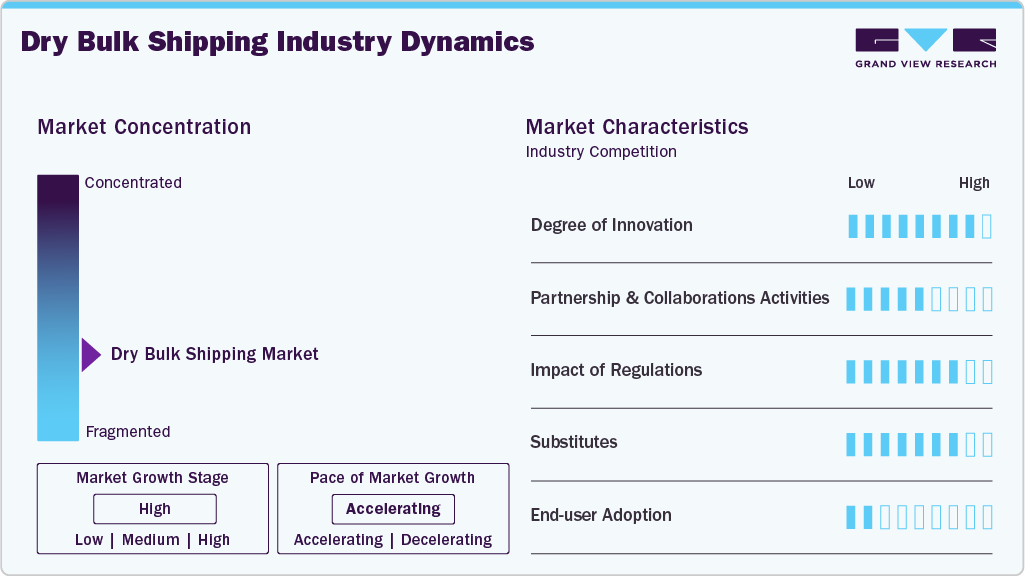
Market Concentration & Characteristics
The industry is moderately fragmented, with the presence of large international shipping companies, regional vessel operators, commodity transportation specialists, and integrated maritime logistics providers competing across global trade routes. Market participants are continuously investing in fleet modernization, fuel-efficient vessels, digital voyage optimization, predictive maintenance technologies, emissions reduction systems, and intelligent fleet management platforms to strengthen their competitive positions. Strategic vessel acquisitions, long-term charter agreements, fleet expansion, geographic diversification, and sustainability initiatives remain key competitive strategies adopted by leading market participants.
 To learn more about this report, Download Free Sample Report
 The market is characterized by continuous technological advancement driven by maritime digitalization, environmental compliance, and growing demand for efficient commodity transportation. Shipping companies are increasingly integrating artificial intelligence, satellite-based vessel monitoring, predictive analytics, weather routing systems, cloud-based fleet management, and autonomous navigation technologies into daily operations to improve fleet productivity and reduce operational risks. As global commodity trade continues to expand and environmental regulations become increasingly stringent, operators capable of delivering fuel-efficient, digitally connected, and environmentally sustainable shipping services are expected to strengthen their competitive advantage. Furthermore, increasing collaboration between shipping companies, commodity exporters, port authorities, and logistics providers will continue to accelerate operational innovation and long-term market growth.
Analyst Perspective
Industrialization, infrastructure development, and international commodity trade increase the demand for efficient maritime transportation. Rising consumption of industrial minerals, coupled with expanding mining and agricultural exports, is driving higher vessel utilization across major global shipping routes. Technological advancements in digital fleet management, voyage optimization, predictive maintenance, AI, fuel-efficient propulsion systems, and vessel performance analytics are transforming conventional bulk shipping into a more efficient industry. Competitive differentiation is increasingly shifting toward fleet modernization, decarbonization strategies, intelligent voyage planning, operational efficiency, and compliance with evolving international maritime regulations, with continued investments expected in green shipping technologies, alternative fuels, smart ports, and digital maritime ecosystems that will strengthen long-term market growth.
Coverage Insights
The iron ore segment accounted for the largest market share of 34.0% in 2025. Iron ore remains the dominant dry bulk commodity due to its critical role in global steel manufacturing and infrastructure development. Major exporters such as Australia and Brazil continue to supply substantial volumes to steel-producing economies, including China, Japan, South Korea, and India. Long-haul transportation of iron ore primarily utilizes Capesize vessels because of their high carrying capacity and cost efficiency. Rising investments in urban infrastructure, industrial construction, transportation networks, and renewable energy projects continue to support steel demand, thereby strengthening iron ore shipping volumes. Long-term supply agreements between mining companies and steel manufacturers, coupled with stable export flows from major mining regions, continue to reinforce the dominance of this segment.
The bauxite segment is expected to register the fastest CAGR during the forecast period. Increasing aluminum production driven by lightweight automotive manufacturing, aerospace applications, renewable energy infrastructure, packaging demand, and electrical transmission projects is significantly boosting global bauxite trade. Rapid expansion of alumina refining capacity across China, India, Indonesia, and the Middle East is further increasing seaborne transportation of bauxite. Growing investments in sustainable aluminum production and rising demand for recyclable lightweight materials are expected to continue driving shipment volumes, making bauxite one of the fastest-growing dry bulk commodities.
Vessel Insights
The capesize segment accounted for the largest market share in 2025 due to its ability to carry very large cargo volumes of iron ore and coal across long-distance international trade routes. These vessels provide significant economies of scale, reducing transportation costs per ton while maximizing operational efficiency for mining companies and commodity traders. Major export corridors between Australia, Brazil, and Asia continue to generate strong demand for Capesize vessels. Increasing global steel production and large-scale mining operations are expected to sustain strong utilization rates for this vessel category throughout the forecast period.
The supramax segment is expected to register the fastest CAGR during the forecast period. Supramax vessels offer greater operational flexibility by serving both major ports and smaller regional ports with onboard cargo handling equipment. Their versatility allows operators to transport diversified cargoes including grains, fertilizers, cement, steel products, forest products, bauxite, and minor bulk commodities across short- and medium-haul trade routes. Rising intra-Asia trade, regional infrastructure development, and increasing agricultural exports are expected to accelerate demand for Supramax vessels over the coming years.
Operation Insights
The owned fleet segment accounted for the largest market share in 2025 and is expected to register the fastest CAGR during the forecast period. Owned fleet operations dominate the market as major shipping companies continue to invest in vessel ownership to achieve greater operational control, improve fleet utilization, and optimize long-term transportation costs. Ownership of Capesize, Panamax, and Supramax vessels enables operators to directly manage vessel deployment, route planning, maintenance schedules, and cargo transportation activities while reducing dependency on third-party charter availability. Increasing investments in fleet modernization, acquisition of fuel-efficient vessels, and adoption of digital fleet management technologies are further supporting the growth of owned fleet operations. Additionally, shipping companies are increasingly expanding their owned fleets to strengthen supply chain reliability, improve profitability during favorable freight cycles, and support long-term contracts with mining, energy, and commodity trading companies.
The chartered fleet segment held a significant share of the market in 2025 and continues to play an important role by providing operational flexibility and capacity optimization for shipping companies and commodity traders. Chartered fleet operations allow companies to access additional vessel capacity without significant capital investment, enabling them to manage seasonal demand fluctuations, changing commodity trade patterns, and freight market volatility. Time charter, voyage charter, and bareboat charter agreements provide flexibility in adjusting transportation capacity based on market conditions. Growing global commodity trade, increasing demand for flexible shipping solutions, and the need to optimize fleet economics are expected to sustain demand for chartered fleet operations.
End-use Insights
The mining & metals segment accounted for the largest market share in 2025 due to strong global demand for iron ore, coal, bauxite, and other mineral commodities required for steel production, aluminum manufacturing, and industrial applications. Large-scale mining operations across Australia, Brazil, China, and other major commodity-producing regions generate substantial demand for Capesize and Panamax vessels to transport high-volume bulk cargo over long-distance international trade routes. Increasing steel production, infrastructure development, urbanization, and industrial expansion across emerging economies are expected to continue driving demand for dry bulk shipping services.
 To learn more about this report, Download Free Sample Report
 The agriculture segment is expected to register the fastest CAGR during the forecast period, driven by increasing global food consumption, rising agricultural commodity trade, and growing demand for transportation of grains, oilseeds, fertilizers, and animal feed across international markets. Dry bulk vessels, particularly Panamax, Supramax, and Handy-size vessels, are widely used for transporting agricultural commodities due to their flexibility in serving regional and international trade routes. Expanding agricultural exports from major producing countries, increasing food security initiatives, and rising trade between grain-producing and importing economies are expected to accelerate demand for dry bulk shipping services in the agriculture sector over the coming years.
Regional Insights
The dry bulk shipping market in Asia Pacific accounted for the largest revenue share of 40.5% in 2025 and is expected to register the fastest CAGR of 9.7% during the forecast period. The region's dominance is supported by its strong industrial base, extensive steel production capacity, rapid urbanization, and high import demand for iron ore, coal, bauxite, and grains. Countries such as China, India, Japan, and South Korea account for a significant share of global dry bulk trade due to expanding infrastructure projects, manufacturing activities, and power generation requirements. Increasing investments in port infrastructure, fleet modernization, digital shipping technologies, and sustainable maritime operations continue to strengthen regional market growth. Furthermore, rising commodity imports and exports across Southeast Asia are driving higher vessel utilization and supporting long-term expansion of dry bulk shipping services.
 To learn more about this report, Download Free Sample Report
 China Dry Bulk Shipping Industry Trends
The China dry bulk shipping market remains the world's largest market owing to its position as the largest importer of iron ore, coal, and bauxite. The country's massive steel manufacturing industry, infrastructure development programs, and growing industrial production continue to generate substantial demand for dry bulk transportation. Shipping companies are increasingly investing in fuel-efficient vessels, digital fleet management systems, and intelligent voyage optimization technologies to improve operational efficiency and reduce transportation costs.
North America Dry Bulk Shipping Industry Trends
The North America dry bulk shipping market is driven by strong agricultural exports, mining activities, and growing exports of grains, coal, fertilizers, and industrial minerals. Increasing investments in bulk cargo terminals, port automation, and fleet optimization technologies continue to strengthen regional shipping capabilities.
The dry bulk shipping market in the U.S. remains the largest contributor to the North American region due to its significant exports of grains, coal, fertilizers, and industrial commodities. Rising agricultural exports, expanding mining operations, and modernization of port infrastructure continue to support demand for dry bulk shipping services across domestic and international trade routes.
Europe Dry Bulk Shipping Industry Trends
The dry bulk shipping market in Europe represented a significant share of 21.1% in 2025, supported by its well-developed maritime infrastructure, strong agricultural exports, industrial manufacturing activities, and extensive seaborne trade networks. The region continues to play a critical role in transporting grains, fertilizers, industrial minerals, and construction materials across international shipping routes. Increasing investments in sustainable shipping technologies, decarbonization initiatives, and environmentally compliant vessels are encouraging fleet modernization among European shipping companies.
The Germany dry bulk shipping market remains one of Europe's leading maritime trade hubs due to its strong industrial economy, major seaports, and extensive import-export activities. Growing demand for raw materials supporting the automotive, manufacturing, and construction industries continues to drive dry bulk shipping volumes.
The dry bulk shipping market in the UK is expected to witness stable growth owing to increasing imports of agricultural commodities, industrial minerals, and energy resources. Port modernization initiatives and investments in digital maritime logistics continue to enhance shipping efficiency across the country.
Key Dry Bulk Shipping Companies Insights
The dry bulk shipping market is highly competitive, with leading shipping companies focusing on fleet expansion, vessel modernization, digital fleet management, fuel-efficient operations, and sustainability initiatives to strengthen their market positions. Companies are increasingly investing in larger, environmentally compliant vessels equipped with advanced navigation systems, voyage optimization software, predictive maintenance platforms, and fuel-saving technologies to improve operational efficiency and reduce emissions. Strategic fleet acquisitions, long-term charter agreements, geographic expansion, and digital transformation remain the primary competitive strategies adopted by major industry participants.
-
COSCO Shipping Bulk Co. is one of the dry bulk shipping operators, providing global transportation services for iron ore, coal, grains, steel products, and other bulk commodities through a diversified fleet of Capesize, Panamax, and Supramax vessels. The company continues expanding its international shipping network while investing in intelligent fleet management and green shipping technologies.
-
Oldendorff Carriers is a privately owned dry bulk shipping company specializing in worldwide transportation of bulk commodities, including iron ore, coal, fertilizers, grains, and bauxite. The company continues strengthening operational efficiency through voyage optimization, digital fleet technologies, and long-term customer partnerships.
Key Dry Bulk Shipping Companies:
The following key companies have been profiled for this study on the dry bulk shipping market:
-
COSCO Shipping Bulk Co.
-
Berge Bulk
-
Oldendorff Carriers
-
Star Bulk Carriers Corp.
-
Golden Ocean Group Ltd.
-
Pan Ocean Co., Ltd.
-
Pacific Basin Shipping Ltd.
-
Navios Maritime Partners L.P.
-
Genco Shipping & Trading Ltd.
-
Ultrabulk A/S
Competitive Benchmarking
Operating Strategies
Competitive Edge
Weaknesses
Mature Players: COSCO Shipping Bulk Co., Oldendorff Carriers, Star Bulk Carriers Corp., Golden Ocean Group Ltd., Pan Ocean Co., Ltd., Pacific Basin Shipping Ltd.
Mature players are focusing on fleet expansion, vessel modernization, digital maritime transformation, and sustainability-driven shipping operations. Their strategies include acquiring fuel-efficient vessels, optimizing fleet deployment across major commodity trade routes, strengthening long-term charter agreements, expanding global port connectivity, implementing AI-enabled voyage optimization systems, and improving operational efficiency through advanced fleet management platforms. These companies are also prioritizing decarbonization initiatives, alternative fuel adoption, emission reduction technologies, and compliance with evolving international maritime regulations to enhance long-term competitiveness.
Mature companies benefit from extensive global shipping networks, large and diversified vessel fleets, established relationships with commodity producers and traders, strong financial capabilities, and deep operational expertise in international bulk transportation. Their ability to manage large-scale Capesize, Panamax, and Supramax fleets, provide reliable transportation capacity, and operate across major global trade corridors provides a significant competitive advantage. Strong customer relationships, integrated maritime capabilities, and investments in digital shipping technologies further strengthen their market position.
Mature companies face challenges, including high capital requirements for vessel acquisition and fleet renewal, exposure to freight rate volatility, fluctuating commodity demand, increasing fuel costs, and stricter environmental compliance requirements. Additionally, the transition toward low-carbon shipping requires significant investments in alternative fuels, energy-efficient vessels, and emission reduction technologies, creating operational and financial pressures.
Emerging Players: Berge Bulk, Navios Maritime Partners L.P., Genco Shipping & Trading Ltd., Ultrabulk A/S
Emerging players are focusing on operational flexibility, specialized bulk transportation services, digital fleet optimization, sustainable vessel operations, and customer-focused shipping solutions. Their strategies include expanding vessel capacity through selective fleet investments, utilizing chartering models to optimize operational flexibility, implementing advanced vessel performance monitoring systems, improving fuel efficiency, and adopting digital technologies for voyage planning and fleet analytics. These companies are also strengthening their presence through niche commodity transportation services and strategic partnerships across regional and international trade routes.
Emerging companies gain competitive advantages through agile fleet management, flexible operating models, specialized expertise in commodity transportation, faster adoption of digital maritime solutions, and the ability to respond quickly to changing market conditions. Their focus on operational efficiency, customer-specific logistics solutions, and sustainable shipping practices enables them to compete effectively in selected dry bulk segments and regional markets.
Emerging companies face challenges, including smaller fleet sizes compared with global shipping leaders, limited geographic coverage, lower bargaining power with customers and suppliers, exposure to freight market cycles, and dependence on charter market conditions. Additionally, significant investments required for fleet modernization, environmental compliance, and the adoption of advanced maritime technologies can create financial constraints.
Recent Developments:
-
In April 2026, Genco Shipping & Trading Limited strengthened its fleet renewal program by acquiring a scrubber-fitted Capesize vessel while divesting older Supramax vessels, enhancing fleet efficiency and increasing exposure to premium earning assets.
-
In July 2025, COSCO Shipping Development launched a major green and intelligent fleet program featuring 10 methanol- and ammonia-ready 210,000 DWT Newcastlemax bulk carriers to be long-term chartered by COSCO SHIPPING Bulk, aligning with digital and decarbonization targets.
Dry Bulk Shipping Market Report Scope
Report Attribute
Details
Market size value in 2025
USD 148.1 billion
Market size value in 2026
USD 157.3 billion
Revenue forecast in 2033
USD 266.7 billion
Growth rate
CAGR of 7.8% from 2026 to 2033
Base year for estimation
2025
Historical data
2021 - 2024
Forecast period
2026 - 2033
Quantitative units
Revenue in USD billion and CAGR from 2026 to 2033
Report coverage
Revenue forecast, company ranking, competitive landscape, growth factors, and trends
Segments covered
Coverage, vessel, operation, end-use, region
Regional scope
North America; Europe; Asia Pacific; Latin America; MEA
Country scope
U.S.; Canada; Mexico; Germany; UK; France; China; Japan; India; South Korea; Australia; Brazil; KSA; UAE; South Africa
Key companies profiled
COSCO Shipping Bulk Co.; Berge Bulk; Oldendorff Carriers; Star Bulk Carriers Corp.; Golden Ocean Group Ltd.; Pan Ocean Co., Ltd.; Pacific Basin Shipping Ltd.; Navios Maritime Partners L.P.; Genco Shipping & Trading Ltd.; Ultrabulk A/S
Customization scope
Free report customization (equivalent up to 8 analysts working days) with purchase. Addition or alteration to country, regional & segment scope.
Pricing and purchase options
Avail customized purchase options to meet your exact research needs. Explore purchase options
Dry Bulk Shipping Market Report Segmentation
This report forecasts revenue growth at the global, regional, and country levels and provides an analysis of the latest industry trends in each of the sub-segments from 2021 to 2033. For this study, Grand View Research has segmented the global dry bulk shipping market report based on coverage, vessel, operation, end-use, and region:
-
Coverage Outlook (Revenue, USD Billion, 2021 - 2033)
-
Iron Ore
-
Coal
-
Grains
-
Bauxite
-
Others
-
-
Vessel Outlook (Revenue, USD Billion, 2021 - 2033)
-
Capesize
-
Panamax
-
Supramax
-
Others
-
-
Operation Outlook (Revenue, USD Billion, 2021 - 2033)
-
Owned Fleet
-
Chartered Fleet
-
-
End-use Outlook (Revenue, USD Billion, 2021 - 2033)
-
Mining & Metals
-
Agriculture
-
Energy & Utilities
-
Construction
-
Others
-
-
Regional Outlook (Revenue, USD Billion, 2021 - 2033)
-
North America
-
U.S.
-
Canada
-
Mexico
-
-
Europe
-
Germany
-
UK
-
France
-
-
Asia Pacific
-
China
-
Japan
-
India
-
South Korea
-
Australia
-
-
Latin America
-
Brazil
-
-
Middle East and Africa (MEA)
-
KSA
-
UAE
-
South Africa
-
-
Research Methodology
The dry bulk shipping market figures in this report are based on a proven research process that combines executive interviews with secondary research from proprietary databases, company filings, and recognized regulatory and institutional sources. Market size is built through value-chain sizing—reconciling supply-side and demand-side estimates—and triangulated with bottom-up and top-down approaches. Every estimate passes multiple levels of expert validation before publication, with each dry bulk shipping segment quantified using the revenue-capture definitions in the table below.
Segment Definition
Segment - Coverage
Revenue capture definition
Iron Ore
The segment revenue is generated from dry bulk shipping services transporting iron ore used primarily by steel manufacturers across international trade routes, including long-haul shipments between mining regions and major steel-producing economies.
Coal
The segment revenue is generated from transportation of thermal and metallurgical coal used in power generation, steel manufacturing, and industrial applications through international dry bulk shipping networks.
Grains
The segment revenue is generated from seaborne transportation of agricultural commodities including wheat, corn, soybeans, barley, and other grains transported between producing and importing countries.
Bauxite
The segment revenue is generated from dry bulk shipping services transporting bauxite used for alumina refining and aluminum production across global mining and industrial supply chains.
Others
The segment revenue is generated from transportation of fertilizers, cement, steel products, salt, forest products, industrial minerals, limestone, gypsum, phosphate rock, and other dry bulk commodities.
Segment - Vessel
Revenue capture definition
Capesize
The segment revenue is generated from Capesize vessels primarily transporting high-volume cargo such as iron ore and coal across long-distance international trade routes where deep-water ports are available.
Panamax
The segment revenue is generated from Panamax vessels transporting coal, grains, fertilizers, and other bulk commodities through major international shipping routes, including the Panama Canal.
Supramax
The segment revenue is generated from Supramax vessels carrying medium-sized dry bulk cargo including grains, cement, steel products, fertilizers, and minor bulk commodities across regional and global trade routes.
Others
The segment revenue is generated from Handymax, Handysize, Newcastlemax, and other specialized dry bulk vessels serving niche commodity transportation requirements and regional maritime trade.
Segment - Operation
Revenue capture definition
Owned Fleet
The segment revenue is generated from shipping companies operating company-owned dry bulk vessels that transport bulk commodities under long-term contracts, spot market operations, and integrated logistics services.
Chartered Fleet
The segment revenue is generated from chartered vessel operations including time charter, voyage charter, and bareboat charter agreements that enable flexible shipping capacity and commodity transportation services.
Segment - End Use
Revenue capture definition
Mining & Metals
The segment revenue is generated from transportation of iron ore, coal, bauxite, steel products, and industrial minerals supporting global mining and metal manufacturing industries.
Agriculture
The segment revenue is generated from transportation of grains, oilseeds, fertilizers, animal feed, and other agricultural commodities across international trade routes.
Energy & Utilities
The segment revenue is generated from transportation of thermal coal, biomass, industrial minerals, and energy-related bulk commodities supporting power generation and utility operations.
Construction
The segment revenue is generated from transportation of cement, limestone, gypsum, aggregates, steel materials, and other construction-related bulk commodities supporting infrastructure development projects.
Others
The segment revenue is generated from transportation services supporting chemicals, fertilizers, forest products, consumer goods manufacturing, and other industrial sectors requiring dry bulk maritime logistics.
Estimation Model
Layer Name
Key Question
Description
Global Commodity Trade Assessment
Where is demand for dry bulk shipping generated?
This layer evaluates global seaborne trade volumes for iron ore, coal, grains, bauxite, fertilizers, and other bulk commodities across mining, agriculture, manufacturing, and energy industries. Demand is assessed across major exporting and importing countries to estimate dry bulk shipping requirements.
Fleet & Vessel Deployment Analysis
Which vessel categories are being deployed?
This layer analyzes deployment across Capesize, Panamax, Supramax, and other vessel classes while evaluating fleet utilization, voyage routes, vessel availability, cargo mix, freight demand, and operational efficiency to estimate revenue by vessel segment.
Shipping Company & Competitive Analysis
How is market supply structured?
This layer evaluates leading dry bulk shipping companies, fleet capacities, chartering strategies, digital fleet management technologies, sustainability initiatives, freight pricing trends, and regional trade networks influencing market revenue.
Market Revenue Forecast
What is the future revenue potential of the market?
This layer integrates commodity demand forecasts, global trade volumes, fleet expansion plans, freight rate trends, port infrastructure investments, decarbonization initiatives, vessel utilization, and shipping company revenues to estimate market size across all major segments and regions.
Delivered Customizations
This report has been delivered with the following In-depth customizations
Client Request
Customization Delivered
Value Adds
Bulk Shipping Company / Ship Owner
- Fleet utilization and vessel deployment analysis across Capesize, Panamax, and Supramax segments
- Benchmarking of fuel-efficient vessel technologies, voyage optimization, and fleet modernization strategies
- Evaluation of owned versus chartered fleet operating models
- Identified fleet optimization and operational efficiency opportunities
- Supported long-term fleet investment and capacity planning decisions
- Enhanced competitiveness through digital fleet management insights
Commodity Producer / Mining Company
- Analysis of dry bulk transportation demand by iron ore, coal, bauxite, grains, and other commodities
- Assessment of global shipping capacity and commodity trade flows
- Evaluation of transportation cost trends and logistics infrastructure
- Improved raw material transportation planning
- Supported supply chain resilience and export strategy development
- Enabled better freight procurement and logistics optimization
Port Operator / Maritime Logistics Provider
- Assessment of bulk cargo handling capacity, vessel traffic trends, and port infrastructure development
- Benchmarking of digital port operations and cargo handling technologies
- Evaluation of regional shipping demand and trade corridor opportunities
- Identified infrastructure investment opportunities
- Improved port capacity planning and operational efficiency
- Supported long-term maritime logistics growth strategies
Frequently Asked Questions About This Report
The global dry bulk shipping market size was valued at USD 148.1 billion in 2025 and is estimated at USD 157.3 billion for 2026.
The global dry bulk shipping market is expected to grow at a CAGR of 7.8% from 2026 to 2033, reaching USD 266.7 billion by 2033.
The iron ore segment accounted for the largest market share of 34.0% in 2025, while bauxite segment is fastest growing coverage.
Asia Pacific dominated the market, accounting for the largest revenue share of 40.5% in 2025.
The market is witnessing steady growth driven by increasing international seaborne trade, rising demand for bulk commodities, expansion of steel production, growing energy requirements, and continuous investments in global infrastructure development.
Some of the key players in the market are COSCO Shipping Bulk Co., Berge Bulk, Oldendorff Carriers, Star Bulk Carriers Corp., Golden Ocean Group Ltd., Pan Ocean Co., Ltd., Pacific Basin Shipping Ltd., Navios Maritime Partners L.P., Genco Shipping & Trading Ltd., and Ultrabulk A/S
The mining & metals segment accounted for the largest market share in 2025, while agriculture segment is the fastest growing end-use.
The capesize segment accounted for the largest market share in 2025, while supramax segment is the fastest growing vessel.
The owned fleet segment accounted for the largest market share in 2025, while chartered fleet segment is the fastest growing operation.
About the Author(s)
Automotive & Transportation Research Team
Technology · Automotive & TransportationThis report was authored by the automotive & transportation research team at Grand View Research - comprising two research analysts, one senior research analyst, and one industry expert - with specialized expertise in the automotive & transportation segment of the technology industry. All findings are based on proprietary technology databases, executive interviews, and regulatory analysis, subject to internal peer review prior to publication.
Last Updated:
Speak to Analyst

Customize this report to your needs - add regions, segments, or data points, with 20% free customization.
Or view our licence options:


ISO 9001:2015 & 27001:2022 Certified
We are GDPR and CCPA compliant! Your transaction & personal information is safe and secure. For more details, please read our privacy policy.


