
- Home
- »
- Communication Services
- »
-
Fixed LTE Market Size, Share & Trends Report, 2026-2033GVR Report cover

Fixed LTE Market (2026 - 2033)
Size, Share & Trends Analysis Report By Demography, By Application (Residential, Commercial, Industrial, Government), By Region (North America, Europe, Asia Pacific, Latin America, MEA), And Segment Forecasts
Market Size, 2025
$59.3MMarket Estimate, 2026
$62.8MMarket Forecast, 2033
$110.7MCAGR, 2026–2033
8.4%Fixed LTE Market Summary
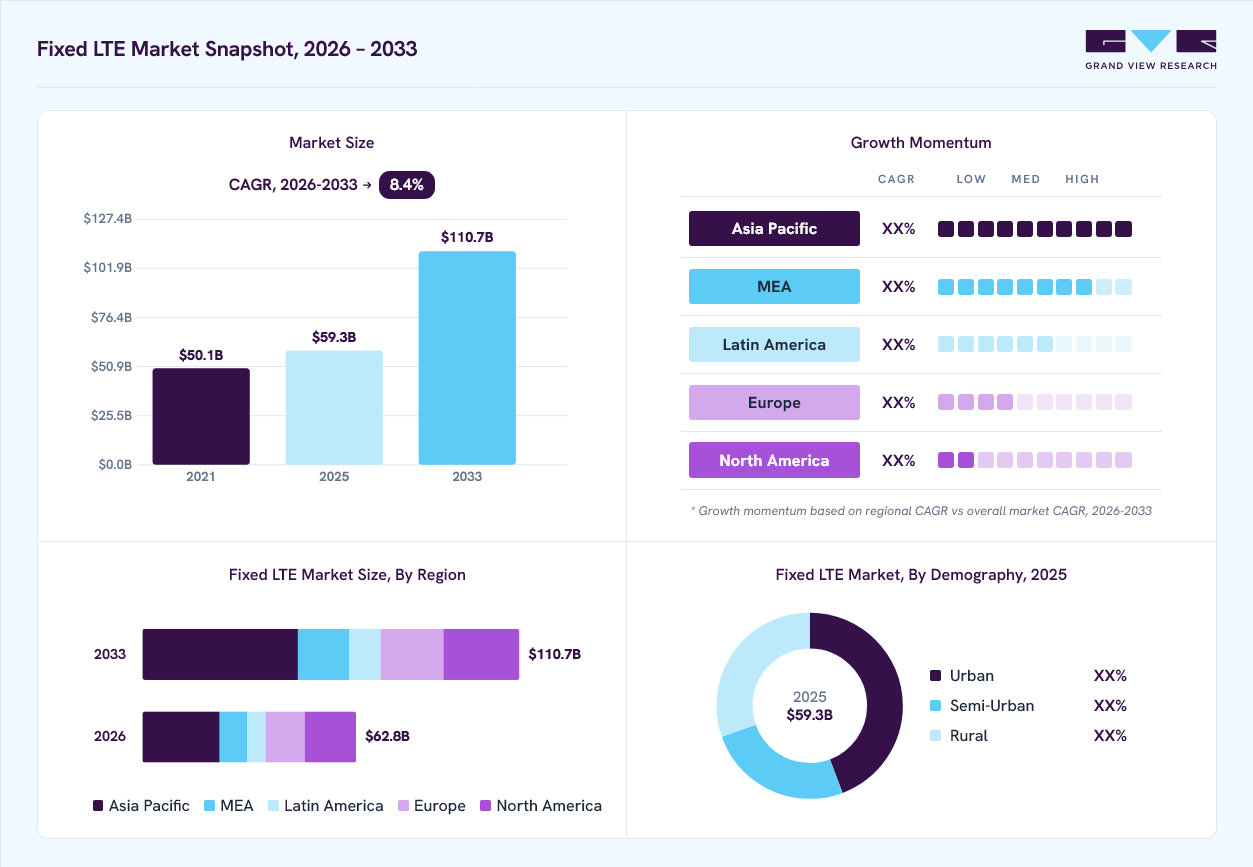
The global fixed LTE market size was valued at USD 59.3 billion in 2025 and is projected to grow from USD 62.8 billion in 2026 to USD 110.7 billion by 2033, at a CAGR of 8.4% from 2026 to 2033. Asia Pacific dominated the market, accounting for the largest revenue share of 35.4% in 2025. The rapid expansion of high-speed internet connectivity in underserved and rural areas is a key driver behind the market growth.
 Source: Grand View Research, IR Documents, Primary Interviews, Paid DatabasesTo learn more about this report,
 Download Free Sample Report
Key Market Trends & Insights
- By demography: Urban segment held the largest revenue share of 44.2% in 2025
- By application: Residential segment held the largest revenue share of 55.7% in 2025
Regional Highlights
- Largest regional market: Asia Pacific (35.4% revenue share, 2025)
- By country: China held the largest market share in 2025
Market Size & Forecast
- Market size in 2025: USD 59.3 Billion
- Estimated market size in 2026: USD 62.8 Billion
- Projected market size by 2033: USD 110.7 Billion
- CAGR (2026-2033): 8.4%
Prism AI by Grand View Research Free to tryAsk a question about the fixed LTE marketTry asking✓Every figure cited from GVR research Prefer the report? Download free sample →
Fixed LTE technology enables telecom operators to deliver reliable broadband services in locations where fiber deployment is expensive, time-consuming, or geographically challenging. Growing demand for high-speed internet from households, businesses, educational institutions, and remote work environments is further encouraging service providers to expand fixed LTE networks. In addition, expanding 4G LTE coverage, declining network equipment costs, and advancements in wireless technologies are improving the scalability and cost-effectiveness of fixed LTE solutions. Government initiatives aimed at expanding broadband access and reducing the digital divide are also supporting deployments across emerging and developed markets.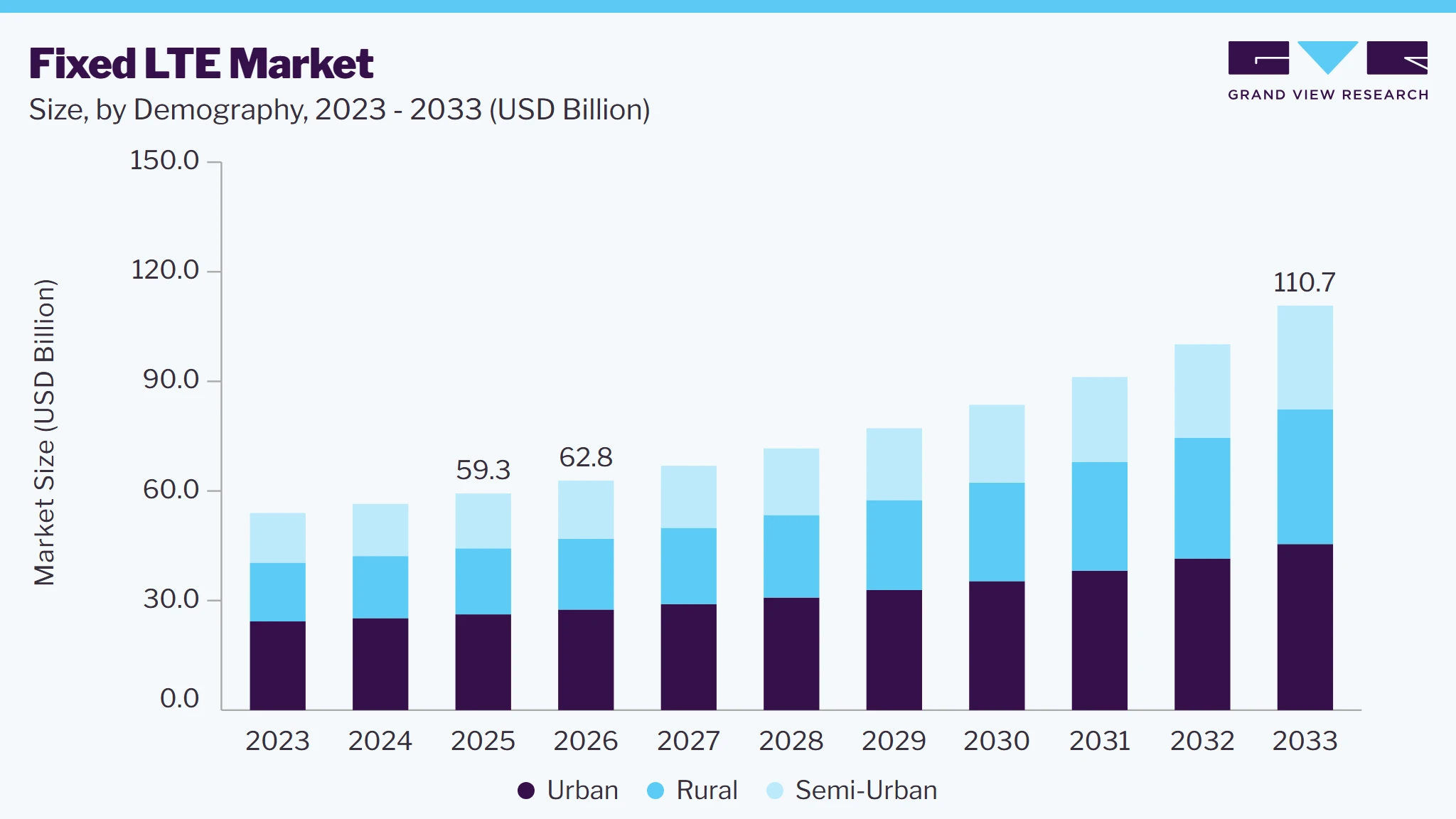 To learn more about this report, Download Free Sample Report
Fixed LTE deployments are increasingly being used to provide broadband connectivity in rural, remote, and underserved locations. Telecom operators can deploy LTE-based broadband infrastructure more rapidly in areas where fiber installation is commercially or geographically challenging. Governments and telecommunications authorities are also supporting wireless broadband initiatives to reduce digital divides and improve access to high-speed internet. Growing demand for online education, telemedicine, remote work, digital payments, and entertainment is further increasing connectivity requirements in these locations. This trend is encouraging operators to adopt fixed LTE as a cost-effective solution to expand broadband availability.
Telecom operators are increasingly upgrading fixed LTE networks through technologies such as LTE-Advanced, carrier aggregation, Massive MIMO, and advanced antenna systems. These technologies improve network capacity, coverage, spectral efficiency, and data speeds, allowing Fixed LTE to support more demanding broadband applications. The use of Customer Premises Equipment (CPE) equipped with advanced antennas and higher LTE category capabilities is also improving connectivity in areas with challenging signal conditions. Network optimization technologies are enabling operators to manage growing data traffic while maintaining service quality. Continued technological improvements are therefore extending the performance and commercial relevance of LTE-based fixed broadband networks.
The growing availability of plug-and-play and self-installable fixed LTE CPE is changing the way operators deploy wireless broadband services. Customers can increasingly activate broadband connections by installing indoor or outdoor LTE routers without requiring extensive professional installation. This reduces installation costs and enables operators to serve a larger customer base more efficiently, particularly in geographically dispersed markets. Manufacturers are also developing CPE devices featuring improved antennas, Wi-Fi capabilities, network management functions, and automatic configuration. The increasing availability of user-friendly CPE is expected to accelerate the adoption of fixed LTE among residential and small-business customers.
Fixed LTE is increasingly being deployed beyond residential broadband to support enterprise and industrial connectivity requirements. Businesses are using LTE-based fixed connections for branch offices, temporary facilities, backup connectivity, surveillance systems, and remote operations. Industrial sectors can also use Fixed LTE to connect equipment and facilities in locations where fiber infrastructure is unavailable or difficult to deploy. The growing use of cloud applications, video surveillance, IoT devices, and digital enterprise platforms is increasing demand for reliable wireless connectivity. This expansion into enterprise and industrial applications is creating additional revenue opportunities for telecom operators and fixed LTE equipment providers.
Market Dynamics
The increasing demand for reliable and high-speed internet connectivity is a major driver of the fixed LTE industry. Households and businesses are increasingly dependent on broadband services for video streaming, cloud applications, online education, remote work, digital commerce, and other bandwidth-intensive activities. This growing dependence is increasing demand for broadband solutions in areas where fiber and cable infrastructure remains limited or costly to deploy. Fixed LTE provides operators with a relatively rapid and flexible approach to delivering broadband services using existing mobile network infrastructure. The ability to extend broadband coverage without extensive last-mile cabling is particularly attractive in rural and geographically dispersed markets.
The continued growth of connected devices and data-intensive applications is further increasing pressure on broadband providers to expand network capacity and coverage. Fixed LTE supports multiple connected devices within homes, offices, and small businesses, making it suitable for a wide range of connectivity requirements. Increasing consumer expectations for reliable broadband performance are encouraging operators to upgrade LTE networks and deploy higher-capacity CPE. In emerging markets, fixed LTE also provides an alternative to fixed-line broadband where telecommunications infrastructure remains underdeveloped. These factors are supporting continued investment in fixed LTE networks and contributing to market expansion.
Increasing competition from fiber broadband and 5G fixed wireless access represents a significant restraint for the fixed LTE industry. Fiber networks generally offer higher speeds, lower latency, greater capacity, and more consistent performance than LTE-based fixed connections, making them attractive in densely populated and high-income markets. In addition, 5G FWA offers significantly higher bandwidth and lower latency than traditional LTE-based solutions, encouraging telecom operators to prioritize next-generation wireless broadband deployments. As 5G coverage expands, operators may increasingly shift investment toward 5G FWA rather than expanding standalone Fixed LTE networks. This competitive pressure could limit the long-term growth potential of fixed LTE, particularly in markets where advanced broadband infrastructure is already widely available.
The expansion of broadband connectivity in emerging markets presents a significant opportunity for the fixed LTE industry. Many developing countries continue to face gaps in fixed-line infrastructure, particularly in rural and remote areas where fiber deployment can be economically challenging. Telecom operators can utilize existing LTE networks to provide broadband services to households, small businesses, schools, healthcare facilities, and government institutions in these underserved locations. Government programs focused on universal broadband access, digital inclusion, and rural connectivity can further support fixed LTE deployments. The technology, therefore, provides operators with an opportunity to address underserved populations while generating new broadband subscribers.
The opportunity is particularly significant in markets experiencing rapid smartphone adoption, increasing internet penetration, and growing demand for digital services. Fixed LTE can provide a scalable broadband solution while operators gradually develop more advanced 5G and fiber infrastructure. The deployment of outdoor CPE, advanced antennas, and network optimization technologies further improves connectivity in locations with weak or inconsistent wireless signals. Increasing demand for remote education, telemedicine, digital financial services, e-commerce, and cloud-based applications is expected to create additional broadband requirements across these markets. Thus, fixed LTE remains commercially relevant as a practical broadband expansion technology in regions where next-generation fixed infrastructure has yet to achieve widespread coverage.
Market Concentration & Characteristics
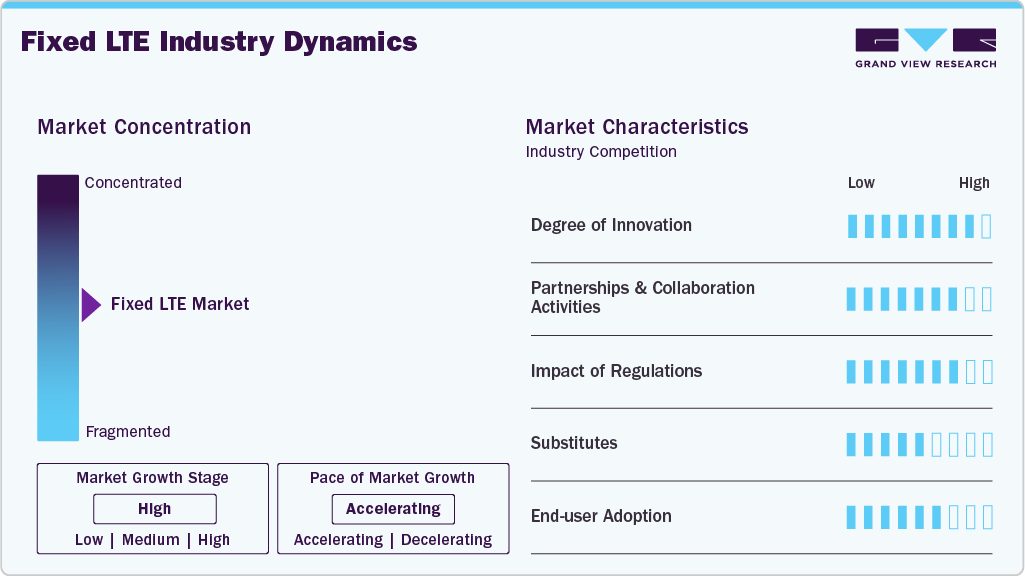
The fixed LTE industry is moderately consolidated, reflecting the presence of several large telecom operators and technology providers that have established strong positions across wireless broadband infrastructure, network equipment, and customer-premises equipment. However, competition remains significant because regional telecom operators, specialized FWA providers, and CPE manufacturers continue to compete across markets and value chain segments. The market is in a high-growth stage, supported by increasing demand for broadband connectivity in underserved and rural areas, while the pace of growth is accelerating as operators increasingly use FWA to complement fiber and other fixed broadband technologies.
 To learn more about this report, Download Free Sample Report
The market demonstrates a high degree of innovation, driven by advancements in LTE-Advanced, advanced CPE, network optimization, and higher-capacity wireless technologies. Partnerships and collaborations are moderately high, as telecom operators work with network equipment manufacturers, CPE vendors, chipset providers, and technology companies to improve network performance and expand service coverage. The impact of regulations is high, since spectrum allocation, licensing frameworks, broadband policies, and government initiatives for rural connectivity directly influence fixed LTE deployment. Substitute availability is growing, primarily due to competition from fiber, cable, satellite broadband, and 5G FWA; however, fixed LTE remains valuable where wired infrastructure is expensive or unavailable. End-user adoption is high, supported by increasing broadband requirements among households and businesses.
Analyst Perspective
The fixed LTE industry is gaining momentum as telecom operators use wireless infrastructure to address broadband gaps, particularly in rural and underserved areas. Growing demand for high-speed connectivity, rising smartphone and IoT adoption, and lower deployment costs than fiber are driving market expansion.
Demography Insights
The urban segment led the market with the largest revenue share of 44.2% in 2025. Urban areas represent the largest demographic segment of the global market due to high population density, strong broadband demand, and extensive availability of LTE network infrastructure. Consumers and businesses in cities increasingly require reliable high-speed connectivity for remote work, cloud applications, video streaming, online services, and connected devices, supporting demand for Fixed LTE solutions. Fixed LTE also provides operators with a flexible option for addressing underserved urban locations, including older buildings, multi-dwelling units, and areas where fiber deployment is constrained by infrastructure or right-of-way limitations.
The rural segment is expected to grow at the fastest CAGR during the forecast period, driven by government and telecom operator initiatives to expand broadband access across underserved and low-density areas. Fiber deployment remains economically challenging in rural regions due to long distances, low population density, and high last-mile infrastructure costs, making Fixed LTE an attractive alternative for extending broadband coverage. Increasing demand for digital education, telemedicine, e-commerce, and remote work is further driving the need for reliable internet connectivity in rural communities. These factors are expected to accelerate the adoption of fixed LTE solutions across rural markets during the forecast period.
Application Insights
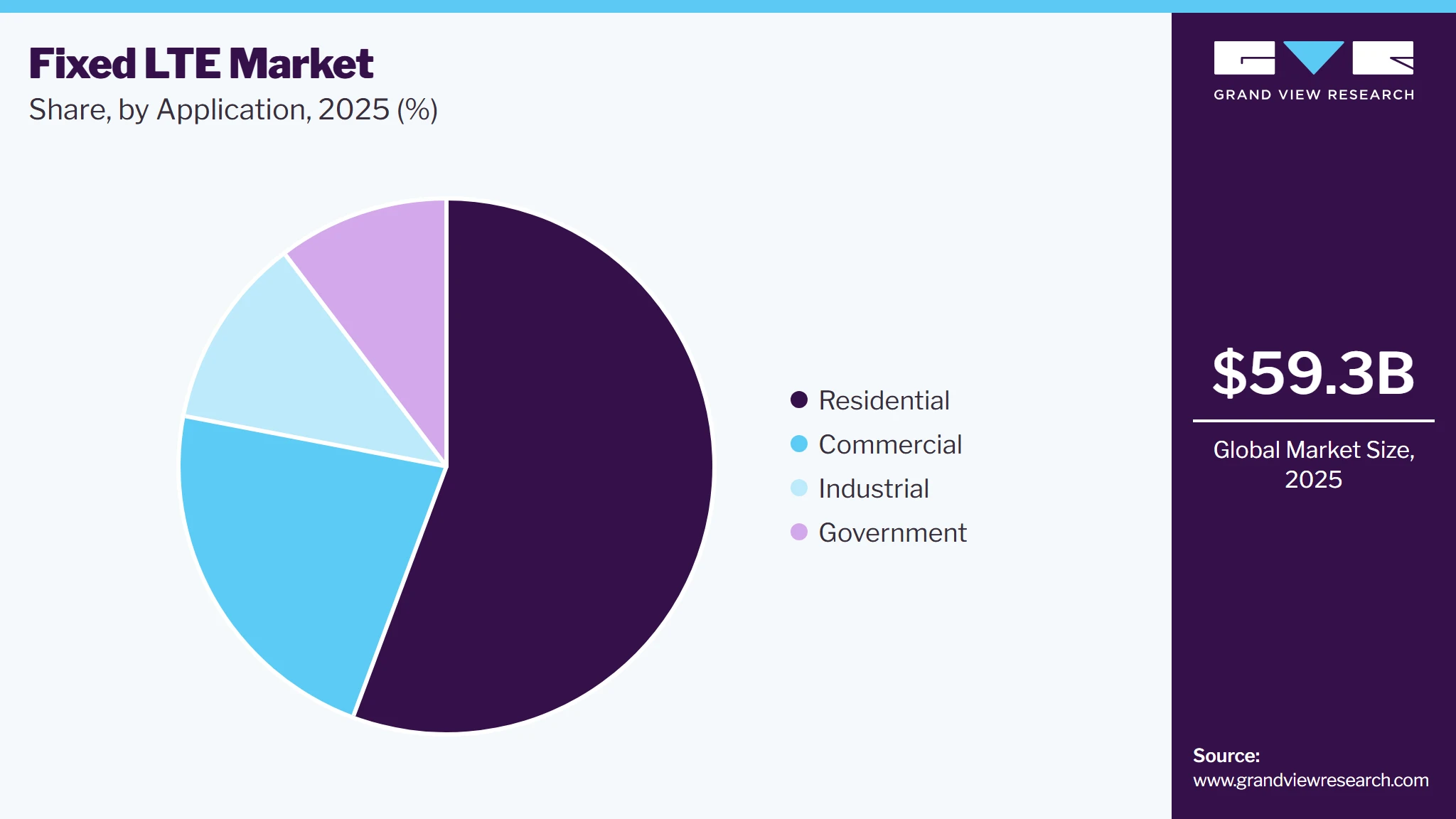
The residential segment led the market with the largest revenue share of 55.7% in 2025, driven by rising demand for high-speed, reliable home broadband connectivity. Increasing adoption of remote work, online education, video streaming, gaming, and connected smart-home devices is driving household demand for broadband services. Fixed LTE provides a cost-effective, rapidly deployable alternative in locations where fiber or cable infrastructure is unavailable, delayed, or economically infeasible to deploy. Operators are also using fixed LTE and FWA services to expand their residential subscriber base without extensive last-mile construction, particularly across underserved and semi-urban markets.
 To learn more about this report, Download Free Sample Report
The industrial segment is expected to grow at the fastest CAGR during the forecast period, driven by the increasing adoption of industrial IoT, automation, smart manufacturing, and connected operational systems. Manufacturing facilities, logistics centers, energy sites, mining operations, and other industrial locations require reliable wireless connectivity for real-time monitoring, machine-to-machine communication, remote operations, and predictive maintenance. Fixed LTE offers rapid deployment and reliable connectivity in industrial locations where fiber infrastructure may be unavailable, costly, or time-consuming to install. The increasing digital transformation of industrial operations and demand for flexible connectivity solutions are therefore expected to accelerate Fixed LTE adoption across industrial applications.
Regional Insights
The fixed LTE market in North America is expected to grow at a moderate CAGR during the forecast period, supported by advanced telecommunications infrastructure, high broadband penetration, and strong demand for reliable high-speed connectivity. Telecom operators have increasingly deployed FWA services to complement fiber and cable networks and address broadband gaps in rural and underserved communities.
U.S. Fixed LTE Market Trends
The fixed LTE market in the U.S. held a substantial market share in the North America in 2025, supported by extensive 4G LTE coverage, strong consumer broadband demand, and significant investments by major telecom operators.
Asia Pacific Fixed LTE Market Trends
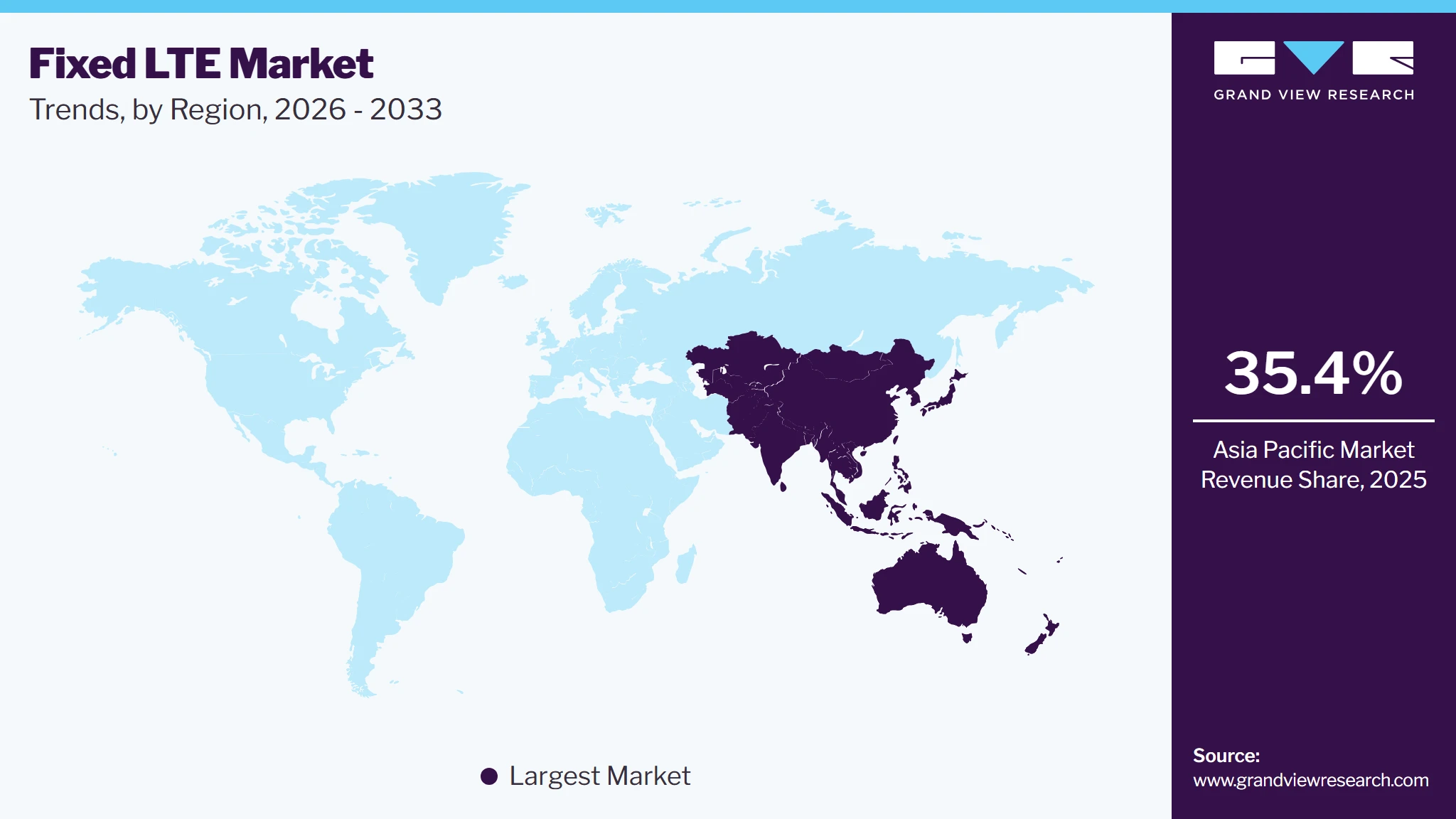
Asia Pacific dominated the global fixed LTE market with the largest revenue share of 35.4% in 2025 and is expected to grow at the fastest CAGR during the forecast period, due to its large population base, expanding broadband demand, and significant investments in wireless telecommunications infrastructure. The region continues to use FWA technologies, including LTE, to address connectivity gaps in rural, semi-urban, and densely populated areas where fiber deployment can be costly or difficult.
 To learn more about this report, Download Free Sample Report
The fixed LTE market in China accounted for the largest market revenue share in the Asia Pacific in 2025, owing to its dominant position in international trade, container shipping, and shipbuilding. The country's extensive port network, including major ports such as Shanghai, Ningbo-Zhoushan, and Shenzhen, handles a substantial share of global cargo traffic, generating significant demand for Fixed LTE Demography. Continued investments under the Belt and Road Initiative (BRI), expansion of maritime logistics infrastructure, and increasing exports of high-value manufactured goods continue to support market growth.
The India fixed LTE market is expected to grow at a rapid CAGR over the forecast period, driven by increasing broadband demand, expanding digital services, and the need to improve connectivity in rural and underserved areas. In addition, government initiatives to improve digital inclusion and continued investments by telecom operators in next-generation networks are expected to create further opportunities for fixed LTE services.
Europe Fixed LTE Market Trends
The fixed LTE market in Europe is expected to grow at a moderate CAGR from 2026 to 2033, supported by robust telecommunications infrastructure, rising broadband demand, and the ongoing need to connect low-density and geographically challenging locations.
The Germany fixed LTE market is a major segment in Europe, driven by the country's need to improve broadband connectivity in rural and geographically dispersed areas.
The fixed LTE market in the UK is expected to grow at a notable CAGR over the forecast period, driven by continued efforts to improve broadband availability across rural and underserved communities. FWA provides an alternative connectivity solution for premises where fixed-line broadband infrastructure is unavailable, difficult to deploy, or economically less attractive. Ofcom continues to track FWA as part of the country's fixed broadband availability, while 4G geographic coverage from at least one mobile network operator reached 96% of the UK landmass in early 2026.
Key Fixed LTE Company Insights
Key players operating in the fixed LTE industry include AT&T Inc., Huawei Technologies Co. Ltd., and T‑Mobile USA, Inc. These companies are focusing on expanding fixed wireless broadband coverage, improving network capacity, and extending high-speed internet connectivity to underserved and hard-to-reach areas.
-
AT&T Inc. is one of the major fixed wireless broadband providers in the U.S., with a significant presence in the Fixed LTE/FWA market. AT&T offers fixed wireless services through its AT&T Internet Air and Fixed Wireless Internet offerings.
-
T-Mobile USA, Inc. is another major provider of fixed LTE. The company offers fixed wireless broadband to residential and business customers, using its cellular infrastructure to provide connectivity without requiring a wired last-mile connection.
Key Fixed LTE Companies:
The following key companies have been profiled for this study on the fixed LTE market.
-
AT&T Inc.
-
Huawei Technologies Co. Ltd.
-
T‑Mobile USA, Inc.
-
Orange
-
BT Limited
-
iConnectSA (Pty) Ltd.
-
Huge TNS
-
Airtel India
-
Home-Connect
-
Rogers Communications
Competitive Benchmarking
Operating Strategies
Competitive Edge
Weaknesses
Mature Players: AT&T Inc., Huawei Technologies Co. Ltd., and T-Mobile USA, Inc.
- These companies focus on expanding fixed wireless access (FWA) coverage, upgrading LTE infrastructure, increasing network capacity, and providing high-speed broadband to residential and enterprise customers. These companies also focus on rural connectivity, network modernization, and bundling broadband with other telecommunications services.
- These companies gain competitive advantages through strong network infrastructure, extensive customer bases, spectrum resources, established distribution channels, strong financial capabilities, and broad geographic presence.
- High infrastructure and spectrum investment requirements, competition from fiber and 5G broadband, regulatory constraints, and high network maintenance costs may impact the growth of these companies.
Emerging Players: iConnectSA (Pty) Ltd.; Huge TNS; Home-Connect
- These companies focus on localized fixed LTE/FWA deployments, affordable broadband services, underserved and rural markets, and flexible connectivity solutions. These companies target areas where fiber and traditional fixed-line broadband infrastructure remain limited.
- These companies gain greater competitive advantages, flexibility, localized market knowledge, cost-effective service offerings, faster response to regional connectivity needs, and the ability to serve niche customer segments.
- Smaller geographic presence, limited financial resources, lower brand recognition, dependence on network infrastructure and spectrum availability, and limited economies of scale could hamper the company’s growth.
Recent Developments
-
In March 2024, AT&T introduced AT&T Internet Air for Business, providing fast, reliable, and secure internet connectivity to small, mid-sized, and large businesses through its 4G LTE, 5G, and 5G+ wireless networks.
-
In January 2022, Rock Connect selected Nokia as the sole vendor to deploy a 4G LTE Fixed Wireless Access (FWA) network in Jamaica, with the project targeting coverage of 95% of the country's population by 2025. Nokia is providing its end-to-end solutions portfolio to establish a customized, digitally enabled, and 5G-ready network infrastructure.
Fixed LTE Market Report Scope
Report Attribute
Details
Market size in 2025
USD 59.3 billion
Estimated market size in 2026
USD 62.8 billion
Projected market size by 2033
USD 110.7 billion
Growth rate
CAGR of 8.4% from 2026 to 2033
Base year for estimation
2025
Historical data
2021 - 2024
Forecast period
2026 - 2033
Quantitative units
Revenue in USD million/billion, and CAGR from 2026 to 2033
Report Demography
Revenue forecast, company ranking, competitive landscape, growth factors, and trends
Segments covered
Demography, application, region
Regional scope
North America; Europe; Asia Pacific; Latin America; MEA
Country scope
U.S.; Canada; Mexico; Germany; UK; France; China; Japan; India; South Korea; Australia; Brazil; KSA; UAE; and South Africa
Key companies profiled
AT&T Inc.; Huawei Technologies Co. Ltd.; T‑Mobile USA, Inc.; Orange; BT Limited; iConnectSA (Pty) Ltd.; Huge TNS; Airtel India; Home-Connect; Rogers Communications
Customization scope
Free report customization (equivalent up to 8 analysts working days) with purchase. Addition or alteration to country, regional & segment scope.
Pricing and purchase options
Avail customized purchase options to meet your exact research needs. Explore purchase options
Global Fixed LTE Market Report Segmentation
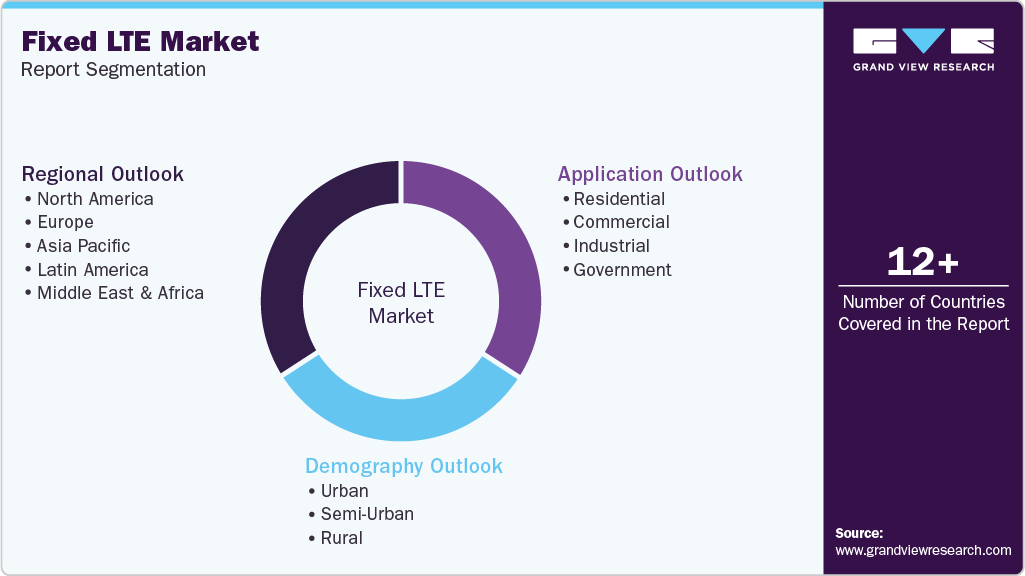
This report forecasts revenue growth at the global, regional, and country levels and provides an analysis of the latest industry trends in each of the sub-segments from 2021 to 2033. For this study, Grand View Research has segmented the global fixed LTE market report based on demography, application, and region.
 To learn more about this report, Download Free Sample Report
-
Demography Outlook (Revenue, USD Billion, 2021 - 2033)
-
Urban
-
Semi-Urban
-
Rural
-
-
Application Outlook (Revenue, USD Billion, 2021 - 2033)
-
Residential
-
Commercial
-
Industrial
-
Government
-
-
Regional Outlook (Revenue, USD Billion, 2021 - 2033)
-
North America
-
U.S.
-
Canada
-
Mexico
-
-
Europe
-
Germany
-
UK
-
France
-
-
Asia Pacific
-
China
-
Japan
-
India
-
South Korea
-
Australia
-
-
Latin America
-
Brazil
-
-
Middle East and Africa (MEA)
-
KSA
-
UAE
-
South Africa
-
-
Research Methodology
The fixed LTE marketfigures in this report are based on a proven research process that combines executive interviews with secondary research from proprietary databases, company filings, and recognized regulatory and institutional sources. Market size is built through value-chain sizing-reconciling supply-side and demand-side estimates-and triangulated with bottom-up and top-down approaches. Every estimate passes multiple levels of expert validation before publication, with eachfixed LTE segment quantified using the revenue-capture definitions in the table below.
Segment Definition
Segment - Demography
Revenue capture definition
Urban
This segment refers to fixed LTE services deployed in densely populated cities and metropolitan areas where demand for high-speed broadband is high.
Semi-Urban
This segment covers fixed LTE services deployed in suburban areas, smaller cities, and developing townships that have moderate population density and varying levels of fixed broadband infrastructure.
Rural
This segment includes fixed LTE services deployed in rural and remote areas where traditional fixed-line broadband infrastructure is limited or unavailable.
Segment - Application
Revenue capture definition
Residential
This segment captures revenue generated from fixed LTE services provided to individual households for internet access, online education, streaming, gaming, remote work, digital communication, and other everyday broadband applications.
Commercial
This segment captures revenue from fixed LTE services used by commercial establishments, including retail stores, offices, restaurants, hotels, and small businesses. These services support internet connectivity, cloud applications, digital payments, customer services, and business operations.
Industrial
This segment captures revenue generated from fixed LTE deployments across manufacturing facilities, warehouses, mining operations, utilities, construction sites, and other industrial environments.
Government
This segment captures revenue generated from fixed LTE services used by government departments, public institutions, municipal facilities, schools, healthcare centers, and other public-sector organizations.
Estimation Model
Layer Name
Key Question
Description
Broadband Connectivity Base Layer
Which households and organizations require broadband connectivity?
This layer establishes the total potential demand base by analyzing households, businesses, industrial facilities, and government institutions across urban, semi-urban, and rural areas. Key factors include population, household formation, internet penetration, broadband subscriptions, and digital connectivity requirements.
Addressable Fixed LTE Market Layer
Which users can realistically be served through Fixed LTE?
This layer narrows the total broadband base to locations suitable for fixed LTE deployment. It considers LTE network coverage, spectrum availability, fiber availability, broadband infrastructure gaps, population density, deployment costs, and demand for high-speed wireless connectivity.
Fixed LTE Adoption Layer
Who is actively adopting Fixed LTE services?
This layer estimates the actual number of fixed LTE connections across residential, commercial, industrial, and government users. It considers operator subscriber data, FWA penetration, network expansion, customer additions, service availability, and adoption rates across urban, semi-urban, and rural markets.
Monetization Layer
How does Fixed LTE adoption translate into market revenue?
This layer converts the active fixed LTE subscriber base into market revenue using average revenue per user (ARPU) and subscription fees. Revenue is calculated across demographic, application, and geographic segments.
Delivered Customizations
This report has been delivered with the following In-depth customizations
Client Request
Customization Delivered
Value Adds
Regional & Country Opportunity Analysis
Delivered region-wise and country-wise market sizing, forecasts, and growth analysis across North America, Europe, Asia Pacific, Latin America, and the Middle East & Africa
Assessment of broadband penetration, rural connectivity gaps, 4G/5G infrastructure investments, and digitalization initiatives
Supported geographic expansion strategies
Identified high-growth countries
Urban, Semi-Urban & Rural Opportunity Analysis
Delivered market analysis across urban, semi-urban, and rural areas based on broadband penetration, network availability, population density, and connectivity requirements
Identified underserved markets
Supported targeted deployment strategies
Competitive Benchmarking & Strategic Landscape Analysis
Benchmarking of major Fixed LTE providers based on subscriber base, network coverage, pricing, spectrum holdings, CPE portfolio, service quality, partnerships, and technology investments
Analysis of product launches, network expansions, partnerships, and strategic initiatives
Supported competitive intelligence and strategic decision-making
Identified market gaps and expansion opportunities
Frequently Asked Questions About This Report
The global fixed LTE market size was estimated at USD 59.3 billion in 2025 and is expected to reach USD 62.8 billion in 2026.
The global fixed LTE market is expected to grow at a compound annual growth rate of 8.4% from 2026 to 2033 to reach USD 110.7 billion by 2033.
The urban segment accounted for the largest market share of 44.2% in 2025. Urban areas represent the largest demographic segment of the fixed LTE market due to high population density, strong broadband demand, and extensive availability of LTE network infrastructure.
The Asia Pacific fixed LTE market led the global market and accounted for 35.4% of the global revenue in 2025, due to its large population base, expanding broadband demand, and significant investments in wireless telecommunications infrastructure.
The rapid expansion of high-speed internet connectivity in underserved and rural areas is a key driver behind the growth of the fixed LTE market.
Some key players operating in the fixed LTE market include AT&T Inc., Huawei Technologies Co. Ltd., T‑Mobile USA, Inc., Orange, BT Limited, iConnectSA (Pty) Ltd., Huge TNS, Airtel India, Home-Connect, and Rogers Communications.
The residential segment accounted for the largest market share of 55.7% in 2025, driven by rising demand for high-speed, reliable home broadband connectivity.
About the Author(s)
Communication Services Research Team
Technology · Communication ServicesThis report was authored by the communication services research team at Grand View Research - comprising two research analysts, one senior research analyst, and one industry expert - with specialized expertise in the communication services segment of the technology industry. All findings are based on proprietary technology databases, executive interviews, and regulatory analysis, subject to internal peer review prior to publication.
Last Updated:
Speak to Analyst

Customize this report to your needs - add regions, segments, or data points, with 20% free customization.
Or view our licence options:


ISO 9001:2015 & 27001:2022 Certified
We are GDPR and CCPA compliant! Your transaction & personal information is safe and secure. For more details, please read our privacy policy.


