
- Home
- »
- Plastics, Polymers & Resins
- »
-
Glass Packaging For Food & Beverages Market Report, 2026-2033GVR Report cover

Glass Packaging For Food & Beverages Market (2026 - 2033)
Size, Share & Trends Analysis Report By Product Type (Containers, Bottles, Jars), By Capacity (Below 250 ml, 250 ml - 500 ml, 500 ml - 1 Liter, 1 Liter - 2 Liter, Above 2 Liter), By End-use (Beverage, Food), By Region, And Segment Forecasts
Market Size, 2025
$68.8BMarket Estimate, 2026
$72.0BMarket Forecast, 2033
$99.6BCAGR, 2026–2033
4.7%Glass Packaging For Food & Beverages Market Summary
The global glass packaging for food & beverages market size was valued at USD 68.8 billion in 2025 and is projected to grow from USD 72.0 billion in 2026 to USD 99.6 billion by 2033, at a CAGR of 4.7% from 2026 to 2033. The market in Asia Pacific dominated with a revenue share of 43.0% in 2025. Rising consumer preference for safe, sustainable, and premium packaging is a key driver of the glass packaging market in food & beverages, as glass is recyclable, non-reactive, and helps preserve product taste and quality.
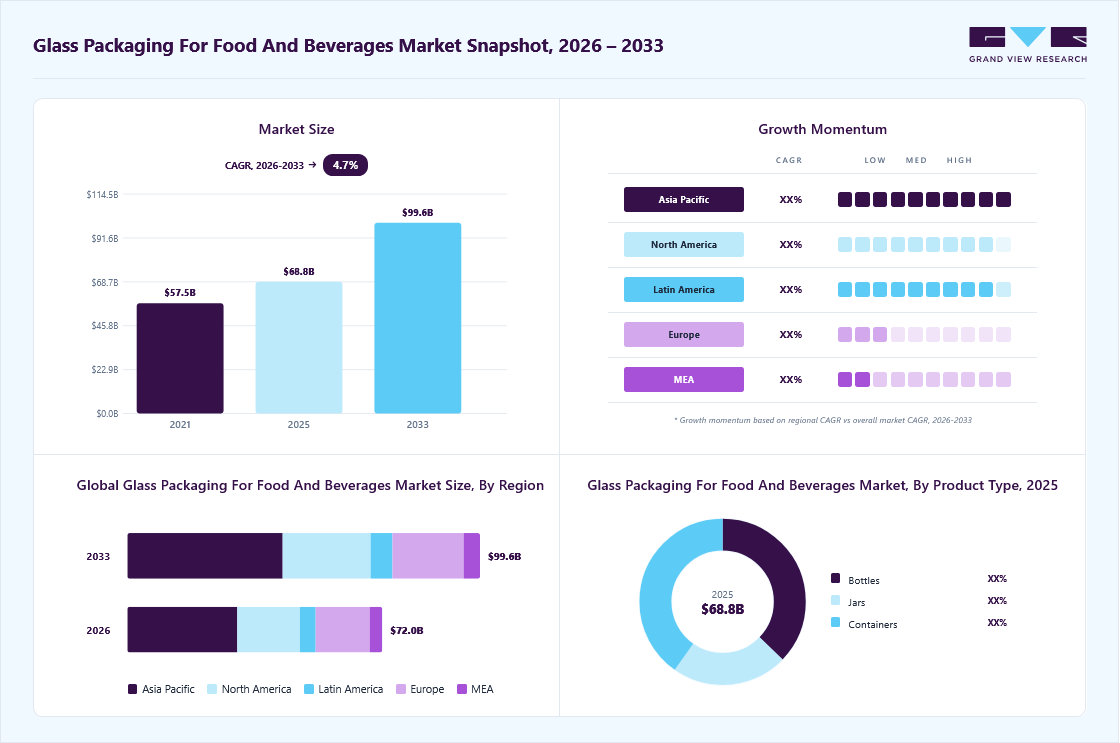 Source: Grand View Research, IR Documents, Primary Interviews, Paid DatabasesTo learn more about this report,
 Download Free Sample Report
 Key Market Trends & Insights
- By end use: Beverage segment held the largest market share of 71.2% in 2025.
- By capacity: Below 250 ml segment held the largest market share of 46.1% in 2025.
- By product type: Containers segment held the largest market share of 40.3% in 2025.
Regional Highlights
- Largest regional market: Asia Pacific (43.0% revenue share, 2025)
- By country: China held the largest market share in 2025
Market Size & Forecast
- Market size in 2025: USD 68.8 Billion
- Estimated market size in 2026: USD 72.0 Billion
- Projected market size by 2033: USD 99.6 Billion
- CAGR (2026-2033): 4.7%
Three ways to get this report
Buy it, customize it, or ask a question.Ask an Analyst
Analyst response in 1 business day
- AccessReport author, directly
- Reply timeWithin 1 working day
- No sales callDirect answer only
- FormatEmail reply
- CostFree, no cost
Get the Full Report
What the study covers
- FormatsPDF · Excel · Dashboard
- Timeline2026–2033 annual, 2025 base
- Coverage20+ countries, 5 regions
- Companies10+ key players profiled
Customize the Report
20% free customization
- IncludeCountries, segments, points
- TailorTo your product definition
- ExtendDeeper competitor detail
- OrA fully bespoke study
- Turnaround5–10 working days
Growing demand for alcoholic beverages, ready-to-drink products, sauces, dairy items, and premium packaged foods further supports market expansion. Rising consumer preference for safe, inert, and preservative-friendly packaging is a major growth driver for the glass packaging market in F&B. Glass does not react with contents, ensuring product purity, taste integrity, and extended shelf stability, making it highly preferred for products such as juices, sauces, dairy beverages, baby food, jams, and alcoholic drinks. As consumers become more conscious about ingredient quality and contamination risks, brands increasingly use glass to communicate freshness, hygiene, and premium product standards. This is especially important in categories where flavor retention and product authenticity strongly influence purchasing decisions.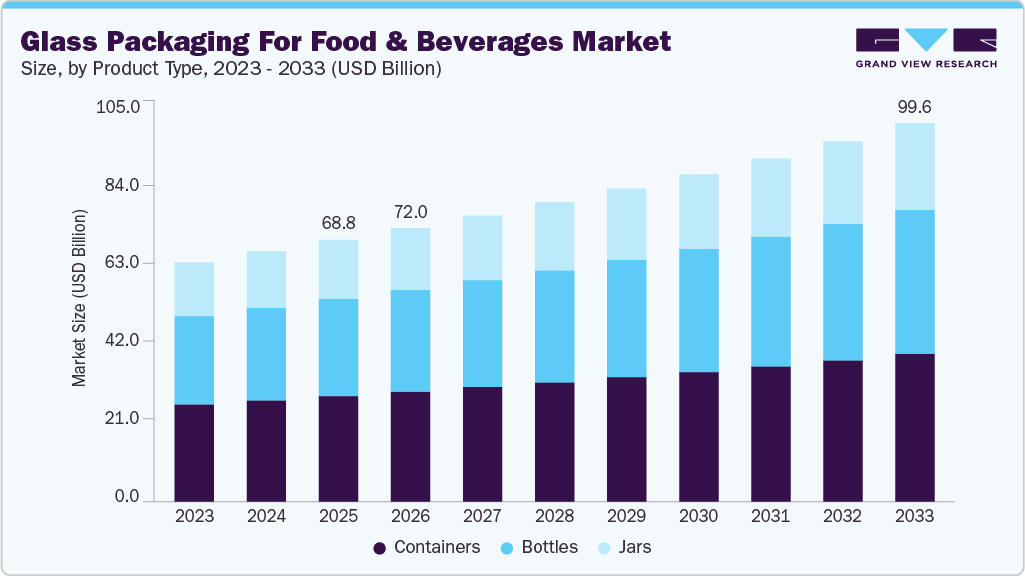 To learn more about this report, Download Free Sample Report
 Sustainability trends and tightening environmental regulations are further accelerating demand for glass packaging across the F&B sector. Glass is 100% recyclable and can be reused multiple times without loss of quality, making it attractive to both manufacturers and environmentally aware consumers. Governments across Europe, North America, and parts of Asia are promoting circular economy models, recycling targets, and restrictions on single-use plastics, encouraging brand owners to shift toward glass bottles and jars. As companies strengthen ESG commitments, glass packaging is increasingly adopted to improve sustainability credentials and reduce dependence on virgin plastic materials.
Premiumization in beverages and specialty food products is another key market catalyst. Wine, spirits, craft beer, cold brew coffee, premium water, gourmet condiments, and artisanal food brands widely prefer glass packaging because of its superior shelf appeal, transparency, weight, and upscale appearance. Glass enhances brand differentiation and supports higher price positioning, particularly in retail environments where packaging strongly influences impulse purchases. Reflecting this trend, in April 2026, Ardagh Glass Packaging-North America introduced a new 275ml glass beverage bottle with Fitz’s Bottling Company for tonic and soda products, helping improve shelf appeal while offering flexible packaging options for craft beverage brands.
Growth in processed food consumption, urban lifestyles, and organized retail distribution is also supporting the market. Increasing demand for ready-to-eat meals, packaged sauces, pickles, spreads, functional beverages, and health drinks has created steady need for durable, tamper-evident, and temperature-resistant packaging formats. Glass performs well in hot-fill, pasteurization, and long-term storage applications, making it suitable for modern food processing systems. At the same time, expansion of supermarkets, e-commerce grocery channels, and export-oriented food trade is driving the use of reliable and visually attractive glass packaging solutions worldwide.
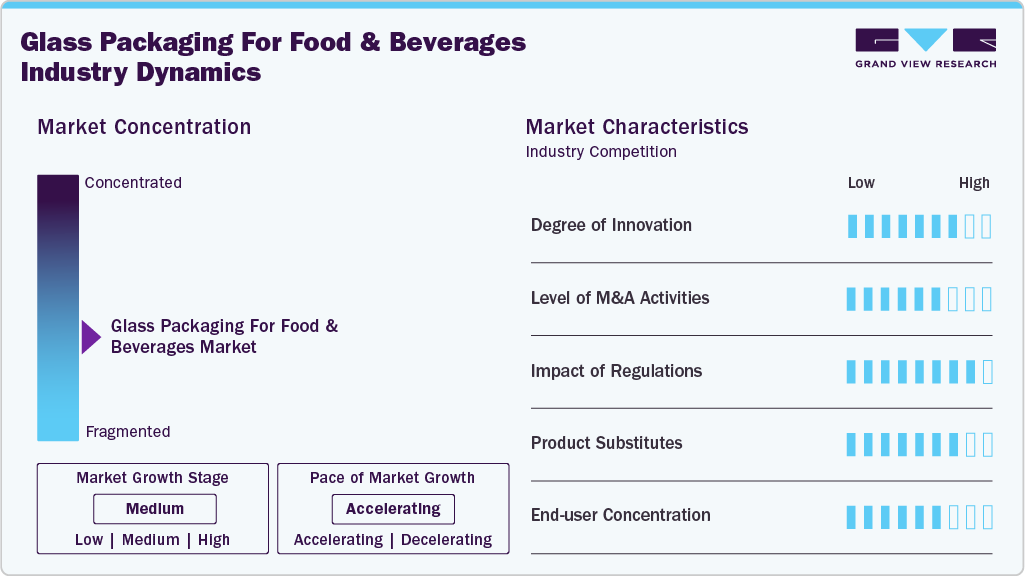
Market Concentrations & Characteristics
The glass packaging for food and beverages industry is characterized by high product integrity requirements, as packaging must preserve taste, freshness, carbonation, aroma, and shelf life across a wide range of products including beverages, sauces, dairy items, condiments, and processed foods. Glass remains a preferred material due to its inert and non-porous nature, which prevents chemical interaction with contents and supports premium quality positioning. Demand is strongly linked to consumer preferences for safe, recyclable, and visually appealing packaging solutions.
Energy intensity is a defining operational characteristic of the glass packaging for food & beverages industry, as glass melting and forming require substantial natural gas and electricity consumption. As a result, profitability is highly influenced by energy prices, raw material availability, cullet supply, transportation costs, and plant utilization rates. Manufacturers are increasingly investing in lightweighting technologies, recycled glass content, furnace modernization, and emissions reduction initiatives to improve cost efficiency and meet sustainability targets.
 To learn more about this report, Download Free Sample Report
 The glass packaging for F&B industry is also shaped by seasonal demand cycles and evolving consumption trends. Beverage categories such as beer, soft drinks, spirits, juices, and premium water often experience peak demand during holidays and summer periods, requiring agile production planning. At the same time, premiumization, craft beverages, health-focused drinks, and export-oriented packaged foods are driving demand for customized bottle and jar designs, smaller batch production, and enhanced branding aesthetics.
Product Type Insights
The containers segment led the market with the largest revenue share of 40.3% in 2025, driven by widespread use in sauces, jams, pickles, baby food, dairy products, and ready-to-eat packaged foods requiring strong barrier protection and extended shelf life. Their reusability, product visibility, resealability, and suitability for hot-fill and pasteurization applications further strengthened demand across global food packaging markets.
The bottles segment is expected to grow at the fastest CAGR during the forecast period, due to its extensive use across water, carbonated soft drinks, juices, beer, wine, spirits, dairy beverages, and functional drinks. Strong demand for recyclable, premium-looking, and flavor-preserving packaging, along with high filling-line compatibility and brand customization options, continued to drive bottle segment growth globally.
Capacity Insights
The below 250 ml segment led the market with the largest revenue share of 46.1% in 2025 and is projected to grow at the fastest CAGR during the forecast period, driven by strong demand for single-serve portions, premium miniatures, health shots, sauces, jams, baby food, and trial-size beverage formats. These smaller packs offer affordability, convenience, portion control, and higher suitability for on-the-go consumption and urban retail channels.
The 250 ml-500 ml segment is anticipated to grow at a significant CAGR during the forecast period, due to its extensive use in soft drinks, juices, dairy beverages, sauces, edible oils, beer, and ready-to-drink products. This range offers an ideal balance between portability and sufficient serving volume, making it highly preferred for retail shelves, foodservice channels, and on-the-go consumption formats.
End Use Insights
The beverage segment led the market with the largest revenue share of 71.2% in 2025, supported by high global consumption of bottled water, carbonated drinks, alcoholic beverages, juices, energy drinks, and functional beverages packaged in glass. Strong preference for glass in premium beverage categories due to its superior taste preservation, carbonation retention, recyclability, and strong brand presentation further accelerated segment leadership.
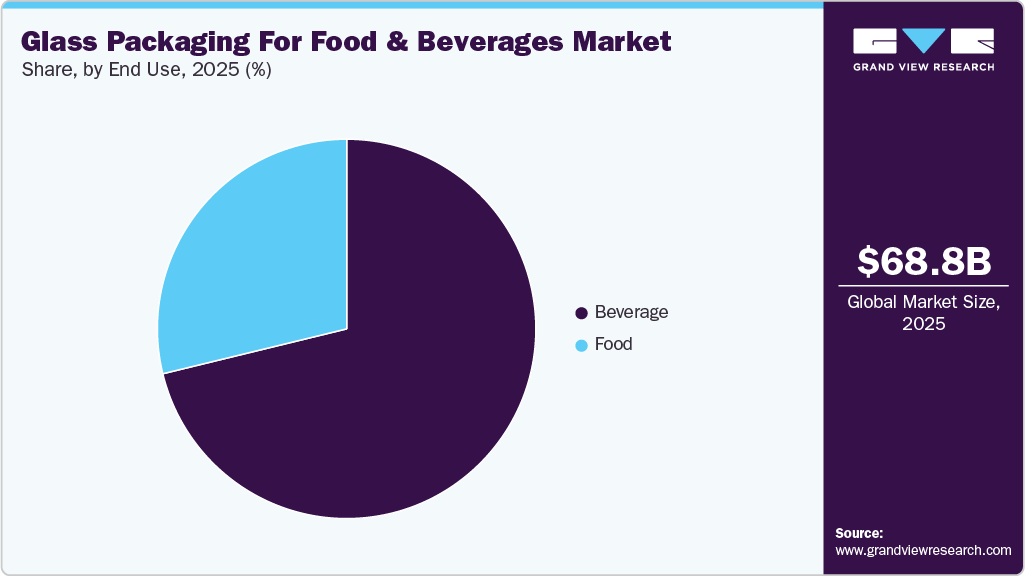 To learn more about this report, Download Free Sample Report
 The food segment is anticipated to grow at the fastest CAGR during the forecast period, driven by growing demand for hygienic and durable packaging across sauces, jams, pickles, baby food, dairy products, spreads, and ready-to-eat items. Glass is widely preferred in food applications for its non-reactive properties, extended shelf-life performance, heat resistance, and ability to preserve product freshness, flavor, and visual appeal.
Regional Insights
The glass packaging for food & beverages market in North America is driven by strong demand for premium alcoholic drinks, bottled sauces, dairy beverages, craft beverages, and health-focused food products across the United States and Canada. The region benefits from the presence of major beverage companies such as The Coca-Cola Company, PepsiCo, Keurig Dr. Pepper, Molson Coors Beverage Company, and Constellation Brands, which continue to drive demand for glass bottles and containers through premiumization, sustainability commitments, and growing consumption of craft beer, spirits, juices, and ready-to-drink beverages.
U.S. Glass Packaging For Food & Beverages Market Trends
The glass packaging for food & beverages market in the U.S. held a significant regional share in 2025, due to its advanced retail infrastructure, strong packaged food industry, and rising consumer preference for recyclable, high-quality containers. Demand is particularly strong from wine, spirits, cold brew coffee, organic sauces, baby food, and functional beverage categories, with companies such as Monster Beverage, Campbell Soup Company, Brown-Forman, Ocean Spray, and National Beverage Corp. leveraging glass packaging to enhance shelf appeal, preserve product quality, and support sustainability goals.
Asia Pacific Glass Packaging For Food & Beverages Market Trends
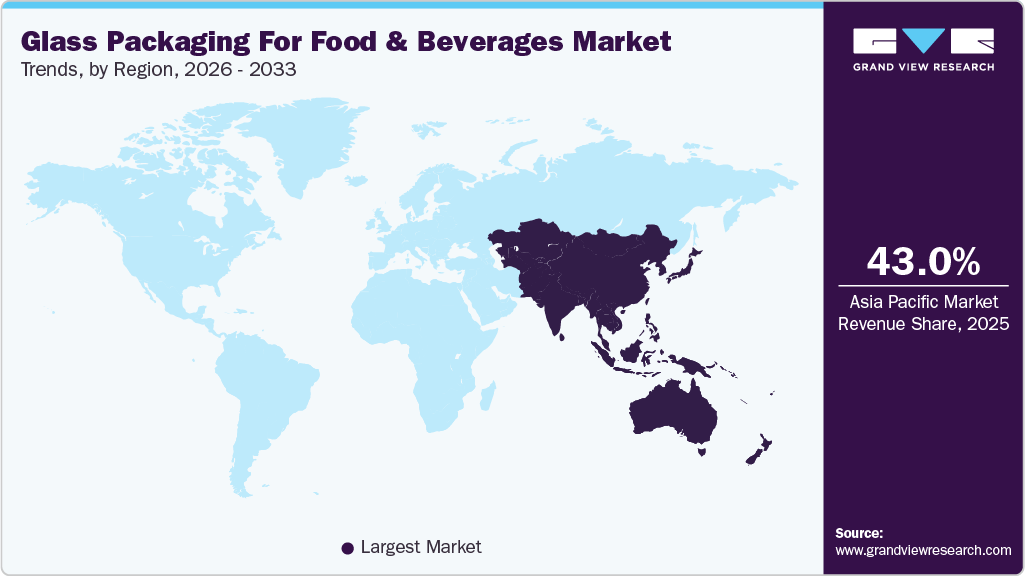
Asia Pacific dominated the global glass packaging for food & beverages market with the largest revenue share of 43.0% in 2025 and is projected to grow at the fastest CAGR during the forecast period, driven by its large population base, rising urbanization, expanding middle-class consumption, and strong demand for bottled beverages, sauces, condiments, and packaged foods across China, India, Japan, Indonesia, and Southeast Asia. The region also benefits from the presence of major beverage producers such as Coca-Cola, PepsiCo, Suntory, Asahi, and Kirin, which continue to invest in premium glass bottles for carbonated drinks, juices, alcoholic beverages, and ready-to-drink tea products.
 To learn more about this report, Download Free Sample Report
 Europe Glass Packaging For Food & Beverages Market Trends
The glass packaging for food & beverages market in Europe represented a mature and sustainability-led regional segment in the global market, driven by stringent environmental regulations, high recycling rates, deposit return systems, and strong consumer preference for eco-friendly packaging across beverages, dairy, sauces, and premium food products. The region is also a center of innovation, with growing investments in lightweight bottles, high recycled-cullet usage, low-carbon furnace technology, digital decoration, and premium, customized designs for wine, beer, spirits, and gourmet foods. Major manufacturers such as Ardagh Group, Verallia, Vetropack, BA Glass, and O-I Glass continue to strengthen Europe’s leadership through sustainable production expansion and advanced packaging solutions.
Key Glass Packaging For Food & Beverages Company Insights
The competitive environment of the glass packaging for food & beverages industry is moderately consolidated, with global leaders and regional manufacturers competing on production capacity, pricing efficiency, product quality, sustainability performance, and packaging innovation. Major players leverage extensive manufacturing networks and long-term contracts with beverage and food brands, while regional players compete through faster delivery, niche bottle designs, and localized customer service. Competition is increasingly shaped by investments in lightweight packaging, higher recycled cullet content, low-emission furnaces, digital printing, and customized premium containers as brand owners seek differentiation and stronger ESG performance.
Key Glass Packaging For Food & Beverages Companies:
The following key companies have been profiled for this study on the glass packaging for food & beverages market.
- Ardagh Group S.A.
- O-IPS
- Stoelzle Glass Group
- Gerresheimer AG
- Verallia
- MJS Packaging
- Vetropack Holding Ltd
- AGI glaspac
- Bormioli Rocco
- PGP Glass
Recent Developments
-
In March 2026, Ardagh Glass Packaging-North America expanded its U.S.-made bottle portfolio with two new 8-oz ring-neck food bottles for dressings, sauces, and marinades. The recyclable flint-glass bottles target small- to mid-size brands seeking premium, sustainable packaging with strong shelf appeal.
-
In February 2026, Gerresheimer showcased sustainable glass packaging at At BIOFACH 2026 in Nuremberg. This packaging is for organic food, beverages, cosmetics, and nutraceuticals, highlighting high recycled-glass content, lightweight designs, refillable systems, and 100% recyclable flint and amber glass formats.
Glass Packaging For Food & Beverages Market Report Scope
Report Attribute
Details
Market size in 2025
USD 68.8 billion
Estimated market size in 2026
USD 72.0 billion
Projected market size by 2033
USD 99.6 billion
Growth rate
CAGR of 4.7% from 2026 to 2033
Base year for estimation
2025
Historical data
2021 - 2024
Forecast period
2026 - 2033
Quantitative units
Revenue in USD million/billion, and CAGR from 2026 to 2033
Report coverage
Revenue forecast, company ranking, competitive landscape, growth factors, and trends
Segments covered
Product type, capacity, end use, region
Regional Scope
North America; Europe; Asia Pacific; Latin America; Middle East & Africa
Key companies profiled
Ardagh Group S.A.; O-IPS; Stoelzle Glass Group; Gerresheimer AG; Verallia; MJS Packaging; Vetropack Holding Ltd; AGI glaspac; Bormioli Rocco; PGP Glass
Customization scope
Free report customization (equivalent up to 8 analysts working days) with purchase. Addition or alteration to country, regional & segment scope.
Pricing and purchase options
Avail of customized purchase options to meet your exact research needs. Explore purchase options
Global Glass Packaging For Food & Beverages Market Report Segmentation
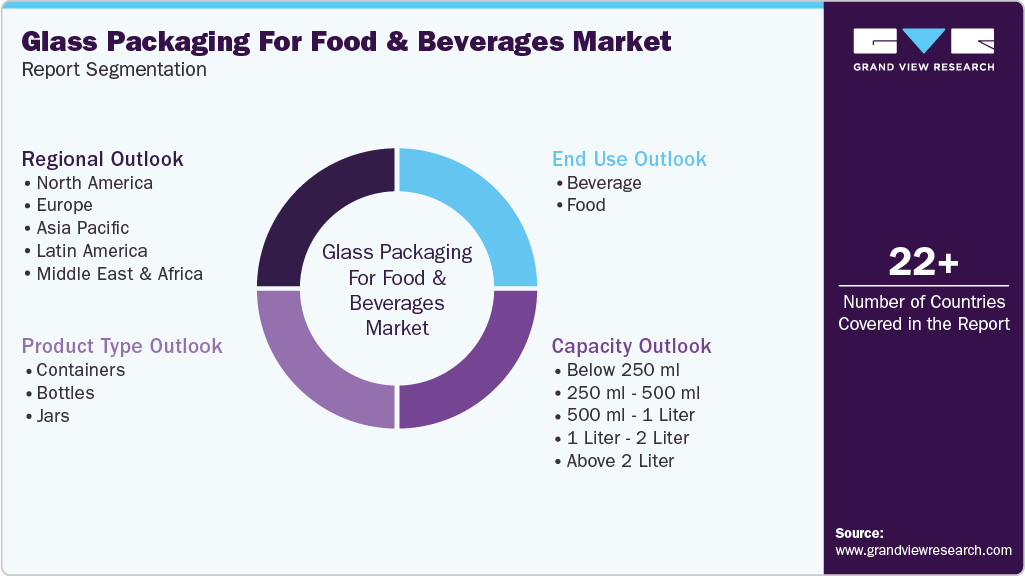
This report forecasts revenue growth at the regional, and country levels and provides an analysis on the latest industry trends and opportunities in each of the sub-segments from 2021 to 2033. For this study, Grand View Research has segmented the global glass packaging for food & beverages market report based on the product type, capacity, application, and region:
 To learn more about this report, Download Free Sample Report
 -
Product Type Outlook (Revenue, USD Million, 2021 - 2033)
-
Containers
-
Bottles
-
Jars
-
-
Capacity Outlook (Revenue, USD Million, 2021 - 2033)
-
Below 250 ml
-
250 ml - 500 ml
-
500 ml - 1 Liter
-
1 Liter - 2 Liter
-
Above 2 Liter
-
-
End Use Outlook (Revenue, USD Million, 2021 - 2033)
-
Beverage
-
Food
-
-
Regional Outlook (Revenue, USD Million, 2021 - 2033)
-
North America
-
U.S.
-
Canada
-
Mexico
-
-
Europe
-
Germany
-
France
-
UK
-
Italy
-
Spain
-
-
Asia Pacific
-
China
-
India
-
Japan
-
South Korea
-
Australia
-
-
Latin America
-
Brazil
-
Argentina
-
-
Middle East & Africa
-
Saudi Arabia
-
UAE
-
South Africa
-
-
Frequently Asked Questions About This Report
The global glass packaging for food & beverages market size was valued at USD 68.8 billion in 2025 and is estimated at USD 72.0 billion for 2026.
The global glass packaging for food & beverages market is expected to grow at a CAGR of 4.7% from 2026 to 2033, reaching USD 99.6 billion by 2033.
The beverages segment led the glass packaging for food & beverages market in 2025 with a 71.2% share due to its superior barrier properties, chemical inertness, and premium perception.
Key players include Ardagh Group S.A.; O-IPS; Stoelzle Glass Group; Gerresheimer AG; Verallia; MJS Packaging; Vetropack Holding Ltd; AGI glaspac; Bormioli Rocco; PGP Glass.
Rising consumer preference for safe, sustainable, and premium packaging is a key driver for the glass packaging market in food & beverages, as glass is recyclable, non-reactive, and preserves product taste and quality.
Asia Pacific dominated with a 43.0% revenue share in 2025.
Containers segment led with a 40.3% revenue share in 2025, while bottles is the fastest-growing type.
The below 250 ml segment led with a 46.1% revenue share in 2025, and is the fastest-growing capacity.
About the Author(s)
Plastics, Polymers & Resins Research Team
Bulk Chemicals · Plastics, Polymers & ResinsThis report was authored by the plastics, polymers & resins research team at Grand View Research - comprising two research analysts, one senior research analyst, and one industry expert - with specialized expertise in the plastics, polymers & resins segment of the bulk chemicals industry. All findings are based on proprietary bulk chemicals databases, executive interviews, and regulatory analysis, subject to internal peer review prior to publication.
Last Updated:
Speak to Analyst

Customize this report to your needs - add regions, segments, or data points, with 20% free customization.
Or view our licence options:


ISO 9001:2015 & 27001:2022 Certified
We are GDPR and CCPA compliant! Your transaction & personal information is safe and secure. For more details, please read our privacy policy.


