
- Home
- »
- Power Generation & Storage
- »
-
Hydrogen Fuel Cells For Stationary Power Market Size, Growth Report, 2026-2033GVR Report cover

Hydrogen Fuel Cells For Stationary Power Market (2026 - 2033)
Size, Share & Trends Analysis Report By Product (PEMFC, SOFC, PAFC, MCFC), By Component (Stack, Balance Of Plant), By System, By End-use, By Region, And Segment Forecasts
Market Size, 2025
$4.3BMarket Estimate, 2026
$4.7BMarket Forecast, 2033
$7.8BCAGR, 2026–2033
7.5%Hydrogen Fuel Cells For Stationary Power Market Summary
The global hydrogen fuel cells for stationary power market size was valued at USD 4.3 billion in 2025 and is projected to grow from USD 4.7 billion in 2026 to USD 7.8 billion by 2033, at a CAGR of 7.5% from 2026 to 2033. Asia Pacific dominated the global market, accounting for the largest revenue share of 46% in 2025. Market growth is driven by the rising deployment of stationary hydrogen fuel cell systems as clean, efficient, and reliable alternatives to conventional power generation across industrial, commercial, and utility-scale applications.
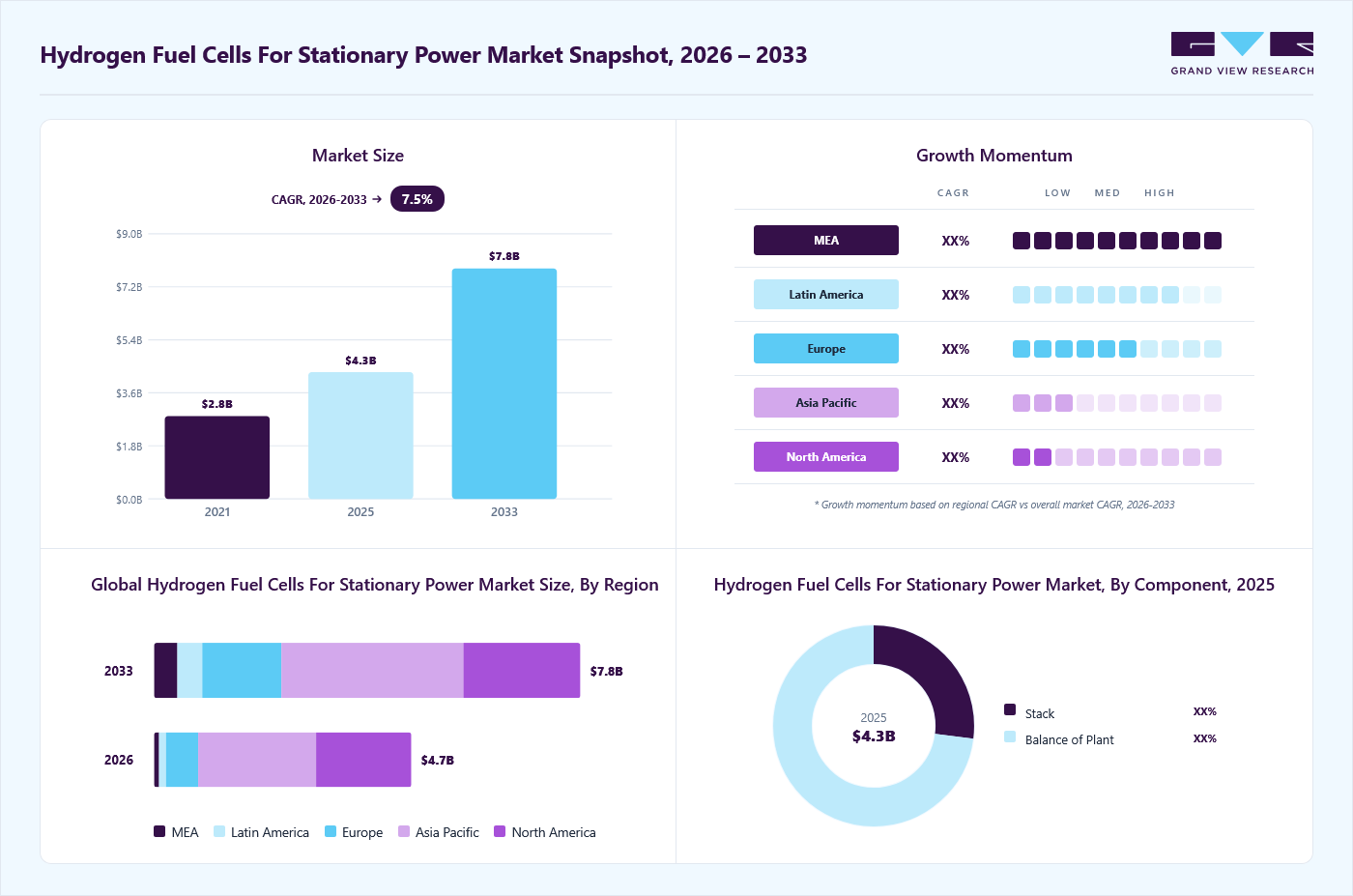 Source: Grand View Research, IR Documents, Primary Interviews, Paid DatabasesTo learn more about this report,
 Download Free Sample Report
 Key Market Trends & Insights
- By system: Large (≥1 MW) segment accounted for a notable revenue share of about 70% in 2025.
- By end use: Utilities segment led the market with the largest revenue share in 2025.
- By product: Solid oxide fuel cell (SOFC) segment holds the largest revenue share in 2025.
- By component: Balance of plant segment holds the largest revenue share in 2025.
Regional Highlights
- Largest regional market: Asia Pacific (46% revenue share, 2025)
- Fastest-growing regional market: Middle East & Africa (highest CAGR, 2026-2033)
- By country: The China hydrogen fuel cells for stationary power industry is a major contributor to the global market.
Market Size & Forecast
- Market size in 2025: USD 4.3 Billion
- Estimated market size in 2026: USD 4.7 Billion
- Projected market size by 2033: USD 7.8 Billion
- CAGR (2026-2033): 7.5%
Three ways to get this report
Buy it, customize it, or ask a question.Ask an Analyst
Analyst response in 1 business day
- AccessReport author, directly
- Reply timeWithin 1 working day
- No sales callDirect answer only
- FormatEmail reply
- CostFree, no cost
Get the Full Report
What the study covers
- FormatsPDF · Excel · Dashboard
- Timeline2026–2033 annual, 2025 base
- Coverage20+ countries, 5 regions
- Companies10+ key players profiled
Customize the Report
20% free customization
- IncludeCountries, segments, points
- TailorTo your product definition
- ExtendDeeper competitor detail
- OrA fully bespoke study
- Turnaround5–10 working days
Increasing focus on decarbonization, energy security, and grid resilience is encouraging industries and governments to adopt fuel cell–based solutions for prime power, backup power, and combined heat and power (CHP) applications.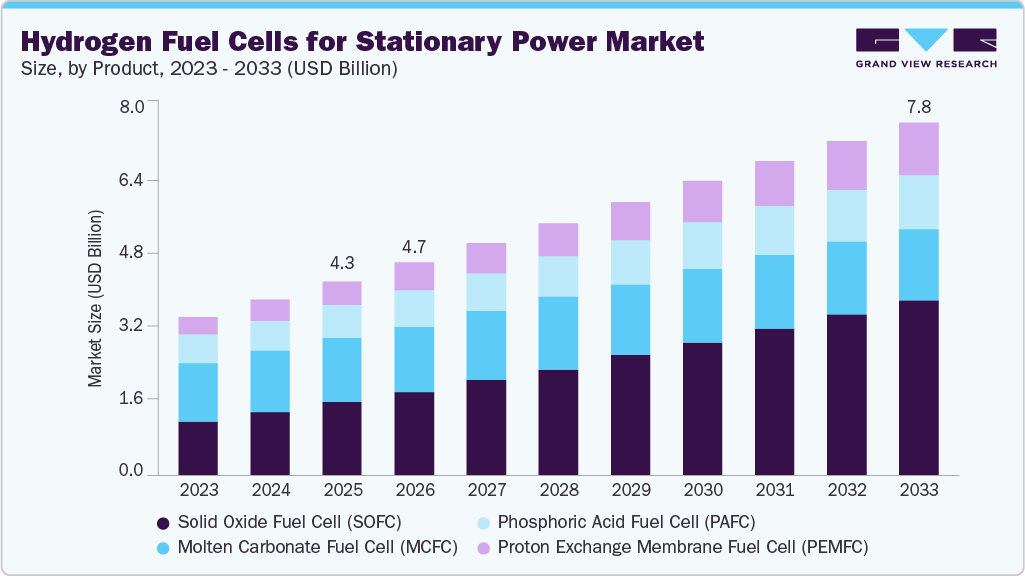 To learn more about this report, Download Free Sample Report
 Technological advancements in fuel cell efficiency, durability, and system integration, along with declining costs of hydrogen production and storage, are further supporting market expansion. Growing investments in green hydrogen production, supported by renewable energy–based electrolysis, are improving fuel availability and long-term sustainability of stationary fuel cell systems. In addition, supportive policy frameworks, financial incentives, and rising demand for low-emission power solutions in data centers, manufacturing facilities, and critical infrastructure are expected to sustain strong market growth through 2033.
Drivers, Opportunities & Restraints
The hydrogen fuel cells for stationary power industry are driven by the increasing demand for low-emission and reliable power solutions, coupled with global decarbonization targets and policies aimed at reducing dependence on fossil fuels. Growing concerns over grid stability, power reliability, and energy security are encouraging the adoption of stationary fuel cell systems for backup power, prime power, and combined heat and power (CHP) applications. Continuous advancements in fuel cell technologies, such as higher efficiency, longer system lifetimes, and improved thermal management, are further supporting market growth by enhancing performance and reducing operational costs.
Significant opportunities exist in the expanding use of stationary hydrogen fuel cells across data centers, hospitals, commercial buildings, and industrial facilities that require an uninterrupted and clean power supply. Increasing investments in green hydrogen production using renewable energy–based electrolysis, along with the development of hydrogen storage and distribution infrastructure, are expected to improve fuel availability and scalability of stationary systems. The integration of fuel cells with microgrids and renewable energy sources also presents strong growth potential by enabling decentralized and resilient power generation.
However, the market faces restraints related to the high capital costs of fuel cell systems and the relatively high cost of low-carbon and green hydrogen compared to conventional fuels. Limited hydrogen infrastructure, challenges in large-scale storage and transportation, and technical complexities associated with system integration can hinder widespread adoption. In addition, competition from alternative clean energy technologies such as battery energy storage systems and gas-based distributed generation may limit the pace of deployment in certain applications.
Product Insights
The Solid Oxide Fuel Cell (SOFC) segment accounted for the largest revenue market share of approximately 38% in 2025. SOFC systems are widely adopted in stationary power applications due to their high electrical efficiency, fuel flexibility, and suitability for continuous, base-load power generation. Their ability to operate at high temperatures enables efficient conversion of hydrogen and other fuels into electricity, while also supporting combined heat and power (CHP) applications. These advantages make SOFCs particularly attractive for industrial facilities, data centers, commercial buildings, and utility-scale distributed generation systems that require reliable and low-emission power.
In addition to holding the largest market share, the SOFC segment is also expected to register the fastest CAGR of 11.3% over the forecast period. This rapid growth is driven by increasing demand for high-efficiency stationary power solutions, rising investments in decentralized energy systems, and continuous technological advancements aimed at improving durability, reducing system costs, and enhancing scalability. Supportive clean energy policies and the growing availability of low-carbon hydrogen are further accelerating the adoption of SOFC-based stationary power systems, positioning the segment as a key growth driver of the market through the forecast horizon.
System Insights
The Large (≥1 MW) system segment accounted for the largest revenue market share of approximately 70% in 2025. Large-scale stationary fuel cell systems are primarily deployed for industrial power generation, utility-scale distributed energy, data centers, and large commercial facilities where high and continuous power output is required. These systems offer advantages such as higher efficiency, economies of scale, and the ability to support base-load power and combined heat and power (CHP) applications. Growing demand for reliable, low-emission power solutions and increased adoption of decentralized generation in energy-intensive industries are key factors supporting the dominance of the large system segment.
In contrast, the Small (<1 MW) system segment is expected to register the fastest CAGR of 11.4% over the forecast period. This rapid growth is driven by rising adoption of compact and modular fuel cell systems across commercial buildings, healthcare facilities, telecom infrastructure, and residential microgrids. Small-scale systems are gaining traction due to their flexibility, lower upfront investment, ease of installation, and suitability for backup power and localized energy needs. Advancements in system design, improved efficiency, and increasing demand for resilient and clean distributed power solutions are expected to accelerate the deployment of small stationary hydrogen fuel cell systems in the coming years.
Component Insights
The balance of plant (BoP) segment accounted for the largest revenue market share of approximately 73% in 2025. Balance of plant components include fuel processing units, power conditioning systems, thermal management, air supply, control systems, and auxiliary equipment required to support fuel cell stack operation. The dominance of this segment is attributed to the complexity and cost-intensive nature of these supporting systems, which are critical for ensuring safe, efficient, and reliable stationary power generation. As stationary fuel cell installations scale up in size and capacity, demand for advanced BoP solutions continues to rise, reinforcing the segment’s leading market position.
The stack segment, while accounting for a smaller share, is expected to register the fastest CAGR of 9.6% over the forecast period. This growth is driven by continuous advancements in stack materials, design optimization, and manufacturing processes aimed at improving efficiency, durability, and power density. Increasing investments in research and development, along with efforts to reduce stack costs and extend operational lifetimes, are accelerating adoption across stationary power applications. As fuel cell technology matures and deployment expands, the stack segment is expected to witness strong growth and play a critical role in overall system performance.
End-use Insights
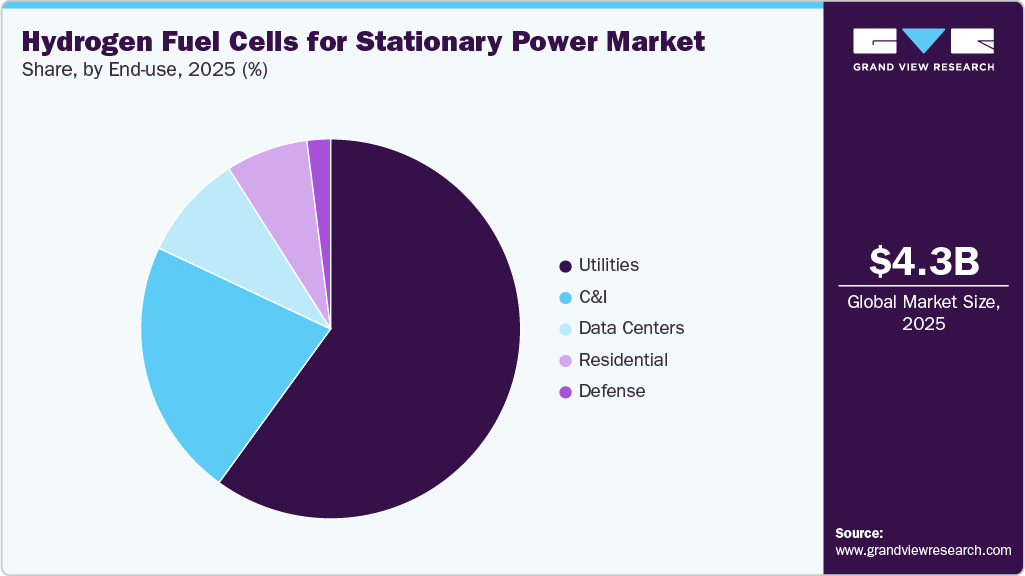
The utilities segment accounted for the largest revenue share of approximately 60% in 2025. Utility-scale adoption of stationary fuel cell systems is driven by the need for reliable, low-emission power generation, grid support, and integration of renewable energy sources. Hydrogen fuel cells are increasingly deployed for base-load power, grid stabilization, and peak shaving applications, offering utilities a flexible solution to meet decarbonization targets while enhancing energy security. Their ability to provide continuous power with high efficiency and minimal emissions positions fuel cells as a viable complement to conventional and renewable generation assets within utility networks.
 To learn more about this report, Download Free Sample Report
 The data centers segment is expected to register the fastest CAGR of 17.1% over the forecast period. Rapid growth in digitalization, cloud computing, artificial intelligence, and hyperscale data center infrastructure is driving demand for highly reliable and uninterrupted power supply solutions. Hydrogen fuel cells are gaining traction as clean alternatives to diesel generators for backup and prime power in data centers, offering lower emissions, reduced noise, and improved sustainability profiles. Increasing pressure on data center operators to meet carbon neutrality goals, along with advancements in fuel cell efficiency and hydrogen availability, is expected to accelerate adoption in this segment significantly.
Regional Insights
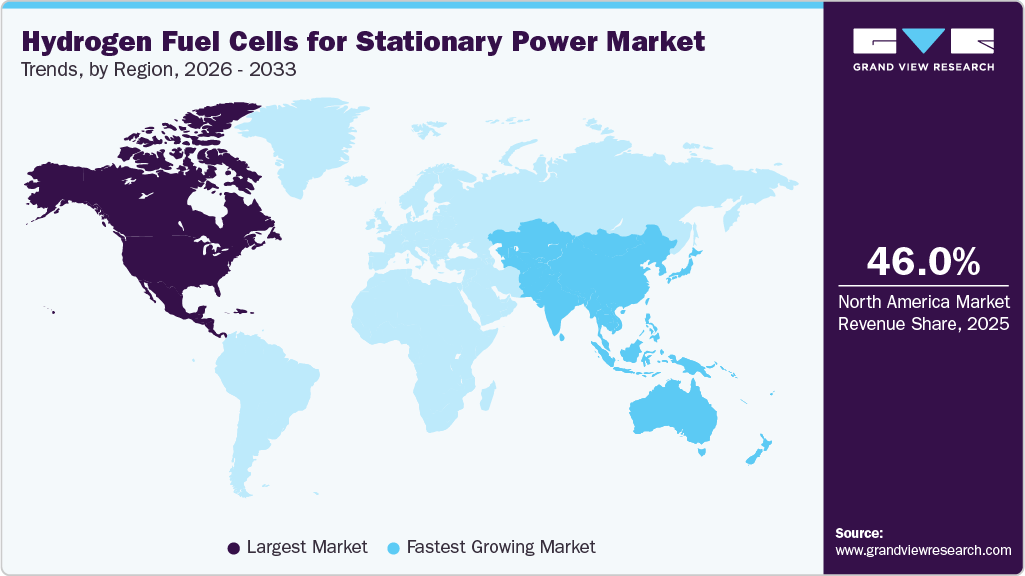
Asia Pacific held over 46% revenue share of the global hydrogen fuel cells for stationary power market in 2025. The region’s strong position is supported by rapid industrialization, rising electricity demand, and proactive government policies promoting clean and low-carbon energy systems. Large-scale deployment of stationary fuel cell systems across industrial facilities, utilities, and commercial infrastructure, along with continuous investments in hydrogen production and supporting infrastructure, are key factors driving market growth. National hydrogen strategies and long-term decarbonization targets continue to reinforce Asia Pacific’s leadership in the global market.
Middle East & Africa Hydrogen Fuel Cells For Stationary Power Market Trends
The hydrogen fuel cells for stationary power market in the Middle East & Africa is expected to register the fastest CAGR of 24.2% over the forecast period. Growth is driven by increasing investments in green and blue hydrogen projects, supported by abundant renewable energy resources and favorable natural gas availability. Rising demand from refining, ammonia production, and industrial power generation, along with government-led energy transition initiatives, is accelerating the adoption of stationary hydrogen fuel cell systems. The region’s focus on developing large-scale hydrogen production hubs and export-oriented infrastructure further strengthens its long-term market potential.
North America Hydrogen Fuel Cells For Stationary Power Market Trends
The hydrogen fuel cells for stationary power market in North America is growing steadily, supported by strong demand for reliable and low-emission power solutions across industrial, commercial, and utility applications.
 To learn more about this report, Download Free Sample Report
 Policy support for hydrogen and clean energy, combined with increasing investments in distributed generation and microgrid development, is driving market adoption. Fuel cells are increasingly deployed for backup power, grid stabilization, and resilience applications, particularly in energy-intensive and mission-critical facilities.
U.S. Hydrogen Fuel Cells For Stationary Power Market Trends
The hydrogen fuel cells for stationary power market in the U.S. is expected to witness consistent growth over the forecast period. Federal and state-level decarbonization policies, hydrogen hub initiatives, and incentives for clean energy technologies are encouraging the adoption of stationary fuel cell systems. Growing deployment across data centers, industrial sites, and utility-scale distributed power projects, along with ongoing investments in blue and green hydrogen production, is supporting market expansion.
Europe Hydrogen Fuel Cells For Stationary Power Market Trends
The hydrogen fuel cells for stationary power market in Europe is expected to grow steadily over the forecast period, driven by strong regulatory support for decarbonization and the transition toward low-carbon energy systems. The European Union’s climate targets, hydrogen strategies, and funding programs are encouraging the deployment of stationary fuel cell systems for distributed generation, backup power, and combined heat and power (CHP) applications. Increasing emphasis on energy efficiency, grid resilience, and integration of renewable energy sources is further supporting market adoption across the region.
Latin America Hydrogen Fuel Cells For Stationary Power Market Trends
The hydrogen fuel cells for stationary power market in Latin America is projected to grow at a notable pace over the forecast period, driven by rising energy demand, industrial expansion, and increasing investments in clean energy infrastructure. Governments in the region are gradually introducing policies to support hydrogen development, while improving economic stability and expanding manufacturing activities, which are creating favorable conditions for market growth. Growing interest in low-emission power generation and decentralized energy solutions is expected to further support the adoption of stationary hydrogen fuel cell systems across key end use sectors.
Key Hydrogen Fuel Cells For Stationary Power Company Insights
Some of the key players operating in the global market include Bloom Energy Corporation and FuelCell Energy, Inc., among others.
-
Bloom Energy Corporation is a leading provider of solid oxide fuel cell (SOFC)–based stationary power solutions, headquartered in the United States. Founded in 2001, the company specializes in on-site power generation systems designed to deliver reliable, low-emission electricity for commercial, industrial, and utility customers. Bloom Energy’s fuel cell systems are widely deployed across data centers, manufacturing facilities, healthcare institutions, and critical infrastructure, offering high efficiency and scalability. The company has also expanded its portfolio to support hydrogen-based power generation, positioning its technology as a key enabler of the transition toward low-carbon and renewable energy systems.
-
FuelCell Energy, Inc. is a U.S.-based company specializing in large-scale stationary fuel cell power plants using molten carbonate fuel cell (MCFC) technology. Established in 1969, the company develops and operates fuel cell systems for utility-scale distributed generation, industrial power, and combined heat and power (CHP) applications. FuelCell Energy’s solutions enable continuous baseload power with low emissions and can be integrated with hydrogen production and carbon capture processes. The company’s focus on high-capacity installations and grid-support applications makes it a prominent participant in the stationary hydrogen fuel cell market.
Key Hydrogen Fuel Cells For Stationary Power Companies:
The following are the leading companies in the hydrogen fuel cells for stationary power market. These companies collectively hold the largest market share and dictate industry trends.
- Advent Technologies
- AFC Energy
- Ballard Power Systems
- Bloom Energy
- Ceres Power
- Cummins Inc.
- Doosan
- FuelCell Energy
- Horizon Fuel Cell Technologies
- Mitsubishi
- Panasonic
- Plug Power
- PowerCell Sweden
- Toshiba Energy Systems & Solutions
Recent Developments
-
In June 2024, Bloom Energy Corporation announced the expansion of its solid oxide fuel cell (SOFC) manufacturing capacity in the United States to support growing demand for stationary power solutions from data centers and industrial customers. The expansion is aimed at accelerating the deployment of high-efficiency, low-emission fuel cell systems for on-site power generation and backup power applications.
Hydrogen Fuel Cells For Stationary Power Market Report Scope
Report Attribute
Details
Market Definition
The market size represents the global revenue generated from the deployment of fuel cell systems that convert hydrogen into electricity for stationary applications, including prime power, backup power, and combined heat and power (CHP) across industrial, commercial, and utility end use sectors.
Market size in 2025
USD 4.3 billion
Estimated Market size in 2026
USD 4.7 billion
Projected Market size by 2033
USD 7.8 billion
Growth rate
CAGR of 7.5% from 2026 to 2033
Base year for estimation
2025
Historical data
2021 - 2024
Forecast period
2026 - 2033
Quantitative Units
Revenue in USD million/billion, capacity in MW, and CAGR from 2026 to 2033
Report coverage
Revenue forecast, competitive landscape, growth factors, and trends
Segments covered
Product, system, component, end-use, region
Regional scope
North America; Europe; Asia Pacific; Latin America; MEA
Country scope
U.S.; Canada; Mexico; Germany; UK; France; Spain; Italy; China; India; Japan; South Korea; Brazil; Argentina; Saudi Arabia; UAE; South Africa
Key companies profiled
Advent Technologies; AFC Energy; Ballard Power Systems; Bloom Energy; Ceres Power; Cummins Inc.; Doosan; FuelCell Energy; Horizon Fuel Cell Technologies; Mitsubishi; Panasonic; Plug Power; PowerCell Sweden; Toshiba Energy Systems & Solutions
Customization scope
Free report customization (equivalent up to 8 analysts working days) with purchase. Addition or alteration to country, regional & segment scope.
Pricing and purchase options
Avail customized purchase options to meet your exact research needs. Explore purchase options
Global Hydrogen Fuel Cells For Stationary Power Market Report Segmentation
This report forecasts volume and revenue growth at global, regional, and country levels and provides an analysis of the latest industry trends in each of the sub-segments from 2021 to 2033. For this study, Grand View Research has segmented the global hydrogen fuel cells for stationary power market report based on product, component, end-use, system, and region:
-
Product Outlook (Revenue, USD Million; Capacity, MW, 2021 - 2033)
-
Proton Exchange Membrane Fuel Cell (PEMFC)
-
Solid Oxide Fuel Cell (SOFC)
-
Phosphoric Acid Fuel Cell (PAFC)
-
Molten Carbonate Fuel Cell (MCFC)
-
-
Component Outlook (Revenue, USD Million; Capacity, MW, 2021 - 2033)
-
Stack
-
Balance of Plant
-
-
System Outlook (Revenue, USD Million; Capacity, MW, 2021 - 2033)
-
Small (<1 MW)
-
Large (≥1 MW)
-
-
End-use Outlook (Revenue, USD Million; Capacity, MW, 2021 - 2033)
-
Residential
-
C&I
-
Data Centers
-
Utilities
-
Defense
-
-
Regional Outlook (Revenue, USD Million; Capacity, MW, 2021 - 2033)
-
North America
-
U.S.
-
Canada
-
Mexico
-
-
Europe
-
Germany
-
UK
-
France
-
Italy
-
Spain
-
-
Asia Pacific
-
China
-
India
-
Japan
-
South Korea
-
-
Latin America
-
Brazil
-
Argentina
-
-
Middle East & Africa
-
Saudi Arabia
-
UAE
-
South Africa
-
-
Frequently Asked Questions About This Report
The global hydrogen fuel cells for stationary power market size was valued at USD 4.3 billion in 2025 and is estimated at USD 4.7 billion for 2026.
The global hydrogen fuel cells for stationary power market is expected to grow at a CAGR of 7.5% from 2026 to 2033, reaching USD 7.8 billion by 2033.
The hydrogen fuel cells for stationary power market is primarily driven by the accelerating global transition toward clean, reliable, and low-carbon power generation, supported by stringent emission regulations and government incentives encouraging fuel cell and hydrogen adoption.
Asia Pacific dominated with a 46.0% revenue share in 2025.
Middle East & Africa is the fastest-growing region over the forecast period.
The balance of plant (BoP) segment led with approximately 73.0%% revenue share in 2025, while stack is the fastest-growing component.
The solid oxide fuel cell (SOFC) segment led with approximately 38.0% revenue share in 2025, and is the fastest-growing product.
The utilities segment led with approximately 60.0% revenue share in 2025, while data centers is the fastest-growing segment.
Key players include Advent Technologies; AFC Energy; Ballard Power Systems; Bloom Energy; Ceres Power; Cummins Inc.; Doosan; FuelCell Energy; Horizon Fuel Cell Technologies; Mitsubishi; Panasonic; Plug Power; PowerCell Sweden; Toshiba Energy Systems & Solutions.
The large (≥1 MW) segment led with a approximately 70.0% revenue share in 2025, while small (<1 MW) is the fastest-growing system.
About the Author(s)
Power Generation & Storage Research Team
Energy & Power · Power Generation & StorageThis report was authored by the power generation & storage research team at Grand View Research - comprising two research analysts, one senior research analyst, and one industry expert - with specialized expertise in the power generation & storage segment of the energy & power industry. All findings are based on proprietary energy & power databases, executive interviews, and regulatory analysis, subject to internal peer review prior to publication.
Last Updated:
Speak to Analyst

Customize this report to your needs - add regions, segments, or data points, with 20% free customization.
Or view our licence options:


ISO 9001:2015 & 27001:2022 Certified
We are GDPR and CCPA compliant! Your transaction & personal information is safe and secure. For more details, please read our privacy policy.


