
- Home
- »
- Plastics, Polymers & Resins
- »
-
In-mold Labeled Plastic Packaging Market Report 2026-2033GVR Report cover

In-mold Labeled Plastic Packaging Market (2026 - 2033)
Size, Share & Trends Analysis Report By Material (Polypropylene (PP), Polyethylene (PE), Polyethylene Terephthalate (PET), Polystyrene (PS)), By Production Process, By Label Material, By Packaging Type, By Region, And Segment Forecasts
Market Size, 2025
$7.2BMarket Estimate, 2026
$7.5BMarket Forecast, 2033
$10.5BCAGR, 2026–2033
4.9%In-mold Labeled Plastic Packaging Market Summary
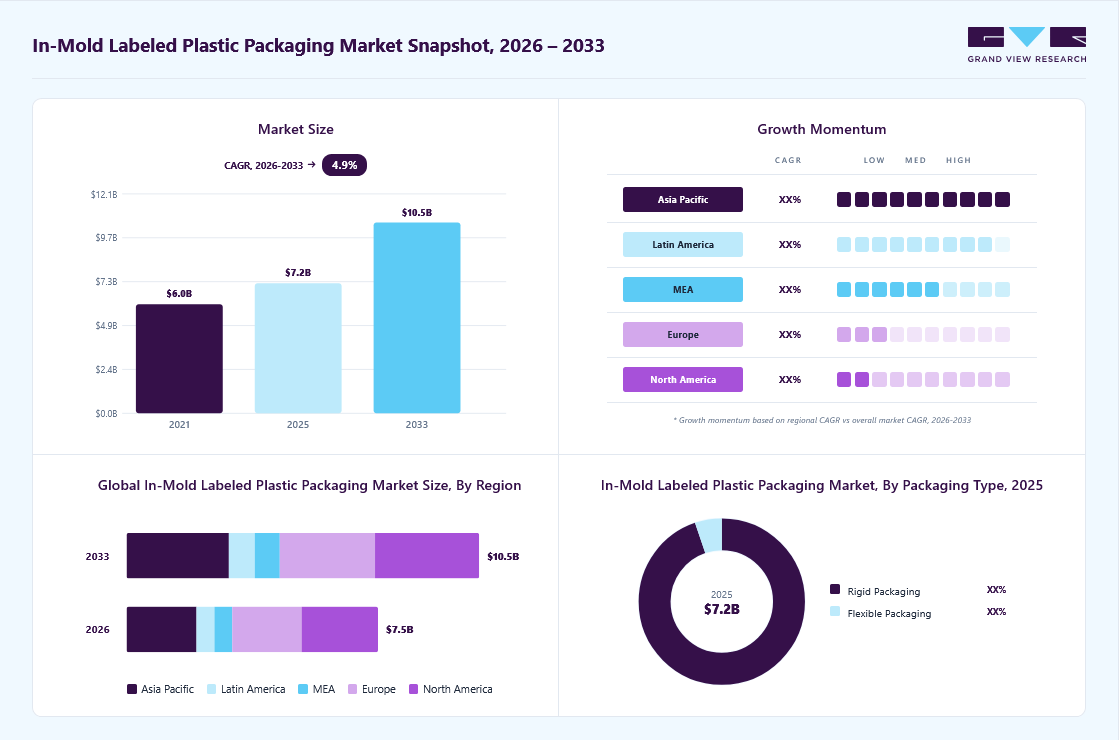
The global in-mold labeled plastic packaging market was valued at USD 7.2 billion in 2025 and is projected to grow from USD 7.5 billion in 2026 to USD 10.5 billion by 2033, at a CAGR of 4.9% from 2026 to 2033. North America dominated the market, accounting for a revenue share of 30.5% in 2025. The market is primarily driven by the growing demand for high-quality, durable, and visually appealing packaging across food & beverages, household products, personal care, and other consumer goods, supported by increasing adoption of in-mold labeling technology, lightweight plastic packaging, enhanced shelf appeal, and high-speed automated packaging operations.
 Source: Grand View Research, IR Documents, Primary Interviews, Paid DatabasesTo learn more about this report,
 Download Free Sample Report
 Key Market Trends & Insights
- By production process: Thermoforming segment is anticipated to expand at a CAGR of 5.3% from 2026 to 2033.
- By material: Polypropylene (PP) held the largest revenue share of 56.9% in 2025.
- By application: Pharmaceuticals & healthcare segment is forecast to register the fastest CAGR of 5.5% from 2026 to 2033.
- By packaging type: Flexible packaging segment is expected to record the fastest CAGR of 8.2% from 2026 to 2033.
- By label material: Polypropylene (PP) labels segment held the largest revenue share of 68.8% in 2025.
Regional Highlights
- Largest regional market: North America (30.5% revenue share, 2025)
- Fastest-growing regional market: Asia Pacific (highest CAGR, 2026-2033)
- By country: The U.S. held the largest market share in 2025.
Market Size & Forecast
- Market size in 2025: USD 7.2 Billion
- Estimated market size in 2026: USD 7.5 Billion
- Projected market size by 2033: USD 10.5 Billion
- CAGR (2026-2033): 4.9%
Three ways to get this report
Buy it, customize it, or ask a question.Ask an Analyst
Analyst response in 1 business day
- AccessReport author, directly
- Reply timeWithin 1 working day
- No sales callDirect answer only
- FormatEmail reply
- CostFree, no cost
Get the Full Report
What the study covers
- FormatsPDF · Excel · Dashboard
- Timeline2026–2033 annual, 2025 base
- Coverage20+ countries, 5 regions
- Companies10+ key players profiled
Customize the Report
20% free customization
- IncludeCountries, segments, points
- TailorTo your product definition
- ExtendDeeper competitor detail
- OrA fully bespoke study
- Turnaround5–10 working days
The in-mold labeled plastic packaging market is driven by the increasing adoption of integrated labeling solutions across food & beverages, household products, personal care, and other consumer goods industries. As brands seek packaging that combines high-quality decoration, durability, and efficient production, in-mold labeling is gaining traction for rigid plastic containers, tubs, cups, and pails. The technology enables labels to be incorporated directly during the molding process, supporting consistent graphics, strong label adhesion, and high-speed automated production while reducing separate labeling operations.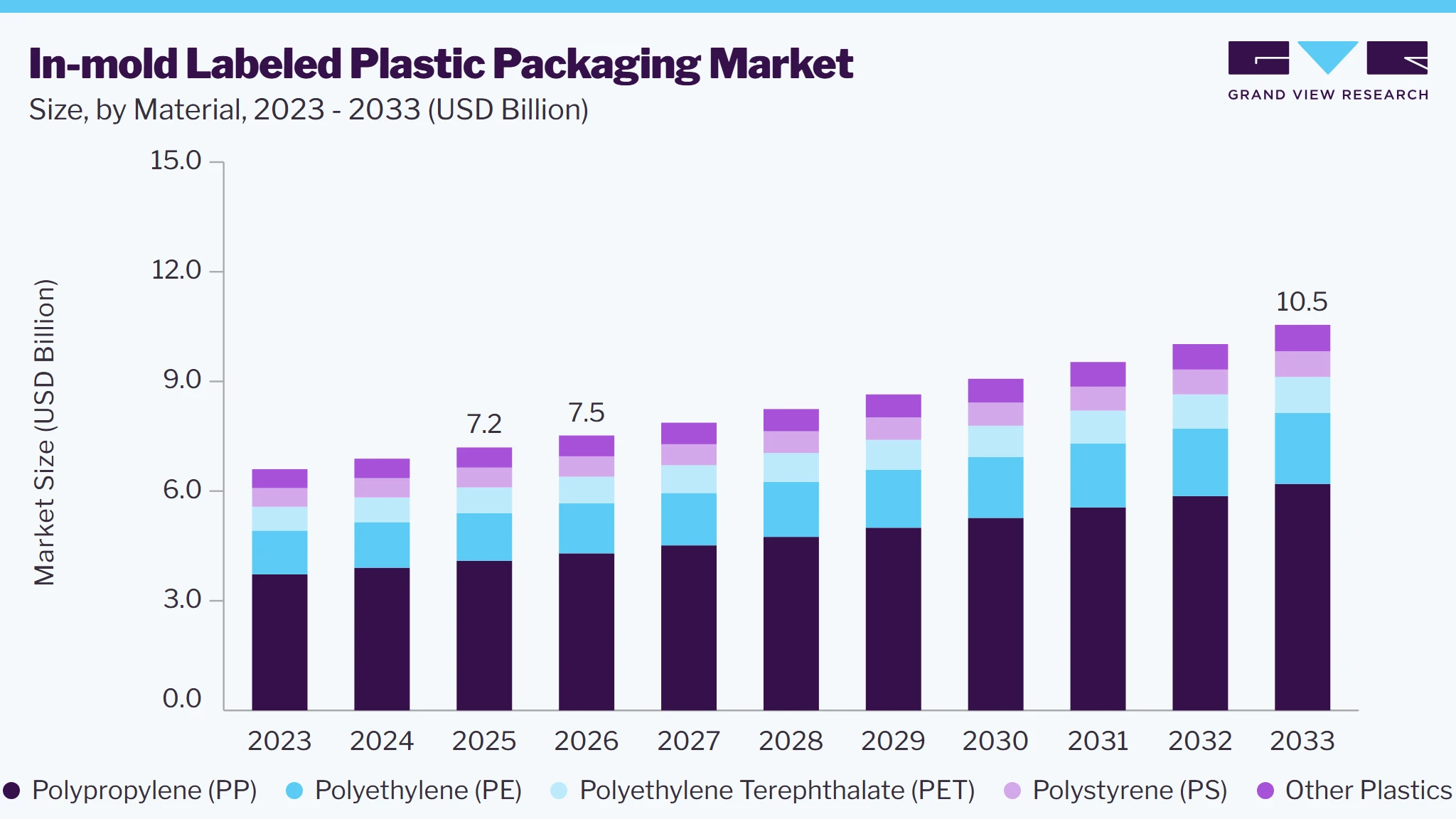 To learn more about this report, Download Free Sample Report
 The growing use of polypropylene (PP) is expected to support market growth in the coming years. PP offers lightweight construction, rigidity, moisture resistance, and good compatibility with in-mold labeling processes, making it widely suitable for food, household, and personal care packaging. Its compatibility with automated molding and decorating lines also enables manufacturers to achieve consistent container dimensions and attractive surface finishes. The continued shift toward lightweight rigid packaging and efficient high-volume production is therefore strengthening the adoption of PP-based in-mold labeled packaging.
Sustainability and recyclability are also influencing product development in the market. Packaging manufacturers are increasingly exploring compatible polymer combinations, lightweight structures, and material-efficient designs to improve the recyclability of in-mold labeled containers. The use of PP-based containers and labels can support streamlined material structures, while advancements in printing, labeling films, and molding technology are helping manufacturers maintain visual quality, durability, and packaging performance alongside environmental considerations.
The expansion of food & beverage packaging is further supporting demand for in-mold labeled plastic packaging. Applications such as yogurt containers, ice-cream tubs, spreads, dairy products, and other packaged foods benefit from durable graphics and moisture-resistant labeling. In-mold labeling also provides strong shelf appeal and consistent decoration for high-volume consumer products, while its integration with automated molding operations helps manufacturers improve production efficiency and reduce handling steps.
Market Dynamics
The in-mold labeled plastic packaging market is witnessing steady growth, driven by increasing demand for durable, visually appealing, and production-efficient packaging across food & beverages, household products, personal care, and other consumer applications. Manufacturers are increasingly adopting in-mold labeling to integrate decoration directly into plastic containers during molding, enabling high-quality graphics, strong label adhesion, and consistent surface finishes. In addition, growing automation in packaging production, demand for lightweight rigid containers, and increasing focus on recyclable packaging structures are supporting market development, while material compatibility and recycling considerations remain important challenges.
The increasing adoption of automated and integrated packaging processes is a key driver of the in-mold labeled plastic packaging market. In-mold labeling combines container forming and label application within the molding process, reducing the need for separate labeling operations and supporting efficient high-volume production. The technology provides durable decoration with strong resistance to moisture, abrasion, and handling, making it suitable for products that require consistent appearance throughout distribution and use.
The growing demand for shelf differentiation across food & beverages, household products, and personal care is further encouraging manufacturers to adopt in-mold labeled packaging. High-resolution graphics, full-surface decoration, and precise label placement allow brands to improve product presentation while maintaining production efficiency. The increasing use of automated injection molding and other high-speed manufacturing systems is also supporting the integration of in-mold labeling into modern packaging lines.
A key restraint for the in-mold labeled plastic packaging market is the complexity of achieving material compatibility between containers and labels while maintaining packaging performance and recyclability. Differences in polymer composition, inks, and coatings can affect recycling efficiency and require manufacturers to carefully select compatible materials. In addition, transitioning to recyclable label structures and optimized packaging designs may require changes in molding processes, equipment, and material formulations, increasing development and production requirements.
A major opportunity lies in the development of recyclable and material-compatible in-mold labeling solutions. Growing emphasis on circular packaging is encouraging manufacturers to use compatible polymers, lightweight label structures, and improved printing technologies that support both product aesthetics and end-of-life recovery. Increasing demand for premium and differentiated packaging across food & beverages, personal care, and household products is also creating opportunities for in-mold labels that provide high-resolution graphics, durable decoration, and efficient integration with automated molding operations.
Market Concentration & Characteristics
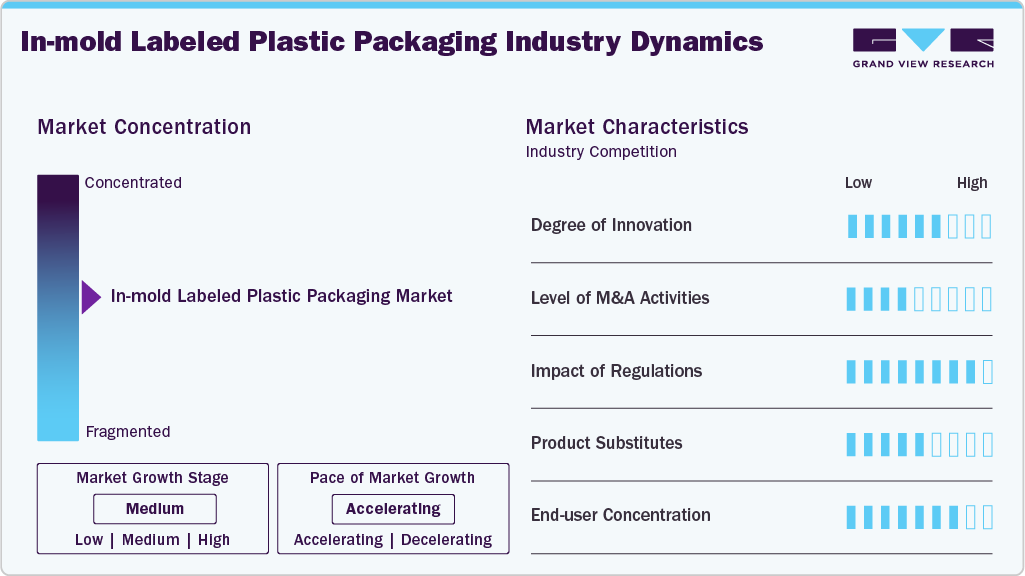
The in-mold labeled plastic packaging market is characterized by high-volume, automated manufacturing, where molding and labeling are integrated into a single production process. Manufacturers focus on production efficiency, precision, economies of scale, and consistent label placement across containers, tubs, cups, and pails. Demand from food & beverages, household products, and personal care supports investments in automated molding, robotic label handling, high-speed production, and high-resolution printing.
 To learn more about this report, Download Free Sample Report
 A defining feature of the industry is its reliance on PP, PE, PET, and other thermoplastics, with PP widely used for its lightweight, rigid, and moisture-resistant properties. Sustainability considerations are increasingly influencing material selection, encouraging recyclable labels, mono-material structures, lightweighting, and material-compatible packaging designs. Advances in precision molding, digital printing, and automation are further improving packaging appearance, production efficiency, and recyclability
Analyst Perspective
The global in-mold labeled plastic packaging market has evolved from a specialized labeling method into an integrated packaging solution, supported by advances in molding, printing, automation, and label integration. Adoption has expanded across food & beverages, household products, personal care, and industrial packaging due to durable decoration, efficient production, and strong shelf appeal. Going forward, growth is expected to be driven by lightweighting, recyclable and mono-material packaging, automation, high-quality graphics, and increasing demand for efficient packaging production, while material compatibility and recyclability will remain key considerations.
Material Insights
The polypropylene (PP) segment led the market with the largest revenue share of 56.9% in 2025. PP is widely used in in-mold labeled containers due to its lightweight structure, rigidity, moisture resistance, and compatibility with injection molding and in-mold labeling processes. Its ability to support high-quality graphics, durable label adhesion, and efficient high-volume production makes it suitable for food & beverages, household products, and personal care packaging. The continued use of PP is supported by its processing efficiency, material versatility, and suitability for recyclable packaging structures.
Polyethylene (PE) is expected to register the fastest growth among the major materials, with a CAGR of 5.2% during the forecast period. PE is increasingly used in packaging formats requiring flexibility, impact resistance, moisture protection, and lightweight construction. Its compatibility with various molding processes and applications across household, personal care, and industrial packaging supports its adoption in in-mold labeled formats. Growing demand for lightweight and durable plastic packaging is expected to further support PE-based in-mold labeling applications.
Production Process Insights
The injection molding segment led the market with the largest revenue share of 61.2% in 2025. The process is widely used for producing rigid containers such as tubs, cups, lids, and pails, while enabling precise integration of labels during molding. Its high production efficiency, dimensional consistency, and suitability for automated, high-volume packaging lines support its strong adoption across food & beverages, household products, and personal care applications.
Thermoforming is expected to register the fastest growth, with a CAGR of 5.3% during the forecast period. The process is gaining adoption for lightweight packaging formats where material efficiency, rapid production, and consistent forming are important. Its compatibility with in-mold labeling and growing demand for lightweight rigid packaging are supporting its use across food, consumer goods, and other packaging applications.
Label Material Insights
The polypropylene (PP) labels segment led the market with the largest revenue share of 68.8% in 2025 and are also projected to register the fastest CAGR of 5.3% during the forecast period. PP labels are widely adopted due to their strong compatibility with PP containers, moisture resistance, durability, and suitability for high-quality graphics. Their efficient integration into molding operations supports high-volume production across food & beverages, household products, personal care, and other consumer packaging applications. Growing demand for lightweight, durable, and recyclable packaging structures is further supporting the use of PP labels.
Polyethylene terephthalate (PET) labels are expected to record the second-fastest growth, with a CAGR of 5.1% during the forecast period. PET labels offer good dimensional stability, durability, moisture resistance, and high-quality printability, making them suitable for packaging applications requiring strong visual appeal and label performance. Their use across food & beverages, personal care, and household products is supported by demand for durable labeling solutions that maintain appearance and performance throughout handling and distribution.
Packaging Type Insights
The rigid packaging segment led the market with the largest revenue share of 94.6% in 2025. Rigid formats such as tubs, cups, containers, and pails are well suited to in-mold labeling because the label can be integrated directly during molding, providing durable decoration, consistent graphics, and resistance to moisture and handling. Strong demand from food & beverages, household products, and personal care applications continues to support the dominance of rigid packaging.
Flexible packaging is expected to register the fastest CAGR of 8.2% during the forecast period. Its growth is supported by increasing demand for lightweight and material-efficient packaging formats, along with improvements in labeling and converting technologies. The growing use of flexible formats across consumer products and the need for attractive, high-quality package decoration are creating additional opportunities for in-mold labeling applications.
Application Insights
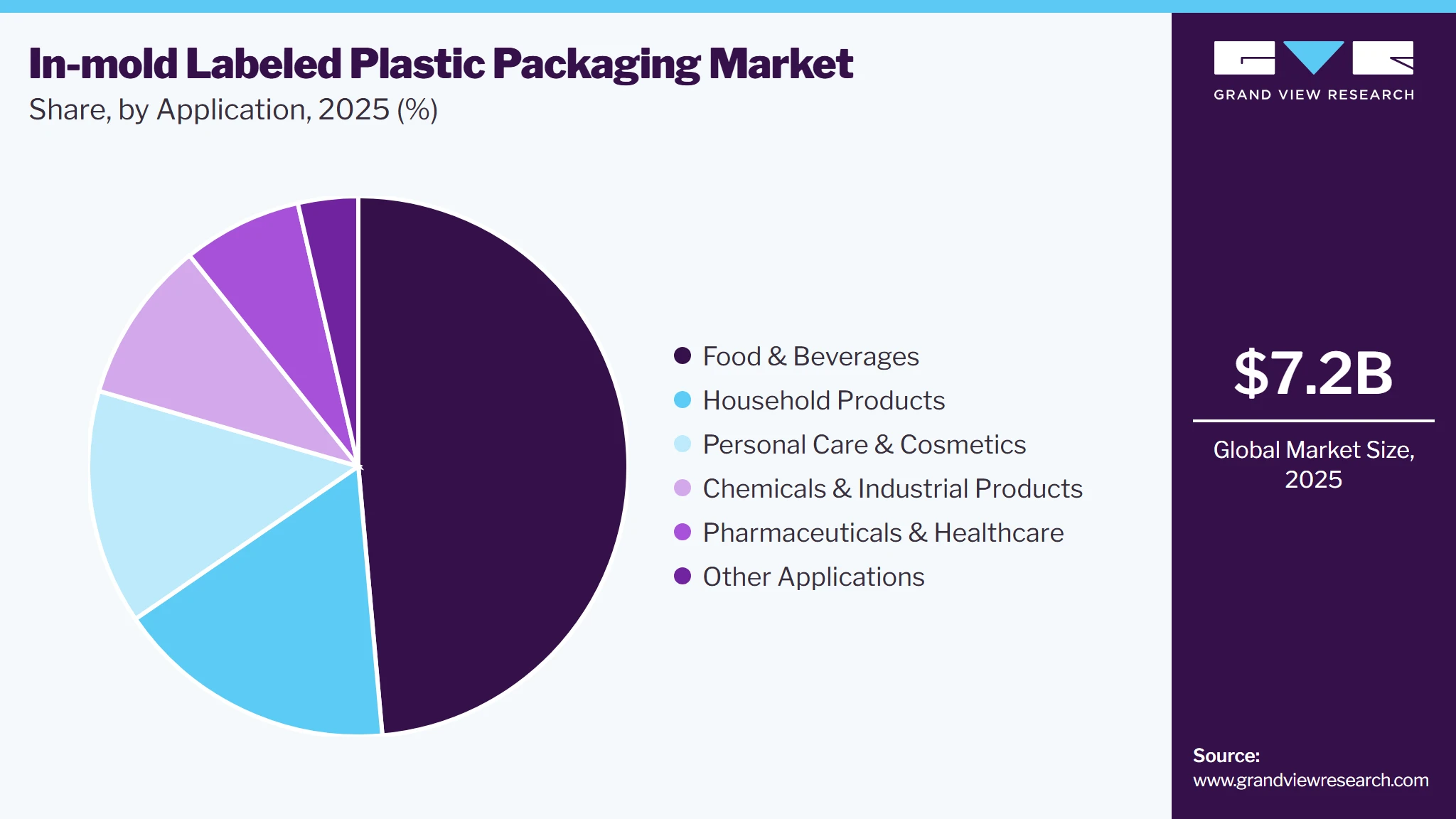
The food & beverages segment led the market with the largest revenue share of 48.6% in 2025. In-mold labeling is widely used for food containers such as dairy tubs, yogurt cups, ice-cream containers, and other rigid packaging formats due to its moisture resistance, durable decoration, and high-quality graphics. The need for attractive shelf presentation and efficient high-volume packaging production continues to support adoption across the food & beverage sector.
 To learn more about this report, Download Free Sample Report
 Pharmaceuticals & healthcare is expected to register the fastest CAGR of 5.5% during the forecast period. In-mold labeled packaging provides durable identification, consistent graphics, and resistance to handling and moisture, making it suitable for selected healthcare and pharmaceutical packaging applications. Increasing demand for reliable product identification, tamper-resistant packaging designs, and efficient automated production is supporting the use of in-mold labeling in this segment.
Regional Insights
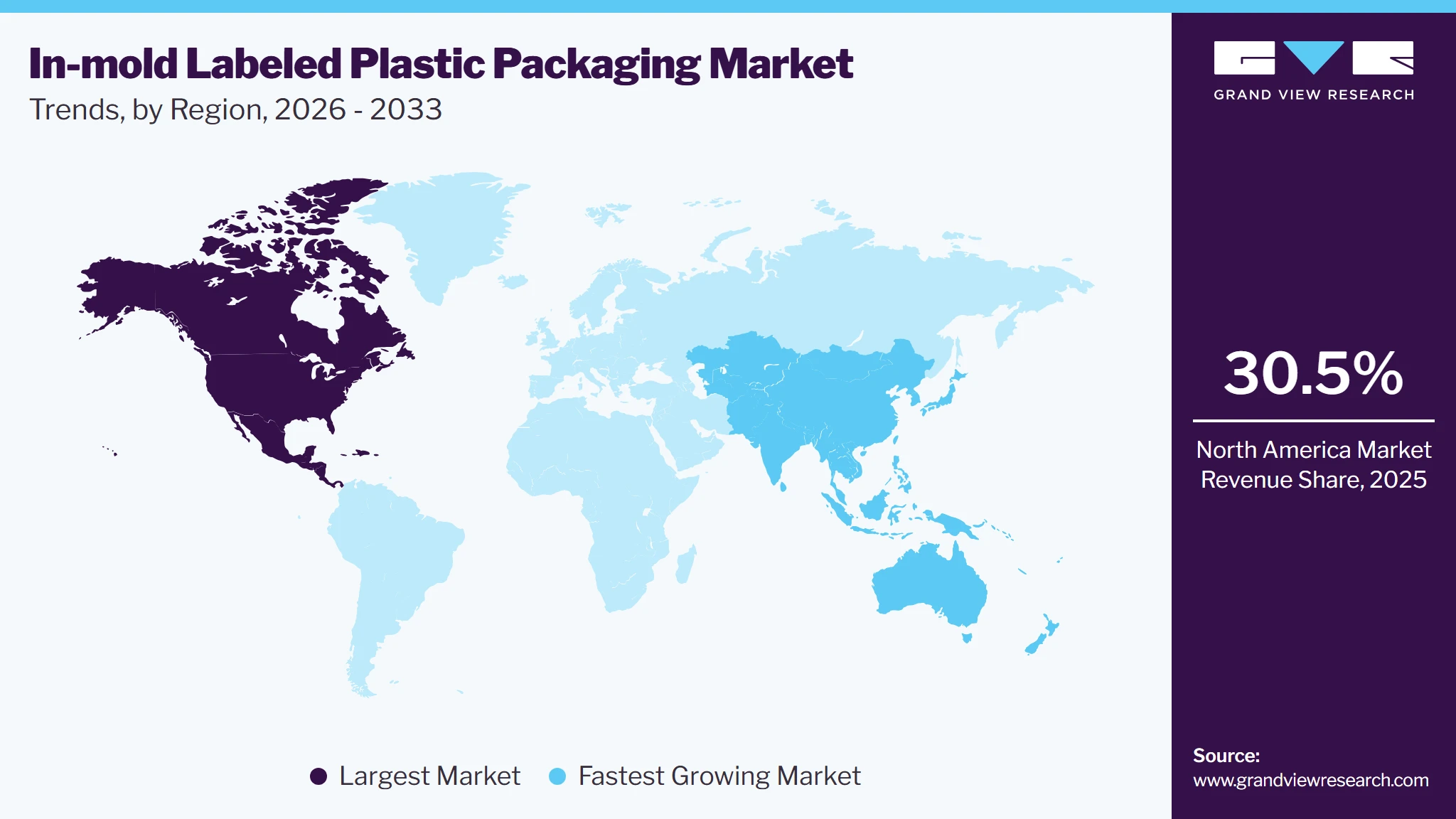
The North America in-mold labeled plastic packaging market is considered as highest revenue share of 2025 with 30.5%, supported by established food & beverage, household, and personal care packaging industries. The region benefits from widespread adoption of automated molding and decorating systems, strong demand for premium shelf appearance, and increasing use of lightweight rigid plastic containers. Growing emphasis on recyclable packaging and production efficiency is also encouraging manufacturers to optimize in-mold labeling processes.
 To learn more about this report, Download Free Sample Report
 U.S. In-mold Labeled Plastic Packaging Market Trends
The U.S. In-mold Labeled Plastic Packaging market is supported by high-volume consumer packaging production and demand for visually differentiated products. Food containers, household packaging, personal care products, and industrial containers are key areas of application, with manufacturers emphasizing automation, high-resolution decoration, and streamlined molding operations. Increasing attention to recyclable materials and efficient packaging designs is also influencing technology and material selection.
Europe In-mold Labeled Plastic Packaging Market Trends
The Europe in-mold labeled plastic packaging market is projected to experience steady growth, supported by established packaging manufacturing capabilities and demand for high-quality decorated plastic containers. The region's strong focus on packaging recyclability, material efficiency, and circular economy practices is encouraging the development of compatible label and container structures. Demand from food, personal care, and household product manufacturers is further supporting adoption of in-mold labeling technology.
The Germany in-mold labeled plastic packaging market represents an important European market due to its advanced plastics processing industry and strong manufacturing base. Demand is supported by food packaging, household products, and industrial applications requiring precise molding and durable decoration. The country's focus on production automation, resource efficiency, and recyclable packaging designs is encouraging continued investment in advanced molding and labeling technologies.
The UK in-mold labeled plastic packaging market is expected to grow steadily, driven by demand for efficient and visually appealing packaging across food & beverages, household products, and personal care. Packaging producers are increasingly focused on lightweighting, recyclability, and efficient labeling processes, while brand owners continue to seek durable graphics and strong shelf differentiation. These trends are supporting the use of in-mold labeling in selected rigid plastic formats.
Asia Pacific In-mold Labeled Plastic Packaging Market Trends
Asia Pacific is expected to be the fastest-growing regional market, registering a 5.6% CAGR during the forecast period. Growth is supported by expanding food & beverage and consumer goods manufacturing, rising organized retail activity, and increasing investments in automated plastic packaging production. The region's large manufacturing base and growing demand for attractive, durable, and lightweight packaging are accelerating adoption of in-mold labeling, particularly in emerging economies.
The China in-mold labeled plastic packaging market is a major Asia Pacific market, supported by its large plastics processing industry and extensive production of packaged food, household goods, and personal care products. Increasing use of high-speed injection molding, automated packaging lines, and advanced decoration technologies is strengthening demand for in-mold labeled containers. Growing domestic consumption and the modernization of packaging production are expected to sustain market expansion.
The India in-mold labeled plastic packaging market is expected to experience strong growth, supported by expanding packaged food, personal care, household, and consumer goods manufacturing. Rising organized retail and increasing investment in modern packaging machinery are encouraging manufacturers to adopt efficient molding and labeling processes. Demand for lightweight packaging, attractive graphics, and automated production is creating additional opportunities for in-mold labeling.
Latin America In-mold Labeled Plastic Packaging Market Trends
The Latin America in-mold labeled plastic packaging market is projected to grow steadily, supported by increasing packaged food consumption and expanding household and personal care product manufacturing. Manufacturers are adopting durable and visually appealing plastic packaging to improve product differentiation while maintaining efficient production. Growing modernization of packaging operations is also creating opportunities for automated in-mold labeling solutions.
The Brazil in-mold labeled plastic packaging market represents a significant Latin American market, supported by its large food & beverage and consumer goods industries. Demand for rigid plastic containers with durable decoration is increasing across packaged foods, household products, and personal care applications. Investments in modern molding equipment and packaging automation are supporting greater use of integrated labeling technologies.
The Argentina in-mold labeled plastic packaging market is expected to witness steady development as food, household, and personal care manufacturers seek efficient packaging formats with strong visual appeal. In-mold labeling offers opportunities to simplify decoration processes while providing resistance to moisture and handling. Gradual modernization of packaging production is expected to support adoption across selected consumer product applications.
Middle East & Africa In-mold Labeled Plastic Packaging Market Trends
The Middle East & Africa in-mold labeled plastic packaging market is expected to grow at a 5.0% CAGR during the forecast period. Expansion of food & beverage, household, personal care, and consumer product industries is increasing demand for durable and visually differentiated plastic packaging. Growing investments in local manufacturing, modern retail infrastructure, and automated packaging equipment are creating favorable conditions for the wider adoption of in-mold labeling technologies.
Key In-mold Labeled Plastic Packaging Company Insights
Some key companies in the in-mold labeled plastic packaging market include Amcor plc, Greiner Packaging, Sonoco Products Company, Faerch A/S, Rosti, Honokage IML Container Plastic Packaging Manufacturer, ALPHA, CCL Label, Multi-Color Corporation, Caixin Plastic, Cherukuri Techno Plast Pvt. Ltd., Airlite Plastics, PT IML Technology, and COLOR PACKAGING&PRINTING CO., LTD. The market is characterized by integrated molding and labeling technologies, high-quality decoration, lightweight rigid packaging, development of recyclable materials, and automated, high-volume production. Key participants are focusing on expanding in-mold labeling capabilities, improving print quality and label-to-container compatibility, developing recyclable packaging structures, and providing customized packaging solutions for food & beverages, household products, personal care, and industrial applications.
-
Amcor plc is a global packaging company offering a broad portfolio of rigid and flexible packaging solutions, with capabilities spanning plastic containers, labels, and specialty packaging formats. Its packaging expertise supports the development of lightweight, recyclable, and high-performance solutions for consumer and healthcare applications, creating opportunities the integrate advanced decoration and labeling technologies.
-
Greiner Packaging develops plastic packaging solutions with capabilities in injection molding, thermoforming, and in-mold labeling. The company focuses on lightweight packaging, sustainable material solutions, and high-quality surface decoration, supporting applications across dairy, food, beverage, and other consumer product categories that require durable, integrated labeling.
Key In-mold Labeled Plastic Packaging Companies:
The following key companies have been profiled for this study on the in-mold labeled plastic packaging market.
-
Amcor plc
-
Greiner Packaging
-
Sonoco Products Company
-
Faerch A/S
-
Rosti
-
Honokage IML Container Plastic Packaging Manufacturer
-
ALPHA
-
CCL Label
-
Multi-Color Corporation
-
Caixin Plastic
-
Cherukuri Techno Plast Pvt. Ltd.
-
Airlite Plastics
-
PT IML Technology.
-
COLOR PACKAGING&PRINTING CO., LTD.
Company Categorization
Category
Operating Strategies
Competitive Edge
Weakness
Established Players (Amcor plc; Greiner Packaging; Sonoco Products Company; Faerch A/S; CCL Label; Multi-Color Corporation)
Expand in-mold labeling, rigid plastic packaging, injection molding, thermoforming, and high-quality printing capabilities, while investing in automation, lightweighting, recyclable materials, and customized packaging for food & beverages, household, personal care, and healthcare.
Global manufacturing scale, advanced molding and printing technologies, broad packaging portfolios, established customer networks, and strong sustainability capabilities support large-volume IML packaging production.
Higher capital and operating costs, complex manufacturing networks, and continuous investment requirements for automation, recyclable materials, and advanced IML technologies.
Emerging & Specialized Players (Rosti; Honokage IML Container Plastic Packaging Manufacturer; ALPHA; Caixin Plastic; Cherukuri Techno Plast Pvt. Ltd.; Airlite Plastics; PT IML Technology; COLOR PACKAGING&PRINTING CO., LTD.)
Concentrate on precision injection molding, IML containers, label integration, customized packaging, and printing, targeting regional food, household, personal care, and industrial applications.
IML specialization, production flexibility, customization, rapid customer response, and cost-efficient regional manufacturing provide advantages in niche packaging requirements.
Limited production scale, regional distribution reach, narrower product portfolios, and lower R&D and automation investment can restrict expansion into large multinational packaging prog
Recent Development
-
In April 2026, Amcor commissioned new production capacity for its DecoFusion hybrid tube technology at its Easthampton, Massachusetts facility. The investment expands capabilities for premium graphics, seamless construction, and advanced decoration, strengthening Amcor’s rigid and specialty packaging development in North America..
-
In April 2026, Faerch announced the scaling of 70% tray-to-tray recycled PET meat trays developed with Norfersk using its CIRPET material. The development strengthens the use of food-grade recycled PET, circular material flows, and recyclable rigid packaging in thermoformed applications.
In-mold Labeled Plastic Packaging Market Report Scope
Report Attribute
Details
Market size in 2025
USD 7.2 billion
Estimated market size in 2026
USD 7.5 billion
Projected market size by 2033
USD 10.5 billion
Growth Rate
CAGR of 4.9% from 2026 to 2033
Base year for estimation
2025
Historical data
2021 - 2024
Forecast period
2026 - 2033
Quantitative units
Revenue in USD billion/million and CAGR from 2026 to 2033
Report coverage
Revenue forecast, company ranking, competitive landscape, growth factors, and trends
Segments covered
Material, production process, label material, packaging type, application, region
Regional Scope
North America; Europe; Asia Pacific; Latin America; Middle East & Africa
Country Scope
U.S.; Canada; Mexico; Germany; France; UK; Italy; Spain; China; India; Japan; South Korea; Australia; Brazil; Argentina; Saudi Arabia; UAE; South Africa
Key companies profiled
Amcor Plc; Greiner Packaging; Sonoco Products Company; Faerch A/S; Rosti; Honokage IML Container Plastic Packaging Manufacturer; ALPHA, CCL Label; Multi-Color Corporation; Caixin Plastic; Cherukuri Techno Plast Pvt. Ltd.; Airlite Plastics; PT IML Technology.; COLOR PACKAGING&PRINTING CO., LTD.
Customization scope
Free report customization (equivalent up to 8 analysts working days) with purchase. Addition or alteration to country, regional & segment scope.
Pricing and purchase options
Avail of customized purchase options to meet your exact research needs. Explore purchase options
Global In-mold Labeled Plastic Packaging Market Report Segmentation
This report forecasts revenue growth at the regional, and country levels and provides an analysis on the latest industry trends and opportunities in each of the sub-segments from 2021 to 2033. For the purpose of this study, Grand View Research has segmented the in-mold labeled plastic packaging market report on the basis of material, production process, label material, packaging type, application and region:
-
Material Outlook (Revenue, USD Billion, 2021 - 2033)
-
Polypropylene (PP)
-
Polyethylene (PE)
-
Polyethylene Terephthalate (PET)
-
Polystyrene (PS)
-
Other Plastics
-
-
Production Process Outlook (Revenue, USD Billion, 2021 - 2033)
-
Injection Molding
-
Thermoforming
-
Blow Molding
-
Other Molding Processes
-
-
Label Material Outlook (Revenue, USD Billion, 2021 - 2033)
-
Polypropylene (PP) Labels
-
Polyethylene Terephthalate (PET) Labels
-
Polyethylene (PE) Labels
-
Other Label Materials
-
-
Packaging Type Outlook (Revenue, USD Billion, 2021 - 2033)
-
Rigid Packaging
-
Cups
-
Tubs & Pails
-
Containers
-
Trays
-
Lids & Closures
-
Other IML Packaging
-
-
Flexible Packaging
-
-
Application Outlook (Revenue, USD Billion, 2021 - 2033)
-
Food & Beverages
-
Dairy & fermented products
-
Ice cream & frozen foods
-
Ready-to-eat / processed foods
-
Spreads, sauces & condiments
-
Meat & seafood
-
Bakery & confectionery
-
Other food & beverage products
-
-
Household Products
-
Cleaning products
-
Detergents
-
Home-care products
-
Other household products
-
-
Personal Care & Cosmetics
-
Skin care
-
Hair care
-
Beauty/cosmetic products
-
Other personal-care products
-
-
Pharmaceuticals & Healthcare
-
Chemicals & Industrial Products
-
Paints & coatings
-
Chemicals
-
Lubricants
-
Industrial products
-
-
Other Applications
-
-
Regional Outlook (Revenue, USD Billion, 2021 - 2033)
-
North America
-
U.S.
-
Canada
-
Mexico
-
-
Europe
-
Germany
-
France
-
UK
-
Italy
-
Spain
-
-
Asia Pacific
-
China
-
India
-
Japan
-
South Korea
-
Australia
-
-
Latin America
-
Brazil
-
Argentina
-
-
Middle East & Africa
-
Saudi Arabia
-
UAE
-
South Africa
-
-
Research Methodology
The in-mold labeled plastic packaging market figures in this report are based on a proven research process that combines executive interviews with secondary research from proprietary databases, company filings, and recognized regulatory and institutional sources. Market size is built through value-chain sizing—reconciling supply-side and demand-side estimates—and triangulated with bottom-up and top-down approaches. Every estimate passes multiple levels of expert validation before publication, with each in-mold labeled plastic packaging segment quantified using the revenue-capture definitions in the table below.
Segment Definition
Material Type
Revenue capture definition
Polypropylene (PP)
Revenue generated from the sale of in-mold labeled plastic packaging manufactured using polypropylene (PP) as the primary container material. Includes PP-based cups, tubs, containers, pails, and other rigid packaging formats produced through injection molding, thermoforming, and related molding processes with integrated in-mold labels.
Polyethylene (PE)
Revenue generated from the sale of in-mold labeled plastic packaging manufactured using polyethylene (PE), including HDPE and other relevant PE grades. Includes PE-based containers, bottles, tubs, and other molded packaging formats incorporating in-mold labels for applications such as food & beverages, household products, personal care, and industrial products.
Polyethylene Terephthalate (PET)
Revenue generated from the sale of in-mold labeled plastic packaging manufactured using polyethylene terephthalate (PET). Includes PET-based containers and packaging formats incorporating in-mold labels where properties such as clarity, dimensional stability, durability, and moisture resistance are required across food, beverage, personal care, and other consumer applications.
Polystyrene (PS)
Revenue generated from the sale of in-mold labeled plastic packaging manufactured using polystyrene (PS). Includes PS-based cups, containers, tubs, and other rigid packaging formats with integrated labels, primarily used where lightweight construction, rigidity, printability, and cost-efficient high-volume production are required.
Other Plastics
Revenue generated from the sale of in-mold labeled plastic packaging manufactured using plastics other than PP, PE, PET, and PS. Includes packaging made from materials such as PVC, ABS, PLA, and other specialty or bio-based polymers used in applications requiring specific performance, appearance, processing, or sustainability characteristics.
Production Process
Revenue capture definition
Injection Molding
Revenue generated from in-mold labeled plastic packaging produced through injection molding, where molten plastic is injected into a mold containing the label to form and decorate the packaging in an integrated process. Includes cups, tubs, containers, pails, and other rigid packaging formats used across food & beverages, household products, personal care, and industrial applications.
Thermoforming
Revenue generated from in-mold labeled plastic packaging manufactured through thermoforming, where heated plastic sheets or films are formed into packaging shapes with integrated labeling or decoration. Includes trays, cups, containers, and other lightweight rigid formats requiring high-quality graphics, material efficiency, and efficient production.
Blow Molding
Revenue generated from in-mold labeled plastic packaging produced through blow molding, where plastic is formed into hollow containers while integrating labels or decorative elements during the molding process. Includes bottles, containers, and other hollow packaging formats used in food & beverages, household products, personal care, and industrial applications.
Other Molding Processes
Revenue generated from in-mold labeled plastic packaging manufactured through molding processes other than injection molding, thermoforming, and blow molding. Includes specialized molding techniques and customized production processes used for packaging requiring specific shapes, material properties, decoration, or application-specific performance.
Label Material
Revenue capture definition
Polypropylene (PP) Labels
Revenue generated from the sale of PP labels used in in-mold labeled plastic packaging. Includes PP-based labels integrated directly into molded containers, providing moisture resistance, durability, high-quality graphics, and compatibility with PP packaging structures across food & beverages, household products, personal care, and other consumer applications.
Polyethylene Terephthalate (PET) Labels
Revenue generated from the sale of PET labels used in in-mold labeled plastic packaging. Includes PET-based labels offering dimensional stability, durability, printability, and resistance to moisture and handling for rigid packaging applications across food, beverages, personal care, and household products.
Polyethylene (PE) Labels
Revenue generated from the sale of PE labels used in in-mold labeled plastic packaging. Includes PE-based labels designed to provide flexibility, impact resistance, moisture resistance, and compatibility with PE packaging structures across consumer, household, personal care, and industrial applications.
Other Label Materials
Revenue generated from the sale of in-mold labels manufactured using materials other than PP, PET, and PE. Includes labels based on PS, paper, specialty polymers, and other materials used where specific print quality, appearance, functionality, material compatibility, or application requirements are needed.
Packaging Type
Revenue capture definition
Rigid Packaging
Revenue generated from the sale of rigid in-mold labeled plastic packaging, including cups, tubs, containers, pails, trays, and other molded formats that retain their shape during handling and use. Includes packaging incorporating in-mold labels for food & beverages, household products, personal care, healthcare, and industrial applications.
Flexible Packaging
Revenue generated from the sale of flexible in-mold labeled plastic packaging, including pouches, films, wraps, and other pliable packaging formats incorporating in-mold or integrated labeling solutions. Includes applications requiring lightweight construction, material efficiency, high-quality graphics, and functional packaging performance across consumer and industrial markets.
Application
Revenue capture definition
Food & Beverages
Revenue generated from in-mold labeled plastic packaging used for food and beverage products, including dairy products, yogurt, ice cream, sauces, spreads, beverages, and other packaged foods. Includes cups, tubs, containers, trays, and other molded formats requiring durable decoration, moisture resistance, and high-quality graphics.
Household Products
Revenue generated from in-mold labeled plastic packaging used for household products, including cleaning agents, detergents, laundry products, storage products, and other home-care goods. Includes rigid containers and tubs requiring durable labels, product identification, and resistance to moisture and handling.
Personal Care & Cosmetics
Revenue generated from in-mold labeled plastic packaging used for personal care and cosmetic products, including creams, lotions, shampoos, conditioners, body-care products, and other beauty applications. Includes containers, tubs, jars, and other formats requiring premium appearance, high-quality graphics, and durable decoration.
Chemicals & Industrial Products
Revenue generated from in-mold labeled plastic packaging used for chemicals and industrial products, including lubricants, agricultural chemicals, coatings, adhesives, and other specialty products. Includes pails, containers, and industrial packaging requiring durable labeling, chemical resistance, and clear product identification.
Pharmaceuticals & Healthcare
Revenue generated from in-mold labeled plastic packaging used for pharmaceutical and healthcare products, including selected medical, healthcare, and pharmaceutical containers requiring durable identification, high-quality graphics, and resistance to moisture and handling.
Other Applications
Revenue generated from in-mold labeled plastic packaging used across other applications not covered above, including automotive, consumer goods, specialty products, and other emerging end-use sectors requiring integrated labeling, durable decoration, and customized molded packaging.
Estimation Model
Layer No.
Layer Name
Key Question
Description
1
End-use Industry Layer
What drives demand?
Estimate demand from key industries including food & beverages, household products, personal care & cosmetics, pharmaceuticals & healthcare, and chemicals & industrial products that use in-mold labeled plastic packaging.
2
Packaging Adoption Layer
Where is in-mold labeling used?
Assess adoption of in-mold labeled packaging across major applications based on requirements such as durable decoration, high-quality graphics, moisture resistance, lightweighting, recyclability, and production efficiency.
3
Material & Process Consumption Layer
Which materials and processes generate demand?
Evaluate consumption of PP, PE, PET, PS, and other plastics, along with injection molding, thermoforming, blow molding, and other molding processes used to manufacture in-mold labeled plastic packaging.
4
Revenue Layer
How is revenue generated?
Revenue is generated through the sale of in-mold labeled plastic packaging across rigid and flexible formats, incorporating PP, PET, PE, and other label materials for food & beverages, household, personal care, healthcare, industrial, and other applications.
Delivered Customizations
This report has been delivered with the following In-depth customizations
Client Request
Customization Delivered
Value Adds
Regional Segmentation
Detailed assessment of the In-Mold Labeled Plastic Packaging market across North America, Europe, Asia Pacific, Latin America, and Middle East & Africa, covering regional demand patterns, molding technologies, material preferences, packaging applications, sustainability trends, and market growth outlook.
Enables identification of high-growth regions, regional demand variations, technology adoption patterns, and expansion opportunities across key markets.
Opportunity Assessment
Comprehensive assessment of opportunities across materials, production processes, label materials, packaging types, applications, and regional markets, focusing on PP and PE packaging, injection molding, thermoforming, recyclable IML structures, automation, and emerging packaging applications.
Helps identify high-potential segment combinations, unmet packaging requirements, emerging demand pockets, and investment opportunities to support product development and market expansion strategies.
Competitive Benchmarking
Comparative benchmarking of key In-Mold Labeled Plastic Packaging companies based on IML capabilities, molding technologies, label integration, product portfolio, material compatibility, automation, sustainability initiatives, manufacturing footprint, application coverage, and strategic developments.
Provides insights into competitive positioning, technology differentiation, capability gaps, product portfolio opportunities, and potential areas for strategic expansion within the IML packaging market.
Frequently Asked Questions About This Report
Asia Pacific is the fastest-growing region over the forecast period.
The polypropylene (PP) labels segment led the market with the largest revenue share of 68.8% in 2025 and are also projected to register the fastest CAGR of 5.3% during the forecast period. PP labels are widely adopted due to their strong compatibility with PP containers, moisture resistance, durability, and suitability for high-quality graphics.
The global in-mold labeled plastic packaging market size was valued at USD 7.2 billion in 2025 and is estimated to reach USD 7.5 billion in 2026.
The global in-mold labeled plastic packaging market is expected to grow at a CAGR of 4.9% from 2026 to 2033, reaching USD 10.5 billion by 2033.
The market is primarily driven by increasing demand for durable and visually appealing packaging, high-speed automated production, lightweight plastic containers, high-quality graphics, integrated molding and labeling, and recyclable packaging structures across food & beverages, household products, personal care, and other consumer applications.
North America dominated the in-mold labeled plastic packaging market with a 30.5% revenue share in 2025.
The polypropylene (PP) segment led the market with the largest revenue share of 56.9% in 2025 while Polyethylene (PE) is expected to be the fastest-growing market.
The injection molding segment led the market with the largest revenue share of 61.2% in 2025 and thermoforming segment is second fastest growing market
Key players in the In-Mold Labeled Plastic Packaging market include Amcor plc, Greiner Packaging, Sonoco Products Company, Faerch A/S, Rosti, Honokage IML Container Plastic Packaging Manufacturer, ALPHA, CCL Label, Multi-Color Corporation, Caixin Plastic, Cherukuri Techno Plast Pvt. Ltd., Airlite Plastics, PT IML Technology, and COLOR PACKAGING&PRINTING CO., LTD.
About the Author(s)
Plastics, Polymers & Resins Research Team
Bulk Chemicals · Plastics, Polymers & ResinsThis report was authored by the plastics, polymers & resins research team at Grand View Research - comprising two research analysts, one senior research analyst, and one industry expert - with specialized expertise in the plastics, polymers & resins segment of the bulk chemicals industry. All findings are based on proprietary bulk chemicals databases, executive interviews, and regulatory analysis, subject to internal peer review prior to publication.
Last Updated:
Speak to Analyst

Customize this report to your needs - add regions, segments, or data points, with 20% free customization.
Or view our licence options:


ISO 9001:2015 & 27001:2022 Certified
We are GDPR and CCPA compliant! Your transaction & personal information is safe and secure. For more details, please read our privacy policy.


