
- Home
- »
- Clinical Diagnostics
- »
-
Laser-induced Fluorescence Detection Instruments Market Report, 2026-2033GVR Report cover
![Laser-induced Fluorescence Detection Instruments Market (2026 - 2033)Report]()
Laser-induced Fluorescence Detection Instruments Market (2026 - 2033)
Size, Share & Trends Analysis Report By Technology (Continuous-wave laser LIF ), By Product (Standalone LIF Instruments), By Application (Cancer Diagnostics, Fluorescence-guided Surgery), By End-use, By Region, And Segment Forecasts
Market Size, 2025
$846.1MMarket Estimate, 2026
$944.9MMarket Forecast, 2033
$2,169.7MCAGR, 2026–2033
12.6%Laser-induced Fluorescence Detection Instruments Market Summary
The global laser-induced fluorescence detection instruments market size was valued at USD 846.1 million in 2025 and is projected to grow from USD 944.9 million in 2026 to USD 2,169.7 million by 2033, at a CAGR of 12.6% from 2026 to 2033. The North America held the largest share of 41.5% of the global market in 2025. The laser-induced fluorescence (LIF) detection instruments industry growth is driven by increasing demand for ultra-sensitive, real-time analytical techniques across environmental monitoring, life sciences, and industrial diagnostics.

Key Market Trends & Insights
- By product: Standalone LIF instruments segment held the largest market share of 39.0% in 2025.
- By technology: Continuous-wave laser LIF segment held the largest market share of 35.5% in 2025.
- By application: Cancer diagnostics segment held the largest market share in 2025.
- By end-use: Pharmaceutical & biotech companies segment held the largest market share of 43.6% in 2025.
Regional Highlights
- Largest regional market: North America (41.5% revenue share, 2025)
- Fastest-growing regional market: Asia Pacific (highest CAGR, 2026-2033)
- By country: The U.S. held the largest share in 2025
Market Size & Forecast
- Market size in 2025: USD 846.1 Million
- Estimated market size in 2026: USD 944.9 Million
- Projected market size by 2033: USD 2,169.7 Million
- CAGR (2026-2033): 12.6%
Advancements in laser power, miniaturization, and AI-integrated data analysis are further enhancing detection capabilities and expanding application scope. The market is gaining momentum as industries increasingly prioritize high-sensitivity, real-time detection technologies. LIF systems offer superior detection limits compared to conventional analytical methods, making them particularly valuable in complex applications such as biologics development, environmental contaminant analysis, and combustion diagnostics. The growing need for precise molecular-level detection, especially in emerging healthcare and sustainability-driven sectors, continues to drive global adoption.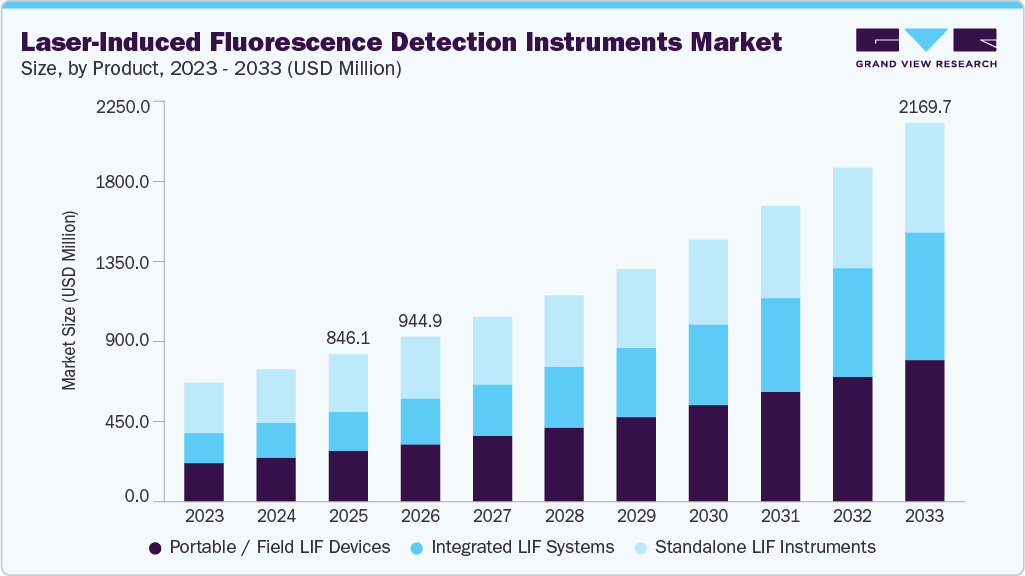
A key growth driver in the market is the rapid advancement in laser technologies, which directly influences the efficiency and sensitivity of LIF systems. In Jan 2026, HÜBNER Photonics introduced the VALO Tidal 3 W femtosecond fiber laser, significantly enhancing excitation power for detecting low-concentration analyses. Such developments are enabling more robust fluorescence signals and improving detection accuracy in demanding applications. In parallel, the emergence of multi-wavelength laser modules has increased the flexibility for multi-analyte detection, enabling researchers to expand the scope of LIF-based investigations.
Another important factor contributing to market growth is the integration of artificial intelligence and advanced software capabilities into LIF systems. Currently, AI-driven data analysis tools have increasingly been deployed to process complex fluorescence datasets, enabling real-time signal correction and improving analytical throughput. This shift toward intelligent systems is particularly beneficial in high-throughput laboratory environments, where speed, accuracy, and automation are critical.
In addition, the market is witnessing a strong push toward miniaturization and portability, expanding the use of LIF systems beyond traditional laboratory settings. According to an MDPI article published in September 2024, a compact LIF detector was deployed for microbial monitoring aboard the Chinese Space Station, demonstrating the potential of lightweight, low-cost systems in extreme and remote environments. This trend is expected to accelerate the adoption of LIF technology in field-based applications such as environmental monitoring and on-site diagnostics.
Market Concentration & Characteristics
The laser-induced fluorescence detection instruments industry demonstrates a high degree of innovation, driven by advancements in imaging speed, software analytics, and laser performance. In October 2024, Dantec Dynamics released DynamicStudio 8.4, introducing Python scripting capabilities and advanced dynamic masking features that significantly improve data processing in LIF experiments. These innovations, combined with the ongoing integration of AI-driven data processing, are continuously enhancing system performance and analytical accuracy.
The laser-induced fluorescence detection instruments industry exhibits a moderate level of mergers and acquisitions, with companies primarily focusing on technological collaborations and integration into broader analytical platforms rather than standalone consolidation. Major analytical instrument providers are expanding their capabilities through strategic acquisitions and partnerships that strengthen fluorescence-based detection workflows, particularly in biopharma and diagnostics. At the same time, specialized LIF system providers and laser manufacturers are collaborating with research institutions and industrial users to enhance application-specific performance, especially in combustion diagnostics, environmental monitoring, and life sciences. This collaborative ecosystem supports innovation while allowing companies to expand their market presence without relying heavily on large-scale acquisitions.
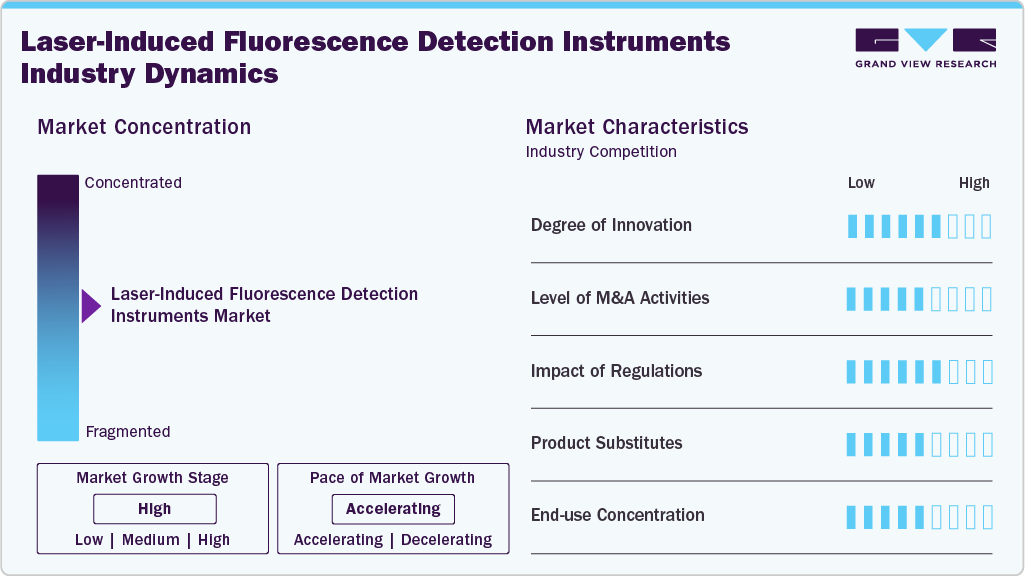
Regulations have a moderate to high impact on the laser-induced fluorescence detection instruments industry, particularly in clinical and diagnostic applications where fluorescence-based systems must comply with stringent approval frameworks. Regulatory bodies such as the U.S. FDA and the European Union under IVDR impose strict requirements on safety, performance, and quality management systems. For instance, the transition to IVDR in Europe requires fluorescence-based diagnostic devices to meet updated certification standards, while in the U.S., mandatory electronic submission formats, such as eSTAR, have streamlined and standardized approval processes since 2023. Although these regulations ensure product reliability and safety, they also increase development timelines and costs, especially for companies entering clinical-grade LIF applications.
There is a moderate level of substitution in the laser-induced fluorescence detection instruments industry, as alternative analytical techniques such as mass spectrometry, chromatography-based detection, and UV-Vis spectroscopy are widely used across similar applications. However, LIF maintains a strong position due to its superior sensitivity, non-destructive analysis, and real-time detection capabilities. Rather than being replaced, LIF is increasingly integrated into modular analytical platforms alongside other detection technologies, enabling laboratories to leverage multiple techniques within a single system. This complementary role, combined with ongoing improvements in portability and automation, continues to sustain the relevance of LIF technology across research, environmental, and industrial applications.
Product Insights
The standalone LIF instruments segment led the market with the largest revenue share of 39.0% in 2025, driven by its widespread adoption in environmental monitoring, industrial diagnostics, and laboratory-based research, where dedicated, high-sensitivity detection systems are required. These instruments offer reliability, ease of deployment, and application-specific customization, making them the preferred choice for routine and field-based analyses. For instance, Dakota Technologies offers UVOST and TarGOST systems that are extensively used for real-time subsurface hydrocarbon detection, particularly in environmental site assessments. Similarly, Unimicro Technologies provides the TriSep 3000 LIF detector, known for its high sensitivity and modular design in analytical laboratory settings, while companies such as Holmarc cater to academic and research institutions with cost-effective LIF systems. The strong presence of such specialized instruments across diverse industries continues to sustain the segment’s dominant revenue position.
The integrated LIF systems segment is expected to grow at the fastest CAGR over the forecast period, driven by increasing demand for multi-functional analytical platforms that combine fluorescence detection with separation and spectroscopy techniques. These systems enhance workflow efficiency, reduce operational complexity, and support high-throughput applications, particularly in biopharmaceutical and clinical research. For instance, Agilent Technologies’ 7100 Capillary Electrophoresis system is widely integrated with ZetaLIF detectors to enable ultra-sensitive biomolecular analysis, especially in protein and glycan studies. In addition, Edinburgh Instruments offers the FLS1000 photoluminescence spectrometer, which incorporates laser-based fluorescence detection for both steady-state and time-resolved measurements. Further, in January 2024, Agilent Technologies, Inc. launch thier ProteoAnalyzer system, which highlights the shift toward automated, integrated platforms designed to streamline complex analytical workflows, thereby accelerating the adoption of integrated LIF solutions.
Technology Insights
The continuous-wave laser LIF segment led the market with the largest revenue share of 35.5% in 2025, driven by its widespread use in steady-state fluorescence measurements across laboratories, environmental monitoring, and industrial quality control applications. These systems are favored for their operational simplicity, stable output, and cost-effectiveness, making them highly suitable for routine and long-duration analytical processes. Continuous-wave LIF enables consistent excitation, which is essential for applications requiring precise quantification and reproducibility, particularly in academic research and standard analytical workflows. For instance, Edinburgh Instruments offers the FLS1000 photoluminescence spectrometer, which supports continuous-wave laser excitation for reliable and high-precision fluorescence analysis, reinforcing the segment’s strong adoption across research and testing environments.
The imaging LIF systems segment is expected to grow at the fastest CAGR over the forecast period, driven by rising demand for spatially resolved and real-time visualization in complex analytical and industrial processes. These systems are increasingly used in advanced applications such as combustion diagnostics, fluid dynamics, and biomedical imaging, where understanding spatial distribution and temporal changes is critical. The ability to capture high-resolution images and analyze dynamic processes in real time is significantly enhancing research capabilities and industrial diagnostics. In November 2023, Dantec Dynamics introduced SpeedSense cameras capable of capturing up to 40,000 frames per second, enabling highly detailed, time-resolved LIF imaging and analysis, thereby supporting the rapid growth of this segment.
Application Insights
The cancer diagnostics segment accounted for the largest market revenue share in 2025, driven by the growing adoption of high-sensitivity fluorescence-based techniques in oncology research and clinical diagnostics. LIF technology plays a critical role in detecting biomarkers, analyzing tumor heterogeneity, and supporting precision medicine approaches, particularly in applications such as fluorescence in situ hybridization (FISH) and molecular diagnostics. The increasing global burden of cancer and demand for early, accurate detection are further strengthening the use of advanced fluorescence-enabled platforms in diagnostic laboratories. In addition, integration with automated, high-throughput systems is improving efficiency and reproducibility in cancer testing workflows. For instance, in March 2026, Agilent Technologies acquired Biocare Medical to expand its portfolio of fluorescence-based cancer diagnostic solutions, reinforcing the importance of LIF-supported technologies in oncology applications.
The fluorescence-guided surgery segment is expected to grow at the fastest CAGR of 14.3% over the forecast period, driven by the increasing need for real-time visualization during surgical procedures to improve precision and patient outcomes. LIF-based imaging enables surgeons to differentiate between healthy and diseased tissues, enhancing accuracy in tumor resection and vascular procedures. The rising adoption of minimally invasive surgeries and advancements in intraoperative imaging technologies are further accelerating the demand for fluorescence-guided systems. These solutions are gaining traction in both developed and emerging healthcare markets due to their ability to reduce complications and improve surgical success rates. For instance, in September 2025, the IC-Flow Imaging System 2.0 received FDA clearance for fluorescence angiography, enabling real-time visualization of blood flow and tissue perfusion and driving growth in this segment.
End-use Insights
The pharmaceutical & biotech companies segment led the market with the largest revenue share of 43.6% in 2025 and is also expected to grow at the fastest CAGR over the forecast period, driven by the increasing use of high-sensitivity detection technologies in biologics development, drug discovery, and gene therapy workflows. LIF instruments are widely used to analyze proteins, nucleic acids, and complex biomolecules at very low concentrations, making them essential in modern biopharmaceutical research and manufacturing. The rising focus on precision medicine, along with growing investments in biologics and advanced therapeutics, is further accelerating adoption. In addition, the need for accurate quality control and high-throughput analytical platforms in drug development pipelines continues to support strong demand from this segment. For instance, in July 2024, Agilent Technologies acquired BIOVECTRA to strengthen its biologics manufacturing capabilities, where fluorescence-based detection technologies play a critical role in analytical and quality assurance processes.
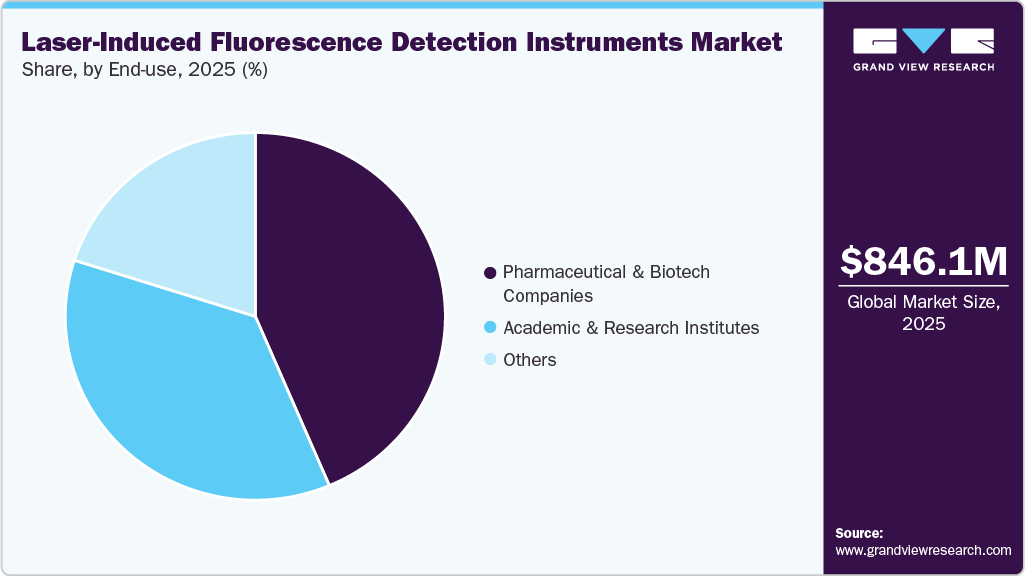
The academic & research institutes segment is anticipated to grow at a significant CAGR during the forecast period, supported by the extensive use of LIF systems in fundamental research, experimental physics, and advanced diagnostics development. These institutions rely on LIF technology for applications such as combustion analysis, fluid dynamics studies, and spectroscopy-based investigations, where precise and real-time measurements are essential. Continuous funding for scientific research and increasing collaboration between academia and industry are further driving the adoption of advanced LIF systems in this segment. Moreover, the flexibility and adaptability of LIF setups make them well-suited for experimental environments requiring customization and innovation.
Regional Insights
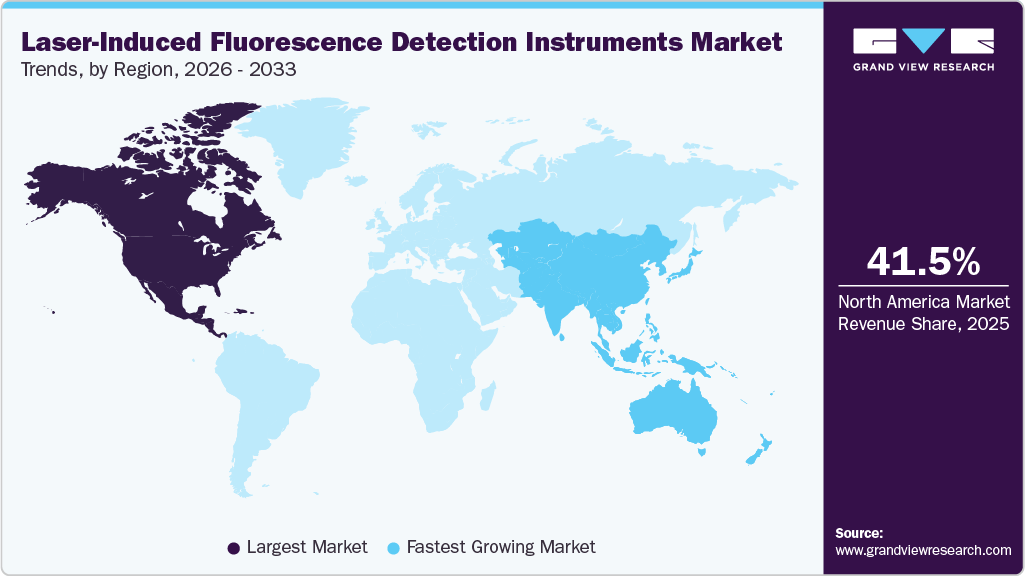
North America dominated the global laser-induced fluorescence detection instruments market with the largest revenue share of 41.5% in 2025, supported by strong research infrastructure, advanced healthcare systems, and widespread adoption of high-end analytical technologies. The region benefits from significant investments in biopharmaceutical research, environmental monitoring, and defense-related diagnostics, all of which rely on high-sensitivity detection methods. The presence of major analytical instrument manufacturers and continuous technological advancements further strengthen market growth. In addition, the growing emphasis on precision medicine and real-time diagnostics is accelerating the integration of LIF systems into clinical and research workflows. Regulatory frameworks in the region, particularly for diagnostic applications, ensure high-quality standards, which support long-term adoption despite increasing compliance requirements.
U.S. Laser-induced Fluorescence Detection Instruments Market Trends
The laser-induced fluorescence detection instruments market in the U.S. accounted for the largest market share in North America in 2025, driven by its leadership in biotechnology, pharmaceutical innovation, and advanced research. High funding levels from government bodies and private organizations support the adoption of sophisticated analytical technologies, including LIF systems. The country also benefits from a strong ecosystem of academic institutions, national laboratories, and industry collaborations that drive continuous innovation. LIF technology is increasingly used in drug discovery, cancer research, and environmental analysis, driven by the growing need for high-throughput, precise detection methods. In addition, the trend toward automation and integration of advanced software tools is further enhancing the efficiency and scalability of LIF-based workflows across laboratories.
Europe Laser-induced Fluorescence Detection Instruments Market Trends
The laser-induced fluorescence detection instruments market in Europe is driven by strong regulatory frameworks, well-established research institutions, and increasing focus on environmental sustainability. The region emphasizes high-quality analytical standards, particularly in clinical diagnostics and environmental monitoring, which supports the adoption of advanced fluorescence-based technologies. Government funding for scientific research and cross-border collaborations further contributes to market growth. The transition toward updated regulatory frameworks, particularly under the In Vitro Diagnostic Regulation (IVDR), is reshaping the market landscape by encouraging modernization of diagnostic technologies.
The UK laser-induced fluorescence detection instruments market is a key contributor to the European market, supported by its strong academic research base and growing life sciences sector. Universities and research institutes play a major role in advancing fluorescence-based technologies, particularly in biomedical imaging and analytical chemistry. The country is also witnessing increasing adoption of LIF systems in pharmaceutical R&D and environmental monitoring applications. The UK’s focus on developing advanced diagnostic capabilities and precision medicine is expected to boost demand for high-sensitivity detection technologies such as LIF in the coming years.
The laser-induced fluorescence detection instruments market in Germany is a major European market, driven by its strong industrial base, engineering expertise, and leadership in scientific research. The country has a well-developed ecosystem of analytical instrument manufacturers and research institutions that actively contribute to technological advancements in optical detection systems. LIF technology is widely used in industrial process monitoring, environmental analysis, and automotive-related combustion research. Furthermore, increasing investments in biotechnology and life sciences are expanding the application scope of LIF systems across both research and commercial environments.
Asia-Pacific Laser-induced Fluorescence Detection Instruments Market Trends
The laser-induced fluorescence detection instruments market in the Asia Pacific is anticipated to grow at the fastest CAGR during the forecast period, driven by expanding pharmaceutical and biotechnology industries, increasing environmental monitoring initiatives, and rising research investments. Countries across the region are rapidly adopting advanced analytical technologies to support industrial development, improve healthcare, and advance sustainability goals. Growing awareness of pollution control and food safety is also contributing to the demand for sensitive detection systems like LIF. In addition, the region benefits from manufacturing cost advantages and a large pool of skilled researchers.
The Japan laser-induced fluorescence detection instruments market represents a technologically advanced market, characterized by strong expertise in photonics, precision engineering, and analytical instrumentation. The country’s focus on high-quality research and innovation supports the adoption of advanced fluorescence-based detection systems in life sciences, materials research, and industrial applications. Japanese companies and research institutions are actively developing compact, high-performance optical systems, which aligns with the growing demand for miniaturized LIF solutions. In addition, the aging population and the growing focus on healthcare innovation are driving the adoption of sensitive diagnostic technologies, further supporting market growth in the country.
The laser-induced fluorescence detection instruments market in China is emerging as a major growth engine, supported by rapid industrialization, expanding research capabilities, and strong government initiatives in healthcare and environmental monitoring. The country is investing heavily in advanced analytical technologies to address challenges related to pollution control, food safety, and public health. In March 2026, China’s National Medical Products Administration (NMPA) introduced new standards for fluorescence-based diagnostic technologies, reflecting the country’s push toward higher-quality, standardized medical devices.
Latin America Laser-induced Fluorescence Detection Instruments Market Trends
The laser-induced fluorescence detection instruments market in Latin America is developing, driven by rising investments in healthcare infrastructure, environmental monitoring, and academic research. Countries in the region are gradually adopting advanced analytical technologies to improve diagnostic capabilities and address environmental challenges. While budget constraints and limited access to high-end instruments may restrict rapid adoption, growing awareness of the benefits of sensitive detection technologies is supporting market expansion. In addition, collaborations with international research organizations and rising government initiatives to improve public health and environmental standards are expected to create new opportunities for LIF system deployment in the region.
Middle East & Africa Laser-induced Fluorescence Detection Instruments Market Trends
The laser-induced fluorescence detection instruments market in the Middle East & Africa is witnessing gradual growth, supported by increasing focus on healthcare modernization, environmental sustainability, and industrial diversification. Governments in the region are investing in advanced diagnostic technologies and research infrastructure, particularly in the UAE and Saudi Arabia. LIF systems are increasingly adopted for oil and gas monitoring, water quality analysis, and healthcare diagnostics.
Key Laser-induced Fluorescence Detection Instruments Company Insight
Some of the leading players operating in the laser-induced fluorescence detection instruments industry include Thermo Fisher Scientific, Agilent Technologies, Horiba Scientific, and Shimadzu Corporation. Companies focus on capturing the market by increasing their presence using various business initiatives, such as partnerships & collaborations with government. Moreover, these companies have well-established product portfolios, which help them capture major market share.
Photon Systems, Inc., ADELIS SAS, and VentEko JSC are some of the emerging market participants in the global market. Developing & launching new and improved diagnostic tools that offer faster results, higher accuracy, and easier usability are prevalent operating strategies for these companies. The players may face challenges in penetrating the market due to competition and regulatory hurdles.
Key Laser-Induced Fluorescence Detection Instruments Companies:
The following key companies have been profiled for this study on the laser-induced fluorescence (LIF) detection instruments market.
- Thermo Fisher Scientific
- Agilent Technologies
- Horiba Scientific
- Shimadzu Corporation
- PerkinElmer
- Bruker Corporation
- Photon Systems, Inc.
- ADELIS SAS
- VentEko JSC
- Inov8 Systems Ltd
- Resonon Inc.
- LIFeLiDAR
Recent Development
-
In February 2026, the U.S. FDA implemented the Quality Management System Regulation (QMSR) aligned with ISO 13485:2016, impacting manufacturers of fluorescence-based and LIF-enabled diagnostic instruments by standardizing quality system requirements.
-
In February 2025, Dantec Dynamics introduced the FlexPIV TR system, leveraging shared infrastructure with planar LIF setups for fluid mechanics research.
Laser-induced Fluorescence Detection Instruments Market Report Scope
Report Attribute
Details
Market size in 2025
USD 846.1 million
Estimated market size in 2026
USD 944.9 million
Projected market size by 2033
USD 2,169.7 million
Growth rate
CAGR 12.6% from 2026 to 2033
Base year for estimation
2025
Historical data
2021 - 2024
Forecast period
2026 - 2033
Quantitative units
Revenue in USD million/billion, and CAGR from 2026 to 2033
Report coverage
Revenue forecast, company ranking, competitive landscape, growth factors, and trends
Segments covered
Technology, product, application, end-use, region
Regional scope
North America; Europe; Asia Pacific; Latin America; MEA
Country scope
U.S.; Canada; Mexico; Germany; UK; France; Italy; Spain; Denmark; Sweden; Norway; China; Japan; India; Australia; South Korea; Thailand; Brazil; Argentina; South Africa; Saudi Arabia; UAE; Kuwait
Key companies profiled
Thermo Fisher Scientific; Agilent Technologies; HORIBA Scientific; Shimadzu Corporation; PerkinElmer; Bruker Corporation; Photon Systems, Inc.; ADELIS SAS; VentEko JSC; Inov8 Systems Ltd; Resonon Inc.; LIFeLiDAR
Customization scope
Free report customization (equivalent to 8 analyst’s working days) with purchase. Addition or alteration to country, regional & segment scope.
Pricing and purchase options
Avail customized purchase options to meet your exact research needs. Explore purchase options
Global Laser-induced Fluorescence Detection Instruments Market Report Segmentation
This report forecasts revenue growth and provides an analysis on the latest trends in each of the sub-segments from 2021 to 2033. For this report, Grand View Research has segmented the global laser-induced fluorescence detection instruments market report based on the technology, product, application, end-use, and region:
-
Product Outlook (Revenue, USD Million, 2021 - 2033)
-
Standalone LIF Instruments
-
Integrated LIF Systems
-
Portable / Field LIF Devices
-
-
Technology Method Outlook (Revenue, USD Million, 2021 - 2033)
-
Continuous-wave laser LIF
-
Pulsed laser LIF
-
Time-resolved LIF
-
Imaging LIF systems
-
Others
-
-
Application Outlook (Revenue, USD Million, 2021 - 2033)
-
Cancer Diagnostics
-
Fluorescence-guided Surgery
-
Biomedical Imaging (FLIM)
-
Drug Discovery
-
Microbiology
-
Others
-
-
End-use Outlook (Revenue, USD Million, 2021 - 2033)
-
Pharmaceutical & biotech companies
-
Academic & research institutes
-
Others
-
-
Regional Outlook (Revenue, USD Million, 2021 - 2033)
-
North America
-
U.S.
-
Canada
-
Mexico
-
-
Europe
-
Germany
-
UK
-
France
-
Italy
-
Spain
-
Denmark
-
Sweden
-
Norway
-
-
Asia Pacific
-
Japan
-
China
-
India
-
Australia
-
South Korea
-
Thailand
-
-
Latin America
-
Brazil
-
Argentina
-
-
Middle East and Africa (MEA)
-
South Africa
-
Saudi Arabia
-
UAE
-
Kuwait
-
-
Frequently Asked Questions About This Report
North America dominated with a 41.5% revenue share in 2025.
The pharmaceutical & biotech companies segment led with a 43.6% revenue share in 2025, while the academic & research institutes segment is anticipated to grow at a significant CAGR.
The continuous-wave laser LIF segment led with a 35.5% revenue share in 2025, while the imaging LIF systems segment is the fastest-growing.
The cancer diagnostics segment held the largest revenue share in 2025, while the fluorescence-guided surgery segment is the fastest-growing.
Standalone LIF instruments segment held the largest share of 39.0% in 2025 due to its widespread adoption in environmental monitoring, industrial diagnostics, and laboratory-based research where dedicated, high-sensitivity detection systems are required.
The global laser-induced fluorescence detection instruments market size was estimated at USD 846.1 million in 2025 and is expected to reach USD 944.9 million in 2026.
The global laser-induced fluorescence detection instruments market is expected to witness a compound annual growth rate of 12.6% from 2026 to 2033 to reach USD 2,169.7 million in 2033.
Some key players operating in the laser-induced fluorescence detection instruments market include Thermo Fisher Scientific, Agilent Technologies, Horiba Scientific, Shimadzu Corporation, PerkinElmer, Bruker Corporation, Photon Systems, Inc., ADELIS SAS, VentEko JSC, Inov8 Systems Ltd, Resonon Inc., and LIFeLiDAR
Key factors driving the laser-induced fluorescence detection instruments market growth are increasing demand for ultra-sensitive, real-time analytical techniques across environmental monitoring, life sciences, and industrial diagnostics.
About the Author(s)
Clinical Diagnostics Research Team
Healthcare · Clinical DiagnosticsThis report was authored by the clinical diagnostics research team at Grand View Research - comprising two research analysts, one senior research analyst, and one industry expert - with specialized expertise in the clinical diagnostics segment of the healthcare industry. All findings are based on proprietary healthcare databases, executive interviews, and regulatory analysis, subject to internal peer review prior to publication.
Last Updated:
Speak to Analyst

Need a Tailored Report?
Customize this report to your needs — add regions, segments, or data points, with 20% free customization.
Or view our licence options:


ISO 9001:2015 & 27001:2022 Certified
We are GDPR and CCPA compliant! Your transaction & personal information is safe and secure. For more details, please read our privacy policy.












