
- Home
- »
- Food Safety & Processing
- »
-
Liquid Packaging Cartons Market Size Report, 2026-2033GVR Report cover
![Liquid Packaging Cartons Market (2026 - 2033)Report]()
Liquid Packaging Cartons Market (2026 - 2033)
Size, Share & Trends Analysis Report By Carton Type (Brick Liquid Cartons, Shaped Liquid Cartons, Gable Top Cartons), By Shelf-Life (Long Shelf-Life Cartons, Short Shelf-Life Cartons), By End Use, By Region, And Segment Forecasts
Market Size, 2025
$29.6BMarket Estimate, 2026
$31.0BMarket Forecast, 2033
$45.1BCAGR, 2026–2033
5.5%Liquid Packaging Cartons Market Summary
The global liquid packaging cartons market size was valued at USD 29.6 billion in 2025 and is projected to grow from USD 31.0 billion in 2026 to USD 45.1 billion by 2033, at a CAGR of 5.5% from 2026 to 2033. The market in Asia Pacific dominated with a revenue share of 37.6% in 2025. The market is driven by the rising demand for sustainable and eco-friendly packaging solutions and the growing consumption of packaged beverages such as milk, juices, and plant-based drinks.

Key Market Trends & Insights
- By shelf-life: Long shelf-life cartons segment held the largest market share of 67.9% in 2025.
- By carton type: Brick liquid cartons segment held the largest market share of 56.1% in 2025.
- By end use: Liquid dairy products segment held the largest market share of 55.1% in 2025.
Regional Highlights
- Largest regional market: Asia Pacific (37.6% revenue share, 2025)
- By country: China held the largest market share in 2025.
Market Size & Forecast
- Market size in 2025: USD 29.6 Billion
- Estimated market size in 2026: USD 31.0 Billion
- Projected market size by 2033: USD 45.1 Billion
- CAGR (2026-2033): 5.5%
Three ways to get this report
Buy it, customize it, or ask a question.Get the Full Report
What the study covers
- FormatsPDF · Excel · Dashboard
- Timeline2026–2033 annual, 2025 base
- Coverage20+ countries, 5 regions
- Companies10+ key players profiled
Customize the Report
20% free customization
- IncludeCountries, segments, points
- TailorTo your product definition
- ExtendDeeper competitor detail
- OrA fully bespoke study
- Turnaround5–10 working days
Ask an Analyst
A direct answer, usually in 1 working day
- AccessReport author, directly
- Reply timeWithin 1 working day
- No sales callDirect answer only
- FormatEmail reply
- CostFree, no cost
Technological advancements in aseptic packaging and increased urbanization further boost market growth. Consumers and regulatory bodies alike are pushing for a reduction in plastic usage, prompting manufacturers to adopt renewable and recyclable materials. Liquid cartons, often made from paperboard with thin layers of polyethylene and aluminum for barrier protection, are perceived as an eco-friendlier alternative to plastic bottles and pouches. For instance, companies such as Tetra Pak have introduced plant-based cartons with reduced carbon footprints, meeting consumer demand for green packaging. This sustainability appeal is a key factor propelling market growth, especially in regions such as Europe, where environmental consciousness is high.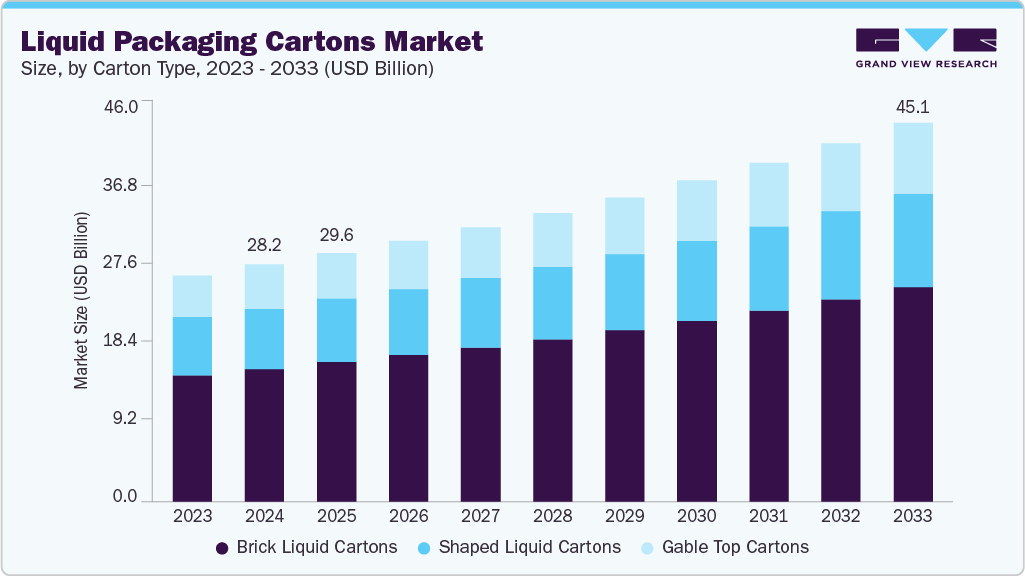
The growing consumption of ready-to-drink (RTD) beverages, dairy products, and non-carbonated drinks. As lifestyles become busier, consumers increasingly prefer portable, lightweight, and easy-to-store packaging formats. Liquid cartons are ideal for products like milk, fruit juices, iced tea, and functional beverages, offering convenience without compromising on shelf stability. For example, brands such as Tropicana and Minute Maid utilize aseptic carton packaging for their juice lines, ensuring long shelf life without refrigeration. The growth of the health and wellness trend is also fueling demand for nutrient-rich beverages, further boosting the use of liquid cartons.
The expansion of organized retail and e-commerce platforms has also played a pivotal role in boosting the liquid packaging cartons market. With the growing penetration of supermarkets, hypermarkets, and online grocery channels, there's increased visibility and accessibility of packaged beverages. Liquid cartons, being stackable and lightweight, are cost-effective to transport and display. This is especially beneficial in emerging economies such as India, Brazil, and Indonesia, where modern trade channels are expanding rapidly. The ability to print high-quality graphics on cartons also enhances shelf appeal, making them a preferred choice for brand differentiation and marketing.
Technological advancements in aseptic packaging and filling machinery are further accelerating the adoption of liquid cartons. Modern filling machines can handle high-speed production while ensuring sterile conditions, extending product shelf life without preservatives. Innovations such as screw caps, reclosable spouts, and paper-based barrier coatings enhance functionality and recyclability. Companies such as SIG and Elopak are investing in new packaging formats and materials to meet evolving industry standards. These innovations not only improve product safety and quality but also align with circular economy goals, reinforcing the market’s growth trajectory.
Market Dynamics
The liquid packaging cartons market is experiencing steady growth, driven by rising demand for convenient, lightweight, and sustainable packaging solutions in the food and beverage sector. Increasing consumption of dairy products, juices, plant-based beverages, and ready-to-drink products is boosting carton adoption due to its product protection and shelf-life benefits. Growing environmental concerns and regulations promoting recyclable packaging are further supporting market expansion. While raw material price fluctuations and competition from alternative packaging formats may restrain growth, advancements in aseptic packaging technologies and increasing investments in sustainable packaging solutions continue to create new opportunities for the market.
One of the primary drivers of the liquid packaging cartons market is the growing demand for sustainable packaging solutions across the food and beverage industry. Increasing consumer awareness regarding environmental issues and the harmful impact of plastic waste has encouraged manufacturers and brand owners to adopt packaging materials with lower environmental footprints. Liquid packaging cartons, which are primarily made from renewable paperboard and offer high recyclability potential, are gaining preference as companies seek to align with sustainability goals and enhance their environmental credentials.
Governments and regulatory bodies worldwide are further implementing stricter regulations aimed at reducing single-use plastics and promoting the use of recyclable and renewable packaging materials. This regulatory support, coupled with corporate commitments to sustainability and circular economy initiatives, is accelerating the adoption of liquid packaging cartons. As beverage and dairy producers continue to prioritize eco-friendly packaging alternatives, demand for carton-based packaging solutions is expected to increase steadily, supporting long-term market growth.
A significant restraint for the liquid packaging cartons market is the volatility in the prices of key raw materials, particularly paperboard, polymers, and aluminum used in carton production. Changes in raw material availability, energy costs, transportation expenses, and global supply chain disruptions can increase manufacturing costs and pressure profit margins for packaging producers. Additionally, supply chain uncertainties and procurement challenges may affect production efficiency and pricing stability, making it difficult for manufacturers to maintain consistent cost structures and competitiveness in the market.
A key opportunity for the liquid packaging cartons market lies in the growing demand for aseptic and shelf-stable packaging solutions. Increasing consumption of dairy products, plant-based beverages, juices, and functional drinks is driving the need for packaging that extends shelf life without requiring refrigeration. Liquid packaging cartons equipped with advanced aseptic technologies offer excellent product protection, reduced storage and transportation costs, and greater distribution flexibility. As manufacturers expand their product portfolios and penetrate emerging markets with limited cold-chain infrastructure, the adoption of aseptic carton packaging is expected to create substantial growth opportunities for the market.
Market Concentration & Characteristics
The market experiences continuous innovation, particularly in sustainability and barrier technology. Companies are developing bio-based coatings, fully recyclable cartons, and advanced aseptic filling systems. For instance, Tetra Pak and Elopak are introducing plant-based polymers and paperboard alternatives to improve environmental performance.
Mergers and acquisitions are occurring as key players aim to strengthen their global reach and diversify product portfolios. Strategic partnerships between packaging converters, filling machine manufacturers, and beverage producers are also common. For instance, in August 2022, SIG acquired Evergreen Asia, Pactiv Evergreen’s chilled carton business, for USD 335.0 million, expanding its presence in China, Taiwan, and South Korea. The deal boosts SIG’s growth in Asia’s dairy market and strengthens its sustainable packaging offerings.
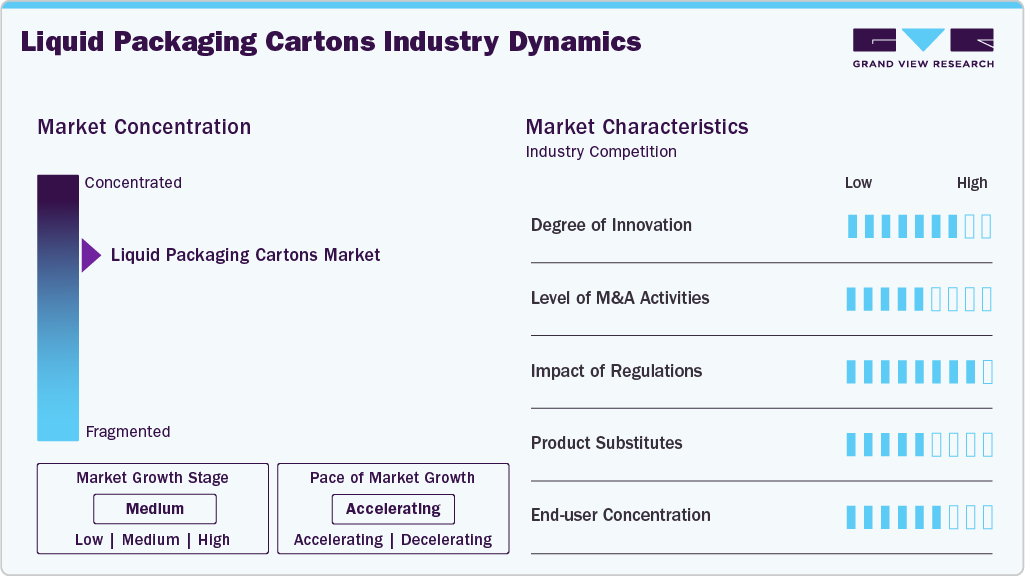
The market is highly regulated, especially in food and beverage applications, due to health and safety requirements. In addition, environmental regulations in the EU and North America are pushing companies to adopt recyclable and renewable materials. Compliance with FDA, EFSA, and other local food safety authorities is mandatory.
Analyst Perspective
The liquid packaging cartons market is expected to experience steady growth, driven by rising demand for sustainable, lightweight, and convenient packaging solutions in the food and beverage industry. Increasing consumption of dairy products, juices, plant-based beverages, and liquid foods is boosting carton adoption due to its product protection and shelf-life advantages. Growing environmental regulations and consumer preference for recyclable packaging are further supporting market expansion.
Carton Type Insights
Based on carton type, the brick liquid cartons segment led the market with the largest revenue share of 56.1% in 2025. Brick liquid cartons are rectangular or square-shaped cartons commonly used for long shelf-life products such as UHT milk, juices, and soups. These cartons are known for their space efficiency in transport and storage and are typically made from paperboard with barrier layers of plastic or aluminum to preserve the contents without refrigeration. Brick cartons are driven by the rising demand for aseptic packaging, particularly in developing countries where cold chain logistics are limited. Their compact design reduces logistic costs and maximizes shelf space, making them ideal for supermarkets and retail environments.
The gable top cartons segment is expected to grow at the fastest CAGR of 5.9% during the forecast period. Gable top cartons are characterized by their foldable top that forms a spout-like closure, making them easy to open and reseal. These cartons are widely used for chilled products such as fresh milk, juices, and liquid dairy alternatives. They are typically made from paperboard with a polyethylene coating for moisture resistance and are often found in refrigerated sections of retail outlets. The growth of the gable top carton segment is closely linked to the rising consumption of fresh, refrigerated beverages such as plant-based milks and cold-pressed juices.
Shelf-Life Insights
Based on shelf-life, the long shelf-life cartons segment led the market with the largest revenue share of 67.9% in 2025. Long shelf-life cartons, also known as aseptic cartons, are designed to preserve liquid products such as milk, juice, soups, and plant-based beverages for extended periods-typically 6 to 12 months-without refrigeration. These cartons are manufactured using multi-layer materials that include paperboard, aluminum foil, and polyethylene, which together provide excellent barrier properties against light, oxygen, and microorganisms. This packaging is widely used for products that need to be stored and transported over long distances without relying on cold chain infrastructure. The key driver for long shelf-life cartons is the growing demand for ambient storage solutions, particularly in emerging economies with limited access to refrigeration and cold chain logistics.
The short shelf-life cartons segment is expected to grow at the fastest CAGR of 5.9% during the forecast period. Short shelf-life cartons are mainly used for fresh liquid products that require refrigeration and are typically consumed within a few days to a few weeks after opening. These cartons are common in products like fresh milk, fresh juices, and other perishable dairy beverages. They are made primarily from paperboard and coated with plastic, offering basic protection against contamination while being cost-effective and recyclable. The demand for short shelf life cartons is largely driven by the increasing consumption of fresh and minimally processed beverages in urban markets.
End-use Insights
Based on end use, the liquid dairy products segment led the market with the largest revenue share of 55.1% in 2025. Liquid dairy products such as milk, flavored milk, yogurt drinks, and cream are the dominant end-use category for liquid packaging cartons. These products are often packaged in aseptic or gable-top cartons, offering long shelf life without refrigeration and preserving nutritional content. Major brands such as Amul, Lactalis, and Nestlé rely heavily on carton packaging for ambient and chilled dairy distribution. The increasing demand for safe, shelf-stable dairy products in both developed and emerging economies drives this segment.
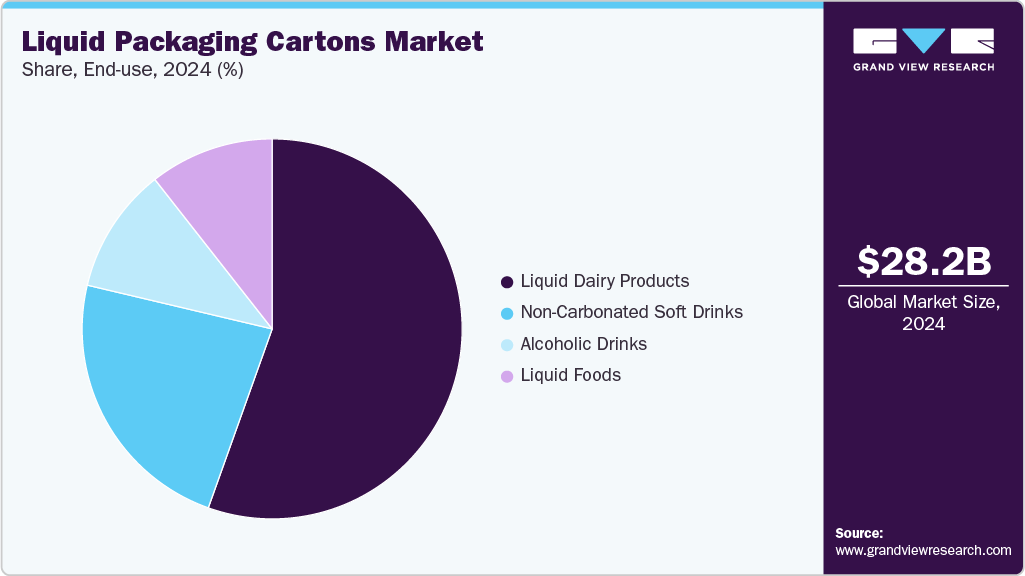
The alcoholic drinks segment is projected to grow at the fastest CAGR of 7.8% during the forecast period. Though relatively niche, this segment is gaining traction with products such as wine, cocktails, and traditional liquors being packaged in cartons, particularly in portable, single-serve formats. Some markets in Europe and Asia are exploring carton packaging for boxed wine and travel-friendly alcohol options. In addition, consumer interest in casual, on-the-go alcoholic beverages and premium boxed wine is supporting the segment’s expansion, especially in urban retail formats and duty-free sales.
Region Insights
Asia Pacific dominated the liquid packaging cartons market with the largest revenue share of 37.6% in 2025 and is expected to grow at the fastest CAGR of 6.0% over the forecast period. This positive outlook is due to rapid urbanization, the growing middle class, and increasing demand for packaged beverages such as milk, juices, and dairy alternatives. Countries such as India and China are witnessing a surge in consumption due to rising health awareness and convenience trends. For instance, in India, companies such as Tetra Pak and SIG are expanding their production capacities to meet the demand for sustainable and shelf-stable packaging. In addition, government initiatives promoting food safety and environmental sustainability are accelerating the shift from plastic to carton-based packaging. The region’s e-commerce boom also supports the growth of liquid cartons, as online grocery platforms prefer lightweight, durable, and eco-friendly packaging solutions.
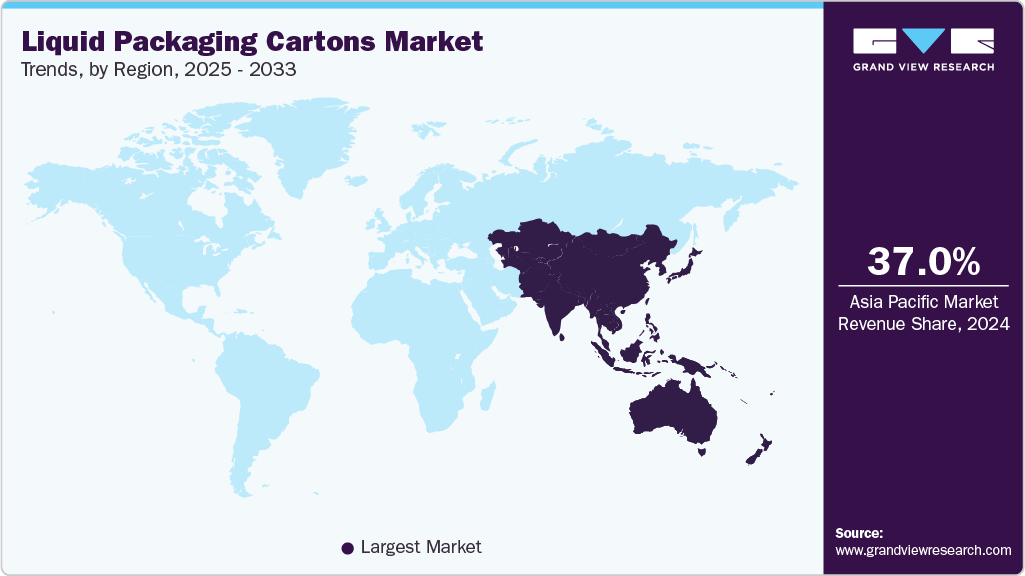
The liquid packaging cartons market in China held the largest share in the Asia Pacific region in 2025. China liquid packaging cartons market is the largest and fastest-growing market, fueled by rising disposable incomes, urbanization, and government policies promoting food safety and sustainability. The dairy industry, led by companies such as Yili and Mengniu, heavily relies on aseptic cartons for UHT milk distribution across vast regions. E-commerce giants like Alibaba and JD.com also drive demand, as cartons are preferred for online grocery deliveries due to their lightweight and tamper-proof nature.
North America Liquid Packaging Cartons Market Trends
North America’s liquid packaging carton market is driven by high demand for plant-based beverages, organic dairy products, and ready-to-drink (RTD) beverages. The U.S. and Canada are leading due to consumer preference for sustainable packaging and stringent regulations on single-use plastics. For instance, Evergreen Packaging and Elopak provide aseptic cartons for brands such as Silk (plant-based milk) and Juicy Juice, catering to eco-conscious consumers. The region’s well-established retail infrastructure and cold chain logistics further support the adoption of liquid cartons for extended shelf-life products.
U.S. Liquid Packaging Cartons Market Trends
The U.S. dominates the North American liquid carton market, driven by the booming demand for alternative dairy products, functional beverages, and sustainable packaging solutions. Major brands such as The Coca-Cola Company (Fairlife milk) and Danone (Horizon Organic) use cartons to appeal to environmentally conscious consumers. The U.S. recycling infrastructure is improving, with initiatives such as the Carton Council promoting carton recycling programs. In addition, the rise of private-label products in retail chains such as Costco and Walmart has increased carton adoption due to cost efficiency and extended shelf life.
Europe Liquid Packaging Cartons Market Trends
Europe liquid packaging cartons market is driven by strict environmental regulations, high recycling rates, and consumer preference for sustainable packaging. The European Union’s Single-Use Plastics Directive (SUPD) has accelerated the shift toward paper-based cartons, particularly in countries such as Germany, France, and Sweden. Companies such as Tetra Pak and Stora Enso are investing in renewable and recyclable materials to meet circular economy goals. For example, in Sweden, Arla Foods uses plant-based cartons for its organic milk, emphasizing carbon-neutral packaging. The region’s well-developed waste management systems ensure high carton recycling rates (over 50% in many countries), reinforcing the sustainability appeal of liquid cartons. Additionally, the growing demand for lactose-free and functional beverages is boosting carton usage in the dairy and juice segments.
Key Liquid Packaging Cartons Company Insights
The competitive environment of the liquid packaging carton market is moderately consolidated, with a few major players dominating global market share while regional and niche manufacturers also maintain a significant presence. Major companies such as Tetra Pak, SIG, and Elopak compete intensely on innovation, sustainability, and cost-efficiency, particularly by offering lightweight, recyclable, and aseptic packaging solutions tailored for dairy, juice, and liquid food industries. These companies heavily invest in R&D and partnerships with beverage producers to maintain technological leadership and brand loyalty. Meanwhile, local players in Asia-Pacific and Latin America are increasingly entering the market with cost-competitive offerings, intensifying price competition, and encouraging broader innovation in packaging formats and materials.
Key Liquid Packaging Cartons Companies:
The following key companies have been profiled for this study on the liquid packaging cartons market.
-
Tetra Pak International S.A.
-
SIG
-
Elopak
-
Mondi
-
Nippon Paper Industries Co., Ltd.
-
UFlex Limited
-
IPI S.r.l.
-
Greatview Aseptic Packaging Company Limited
-
WestRock Company
-
Heli Packaging Technology (Qingzhou) Co., Ltd
-
Parksons Packaging Ltd.
Competitive Benchmarking
Category
Operating Strategies
Competitive Edge
Weakness
Established Players (Tetra Pak International S.A., SIG, Elopak, Mondi, Nippon Paper Industries Co., Ltd., UFlex Limited, and WestRock Company)
- Focus on large-scale production, global supply networks, and long-term contracts with multinational food and beverage manufacturers.
- Invest heavily in aseptic technology, sustainable carton materials, and integrated filling equipment solutions to strengthen market leadership.
- Strong brand recognition, extensive distribution networks, and established relationships with global beverage and dairy companies.
- Advanced R&D capabilities, proprietary technologies, and comprehensive product portfolios supported by significant financial resources.
- High operational and capital expenditure requirements can limit flexibility and increase cost pressures.
- Large organizational structures may slow decision-making and adaptation to emerging market trends.
Emerging Players (IPI S.r.l., Greatview Aseptic Packaging Company Limited, Heli Packaging Technology (Qingzhou) Co., Ltd., and Parksons Packaging Ltd.)
- Emphasize regional market expansion and customer-specific packaging solutions to build market presence.
- Pursue strategic partnerships, cost-competitive manufacturing, and selective capacity expansion to gain market share.
- Greater operational flexibility and ability to respond quickly to changing customer requirements and niche market opportunities.
- Competitive pricing strategies and focused investments in high-growth regional markets.
- Limited global reach, brand visibility, and customer base compared with established multinational competitors.
- Lower financial resources and R&D capabilities may constrain technological innovation and large-scale expansion initiatives.
Recent Developments
-
In July 2025, SIG launched the world’s first aseptic 1-liter carton pack that offers full barrier protection without an aluminum layer, reducing the carbon footprint by up to 61%. Made from over 80% paper and renewable materials, the sustainable packaging maintains up to 12 months of shelf life and works with existing filling lines. This innovation supports oxygen-sensitive products like juices and plant-based drinks and is now available globally following SIG’s new aseptic carton plant opening in India.
-
In July 2025, Greatview, a global supplier of aseptic carton packaging solutions, opened a new manufacturing facility in Perugia, Italy, through its major shareholder NewJF International. This strategic expansion aims to meet the increasing demand for high-quality, sustainable aseptic carton packaging specifically for liquid food products such as dairy in Europe. The new plant addresses the growing need for European-produced, environmentally conscious packaging, offering customers a reliable and competitive option while reinforcing Greatview’s commitment to sustainability and local sourcing.
Liquid Packaging Cartons Market Report Scope
Report Attribute
Details
Market size in 2025
USD 29.6 billion
Estimated market size in 2026
USD 31.0 billion
Projected market size by 2033
USD 45.1 billion
Growth rate
CAGR of 5.5% from 2026 to 2033
Base year for estimation
2025
Historical data
2021 - 2024
Forecast period
2026 - 2033
Quantitative units
Revenue in USD million/billion and CAGR from 2026 to 2033
Report coverage
Revenue forecast, company ranking, competitive landscape, growth factors, and trends
Segments covered
Carton type, shelf-life, end use, region
Regional scope
North America; Europe; Asia Pacific; Latin America; MEA
Country scope
U.S.; Canada; Mexico; Germany; UK; France; Italy; Spain; China; Japan; India; South Korea; Australia; Brazil; Argentina; Saudi Arabia; South Africa; UAE
Key companies profiled
Tetra Pak International S.A.; SIG; Elopak; Mondi; Nippon Paper Industries Co., Ltd.; UFlex Limited; IPI S.r.l.; Greatview Aseptic Packaging Company Limited; WestRock Company; Heli Packaging Technology (Qingzhou) Co., Ltd.; Parksons Packaging Ltd.
Customization scope
Free report customization (equivalent up to 8 analysts' working days) with purchase. Addition or alteration to country, regional & segment scope.
Pricing and purchase options
Avail customized purchase options to meet your exact research needs. Explore purchase options
Global Liquid Packaging Cartons Market Report Segmentation
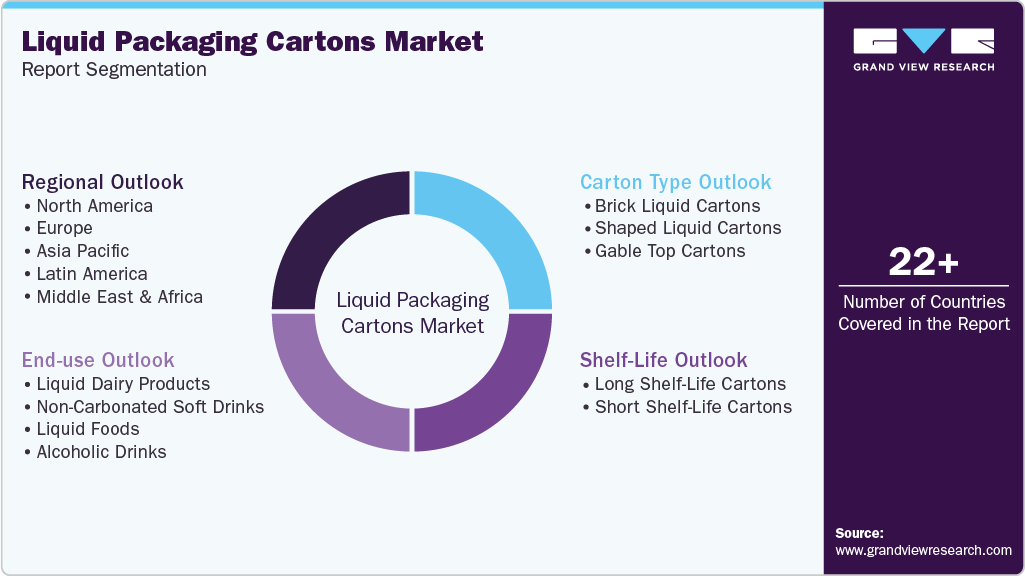
This report forecasts revenue growth at a global level and provides an analysis of the latest industry trends in each of the sub-segments from 2021 to 2033. For this study, Grand View Research has segmented the global liquid packaging cartons market report based on carton type, shelf-life, enduse, and region:
-
Carton Type Outlook (Revenue, USD Million, 2021 - 2033)
-
Brick Liquid Cartons
-
Shaped Liquid Cartons
-
Gable Top Cartons
-
-
Shelf-Life Outlook (Revenue, USD Million, 2021 - 2033)
-
Long Shelf-Life Cartons
-
Short Shelf-Life Cartons
-
-
End-use Outlook (Revenue, USD Million, 2021 - 2033)
-
Liquid Dairy Products
-
Non-Carbonated Soft Drinks
-
Liquid Foods
-
Alcoholic Drinks
-
-
Region Outlook (Revenue, USD Million, 2021 - 2033)
-
North America
-
U.S.
-
Canada
-
Mexico
-
-
Europe
-
Germany
-
France
-
UK
-
Italy
-
Spain
-
-
Asia Pacific
-
China
-
India
-
Japan
-
Australia
-
South Korea
-
-
Latin America
-
Brazil
-
Argentina
-
-
Middle East & Africa
-
South Africa
-
Saudi Arabia
-
UAE
-
-
Research Methodology
The liquid packaging cartons market figures in this report are based on a proven research process that combines executive interviews with secondary research from proprietary databases, company filings, and recognized regulatory and institutional sources. Market size is built through value-chain sizing - reconciling supply-side and demand-side estimates - and triangulated with bottom-up and top-down approaches. Every estimate passes multiple levels of expert validation before publication, with each liquid packaging cartons segment quantified using the revenue-capture definitions in the table below.
Segment Definition
Segment - Carton Type
Revenue capture definition
Brick Liquid Cartons
Revenue generated from the sale of brick-shaped liquid packaging cartons designed for efficient storage, transportation, and shelf optimization. This segment includes aseptic and fresh cartons used for milk, juices, plant-based beverages, and other liquid food products.
Shaped Liquid Cartons
Revenue generated from the sale of uniquely designed liquid packaging cartons featuring customized shapes that enhance product differentiation, brand visibility, and consumer convenience. This segment includes premium beverage and specialty liquid food packaging applications.
Gable Top Cartons
Revenue generated from the sale of gable top liquid packaging cartons commonly used for refrigerated products. This segment includes cartons utilized for milk, dairy beverages, juices, and other fresh liquid products requiring short-term preservation and easy-pour functionality.
Segment - Shelf-Life
Revenue capture definition
Long Shelf Life Cartons
Revenue generated from the sale of aseptic liquid packaging cartons designed to preserve product quality for extended periods without refrigeration. This segment includes cartons used for UHT milk, juices, plant-based drinks, liquid foods, and other shelf-stable beverages.
Short Shelf Life Cartons
Revenue generated from the sale of refrigerated liquid packaging cartons intended for products with limited storage duration. This segment includes packaging solutions for fresh milk, dairy beverages, chilled juices, and other perishable liquid products.
Segment - End Use
Revenue capture definition
Liquid Dairy Products
Revenue generated from the sale of liquid packaging cartons used for dairy products such as milk, flavored milk, cream, yogurt drinks, and other dairy-based beverages requiring product protection and shelf-life preservation.
Non-Carbonated Soft Drinks
Revenue generated from the sale of liquid packaging cartons used for juices, nectars, iced teas, sports drinks, energy drinks, and plant-based beverages. This segment includes both aseptic and refrigerated packaging applications.
Liquid Foods
Revenue generated from the sale of liquid packaging cartons used for soups, broths, sauces, cooking creams, and other liquid food products. This segment includes packaging solutions designed to maintain product freshness, safety, and convenience.
Alcoholic Drinks
Revenue generated from the sale of liquid packaging cartons used for wine, cocktails, spirits, and other alcoholic beverages. This segment includes carton packaging solutions that offer portability, sustainability, and extended product protection002E
Estimation Model
Layer Name
Key Question
Description
Liquid Consumption Demand Layer
What forms the demand base?
Identify global consumption volumes of liquid products packaged in cartons across major end-use categories, including liquid dairy products, non-carbonated soft drinks, liquid foods, and alcoholic drinks. This layer establishes the total addressable demand for liquid packaging cartons based on production, consumption, and packaging requirements of liquid products across regions.
Carton Packaging Penetration Layer
Where are liquid packaging cartons utilized?
Estimate the proportion of liquid products packaged in cartons compared to alternative formats such as plastic bottles, glass bottles, metal cans, and flexible pouches. Assess carton adoption rates across end-use industries and geographies, considering factors such as sustainability initiatives, shelf-life requirements, product compatibility, and consumer preferences.
Packaging Volume Intensity Layer
How much carton packaging volume is consumed?
Analyze average carton consumption volumes based on product type, packaging format, pack size, and shelf-life requirements. Packaging intensity is influenced by consumption trends, product mix, distribution channels, aseptic packaging adoption, and regional beverage and food production patterns.
Revenue Layer
How is market revenue generated?
Market revenue is quantified through the sale of liquid packaging cartons, including brick liquid cartons, shaped liquid cartons, and gable top cartons for both long shelf-life and short shelf-life applications. Revenue is generated from recurring demand across dairy producers, beverage manufacturers, liquid food processors, and alcoholic beverage companies, supported by value-added features such as aseptic technology, enhanced barrier properties, printing, and sustainable packaging solutions.
Delivered Customizations
This report has been delivered with the following In-depth customizations
Client Request
Customization Delivered
Value Adds
Regional Segmentation Analysis
Delivered a detailed regional assessment of the liquid packaging cartons market across North America, Europe, Asia Pacific, Central & South America, and Middle East & Africa, covering market size, growth trends, regulatory landscape, technological developments, supply chain dynamics, and end-use industry demand.
Enabled stakeholders to identify high-growth regions, evaluate market attractiveness, and formulate region-specific expansion and investment strategies.
Cross-Segmentation Analysis
Provided an in-depth cross-segmentation analysis of the liquid packaging cartons market by Carton Type (Brick Liquid Cartons, Shaped Liquid Cartons, Gable Top Cartons), Shelf Life (Long Shelf Life Cartons, Short Shelf Life Cartons), and End Use (Liquid Dairy Products, Non-Carbonated Soft Drinks, Liquid Foods, Alcoholic Drinks) across key geographic regions.
Provided actionable insights into high-potential segment combinations, evolving consumption patterns, and revenue opportunities across diverse application areas and product categories.
Competitive Benchmarking
Comprehensive benchmarking assessment of leading market participants based on product portfolio strength, carton technology capabilities, production capacity, geographic footprint, sustainability initiatives, innovation focus, strategic developments, and competitive positioning
Facilitated evaluation of competitive dynamics, identification of industry best practices, and assessment of key differentiators influencing market leadership.
Frequently Asked Questions About This Report
Asia Pacific dominated the liquid packaging cartons market with a 37.6% revenue share in 2025.
Asia Pacific is the fastest-growing region in the liquid packaging cartons market with a CAGR of 6.0% over the forecast period.
The brick liquid cartons segment led the liquid packaging cartons market with a 56.1% revenue share in 2025.
The long shelf-life cartons segment led the liquid packaging cartons market with a 67.9% revenue share in 2025.
The global liquid packaging cartons market size was valued at USD 29.6 billion in 2025 and is estimated at USD 31.0 billion for 2026.
The global liquid packaging cartons market is expected to grow at a CAGR of 5.5% from 2026 to 2033, reaching USD 45.1 billion by 2033.
The liquid dairy products segment led the liquid packaging cartons market with a 55.1% revenue share in 2025.
Key players in the liquid packaging cartons market include Tetra Pak International S.A.; SIG; Elopak; Mondi; Nippon Paper Industries Co., Ltd.; UFlex Limited; IPI S.r.l.; Greatview Aseptic Packaging Company Limited; WestRock Company; Heli Packaging Technology (Qingzhou) Co., Ltd.; and Parksons Packaging Ltd.
Key factors driving the liquid packaging cartons market include rising demand for sustainable packaging, increasing consumption of dairy products and beverages, growing adoption of aseptic cartons for longer shelf life, and regulations promoting recyclable packaging solutions.
About the Author(s)
Food Safety & Processing Research Team
Consumer Goods · Food Safety & ProcessingThis report was authored by the food safety & processing research team at Grand View Research - comprising two research analysts, one senior research analyst, and one industry expert - with specialized expertise in the food safety & processing segment of the consumer goods industry. All findings are based on proprietary consumer goods databases, executive interviews, and regulatory analysis, subject to internal peer review prior to publication.
Last Updated:
Speak to Analyst


Customize this report to your needs - add regions, segments, or data points, with 20% free customization.
Or view our licence options:


ISO 9001:2015 & 27001:2022 Certified
We are GDPR and CCPA compliant! Your transaction & personal information is safe and secure. For more details, please read our privacy policy.


