
- Home
- »
- Advanced Interior Materials
- »
-
Magnetic Separation In Mining Market Report, 2026-2033GVR Report cover

Magnetic Separation In Mining Market (2026 - 2033)
Size, Share & Trends Analysis Report By Material (Iron Ore & Magnetite Beneficiation, Base Metals, Coal Processing, Industrial Minerals), By Region (North America, Europe), And Segment Forecasts
Market Size, 2025
$47.9BMarket Estimate, 2026
$50.1BMarket Forecast, 2033
$74.0BCAGR, 2026–2033
5.7%Magnetic Separation In Mining Market Summary
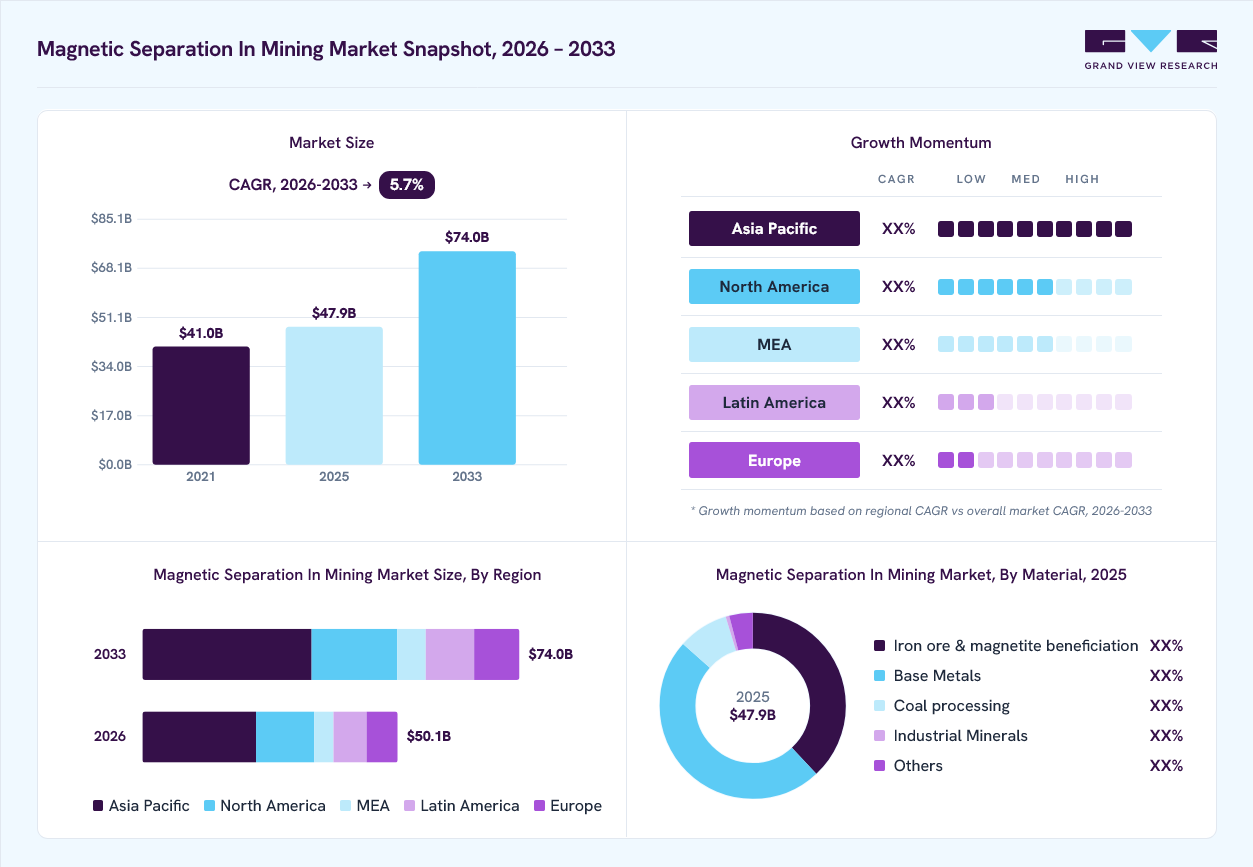
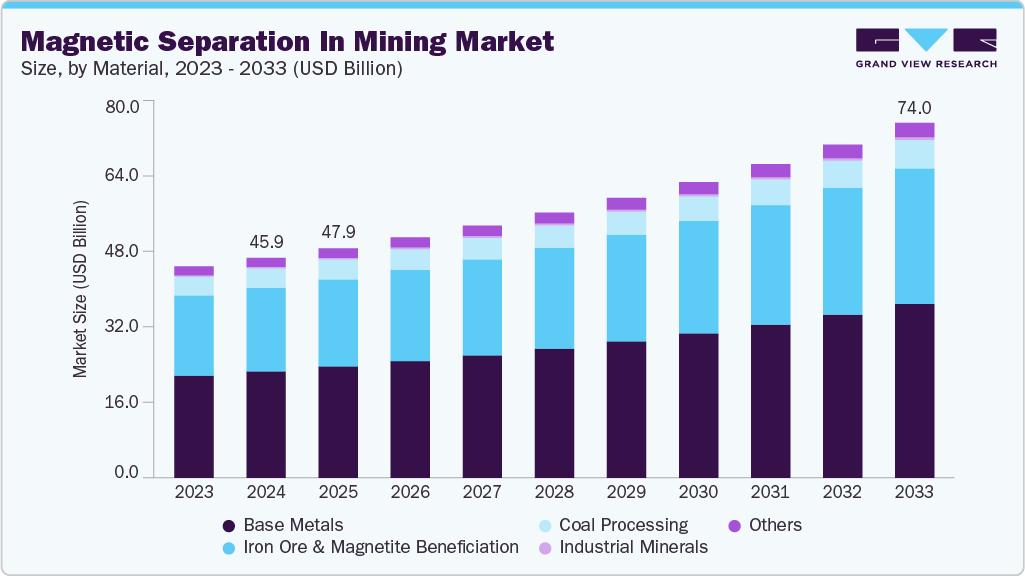
The global Magnetic Separation in Mining market size was valued at USD 47.9 billion in 2025 and is projected to grow from USD 50.1 billion in 2026 to USD 74.0 billion by 2033, at a CAGR of 5.7% from 2026 to 2033. The market in Asia Pacific dominated with a revenue share of 44.3% in 2025. The industry involves technologies and equipment used to separate magnetic minerals from non-magnetic materials to enhance ore purity and recovery efficiency.
 Source: Grand View Research, IR Documents, Primary Interviews, Paid DatabasesTo learn more about this report,
 Download Free Sample Report
 Key Market Trends & Insights
- By material: Base metals segment held the largest market share of 48.5% in 2025.
Regional Highlights
- Largest regional market: Asia Pacific (44.3% revenue share, 2025)
- By country: China held the largest market share in 2025.
Market Size & Forecast
- Market size in 2025: USD 47.9 Billion
- Estimated market size in 2026: USD 50.1 Billion
- Projected market size by 2033: USD 74.0 Billion
- CAGR (2026-2033): 5.7%
Three ways to get this report
Buy it, customize it, or ask a question.Ask an Analyst
A direct answer, usually in 1 working day
- AccessReport author, directly
- Reply timeWithin 1 working day
- No sales callDirect answer only
- FormatEmail reply
- CostFree, no cost
Get the Full Report
What the study covers
- FormatsPDF · Excel · Dashboard
- Timeline2026–2033 annual, 2025 base
- Coverage20+ countries, 5 regions
- Companies10+ key players profiled
Customize the Report
20% free customization
- IncludeCountries, segments, points
- TailorTo your product definition
- ExtendDeeper competitor detail
- OrA fully bespoke study
- Turnaround5–10 working days
The market is expanding rapidly, driven by the global surge in demand for essential minerals and metals that power modern technologies and infrastructure. As industries transition toward clean energy systems, electric vehicles, and urban development, the need for minerals such as magnetite, hematite, and rare earth elements has intensified. Magnetic separation innovations are projected to increase mineral extraction efficiency by 30% by 2025, underscoring the growing importance of this technology for mining companies facing declining ore grades and rising cost pressures.Magnetic separation enhances recovery rates and ensures consistent feedstock quality for downstream processes, including steelmaking, battery materials, and catalyst production. Traditional separators had a limited ability to recover fine or weakly magnetic minerals, but modern systems, such as high-gradient and superconducting magnetic separators, have transformed performance standards. These advanced systems capture ultra-fine particles and effectively separate valuable minerals from complex or low-grade ores that were once considered uneconomical. This advancement extends mine life, enhances resource recovery, and minimizes waste generation. As mining operations encounter deeper and more challenging ore bodies, the ability to extract valuable materials with precision and minimal loss has made magnetic separation one of the most indispensable tools in modern mineral processing.
 To learn more about this report, Download Free Sample Report
 Automation and digitalization are transforming the operation of magnetic separation systems within mining facilities. The integration of real-time sensors, AI-based control algorithms, and data-driven monitoring systems enables operators to dynamically adjust magnetic field strength, feed rate, and moisture control, thereby maintaining optimal separation efficiency. These technologies not only improve throughput but also reduce operational downtime through the use of predictive maintenance. Automated control frameworks help optimize plant performance, reduce energy consumption, and minimize human error. The digital transformation of mining operations, with magnetic separation at its core, is enabling companies to achieve higher productivity, consistent product quality, and improved cost management.
Sustainability has also become a crucial growth factor influencing the adoption of magnetic separation. Unlike flotation or chemical-based methods, magnetic separation is a cleaner and more resource-efficient process that uses less water and energy. This characteristic makes it an attractive choice for mining firms seeking to reduce their environmental footprint and meet global sustainability targets. Moreover, it enables recovery of valuable minerals from mine tailings, slag, and industrial waste streams, turning potential environmental liabilities into economic opportunities. The technology’s contribution to resource recycling and reduced carbon intensity aligns with global goals for greener and more responsible mining practices.
Ongoing research and development are shaping the next wave of innovation in magnetic separation. Companies and research institutes are investing in the development of nanomaterials and hybrid magnetic-fluid systems that can achieve higher precision and adaptability. Modular designs are being created for remote and small-scale mining operations, allowing flexibility in installation and use. Future systems are expected to integrate magnetic separation with complementary techniques such as gravity and sensor-based sorting to handle a broader range of mineral types.
Market Dynamics
The increasing depletion of high-grade mineral deposits has compelled mining companies to process lower-grade, more complex ores, thereby significantly driving the adoption of magnetic separation technologies. These systems enable efficient recovery of valuable magnetic minerals such as magnetite, hematite, and ilmenite, as well as rare earth minerals, while removing unwanted gangue materials. By improving ore grade before downstream processing, magnetic separation enhances metal recovery, reduces processing losses, and increases the overall economic viability of mining operations. As global demand for iron ore, base metals, and critical minerals continues to rise, mining companies are investing in advanced magnetic separation equipment to maximize resource utilization and maintain production efficiency.
The growing global demand for iron ore and critical minerals is a major driver of magnetic separation in the mining market. Iron ore remains an essential raw material for steel production, supported by expanding infrastructure development, urbanization, and industrial manufacturing across emerging and developed economies. At the same time, the accelerating adoption of electric vehicles, renewable energy systems, and advanced electronics has significantly increased the demand for critical minerals such as rare earth elements, lithium-bearing minerals, nickel, cobalt, and graphite. To meet this rising demand, mining companies are expanding production capacities and investing in efficient mineral processing technologies, including magnetic separation systems that improve ore quality and recovery rates.
Magnetic separation plays a vital role in concentrating magnetic minerals and removing impurities prior to downstream processing, thereby enabling greater operational efficiency and improved resource utilization. Modern high-intensity and high-gradient magnetic separators are increasingly being deployed to recover fine and weakly magnetic minerals from complex ore bodies, helping mining companies maximize extraction from existing deposits. As governments across several countries prioritize domestic production of critical minerals to strengthen supply chain resilience and support clean energy initiatives, investments in new mining projects and mineral beneficiation facilities are expected to increase, further driving demand for advanced magnetic separation equipment.
The high capital investment associated with advanced magnetic separation equipment remains a significant restraint on the magnetic separation market in mining. High-intensity and high-gradient magnetic separators require substantial upfront expenditure for equipment procurement, installation, infrastructure modifications, and integration with existing mineral processing facilities. In addition to the initial investment, ongoing costs for maintenance, power consumption, spare parts, and the skilled workforce further increase the total cost of ownership.
Opportunity - Rising adoption of dry magnetic separation technologies for water efficient processing
The rising adoption of dry magnetic separation technologies presents a significant growth opportunity for the magnetic separation market in mining, as mining companies seek to reduce water consumption and improve environmental sustainability. Unlike conventional wet processing methods, dry magnetic separators operate without the need for large volumes of water, making them particularly suitable for mining operations in arid and water-stressed regions. These systems also lower operating costs associated with water treatment, tailings management, and wastewater disposal while supporting compliance with increasingly stringent environmental regulations.
Analyst Perspective
The magnetic separation in mining market is gaining strong momentum as mining companies increasingly focus on maximizing mineral recovery, improving ore quality, and reducing processing costs while meeting stricter environmental standards. The depletion of high-grade ore deposits is driving increased investment in advanced magnetic separation technologies that efficiently process lower-grade and more complex mineral resources, particularly iron ore, base metals, rare earth elements, and other critical minerals. Growing demand for minerals used in steel production, electric vehicles, renewable energy, and battery manufacturing is further accelerating the adoption of high-intensity, high-gradient, and dry magnetic separation systems that enhance resource efficiency and reduce water consumption.
Material Insights
Based on material, base metals beneficiation segment led the market with the largest revenue share of 48.5% in 2025. The base metals segment is witnessing strong growth due to rising global demand for copper, nickel, zinc, and other essential industrial metals. The expansion of electric vehicles, renewable energy infrastructure, and electronics manufacturing has significantly increased the consumption of these metals, creating pressure to maximize recovery from existing ore sources. Magnetic separation is playing a critical role in improving the beneficiation efficiency of base metal ores by separating magnetic and non-magnetic minerals with higher precision.
The growth of the iron ore and magnetite beneficiation segment is being driven by the rising global demand for high-grade iron ore used in steelmaking. As steel production expands across developing economies such as India, China, and Brazil, mining companies are increasingly adopting advanced magnetic separation technologies to improve ore purity and recovery rates. For example, Xinhai’s Magnetite Separation Production Line demonstrates how modern processing systems enhance the efficiency of magnetite beneficiation. The depletion of easily accessible high-grade deposits has further encouraged miners to focus on beneficiation processes that can efficiently extract iron content from low-grade ores, thereby reducing waste and enhancing the overall yield of operations.
Regional Insights
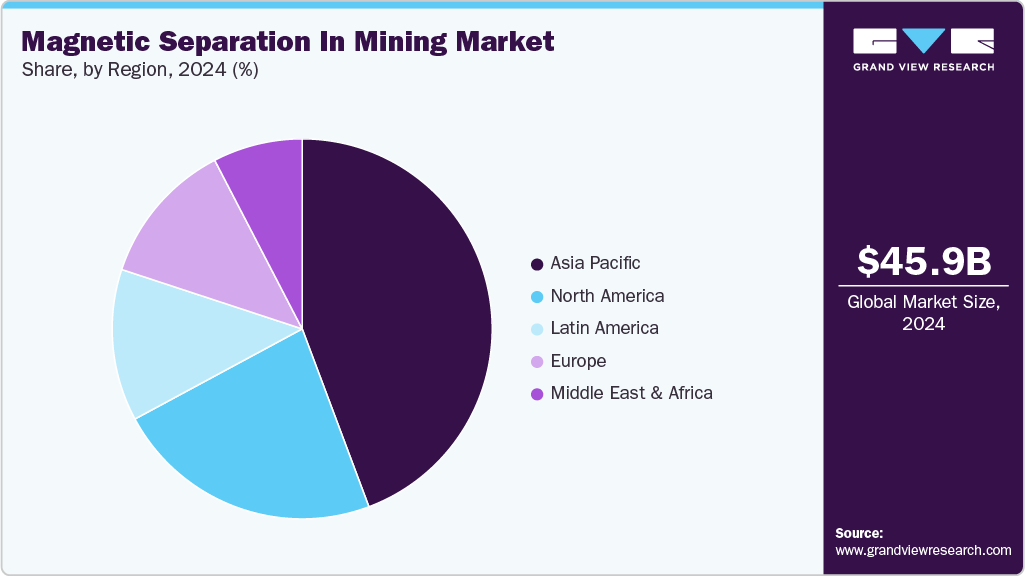
Asia Pacific dominated the magnetic separation in mining market with the largest revenue share of 44.3% in 2025. The Asia Pacific magnetic separation in mining industry is experiencing strong growth, driven by the rising demand for iron ore beneficiation in China, India, and Australia. As ore grades continue to decline, miners are relying on magnetic separation systems to upgrade material quality for steelmaking efficiently. The region’s dominance in iron ore production and consumption is reinforcing this demand, as steel manufacturers seek consistent high-grade feedstock for expanding infrastructure and construction activities. The region accounted for more than 70% of global iron ore production in 2024, with Australia producing around 930 million tons, China producing nearly 250 million tons, and India contributing close to 250 million tons. This growing emphasis on beneficiation is directly boosting the adoption of advanced magnetic separation technologies.
 To learn more about this report, Download Free Sample Report
 China Magnetic Separation in Mining Market Trends
The magnetic separation in mining market in the China held the largest share in the Asia Pacific region in 2025. China's magnetic separation in mining market is supported by the country's large-scale mining and mineral-processing industry, particularly for iron ore, coal, rare earths, and other metallic minerals. Increasing demand for domestic mineral resources, beneficiation of lower-grade ores, and recovery of valuable minerals from complex deposits is encouraging the adoption of high-intensity magnetic separators, wet magnetic separators, and advanced dry separation technologies. In parallel, investments in mine modernization, automation, energy-efficient processing, and environmental compliance are driving upgrades to mineral-processing equipment, while China's strategic focus on strengthening domestic supply chains for critical minerals is supporting demand for more efficient and selective separation technologies.
North America Magnetic Separation In Mining Market Trends
The magnetic separation in mining industry in North America is expanding steadily, driven by the growing focus on mineral beneficiation and the modernization of mining operations in the U.S. and Canada. As ore grades decline and demand for high-purity feedstock increases, miners are investing in advanced magnetic separation systems to improve recovery efficiency and reduce waste. The technology is particularly vital in the processing of iron ore, taconite, and other magnetically susceptible minerals used in the steel and construction industries. Infrastructure development and renewed domestic mining initiatives are reinforcing this demand across the region.
U.S. Magnetic Separation In Mining Market Trends
The U.S. magnetic separation in mining industryis experiencing strong growth, driven by the expansion of domestic mining and mineral processing operations. As the country focuses on reducing reliance on imported raw materials, especially from Asia, there is a growing need for efficient beneficiation systems that can improve ore quality and recovery rates. With electric vehicle sales in the U.S. reaching an all-time high of 438,487 units in Q3 2025 and overall production projected to rise sharply throughout the decade, demand for neodymium, praseodymium, and other magnet materials is intensifying. Increasing infrastructure spending and the revival of U.S. steel production are also boosting demand for upgraded feedstock, further supporting market growth.
Europe Magnetic Separation In Mining Market Trends
The magnetic separation in mining industry in Europe is expanding as the region intensifies efforts to strengthen domestic mineral processing and recycling capacities. The European Union’s focus on securing critical raw materials and reducing dependence on imports from outside the region has encouraged investment in beneficiation and recovery infrastructure.
Middle East & Africa Magnetic Separation In Mining Market Trends
The magnetic separation in mining industry in the Middle East and Africa is gaining momentum as mining activities expand across key mineral-producing countries, including Saudi Arabia, South Africa, Morocco, and Egypt. Governments are investing heavily in mineral beneficiation projects to enhance value addition before export, resulting in the integration of magnetic separation technologies in new processing plants. The growing emphasis on resource diversification and industrial development under national programs such as Saudi Vision 2030 and South Africa’s Mining Charter is driving demand for advanced beneficiation equipment.
Latin America Magnetic Separation In Mining Market Trends
The Latin America magnetic separation in mining industryis expanding steadily, driven by the region’s vast mineral wealth and growing emphasis on enhancing beneficiation efficiency. Countries such as Brazil, Chile, and Peru are investing in advanced ore processing systems to enhance recovery rates and export value. Iron ore and copper producers are integrating magnetic separation into their concentrator circuits to boost product purity and reduce waste. As mining companies strive to maximize output from existing deposits and minimize processing costs, the demand for high-performance magnetic separators is increasing across the region.
Key Magnetic Separation In Mining Company Insights
Some of the key players operating in the market Bunting Magnetics Co., Dings Magnetic Group, and others.
-
Bunting Magnetics Co., headquartered in Newton, Kansas, is a global leader in magnetic technology solutions established in 1959. The company specializes in designing and manufacturing magnetic equipment for a wide range of industries, including mining, recycling, food processing, plastics, and pharmaceuticals. Its operations span North America, Europe, and Asia, supported by advanced research and development and production facilities. In the mining industry, Bunting Magnetics offers a comprehensive range of magnetic separation equipment specifically designed for processing ores and minerals. Its offerings include high-intensity magnetic separators, cross-belt and drum magnets, eddy current separators, and metal detectors used in removing ferrous and non-ferrous contaminants.
-
Dings Magnetic Group, founded in 1899 and based in Milwaukee, Wisconsin, is one of the oldest manufacturers of industrial magnetic equipment in the United States. The company has a long-standing reputation for engineering durable and high-performance magnetic solutions across various industries, including mining, aggregates, recycling, and bulk material handling. In the mining sector, Dings Magnetic Group offers a wide range of magnetic separation technologies designed to enhance material purity and process reliability. Its key products include overhead self-cleaning electromagnetic separators, drum separators, and suspended magnets, which effectively remove tramp iron and magnetic impurities from conveyed materials.
Key Magnetic Separation In Mining Companies:
The following key companies have been profiled for this study on the magnetic separation in mining market.
-
Bunting Magnetics Co.
-
Dings Magnetic Group
-
Eriez Manufacturing Co.
-
Goudsmit Magnetics Group
-
Kanetec Co., Ltd.
-
LONGi Magnet Co., Ltd.
-
Metso Outotec Corporation
-
Multotec Pty Ltd.
-
SLon Magnetic Separator Ltd.
-
STEINERT GmbH
-
Illumina, Inc.
Competitive Benchmarking
Category
Operating Strategies
Competitive Edge
Weakness
Established Players (e.g. Eriez Manufacturing Co., Metso Outotec Corporation)
- Mature participants in the magnetic separation in mining market primarily focus on offering comprehensive mineral processing solutions through integrated portfolios of magnetic separators, beneficiation equipment, and process optimization services.
- These companies emphasize continuous product innovation, large scale manufacturing, and long term partnerships with mining operators processing iron ore, base metals, rare earth elements, coal, and industrial minerals.
- Established players possess significant competitive advantages through their extensive engineering expertise, broad product portfolios, and global manufacturing capabilities.
- Their ability to provide complete mineral processing solutions, including equipment installation, commissioning, maintenance, and technical support, strengthens long term customer relationships and enhances operational reliability.
- Despite their strong market positions, mature players face challenges related to high manufacturing costs, capital intensive research and development, and dependence on mining investment cycles.
- Developing advanced magnetic separation systems requires significant investments in engineering, testing, automation technologies, and manufacturing facilities.
Emerging & Regional Players (e.g., SLon Magnetic Separator Ltd., LONGi Magnet Co., Ltd.)
- Emerging participants in the magnetic separation in mining market generally focus on specialized separation technologies, regional market expansion, and application specific beneficiation solutions. R
- Rather than competing directly with established equipment manufacturers across the full product spectrum, these companies often target niche opportunities involving rare earth processing, battery minerals, industrial minerals, and small to medium sized mining operations.
- Emerging companies benefit from operational flexibility and the ability to develop innovative magnetic separation technologies without extensive legacy product constraints.
- Their engineering teams can rapidly customize equipment designs for specific ore characteristics and customer requirements, enabling quicker responses to evolving beneficiation challenges.
- Emerging participants face significant challenges related to limited manufacturing capacity, restricted financial resources, and lower global market recognition.
- Competing with established equipment manufacturers that possess extensive product portfolios, worldwide service networks, and proven operating histories can be difficult, particularly for large mining projects requiring comprehensive technical support and long term service agreements.
Recent Development
- In October 2025, Sable Exploration and Mining entered into a supply agreement with Daemaneng Minerals to accelerate the production ramp-up at the Lapon plant. This agreement focuses on enhancing the beneficiation process, particularly by leveraging magnetic separation technology to upgrade the DMS-grade magnetite product efficiently. Daemaneng Minerals will take over operations, logistics, and sales, aiming to reach 5,000 tons of product within three months and scale up to 15,000 tons per month by April 2026.
Magnetic Separation In Mining Market Report Scope
Report Attribute
Details
Market definition
The market value represents the economic throughput associated with magnetic separation technology across global mining and mineral beneficiation operations.
Market size in 2025
USD 47.9 billion
Estimated market size in 2026
USD 50.1 billion
Projected market size by 2033
USD 74.0 billion
Growth rate
CAGR of 5.7% from 2026 to 2033
Base year for estimation
2025
Historical data
2021 - 2024
Forecast period
2026 - 2033
Quantitative units
Revenue in USD million and CAGR from 2026 to 2033
Report coverage
Revenue forecast, company ranking, competitive landscape, growth factors, and trends
Segments covered
Material and region.
Regional scope
North America; Europe; Asia Pacific; Latin America; Middle East & Africa
Country scope
U.S., Canada, Mexico, Finland, Sweden, Russia, Poland, India, China, Indonesia, Australia, Chile, Peru, Brazil, Saudi Arabia, South Africa
Key companies profiled
Eriez Manufacturing Co.; Metso Outotec Corporation; STEINERT GmbH; Bunting Magnetics Co.; Goudsmit Magnetics Group; SLon Magnetic Separator Ltd.; LONGi Magnet Co., Ltd.; Kanetec Co., Ltd.; Multotec Pty Ltd.; Dings Magnetic Group
Customization scope
Free report customization (equivalent up to 8 analysts' working days) with purchase. Addition or alteration to country, regional & segment scope.
Pricing and purchase options
Avail customized purchase options to meet your exact research needs. Explore purchase options
Global Magnetic Separation In Mining Market Report Segmentation
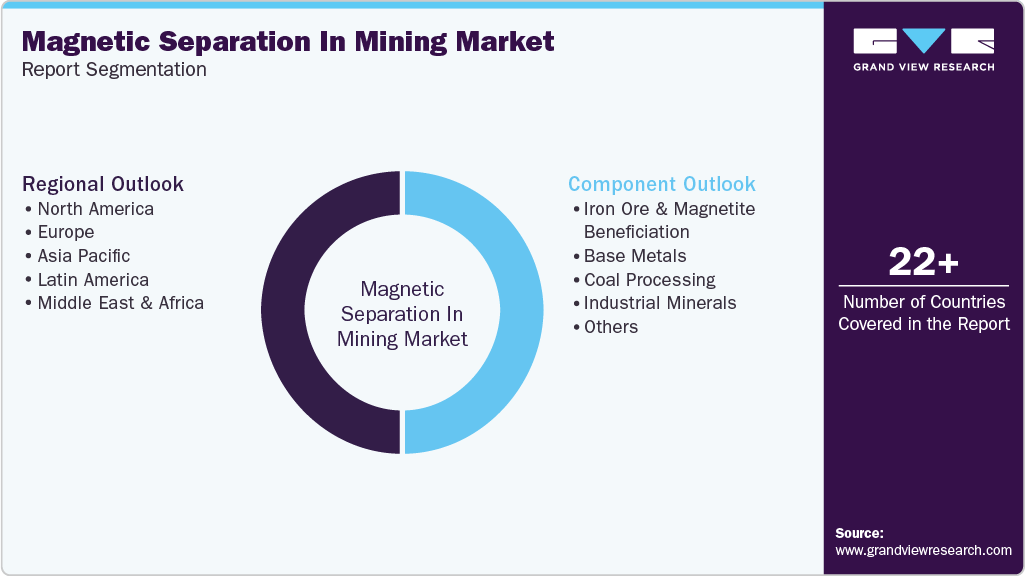
This report forecasts revenue growth at global, regional, and country levels and provides an analysis of the latest industry trends in each of the sub-segments from 2021 to 2033. For this study, Grand View Research has segmented the global magnetic separation in mining market report on the basis of material and region:
 To learn more about this report, Download Free Sample Report
 -
Material Outlook (Revenue, USD Million, 2021 - 2033)
-
Iron Ore & Magnetite Beneficiation
-
Base Metals
-
Coal Processing
-
Industrial Minerals
-
Others
-
-
Regional Outlook (Revenue, USD Million, 2021 - 2033)
-
North America
-
U.S.
-
Canada
-
Mexico
-
-
Europe
-
Russia
-
Finland
-
Norway
-
Sweden
-
-
Asia Pacific
-
China
-
India
-
Australia
-
-
Latin America
-
Brazil
-
-
Middle East & Africa
-
South Africa
-
Saudi Arabia
-
-
Research Methodology
The magnetic separation in mining market figures in this report are based on a proven research process that combines executive interviews with secondary research from proprietary databases, company filings, and recognized regulatory and institutional sources. Market size is built through value-chain sizing - reconciling supply-side and demand-side estimates - and triangulated with bottom-up and top-down approaches. Every estimate passes multiple levels of expert validation before publication, with each magnetic separation in mining segment quantified using the revenue-capture definitions in the table below.
Segment Definition
Material
Revenue Capture Definition
Iron ore & magnetite beneficiation
The iron ore and magnetite beneficiation segment represents the revenue generated from magnetic separation technologies used to concentrate iron bearing ores and remove impurities during mineral processing.
Base Metals
Market value reflects the adoption of magnetic separation systems that improve mineral recovery, enhance concentrate quality, and increase operational efficiency.
Coal processing
The coal processing segment represents revenue generated from magnetic separation systems used to remove tramp iron and magnetic contaminants from coal handling and preparation processes.
Industrial Minerals
The industrial minerals segment includes revenue generated from magnetic separation technologies used in the beneficiation of minerals such as silica, feldspar, kaolin, phosphate, limestone, and talc.
Others
The others segment captures revenue generated from magnetic separation applications in rare earth elements, lithium bearing minerals, mineral sands, precious metals, and other specialty mining operations.
Estimation Model
Layer Name
Key Question
Description
Mining & Mineral Processing Demand Base Layer
What forms the demand base?
Identify global mining activities across iron ore, base metals, coal, industrial minerals, rare earth elements, and critical minerals. Assess mineral production volumes, beneficiation requirements, and investments in mining and mineral processing facilities to establish the total addressable demand for magnetic separation technologies.
Magnetic Separation Application Penetration Layer
Where is magnetic separation utilized?
Estimate the penetration of magnetic separation technologies across key applications including iron ore beneficiation, base metal processing, coal preparation, industrial mineral processing, rare earth recovery, and recycling operations. Analyze the adoption of low intensity, high intensity, wet, and dry magnetic separators across mining operations and mineral processing plants in different regions.
Magnetic Separation Processing Intensity Layer
How much magnetic separation is utilized?
Analyze magnetic separation intensity based on ore throughput, mineral grade, beneficiation requirements, recovery targets, and processing efficiency. Evaluate technology utilization across different ore types and processing stages. Processing intensity varies according to mineral characteristics, plant capacity, separation technology, and recovery efficiency requirements.
Revenue Layer
How is market revenue generated?
Revenue generation is driven by demand from mining companies, mineral processing facilities, and recycling operations seeking improved mineral recovery and operational efficiency. Market value is influenced by mining investments, equipment capacity, technological advancements, maintenance services, and regional mineral production trends.
Delivered Customizations
This report has been delivered with the following In-depth customizations
Client Request
Customization Delivered
Value Adds
Regional Segmentation
Detailed regional analysis of the magnetic separation in mining market across North America, Europe, Asia Pacific, Latin America, and Middle East & Africa. Included evaluation of mining activities, iron ore beneficiation capacity, critical mineral production, processing plant investments, mineral exploration, government mining policies, and adoption of magnetic separation technologies across major mining regions.
Identified high growth mining regions and mineral processing hubs. Enabled strategic expansion planning based on mining investments, mineral production trends, and increasing demand for efficient ore beneficiation technologies. Supported regional demand forecasting and market entry strategies.
Trade Assessment
Evaluation of global magnetic separation in mining trade flows, export import trends, country level trade balances, quarry production competitiveness, logistics routes, tariff impacts, and international sourcing patterns. Included assessment of major exporting countries, import dependent markets, container shipping dynamics, and evolving global trade patterns affecting magnetic separation in mining products.
Highlighted export opportunities, sourcing risks, and supply diversification possibilities. Supported strategic procurement decisions, logistics planning, and international market expansion initiatives.
Competitive Benchmarking
Benchmarking analysis of leading magnetic separation equipment manufacturers based on production capacity, technology portfolio, product performance, geographic footprint, manufacturing capabilities, research and development investments, and sustainability initiatives.
Assisted in evaluating competitive positioning, technological strengths, and market leadership opportunities. Supported competitive intelligence, partnership assessments, acquisition evaluations, and strategic differentiation initiatives.
Frequently Asked Questions About This Report
The global magnetic separation in mining market size was valued at USD 47.9 billion in 2025 and is estimated at USD 50.1 billion for 2026.
The global magnetic separation in mining market is expected to grow at a CAGR of 5.7% from 2026 to 2033, reaching USD 74.0 billion by 2033.
Asia Pacific dominated the market with revenue share of 44.3% in 2025.
Asia Pacific is anticipated to register the fastest CAGR over the forecast period.
Based on material, base metals accounted for largest revenue share of 48.5% in 2025.
Industrial minerals registered the fastest CAGR in material segment over the forecast period.
The key players operating in the magnetic separation in mining market are Eriez Manufacturing Co.; Metso Outotec Corporation; STEINERT GmbH; Bunting Magnetics Co.; Goudsmit Magnetics Group; SLon Magnetic Separator Ltd.; LONGi Magnet Co., Ltd.; Kanetec Co., Ltd.; Multotec Pty Ltd.; Dings Magnetic Group
The key factor driving the growth of the global magnetic separation in mining market is the increasing demand for efficient mineral processing technologies that enhance ore purity, reduce waste generation, and improve recovery rates across iron ore, rare earth, and non-ferrous metal mining operations.
China dominated the Asia Pacific market in 2025.
About the Author(s)
Advanced Interior Materials Research Team
Advanced Materials · Advanced Interior MaterialsThis report was authored by the advanced interior materials research team at Grand View Research - comprising two research analysts, one senior research analyst, and one industry expert - with specialized expertise in the advanced interior materials segment of the advanced materials industry. All findings are based on proprietary advanced materials databases, executive interviews, and regulatory analysis, subject to internal peer review prior to publication.
Last Updated:
Speak to Analyst

Customize this report to your needs - add regions, segments, or data points, with 20% free customization.
Or view our licence options:


ISO 9001:2015 & 27001:2022 Certified
We are GDPR and CCPA compliant! Your transaction & personal information is safe and secure. For more details, please read our privacy policy.


