
- Home
- »
- Food Safety & Processing
- »
-
Metal Cans Market Size, Share & Trends Report, 2026-2033GVR Report cover

Metal Cans Market (2026 - 2033)
Size, Share & Trends Analysis Report By Material (Aluminum, Steel), By Product (2- Piece Drawn And Ironed, 2- Piece DRD, 3- Piece), By Closure Type (EOE, POE), By Application (Food, Beverages), By Region, And Segment Forecasts
Market Size, 2025
$77.8BMarket Estimate, 2026
$82.6BMarket Forecast, 2033
$127.8BCAGR, 2026–2033
6.4%Metal Cans Market Summary
The global metal cans market size was valued at USD 77.8 billion in 2025 and is projected to grow from USD 82.6 billion in 2026 to USD 127.8 billion by 2033, at a CAGR of 6.4% from 2026 to 2033. The market in North America dominated with a revenue share of 32.1% in 2025. The market is driven by increasing demand for sustainable and recyclable packaging, especially in the food and beverage sector.
 Source: Grand View Research, IR Documents, Primary Interviews, Paid DatabasesTo learn more about this report,
 Download Free Sample Report
 Key Market Trends & Insights
- By material: Aluminum segment held the largest market share of 74.5% in 2025.
- By product: 2-piece drawn and ironed segment held the largest market share of 70.4% in 2025.
- By closure type: Easy-open end (EOE) segment held the largest market share of 78.6% in 2025.
- By application: Beverages segment held the largest market share of 77.2% in 2025.
Regional Highlights
- Largest regional market: North America (32.1% revenue share, 2025)
- Fastest-growing regional market: Asia Pacific (highest CAGR, 2026-2033)
- By country: The U.S. held the largest market share in 2025.
Market Size & Forecast
- Market size in 2025: USD 77.8 Billion
- Estimated market size in 2026: USD 82.6 Billion
- Projected market size by 2033: USD 127.8 Billion
- CAGR (2026-2033): 6.4%
Three ways to get this report
Buy it, customize it, or ask a question.Ask an Analyst
Analyst response in 1 business day
- AccessReport author, directly
- Reply timeWithin 1 working day
- No sales callDirect answer only
- FormatEmail reply
- CostFree, no cost
Get the Full Report
What the study covers
- FormatsPDF · Excel · Dashboard
- Timeline2026–2033 annual, 2025 base
- Coverage20+ countries, 5 regions
- Companies10+ key players profiled
Customize the Report
20% free customization
- IncludeCountries, segments, points
- TailorTo your product definition
- ExtendDeeper competitor detail
- OrA fully bespoke study
- Turnaround5–10 working days
In addition, rising urbanization and consumer preference for convenient, ready-to-eat products are boosting market growth. The push for sustainable packaging is a major catalyst for market growth. Metal, especially aluminum, is infinitely recyclable and retains material quality through repeated cycles. Aluminum cans use about 90% less energy when made from recycled content. Beverage industry giants such as Coca‑Cola and PepsiCo are scaling up recycled-aluminum usage in response to consumer and regulatory pressure.In India, for instance, in May 2024, Ball Corporation partnered with CavinKare to introduce retort two-piece aluminum cans for CavinKare’s popular milkshakes in India, marking a significant move towards sustainable and convenient dairy packaging. Both companies emphasize that this collaboration not only delivers superior product quality but also significantly reduces environmental impact, supporting a shift towards 100% sustainable packaging and reinforcing their leadership in eco-conscious innovation within the Indian beverage sector.
 To learn more about this report, Download Free Sample Report
 In addition, urban lifestyles and busier schedules are fueling demand for ready-to-drink (RTD) yogurt, soups, beverages, and on-the-go meals. Metal cans offer durability, portability, extended shelf life, and strong barrier properties, ideal for these applications. A growing number of brands, from Nespresso’s canned coffee to craft beer, are adopting metal, supported by innovations such as resealable tops, embossed branding, and lightweighting.
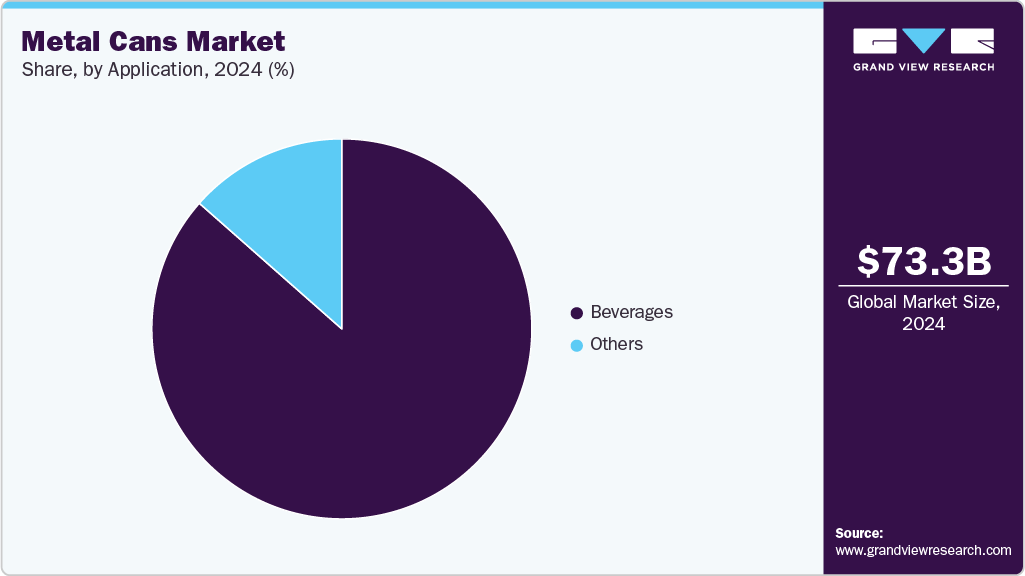
Beverages, particularly soft drinks, energy drinks, beer, and alcoholic RTDs, account for around 77% of the market. The craft beer movement and premium drinks market are driving demand for eye-catching designs, slimmer cans, and specialty coatings. In July 2023, Effingut, a craft brewing company, announced the launch of its signature craft beers in 500-ml cans.
Despite strong demand, the market is sensitive to global metal costs and policy shifts. Aluminum and steel price fluctuations, amplified by U.S. tariffs such as the recent 25-50% levies, are raising production costs and potentially nudging some manufacturers toward cheaper plastic alternatives. For example, U.S. canned food producers face price increases of 9-15%, which could impact demand. However, a stronger recycling infrastructure and lightweighting efforts offer long-term mitigation by reducing dependence on virgin aluminum.
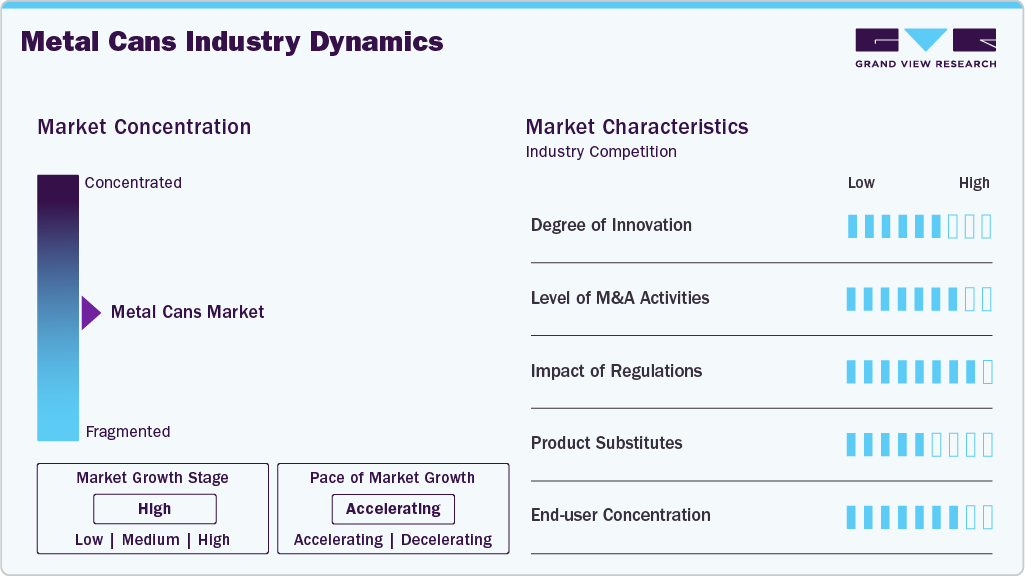
Industry Characteristics
The metal cans industry requires significant capital investment in high-speed can manufacturing lines, coating/printing systems, and recycling infrastructure. Companies also invest in R&D for innovations such as BPA-free linings, light-weighting technologies, and advanced forming techniques. Automation and quality control technologies (e.g., AI-based inspection) are increasingly adopted to reduce waste and boost throughput.
 To learn more about this report, Download Free Sample Report
 Metal cans are regulated under food safety and packaging directives such as the FDA (U.S.), EFSA (Europe), and REACH compliance. Environmental regulations, such as extended producer responsibility (EPR) schemes and single-use packaging bans, encourage the use of recyclable materials. Sustainability is both a requirement and a value proposition, with aluminum being among the most recycled materials globally, with recycling rates over 70% in many regions.
Material Insights
The aluminum segment recorded the largest market revenue share of over 74.5% in 2025 and is expected to grow at the fastest CAGR of 6.6% during the forecast period. Aluminum is the most widely used material for beverage cans due to its light weight, corrosion resistance, and excellent barrier properties. Aluminum cans are primarily used for carbonated soft drinks, energy drinks, and beer, offering excellent shelf life and sustainability credentials. The demand for aluminum cans is driven by growing consumer and regulatory pressure for sustainable packaging. The near-infinite recyclability of aluminum with minimal degradation and lower energy use during recycling is a key advantage.
Steel cans are predominantly used in food packaging due to their strength, rigidity, and ability to withstand heat sterilization. These cans often have a thin coating of tin to resist corrosion (commonly referred to as tinplate). Steel offers strong protection for acidic and perishable foods such as tomatoes, soups, pet foods, and canned vegetables. Its magnetic properties also make it easier to sort and recycle during waste processing, supporting closed-loop recycling systems. Steel cans are primarily driven by demand in the food industry, particularly for long shelf-life and shelf-stable products.
Product Insights
The 2-piece drawn and ironed segment recorded the largest market revenue share of over 70.4% in 2025 and is anticipated to grow at the fastest CAGR of 6.8% during the forecast period. D&I cans are predominantly used for beverage packaging, such as beer, soft drinks, and energy drinks, due to their lightweight, high-speed production capabilities, and seamless structure that improves shelf life by reducing leakage risks. The high-speed manufacturing process of D&I cans offers cost-efficiency at scale, making them a preferred choice for major beverage brands focusing on sustainability and mass distribution.
2-piece draw redraw (DRD) cans are made using a drawing process that creates thicker-walled containers suitable for holding heavier and solid products. Unlike D&I cans, DRD cans are more rigid and can accommodate retort processing, making them ideal for food products such as soups, sauces, pet foods, and nutritional products that require heat sterilization and longer shelf lives. Their superior structural integrity and resistance to internal pressure changes make them ideal for vacuum-sealed or retort-processed products.
Closure Type Insights
The easy-open end (EOE) segment recorded the largest market revenue share of over 78.6% in 2025 and is expected to grow at the fastest CAGR of 6.7% during the forecast period. Easy-Open End (EOE) closures are metal can lids that can be easily removed by pulling a ring or tab, eliminating the need for a can opener. These ends are commonly used in food and beverage cans such as soups, vegetables, soft drinks, and beer. EOEs enhance user convenience and are widely adopted across various can sizes and materials. The primary driver for EOEs is consumer convenience, as they allow quick access to the contents without additional tools.
Peel-off ends (POE) are closures that feature a foil or membrane sealed onto the can’s top, which is peeled away to access the contents. These are typically used for products that require extra hygiene or easy sterilization, such as infant formula, pharmaceutical items, and dairy products. POE closures are driven by the need for hygienic packaging solutions, especially in sectors such as infant nutrition and pharmaceuticals. Their ability to maintain sterility while being easy to open makes them ideal for sensitive applications. In addition, the rise in premium packaging and increasing health and safety awareness among consumers has led to growing demand for POEs in niche but high-value product categories.
Application Insights
The beverages segment recorded the largest market share of over 77.2% in 2025 and is expected to grow at the fastest CAGR of 6.6% during the forecast period. The beverage segment is the largest application segment for metal cans and includes both alcoholic and non-alcoholic drinks such as beer, carbonated soft drinks, energy drinks, juices, and sparkling water. This dominance is due to their lightweight, recyclability, and efficient chilling properties. Beverage brands often favor metal cans for their aesthetic appeal and ability to retain carbonation and freshness over extended periods. The growing popularity of on-the-go beverage formats, especially in urban centers and during outdoor events, also propels demand. In addition, global awareness and regulatory pressures regarding plastic waste have encouraged beverage companies to transition to fully recyclable metal cans.
 To learn more about this report, Download Free Sample Report
 The food segment includes metal cans used for packaging canned vegetables, fruits, ready-to-eat meals, pet food, soups, sauces, and seafood. Metal cans provide a long shelf life, protect food from contamination, and maintain nutritional value due to their airtight sealing and light barrier properties. They are widely adopted for both household and institutional food applications, especially in regions with high urbanization and busy lifestyles that demand convenience and long-lasting storage. The primary drivers for metal cans in the food segment are increasing demand for ready-to-eat and convenience food products, rising pet ownership (boosting demand for canned pet food), and strong consumer preference for sustainable packaging. Growing exports of canned food items, particularly from developing countries, also contribute to market expansion.
Region Insights
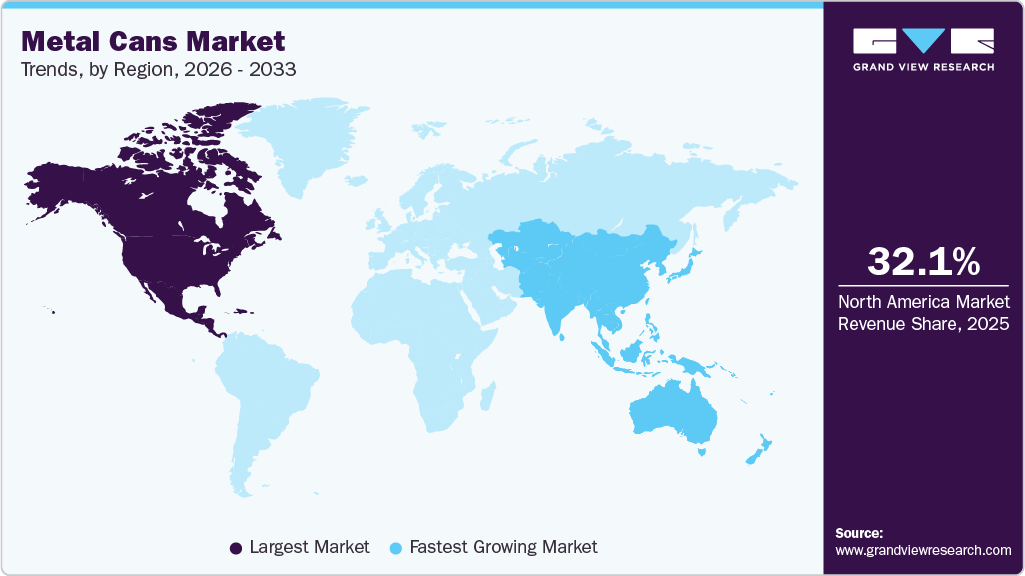
North America dominated the market and accounted for the largest revenue share of over 32.14% in 2025. This positive outlook is due to high consumption of canned beverages (beer, soda) and processed foods. The U.S. and Canada have well-established recycling infrastructures, making metal cans an eco-friendly choice. Craft beer and energy drink trends have further boosted demand; companies such as Crown and Ball Corporation supply billions of cans annually to brands such as Coca-Cola and Pepsi. Moreover, the shift from plastic to metal packaging in products such as aerosols and pet food supports market growth.
 To learn more about this report, Download Free Sample Report
 Europe Metal Cans Market Trends
The metal cans market in Europe is a mature yet growing market, driven by strict sustainability regulations and high recycling rates. Germany, the UK, and France lead in canned food and beverage consumption, with a strong preference for eco-friendly packaging. The beer industry, particularly in Germany, relies heavily on metal cans for export and domestic sales. In addition, the rise of canned wines and premium beverages has expanded the market. Companies such as Ardagh Group S.A. and CANPACK are investing in lightweight, recyclable cans to meet EU circular economy goals.
Asia Pacific Metal Cans Market Trends
The metal cans market in the Asia Pacific is expected to grow at the fastest CAGR of 7.0% over the forecast period. This outlook is due to rapid urbanization, a growing middle class, and increasing demand for packaged food and beverages. Countries such as China, India, and Japan are major contributors, with the food & beverage industry expanding significantly. The rise of ready-to-eat meals, canned seafood, and energy drinks has fueled demand for metal packaging. In addition, sustainability concerns are pushing manufacturers toward recyclable metal cans. For example, in India, companies such as Ball Corporation and Hindustan Tin Works Ltd are investing in sustainable metal packaging solutions to cater to the booming beverage industry. The region’s e-commerce growth also drives demand for canned goods due to their longer shelf life and durability during transportation.
Key Metal Cans Company Insights
The competitive environment of the global market is characterized by the presence of several well-established players operating across a highly consolidated and moderately fragmented landscape. Key companies such as Ball Corporation, Crown, Ardagh Group S.A., Silgan Containers, and CANPACK dominate due to their extensive product portfolios, global manufacturing footprint, and strong relationships with end-users. Competition is driven by pricing pressure, innovation in lightweight and recyclable designs, and growing demand for sustainable packaging. In addition, new entrants face high capital requirements and stringent environmental regulations, giving established players a competitive edge. Strategic partnerships, mergers, and acquisitions are common tactics to gain market share and expand into emerging economies.
-
In May 2025, VulCan Packaging launched North America’s first commercial-scale aTULC (aluminum Toyo Ultimate Can) manufacturing unit, introducing a new era of sustainable beverage packaging to the region. This innovation, developed in partnership with Stolle Machinery Company, is designed to enhance shelf life, improve brand visibility, and meet the growing demand for eco-friendly packaging among beverage brands across North America.
-
In December 2024, Ball Corporation partnered with Dabur India Limited to launch Réal Bites juice in fully recyclable aluminum cans, marking a significant step toward eco-friendly packaging in India.
Key Metal Cans Companies:
The following key companies have been profiled for this study on the metal cans market.
- Sonoco Products Company
- Toyo Seikan Co., Ltd.
- Ball Corporation
- Crown
- CANPACK
- Ardagh Group S.A.
- Hindustan Tin Works Ltd
- Trivium Packaging
- Silgan Containers
- Ohio Art Metal Pack, LLC
- Mauser Packaging Solutions
- Envases Group
- Nampak Ltd.
Metal Cans Market Report Scope
Report Attribute
Details
Market size in 2025
USD 77.8 billion
Estimated market size in 2026
USD 82.6 billion
Projected market size by 2033
USD 127.8 billion
Growth rate
CAGR of 6.4% from 2026 to 2033
Historical data
2021 - 2025
Forecast period
2026 - 2033
Quantitative units
Revenue in USD million/billion, Volume in Million Units, and CAGR from 2026 to 2033
Report coverage
Revenue forecast, volume forecast, competitive landscape, growth factors, and trends
Segments covered
Material, product, closure type, application, region
Regional scope
North America; Europe; Asia Pacific; Latin America; MEA
Country scope
U.S.; Canada; Mexico; Germany; France; UK; Italy; Spain; China; India; Japan; Australia; South Korea; Indonesia; Thailand; Vietnam; Philippines; Malaysia; Singapore; Brazil; Saudi Arabia
Key companies profiled
Sonoco Products Company; Toyo Seikan Co., Ltd.; Ball Corporation; Crown; CANPACK; Ardagh Group S.A.; Hindustan Tin Works Ltd; Trivium Packaging; Silgan Containers; Ohio Art Metal Pack, LLC; Mauser Packaging Solutions; Envases Group; Nampak Ltd.
Customization scope
Free report customization (equivalent up to 8 analyst’s working days) with purchase. Addition or alteration to country, regional, and segment scope.
Pricing and purchase options
Avail customized purchase options to meet your exact research needs. Explore purchase options
Global Metal Cans Market Report Segmentation
This report forecasts revenue growth at a global level and provides an analysis of the latest industry trends in each of the sub-segments from 2021 to 2033. For this study, Grand View Research has segmented the global metal cans market report based on material, product, closure type, application, and region:
-
Material Outlook (Revenue, USD Million; Volume, Million Units, 2021 - 2033)
-
Aluminum
-
Steel
-
-
Product Outlook (Revenue, USD Million; Volume, Million Units, 2021 - 2033)
-
2- Piece Drawn and Ironed
-
2- Piece Draw Redraw (DRD)
-
3- Piece
-
-
Closure Type Outlook (Revenue, USD Million; Volume, Million Units, 2021 - 2033)
-
Easy- Open End (EOE)
-
Peel- off End (POE)
-
Others
-
-
Application Outlook (Revenue, USD Million; Volume, Million Units, 2021 - 2033)
-
Food
-
Beverages
-
Others
-
-
Regional Outlook ((Revenue, USD Million; Volume, Million Units, 2021 - 2033)
-
North America
-
U.S.
-
Canada
-
Mexico
-
-
Europe
-
Germany
-
France
-
UK
-
Italy
-
Spain
-
-
Asia Pacific
-
China
-
India
-
Japan
-
Australia
-
South Korea
-
Indonesia
-
Thailand
-
Vietnam
-
Philippines
-
Malaysia
-
Singapore
-
-
Latin America
-
Brazil
-
-
Middle East & Africa
-
Saudi Arabia
-
-
Frequently Asked Questions About This Report
The key factors that are driving the metal cans market include growing beverages demand among young population in the global market, increased demand for environment friendly packaging solutions, and an increasing number of sustainable packaging startups.
Some of the key players operating in the metal cans market include Sonoco Products Company; Toyo Seikan Co., Ltd.; Ball Corporation; Crown; CANPACK; Ardagh Group S.A.; Hindustan Tin Works Ltd; Trivium Packaging; Silgan Containers; Ohio Art Metal Pack, LLC; Mauser Packaging Solutions; Envases Group; and Nampak Ltd.
The global metal cans market size was estimated at USD 77.8 billion in 2025 and is expected to reach USD 82.6 billion in 2026.
2-piece drawn and ironed held the largest revenue share 70.4% in 2025.
Easy-open end (EOE) held the largest share (over 78.6%) in 2025.
The beverages segment led with a 77.2% revenue share in 2025.
North America dominated with a 32.1% revenue share in 2025.
The global metal cans market is expected to grow at a compound annual growth rate of 6.4% from 2026 to 2033 to reach USD 127.8 billion by 2033.
Aluminum segment by material dominated the market with a revenue share of nearly 74.5% in 2025.
About the Author(s)
Food Safety & Processing Research Team
Consumer Goods · Food Safety & ProcessingThis report was authored by the food safety & processing research team at Grand View Research - comprising two research analysts, one senior research analyst, and one industry expert - with specialized expertise in the food safety & processing segment of the consumer goods industry. All findings are based on proprietary consumer goods databases, executive interviews, and regulatory analysis, subject to internal peer review prior to publication.
Last Updated:
Speak to Analyst

Customize this report to your needs - add regions, segments, or data points, with 20% free customization.
Or view our licence options:


ISO 9001:2015 & 27001:2022 Certified
We are GDPR and CCPA compliant! Your transaction & personal information is safe and secure. For more details, please read our privacy policy.


