
- Home
- »
- Power Generation & Storage
- »
-
Micro Battery Market Size And Share Report, 2026-2033GVR Report cover
![Micro Battery Market (2026 - 2033)Report]()
Micro Battery Market (2026 - 2033)
Size, Share & Trends Analysis Report By Material (Alkaline, Silver Oxide, Lithium), By Type (Thin Film Batteries, Printed Batteries, Solid-state Chip Batteries, Button Batteries), By Capacity, By Battery Type, By Region, And Segment Forecasts
Market Size, 2025
$812.1MMarket Estimate, 2026
$994.4MMarket Forecast, 2033
$4,501.2MCAGR, 2026–2033
24.1%Micro Battery Market Summary
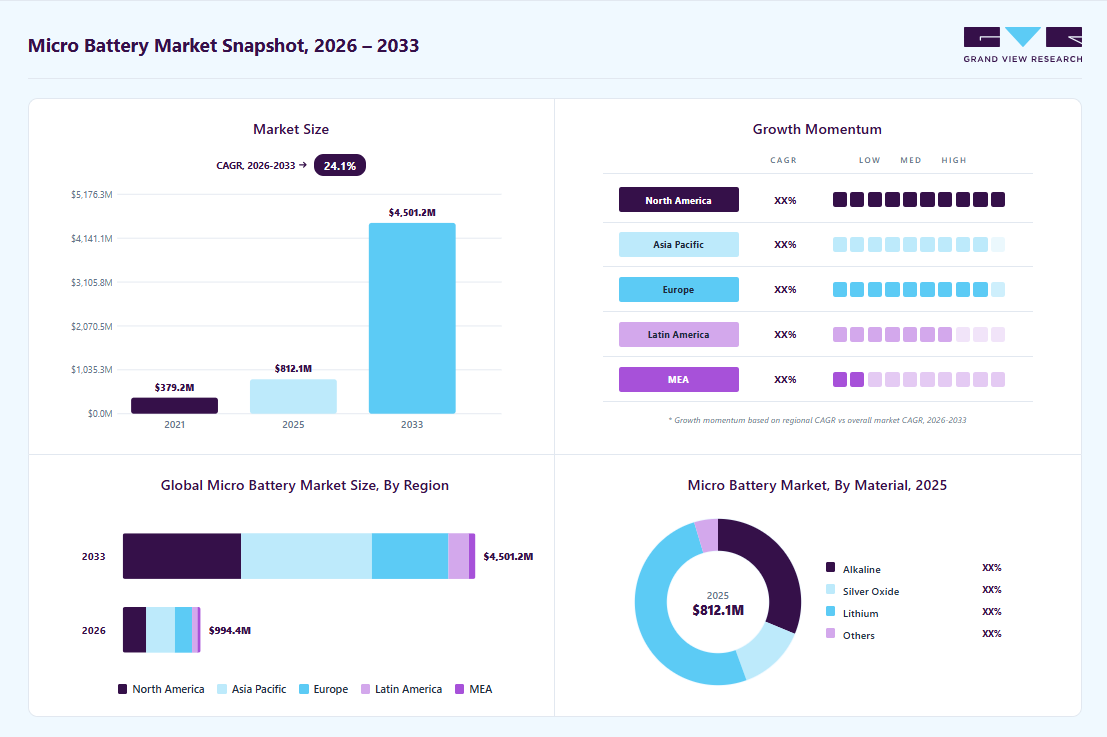
The global micro battery market size was valued at USD 812.1 million in 2025 and is projected to grow from USD 994.4 million in 2026 to USD 4,501.2 million by 2033, at a CAGR of 24.1% from 2026 to 2033. The Asia Pacific held the largest share of 36.9% of the global market in 2025. The global micro battery market is flourishing due to the rapid proliferation of compact, power-efficient electronic devices and sustained innovation in miniaturization technologies.
Key Market Trends & Insights
- By material: Lithium segment held the largest revenue share of 50.9% in 2025.
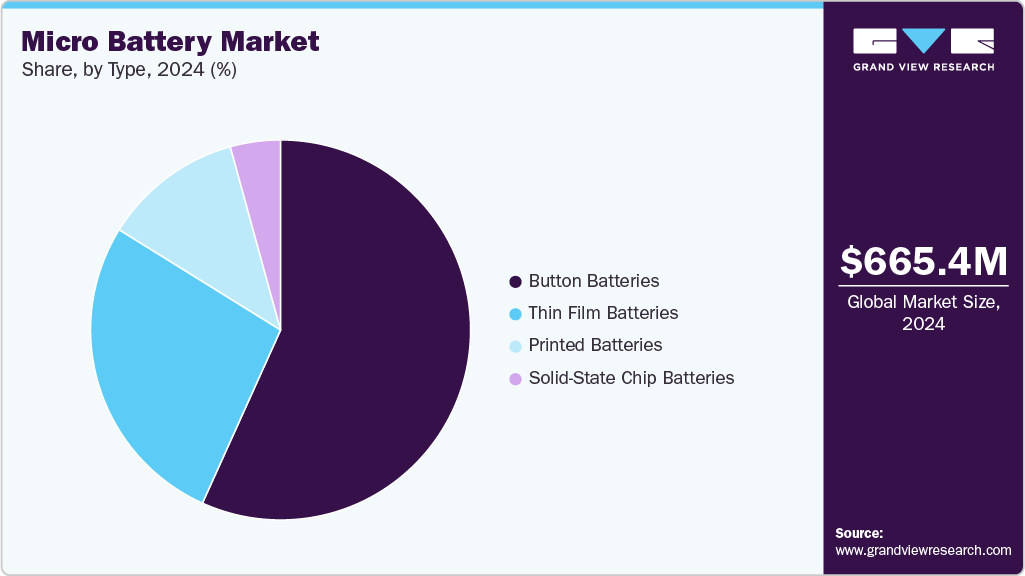
- By type: Button battery segment accounted for the largest revenue share of 57.0% in 2025.
- By capacity: 10 mAh to 100 mAh segment held the largest revenue share of 58.1% in 2025.
- By battery type: Primary segment held the largest revenue share of 61.6% in 2025.
Regional Highlights
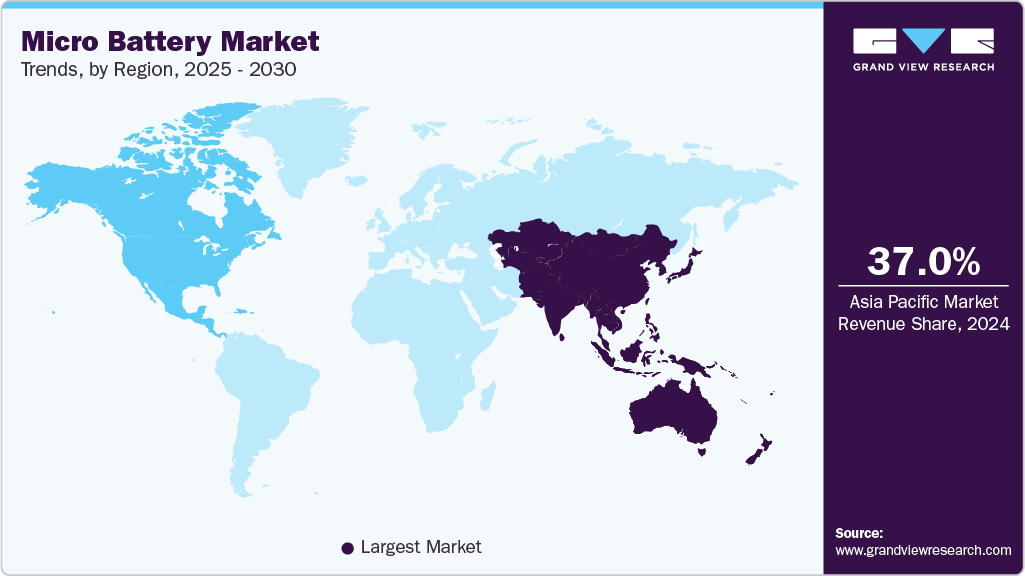
- Largest regional market: Asia Pacific (36.9% revenue share, 2025)
- Fastest-growing regional market: North America (26.1% CAGR, 2026-2033)
- By country: China held the largest market share within Asia Pacific in 2025.
Market Size & Forecast
- Market size in 2025: USD 812.1 Million
- Estimated market size in 2026: USD 994.4 Million
- Projected market size by 2033: USD 4,501.2 Million
- CAGR (2026-2033): 24.1%
Sustainability considerations are increasingly shaping the micro battery market, as manufacturers and end-users seek environmentally responsible power solutions for next-generation electronics. The shift toward solid-state and mercury-free chemistries, along with reduced use of hazardous electrolytes and lower material intensity, supports compliance with increasingly stringent environmental regulations, particularly in Europe and certain parts of Asia. Additionally, the long service life and low self-discharge characteristics of micro batteries help reduce the replacement frequency in medical implants, IoT sensors, and smart wearables, thereby minimizing electronic waste. Growing interest in energy-efficient, maintenance-free devices further aligns the adoption of micro batteries with broader sustainability and circular economy objectives.
From a technological perspective, the micro battery market is advancing rapidly due to breakthroughs in thin-film, solid-state, and lithium-based micro battery architectures, which deliver higher energy density within extremely small form factors. Innovations in microfabrication, advanced packaging, and flexible substrates enable the integration of batteries directly onto semiconductor chips and flexible electronics. These developments enhance safety, thermal stability, and charging efficiency, while supporting innovative device designs for medical implants, smart cards, and connected sensors. As R&D efforts continue to enhance power output, rechargeability, and compatibility with energy-harvesting systems, micro batteries are becoming a critical enabler of autonomous, always-on electronic applications.
Drivers, Opportunities & Restraints
A primary driver of the global micro battery market is the surging proliferation of compact and connected electronics, including wearables, smart medical implants, and IoT devices that require ultra-small, reliable power sources. For example, advancements such as Ensurge Micropower’s shipment of 10-micron solid-state lithium micro batteries in June 2024 underscore how technological innovation is directly fueling adoption in digital health applications and sensors that demand high performance in minuscule form factors. Additionally, the expanding ecosystem of IoT endpoints predicted to reach tens of billions of connected units worldwide is further boosting demand for micro batteries with stable voltage output and long service life.
Significant opportunities stem from integration with emerging technologies and nascent application verticals, particularly energy harvesting systems and advanced IoT sensor networks. Hybrid systems that combine micro batteries with energy harvesting are enabling autonomous nodes with extended lifespans, thereby expanding the use cases in smart infrastructure, industrial monitoring, and smart packaging. There is also a growing scope for micro batteries in 5G-enabled devices, autonomous systems, and aerospace/defense applications, where miniaturized, high-reliability power sources offer differentiated value. Strategic collaborations and R&D investments focused on flexible, solid-state, and biodegradable micro battery designs offer further avenues for market expansion.
Despite robust demand, the micro battery market faces notable restraints, including manufacturing complexity, energy density limitations, and regulatory pressures. Achieving high energy storage in extremely small volumes remains a technical challenge, often resulting in higher unit costs and slower development cycles that can deter adoption in power-intensive applications. Fluctuating raw material costs, particularly those of lithium and silver, continue to impact production economics and profit margins. Moreover, stringent environmental and recycling regulations impose additional compliance costs and complicate end-of-life management for micro batteries, especially those with legacy chemistries.
Material Insights
By material, the lithium segment dominated the micro battery market, accounting for the largest revenue share of 50.9% in 2025. This leadership is primarily driven by lithium batteries’ superior energy density, compact form factor, and long operational life, making them highly suitable for modern miniaturized electronic devices such as wearables, medical implants, and IoT-enabled sensors. Additionally, their low self-discharge rate and reliable performance under varying conditions enhance their adoption across both consumer and industrial applications, supporting sustained market dominance over the forecast period.
The silver oxide segment is projected to register the fastest CAGR of 26.6% during the forecast period, owing to its stable discharge voltage and high energy-to-weight ratio. These batteries are particularly well-suited for precision-driven applications such as watches, hearing aids, and medical instruments, where consistent power output is critical. Their ability to deliver reliable performance in compact sizes makes them increasingly preferred in high-value, low-drain electronic devices.
Type Insights
By type, the button battery segment accounted for the largest revenue share of 57.0% in 2025. This dominance is attributed to their compact size, lightweight structure, and widespread use across a variety of small electronic devices, including watches, calculators, hearing aids, and medical instruments. Their ability to deliver stable voltage and reliable performance in space-constrained applications makes them highly suitable for miniaturized consumer electronics. Additionally, the increasing demand for wearable devices and portable healthcare equipment continues to drive strong adoption of button batteries globally.
The button batteries segment is also expected to register the fastest CAGR of 24.5% over the forecast period, driven by the rapid expansion of IoT-enabled devices, smart wearables, and compact medical technologies. As device manufacturers continue to prioritize miniaturization and energy efficiency, the demand for high-performance, small-form batteries is rising significantly, further accelerating growth in this segment.
Moreover, advancements in battery chemistry and design are enhancing the efficiency, lifespan, and safety of button batteries, making them more suitable for next-generation applications. Their growing integration into smart devices, fitness trackers, and wireless sensors, along with increasing consumer preference for compact and portable electronics, is expected to sustain strong growth momentum in the coming years.
Capacity Insights
By capacity, the 10 mAh to 100 mAh segment held the largest revenue share of 58.1% in 2025. This dominance is driven by its widespread applicability across compact electronic devices such as wearables, hearing aids, calculators, and small medical instruments. Batteries within this capacity range offer an optimal balance between size, power output, and cost, making them highly suitable for devices that require moderate energy over extended periods. Additionally, the growing adoption of portable and miniaturized electronics continues to reinforce the demand for this segment.
The above 100 mAh segment is projected to register the fastest CAGR of 27.2% over the forecast period, supported by increasing demand for high-capacity micro batteries in advanced applications. Devices such as smart wearables, medical monitoring systems, and IoT-enabled sensors require longer operational lifespans and higher energy storage, driving the shift toward higher-capacity batteries. This trend is particularly prominent in applications where frequent battery replacement is not feasible.
Battery Type Insights
By battery type, the primary segment held the largest revenue share of 61.6% in 2025. This dominance is attributed to the widespread use of non-rechargeable batteries in applications requiring low power consumption, long shelf life, and cost efficiency. Primary batteries are commonly utilized in devices such as watches, remote controls, medical implants, and sensors, where continuous replacement is minimal, and reliability is critical. Their ready-to-use nature and stable performance over extended periods further support their strong adoption across consumer and healthcare applications.
The secondary segment is expected to register the fastest CAGR of 25.5% over the forecast period, driven by the increasing demand for rechargeable and sustainable energy solutions. With the rising adoption of smart wearables, wireless devices, and portable electronics, consumers and manufacturers are increasingly preferring rechargeable micro batteries to reduce long-term costs and environmental impact. This shift is significantly contributing to the rapid growth of the secondary segment.
Additionally, advancements in rechargeable battery technologies, particularly in lithium-ion and solid-state chemistries, are enhancing energy density, charging efficiency, and lifecycle performance. These improvements are expanding the application scope of secondary batteries in compact and high-performance devices, including medical equipment and IoT-enabled systems, thereby accelerating their market growth.
Regional Insights
The Asia Pacific micro battery market held the largest revenue share of 36.97% in 2025, driven by the region’s strong electronics manufacturing base and rapidly expanding consumer demand. Countries across the Asia Pacific serve as major production hubs for compact electronic devices, including wearables, medical instruments, and IoT-enabled products, which significantly fuels the demand for micro batteries. Additionally, the presence of cost-efficient manufacturing, large-scale production capabilities, and a growing middle-class population continues to support market dominance in the region.
China Micro Battery Market Trends
China plays a pivotal role in the Asia Pacific micro battery market, supported by its position as a global leader in electronics manufacturing and battery production. The country benefits from a robust supply chain, continuous technological advancements, and strong domestic demand for smart devices and healthcare electronics. Increasing investments in battery innovation and the rapid expansion of IoT and wearable technologies further strengthen China’s contribution to market growth.
North America Micro Battery Market Trends
North America is expected to register the fastest CAGR of 26.1% over the forecast period, driven by high adoption of advanced technologies and strong demand for premium electronic and medical devices. The region’s focus on innovation, coupled with significant R&D investments and the presence of leading technology companies, is accelerating the development and adoption of high-performance micro batteries. Growing demand for smart wearables, connected devices, and portable healthcare solutions is a key factor supporting rapid market expansion.
Europe Micro Battery Market Trends
Strong regulatory frameworks and a growing focus on sustainability and energy efficiency characterize Europe’s micro battery market. Increasing demand for eco-friendly and high-performance battery solutions across consumer electronics and medical applications supports steady growth. Technological advancements and innovation in miniaturized devices further contribute to market expansion across the region.
Latin America Micro Battery Market Trends
Latin America is witnessing gradual growth in the micro battery market, supported by increasing adoption of consumer electronics and improving digital infrastructure. Rising urbanization and demand for affordable electronic devices are driving steady market penetration. While the market remains in a developing phase, long-term growth opportunities are supported by improving economic conditions and technological accessibility.
Middle East & Africa Micro Battery Market Trends
The Middle East & Africa micro battery market is at an early phase of development, driven by growing adoption of electronic devices, healthcare equipment, and monitoring systems. Expansion of digital infrastructure and increasing awareness of advanced technologies are supporting market development. Demand is expected to rise steadily as access to modern electronics and healthcare solutions improves across the region.
Key Micro Battery Company Insights
Some of the key players operating in the global micro battery market include Cymbet Corporation, Murata Manufacturing Co., Ltd., among others.
-
Cymbet Corporation (est. 2006) plays a key role in advancing the commercialization of solid-state micro battery technologies, specializing in thin-film lithium batteries designed for embedded and energy-autonomous applications. The company’s wafer-level manufacturing approach enables the scalable production of compact batteries with long cycle life, high reliability, and enhanced safety. Cymbet’s solutions are widely aligned with the requirements of medical devices, industrial sensors, and IoT systems that demand maintenance-free power over extended operating lifetimes.
-
Murata Manufacturing Co., Ltd. (est. 1944) is a major global contributor to the micro battery market through its extensive portfolio of miniaturized lithium-based and solid-state energy storage solutions. Leveraging advanced materials science and precision manufacturing, Murata delivers high-performance batteries optimized for compact electronics. The company’s vertically integrated production model supports consistent quality, high energy density, and long operational stability, enabling deployment across consumer electronics, healthcare devices, and connected industrial applications.
-
VARTA AG (est. 1887) is a well-established player in the micro battery landscape, offering a broad range of primary and secondary micro batteries, including button cells and specialized small-format power solutions. The company emphasizes reliability, long self-life, and consistent performance, supported by decades of battery engineering expertise. VARTA’s manufacturing scale and focus on quality standards position it strongly across consumer electronics, medical devices, and industrial electronics, requiring dependable, compact power sources.
Key Micro Battery Companies:
The following key companies have been profiled for this study on the micro battery market.
- Blue Spark Technologies
- Cymbet Corporation
- Front Edge Technology, Inc.
- Maxell Holdings Ltd
- Molex
- Murata Manufacturing Co., Ltd.
- Panasonic Corporation
- Shenzhen Grepow Battery Co. Ltd.
- TDK Corporation
- VARTA AG
Recent Developments
-
In March 2025, Murata Manufacturing Co., Ltd. announced the expansion of its micro battery production capacity to support rising demand from wearable electronics and medical device manufacturers. The company focused on enhancing energy density and reliability through process optimization and the integration of advanced materials, thereby strengthening its position in compact and high-performance power solutions.
-
In July 2025, VARTA AG introduced an upgraded range of micro and button batteries with improved shelf life and stability, targeting applications requiring long-term, maintenance-free power. The development aligns with growing demand from healthcare, consumer electronics, and industrial monitoring segments, where consistent performance over extended periods is critical.
-
In November 2025, Cymbet Corporation advanced its solid-state micro battery platform by scaling wafer-level manufacturing for embedded energy storage applications. The company emphasized improved cycle life and safety characteristics, supporting broader adoption of autonomous sensors, IoT devices, and compact medical electronics that require reliable, long-lasting power in confined spaces.
Micro Battery Market Report Scope
Report Attribute
Details
Market definition
Market size is derived by estimating unit demand across key applications and multiplying it by average selling prices, using a bottom-up approach. The results are validated through top-down analysis, company revenues, and industry benchmarks to ensure accuracy and reliability.
Market size in 2025
USD 812.1 million
Estimated market size in 2026
USD 994.4 million
Projected market size by 2033
USD 4,501.2 million
Growth rate
CAGR of 24.1% from 2026 to 2033
Historical data
2021 - 2024
Forecast period
2026 - 2033
Quantitative units
Revenue in USD million/billion, and CAGR from 2026 to 2033
Report coverage
Revenue Forecast, competitive landscape, growth factors, and trends
Segments covered
Material, type, capacity, battery type, region
Regional scope
North America; Europe; Asia Pacific; Latin America; Middle East & Africa
Country Scope
U.S.; Canada; Mexico; Germany; UK; France; Spain; China; India; South Korea; Australia
Key companies profiled
Blue Spark Technologies; Cymbet Corporation; Front Edge Technology, Inc.; Maxell Holdings Ltd; Molex; Murata Manufacturing Co., Ltd.; Panasonic Corporation; Shenzhen Grepow Battery Co. Ltd.; TDK Corporation; VARTA AG
Customization scope
Free report customization (equivalent up to 8 analyst’s working days) with purchase. Addition or alteration to country, regional & segment scope
Pricing and purchase options
Avail customized purchase options to meet your exact research needs. Explore purchase options
Global Micro Battery Market Report Segmentation
This report forecasts revenue growth at global, regional, and country levels and provides an analysis of the latest industry trends in each of the sub-segments from 2021 to 2033. For the purpose of this study, Grand View Research has segmented the global micro battery market report on the basis of material, type, capacity, battery type, and region:
-
Material Outlook (Revenue, USD Million, 2021 - 2033)
-
Alkaline
-
Silver Oxide
-
Lithium
-
Others
-
-
Type Outlook (Revenue, USD Million, 2021 - 2033)
-
Thin Film Batteries
-
Printed Batteries
-
Solid-state chip Batteries
-
Button Batteries
-
-
Capacity Outlook (Revenue, USD Million, 2021 - 2033)
-
Below 10 mAH
-
10 mAH to 100 mAH
-
Above 100 mAH
-
-
Battery Type Outlook (Revenue, USD Million, 2021 - 2033)
-
Primary
-
Secondary
-
-
Regional Outlook (Revenue, USD Million, 2021 - 2033)
-
North America
-
U.S.
-
Canada
-
Mexico
-
-
Europe
-
Germany
-
UK
-
France
-
Spain
-
-
Asia Pacific
-
China
-
India
-
South Korea
-
Australia
-
-
Latin America
-
Middle East & Africa
-
Frequently Asked Questions About This Report
The global micro battery market size was valued at USD 812.1 million in 2025 and is estimated at USD 994.4 million for 2026.
The global micro battery market is expected to grow at a CAGR of 24.1% from 2026 to 2033, reaching USD 4,501.2 million by 2033.
Asia Pacific dominated the global micro battery market with a revenue share of 36.9% in 2025.
Some of the key players operating in the micro battery market include Blue Spark Technologies, Cymbet Corporation, Front Edge Technology, Inc., Maxell Holdings Ltd, Molex, Murata Manufacturing Co., Ltd., Panasonic Corporation, Shenzhen Grepow Battery Co. Ltd., TDK Corporation, and VARTA AG.
North America is the fastest-growing region over the forecast period, with a CAGR of 26.1%.
The lithium segment led the market with a 50.9% revenue share in 2025, while the silver oxide segment is the fastest-growing.
The button battery segment held the largest revenue share of 57.0% in 2025 and is also expected to register the fastest growth during the forecast period.
The 10 mAh to 100 mAh segment held the largest revenue share of 58.1% in 2025, while the above 100 mAh segment is projected to grow at the fastest rate.
The primary segment held the largest revenue share of 61.6% in 2025, while the secondary segment is expected to register the fastest CAGR over the forecast period.
Key factors driving the micro battery market include the rising adoption of wearables, smart medical implants, and IoT devices, increasing demand for compact and reliable power sources, advancements in thin-film and solid-state battery technologies, growing deployment of connected sensors, and expanding applications in healthcare, consumer electronics, and industrial monitoring systems.
About the Author(s)
Power Generation & Storage Research Team
Energy & Power · Power Generation & StorageThis report was authored by the power generation & storage research team at Grand View Research - comprising two research analysts, one senior research analyst, and one industry expert - with specialized expertise in the power generation & storage segment of the energy & power industry. All findings are based on proprietary energy & power databases, executive interviews, and regulatory analysis, subject to internal peer review prior to publication.
Last Updated:
Speak to Analyst


Customize this report to your needs — add regions, segments, or data points, with 20% free customization.
Or view our licence options:


ISO 9001:2015 & 27001:2022 Certified
We are GDPR and CCPA compliant! Your transaction & personal information is safe and secure. For more details, please read our privacy policy.


