
- Home
- »
- Agrochemicals & Fertilizers
- »
-
Middle East Agrochemicals Market, Industry Report, 2033GVR Report cover
![Middle East Agrochemicals Market Size, Share & Trends Report]()
Middle East Agrochemicals Market (2025 - 2033) Size, Share & Trends Analysis Report By Product (Fertilizers, Crop Protection Chemicals-based, Crop Protection Chemicals, Plant Growth Regulators), By Application, By Country, And Segment Forecasts
- Report ID: GVR-4-68040-717-1
- Number of Report Pages: 80
- Format: PDF
- Historical Range: 2018 - 2023
- Forecast Period: 2025 - 2033
- Industry: Bulk Chemicals
- Report Summary
- Table of Contents
- Segmentation
- Methodology
- Download FREE Sample
-
 Download Sample Report
Middle East Agrochemicals Market Summary
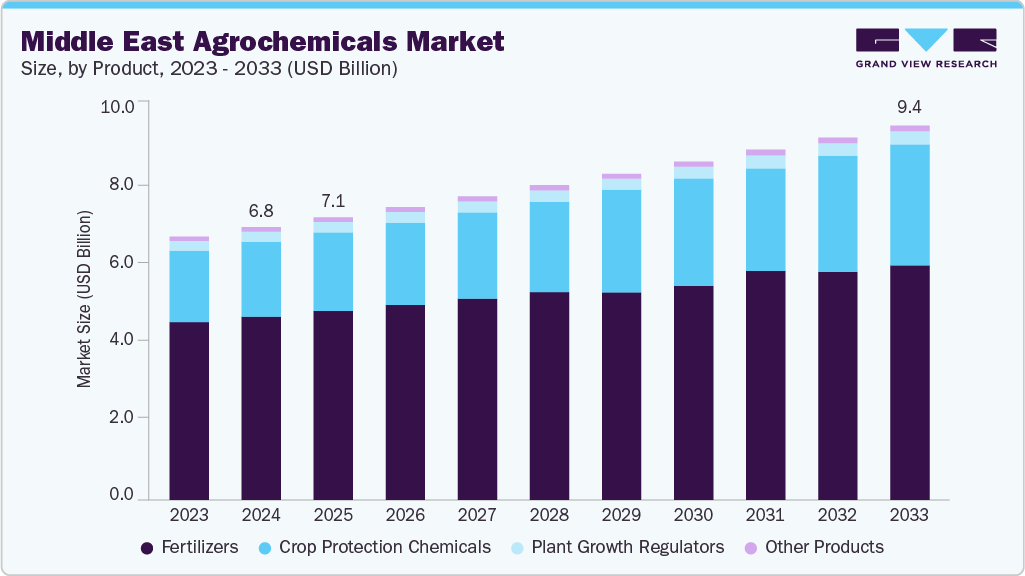
The Middle East agrochemicals market size was estimated at USD 6.81 billion in 2024 and is projected to reach USD 9.35 billion by 2033, growing at a CAGR of 3.6% from 2025 to 2033, due to its critical role in the protection and nutrition of cereal and grain crops, driving the demand for crop protection chemicals. These inputs help farmers safeguard crops against pests and diseases, optimize growth conditions, and improve yields, thereby contributing to food security amid growing populations and limited arable land.
Key Market Trends & Insights
- Israel dominated the Middle East agrochemicals market with the largest revenue share of 27.3% in 2024.
- By application, cereal & grains segment dominated the market with a revenue share of 38.8% in 2024.
- By product, fertilizers segment dominated the Middle East agrochemicals market with a revenue share of 67.2% in 2024.
Market Size & Forecast
- 2024 Market Size: USD 6.81 Billion
- 2033 Projected Market Size: USD 9.35 Billion
- CAGR (2025-2033): 3.6%
Effective use of fertilizers ensures balanced nutrition by supplying essential macronutrients (nitrogen, phosphorus, potassium) and micronutrients, enhancing plant development, stress tolerance, and crop quality. In addition, by integrating crop protection chemicals with precision farming practices, such as soil analysis, timing of sowing, and split fertilization, producers can maximize yields while minimizing losses, making agrochemicals indispensable in cereal and grain cultivation. Furthermore, it improves herbicide effectiveness, facilitate nutrient uptake, and mitigate stress, reinforcing the role of agrochemicals as a key driver in cereal crop production.The fungicides segment of the agrochemicals market is driven by the urgent need to manage resistance among plant-pathogenic fungi, which has affected the effectiveness of established fungicide classes such as DMIs, strobilurins, SDHIs, phenylamides, and carboxylic acid amides. This challenge companies to innovate using advanced approaches, including structure- and target-based design, inverse design, and multi-parameter optimization in agrochemicals. Key market drivers include the discovery of entirely new modes of action, as seen with products like oxathiapiprolin and flufenoxadiazam, which provide novel solutions against oomycetes, gray mold, and soybean rust.
In addition, expanding the scope of previously niche fungicide classes, such as SDHIs and quinone-inside inhibitors (QiIs), has opened broader applications across multiple pathogens and crop types, boosting their commercial potential. Another significant driver is the development of resistance-breaking active ingredients, exemplified by metyltetraprole, which overcomes mutations in fungal populations that reduce the efficacy of older fungicides. Overall, these strategies, innovating new modes of action, broadening existing ones, and designing resistance breakers, underscore the dynamic growth of the fungicides-based agrochemicals market, enabling sustainable crop protection while addressing resistance challenges and supporting food security.
Plant growth regulators (PGR) based agrochemicals market is growing steadily, as they enable farmers and horticulturists to optimize plant growth, development, and yield under varying environmental and stress conditions. Synthetic PGRs that can reliably regulate bud, flower, fruit, and root formation. PGRs are widely applied in agriculture, horticulture, and viticulture to enhance growth in short growing seasons, low fertility soils, or disease-prone conditions, and to improve harvest outcomes by preventing premature fruit drop, accelerating maturity, or controlling ripening. The effectiveness of PGRs depends on proper timing, crop growth stage, environmental conditions, and application methods, which has driven the development of advanced formulations and precise application technologies. Repeated, low-rate applications under controlled conditions ensure uniform and predictable crop responses, further fueling the adoption of PGRs as an essential segment of the agrochemicals market.
However, despite its promising growth prospects, the Middle East agrochemicals market is restrained by several challenges that could limit its expansion. High production costs, fluctuating raw material prices, and dependence on imported chemical inputs increase operational expenses for manufacturers. In addition, limited awareness and adoption of advanced agrochemical technologies among smallholder farmers, coupled with concerns over environmental impact and soil health, can slow market penetration. These factors collectively act as significant restraints on the overall growth of the agrochemicals sector in the region.
Market Concentration & Characteristics
The Middle East agrochemicals market is moderately fragmented, with several key players holding significant market share due to their large-scale operations and integrated capabilities. Leading companies leverage extensive value chain integration, from raw material sourcing and formulation development to distribution and logistics, enabling cost efficiencies, consistent product quality, and reliable supply. Their robust regional networks and technological expertise allow them to effectively serve critical sectors, including crop protection, Fertilizers, and specialty chemicals, while adhering to stringent regulatory frameworks. This strategic positioning supports the growing demand for sustainable and high-performance agrochemical solutions across the Middle East.
Emerging and established players in the Middle East agrochemicals market, are expanding their presence by leveraging regional advantages such as rapid industrialization, growing demand in agriculture, and increasing investments in advanced green technologies like hydrogen and ammonia production. These companies focus on producing cost-effective agrochemicals while targeting key applications in agriculture, Cereal & Grains, and Oilseeds & Pulses, serving both domestic and export markets. The combination of dominant multinational corporations and agile regional firms capitalizing on local resources and market needs is reshaping the competitive dynamics of the Middle East agrochemicals industry.
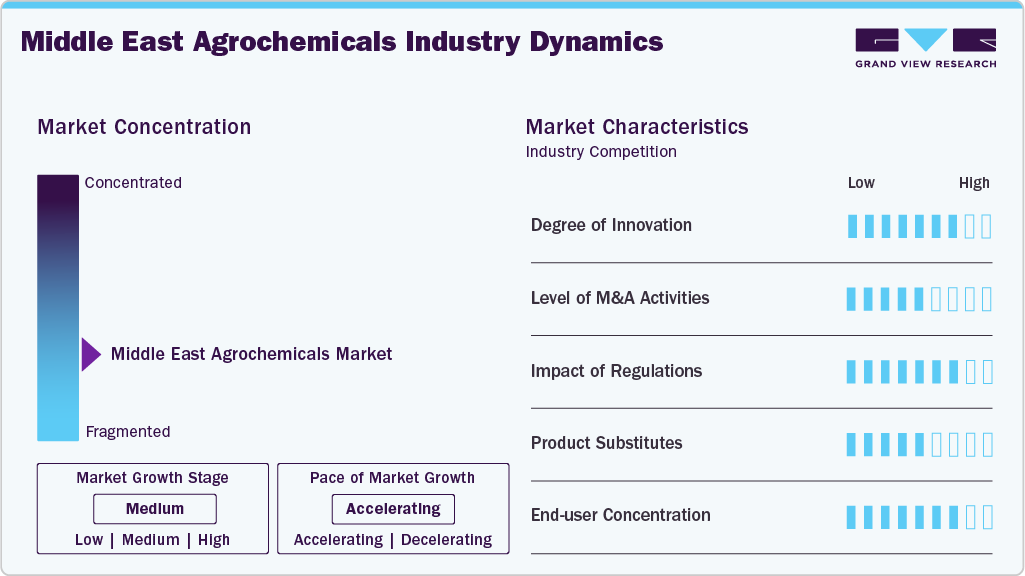
Despite these growth opportunities, the market faces several challenges, including supply chain disruptions, volatile raw material and energy prices, and stringent regulatory pressures related to environmental sustainability and carbon emissions. In addition, climate-related risks such as rising temperatures, water scarcity, and extreme weather events threaten production facilities and feedstock availability. These technological, environmental, and regulatory challenges underscore the need for continuous innovation and strategic adaptation among companies to ensure resilient and sustainable growth in the Middle East agrochemicals market.
Product Insights
Fertilizers segment dominated the Middle East agrochemicals market and accounted for the largest revenue share of 67.2% in 2024, driven by its role boosting crop yields and quality to meet the rising food demand. By supplying vital macro and micronutrients, they support crucial plant functions such as chlorophyll production, root development, flowering, and resilience against environmental stress. Market growth is driven by the shift from traditional organic inputs to advanced synthetic and controlled-release formulations that enhance efficiency while reducing nutrient loss and environmental impact. With increasing emphasis on sustainable farming and integrated nutrient management, Fruits & Vegetables-based agrochemicals play a pivotal role in maintaining soil health, improving productivity, and supporting climate-resilient agriculture worldwide. For instance, in June 2025, FMC Corporation has announced the expansion of its novel fluindapyr fungicide Product into the European, Middle East, and Africa (EMEA) region with the regulatory approval of Tremisia fungicide in Ukraine. This marks the company’s first introduction of fluindapyr-based solutions in the region. The approval covers oilseed rape, sunflower, and wheat, spanning more than 10 million hectares of Ukrainian farmland, a significant market given Ukraine’s position as a leading global exporter of these crops.
Crop protection chemicals segment Middle East agrochemicals market is expected to grow fastest with a CAGR of 5.5% from 2025 to 2033 during the forecast period, driven by the region's growing demand for food security and sustainable agricultural productivity. Many crops would suffer substantial yield losses without effective protection due to weeds, pests, and diseases. Insecticides, herbicides, and fungicides are essential for safeguarding crop output and preventing pest-related human and animal health threats. Over the past six decades, these chemicals' environmental and toxicological profiles have improved significantly, aligning with stricter safety standards and sustainability goals. Research and development have focused on creating highly targeted products that are potent against specific threats while minimizing impact on non-target organisms and the surrounding environment, an increasingly important factor in the arid and ecologically sensitive landscapes of the Middle East. For instance, in April, 2025, Delta Saudi Chemical Industries Company has introduced DeltaCopper 850 WP to the Middle East agrochemicals market. The product features a high-copper formulation designed to deliver strong protection against fungal and bacterial diseases while being safe for plants. Proven effective in field trials, DeltaCopper 850 WP offers growers in the region a reliable, broad-spectrum crop protection solution from the first application.
Application Insights
The cereal & grains segment dominated the Middle East agrochemicals market. It accounted for the largest revenue share of 38.8% in 2024, driven by its role in providing crops with one of the most essential nutrients for growth, yield optimization, and overall plant health. Agrochemicals are critical for chlorophyll production, protein synthesis, and plant metabolism, yet most agricultural soils cannot naturally supply them in sufficient quantities to meet the demands of intensive farming. As global population growth accelerates, the pressure on crop yields, especially cereals and grains, increases, driving higher agrochemical demand. The market is further propelled by the depletion of soil nutrients, which makes regular supplementation essential. For instance, Bayer delivers tailored seed solutions in the Middle East, combining advanced genetics, bioProduct, and data science to help farmers boost yields even in harsh desert conditions. The company is expanding its leadership in biologicals, introducing nature-derived solutions like pheromones, botanicals, plant extracts, and biostimulants. Leveraging its regulatory expertise and global reach, Bayer brings innovations to market faster, empowering partners to support millions of growers across the region.
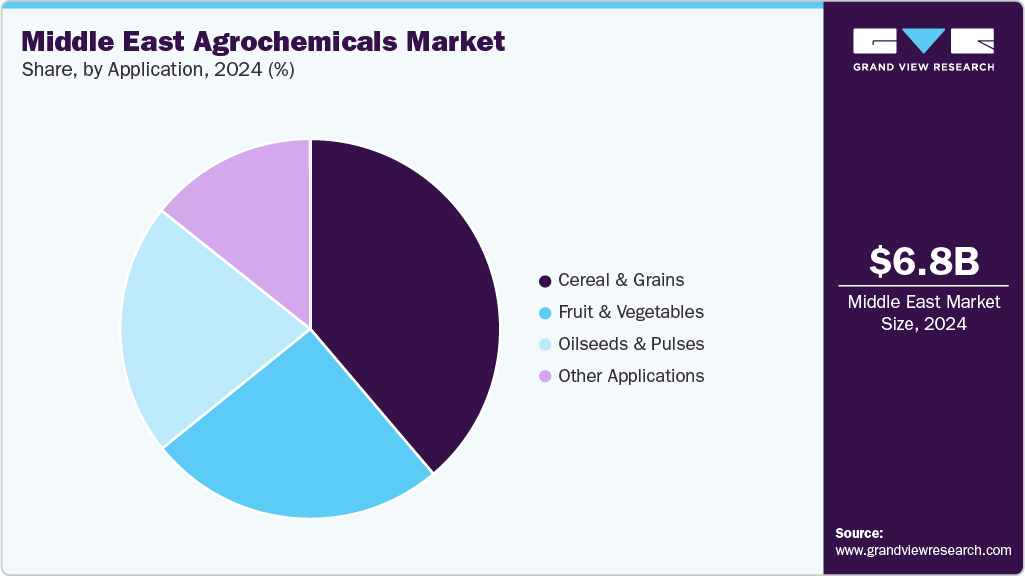
Fruits & vegetables segment Middle East agrochemicals market is expected to grow fastest with a CAGR of 4.1% from 2025 to 2033 during the forecast period, driven by its importance in modern agriculture, supplying one of the three key macronutrients necessary for healthy plant growth. As natural soil phosphorus is steadily depleted through crop uptake and rainfall leaching, Fertilizers play a critical role in replenishing nutrient reserves.
These Fertilizers support vital plant functions such as energy transfer, nutrient transport, photosynthesis, and cell division, ultimately strengthening root systems, enhancing stem structure, improving flowering, boosting seed production, increasing disease resistance, and elevating overall crop quality. For Instance, in July 2024 KBR has been selected by Shell to provide its blue ammonia Product for the Blue Horizons low-carbon hydrogen and ammonia project in Duqm, Oman. The 3,000-metric-tons-per-day facility will integrate KBR’s advanced ammonia synthesis loop with hydrogen from Shell’s Blue Hydrogen Product, delivering cost-competitive, low-carbon ammonia. While primarily an energy transition initiative, the project also holds strategic relevance for the Middle East agrochemicals market, as ammonia is a key feedstock for nitrogen-based Fertilizers, potentially supporting the region’s sustainable agriculture goals and reducing the carbon footprint of Fruits & Vegetables production.
Country Insights
Israel Agrochemicals Market Trends
The Middle East agrochemicals market in Israel held 27.3% of the Middle East agrochemicals market revenue share in 2024, strongly driven by unique geographic and environmental conditions, such as arid climates and limited water resources, have fostered innovations that indirectly drive the demand for agrochemicals in the country. Advanced controlled atmosphere storage systems extend the shelf life of fruits and vegetables, increasing the importance of effective pesticides and fungicides during cultivation to ensure high-quality yields. Packaging innovations, including sustainable and protective solutions, help reduce post-harvest losses, complementing the use of crop protection chemicals. According to the report of the State Comptroller of Israel, pesticide use in the fruits and vegetables sector is among the highest, with 1.52 tons per 1,000 dunams and 1.57 tons per 1,000 tons of production in 2018. This is largely driven by the need to protect high-value crops, despite limited government tracking of pesticide types, crops, or farmers.
Oman Agrochemicals Market Trends
The Oman agrochemicals market is expected to grow fastest, with a CAGR of 4.8% from 2025 to 2033 due to the increasing demand for insecticides and fungicides as agrochemicals, due to the need to ensure food safety and maintain high-quality yields in fruits and vegetables. Advanced techniques, such as gold nanoparticle (AuNP)-immersed paper imprinting coupled with mass spectrometry imaging, have demonstrated the ability to track the penetration and migration of pesticides like chlorantraniliprole and azoxystrobin within produce. These insights reveal that factors such as the chemical properties of pesticides and the water content of crops influence their effectiveness, highlighting the importance of targeted applications. As a result, growers in Oman are increasingly adopting insecticides and fungicides to protect crops from pests and diseases, reduce post-harvest losses, and meet food safety standards, driving growth in the agrochemicals market.
Key Middle East Agrochemicals Company Insights
Some of the key players operating in the Middle East agrochemicals market include BASF and Nufarm
-
Nufarm, a leading global crop protection and seed Product company, is a mature and influential player in the Middle East agrochemicals market. With a strong focus on innovative crop protection solutions and sustainable agricultural practices, Nufarm has been actively supporting the region’s goals for enhanced food security, productivity, and environmental stewardship. The company offers a diverse portfolio of herbicides, fungicides, insecticides, and seed treatment products tailored to the unique climatic and agronomic conditions of the Middle East. Leveraging its global R&D capabilities and regional expertise, Nufarm collaborates closely with local distributors, farmers, and government agencies to introduce advanced formulations that improve crop yields while reducing environmental impact. Its strategic presence in the Middle East is reinforced by partnerships that align with initiatives such as Saudi Vision 2030 and regional agricultural modernization programs. By integrating sustainable chemistry with farmer-centric solutions, Nufarm is playing a key role in strengthening agricultural resilience, supporting the efficient use of resources, and driving the region’s transition toward more sustainable and productive farming systems.
SABIC and SAUDI DELTA COMPANY, Inc. are emerging market participants in the Middle East agrochemicals market.
-
Saudi Delta Company, Inc., a well-established Saudi-based manufacturer, is a prominent and growing player in the Middle East agrochemicals market within the MEA region. Specializing in the production of pesticides, Fertilizers, and other crop protection products, the company plays a crucial role in supporting the region’s agricultural productivity and food security. Leveraging decades of manufacturing expertise, Saudi Delta Company develops high-quality agrochemical solutions tailored to the specific agronomic and climatic conditions of the Middle East. Its operations are aligned with national priorities such as Saudi Vision 2030, focusing on modernizing the agricultural sector, enhancing sustainability, and reducing dependency on imports through domestic production capabilities.
-
Saudi Delta Company has expanded its portfolio to include eco-friendly and low-toxicity formulations, catering to the rising demand for sustainable agrochemicals in line with stricter regulatory frameworks across the GCC. Through collaborations with regional research institutions and partnerships with global agrochemical Product providers, the company continues to innovate and deliver solutions that enhance crop yields, reduce environmental impact, and strengthen the resilience of the Middle East’s agricultural sector. This strategic approach positions Saudi Delta Company as a key enabler of agricultural modernization and sustainable growth in the region.
Key Middle East Agrochemicals Companies:
- Shell plc
- SABIC
- Bayer AG
- ADAMA
- SAUDI DELTA COMPANY, Inc.
- ASTRA
- Mobidco
- ALAHMARI GROUP
- BASF
- FMC Corporation
- Nufarm
- Corteva
Recent Developments
-
In July 2025, ADAMA launched Trinalor Insecticide, targeting tough tree crop pests such as navel orangeworm, codling moth, and leafrollers. The product is based on chlorantraniliprole (Group 28 mode of action), a well-established active ingredient known for long-lasting, ingestion-based pest control with minimal impact on beneficial insects and pollinators. Trinalor offers fast feeding cessation, up to three weeks of residual activity, and strong resistance management potential, making it compatible with Integrated Pest Management (IPM) programs.
-
In April 2025, BASF introduced Sokalan CP 301, its first readily biodegradable dispersant designed specifically for the agrochemical market, addressing the growing demand for sustainable agricultural additives in line with global regulations such as the EU Green Deal. Dispersants are critical in ensuring uniform distribution and stability of active ingredients in agricultural formulations, but conventional non-biodegradable options can persist in the environment and face increasing regulatory scrutiny. Sokalan CP 301 fills a market gap by combining high dispersing efficiency for challenging active ingredients with strong storage stability, while meeting biodegradability requirements in sludge and soil. This innovation reflects BASF’s commitment to enabling the green transformation of agriculture and setting new benchmarks for environmentally responsible agrochemical solutions.
Middle East Agrochemicals Market Report Scope
Report Attribute
Details
Market size value in 2025
USD 7.06 billion
Revenue forecast in 2033
USD 9.35 billion
Growth rate
CAGR of 3.6% from 2025 to 2033
Base year for estimation
2024
Historical data
2018 - 2023
Forecast period
2025 - 2033
Quantitative units
Revenue in USD million, volume in kilotons, and CAGR from 2025 to 2033
Report coverage
Revenue forecast, company ranking, competitive landscape, growth factors, and trends
Segments covered
Product, application, country
Country scope
Oman; Kuwait; Saudi Arabia; UAE; Qatar; Bahrain; Israel
Key companies profiled
Shell plc; SABIC; Bayer AG; SAUDI DELTA COMPANY, Inc.; ASTRA; Mobidco; ALAHMARI GROUP; BASF; FMC Corporation; Nufarm; Corteva; ADAMA
Customization scope
Free report customization (equivalent to up to 8 analysts’ working days) with purchase. Addition or alteration to country, regional & segment scope.
Pricing and purchase options
Avail customized purchase options to meet your exact research needs. Explore purchase options
Middle East Agrochemicals Market Report Segmentation
This report forecasts revenue growth at global, regional, and country levels and provides an analysis of the latest industry trends in each of the sub-segments from 2018 to 2033. For this study, Grand View Research has segmented the Middle East agrochemicals market report based on product, application, and country:
-
Product Outlook (Volume, Kilotons; Revenue, USD Million, 2018 - 2033)
-
Fertilizers
-
Crop Protection Chemicals
-
Plant Growth Regulators
-
Other Products
-
-
Application Outlook (Volume, Kilotons; Revenue, USD Million, 2018 - 2033)
-
Cereal & Grains
-
Oilseeds & Pulses
-
Fruits & Vegetables
-
Other Applications
-
-
Country Outlook (Volume, Kilotons; Revenue, USD Million, 2018 - 2033)
-
Middle East
-
Oman
-
Kuwait
-
Saudi Arabia
-
UAE
-
Qatar
-
Bahrain
-
Israel
-
-
Frequently Asked Questions About This Report
b. The Middle East agrochemicals market size was estimated at USD 6.81 billion in 2024 and is expected to reach USD 7.06 billion in 2025.
b. The Middle East agrochemicals market is expected to grow at a compound annual growth rate of 3.6% from 2025 to 2033 to reach USD 9.35 billion by 2033.
b. The fertilizers Middle East agrochemicals segment led the market and accounted for the largest revenue share of 67.2% in 2024, driven by its role boosting crop yields and quality to meet the rising food demand.
b. Some of the key players operating in the Middle East agrochemicals market include Shell plc, SABIC, Bayer AG, SAUDI DELTA COMPANY, Inc., ASTRA, Mobidco, ALAHMARI GROUP, BASF, FMC Corporation, Nufarm, Corteva, ADAMA.
b. The growth in the Middle East agrochemicals market is attributed to its critical role in the protection and nutrition of cereal and grain crops.


Share this report with your colleague or friend.
Need a Tailored Report?
Customize this report to your needs — add regions, segments, or data points, with 20% free customization.


ISO 9001:2015 & 27001:2022 Certified
We are GDPR and CCPA compliant! Your transaction & personal information is safe and secure. For more details, please read our privacy policy.
Trusted market insights - try a free sample
See how our reports are structured and why industry leaders rely on Grand View Research. Get a free sample or ask us to tailor this report to your needs.













