
- Home
- »
- Petrochemicals
- »
-
Middle East Petrochemicals Market, Industry Report, 2033GVR Report cover
![Middle East Petrochemicals Market Size, Share & Trends Report]()
Middle East Petrochemicals Market (2025 - 2033) Size, Share & Trends Analysis Report By Product (Ethylene, Propylene, Butadiene, Benzene, Xylene, Toluene, Methanol), By Country (Oman, Kuwait, Saudi Arabia, UAE, Qatar, Bahrain), And Segment Forecasts
- Report ID: GVR-4-68040-716-9
- Number of Report Pages: 80
- Format: PDF
- Historical Range: 2018 - 2023
- Forecast Period: 2025 - 2033
- Industry: Bulk Chemicals
- Report Summary
- Table of Contents
- Segmentation
- Methodology
- Download FREE Sample
-
 Download Sample Report

Middle East Petrochemicals Market Summary
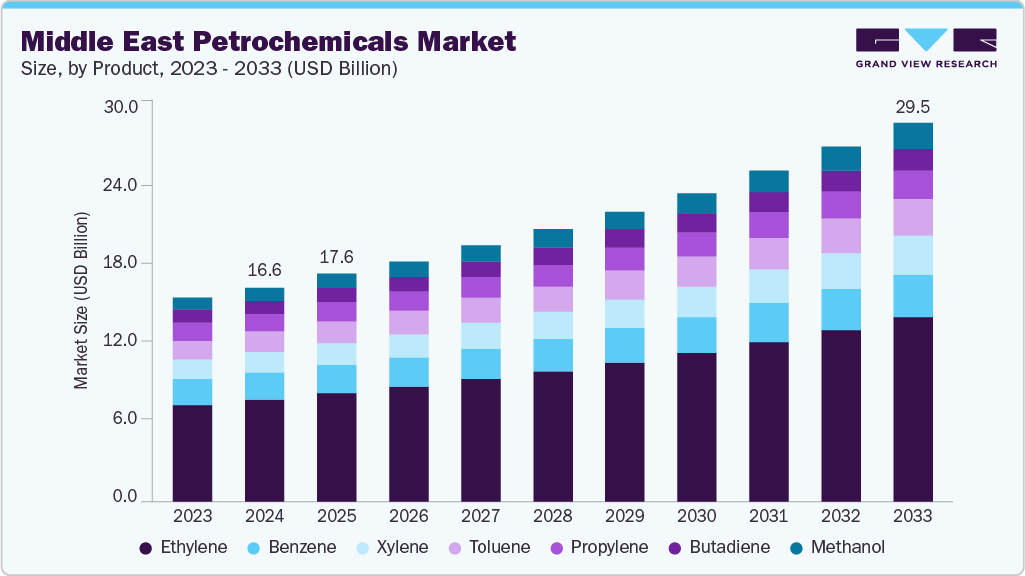
The Middle East petrochemicals market size was estimated at USD 16.55 billion in 2024 and is projected to reach USD 29.46 billion by 2033, growing at a CAGR of 6.7% from 2025 to 2033, due to its increasing demand as fuels and as essential feedstocks for various industrial applications. The combustion of crude oil historically opened the path for generating multiple forms of energy, making petroleum a vital source for lighting, heating, and transportation, particularly as the most efficient fuel for internal combustion engines.
Key Market Trends & Insights
- Saudi Arabia dominated the Middle East petrochemicals market with the largest revenue share of 41.9% in 2024.
- The Middle East petrochemicals market is projected to grow at a CAGR of 6.7% from 2025 to 2033.
- By Product, ethylene dominated the Middle East petrochemicals market with a revenue share of 29.7% in 2024.
- By Product, methanol segment is expected to witness the fastest growth of 8.1% from 2025 to 2033.
Market Size & Forecast
- 2024 Market Size: USD 16.6 Billion
- 2033 Projected Market Size: USD 29.5 Billion
- CAGR (2025-2033): 6.7%
- Saudi Arabia: Largest market in 2024
- UAE: Fastest growing market
This role grew rapidly with the rise of motor vehicles and other engine-powered machinery. Beyond transportation, petroleum emerged as a critical raw material for synthesizing organic compounds. Petrochemicals encompass a broad spectrum of industrially important products, including fuels such as gasoline and kerosene, and petroleum jelly, which serves as an ointment base, lubricant, and protective coating. They also provide essential raw materials for producing wax, fertilizers, preservatives, soaps, detergents, dyes, plastics, plasters, footwear, and explosives. Wax, a petroleum by-product, is widely used in candles and molds, with advancements in wax emulsion production enhancing quality and stability for industrial applications. These diverse uses highlight petrochemicals’ indispensable role in powering economies, enabling manufacturing, and supporting modern lifestyles, making their continued development and availability a key driver for industrial growth worldwide.Ethylene remains a cornerstone of the petrochemical industry, driven by its versatility and vital role across multiple high-demand sectors. One of its primary growth drivers is its extensive use in polyethylene production, particularly high-density polyethylene (HDPE) and low-density polyethylene (LDPE). HDPE’s exceptional strength and durability make it indispensable for rigid containers, detergent bottles, and underground piping applications. At the same time, LDPE’s flexibility supports widespread use in shopping bags, squeezable bottles, and film packaging. The scale of demand underscores ethylene’s central role in the plastics value chain. Another major driver is its use in producing ethylene glycol, a critical intermediate for antifreeze and polyester manufacturing. In the automotive sector, ethylene glycol enhances coolant performance by lowering freezing points and preventing corrosion, while in textiles and packaging, it is essential for producing polyester fibers and resins.
In the downstream segment, ethylene-derived polymers such as polypropylene and vinyl chloride monomer (VCM) further enhance its market significance. Polypropylene’s lightweight yet durable properties make it a valuable material in the automotive industry, improving fuel efficiency without compromising strength. At the same time, its widespread use in packaging ensures product safety during transportation and storage. VCM, which is converted into PVC, supports expanding infrastructure needs and is poised for growth in line with global construction activity. Beyond these, ethylene is essential in producing synthetic rubbers and specialty polymers, integral to high-performance automotive components and weather-resistant materials.
However, despite its promising growth outlook, the Middle East petrochemical market faces notable challenges that could restrain its expansion. Stringent regulatory frameworks in the region, particularly those governing emissions control, waste management, and broader environmental sustainability, are increasing compliance costs for petrochemical producers and technology developers.
Market Concentration & Characteristics
The Middle East petrochemicals market is moderately fragmented, with major players holding substantial market share through extensive vertical integration and large-scale operations. These companies control significant portions of the value chain, from feedstock production and refining to advanced petrochemical manufacturing and distribution, enabling cost optimization, consistent product quality, and reliable supply to key sectors such as benzene, toluene, xylene, polyethylene, and polypropylene. Their strong infrastructure, advanced R&D capabilities, and broad distribution networks allow them to serve both regional and global markets while meeting stringent environmental and regulatory requirements.
Alongside these dominant players, companies are expanding their presence by leveraging technological expertise, innovative process solutions, and regional market opportunities. These emerging and mid-sized participants are focusing on cost-efficient petrochemical production, specialty chemicals, and low-carbon solutions, targeting applications in packaging, automotive, construction, and energy sectors. The competitive landscape is thus evolving, driven by the interplay between large integrated producers with global reach and agile innovators capitalizing on niche opportunities and sustainability trends.
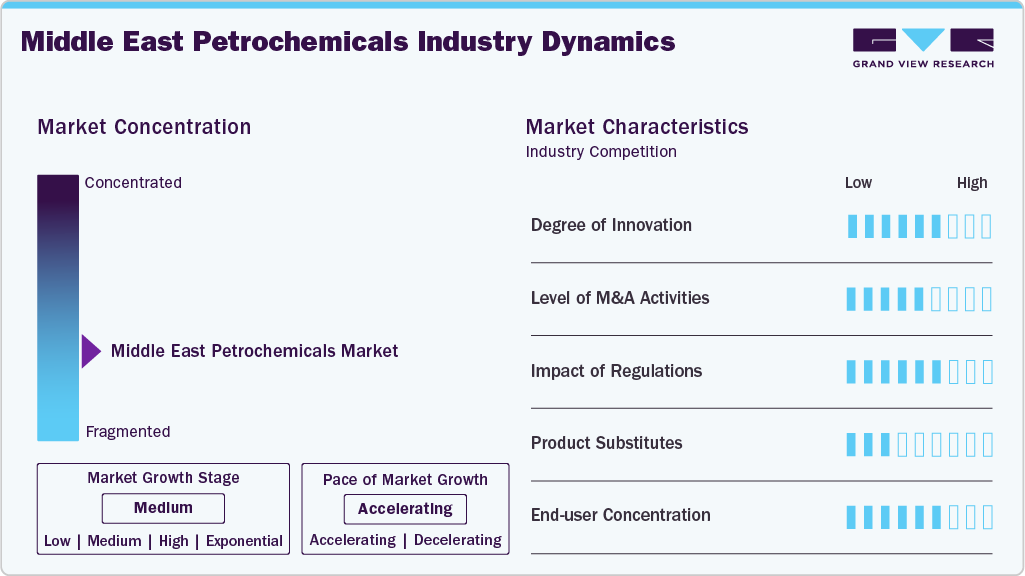
However, the sector faces challenges including feedstock price volatility, supply chain constraints, and regulatory pressures to reduce carbon emissions and improve environmental performance. In addition, climate-related risks such as water scarcity, extreme heat, and weather disruptions threaten operational continuity. To sustain growth, market players are increasingly investing in green hydrogen, carbon capture, circular economy initiatives, and digitalization to enhance efficiency, resilience, and alignment with the region’s long-term decarbonization goals.
Product Insights
Ethylene segment dominated the Middle East petrochemicals market with a market share of 29.7% in 2024, driven by its high chemical reactivity due to the carbon-carbon double bond, making it ideal for producing a wide range of value-added derivatives. Its versatility supports the production of key petrochemicals products such as polyethylene, polyvinyl chloride, polyester, polystyrene, ethylene oxide, ethylene glycols, styrene, vinyl acetate monomer (VAM), and ethylene dichloride (EDC), which serve vital industries including packaging, construction, automotive, and textiles. In the region, demand is fueled by the need for downstream diversification, infrastructure growth, and expansion of plastics and polymer manufacturing. Ethylene’s role in producing high-demand intermediates like ethylene glycols, used in antifreeze and PET packaging, further strengthens its strategic importance. For instance, in May 2024, SABIC announced an expansion of its ethylene production capacity at its Jubail complex to meet rising domestic and export demand, reinforcing the Middle East’s position as a global hub for ethylene-based products.
Methanol segment of Middle East petrochemicals byproducts are expected to grow at the fastest with a CAGR of 8.1% from 2025 to 2033 during the forecast period, due to highly versatile industrial feedstock essential for producing chemicals like acetic acid, formaldehyde, and various petrochemicals derivatives used in plastics, fibers, paints, adhesives, and pharmaceuticals. Its ability to be produced from natural gas, waste, and captured CO₂ with green hydrogen makes it valuable for both conventional and sustainable markets. Beyond chemicals, methanol serves as a clean-burning fuel for transport, power generation, and heating, with renewable methanol offering carbon-neutral benefits. It plays a dual role in the Middle East as a key petrochemicals feedstock and cleaner energy carrier, supporting low-emission growth strategies. For instance, in August 2025, Fuji Electric and Mitsubishi Gas Chemical announced a joint study to develop a hydrogen fuel cell system using green methanol, with demonstrations planned by March 2027. This system aims to deliver clean, on-demand power while addressing hydrogen storage and transport challenges.
Country Insights
Saudi Arabia Petrochemicals Market Trends
The Middle East petrochemicals market in Saudi Arabia held 41.9% of the Middle East petrochemicals market revenue share in 2024, due to strong demand for polyethylene-based ethylene product of petrochemicals, across industries such as packaging, construction, automotive, and consumer goods for its durability, chemical resistance, and processability. Advanced grades like HDPE and UHMWPE meet high-performance needs in sectors like defense, aerospace, and energy. The industry is increasingly focusing on sustainability, recyclability, and bio-based alternatives to meet environmental regulations and consumer expectations. Technological innovations in catalysts, polymerization, and digital manufacturing enhance product quality and efficiency. Global market growth, competitive differentiation, and value chain integration further drive the development and adoption of polyethylene-based petrochemicals.
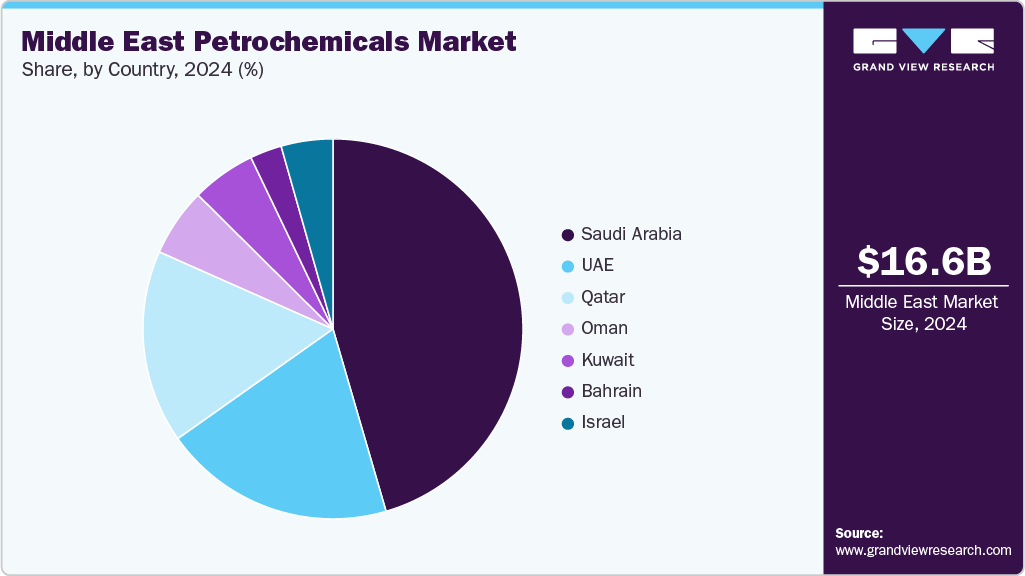
UAE is likely to exhibit the highest CAGR of 7.1% during the review period. The UAE petrochemical sector is undergoing rapid transformation driven by large-scale capacity expansion, strategic consolidation, and government-backed diversification initiatives. ADNOC is spearheading growth by doubling petrochemical output, forming Borouge Group International with OMV and Borealis, and pursuing acquisitions such as Covestro to diversify into high-value chemicals. This expansion not only positions the UAE as a global polyolefins leader but also reduces reliance on fuel products, aligning with global energy transition dynamics. Supported by initiatives like Ta’zeez in Ruwais, the country is building downstream capacity for products such as PVC, ammonia, and methanol while ensuring sustainable growth through low-carbon technologies, recycling, and bio-based feedstocks.
The sector’s growth is further strengthened by the UAE’s strategic geographic location, providing efficient access to high-demand Asian markets where polyethylene consumption is set to double by 2030. Adoption of Industry 4.0 tools-AI, IoT, and digitalized supply chains-enhances productivity, cost efficiency, and sustainability.
Key Middle East Petrochemicals Company Insights
Some of the key players operating in the Middle East petrochemicals market include SABIC and Saudi Arabian Oil Co.
-
Saudi Arabian Oil Co. (Aramco) is a dominant force in the Middle East petrochemicals market, leveraging vast upstream resources, an extensive refining network, and advanced chemical capabilities. The company integrates refining and petrochemicals to maximize value from hydrocarbons, aligning with Saudi Vision 2030 to drive economic diversification and sustainability. Aramco has invested in technologies to convert crude directly into chemicals, expanded production of polyethylene, polypropylene, and aromatics, and forged global partnerships for technology transfer. It is also advancing low-carbon initiatives, including carbon capture, advanced recycling, and hydrogen development. Through its scale, feedstock security, and innovation, Aramco reinforces the region’s global petrochemicals leadership while supporting its low-emission transition.
Exxon Mobil Corporation and Chevron Lummus Global (CLG) are emerging market participants in the Middle East petrochemicals market.
-
Exxon Mobil Corporation is a significant international player in the Middle East petrochemicals market, operating through joint ventures and partnerships in countries such as Qatar and Saudi Arabia. The company leverages its advanced refining and chemical integration technologies to produce high-value petrochemicals, including polyethylene, polypropylene, and aromatics, for both regional and global markets. ExxonMobil’s Middle East strategy focuses on large-scale, high-efficiency projects that maximize feedstock value and support industrial diversification. The company is also investing in lower-emission solutions, such as carbon capture and energy efficiency enhancements, to align with regional sustainability goals. Through its technological expertise, strong capital base, and collaborative approach, ExxonMobil continues to strengthen its role in the region’s petrochemicals growth and export competitiveness.
Key Middle East Petrochemicals Companies:
- SABIC
- Exxon Mobil Corporation
- Chevron Lummus Global (CLG)
- Kinetic Technologies
- Linde PLC
- Sipchem Company
- Saudi Arabian Oil Co.
- Tasnee
- INEOS AG
- Shell Global
Recent Developments
-
In June 2025, INEOS begun advanced recycled plastic production at its Lavéra petrochemicals complex by processing pyrolysis oil, made from hard-to-recycle post-consumer plastic waste, into virgin-quality polyethylene and polypropylene. This move aligns with the EU’s strict 2030 and 2040 recycled content regulations and supports the shift toward circular economy practices in plastics. Lavéra facility’s ability to convert pyrolysis oil into recycled ethylene and propylene for use in packaging, infrastructure, and consumer goods demonstrates a key shift in the petrochemicals industry’s feedstock mix, from solely fossil-based sources to certified recycled and renewable inputs, indicating that Middle East producers will need to adapt similar innovations to remain competitive in evolving global plastic supply chains and use of petrochemicals.
-
In February 2025, TA’ZIZ awarded a $1.7 billion EPC contract to SAMSUNG E&A for the construction of one of the world’s largest methanol plants in Al Ruwais Industrial City, Abu Dhabi. The 1.8 mtpa facility, the UAE’s first methanol production plant, is set for completion in 2028 and will be powered by clean energy, making it among the most energy-efficient globally. The project marks a major step in advancing the UAE’s economic diversification by creating new chemical value chains and positioning the country as a leader in sustainable chemical production. In its first phase, TA’ZIZ will produce 4.7 mtpa of chemicals-including methanol, low-carbon ammonia, PVC, ethylene dichloride, vinyl chloride monomer, and caustic soda-several of which will be produced domestically for the first time, strengthening the UAE’s role as a global hub for advanced chemicals.
-
In May 2024, ExxonMobil completed its acquisition of Pioneer Natural Resources, significantly expanding its upstream oil and gas operations in the Permian Basin, one of the key global sources of feedstock for the petrochemicals industry. The deal more than doubles ExxonMobil’s Permian footprint to over 1.4 billion net acres, with an estimated 16 billion barrels of oil equivalent resources. Production is expected to grow from 1.3 billion barrels of oil equivalent per day (2023) to about 2 billion by 2027.
Middle East Petrochemicals Market Report Scope
Report Attribute
Details
Market size value in 2025
USD 17.59 billion
Revenue forecast in 2033
USD 29.46 billion
Growth rate
CAGR of 6.7% from 2025 to 2033
Base year for estimation
2024
Historical data
2018 - 2023
Forecast period
2025 - 2033
Quantitative units
Revenue in USD million/billion, Volume in Kilotons, and CAGR from 2025 to 2033
Report coverage
Revenue forecast, company ranking, competitive landscape, growth factors, and trends
Segments covered
Product, country
Regional scope
Middle East
Country scope
Oman; Kuwait; Saudi Arabia; UAE; Qatar; Bahrain; Israel
Key companies profiled
SABIC; Exxon Mobil Corporation; Chevron Lummus Global (CLG); Kinetic Technologies; Linde PLC; Sipchem Company; Saudi Arabian Oil Co.; Tasnee; INEOS AG; Shell Global
Customization scope
Free report customization (equivalent to up to 8 analysts’ working days) with purchase. Addition or alteration to country, regional & segment scope.
Pricing and purchase options
Avail customized purchase options to meet your exact research needs. Explore purchase options
Middle East Petrochemicals Market Report Segmentation
This report forecasts revenue growth at regional, and country levels and provides an analysis of the latest industry trends in each of the sub-segments from 2018 to 2033. For this study, Grand View Research has segmented the Middle East petrochemicals market report based on product and country.
-
Product Outlook (Revenue, USD Billion; Volume, Kilotons, 2018 - 2033)
-
Ethylene
-
Propylene
-
Butadiene
-
Benzene
-
Xylene
-
Toluene
-
Methanol
-
-
Country Outlook (Revenue, USD Billion; Volume, Kilotons, 2018 - 2033)
-
Middle East
-
Oman
-
Kuwait
-
Saudi Arabia
-
UAE
-
Qatar
-
Bahrain
-
Israel
-
-
Frequently Asked Questions About This Report
b. The Middle East petrochemicals market size was estimated at USD 16.6 billion in 2024 and is expected to reach USD 17.6 billion in 2025.
b. The Middle East petrochemicals market is expected to grow at a compound annual growth rate of 6.7% from 2025 to 2033 to reach USD 29.46 billion by 2033.
b. The Saudi Arabia Middle East petrochemicals segment led the market and accounted for the largest revenue share of 41.9% in 2024, due to strong demand for polyethylene-based ethylene product of petrochemicals, across industries such as packaging.
b. Some of the key players operating in the Middle East petrochemicals market include SABIC, Exxon Mobil Corporation, Chevron Lummus Global (CLG), Kinetic Technologies, Linde PLC, Sipchem Company, Saudi Arabian Oil Co., Tasnee, INEOS AG and Shell Global.
b. The growth in the Middle East petrochemicals market is attributed to its increasing demand for fuels and essential feedstocks for various industrial applications. The combustion of crude oil historically opened the path for generating multiple forms of energy, making petroleum a vital source for lighting, heating, and transportation, particularly as the most efficient fuel for internal combustion engines.


Share this report with your colleague or friend.
Need a Tailored Report?
Customize this report to your needs — add regions, segments, or data points, with 20% free customization.


ISO 9001:2015 & 27001:2022 Certified
We are GDPR and CCPA compliant! Your transaction & personal information is safe and secure. For more details, please read our privacy policy.
Trusted market insights - try a free sample
See how our reports are structured and why industry leaders rely on Grand View Research. Get a free sample or ask us to tailor this report to your needs.













