
- Home
- »
- Advanced Interior Materials
- »
-
Middle East Powder Metallurgy Market, Industry Report 2033GVR Report cover
![Middle East Powder Metallurgy Market Size, Share & Trends Report]()
Middle East Powder Metallurgy Market (2025 - 2033) Size, Share & Trends Analysis Report By Material (Titanium, Steel, Nickel, Aluminum, Cobalt), By Process, By Application (Automotive, Oil & Gas), By End-use, By Country, And Segment Forecasts
- Report ID: GVR-4-68040-748-7
- Number of Report Pages: 100
- Format: PDF
- Historical Range: 2021 - 2023
- Forecast Period: 2025 - 2033
- Industry: Advanced Materials
- Report Summary
- Table of Contents
- Segmentation
- Methodology
- Download FREE Sample
-
 Download Sample Report
Middle East Powder Metallurgy Market Summary
The Middle East powder metallurgy market size was valued at USD 40.4 million in 2024 and is projected to reach USD 92.5 million by 2033, growing at a CAGR of 9.5% from 2025 to 2033. The region's expanding automotive and industrial manufacturing sectors primarily drive the market's growth.
Key Market Trends & Insights
- The powder metallurgy market in the Middle East is expected to grow at a substantial CAGR of 9.5% from 2025 to 2033.
- By material, titanium is anticipated to register the fastest CAGR of 11.3% from 2025 to 2033.
- By process, metal injection molding accounted for the largest market revenue share of over 56.0% in 2024.
- By application, the medical & dental segment is anticipated to register the fastest CAGR of 10.3% from 2025 to 2033.
- By end use, OEM’s segment is anticipated to register the fastest CAGR of 9.7% from 2025 to 2033.
Market Size & Forecast
- 2024 Market Size: USD 40.4 Million
- 2033 Projected Market Size: USD 92.5 Million
- CAGR (2025-2033): 9.5%
Powder metallurgy is increasingly being adopted to produce high-precision components such as gears, bushings, and structural parts, which offer minimal material wastage and enhanced durability. The rising emphasis on lightweight components and the gradual adoption of electric vehicles (EVs) in the Middle East further fuel demand, as powder metallurgy enables the production of complex, lightweight, and high-strength parts essential for EV efficiency and performance.
Sustainability and material efficiency are key priorities for Middle Eastern industries, particularly in energy-intensive sectors and growing environmental regulations. Powder metallurgy generates less scrap than traditional machining methods, with material utilization rates often reaching 95-98%, contributing to cost savings and reduced environmental impact. This high efficiency aligns with the region’s goals of promoting circular economy practices and sustainable manufacturing.
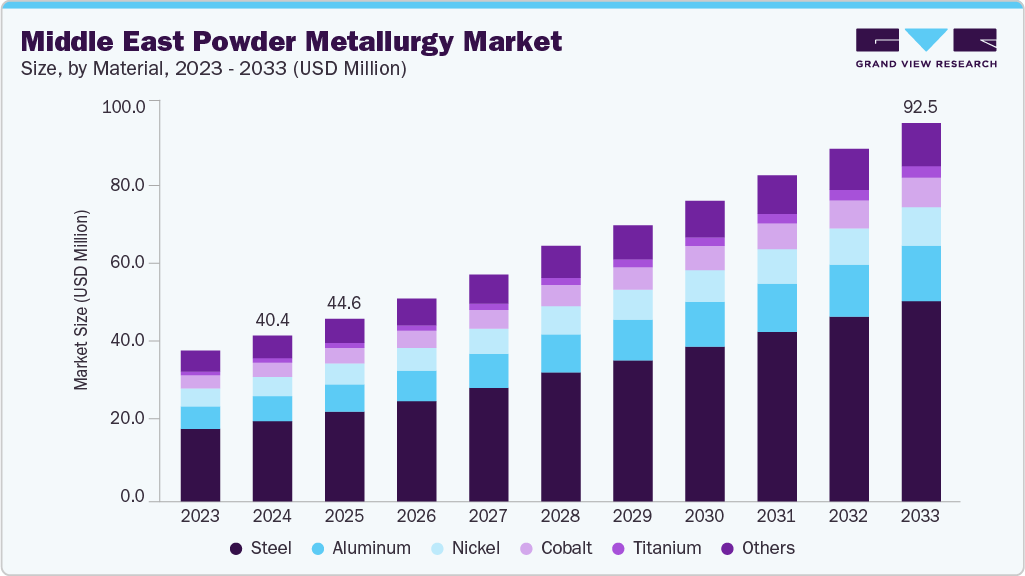
Technological advancements in powder production and processing further support market growth in the Middle East. Innovations such as gas and plasma atomization, laser sintering, and improved powder handling systems enhance powder quality, consistency, and mechanical performance. These developments enable tighter tolerances and durable finished parts, facilitating the adoption of high-performance powders such as nickel-based superalloys, aluminum alloys, and tungsten in industries such as defense, oil & gas, and heavy machinery. Leading industrial players in the region are increasingly integrating powder metallurgy components into engines, turbines, and other critical equipment for operational efficiency and performance optimization.
Government initiatives and strategic investments are also shaping the powder metallurgy landscape in the Middle East. Several countries fund advanced manufacturing research, support industry-academia collaborations, and encourage technology transfer to enhance domestic capabilities. Such programs aim to accelerate innovation, lower production costs, and broaden the adoption of powder metallurgy across the region's traditional and emerging sectors.
Drivers, Opportunities & Restraints
The powder metallurgy market in the Middle East is growing strongly due to the expanding automotive, aerospace, and medical industries. For example, Saudi Arabia's Vision 2030 promotes local manufacturing growth, including the automotive sector, where powder metallurgy plays a key role in making lightweight and durable parts. Companies like Emirates and Qatar Airways are investing in advanced technologies, such as additive manufacturing, to improve aircraft performance and lower weight in the aerospace industry. In addition, the medical field increasingly uses powder metallurgy to produce custom implants and surgical tools, driven by the need for personalized healthcare options.
Significant opportunities exist in the Middle East, especially in additive manufacturing (AM) and advanced material development. The region's push for industrial diversification and technological progress creates a supportive environment for adopting AM technologies. For example, the UAE's National Additive Manufacturing Strategy aims to position the country as a leader in 3D printing by 2030, which involves using metal powders to produce complex parts. Besides, advances in material science are enabling the creation of high-performance alloys designed for specific uses in aerospace, automotive, and medical industries, opening up pathways for growth and innovation.
Despite promising growth prospects, the regional market faces several challenges. A significant obstacle is the high cost of producing metal powders, which can be more expensive than traditional raw materials used in casting and forging. This cost issue makes it difficult for widespread adoption, especially among small and medium-sized businesses. The region's dependence on imported raw materials and advanced manufacturing technologies can also create supply chain vulnerabilities and potential delays. Moreover, the need for a skilled workforce experienced in powder metallurgy techniques remains a barrier, as specialized training and education programs are still developing in the region.
Material Insights
The titanium is anticipated to register the fastest CAGR of 11.3% over the forecast period. Powder metallurgy enables efficient and cost-effective production of titanium components that are otherwise expensive and difficult to machine using conventional methods. In the regional aerospace sector, titanium powders are increasingly used to manufacture structural parts and engine components that demand high strength-to-weight ratios and superior heat resistance. For example, Gulfstream and Emirates Engineering are exploring titanium AM parts for aircraft maintenance and retrofitting, reflecting the growing adoption of high-performance powders in the region.
Application Insights
The medical & dental segment is anticipated to register the fastest CAGR of 10.3% during the forecast period. The medical industry increasingly depends on powder metallurgy to produce miniaturized, precise, cost-effective surgical and diagnostic tools. Additive manufacturing is especially transformative, enabling rapid prototyping, customization, and small-batch production of implants and instruments tailored to individual patients. The rising use of minimally invasive surgical techniques, along with regulatory approvals for 3D-printed medical devices, further drives the growth of this segment in the region.
Powder metallurgy techniques, including metal injection molding and additive manufacturing, are increasingly adopted in the Middle East for producing complex parts such as turbine blades, structural brackets, and engine components using materials like titanium, nickel-based alloys, and stainless steel. These parts are designed to withstand extreme temperatures, high stress, and corrosive environments, making powder metallurgy an ideal choice for achieving performance and weight reduction goals. The region's defense industry also utilizes powder metallurgy to produce high-precision components for weapons systems, drones, and protective gear. By enabling near-net-shape manufacturing with minimal material waste and less machining, powder metallurgy offers a cost-effective and sustainable solution for critical applications.
End-use Insights
The OEM’s segment is anticipated to register the fastest CAGR of 9.7% from 2025 to 2033. OEMs in the Middle East benefit from powder metallurgy’s ability to produce near-net-shape parts with minimal waste, reduced machining, and shorter production cycles, which are critical for maintaining profitability and competitiveness in high-volume manufacturing environments. This is particularly relevant in the automotive sector, where regional OEMs increasingly use powder metallurgy to produce gears, camshaft components, and structural parts that meet stringent performance, durability, and safety standards. As the industry continues to focus on lightweighting, fuel efficiency, and precision engineering, powder metallurgy provides a versatile and cost-effective solution to meet evolving design and material requirements.
Additive manufacturing operators in the Middle East are also anticipated to grow significantly over the forecast period. These operators play a pivotal role in bridging the gap between concept and production by offering speed, design flexibility, and material efficiency. The increasing number of service bureaus and contract manufacturers adopting laser-based powder bed fusion, binder jetting, and electron beam melting reinforces this trend. Moreover, AM operators are driving innovation in powder handling, recycling, and process optimization, enhancing the cost-effectiveness and sustainability of additive manufacturing. They are increasingly participating in R&D collaborations to develop new alloys and printing techniques tailored to specific industrial applications, further accelerating the adoption of powder metallurgy technologies across the region.
Process Insights
The metal injection molding segment accounted for the largest market revenue share of over 56.0% in 2024. Metal Injection Molding (MIM) is especially useful for creating small, complex-shaped parts with tight tolerances and excellent surface finish. This makes it perfect for applications in medical, electronics, automotive, and consumer goods markets in the Middle East. As miniaturization becomes increasingly important-particularly in electronics and medical devices-MIM offers a scalable, cost-effective way to produce high-volume, precision metal parts like connectors, gears, surgical instruments, and watch components. MIM remains the leading process in the Middle East powder metallurgy industry, demonstrating its widespread use among powder-based manufacturing methods.
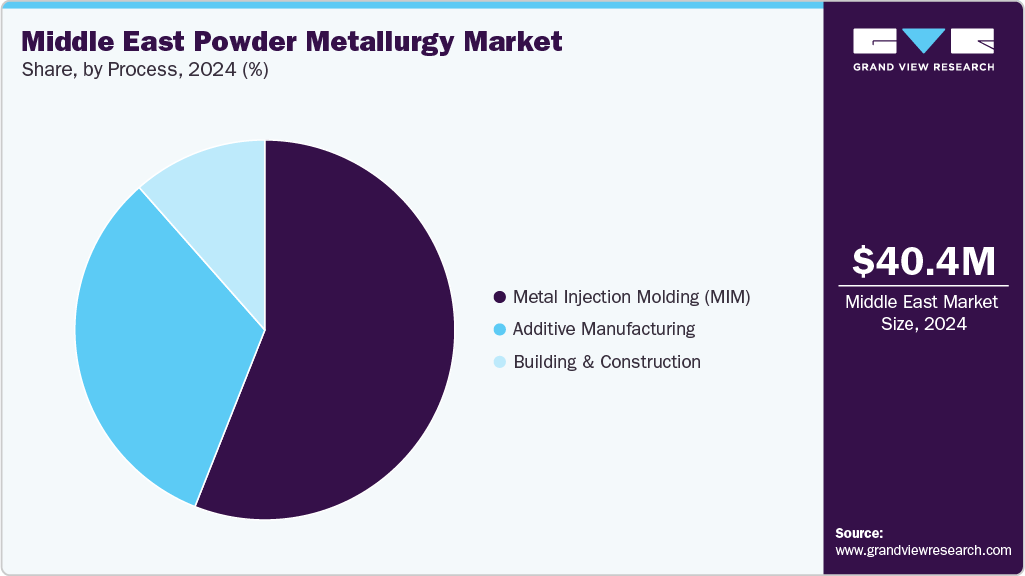
Powder Metal Hot Isostatic Pressing (PM HIP) and additive manufacturing are also critical regional processes. Among these, additive manufacturing is expected to have the fastest CAGR over the forecast period because of its ability to create complex shapes, cut down material waste, and enable quick prototyping. AM is especially useful in aerospace, medical, automotive, and defense sectors, where lightweight structures, customization, and performance are essential. Techniques like Selective Laser Melting (SLM) and Electron Beam Melting (EBM) allow precise layer-by-layer building of parts from metals such as titanium, stainless steel, and aluminum. The increasing use of AM in regional aerospace MRO facilities, medical device manufacturing, and automotive prototyping highlights its growing importance in the Middle East powder metallurgy industry.
Country Insights
The Middle East powder metallurgy industry is witnessing growing adoption across key industrial sectors, spurred by demand from automotive, aerospace, medical, and defense sectors. High-income developing economies such as Saudi Arabia and the UAE are increasingly investing in advanced manufacturing technologies, including additive manufacturing, metal injection molding, and hot isostatic pressing (HIP), to produce high-precision, durable, and lightweight components.
Saudi Arabia Powder Metallurgy Market Trends
The powder metallurgy industry in Saudi Arabia is gaining ground as manufacturers seek lightweight, high-precision, and durable components while decreasing costs. In particular, the automotive industry uses powder metallurgy to produce gears, bearings, and structural parts that improve fuel efficiency and cut emissions. Industries such as aerospace, defense, and heavy machinery are also adopting advanced powder metallurgy techniques to create high-performance, wear-resistant parts.
UAE Powder Metallurgy Market Trends
The powder metallurgy industry in the UAE is establishing itself as a center for advanced manufacturing, including powder metallurgy, supported by strategic initiatives like the National Additive Manufacturing Strategy. Rapid industrial growth, infrastructure investments, and access to skilled labor fuel the adoption of processes such as metal injection molding, additive manufacturing, and sintering.
Key Middle East Powder Metallurgy Company Insights
Some of the key players operating in the market include Iran Powder Metallurgy Complex, Masria for Metallurgical Powder Industry, and others.
-
Iran Powder Metallurgy Complex (IPMC), established in 1984 and based in Qazvin, Iran, is the sole producer of iron and metal powders in Iran and the largest in the Middle East. Utilizing water atomization technology originally supplied by Mannesmann Demag, IPMC manufactures a variety of metal powders, including iron powder in different grades and specifications. The company serves automotive, defense, and manufacturing industries, producing components like gears, bearings, and structural parts. IPMC's advanced production capabilities and extensive product range make it a key player in the region's powder metallurgy sector.
-
Tiangong International Co., Ltd., established in 1981 and headquartered in Danyang, Jiangsu Province, China, is a leading manufacturer of high-speed steel, die steel, cutting tools, and titanium alloys. The company operates over 1.3 million square meters of manufacturing facilities and employs over 3,600 individuals. Tiangong's products are utilized across various industries, including automotive, aerospace, and manufacturing, to produce components such as gears, turbochargers, and fuel system parts.
Key Middle East Powder Metallurgy Companies:
- 6K Additive
- American Elements Inc.
- CNPC Powder North America Inc.
- Falcon Advanced Metals PLC
- Höganäs AB
- Iran Powder Metallurgy Complex
- Ibraka Ltd.
- Kimetsan
- Tiangong International
- TG Manufacturing
Recent Development
-
In 2024, 6K Additive expanded its international presence by establishing new distribution and agent partnerships in select countries across Europe, the Middle East, and Asia. This strategic move aims to ensure customers in these regions have optimal access to 6K Additive’s full suite of additive manufacturing metal powders, enhancing the availability and delivery of high-quality materials for various industries.
-
Iran Powder Metallurgy Complex (IPMC), the sole producer of iron and metal powders in Iran and the largest in the Middle East, continues to enhance its production capabilities. The company utilizes advanced water atomization technology to manufacture a variety of metal powders, including iron powder in different grades and specifications. These developments support the growing demand for high-quality metal powders in automotive, defense, and manufacturing sectors.
Middle East Powder Metallurgy Market Report Scope
Report Attribute
Details
Market size value in 2025
USD 44.6 million
Revenue forecast in 2033
USD 92.5 million
Growth rate
CAGR of 9.5% from 2025 to 2033
Base year for estimation
2024
Historical data
2021 - 2023
Forecast period
2025 - 2033
Quantitative units
Revenue in USD million, volume in tons, and CAGR from 2025 to 2033
Report coverage
Volume forecast, revenue forecast, competitive landscape, growth factors, and trends
Segments covered
Material, process, application, end-use, country
Regional scope
Middle East
Country scope
Saudi Arabia; UAE; Qatar; Oman; Iran
Key companies profiled
6K Additive; American Elements Inc.; CNPC Powder North America Inc.; Falcon Advanced Metals PLC; Höganäs AB; Ibraka Ltd.; Iran Powder Metallurgy Complex (IPMC); Kimetsan; Tiangong International; TG Manufacturing
Customization scope
Free report customization (equivalent up to 8 analysts working days) with purchase. Addition or alteration to country, regional & segment scope.
Pricing and purchase options
Avail customized purchase options to meet your exact research needs. Explore purchase options
Middle East Powder Metallurgy Market Report Segmentation
This report forecasts revenue and volume growth at regional and country levels and provides an analysis of the latest industry trends in each of the sub-segments from 2021 to 2033. For this study, Grand View Research has segmented the Middle East powder metallurgy market report on the basis of material, process, application, end-use, and country.
-
Material Outlook (Volume, Tons; Revenue, USD Million, 2021 - 2033)
-
Titanium
-
Nickel
-
Steel
-
Aluminum
-
Cobalt
-
Others
-
-
Process Outlook (Volume, Tons; Revenue, USD Million, 2021 - 2033)
-
Additive Manufacturing
-
Powder Bed
-
Blown Powder
-
-
Hot Isostatic Pressing
-
Metal Injection Molding
-
-
Application Outlook (Volume, Tons; Revenue, USD Million, 2021 - 2033)
-
Aerospace & Defense
-
Automotive
-
Medical & Dental
-
Oil & Gas
-
Industrial
-
-
End-use Outlook (Volume, Tons; Revenue, USD Million, 2021 - 2033)
-
OEMs
-
AM Operators
-
-
Regional Outlook (Volume, Tons; Revenue, USD Million, 2021 - 2033)
-
Middle East
-
Saudi Arabia
-
UAE
-
Qatar
-
Oman
-
Iran
-
-
Frequently Asked Questions About This Report
b. Some of the key players operating in the powder metallurgy market include 6K Additive, American Elements Inc., CNPC Powder North America Inc., Falcon Advanced Metals PLC, Höganäs AB, Ibraka Ltd., Iran Powder Metallurgy Complex (IPMC), Kimetsan, Tiangong International, and TG Manufacturing.
b. The Middle East powder metallurgy market is growing steadily, driven by rising demand from the aerospace and defense sectors for lightweight, high-precision components. Adoption is also increasing in automotive, medical, and industrial applications, supported by advances in additive manufacturing, MIM, and HIP technologies.
b. The Middle East powder metallurgy market size was estimated at USD 40.4 million in 2024 and is expected to reach USD 44.6 million in 2025.
b. The Middle East powder metallurgy market is expected to grow at a compound annual growth rate of 4.3% from 2025 to 2033 to reach USD 62.3 million by 2033.
b. By process, metal injection molding accounted for the largest market revenue share of over 56.0% in 2024.


Share this report with your colleague or friend.
Need a Tailored Report?
Customize this report to your needs — add regions, segments, or data points, with 20% free customization.


ISO 9001:2015 & 27001:2022 Certified
We are GDPR and CCPA compliant! Your transaction & personal information is safe and secure. For more details, please read our privacy policy.
Trusted market insights - try a free sample
See how our reports are structured and why industry leaders rely on Grand View Research. Get a free sample or ask us to tailor this report to your needs.













