
- Home
- »
- Renewable Energy
- »
-
Natural Gas Liquids Market Size & Share Report, 2026-2033GVR Report cover

Natural Gas Liquids Market (2026 - 2033)
Size, Share & Trends Analysis Report By Application (Industrial, Commercial, Residential), By Product (Ethane, Propane, Isobutene, Natural Gasoline), By Region (North America, Europe, Asia Pacific, MEA), And Segment Forecasts
Market Size, 2025
$16.3BMarket Estimate, 2026
$17.2BMarket Forecast, 2033
$25.7BCAGR, 2026–2033
5.9%Natural Gas Liquids Market Summary
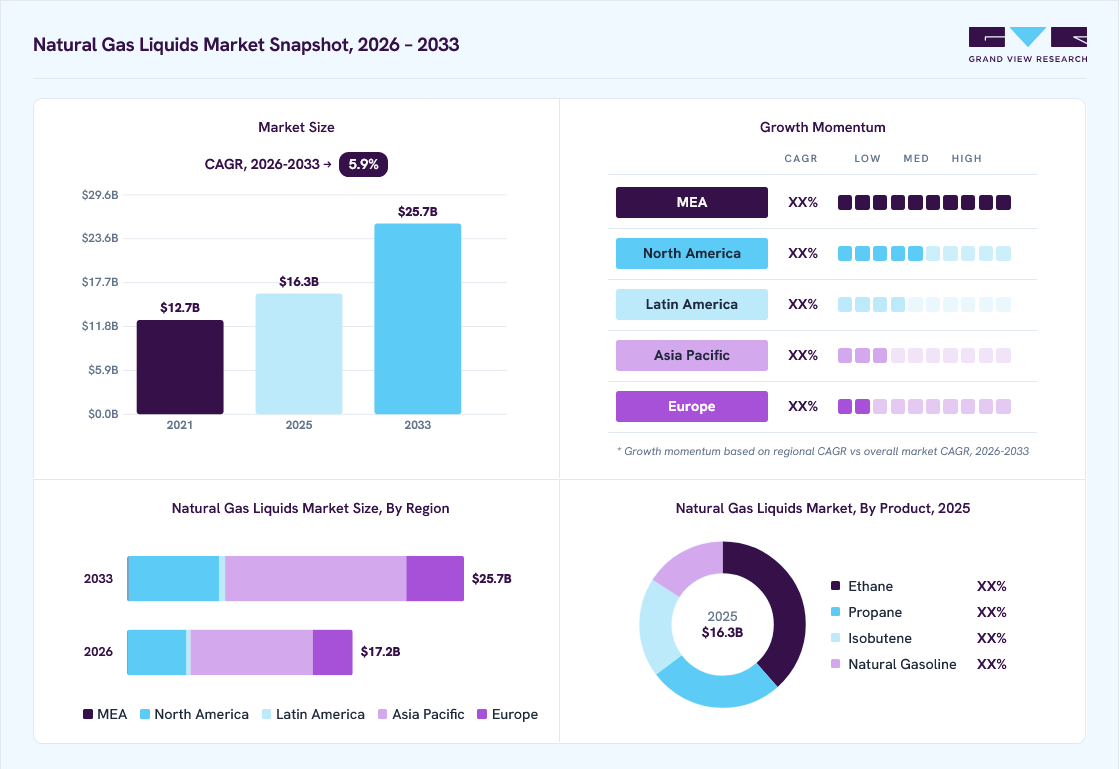
The global natural gas liquids market size was valued at USD 16.3 billion in 2025 and is projected to grow from USD 17.2 billion in 2026 to USD 25.7 billion by 2033, at a CAGR of 5.9% from 2026 to 2033. Asia Pacific dominated the market, accounting for a revenue share of 54.3% in 2025. This growth is driven by the increasing demand for NGLs as essential feedstocks in the petrochemical industry, as well as their use in heating, transportation, and industrial applications.
 Source: Grand View Research, IR Documents, Primary Interviews, Paid DatabasesTo learn more about this report,
 Download Free Sample Report
Key Market Trends & Insights
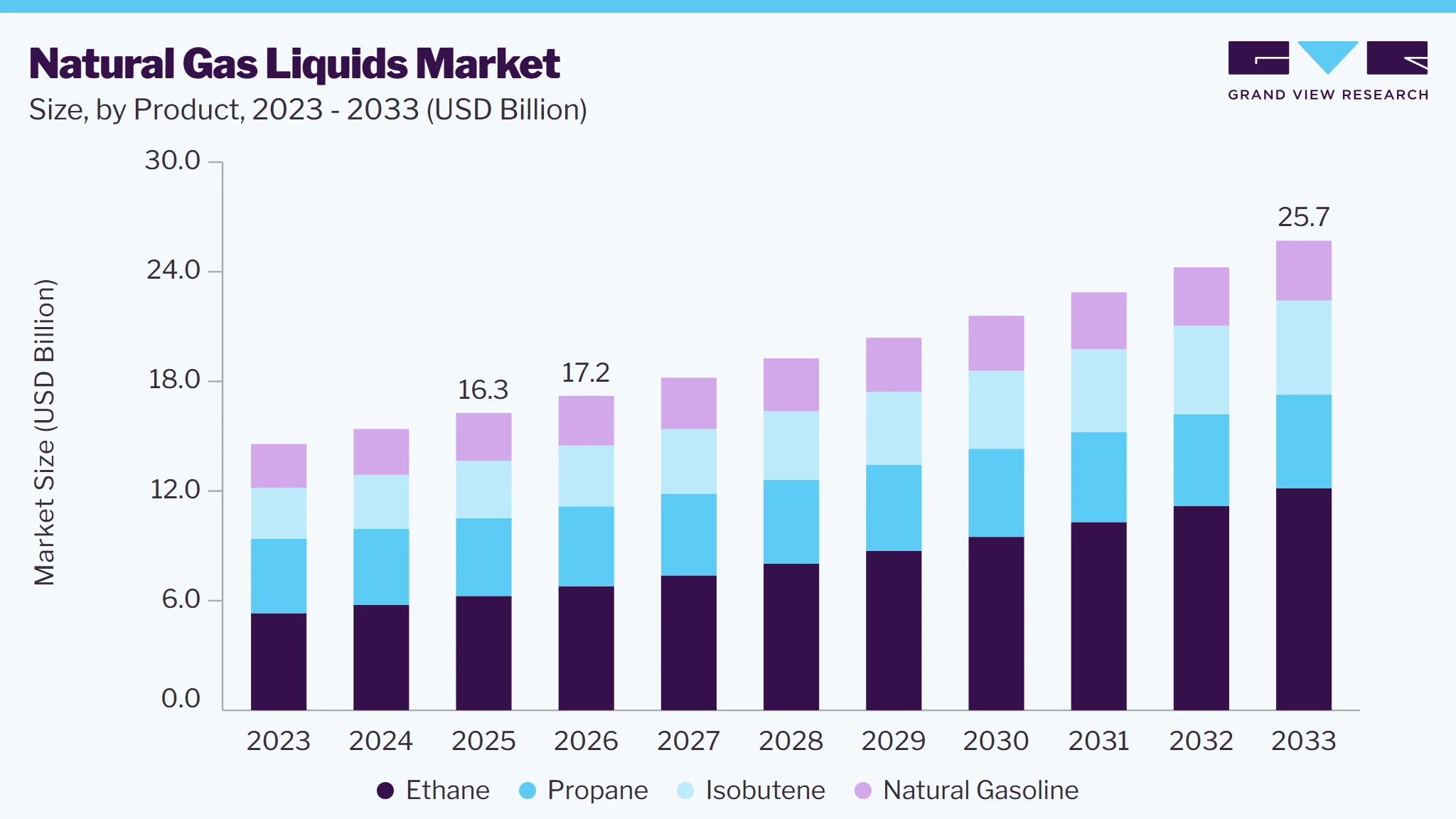
- By product: Ethane segment led the market with the largest revenue share of 38.4% in 2025.
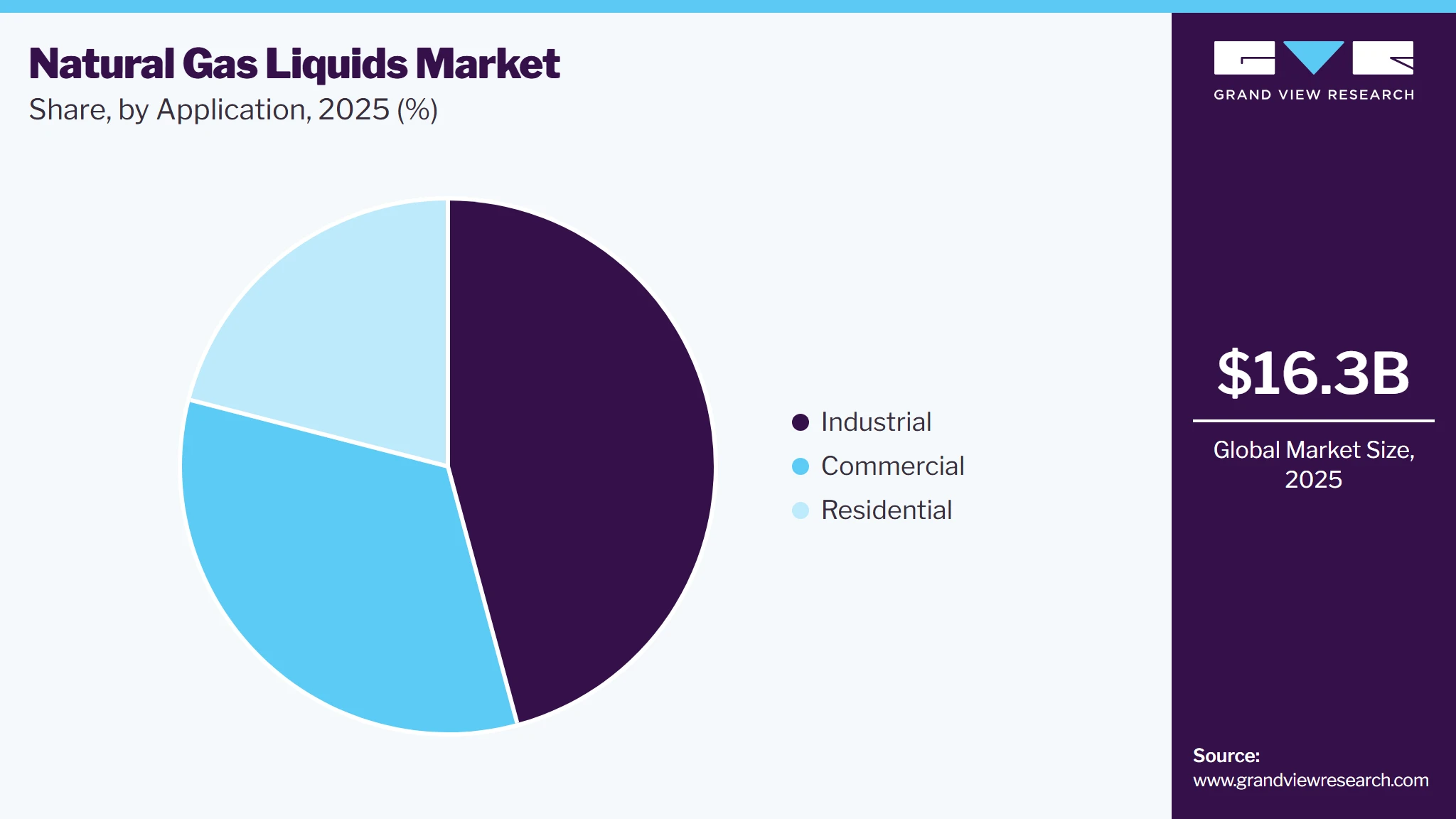
- By application: Industrial segment led the market with the largest revenue share of 45.8% in 2025.
Regional Highlights
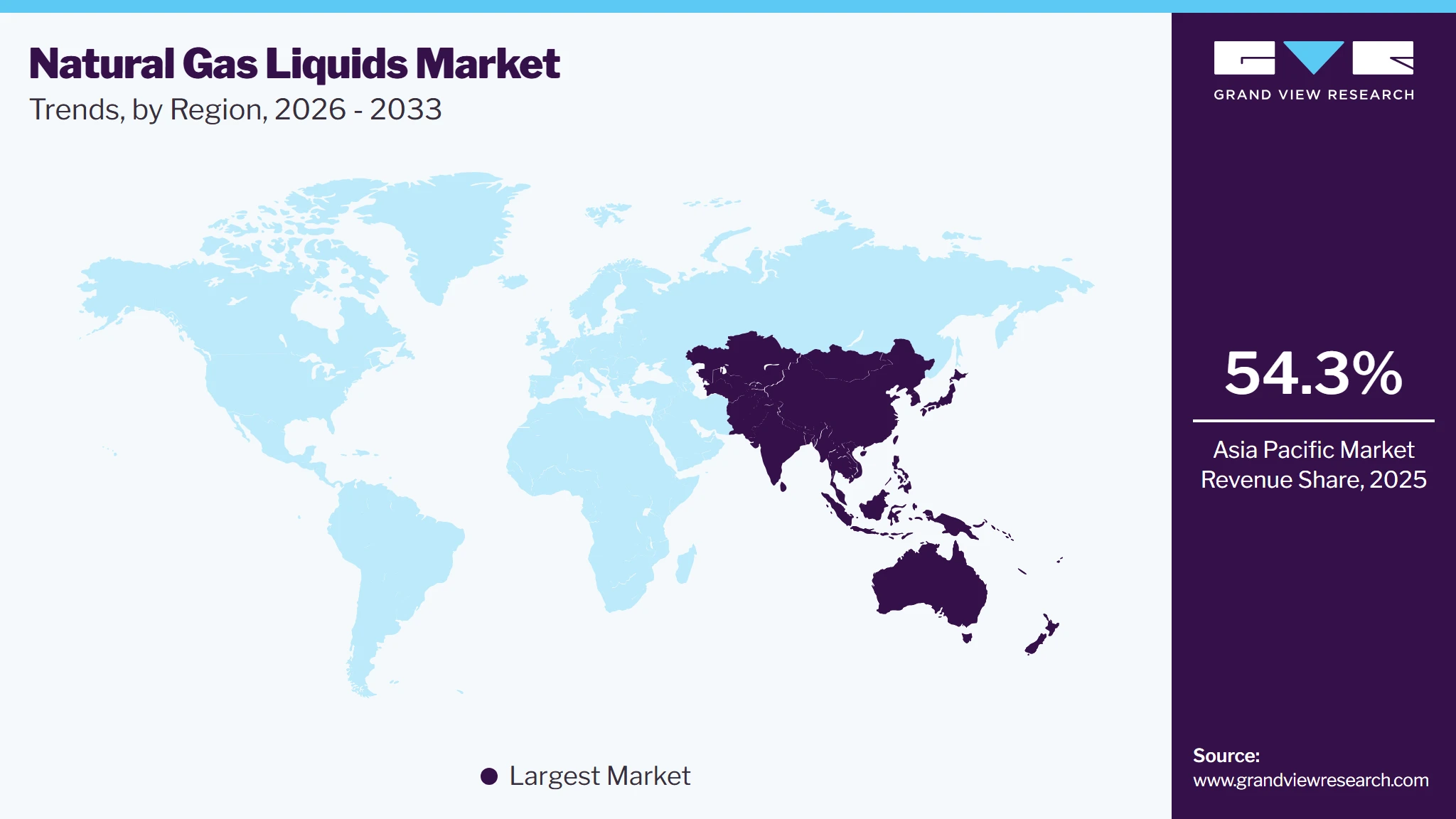
- Largest regional market: Asia Pacific (54.3% revenue share, 2025)
- By country: The China held the largest market share in 2025.
Market Size & Forecast
- Market size in 2025: USD 16.3 Billion
- Estimated market size in 2026: USD 17.2 Billion
- Projected market size by 2033: USD 25.7 Billion
- CAGR (2026-2033): 5.9%
Prism AI by Grand View Research Free to tryAsk a question about the natural gas liquids marketTry asking✓Every figure cited from GVR research Prefer the report? Download free sample →
The rapid expansion of shale gas production, particularly in North America, has significantly boosted the supply of natural gas liquids (NGLs), making them a critical component of the global energy mix. Additionally, the growing demand for plastics, chemicals, and other petrochemical products is fueling the need for NGLs such as ethane, propane, and butane, which are key raw materials in their production.Governments and industries worldwide are increasingly adopting NGLs as a cleaner and more efficient alternative to traditional fossil fuels. Stringent environmental regulations aimed at reducing carbon emissions and promoting sustainable energy sources are further accelerating the demand for NGLs. Companies are investing in advanced extraction and processing technologies to enhance the efficiency and sustainability of NGL production. Innovations in fractionation and transportation infrastructure are also improving the accessibility and cost-effectiveness of NGLs, making them a viable option for a wide range of applications. These developments are aligning the NGL market with global sustainability goals and driving its growth across regions.
 To learn more about this report, Download Free Sample Report
Technological advancements in natural gas processing and NGL extraction are playing a pivotal role in market expansion. Modern techniques, such as cryogenic processing and modular liquefaction, are increasing the efficiency of NGL recovery from natural gas streams. The integration of digital technologies, such as IoT and data analytics, is enabling real-time monitoring and optimization of NGL production processes, reducing operational costs and improving output quality. Furthermore, the rise of renewable energy integration and the development of bio-based NGL alternatives are creating new opportunities for market growth, as industries seek to balance energy demand with environmental responsibility.
The growing awareness of the economic and environmental benefits of NGLs is another key driver of market growth. NGLs offer a cost-effective and versatile energy solution, particularly in regions with abundant natural gas resources. Their use as feedstocks in petrochemical production helps reduce reliance on crude oil, while their application as cleaner-burning fuels supports efforts to lower greenhouse gas emissions. As global energy demand continues to rise and the transition toward cleaner energy sources gains momentum, the NGL market is poised to play a crucial role in ensuring energy security and supporting sustainable development worldwide.
Market Dynamics
The natural gas liquids (NGL) market is driven by rising global demand for petrochemical feedstocks, increasing natural gas production from shale and unconventional reserves, and growing utilization of ethane, propane, and butane across industrial and energy applications. Expanding petrochemical capacity, particularly in Asia Pacific and North America, is supporting demand for NGL-derived products such as ethylene and propylene. However, market growth is influenced by volatility in crude oil and natural gas prices, infrastructure constraints, and fluctuations in supply-demand balance. Increasing investments in natural gas processing, export terminals, and cleaner energy transition initiatives are creating new opportunities for market expansion.
The NGL market is significantly driven by the expansion of the global petrochemical sector, where NGL components serve as cost-effective and reliable raw materials for producing olefins, polymers, and specialty chemicals. Growing demand for plastics, packaging materials, synthetic fibers, and industrial chemicals is increasing the consumption of ethane, propane, and other NGL fractions. The shift toward lighter feedstocks in petrochemical manufacturing, supported by technological advancements in cracking processes, is further strengthening the role of NGLs in global chemical value chains.
In 2025, major petrochemical producers in the Middle East, North America, and Asia continued investing in integrated refining and chemical complexes to enhance production of high-value derivatives such as ethylene and propylene. For instance, new and expanded ethane-based cracker projects in the U.S. Gulf Coast region improved demand for domestically produced NGLs, while China’s continued addition of large-scale petrochemical capacity increased imports and utilization of NGL-based feedstock. These capacity expansions are expected to sustain NGL consumption growth through 2026.
The NGL market faces significant constraints due to fluctuations in crude oil and natural gas prices, which directly impact NGL production economics, pricing, and profitability. Since NGLs are often recovered as by-products of natural gas processing and crude oil production, changes in upstream drilling activity, energy demand, and geopolitical conditions can create supply instability. Additionally, infrastructure limitations, including insufficient pipelines, storage facilities, and export capacity in certain regions, can restrict the efficient transportation and commercialization of NGL volumes.
The market is gaining growth opportunities through increasing investments in export terminals, storage facilities, fractionation units, and transportation networks. As NGL production volumes rise and demand for ethane, propane, and butane-based products expands, enhanced infrastructure is enabling more efficient distribution and international trade. The development of integrated NGL supply chains is helping market participants improve logistics flexibility, optimize resource utilization, and address growing demand from petrochemical and industrial applications.
Analyst Perspective
The natural gas liquids (NGL) market is growing due to rising natural gas production, increasing petrochemical demand, and expansion of processing and export infrastructure. Companies are focusing on integrated NGL value chains, including pipelines, fractionation, storage, and trading capabilities, to improve operational efficiency. A key trend shaping the market is the growing adoption of advanced processing technologies and digital solutions to optimize NGL recovery and reduce operating costs. However, commodity price volatility, infrastructure constraints, and regulatory pressures remain major challenges. Future growth will be supported by increasing demand for ethane, propane, and other NGL products across industrial and chemical applications.
Application Insights
Based on application, the industrial segment led the market with the largest revenue share of 45.8% in 2025. This dominance is primarily driven by the extensive use of NGLs as feedstocks in the petrochemical industry, where they are essential for producing plastics, synthetic rubber, solvents, and other chemical products. Ethane, propane, and butane, the primary components of NGLs, are critical raw materials for manufacturing ethylene and propylene, which are the building blocks of a wide range of industrial products.
 To learn more about this report, Download Free Sample Report
The rapid growth of the petrochemical sector, particularly in regions like North America, Asia Pacific, and the Middle East, has significantly boosted the demand for NGLs. Additionally, industries such as refining, manufacturing, and oil & gas rely on NGLs for heating, fuel blending, and as process inputs, further solidifying the industrial segment's leading position in the market
Another key factor contributing to the industrial segment's dominance is the increasing adoption of NGLs as a cleaner and more cost-effective alternative to traditional fossil fuels in industrial processes. NGLs offer higher energy efficiency and lower emissions compared to coal and oil, making them an attractive option for industries aiming to reduce their carbon footprint and comply with stringent environmental regulations. The expansion of shale gas production, particularly in the U.S., has ensured a steady and abundant supply of NGLs, enabling industries to meet their growing energy and feedstock needs.
Furthermore, advancements in extraction and processing technologies have improved the efficiency and affordability of NGLs, making them a preferred choice for industrial applications. These factors collectively underscore the industrial segment's pivotal role in driving the growth of the global NGL market.
Product Insights
Based on product, the ethane segment led the market with the largest revenue share of 38.4% in 2025. This segment's dominance is attributed to its critical role as a feedstock in the petrochemical industry. Ethane is a key raw material for producing ethylene, which is widely used in the manufacturing of plastics, synthetic fibers, and other chemical products. The rapid expansion of the petrochemical sector, particularly in regions like North America, the Middle East, and Asia Pacific, has driven significant demand for ethane. The shale gas boom in the U.S. has further bolstered ethane production, as it is abundantly available in natural gas streams. This abundant supply, coupled with the growing demand for ethylene derivatives, has solidified ethane's position as the dominant segment in the NGL market.
Another key factor contributing to ethane's dominance is its cost-effectiveness and efficiency as a petrochemical feedstock compared to other alternatives like naphtha. Ethane cracking, the process of converting ethane into ethylene, is highly efficient and produces fewer byproducts, making it a preferred choice for petrochemical manufacturers.
Additionally, the development of advanced extraction and fractionation technologies has improved the recovery and processing of ethane, ensuring a stable and cost-competitive supply. The increasing focus on lightweight plastics and sustainable materials in industries such as packaging, automotive, and construction has further amplified the demand for ethane-derived products. These factors collectively highlight ethane's pivotal role in the global NGL market and its dominance as the largest segment.
Regional Insights
Asia Pacific dominated the natural gas liquids market with the largest revenue share of 54.3% in 2025, accounting for the largest revenue share of over 54.0%. This dominance is largely driven by rapid industrialization, urbanization, and increasing demand for petrochemical products. Countries like China and India are major contributors to market growth, as their expanding manufacturing and construction sectors require large quantities of NGLs for chemical production and energy use. The region’s focus on reducing reliance on crude oil and adopting cleaner energy sources is also boosting the demand for NGLs. Additionally, investments in natural gas infrastructure and the development of new petrochemical plants are further propelling the market, positioning Asia Pacific as a key growth hub in the global NGL industry.
 To learn more about this report, Download Free Sample Report
China Natural Gas Liquids Market Trends
The natural gas liquids market in China held the largest share in the Asia Pacific region in 2025. Natural gas liquids market in China is growing rapidly, driven by the country’s booming petrochemical industry and increasing demand for cleaner energy sources. The Chinese government’s focus on reducing carbon emissions and promoting sustainable development has led to a surge in the use of NGLs as feedstocks for chemical production and as alternatives to traditional fossil fuels. China’s growing middle class and expanding manufacturing sector are also driving demand for NGL-derived products, such as plastics and synthetic materials. Additionally, investments in natural gas infrastructure and the development of shale gas resources are further supporting market growth, positioning China as a key player in the global NGL market.
North America Natural Gas Liquids Market Trends
The North America natural gas liquids market is experiencing significant growth, driven by the region’s abundant shale gas reserves, advanced extraction technologies, and robust petrochemical industry. The United States, in particular, is a global leader in NGL production, thanks to the rapid expansion of shale gas operations in regions like the Permian Basin and Marcellus Shale. The region’s well-developed infrastructure for NGL extraction, fractionation, and transportation further supports its leading position. Additionally, the growing demand for NGLs as feedstocks in petrochemical manufacturing and as cleaner-burning fuels in industrial and residential applications has solidified North America’s dominance in the global NGL market.
The natural gas liquids market in the U.S. is thriving, fueled by the country’s shale gas boom and increasing demand for petrochemical feedstocks. The U.S. is the largest producer of NGLs globally, with ethane, propane, and butane being the primary components. The petrochemical industry is a major driver of market growth, as NGLs are essential for producing ethylene, propylene, and other chemical derivatives. The U.S. government’s focus on energy independence and infrastructure development has further boosted the demand for NGLs. Additionally, advancements in extraction and fractionation technologies have improved the efficiency and cost-effectiveness of NGL production, positioning the U.S. as a key player in the global NGL market.
Europe Natural Gas Liquids Market Trends
Europe’s natural gas liquids market is growing steadily, supported by the region’s focus on sustainability and energy diversification. Countries like Germany, France, and the UK are investing in natural gas infrastructure and petrochemical production, driving the demand for NGLs. The region’s stringent environmental regulations and commitment to reducing carbon emissions are also boosting the adoption of NGLs as cleaner-burning fuels and chemical feedstocks. Additionally, the growing demand for lightweight plastics and sustainable materials in industries such as automotive and packaging is further propelling the market, making Europe a significant player in the global NGL industry.
The natural gas liquids (NGLs) market in the UK is experiencing steady growth, driven by the country’s focus on energy diversification and reducing carbon emissions. The UK’s petrochemical industry is a key driver of demand for NGLs, particularly ethane and propane, which are essential feedstocks for producing plastics, chemicals, and synthetic materials. The country’s investments in natural gas infrastructure, including import terminals and pipelines, are supporting the availability and distribution of NGLs.
Additionally, the UK government’s commitment to achieving net-zero emissions by 2050 is encouraging the adoption of cleaner energy sources, including NGLs, as alternatives to traditional fossil fuels. These factors, combined with advancements in extraction and processing technologies, are positioning the UK as a significant player in the European NGL market.
Middle East & Africa Natural Gas Liquids Market Trends
In the Middle East and Africa, the natural gas liquids market is gaining momentum, driven by the region’s abundant natural gas reserves and focus on petrochemical production. Countries like Saudi Arabia, Qatar, and the UAE are major producers of NGLs, supplying global markets with ethane, propane, and butane. The region’s investments in natural gas infrastructure and petrochemical plants are further boosting market growth. Additionally, the growing demand for NGLs as feedstocks for chemical production and as alternatives to crude oil is driving the market, positioning the Middle East and Africa as key players in the global NGL industry.
Key Natural Gas Liquids Market Company Insights
The competitive landscape of the natural gas liquids industry is evolving rapidly, driven by the increasing demand for NGLs as feedstocks in petrochemical production and as cleaner energy sources. Key players range from global energy giants to regional specialists, all competing to capitalize on the growing need for NGLs.
Market dynamics are shaped by technological advancements in extraction, fractionation, and transportation, as well as the integration of digital technologies for process optimization. Strategic partnerships with petrochemical manufacturers, energy providers, and infrastructure developers are becoming crucial in strengthening market positions. Additionally, the focus on sustainability and regulatory compliance is driving innovation and investment in cleaner and more efficient NGL production, further intensifying market competition.
Key Natural Gas Liquids Companies
The following key companies have been profiled for this study on the natural gas liquids market.
-
ExxonMobil Corporation
-
Chevron Corporation
-
Royal Dutch Shell plc
-
BP plc
-
ConocoPhillips
-
TotalEnergies SE
-
Enterprise Products Partners LP
-
Eni S.p.A.
-
Occidental Petroleum Corporation
-
Saudi Aramco
-
Gazprom
-
Phillips 66
-
ONEOK, Inc.
-
Qatar Petroleum
-
Williams Companies, Inc.
Competitive Benchmarking
Category
Operating Strategies
Competitive Edge
Weakness
Established Players (ExxonMobil Corporation; Chevron Corporation; Shell plc; BP plc; ConocoPhillips; TotalEnergies; Enterprise Products Partners LP, Eni S.p.A.; Occidental Petroleum Corporation; Saudi Aramco)
- Maintain vertically integrated operations spanning upstream gas production, NGL extraction, processing, fractionation, storage, transportation, and global marketing.
- Expand NGL production capacity through investments in shale gas and liquids-rich basins such as the Permian, Eagle Ford, and Marcellus.
- Strengthen midstream infrastructure through pipeline networks, fractionation facilities, export terminals, and storage assets.
- Large-scale production capabilities and extensive global asset portfolios.
- Strong financial position enabling large capital investments in NGL infrastructure and acquisitions.
- Integrated supply chains provide cost advantages and greater control over production, logistics, and distribution.
- High exposure to commodity price volatility affecting NGL margins and profitability.
- Large asset bases can create operational complexity and slower strategic decision-making.
- Significant capital requirements for maintaining and expanding infrastructure.
Emerging Players (Targa Resources; Kinetik)
- Focus on expanding NGL production through targeted investments in high-return assets and liquids-rich shale plays.
- Utilize acquisitions, partnerships, and joint ventures to increase resource access and infrastructure capabilities.
- Prioritize operational efficiency and cost optimization to compete with larger integrated companies.
- Greater operational flexibility and faster decision-making compared with large integrated companies.
- Ability to focus on niche assets, specific regions, or high-growth production areas.
- Lower organizational complexity enables quicker adaptation to market changes.
- Smaller production volumes and limited geographic diversification compared with global majors.
- Lower financial capacity for large-scale infrastructure investments and international expansion.
- Greater dependence on third-party pipelines, processors, and logistics providers.
Recent Developments
-
In December 2024, ExxonMobil announced to expand its NGL processing capacity by constructing a new fractionation plant in the Gulf Coast region to separate NGLs into ethane, propane, and butane, meeting growing petrochemical and export demand by first quarter of 2025. This initiative aims to strengthen ExxonMobil’s position as a leading NGL supplier, with an expected 20% increase in processing capacity and USD 500 million in annual revenue.
-
In February 2025, Chevron announced to invest one USD billion to expand its NGL export infrastructure, including new storage facilities and loading terminals at key ports. This initiative aims to meet rising global demand, particularly in Asia and Europe. The expansion is expected to boost export volumes by 30%.
Natural Gas Liquids Market Report Scope
Report Attribute
Details
Market Definition
The natural gas liquids (NGL) market is defined as the revenue generated from the sales of NGL products, including ethane, propane, isobutene, and natural gasoline, used across industrial, commercial, and residential applications.
Market size in 2025
USD 16.3 billion
Estimated market size in 2026
USD 17.2 billion
Projected market size by 2033
USD 25.7 billion
Growth rate
CAGR of 5.9% from 2026 to 2033
Base year for estimation
2025
Historical data
2021 - 2024
Forecast period
2026 - 2033
Quantitative units
Revenue in USD Million and CAGR from 2026 to 2033
Report coverage
Revenue forecast, company ranking, competitive landscape, growth factors, and trends
Segments covered
Product, Application, Region
Regional scope
North America, Europe, Asia Pacific, Latin America, Middle East & Africa
Country scope
U.S.; Canada; Mexico; Germany; UK; Italy; Spain; France; Russia; China; India; Japan; Australia; Brazil; Argentina; Saudi Arabia; South Africa; UAE
Key companies profiled
ExxonMobil Corporation; Chevron Corporation; Shell plc; BP plc; ConocoPhillips; TotalEnergies; Enterprise Products Partners LP, Eni S.p.A.; Occidental Petroleum Corporation; Saudi Aramco; Targa Resources; Kinetik
Customization scope
Free report customization (equivalent up to 8 analysts' working days) with purchase. Addition or alteration to country, regional & segment scope.
Pricing and purchase options
Avail customized purchase options to meet your exact research needs. Explore purchase options
Global Natural Gas Liquids Market Report Segmentation
This report forecasts revenue growth at global, regional, and country levels and provides an analysis of the latest industry trends in each of the sub-segments from 2021 to 2033. For this study, Grand View Research has segmented the global natural gas liquids market report based on the application, product, and region:
 To learn more about this report, Download Free Sample Report
-
Application Outlook (Revenue, USD Million, 2021 - 2033)
-
Industrial
-
Commercial
-
Residential
-
-
Product Outlook (Revenue, USD Million, 2021 - 2033)
-
Ethane
-
Propane
-
Isobutene
-
Natural Gasoline
-
-
Regional Outlook (Revenue, USD Million, 2021 - 2033)
-
North America
-
U.S.
-
Canada
-
Mexico
-
-
Europe
-
Germany
-
UK
-
France
-
Italy
-
Spain
-
Russia
-
-
Asia Pacific
-
China
-
Japan
-
India
-
Australia
-
-
Central & South America
-
Brazil
-
Argentina
-
-
Middle East & Africa
-
Saudi Arabia
-
UAE
-
South Africa
-
-
Research Methodology
The Natural Gas Liquids market figures in this report are based on a proven research process that combines executive interviews with secondary research from proprietary databases, company filings, and recognized regulatory and institutional sources. Market size is built through value-chain sizing - reconciling supply-side and demand-side estimates - and triangulated with bottom-up and top-down approaches. Every estimate passes multiple levels of expert validation before publication, with each Natural Gas Liquids segment quantified using the revenue-capture definitions in the table below.
Segment Definition
Segment - Product
Revenue capture definition
Ethane
Ethane Natural Gas Liquids are light hydrocarbon liquids primarily recovered from natural gas streams and used as a feedstock for ethylene production in petrochemical applications. Revenue is generated from the sales of ethane supplied to petrochemical producers and industrial users.
Propane
Propane Natural Gas Liquids are hydrocarbon liquids extracted during natural gas processing and crude oil production, widely used for heating, cooking, petrochemical feedstock, and fuel applications. Revenue is generated from the sales of propane across residential, commercial, industrial, and petrochemical markets.
Isobutene
Isobutene Natural Gas Liquids are branched hydrocarbon compounds derived from NGL processing and used as feedstock for producing fuel additives, synthetic rubber, and specialty chemicals. Revenue is generated from the sales of isobutene supplied to chemical manufacturers and industrial applications.
Natural Gasoline
Natural Gasoline Natural Gas Liquids are heavier hydrocarbon liquids consisting primarily of pentanes and higher hydrocarbons, used as gasoline blending components, petrochemical feedstock, and diluents. Revenue is generated from the sales of natural gasoline to refineries, petrochemical facilities, and industrial users.
Segment - Application
Revenue capture definition
Industrial
Industrial Natural Gas Liquids (NGLs) are NGL products consumed across industrial applications, including petrochemical manufacturing, chemical processing, refining, and industrial fuel operations. Revenue is generated from the sales of NGL products such as ethane, propane, isobutene, and natural gasoline supplied to industrial end users for feedstock, heating, and processing applications.
Commercial
Commercial Natural Gas Liquids (NGLs) are NGL products utilized in commercial applications such as heating, cooking, power generation, and other business-related energy requirements. Revenue is generated from the sales of NGL products supplied to commercial establishments for energy and fuel-related applications.
Residential
Residential Natural Gas Liquids (NGLs) are NGL products used for household energy needs, including residential heating, cooking, and fuel applications. Revenue is generated from the sales of NGL products, primarily propane and other suitable NGL derivatives, distributed for residential consumption.
Estimation Model
Layer Name
Key Question
Description
Natural Gas Liquids Supply & Production Layer
What drives the availability of NGLs in the market?
Identify key supply sources for natural gas liquids, including natural gas processing plants, crude oil production facilities, and gas fractionation units. Assess factors such as natural gas production levels, upstream exploration activities, processing capacity additions, and NGL recovery rates that influence overall market supply.
Natural Gas Liquids Product & Processing Layer
What types of NGL products are traded and consumed?
Analyze the adoption and demand for major NGL products, including ethane, propane, isobutene, and natural gasoline. Assess product utilization based on applications such as petrochemical feedstock, fuel blending, heating, and industrial processing, along with factors influencing product pricing, processing requirements, and market preference.
Natural Gas Liquids Application & End-Use Layer
Where are NGL products utilized?
Evaluate NGL consumption across key applications, including industrial, commercial, and residential sectors. Assess demand drivers such as petrochemical production, chemical manufacturing, industrial fuel requirements, residential heating needs, and energy consumption patterns influencing NGL adoption across end-use industries.
Revenue Layer
How is market revenue generated?
Market revenue is quantified through the sales of natural gas liquids, including ethane, propane, isobutene, and natural gasoline supplied across industrial, commercial, and residential applications. The overall market value is determined by NGL product pricing, processing activities, transportation infrastructure, supply-demand dynamics, and consumption across end-use sectors.
Delivered Customizations
This report has been delivered with the following In-depth customizations
Client Request
Customization Delivered
Value Adds
Product Type Assessment
Analyzed key NGL product categories, including ethane, propane, butane, isobutane, and natural gasoline, based on supply dynamics, pricing factors, and end-use applications. Evaluated demand patterns and growth potential across different NGL product segments.
Supported identification of high-growth NGL products, understanding of market demand shifts, and assessment of opportunities across the NGL value chain.
Competitive Landscape Assessment
Benchmarked key NGL market participants based on production capacity, processing and fractionation capabilities, infrastructure footprint, geographic presence, supply chain integration, and strategic initiatives. Evaluated the competitive positioning of established and emerging players.
Supported competitor benchmarking, identification of leading NGL suppliers, and assessment of strategic expansion opportunities in NGL production, processing, and distribution markets.
Application Demand Assessment
Analyzed NGL demand across major applications, including petrochemicals, industrial fuels, residential and commercial heating, and transportation. Evaluated consumption trends, application-specific growth drivers, and factors influencing NGL adoption.
Helped understand end-use demand patterns, identify high-potential application segments, and assess future growth opportunities for NGL products.
Frequently Asked Questions About This Report
Based on application, the industrial segment accounted for largest revenue share of 45.8% in 2025.
The key players operating in the natural gas liquids market are ExxonMobil Corporation, Chevron Corporation, Shell plc, BP plc, ConocoPhillips, TotalEnergies, Enterprise Products Partners LP, Eni S.p.A., Occidental Petroleum Corporation, Saudi Aramco, Targa Resources, Kinetik, and others.
The natural gas liquids market is primarily driven by rising natural gas production, increasing petrochemical feedstock demand, expanding industrial applications, and investments in NGL processing, storage, and transportation infrastructure.
The global natural gas liquids market size was estimated at USD 16.3 billion in 2025 and is expected to reach USD 17.2 billion in 2026.
The Asia Pacific region dominated the natural gas liquids market with a revenue share of 54.3% in 2025.
China dominated the Asia Pacific region market with a revenue share of 68.1% in 2025.
North America is anticipated to register the fastest CAGR of 6.4% over the forecast period.
Based on product, the ethane segment accounted for largest revenue share of 38.4% in 2025.
The global natural gas liquids market is expected to grow at a CAGR of 5.9% from 2026 to 2033 to reach USD 25.7 billion by 2033.
About the Author(s)
Renewable Energy Research Team
Energy & Power · Renewable EnergyThis report was authored by the renewable energy research team at Grand View Research - comprising two research analysts, one senior research analyst, and one industry expert - with specialized expertise in the renewable energy segment of the energy & power industry. All findings are based on proprietary energy & power databases, executive interviews, and regulatory analysis, subject to internal peer review prior to publication.
Last Updated:
Speak to Analyst

Customize this report to your needs - add regions, segments, or data points, with 20% free customization.
Or view our licence options:


ISO 9001:2015 & 27001:2022 Certified
We are GDPR and CCPA compliant! Your transaction & personal information is safe and secure. For more details, please read our privacy policy.


