
- Home
- »
- Pharmaceuticals
- »
-
Plant-based Excipients Market Size, Share Report 2026-2033GVR Report cover

Plant-based Excipients Market (2026 - 2033)
Size, Share & Trends Analysis Report By Chemical Nature (Carbohydrates, Proteins, Polymers, Minerals), By Application And Function (Binders & Diluents), By Region, And Segment Forecasts
Market Size, 2025
$2.1BMarket Estimate, 2026
$2.2BMarket Forecast, 2033
$2.9BCAGR, 2026–2033
4.3%Plant-based Excipients Market Summary
The global plant-based excipients market size was valued at USD 2.1 billion in 2025 and is projected to grow from USD 2.2 billion in 2026 to USD 2.9 billion in 2033, at a CAGR of 4.3% from 2026 to 2033. North America dominated the market, accounting for a revenue share of 37.5% in 2025. Factors such as rising R&D in natural and plant-based excipients and increasing demand for halal, vegan, and vegetarian pharmaceuticals are driving market growth.
Key Market Trends & Insights
- By chemical nature: The carbohydrates segment held the largest share of around 21.5% in 2025.
- By application and function: The binders and diluents segment held the largest share of over 20.5% in 2025.
Regional Highlights
- Largest regional market: North America (37.5% revenue share, 2025)
- Fastest-growing regional market: Asia Pacific (highest CAGR, 2026-2033)
Market Size & Forecast
- Market size in 2025: USD 2.1 Billion
- Estimated market size in 2026: USD 2.2 Billion
- Projected market size by 2033: USD 2.9 Billion
- CAGR (2026-2033): 4.3%
Prism AI by Grand View Research Free to tryAsk a question about the plant-based excipients marketTry asking✓Every figure cited from GVR research Prefer the report? Download free sample →
Plant-based excipients are increasingly being incorporated into pharmaceutical formulations due to their functional versatility and compatibility with a wide range of dosage forms. Ingredients such as starch, cellulose, pectin, guar gum, and other naturally derived materials are widely used as binders, diluents, disintegrants, stabilizers, coating agents, and controlled-release materials. The growing preference for naturally sourced formulation components has encouraged pharmaceutical manufacturers to evaluate plant-derived alternatives across drug development and manufacturing processes.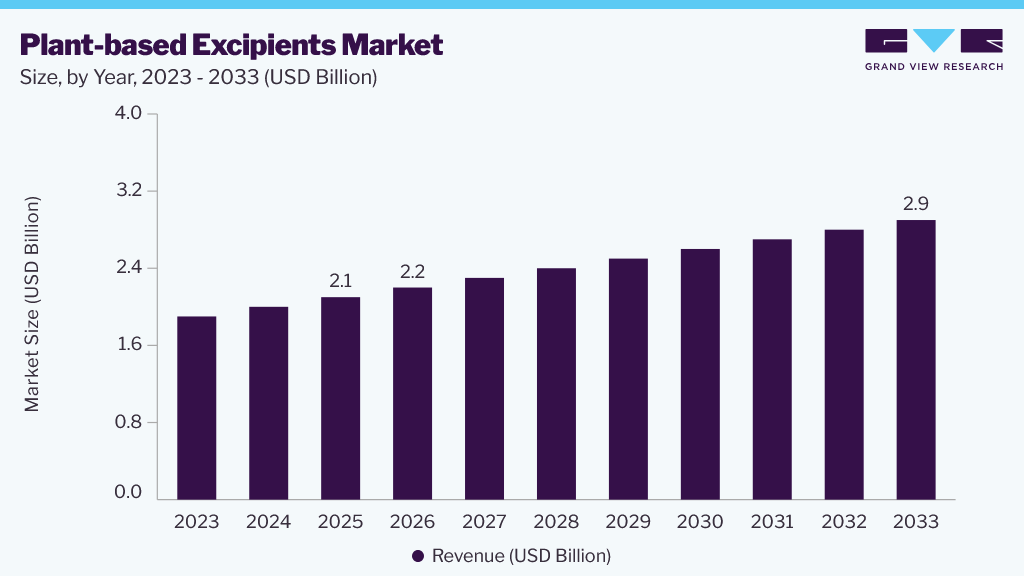 Source: Grand View Research, IR Documents, Primary Interviews, Paid DatabasesTo learn more about this report,
 Download Free Sample Report
Industry participants are also expanding their excipient portfolios through strategic acquisitions and product portfolio enhancement initiatives. For instance, in May 2025, Roquette completed the acquisition of IFF Pharma Solutions. The acquisition expanded Roquette's pharmaceutical excipients portfolio and strengthened its presence in drug delivery and formulation solutions.
Despite increasing adoption, replacing well-established synthetic and conventional excipients remains a key industry challenge. Pharmaceutical manufacturers must ensure consistent functionality, quality, and performance across different formulation environments, while managing variability associated with naturally derived raw materials. As a result, ongoing research and formulation optimization remain critical to supporting the broader adoption of plant-based excipients across pharmaceutical applications.
Analyst Perspective
The plant-based excipients market is gaining traction as pharmaceutical manufacturers increasingly prioritize naturally derived, sustainable, and regulatory-compliant formulation ingredients. Growing demand for vegan, vegetarian, halal, and clean-label pharmaceutical products is encouraging the adoption of plant-based alternatives across multiple dosage forms. In addition, advancements in formulation science are expanding the functional capabilities of plant-derived excipients in drug delivery, stabilization, and controlled-release applications. While consistency and performance validation remain, key challenges compared to conventional excipients, ongoing investments in research and product development are improving commercial viability. Long-term market growth will be influenced by innovation, regulatory acceptance, and formulation versatility.
Chemical Nature Insights
The carbohydrates segment held the largest share of around 21.5% of the market in 2025. Carbohydrate-based excipients are widely used in pharmaceutical formulations due to their multifunctional properties and broad regulatory acceptance. Plant-derived carbohydrates such as starch, cellulose, pectin, and alginates are widely incorporated as binders, diluents, disintegrants, stabilizers, and controlled-release agents in tablet, capsule, and liquid dosage forms. Their compatibility with a wide range of active pharmaceutical ingredients, cost-effectiveness, and established use in pharmaceutical manufacturing continue to support widespread adoption across the industry.
The ethers & carboxylic acids segment is expected to grow at a fast pace during the forecast period. The increasing demand for advanced drug delivery systems and formulation technologies is driving the adoption of excipients that improve the solubility, dissolution, and bioavailability of poorly soluble active pharmaceutical ingredients. Ethers and carboxylic acid derivatives play a critical role in enhancing the performance of oral dosage formulations, particularly for compounds with limited aqueous solubility.
Application And Function Insights
The binders and diluents segment held the largest share of over 20.5% in 2025. The segment's dominance is attributed to its use in formulations to impart flexibility or strengthen the bonding strength between particles. Binders help improve the gripping of substances in tablets and granules, which is crucial. They ensure the formulations are produced with the required physical strength and quantity. Binders and diluents are widely used to enhance particle adhesion, tablet integrity, and formulation stability in pharmaceutical manufacturing. The widespread use of naturally derived binders is supported by their biodegradability, formulation compatibility, and broad applicability across pharmaceutical and nutraceutical products.
Film-forming and coating agents are expected to grow at a significant rate during the forecast period. Increasing demand for advanced coating technologies that enhance product stability, appearance, protection, and controlled-release performance across pharmaceutical formulations. Manufacturers are expanding their portfolios with plant-derived coating materials to address evolving formulation requirements and sustainability objectives. For instance, in February 2025, Roquette launched a coatings platform comprising Tabshield and ReadiLYCOAT, a plant-based, ready-to-use coating system. The launch expanded the company's excipient portfolio with film-coating solutions designed for immediate and enteric-release applications, strengthening its presence in pharmaceutical coating technologies.
Regional Insights
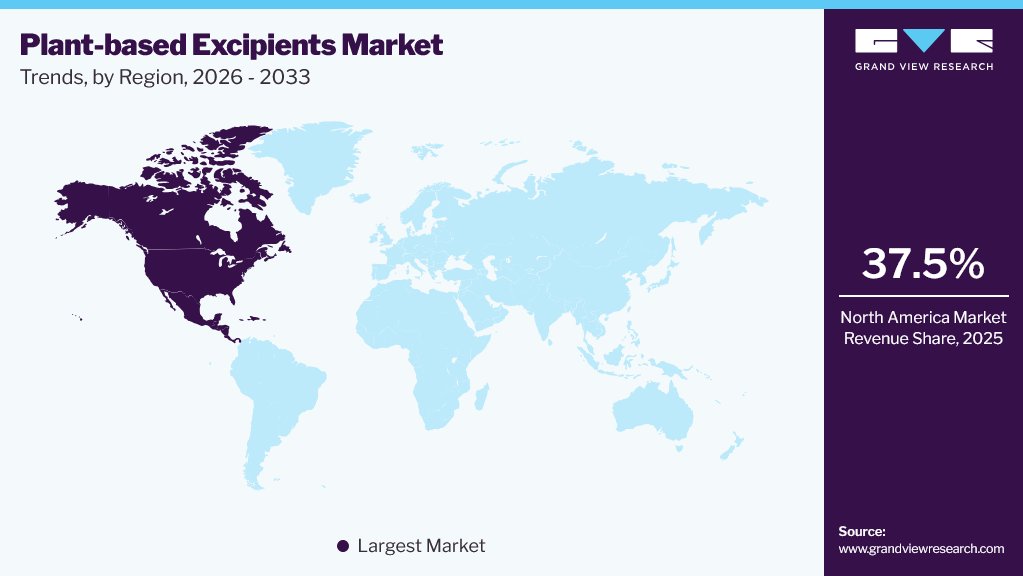
North America dominated the market, with a market share of approximately 37.5% in 2025, primarily driven by a well-established pharmaceutical industry, strong research capabilities, and an increasing focus on naturally derived formulation ingredients. Pharmaceutical manufacturers are actively evaluating plant-derived excipients to support clean-label, vegan, and specialty pharmaceutical formulations while addressing evolving consumer and regulatory expectations. The presence of major suppliers and ongoing investments in formulation technologies continue to support market development across the region.
 To learn more about this report, Download Free Sample Report
Asia Pacific Plant-based Excipients Market Trends
Asia Pacific is estimated to record the fastest CAGR over the forecast period. The region is witnessing increasing pharmaceutical manufacturing activity, expansion of generic drug production, and growing investments in healthcare infrastructure across countries such as India, China, and Southeast Asian markets. Demand for plant-based excipients is also supported by the growing use of naturally derived ingredients in pharmaceutical and nutraceutical formulations. In addition, the large vegetarian and halal consumer base across several countries is encouraging manufacturers to explore plant-derived alternatives for pharmaceutical applications.
Key Plant-based Excipients Market Companies Insights
Major companies operating in the plant-based excipients market are expanding their portfolios through product innovation, strategic acquisitions, and investments in naturally derived formulation ingredients. Industry participants are increasingly developing multifunctional excipients that enhance formulation stability, drug-delivery performance, and manufacturing efficiency across pharmaceutical and nutraceutical applications.
Key Plant-based Excipients Companies
The following key companies have been profiled for this study on the plant-based excipients market:
-
Roquette Frères
-
BASF Corporation
-
DFE Pharma
-
Evonik
-
JRS PHARMA
-
Cristalco
-
Lonza Group AG
-
Ashland Inc.
-
Colorcon
-
Ingredion Incorporated
Recent Developments
- For instance, in May 2024, Roquette announced the commercialization of LYCAGEL Flex, a pea starch-based excipient for nutraceutical and pharmaceutical softgel capsules. The launch strengthens the company’s presence in plant-derived excipients and provides manufacturers with additional formulation options for softgel development.
- In March 2024, IFF signed a definitive agreement to sell its Pharma Solutions business to Roquette. The acquisition expanded Roquette’s pharmaceutical excipients portfolio and strengthened its capabilities in drug delivery and formulation solutions.
Plant-based Excipients Market Report Scope
Report Attribute
Details
Market size in 2025
USD 2.1 billion
Estimated market size in 2026
USD 2.2 billion
Projected market size by 2033
USD 2.9 billion
Growth rate
CAGR of 4.3% from 2026 to 2033
Base year for estimation
2025
Actual data
2021 – 2024
Forecast period
2026 – 2033
Quantitative units
Revenue in USD billion, and CAGR from 2026 to 2033
Report coverage
Revenue forecast, company ranking, competitive landscape, growth factors, and trends
Segments covered
Chemical nature, application and function, region
Regional Scope
North America; Europe; Asia Pacific; Latin America; MEA
Country Scope
U.S.; Canada; Germany; UK; France; Italy; Spain; Denmark; Sweden; Norway; China; Japan; India; Australia; South Korea; Thailand; Brazil; Mexico; Argentina; South Africa; Saudi Arabia; UAE; Kuwait; Rest of Europe; Rest of Asia Pacific; Rest of Latin America; Rest of Middle East And Africa
Key companies profiled
Roquette Frères; BASF Corporation; DFE Pharma; Evonik; JRS PHARMA; Lonza Group AG; Ashland Inc.; Colorcon; Ingredion Incorporated; Cristalco
Customization scope
Free report customization (equivalent up to 8 analysts working days) with purchase. Addition or alteration to country, regional & segment scope.
Pricing and purchase options
Avail of customized purchase options to meet your exact research needs. Explore purchase options
Plant-based Excipients Market Report Segmentation
This report forecasts revenue growth and analyzes the latest trends in each sub-segment from 2021 to 2033. For this report, Grand View Research has segmented the plant-based excipients market on the chemical nature, application and function, and region:
- Chemical Nature Outlook (Revenue, USD Billion, 2021 - 2033)
- Carbohydrates
- Proteins
- Polymers
- Minerals
- Glycoside & Waxes
- Esters
- Ethers & Carboxylic Acids
- Others
- Application And Function Outlook (Revenue, USD Billion, 2021 - 2033)
- Binders & Diluents
- Glidants
- Lubricants & Disintegrants
- Film Forming & Coating Agents
- Plasticizers
- Suspending Agents
- Preservatives & Antioxidants
- Colorants & Flavoring Agents
- Regional Outlook (Revenue, USD Billion, 2021 - 2033)
- North America
- U.S.
- Canada
- Europe
- UK
- Germany
- France
- Italy
- Spain
- Denmark
- Sweden
- Norway
- Rest of Europe
- Asia Pacific
- Japan
- China
- India
- Australia
- South Korea
- Thailand
- Rest of Asia Pacific
- Latin America
- Brazil
- Mexico
- Argentina
- Rest of Latin America
- Middle East and Africa
- South Africa
- Saudi Arabia
- UAE
- Kuwait
- Rest of Middle East and Africa
- North America
Frequently Asked Questions About This Report
Some key players operating in the plant-based excipients market include Roquette Frères, BASF Corporation, Lonza, DFE Pharma, Evonik, JRS PHARMA, Micro Powders, Inc., Henan Fumei Bio-Technology CO., LTD., ADC, SpecializedRx, Cristalco.
North America dominated with a 37.5% revenue share in 2025.
The global plant-based excipients market size was estimated at USD 2.1 billion in 2025 and is expected to reach USD 2.2 billion in 2023.
The global plant-based excipients market is expected to grow at a compound annual growth rate of 4.3% from 2026 to 2033 to reach USD 2.9 billion by 2033.
chemical nature dominated the plant-based excipients market with a share of 21.5% in 2025.
About the Author(s)
Pharmaceuticals Research Team
Healthcare · PharmaceuticalsThis report was authored by the pharmaceuticals research team at Grand View Research - comprising two research analysts, one senior research analyst, and one industry expert - with specialized expertise in the pharmaceuticals segment of the healthcare industry. All findings are based on proprietary healthcare databases, executive interviews, and regulatory analysis, subject to internal peer review prior to publication.
Last Updated:
Speak to Analyst

Customize this report to your needs - add regions, segments, or data points, with 20% free customization.
Or view our licence options:


ISO 9001:2015 & 27001:2022 Certified
We are GDPR and CCPA compliant! Your transaction & personal information is safe and secure. For more details, please read our privacy policy.


