
- Home
- »
- Electronic & Electrical
- »
-
Portable Printer Market Size, Share & Trends Report 2033GVR Report cover

Portable Printer Market (2026 - 2033)
Size, Share & Trends Analysis Report By Technology (Thermal, Inkjet, ZINK, Dye-sublimation), By Application, By End-user (Consumer, Commercial & Enterprise), By Distribution Channel (Offline, Online), By Region, And Segment Forecasts
Market Size, 2025
$1.5BMarket Estimate, 2026
$1.6BMarket Forecast, 2033
$2.3BCAGR, 2026–2033
5.0%Portable Printer Market Summary
The global portable printer market size was valued at USD 1.5 billion in 2025 and is projected to grow from USD 1.6 billion in 2026 to USD 2.3 billion by 2033, at a CAGR of 5.0% from 2026 to 2033. North America dominated the global portable printer market with the largest revenue share of 32.3% in 2025. Demand is being driven by the wider deployment of portable printers for receipt, label, and document printing across retail, logistics, transportation, and field service operations. In parallel, advancements in smartphone connectivity and compact photo printing technologies are expanding consumer adoption for instant and personalized printing applications.
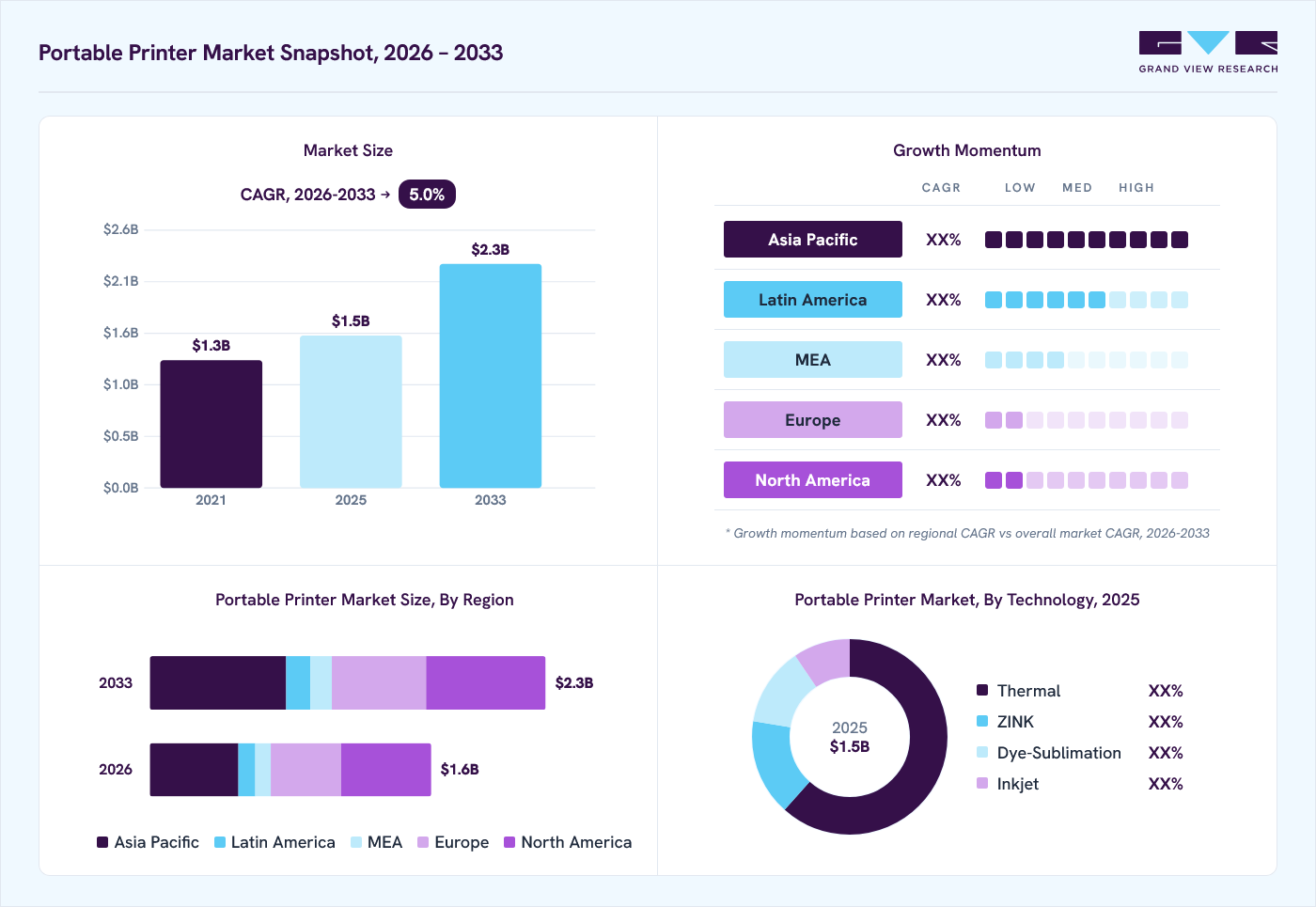 Source: Grand View Research, IR Documents, Primary Interviews, Paid DatabasesTo learn more about this report,
 Download Free Sample Report
 Key Market Trends & Insights
- By technology: Thermal portable printer accounted for the largest share of 61.6% in 2025.
- By application: Portable printer for label and barcode printing accounted for 33.1% of global revenue in 2025.
- By end-user: Portable printer for commercial & enterprise accounted for a revenue share of 69.9% in 2025.
- By distribution channel: Sales of portable printers through the offline channel accounted for the largest share of 61.6% of the global revenue in 2025.
Regional Highlights
- Largest regional market: North America (32.3% revenue share, in 2025)
- Fastest growing regional market: Asia Pacific (highest CAGR, 2026-2033)
- By country: The U.S. held the largest market share in 2025.
Market Size & Forecast
- Market size in 2025: USD 1.5 Billion
- Estimated market size in 2026: USD 1.6 Billion
- Projected market size by 2033: USD 2.3 Billion
- CAGR (2026-2033): 5.0%
Three ways to get this report
Buy it, customize it, or ask a question.Ask an Analyst
Analyst response in 1 business day
- AccessReport author, directly
- Reply timeWithin 1 working day
- No sales callDirect answer only
- FormatEmail reply
- CostFree, no cost
Get the Full Report
What the study covers
- FormatsPDF · Excel · Dashboard
- Timeline2026–2033 annual, 2025 base
- Coverage20+ countries, 5 regions
- Companies10+ key players profiled
Customize the Report
20% free customization
- IncludeCountries, segments, points
- TailorTo your product definition
- ExtendDeeper competitor detail
- OrA fully bespoke study
- Turnaround5–10 working days
Portable printers have evolved from niche productivity tools into a mainstream technology category, driven by increasing demand for compact, wireless, and mobile printing solutions across both consumer and enterprise applications. Continuous advancements in thermal printing, battery life, cloud connectivity, and smartphone compatibility have accelerated adoption, while falling device prices have expanded accessibility. Among the fastest-growing segments, the portable photo printer market continues to benefit from rising consumer demand for instant photo printing, personalized gifting, and creative content generation. Leading brands such as Canon, Fujifilm, and HP have introduced compact devices that seamlessly integrate with mobile applications, reinforcing the strong growth trajectory of the portable photo printer market.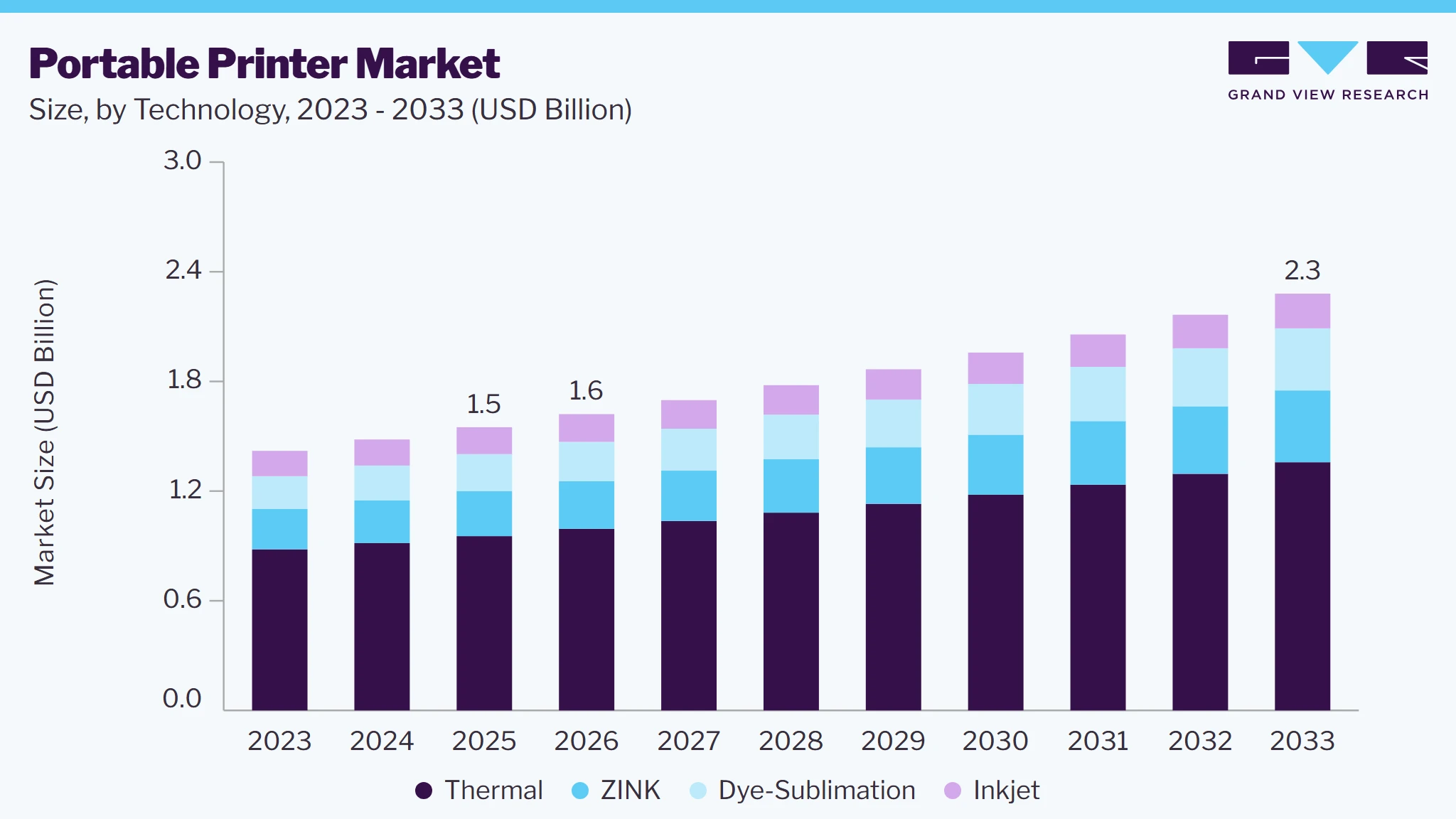 To learn more about this report, Download Free Sample Report
 The portable printer market is driven by increasing demand for mobile, on-site printing across retail, logistics, field service, healthcare, and transportation. Businesses are adopting portable printers to generate receipts, invoices, labels, and work orders directly at the point of service, improving workflow efficiency and reducing reliance on fixed printing infrastructure. Manufacturers, including Rongta and Xprinter, identify these industries as key application areas for portable printing solutions.
The expansion of e-commerce, mobile POS, and last-mile delivery is further supporting market growth by increasing demand for portable receipt and label printing. Retailers, courier companies, warehouses, and service providers increasingly rely on compact mobile printers to streamline shipping, inventory management, and customer transactions. According to the Universal Postal Union (UPU), 71% of surveyed postal operators now identify as e-commerce service providers, reflecting the continued expansion of parcel fulfillment and last-mile delivery networks, where portable receipt and label printers play an important role in shipping and proof-of-delivery workflows.
Beyond logistics and retail, portable printers are also being deployed across public safety and field operations. For instance, the Los Angeles County Sheriff's Office adopted Seiko mobile printers, enabling officers to print citations directly from patrol vehicles and improving field productivity. According to Zebra Technologies' Future of Field Operations study, 88% of public safety organizations expected mobile technologies to improve productivity and efficiency within a year, while 79% anticipated reduced operating costs through the deployment of mobile devices and printers, reinforcing the value of portable printing in field operations.
Continuous improvements in battery life and device durability are supporting wider adoption of portable printers in enterprise environments. Longer operating times reduce downtime for mobile workers and improve productivity across logistics, warehousing, and field service operations. For example, TSC Auto ID reports that its Alpha-40L mobile thermal printer delivers over 45 hours of receipt printing on a single charge, while the Alpha-30L exceeds 23.5 hours, reflecting advances in battery performance for mobile printing applications.
Business mobility and digital transformation are creating significant opportunities across enterprise printing solutions. The portable scanner printer market is gaining traction among healthcare professionals, insurance agents, financial institutions, and field service technicians that require on-site document scanning and printing to improve operational efficiency. At the same time, the portable barcode printer market has become increasingly important for retail, warehousing, manufacturing, and logistics operations, enabling real-time barcode and label printing to support inventory accuracy and supply chain visibility. Companies including Brother, Epson, Zebra Technologies, Honeywell, and BIXOLON continue to introduce rugged, wireless, and cloud-enabled solutions, strengthening innovation across both the portable scanner printer market and the portable barcode printer market.
From a regional perspective, the Middle East & Africa portable printer market is emerging as an attractive growth opportunity, supported by rapid digitalization, expanding retail infrastructure, increasing healthcare investments, and the widespread adoption of mobile point-of-sale systems. Countries such as the United Arab Emirates, Saudi Arabia, and South Africa are witnessing growing deployment of portable printers across logistics, hospitality, healthcare, and government applications. Continued investments in smart city initiatives, e-commerce, and field-based workforce solutions are expected to further accelerate demand across the Middle East & Africa portable printer market, while sustained growth in omnichannel retail and warehouse automation will continue to create long-term opportunities for the portable barcode printer market.
Market Dynamics
Growing enterprise investment in mobile workforce technologies is supporting demand for portable printers across logistics, retail, transportation, field service, and healthcare. Businesses are increasingly equipping frontline employees with mobile devices to enable on-site receipt, invoice, label, and document printing, improving productivity and reducing dependence on fixed printing infrastructure. According to Zebra Technologies' Asia-Pacific Future of Field Operations study, the use of mobile printers was projected to increase by 60% between 2018 and 2023, reflecting the expanding role of portable printing in enterprise mobility.
Despite their growing popularity, portable printers continue to face performance limitations that restrict their adoption across high-volume and enterprise printing environments. Most portable printers are engineered with mobility, compactness, and battery efficiency as primary design priorities, often resulting in slower print speeds compared to conventional desktop or office printers. In addition, these devices typically support lower paper capacities and are designed to accommodate only specific media types and smaller paper formats, limiting their versatility for applications that require frequent, large-format, or high-volume printing.
Media compatibility also remains a significant challenge, as many portable printers are optimized for thermal paper, labels, receipts, or standard photo paper, with limited support for diverse paper sizes, specialty media, or duplex printing. This reduces their suitability for businesses requiring extensive document handling, professional-quality color printing, or complex print jobs. Consequently, while portable printers serve as an effective solution for mobile professionals, field services, retail, logistics, and personal use, they are generally viewed as complementary devices rather than replacements for traditional office printers. These functional constraints continue to limit broader adoption in centralized office environments and organizations with high-throughput printing requirements.
The increasing digitalization of small businesses, mobile vendors, home-based enterprises, and direct-to-consumer sellers is creating new opportunities for portable printers. As merchants expand digital payment acceptance, home delivery, and online order fulfillment, demand for compact Bluetooth-enabled receipt and label printers is increasing to support billing, shipping, and inventory management without relying on traditional POS infrastructure. For instance, PhonePe surpassed 50 million registered merchants in 2026, covering more than 98% of India's postal codes, highlighting the rapid expansion of digitally enabled merchant ecosystems that increasingly rely on mobile business tools.
Consumer Insights
 To learn more about this report, Download Free Sample Report
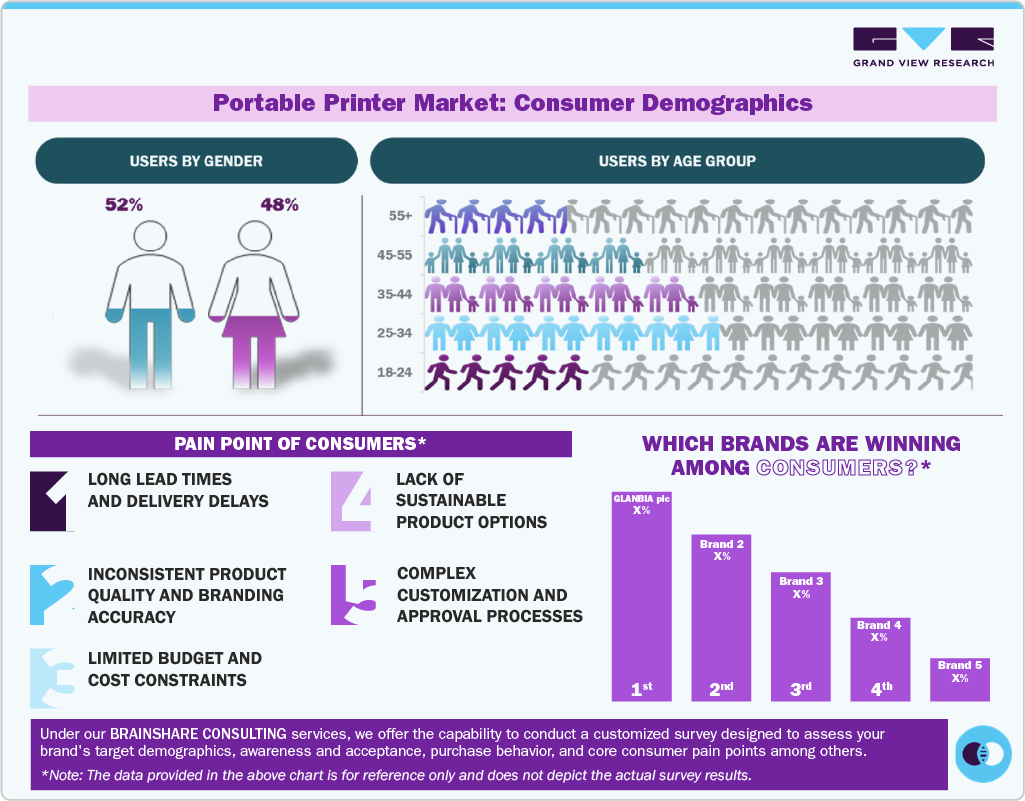
 The gender distribution in the portable printer market reflects growing consumer demand for compact, smartphone-connected printing solutions across personal, creative, and home office applications.
-
Female consumers account for approximately 54% of the market, driven by higher adoption of portable photo printers for journaling, scrapbooking, crafts, gifting, travel photography, and personalized creative projects.
-
Male consumers represent around 46% of the market, with demand supported by portable document printers for remote work, business travel, education, and personal productivity, alongside growing interest in mobile printing technologies.
-
Portable printer purchasing decisions are increasingly influenced by lifestyle, convenience, and smartphone compatibility rather than gender alone, resulting in broader adoption across diverse consumer groups.
By age group, consumers aged 25-44 years account for the largest share of the market. This segment comprises working professionals, parents, entrepreneurs, and frequent travelers seeking portable printing solutions for home offices, business mobility, creative hobbies, and family photo printing. Consumers aged 18-24 years contribute significantly through demand for portable photo printers used for social media content creation, journaling, DIY crafts, and gifting, while the 45+ age group primarily purchases portable document and photo printers for travel, home organization, and personal convenience.
Consumers in the portable printer market commonly encounter several practical pain points throughout product selection and everyday use.
-
Consumers in the portable printer market commonly encounter several practical pain points throughout product selection and everyday use.
-
Limited battery life can restrict continuous printing during travel and field use.
-
Consumers also experience wireless connectivity issues, slower print speeds, and inconsistent print quality, particularly when printing high-resolution photos or using third-party media.
These consumer insights reflect purchasing preferences within the consumer portable printer segment only. Accordingly, manufacturers are prioritizing user-friendly mobile applications, wireless connectivity, compact form factors, longer battery life, and improved print quality to enhance the everyday printing experience for individual users.
Analyst Perspective
Portable printers have transitioned from niche accessories to mainstream products by enabling printing outside fixed workspaces. Market analysis projects steady annual growth of about 5% through 2033, demonstrating that the sector remains in an expanding adoption phase rather than reaching maturity. This ongoing momentum stems from two distinct consumer bases expanding across different use cases. Commercial adoption is driven by mobile professionals utilizing portable units to print documents on the go and boost field-based productivity. Meanwhile, the consumer market is surging due to the rising popularity of compact, user-friendly thermal photo and label printers. Their low cost converts them into easy, impulse-driven buys rather than conventional office investments, substantially widening overall market reach. Consequently, the category now encompasses several distinct product segments instead of operating as a single homogeneous market. Each unique segment targets specific needs, delivers tailored value, and faces a distinct competitive landscape.
Technology Insights
Thermal portable printers accounted for 61.6% of global revenue in 2025, driven by widespread adoption across retail, logistics, warehousing, healthcare, and field service applications requiring fast, reliable, and low-maintenance mobile printing. For instance, in October 2023, PrintekMobile launched its next-generation FieldPro thermal printer, featuring rugged construction and enhanced connectivity to support on-site receipt, invoice, and label printing for mobile workers.
Dye-sublimation portable printers are projected to grow at a CAGR of 6.8% from 2026 to 2033, supported by rising demand for premium instant photo printing, personalized gifting, and creative applications. For instance, in January 2026, Fujifilm introduced the instax mini Link+ smartphone printer with new Design Print mode, enhanced creative print features, and expanded app functionality, reinforcing innovation in compact dye-sublimation photo printers.
Application Insights
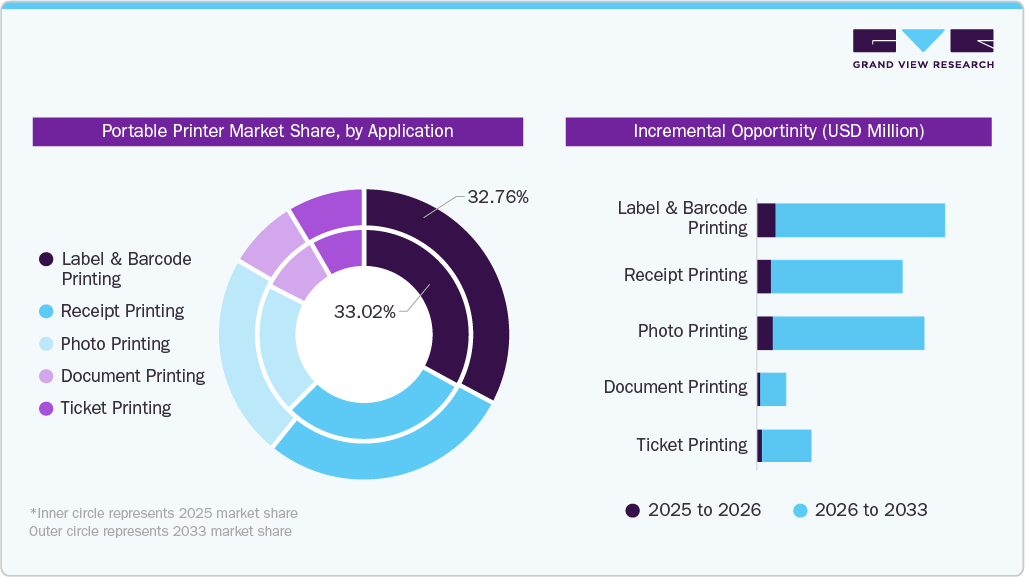
Portable printer for label and barcode printing accounted for 33.1% of global revenue in 2025, driven by rising demand from e-commerce, retail, logistics, and small businesses requiring on-demand labeling and streamlined shipping workflows. For instance, in August 2026, Phomemo launched the PM643 Smart Label Printer and the D422S Integrated Shipping Solution, designed for growing businesses, featuring capabilities for shipping label creation, barcode printing, and fulfillment workflow optimization.
 To learn more about this report, Download Free Sample Report
 Portable printer for photo printing is projected to grow at a CAGR of 6.7% from 2026 to 2033, supported by rising demand for instant photo printing, personalized gifting, and creative applications. Smartphone-connected printers are enabling users to easily transform digital images into customized physical prints. For instance, in 2025, Fujifilm announced plans to launch a premium Instax mobile printer featuring enhanced text printing capabilities on instant film, reflecting ongoing innovation in portable photo printing and personalized photo experiences.
End-user Insights
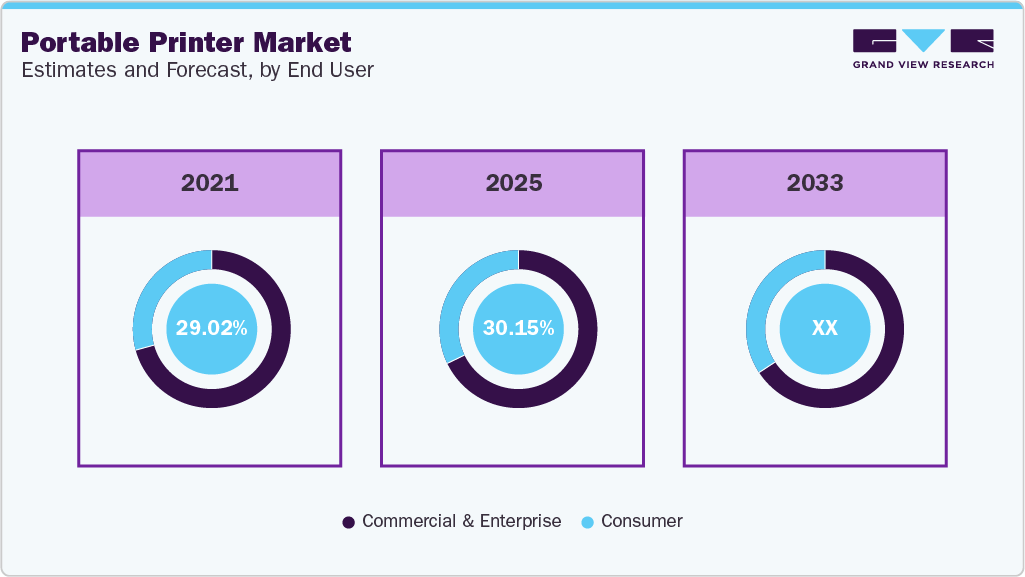
Portable printers for commercial & enterprise accounted for a share of 69.9% of the global revenue in 2025, driven by adoption across retail, logistics, hospitality, and field service operations requiring on-site printing. Businesses use mobile printers for receipts, labels, invoices, and service documents to improve workflow efficiency without fixed printing infrastructure. For instance, in April 2023, PrintekMobile launched its next-generation FieldPro printer, designed for mobile workers with enhanced connectivity and rugged performance to support on-site receipt, invoice, and document printing needs.
 To learn more about this report, Download Free Sample Report
 The portable printer for consumers is projected to grow at a CAGR of 4.6% from 2026 to 2033, supported by the rising adoption of compact smartphone-connected photo printers. Demand is driven by ZINK and dye-sublimation devices used for instant photos, journaling, gifting, and creative projects. For instance, in April 2026, Polaroid launched the Hi-Print 3×3 portable photo printer, featuring smartphone connectivity, customizable square photo printing, and a built-in frame design, strengthening the appeal of portable printers for lifestyle, gifting, and creative consumer applications.
Distribution Channel Insights
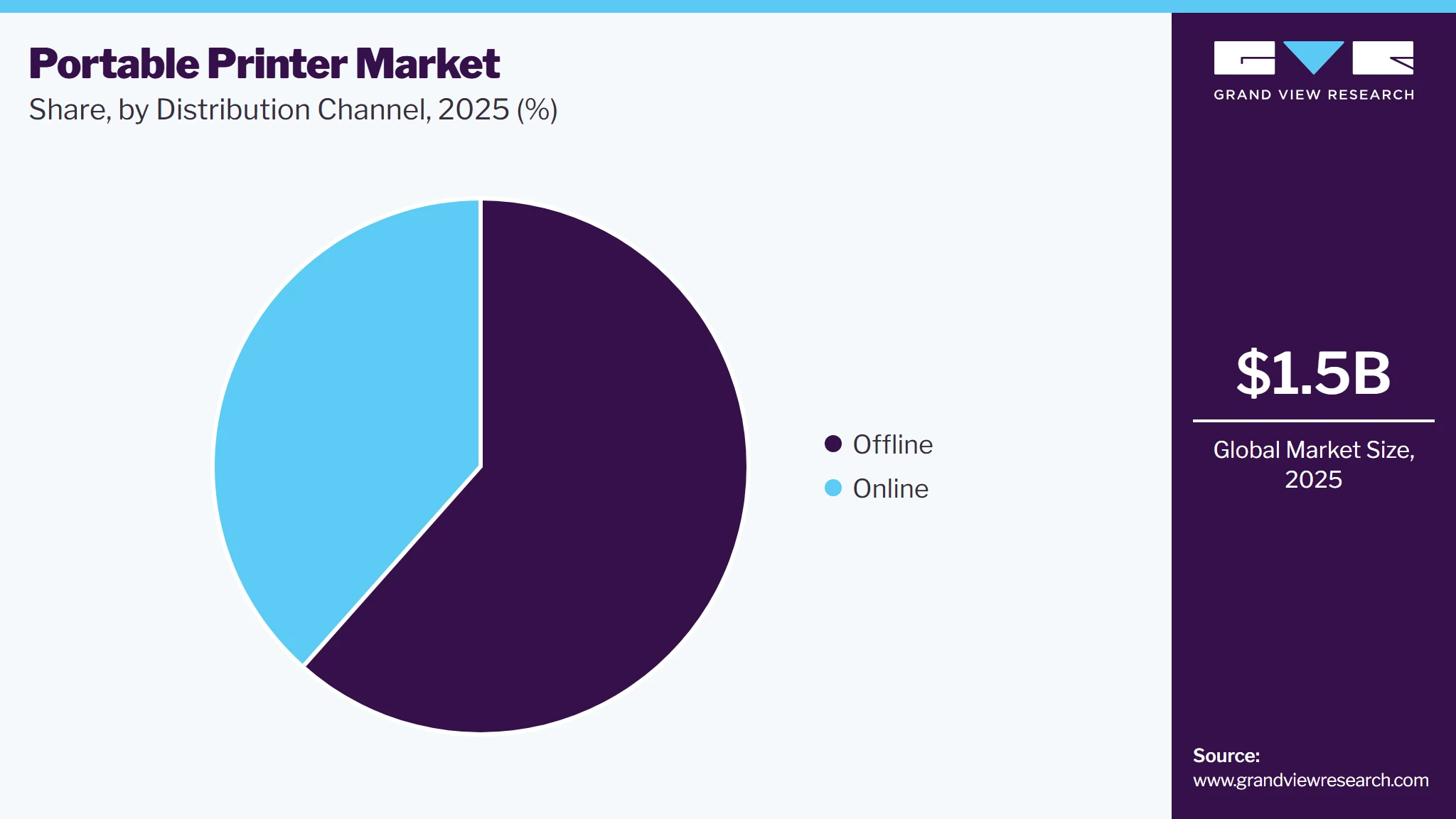
Sales of portable printers through offline channels accounted for a share of 61.6% of the global revenue in 2025. The offline channel remains dominant due to strong enterprise procurement through authorized distributors, value-added resellers (VARs), system integrators, and specialty POS and Auto-ID solution providers. Businesses purchasing mobile receipt, label, barcode, and ticket printers often require product demonstrations, software integration, after-sales support, and maintenance services before deployment.
In addition, consumer purchases through electronics retailers such as Best Buy, MediaMarkt, Bic Camera, and Yodobashi Camera continue to support offline sales, particularly for portable photo printers, where customers prefer to evaluate print quality and device features before purchase.
 To learn more about this report, Download Free Sample Report
 Sales of portable printers through online channels are projected to grow at a CAGR of 5.7% from 2026 to 2033. Growth is driven by the increasing preference for direct-to-consumer purchasing through brand websites and e-commerce marketplaces such as Amazon, JD.com, Tmall, and Flipkart, where consumers can compare prices, specifications, and reviews before purchasing. Manufacturers are also strengthening online sales through exclusive product launches and digital marketing campaigns.
For instance, brands including Phomemo, MUNBYN, Xiaomi, and Fujifilm have expanded their online-first product offerings, making portable photo, document, and label printers more accessible to consumers and small businesses while reducing dependence on traditional retail channels.
Regional Insights
The portable printer market in North America led the global market, accounting for the largest revenue share of 32.3% in 2025. Growth is supported by the region's mature enterprise mobility ecosystem and widespread adoption of mobile POS, warehouse management, and field service solutions. According to a March 2025 article by Digital Commerce 360, citing U.S. Department of Commerce data, U.S. e-commerce sales reached USD 1.192 trillion in 2024, with online sales accounting for a record 22.7% of total retail sales. The continued expansion of e-commerce fulfillment and omnichannel retail operations is driving demand for portable receipt, label, and barcode printers across warehouses, distribution centers, and last-mile delivery networks.
 To learn more about this report, Download Free Sample Report
 U.S. Portable Printer Market Trends
The U.S. accounted for approximately 85.9% of the North American portable printer market in 2025. The country's leadership is supported by the strong presence of leading manufacturers such as Zebra Technologies, HP, and Brother, as well as the early adoption of enterprise mobility solutions by large retailers, healthcare providers, and transportation networks. High consumer spending on connected devices and widespread adoption of portable photo printers further strengthen the U.S. market.
Europe Portable Printer Market Trends
The portable printer market in Europe accounted for 25.2% of the global market in 2025. Demand is primarily driven by stringent product traceability, inventory management, and labeling requirements across manufacturing, pharmaceuticals, food processing, and logistics. As businesses continue digitalizing warehouse and field operations, portable barcode and label printers are increasingly deployed to improve operational efficiency and regulatory compliance.
The portable printer market in Germany accounted for the largest revenue share of around 20.6% in 2025. Its share is supported by one of Europe's most advanced manufacturing and logistics sectors, where Industry 4.0 initiatives continue to accelerate deployment of rugged mobile printers for inventory management, production labeling, warehouse operations, and asset tracking.
France portable printer market is projected to grow at a CAGR of 4.2% from 2026 to 2033. Growth is supported by increasing adoption of mobile POS systems across retail and hospitality, alongside growing use of portable ticket printers in transportation and event management. Consumer demand for portable photo printers is also benefiting from rising interest in personalized photo printing and creative lifestyle applications.
Asia Pacific Portable Printer Market Trends
The Asia Pacific portable printer market is projected to grow at a CAGR of 6.3% from 2026 to 2033. Growth is underpinned by expanding manufacturing capacity, rapid smartphone adoption, rising SME digitization, and increasing demand for mobile printing solutions across consumer and enterprise applications. The region also benefits from being the global manufacturing hub for portable printers, with China, Japan, and South Korea serving as major production and innovation centers.
China portable printer market led with share of 38.5% of the global market in 2025. The country's dominance is supported by its strong electronics manufacturing ecosystem and the world's largest parcel delivery network. According to the State Post Bureau of China, more than 170 billion parcels were handled in 2024, driving extensive deployment of portable label and barcode printers across courier services, warehouses, and e-commerce fulfillment operations.
The India portable printer market is projected to grow at a CAGR of 8.7% from 2026 to 2033. Growth is driven by rapid merchant digitization and increasing deployment of portable receipt printers alongside mobile payment infrastructure. According to the Press Information Bureau (PIB), UPI transaction value increased from USD 254 billion (₹21.3 lakh crore) in FY2019-20 to approximately USD 2.54 trillion (₹213.8 lakh crore) by January FY2024-25, while Person-to-Merchant (P2M) transactions reached approximately USD 706 billion (₹59.3 lakh crore). The continued expansion of digital payments among merchants is accelerating mobile POS adoption and driving demand for portable receipt-printing solutions.
Central & South America Portable Printer Market Trends
The Central & South America portable printer industry is projected to grow at a CAGR of 5.3% from 2026 to 2033. Growth is supported by the region's expanding retail and food delivery sectors, where portable receipt printers are increasingly used by restaurants, cafés, and mobile vendors. In addition, growing investments in warehouse modernization and cross-border trade are driving the adoption of portable barcode and label printers across distribution centers and logistics operations, particularly in Brazil.
Middle East & Africa Portable Printer Market Trends
The Middle East & Africa portable printer market is projected to grow at a CAGR of 4.8% from 2026 to 2033. Growth is supported by the GCC's expanding tourism, aviation, and hospitality sectors, which are increasing the need for mobile ticketing, receipt printing, and on-site customer service solutions. According to the UN Tourism World Tourism Barometer article published in January 2025, the Middle East welcomed 95 million international tourist arrivals in 2024, representing 32% growth over 2019 and making it the strongest-performing region globally. The continued rise in passenger traffic, hotel occupancy, and large-scale events is driving demand for portable ticket and receipt printers, while ongoing investments in healthcare and logistics are supporting the adoption of mobile barcode and label printers for field operations and asset tracking.
Key Portable Printer Company Insights
The global portable printer market is moderately fragmented, with competition among established printing technology companies, enterprise mobility solution providers, consumer photo printer manufacturers, and emerging mobile printing brands. Market participants compete on product innovation, wireless connectivity, software integration, application-specific solutions, and distribution expansion across consumer and enterprise end-use markets.
-
Enterprise Mobile Printing Leaders: Companies such as Zebra Technologies Corporation, Brother Industries, Ltd., Seiko Epson Corporation, BIXOLON Co., Ltd., and SATO Holdings Corporation lead the enterprise segment with rugged mobile receipt, label, barcode, and ticket printers for retail, logistics, healthcare, manufacturing, and field service applications. Their strengths include broad product portfolios, enterprise software integration, global distribution networks, and long-standing customer relationships.
-
Consumer Photo & Mobile Printing Specialists: Canon Inc., Fujifilm Holdings Corporation, and Xiaomi Corporation focus on portable photo and document printers with smartphone connectivity, wireless printing, and app-enabled features. These companies differentiate through user experience, print quality, and ecosystem integration for personal and lifestyle applications.
-
Emerging Digital-First & Value-Oriented Brands: Phomemo, MUNBYN, HPRT, and PeriPage are expanding through affordable, application-specific portable printers sold primarily via e-commerce and direct-to-consumer channels. Their competitive positioning is driven by rapid product launches, competitive pricing, and compact, smartphone-centric designs targeting small businesses and home users.
-
Regional Manufacturers & ODM/OEM Suppliers: Manufacturers across China, Japan, South Korea, and Taiwan supply portable printers under proprietary and private-label brands. They compete through cost-efficient manufacturing, product customization, and flexible OEM/ODM capabilities, supporting both global brands and regional distributors.
 To learn more about this report, Download Free Sample Report
Key Portable Printer Companies
The following key companies have been profiled for this study on the portable printer market:
-
Canon
-
HP
-
Brother Industries
-
Epson
-
Fujifilm
-
Zebra Technologies
-
Honeywell
-
BIXOLON
-
Star Micronics
-
SATO
-
TSC
Competitive Benchmarking
Category
Operating Strategies
Competitive Edge
Weakness
Established Players (Seiko Epson Corporation; Brother Industries, Ltd.; Canon Inc.; HP Inc.; Zebra Technologies Corporation; BIXOLON Co., Ltd.; SATO Holdings Corporation)
Focus on expanding product portfolios across portable photo, document, receipt, ticket, and label & barcode printers while strengthening mobile software ecosystems, SDK support, enterprise workflow integration, and regional distribution partnerships. Continue investing in wireless connectivity, battery performance, ruggedized designs, and application-specific solutions for retail, logistics, healthcare, transportation, and field services.
Extensive enterprise customer base, diversified technology portfolio spanning thermal, inkjet, and photo printing, strong software and SDK ecosystems, global distribution and after-sales service networks, and proven reliability in mission-critical business applications.
Higher product development and certification costs, slower response to niche market opportunities, and increasing pricing pressure from low-cost Asian manufacturers, particularly in consumer and SMB segments.
Emerging Players (Phomemo; HPRT; MUNBYN; PeriPage; Xiaomi; Fujifilm)
Focus on compact, application-specific portable printers targeting photo printing, labeling, and small-business applications through rapid product refresh cycles, app-centric user experiences, online-first sales strategies, and competitive pricing. Prioritize smartphone integration, lightweight designs, and direct-to-consumer expansion.
Faster product commercialization, competitive pricing, strong e-commerce presence, and the ability to quickly introduce niche products tailored to specific consumer and SME use cases.
Limited penetration in large enterprise accounts, smaller global service and distribution networks, fewer enterprise software integrations, and greater dependence on online marketplaces for customer acquisition and brand visibility.
Recent Developments
-
In April 2026, Fujifilm Philippines launched the limited-edition instax mini Evo Cinema Edition instant camera and showcased the instax mini Link smartphone printer as part of its expanding instax ecosystem. The launch strengthens Fujifilm's presence in the Philippine instant imaging market by reinforcing its connected ecosystem of instant cameras, smartphone printers, and mobile printing applications.
-
In October 2025, Xiaomi expanded the global availability of its Portable Photo Printer Pro, a dye-sublimation portable printer offering high-resolution photo printing, wireless smartphone connectivity, and rechargeable battery operation. The expansion strengthens Xiaomi's presence in the portable photo printer market while increasing competition in the premium consumer printing segment.
-
In September 2025, Panduit expanded its PXE Mobile Printer portfolio with the launch of the MP500 and MP550 mobile printers, designed for industrial labeling and identification applications across electrical, network infrastructure, and industrial environments. The launch strengthens Panduit's enterprise mobile printing portfolio by addressing growing demand for portable labeling solutions in field operations.
Portable Printer Market Report Scope
Report Attribute
Details
Market size in 2025
USD 1.5 billion
Estimated market size in 2026
USD 1.6 billion
Projected market size by 2033
USD 2.3 billion
Growth rate
CAGR of 5.0% from 2026 to 2033
Base year
2025
Actuals
2021 - 2025
Forecast period
2026 - 2033
Quantitative units
Revenue in USD million and CAGR from 2026 to 2033
Report coverage
Revenue forecast, company ranking, competitive landscape, growth factors, and trends
Segments covered
Technology, application, end-user, distribution channel, region
Regional scope
North America, Europe, Asia Pacific, Central & South America, Middle East & Africa
Country scope
U.S.; Canada; Mexico; Germany; UK; France; Italy; Spain; China; Japan; India; South Korea; Australia & New Zealand; Brazil; South Africa
Key companies profiled
Canon; HP; Brother Industries; Epson; Fujifilm
Zebra Technologies; Honeywell; BIXOLON; Star Micronics; SATO; TSC
Customization scope
Free report customization (equivalent up to 8 analysts’ working days) with purchase. Addition or alteration to country, regional & segment scope.
Pricing and purchase options
Avail customized purchase options to meet your exact research needs. Explore purchase options
Global Portable Printer Market Segmentation
This report forecasts revenue growth at the global, regional & country levels and provides an analysis of the latest trends and opportunities in each sub-segment from 2021 to 2033. For this study, Grand View Research has segmented the portable printer market by technology, application, end user, distribution channel, and region:
-
Technology Outlook (Revenue, USD Billion, 2021 - 2033)
-
Thermal
-
Inkjet
-
Food & Beverage
-
ZINK
-
Dye-Sublimation
-
-
Application Outlook (Revenue, USD Billion, 2021 - 2033)
-
Photo Printing
-
Document Printing
-
Receipt Printing
-
Label & Barcode Printing
-
Ticket Printing
-
-
End-user Outlook (Revenue, USD Billion, 2021 - 2033)
-
Consumer
-
Commercial & Enterprise
-
-
Distribution Channel Outlook (Revenue, USD Billion, 2021 - 2033)
-
Offline
-
Online
-
-
Regional Outlook (Revenue, USD Billion, 2021 - 2033)
-
North America
-
U.S.
-
Canada
-
Mexico
-
-
Europe
-
Germany
-
UK
-
France
-
Italy
-
Spain
-
-
Asia Pacific
-
China
-
Japan
-
India
-
South Korea
-
Australia & New Zealand
-
-
Central & South America
-
Brazil
-
-
Middle East & Africa
-
South Africa
-
-
Research Methodology
The portable printer market figures in this report are based on a proven research process that combines executive interviews with secondary research from proprietary databases, company filings, and recognized regulatory and institutional sources. Market size is built through value-chain sizing—reconciling supply-side and demand-side estimates—and triangulated with bottom-up and top-down approaches. Every estimate passes multiple levels of expert validation before publication, with each portable printer segment quantified using the revenue-capture definitions in the table below.
Segment Definition
Segment - Distribution Channel
Revenue capture definition
Offline
Revenue is generated from the sale of portable printers through traditional sales channels, including electronics retailers, office supply stores, consumer electronics chains, specialty printer dealers, distributors, value-added resellers (VARs), wholesalers, and direct business-to-business (B2B) sales. The segment covers purchases by both consumers and enterprise customers for mobile photo printing, document printing, receipt printing, ticket printing, and label & barcode printing applications. Sales transacted through offline channels are included within the segment.
Online
Revenue is generated from the sale of portable printers through digital sales channels, including manufacturer websites, e-commerce platforms, online marketplaces, and authorized online retailers. The segment covers purchases by both consumers and enterprise customers for mobile photo printing, document printing, receipt printing, ticket printing, and label & barcode printing applications. Sales transacted through online channels are included within the segment.
Estimation Model
Layer
Key Question
Description
Addressable User Base Layer
Who forms the addressable user base?
Consumers and organizations requiring printing outside traditional office environments, including travelers, students, remote workers, field service personnel, retail stores, logistics providers, healthcare professionals, hospitality businesses, and public agencies.
Printing Need Layer
Who requires portable printing?
Users with recurring on-the-go printing requirements for photos, documents, receipts, labels & barcodes, or tickets where portability and wireless connectivity are essential.
Portable Printer Adoption Layer
Which users purchase portable printers?
Users purchasing portable photo, document, receipt, label & barcode, and ticket printers based on mobility requirements, print volume, application, connectivity, and total cost of ownership.
Monetization Layer
How much revenue is generated?
Revenue generated from sales of portable printers across technologies, applications, end users, distribution channels, brands, and price tiers.
Delivered Customizations
This report has been delivered with the following In-depth customizations
CLIENT REQUEST
CUSTOMIZATION DELIVERED
VALUE ADDS
Application × End User × Technology Demand Matrix
Developed a three-dimensional demand model quantifying market size, growth, penetration, and adoption across every combination of application (Photo, Document, Receipt, Label & Barcode, Ticket), end user (Consumer, Enterprise), and printing technology (Thermal, Inkjet, ZINK, Dye-Sublimation).
Identified high-growth demand pockets, whitespace opportunities, and optimal product-market fit across applications and customer segments, supporting portfolio prioritization and strategic investment decisions.
Price Band × Feature Positioning Analysis
Evaluated competitive positioning across price bands by benchmarking printer specifications, connectivity options, battery performance, print speed, resolution, media compatibility, ruggedness, and software ecosystem capabilities.
Identified feature gaps, premiumization opportunities, and competitive positioning strategies, enabling optimized product differentiation, pricing decisions, and portfolio planning.
Enterprise Procurement & Purchase Decision Analysis
Assessed enterprise procurement behavior across organization size, industry vertical, fleet size, procurement model, replacement cycle, vendor selection criteria, and total cost of ownership (TCO).
Identified key procurement drivers and purchasing patterns across enterprise customers, enabling targeted sales strategies, stronger customer acquisition, and improved commercial planning.
Segment
What Defines It
Photo Printers
Compact, high-resolution output aimed at personal and semi-professional use; the segment most associated with premium pricing and design-led branding.
Business Document Printers
Built for speed and multi-device compatibility in corporate settings, the segment is closest to displacing traditional desktop printers for mobile and hybrid workers.
All-in-One Portable Units
Combines printing, scanning, and copying in a single portable footprint; positioned for small businesses and shared workspaces that cannot justify a full office fleet.
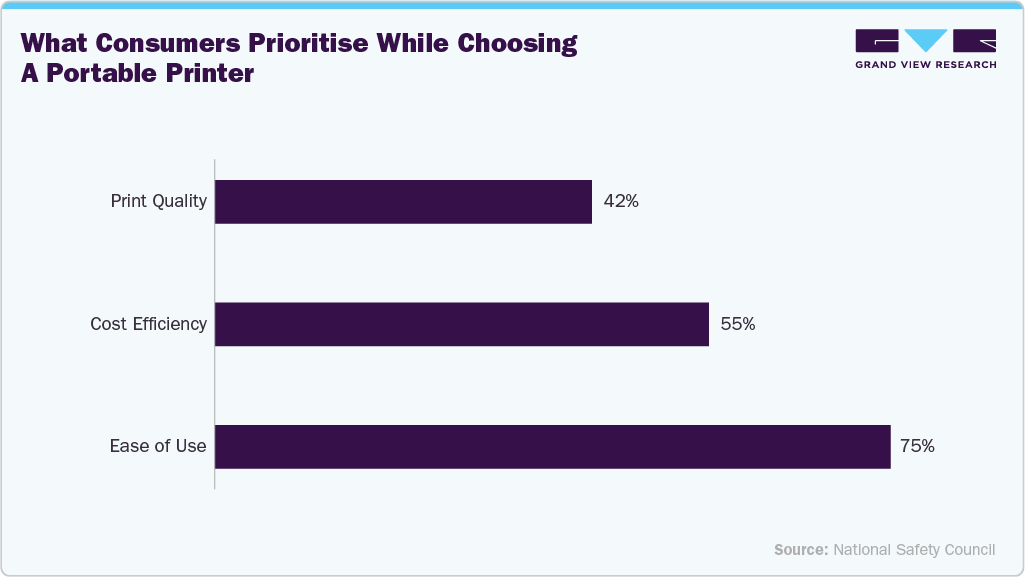
What Buyers Actually Optimize For:
Functionality and convenience remain the primary purchase drivers across the category, with consumers placing the greatest emphasis on ease of use, followed by pricing and product quality. This suggests that manufacturers can create stronger competitive differentiation by enhancing user experience, intuitive design, and product accessibility, rather than relying solely on incremental improvements in technical specifications or materials.
 To learn more about this report, Download Free Sample Report
 The Five Forces Behind Adoption:
Driver
Why It Matters
Mobility & Convenience
Removes dependence on fixed print shops, the single most cited reason for adoption among traveling professionals and students.
Wireless & App Integration
Direct printing from smartphones, tablets, and cloud storage has become a baseline expectation rather than a premium feature.
Inkless / Thermal Tech
Heat-sensitive paper removes cartridge dependency, lowering both cost-per-print and mechanical failure points.
Affordability
Entry price points as low as $15-$50 put portable thermal units within impulse-purchase range, widening the buyer base beyond professional users.
Sustainability Positioning
Recyclable materials and reduced ink/toner consumption increasingly factor into purchase decisions among environmentally conscious consumers.
“The competitive battleground is increasingly shifting beyond price alone. Manufacturers that combine functional design, durability, and space-efficient solutions with aesthetically appealing products are better positioned to capture demand and build long-term consumer preference.”
Frequently Asked Questions About This Report
North America dominated the market with a share of 32.3% in 2025. Growth is supported by the region's mature enterprise mobility ecosystem and widespread adoption of mobile POS, warehouse management, and field service solutions
The global portable printer market is driven by wider deployment of portable printers for receipt, label, and document printing across retail, logistics, transportation, and field service operations
Some key players in the portable printer market include Canon; HP; Brother Industries; Epson; Fujifilm; Zebra Technologies; Honeywell; BIXOLON; Star Micronics; SATO; and TSC
The Asia Pacific portable printer market is projected to grow at a CAGR of 6.3 % from 2026 to 2033
Portable printer for label and barcode printing accounted for 33.1% of global revenue in 2025, while portable printer for photo printing is fastest-growing segment.
The portable printer market size was valued at 1.5 billion in 2025 and is projected to reach USD 1.6 billion in 2026.
The portable printer market is expected to grow at a CAGR of 5.0% from 2026 to 2033 to reach USD 2.3 billion by 2033.
Thermal portable printers accounted for 61.6% of global revenue in 2025, while the dye-sublimation portable printers is fastest-growing segment
Sales of portable printer through offline channels accounted for a share of 61.6% of the global revenue in 2025, while sales of portable printers through online channels are fastest-growing segment.
About the Author(s)
Electronic & Electrical Research Team
Consumer Goods · Electronic & ElectricalThis report was authored by the electronic & electrical research team at Grand View Research - comprising two research analysts, one senior research analyst, and one industry expert - with specialized expertise in the electronic & electrical segment of the consumer goods industry. All findings are based on proprietary consumer goods databases, executive interviews, and regulatory analysis, subject to internal peer review prior to publication.
Last Updated:
Speak to Analyst

Customize this report to your needs - add regions, segments, or data points, with 20% free customization.
Or view our licence options:


ISO 9001:2015 & 27001:2022 Certified
We are GDPR and CCPA compliant! Your transaction & personal information is safe and secure. For more details, please read our privacy policy.


