
- Home
- »
- Next Generation Technologies
- »
-
Road Cargo Security Market Size And Share Report, 2033GVR Report cover

Road Cargo Security Market (2026 - 2033)
Size, Share & Trends Analysis Report By Solution (Cargo Tracking & Visibility, Surveillance & Monitoring), By End-use (Logistics Service Providers, Freight Forwarders, Retail & E-commerce), By Region, And Segment Forecasts
Market Size, 2025
$3.6BMarket Estimate, 2026
$3.8BMarket Forecast, 2033
$7.8BCAGR, 2026–2033
10.7%Road Cargo Security Market Summary
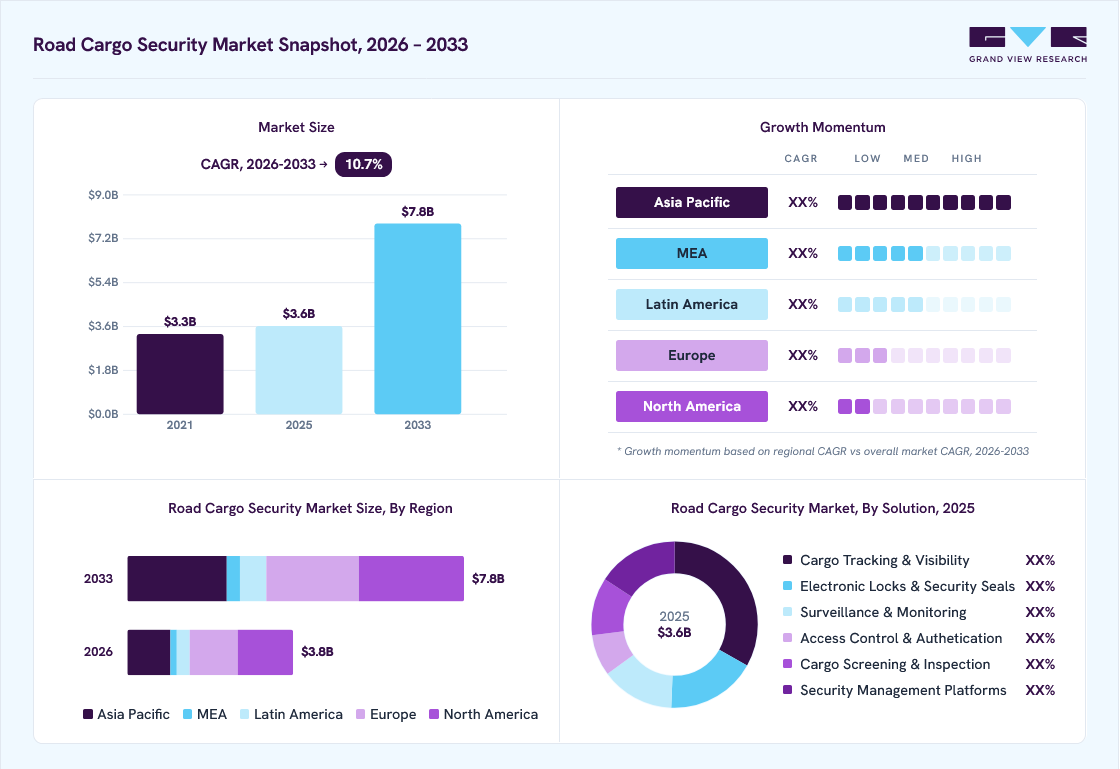
The global road cargo security market size was valued at USD 3.6 billion in 2025 and is projected to grow from USD 3.8 billion in 2026 to USD 7.8 billion by 2033, at a CAGR of 10.7% from 2026 to 2033. North America dominated the market, accounting for the largest revenue share of 33.7% in 2025. The market is experiencing robust growth owing to the increasing incidence of cargo theft, growing complexity of global and regional supply chains, rising adoption of connected fleet technologies, and stringent regulatory requirements for transportation security.
 Source: Grand View Research, IR Documents, Primary Interviews, Paid DatabasesTo learn more about this report,
 Download Free Sample Report
 Key Market Trends & Insights
- By solution: The cargo tracking & visibility segment accounted for the largest market share of 33.1% in 2025.
- By end-use: The logistics service providers segment dominated the market in 2025.
Regional Highlights
- Largest regional market in 2025: North America (33.7% revenue share, 2025)
- Fastest growing regional market: Asia Pacific (highest CAGR, 2026-2035)
- By country: The U.S. held the largest market share in 2025.
Market Size & Forecast
- Market Size in 2025: USD 3.6 Billion
- Estimated market size in 2026: USD 3.8 Billion
- Projected Market Size by 2033: USD 7.8 Billion
- CAGR (2026-2033): 10.7%
Three ways to get this report
Buy it, customize it, or ask a question.Ask an Analyst
A direct answer, usually in 1 working day
- AccessReport author, directly
- Reply timeWithin 1 working day
- No sales callDirect answer only
- FormatEmail reply
- CostFree, no cost
Get the Full Report
What the study covers
- FormatsPDF · Excel · Dashboard
- Timeline2026–2033 annual, 2025 base
- Coverage20+ countries, 5 regions
- Companies10+ key players profiled
Customize the Report
20% free customization
- IncludeCountries, segments, points
- TailorTo your product definition
- ExtendDeeper competitor detail
- OrA fully bespoke study
- Turnaround5–10 working days
Logistics providers, freight forwarders, retailers, manufacturers, and pharmaceutical companies are increasingly investing in advanced cargo security solutions to safeguard high-value shipments, improve shipment visibility, and minimize financial losses caused by theft, tampering, and operational disruptions. Technological advancements in IoT-enabled tracking devices, AI-powered video analytics, electronic locks, cloud-based fleet management, and predictive security platforms are further transforming road cargo security from reactive monitoring to proactive risk management.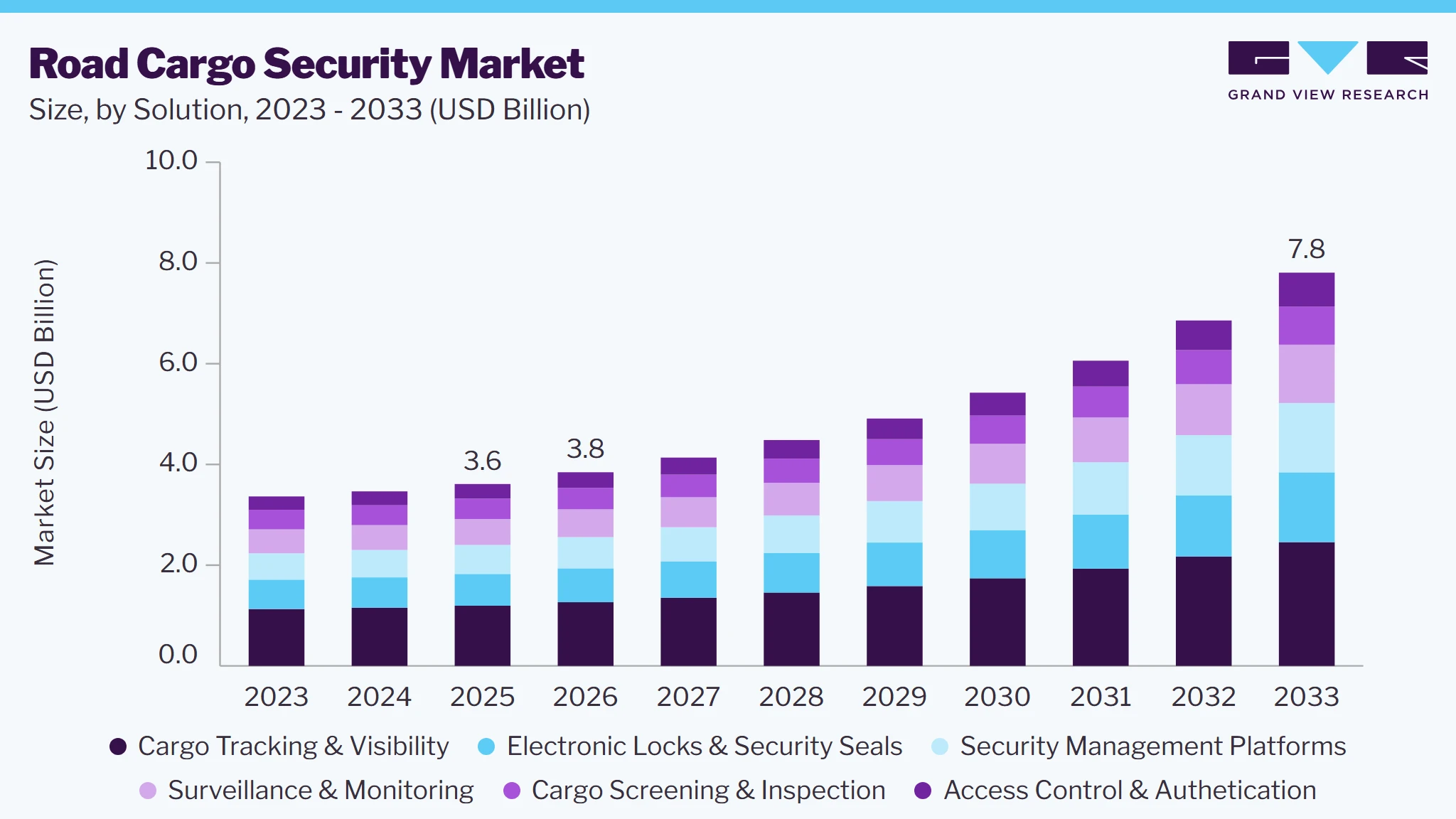 To learn more about this report, Download Free Sample Report
 The rapid expansion of global trade and cross-border road freight transportation is significantly driving the road cargo security industry. Increasing shipment volumes, higher transportation frequencies, and growing movement of high-value goods have elevated the need for comprehensive cargo protection solutions throughout the supply chain. Logistics companies are increasingly deploying intelligent cargo tracking systems, electronic security seals, video telematics, geofencing technologies, and centralized security management platforms to improve shipment visibility and mitigate cargo theft risks. As supply chains become increasingly interconnected and time-sensitive, organizations are prioritizing investments in advanced cargo security technologies that enhance operational resilience and ensure uninterrupted freight movement.
The growing adoption of digital logistics and connected fleet management is further accelerating market growth. Fleet operators are integrating IoT sensors, artificial intelligence, GPS tracking, cloud computing, and advanced analytics into transportation operations to monitor cargo conditions, optimize routes, detect suspicious activities, and enable real-time incident response.
These technologies improve operational efficiency while reducing cargo losses, insurance costs, and delivery delays. Furthermore, increasing regulatory compliance requirements related to transportation security, pharmaceutical logistics, hazardous materials handling, and customs procedures are encouraging organizations to modernize cargo security infrastructure.
In addition, the rapid growth of e-commerce, omnichannel retail, pharmaceutical distribution, and high-value manufacturing supply chains is creating substantial opportunities for advanced road cargo security solutions. Retailers and logistics providers are increasingly handling larger volumes of valuable shipments that require end-to-end visibility and enhanced protection against theft, tampering, and unauthorized access.
The continued evolution of intelligent transportation systems, predictive security analytics, autonomous fleet technologies, and integrated logistics platforms is expected to further strengthen demand for comprehensive road cargo security solutions throughout the forecast period.
Market Dynamics
The increasing frequency and sophistication of cargo theft incidents across domestic and international transportation networks remain one of the primary drivers of the road cargo security industry. Organized criminal activities targeting high-value shipments, pharmaceuticals, electronics, consumer goods, and automotive components are causing significant financial losses for logistics operators and cargo owners. To address these challenges, transportation companies are increasingly deploying GPS tracking systems, IoT-enabled cargo monitoring devices, electronic security seals, AI-powered surveillance systems, and cloud-based security management platforms that provide continuous visibility throughout the transportation lifecycle. These technologies enable proactive threat detection, faster incident response, improved route optimization, and enhanced asset protection.
Moreover, customers increasingly expect real-time shipment tracking, accurate delivery updates, and transparent logistics operations. The growing emphasis on supply chain visibility, customer satisfaction, and operational resilience continues to accelerate investment in intelligent cargo security solutions across multiple industries.
Despite favorable growth prospects, the adoption of advanced road cargo security solutions remains constrained by high implementation costs and integration challenges. Deploying comprehensive cargo security systems requires significant investments in IoT hardware, surveillance equipment, cloud software platforms, cybersecurity infrastructure, communication networks, and ongoing maintenance services. Small and medium-sized logistics operators face budget limitations that restrict large-scale technology adoption.
In addition, integrating multiple security technologies with existing transportation management systems (TMS), fleet management platforms, enterprise resource planning (ERP) software, and legacy logistics infrastructure can be technically complex and resource-intensive. Organizations must also address data privacy concerns, cybersecurity risks, interoperability issues, and workforce training requirements before fully realizing the benefits of digital cargo security platforms.
The rapid development of smart logistics ecosystems and connected transportation infrastructure presents significant growth opportunities for the market. Logistics providers are increasingly leveraging artificial intelligence, machine learning, predictive analytics, IoT connectivity, edge computing, and cloud-based security platforms to improve cargo monitoring, automate threat detection, optimize fleet operations, and reduce operational risks. These intelligent technologies enable predictive risk assessment, automated alert generation, route optimization, and real-time decision-making that significantly improve transportation security.
Growing investments in smart cities, intelligent transportation systems, autonomous commercial vehicles, digital freight platforms, and sustainable logistics are expected to further expand the market. The increasing adoption of blockchain-enabled supply chain traceability, digital freight documentation, remote asset monitoring, and AI-powered security analytics is creating new opportunities for solution providers to deliver comprehensive end-to-end cargo security ecosystems that enhance operational efficiency while protecting valuable shipments across global road transportation networks.
Market Concentration & Characteristics
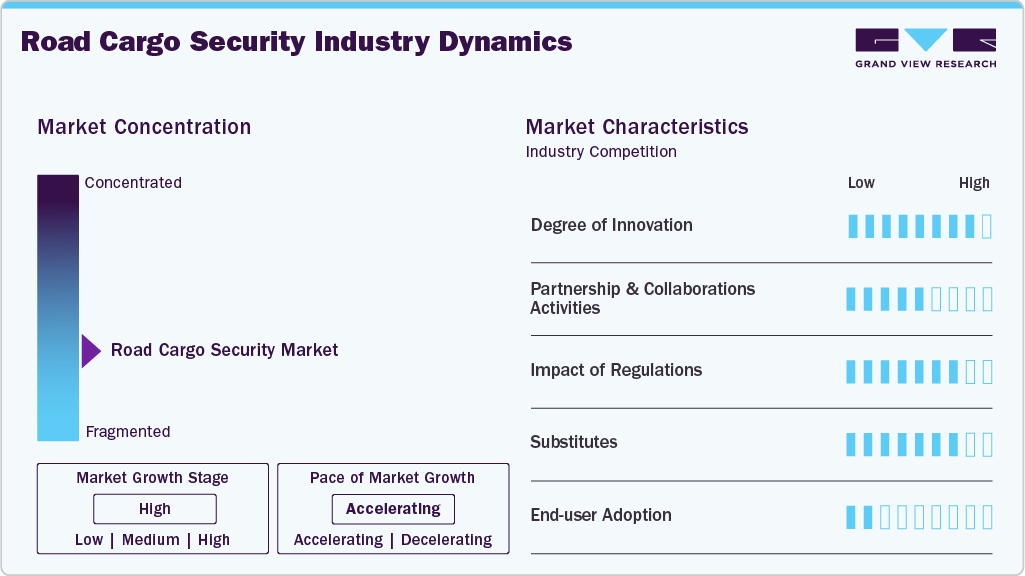
The market for road cargo security is moderately fragmented, with the presence of established physical security providers, fleet telematics companies, IoT solution providers, transportation technology vendors, and software platform developers competing across multiple technology segments. Market participants are continuously investing in artificial intelligence, cloud-based fleet management, IoT-enabled cargo monitoring, electronic locking systems, predictive analytics, and integrated security platforms to strengthen their competitive positions. Strategic acquisitions, technology partnerships, geographic expansion, and product innovation remain key competitive strategies adopted by leading companies.
 To learn more about this report, Download Free Sample Report
 The market is characterized by rapid technological innovation driven by digital logistics transformation, increasing regulatory compliance requirements, and growing demand for intelligent transportation security. Vendors are increasingly focusing on integrating GPS tracking, real-time video surveillance, biometric authentication, edge computing, predictive threat analytics, and centralized command platforms into unified cargo security ecosystems. As supply chains become increasingly digitized and interconnected, solution providers capable of delivering scalable, AI-enabled, and cloud-native cargo security platforms are expected to gain significant competitive advantages. Furthermore, increasing collaboration between logistics companies, insurance providers, transportation authorities, and technology vendors will continue to accelerate innovation and long-term market growth.
Analyst Perspective
The market is witnessing sustained growth due to increasing focus on shipment protection and supply chain resilience. Rising cargo theft, cross-border trade, e-commerce expansion, and transportation of high-value goods are driving demand for advanced security solutions. IoT, AI, GPS tracking, video telematics, cloud-based fleet management, and predictive analytics are enhancing cargo monitoring and risk management. Real-time visibility and automated incident response are enabling proactive threat detection and minimizing transportation disruptions. Companies are increasingly investing in AI-powered security analytics, intelligent fleet monitoring, and integrated cargo security platforms. Continued advancements in connected transportation infrastructure and smart logistics ecosystems are expected to improve operational efficiency and strengthen global road freight security.
Solution Insights
The cargo tracking & visibility segment accounted for the largest market share of 33.1% in 2025. The segment dominates the market owing to the growing demand for real-time shipment visibility, increasing adoption of IoT-enabled tracking devices, and rising emphasis on supply chain transparency. Logistics providers are increasingly deploying GPS tracking systems, RFID technology, telematics, geofencing, and cloud-based fleet management platforms to continuously monitor cargo location, shipment conditions, and transportation routes. These solutions enable organizations to minimize cargo theft, improve route optimization, reduce delivery delays, and enhance customer satisfaction through accurate shipment updates. The rapid expansion of e-commerce, cross-border trade, and high-value freight transportation continues to accelerate investment in intelligent cargo tracking and visibility solutions.
The security management platforms segment is expected to register the fastest CAGR during the forecast period. Organizations are increasingly adopting integrated security management platforms that consolidate cargo monitoring, fleet security, threat intelligence, incident management, compliance reporting, and predictive risk analytics into centralized dashboards. These platforms leverage artificial intelligence, cloud computing, big data analytics, and machine learning to identify security risks, automate incident response, and improve decision-making across transportation operations. Growing demand for unified security ecosystems capable of managing large fleets across multiple geographies is expected to drive significant growth in this segment.
End-use Insights
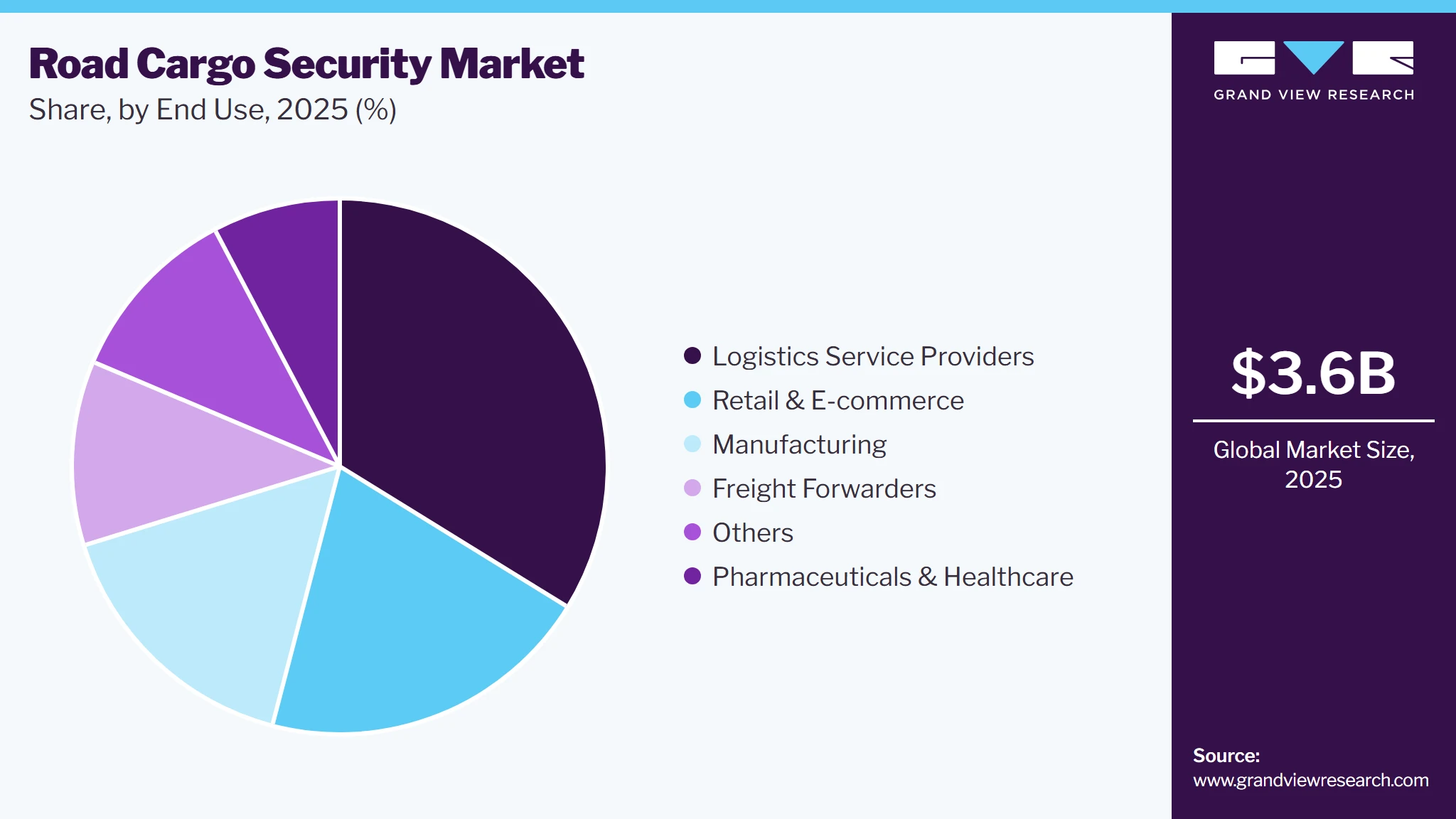
The logistics service providers segment accounted for the largest market share in 2025. Third-party logistics (3PL) providers, transportation companies, integrated logistics operators, and fleet management organizations are making substantial investments in advanced cargo security technologies to improve shipment visibility, reduce cargo theft, strengthen regulatory compliance, and optimize transportation efficiency. Increasing freight volumes, expanding global trade, and growing customer expectations for real-time shipment tracking continue to drive adoption of intelligent cargo security solutions across logistics service providers.
 To learn more about this report, Download Free Sample Report
 The retail & e-commerce segment is expected to register the fastest CAGR during the forecast period. The rapid growth of online retail, omnichannel fulfillment, direct-to-consumer delivery models, and same-day delivery services has significantly increased demand for secure transportation of high-value consumer goods. Retailers and e-commerce companies are increasingly deploying cargo tracking systems, AI-powered monitoring platforms, electronic security seals, and predictive risk analytics to reduce shipment losses, improve customer satisfaction, and strengthen end-to-end supply chain visibility. Continuous expansion of cross-border e-commerce further supports long-term segment growth.
Regional Insights
The North America road cargo security market accounted for the largest revenue share of 33.7% in 2025 and is projected to maintain its leading position throughout the forecast period. The region's dominance is attributed to its highly developed road freight transportation network, increasing investments in connected fleet technologies, and stringent cargo security regulations. Rising cargo theft incidents involving high-value goods, pharmaceuticals, electronics, and retail shipments have encouraged logistics providers to adopt advanced cargo security solutions such as IoT-enabled tracking devices, AI-powered surveillance systems, electronic locks, and cloud-based fleet security platforms. Furthermore, growing adoption of digital freight management, real-time shipment visibility, and predictive security analytics continues to strengthen market growth across North America.
 To learn more about this report, Download Free Sample Report
 U.S. Road Cargo Security Industry Trends
The U.S. road cargo security market represents the largest contributor to the North American market owing to its extensive commercial trucking industry, growing cross-border freight movement, and increasing adoption of intelligent transportation technologies. Logistics companies, retailers, and fleet operators are increasingly deploying GPS tracking, video telematics, geofencing, electronic cargo seals, and AI-driven security platforms to reduce cargo theft and improve operational efficiency. Rising investments in connected vehicle technologies, transportation digitalization, and supply chain resilience continue to support strong market growth across the country.
Europe Road Cargo Security Market Trends
Europe road cargo security market continues to represent a significant market due to increasing cross-border trade, expanding logistics operations, and stringent transportation security regulations. Freight operators are increasingly implementing advanced cargo monitoring technologies, digital fleet management systems, and integrated security platforms to improve shipment visibility and reduce cargo-related risks. Growing investments in intelligent transportation systems, connected logistics infrastructure, and digital supply chains continue to drive market expansion across the region.
Germany road cargo security market remains one of Europe's leading markets due to its strong manufacturing base, extensive road freight network, and central position within European logistics corridors. Logistics providers are increasingly investing in AI-enabled cargo monitoring, electronic security seals, and predictive fleet management solutions to enhance transportation efficiency and protect high-value industrial shipments.
The UK road cargo security market continues to witness increasing adoption of road cargo security technologies owing to the rapid growth of e-commerce, expanding last-mile delivery networks, and increasing demand for secure transportation of retail and pharmaceutical products. Rising deployment of cloud-based fleet management systems, real-time cargo tracking, and intelligent surveillance technologies continues to accelerate market growth.
Asia Pacific Road Cargo Security Market Trends
The Asia Pacific road cargo security market is expected to register the fastest CAGR of 12.7% during the forecast period. Rapid industrialization, expanding manufacturing activities, increasing cross-border trade, and strong growth in e-commerce logistics are significantly driving demand for advanced cargo security solutions. Governments and logistics companies across the region are investing in intelligent transportation infrastructure, connected fleet technologies, and digital freight management systems to improve supply chain security and operational efficiency.
China road cargo security market continues to dominate the regional market owing to its extensive manufacturing sector, large commercial vehicle fleet, and rapidly expanding logistics industry. The country is witnessing significant adoption of IoT-enabled cargo tracking, AI-powered surveillance, and cloud-based transportation management platforms to support domestic and international freight operations.
Japan road cargo security market remains a key contributor due to its technologically advanced logistics infrastructure and early adoption of intelligent transportation systems. Logistics companies are increasingly deploying automated fleet monitoring, predictive security analytics, and integrated cargo management platforms to improve shipment reliability and operational performance.
India road cargo security market is emerging as one of the fastest-growing markets driven by rapid expansion of the logistics sector, increasing road freight volumes, government investments in transportation infrastructure, and rising adoption of digital fleet management solutions. The rapid growth of e-commerce, organized retail, pharmaceutical logistics, and third-party logistics providers is creating significant demand for advanced cargo security technologies across the country.
Key Road Cargo Security Company Insights
The market for road cargo security is highly competitive, with leading security providers, telematics companies, fleet technology vendors, and logistics software providers focusing on intelligent cargo protection, connected fleet management, AI-powered surveillance, and cloud-based transportation security platforms. Companies are investing heavily in Internet of Things (IoT), artificial intelligence, machine learning, predictive analytics, video telematics, and integrated fleet security solutions to enhance shipment visibility, reduce cargo theft, and improve operational efficiency. Strategic acquisitions, product innovation, technology partnerships, and geographic expansion remain the primary growth strategies adopted by major market participants.
-
Brink's Incorporated is one of the providers of secure transportation and cargo protection solutions, offering integrated logistics security services, high-value cargo transportation, real-time shipment monitoring, risk management, and secure supply chain solutions. The company continues to strengthen its portfolio through digital tracking technologies, operational security enhancements, and global logistics expansion.
-
ORBCOMM is a provider of IoT-enabled transportation visibility and fleet management solutions, offering GPS tracking, telematics, cargo monitoring, cold chain visibility, trailer management, and cloud-based logistics platforms. The company continues to expand its intelligent transportation ecosystem by integrating AI-driven analytics, predictive maintenance capabilities, and advanced fleet visibility solutions for logistics providers worldwide.
Key Road Cargo Security Companies
The following key companies have been profiled for this study on the road cargo security market.
-
Brink’s Incorporated
-
G4S Limited
-
Loomis
-
Prosegur
-
GardaWorld
-
Securitas
-
Maltacourt
-
ORBCOMM
-
Samsara
-
Geotab
Company Categorization
Operating Strategies
Competitive Edge
Weaknesses
Mature Players: Brink's Incorporated, G4S Limited, Loomis, Prosegur, GardaWorld, Securitas
Mature players are expanding their road cargo security portfolios by integrating AI-powered surveillance, real-time cargo tracking, electronic security systems, fleet monitoring platforms, video telematics, predictive analytics, and managed transportation security services. Strategic priorities include strengthening global logistics security operations, expanding technology partnerships, enhancing digital fleet visibility, improving end-to-end shipment traceability, supporting regulatory compliance, and delivering integrated physical and digital cargo protection solutions across international supply chains.
Mature companies benefit from strong global operational networks, established customer relationships, extensive logistics security expertise, integrated service portfolios, significant investments in digital transportation technologies, and broad managed security capabilities. Their ability to provide comprehensive physical security, intelligent monitoring, risk management, and end-to-end logistics security services provides a strong competitive advantage across global freight transportation markets.
Mature companies face challenges associated with high operational costs, labor-intensive service delivery models, complex multinational operations, legacy infrastructure modernization requirements, increasing cybersecurity threats, and slower deployment of emerging digital technologies compared with agile technology-focused competitors.
Emerging Players: ORBCOMM, Samsara, Geotab, Maltacourt
Emerging players focus on cloud-based fleet management, IoT-enabled cargo monitoring, AI-powered analytics, video telematics, predictive security intelligence, connected transportation platforms, and software-driven logistics visibility solutions. Their strategies emphasize rapid product innovation, cloud-native SaaS deployment models, scalable subscription-based services, intelligent fleet analytics, strategic partnerships with logistics providers, and continuous enhancement of real-time cargo monitoring and operational intelligence capabilities.
Emerging companies gain competitive advantages through agile product innovation, cloud-native architectures, advanced telematics capabilities, flexible subscription models, strong expertise in connected fleet technologies, transportation analytics, artificial intelligence, and rapid implementation compared with traditional security service providers.
Emerging players face challenges including comparatively limited global service infrastructure, lower brand recognition in physical security services, dependence on technology partnerships, limited end-to-end managed security capabilities, and increasing competition from established logistics security providers expanding their digital technology portfolios.
Recent Developments:
-
In June 2026, Samsara launched its Tracking Label and Agentic Shipment Center to close visibility gaps across the supply chain, giving logistics teams better shipment tracking, stronger exception management, and improved protection against cargo theft.
-
In June 2025, ORBCOMM launched CrewView, its latest supply-chain insights module for shipping lines, enhancing smart container monitoring, shipment visibility, and operational control across multimodal logistics networks.
Road Cargo Security Market Report Scope
Report Attribute
Details
Market size value in 2025
USD 3.6 billion
Market size value in 2026
USD 3.8 billion
Revenue forecast in 2033
USD 7.8 billion
Growth rate
CAGR of 10.7% from 2026 to 2033
Base year for estimation
2025
Historical data
2021 - 2024
Forecast period
2026 - 2033
Quantitative units
Revenue in USD billion and CAGR from 2026 to 2033
Report coverage
Revenue forecast, company ranking, competitive landscape, growth factors, and trends
Segments covered
Solution, end-use, region
Regional scope
North America; Europe; Asia Pacific; Latin America; MEA
Country scope
U.S.; Canada; Mexico; Germany; UK; France; China; Japan; India; South Korea; Australia; Brazil; KSA; UAE; South Africa
Key companies profiled
Brink’s Incorporated; G4S Limited; Loomis; Prosegur; GardaWorld; Securitas; Maltacourt; ORBCOMM; Samsara; Geotab
Customization scope
Free report customization (equivalent up to 8 analysts working days) with purchase. Addition or alteration to country, regional & segment scope.
Pricing and purchase options
Avail customized purchase options to meet your exact research needs. Explore purchase options
Global Road Cargo Security Market Report Segmentation
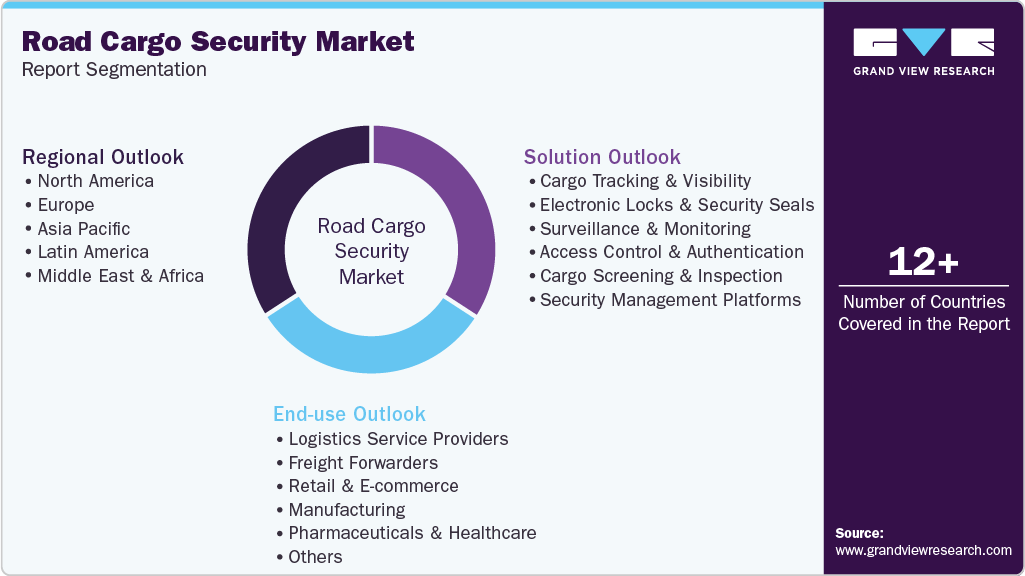
This report forecasts revenue growth at the global, regional, and country levels and provides an analysis of the latest industry trends in each of the sub-segments from 2021 to 2033. For this study, Grand View Research has segmented the global road cargo security market report based on solution, end-use, and region:
 To learn more about this report, Download Free Sample Report
 -
Solution Outlook (Revenue, USD Billion, 2021 - 2033)
-
Cargo Tracking & Visibility
-
Electronic Locks & Security Seals
-
Surveillance & Monitoring
-
Access Control & Authentication
-
Driver Authentication
-
Mission Authentication Systems
-
-
Cargo Screening & Inspection
-
Security Management Platforms
-
Control Towers
-
Fleet Security Platforms
-
Secure Truck Parking
-
Others
-
-
-
End-use Outlook (Revenue, USD Billion, 2021 - 2033)
-
Logistics Service Providers
-
Freight Forwarders
-
Retail & E-commerce
-
Manufacturing
-
Pharmaceuticals & Healthcare
-
Others
-
-
Regional Outlook (Revenue, USD Billion, 2021 - 2033)
-
North America
-
U.S.
-
Canada
-
Mexico
-
-
Europe
-
Germany
-
UK
-
France
-
-
Asia Pacific
-
China
-
Japan
-
India
-
South Korea
-
Australia
-
-
Latin America
-
Brazil
-
-
Middle East and Africa (MEA)
-
KSA
-
UAE
-
South Africa
-
-
Research Methodology
The road cargo security market figures in this report are based on a proven research process that combines executive interviews with secondary research from proprietary databases, company filings, and recognized regulatory and institutional sources. Market size is built through value-chain sizing—reconciling supply-side and demand-side estimates—and triangulated with bottom-up and top-down approaches. Every estimate passes multiple levels of expert validation before publication, with each road cargo security segment quantified using the revenue-capture definitions in the table below.
Segment Definition
Segment - Solution
Revenue capture definition
Cargo Tracking & Visibility
The segment revenue is generated from cargo tracking and visibility solutions that provide real-time shipment location, GPS tracking, IoT-enabled asset monitoring, geofencing, predictive ETA, route optimization, RFID tracking, and cloud-based fleet visibility platforms used to improve cargo security throughout road transportation.
Electronic Locks & Security Seals
The segment revenue is generated from electronic locking systems, smart security seals, tamper-evident locks, remotely controlled locking devices, and intelligent cargo access control technologies designed to prevent unauthorized access and cargo theft during road transportation.
Surveillance & Monitoring
The segment revenue is generated from onboard surveillance systems, AI-powered video monitoring, vehicle cameras, cargo compartment monitoring, driver behavior monitoring, and remote fleet surveillance solutions that improve cargo protection, incident detection, and operational visibility.
Access Control & Authentication
The segment revenue is generated from biometric authentication, driver identity verification, digital credentials, secure access management systems, multi-factor authentication, and electronic authorization platforms used to control access to cargo, vehicles, and transportation facilities.
Cargo Screening & Inspection
The segment revenue is generated from cargo screening technologies including X-ray inspection systems, explosive detection equipment, AI-assisted cargo inspection platforms, automated screening solutions, and inspection services that ensure shipment integrity and regulatory compliance.
Security Management Platforms
The segment revenue is generated from integrated software platforms providing centralized cargo security management, incident reporting, risk assessment, threat intelligence, compliance management, fleet security analytics, and real-time monitoring across road freight transportation networks.
Segment - End Use
Revenue capture definition
Logistics Service Providers
The segment revenue is generated from cargo security solutions deployed by third-party logistics providers (3PLs), transportation companies, and integrated logistics operators to secure freight movement, improve shipment visibility, reduce cargo theft, and enhance fleet security operations.
Freight Forwarders
The segment revenue is generated from cargo security technologies adopted by freight forwarding companies to improve shipment tracking, cross-border transportation security, cargo integrity, documentation security, and multimodal logistics visibility.
Retail & E-commerce
The segment revenue is generated from cargo security solutions supporting online retailers, omnichannel distributors, fulfillment centers, and last-mile delivery providers to protect high-value shipments, reduce cargo losses, and improve customer delivery visibility.
Manufacturing
The segment revenue is generated from cargo security technologies deployed by manufacturing companies to secure inbound raw materials, industrial equipment, finished products, and just-in-time supply chain operations during road transportation.
Pharmaceuticals & Healthcare
The segment revenue is generated from cargo security solutions supporting pharmaceutical manufacturers, healthcare distributors, and medical logistics providers transporting temperature-sensitive medicines, vaccines, medical devices, and regulated healthcare products requiring secure chain-of-custody monitoring.
Others
The segment revenue is generated from cargo security deployments across automotive, food & beverages, chemicals, consumer goods, agriculture, government, defense, and other industries requiring secure road freight transportation.
Segment - Access Control & Authentication
Revenue capture definition
Driver Authentication
The segment revenue is generated from driver authentication solutions, including biometric verification, facial recognition, fingerprint scanning, mobile credentials, digital identity management, multi-factor authentication, and driver access verification systems used to ensure that only authorized personnel can operate commercial vehicles and access cargo during transportation.
Mission Authentication Systems
The segment revenue is generated from mission authentication systems that verify shipment assignments, delivery authorizations, route approvals, electronic proof of delivery, secure dispatch validation, digital trip authorization, and mission-specific access controls to prevent cargo theft, unauthorized vehicle movement, and fraudulent transportation activities.
Segment - Security Management Platforms
Revenue capture definition
Control Towers
The segment revenue is generated from centralized logistics control tower platforms that provide end-to-end shipment visibility, fleet monitoring, security event management, route optimization, incident response, predictive analytics, and real-time operational intelligence across road transportation networks.
Fleet Security Platforms
The segment revenue is generated from integrated fleet security platforms offering vehicle tracking, AI-powered video telematics, driver behavior monitoring, geofencing, cargo security analytics, risk management, theft prevention, and cloud-based fleet security management solutions for commercial transportation operators.
Secure Truck Parking
The segment revenue is generated from secure truck parking solutions, including monitored parking facilities, access-controlled parking infrastructure, reservation platforms, surveillance systems, perimeter security technologies, and digital parking management solutions designed to protect commercial vehicles, drivers, and cargo during transit and rest periods.
Others
The segment revenue is generated from other security management platforms, including transportation security command centers, incident management systems, compliance management software, threat intelligence platforms, emergency response solutions, cargo risk assessment tools, and integrated transportation security management applications supporting road freight operations.
Estimation Model
Layer Name
Key Question
Description
Road Freight Infrastructure Assessment
Where is demand for road cargo security solutions generated?
This layer evaluates commercial trucking activity, freight transportation volumes, logistics infrastructure, cross-border road trade, fleet expansion, and cargo movement across major industries. Demand is assessed across logistics providers, freight operators, retailers, manufacturers, pharmaceutical companies, and government transportation agencies to estimate cargo security solution adoption.
Security Technology & Solution Mapping
Which cargo security technologies are being deployed?
This layer analyzes adoption across cargo tracking, electronic locks, surveillance systems, access control, cargo inspection technologies, and integrated security management platforms. Technology adoption trends related to IoT, AI-powered analytics, telematics, cloud computing, GPS tracking, and predictive security platforms are incorporated to estimate demand by solution category.
Vendor Ecosystem & Competitive Analysis
How is market supply structured?
This layer evaluates leading cargo security providers, fleet telematics companies, IoT solution vendors, transportation software providers, and physical security companies. The analysis incorporates product innovation, strategic partnerships, pricing trends, managed security services, technology integration, and regional distribution capabilities influencing overall market revenue.
Market Revenue Forecast
What is the future revenue potential of the market?
This layer integrates freight transportation volumes, cargo theft statistics, fleet digitalization trends, technology adoption rates, infrastructure investments, regulatory requirements, vendor revenues, pricing models, and enterprise demand forecasts to estimate market revenue across all major segments and regions.
Delivered Customizations
This report has been delivered with the following In-depth customizations
Client Request
Customization Delivered
Value Adds
Logistics Service Provider (3PL/4PL)
- Evaluation of AI-powered cargo tracking, fleet monitoring, and shipment visibility platforms.
- Analysis of cargo theft trends, route risk assessment, and predictive security technologies.
- Benchmarking of transportation security solutions, telematics platforms, and fleet security vendors.
- Identified opportunities to reduce cargo theft and shipment losses.
- Improved fleet visibility and operational efficiency across transportation networks.
- Enabled data-driven investments in intelligent cargo security technologies.
Retail & E-commerce Company
- Assessment of last-mile delivery security solutions and real-time shipment monitoring technologies.
- Analysis of high-value goods protection strategies and omnichannel logistics security.
- Benchmarking of cargo visibility platforms, electronic security seals, and AI-enabled monitoring systems.
- Enhanced protection of high-value customer shipments.
- Improved delivery transparency and customer satisfaction.
- Reduced financial losses associated with cargo theft and delivery disruptions.
Freight Forwarder / Transportation Company
- Assessment of cross-border cargo security technologies and multimodal shipment visibility solutions.
- Analysis of electronic documentation security, route optimization, and cargo inspection technologies.
- Competitive benchmarking of fleet telematics, security management platforms, and connected logistics solutions.
- Improved end-to-end shipment visibility across domestic and international freight operations.
- Enhanced transportation risk management and cargo integrity.
- Supported digital transformation of freight security operations.
Frequently Asked Questions About This Report
The global road cargo security market was valued at USD 3.6 billion in 2025 and is estimated to reach USD 3.8 billion in 2026.
The global road cargo security market is projected to grow at a CAGR of 10.7% from 2026 to 2033, reaching USD 7.8 billion by 2033.
Asia Pacific is the fastest-growing region over the forecast period.
North America dominated the road cargo security market with a 33.7% revenue share in 2025, supported by advanced logistics infrastructure, widespread adoption of digital fleet management technologies, and increasing investments in transportation security.
The logistics service providers segment dominated the market in 2025, while retail & e-commerce segment is fastest growing end-use.
The cargo tracking & visibility segment accounted for the largest market share of 33.1% in 2025, while security management platforms segment is fastest growing solution.
Key market participants include Brink's Incorporated, G4S Limited, Loomis, Prosegur, GardaWorld, Securitas, Maltacourt, ORBCOMM, Samsara, and Geotab. These companies focus on cargo tracking and visibility, connected fleet management, AI-powered surveillance, transportation security services, electronic cargo protection systems, IoT-enabled monitoring, and integrated logistics security platforms to strengthen supply chain resilience and improve shipment security.
Key growth drivers include rising cargo theft incidents, increasing adoption of connected fleet technologies, growing demand for real-time shipment visibility, expansion of e-commerce logistics, increasing cross-border trade, stricter transportation security regulations, and advancements in IoT, AI-powered surveillance, cloud-based fleet management, and predictive security analytics.
About the Author(s)
Next Generation Technologies Research Team
Technology · Next Generation TechnologiesThis report was authored by the next generation technologies research team at Grand View Research - comprising two research analysts, one senior research analyst, and one industry expert - with specialized expertise in the next generation technologies segment of the technology industry. All findings are based on proprietary technology databases, executive interviews, and regulatory analysis, subject to internal peer review prior to publication.
Last Updated:
Speak to Analyst

Customize this report to your needs - add regions, segments, or data points, with 20% free customization.
Or view our licence options:


ISO 9001:2015 & 27001:2022 Certified
We are GDPR and CCPA compliant! Your transaction & personal information is safe and secure. For more details, please read our privacy policy.


