
- Home
- »
- Food Additives & Nutricosmetics
- »
-
Sorbitol Market Size & Share Report, 2026-2033GVR Report cover

Sorbitol Market (2026 - 2033)
Size, Share & Trends Analysis Report By Product (Liquid, Crystal), By Application (Oral Care, Vitamin C, Surfactant), By End-use (Personal Care), By Region, And Segment Forecasts
Market Size, 2025
$2.0BMarket Estimate, 2026
$2.1BMarket Forecast, 2033
$3.4BCAGR, 2026–2033
6.7%Sorbitol Market Summary
The global sorbitol market size was valued at USD 2.0 billion in 2025 and is projected to grow from USD 2.1 billion in 2026 to USD 3.4 billion by 2033, at a CAGR of 6.7% from 2026 to 2033. Asia Pacific dominated the market, accounting for a revenue share of 58.7% in 2025. The market is expected to witness significant growth over the forecast period owing to the rising usage of sorbitol in diabetic and dietetic food and beverages.
 Source: Grand View Research, IR Documents, Primary Interviews, Paid DatabasesTo learn more about this report,
 Download Free Sample Report
Key Market Trends & Insights
- By product: Liquid sorbitol held a dominant position, contributing 76.2% of total revenue in 2025.
- By application: Diabetic and dietetic food and beverages accounted for the largest revenue share of 35.7% in 2025.
- By end use: Food captured the largest revenue share of 36.1% in 2025.
Regional Highlights
- Largest regional market: Asia Pacific (58.7% revenue share, 2025)
- By country: China held the largest market share in 2025.
Market Size & Forecast
- Market size in 2025: USD 2.0 Billion
- Estimated market size in 2026: USD 2.1 Billion
- Projected market size by 2033: USD 3.4 Billion
- CAGR (2026-2033): 6.7%
Three ways to get this report
Buy it, customize it, or ask a question.Ask an Analyst
Analyst response in 1 business day
- AccessReport author, directly
- Reply timeWithin 1 working day
- No sales callDirect answer only
- FormatEmail reply
- CostFree, no cost
Get the Full Report
What the study covers
- FormatsPDF · Excel · Dashboard
- Timeline2026–2033 annual, 2025 base
- Coverage20+ countries, 5 regions
- Companies10+ key players profiled
Customize the Report
20% free customization
- IncludeCountries, segments, points
- TailorTo your product definition
- ExtendDeeper competitor detail
- OrA fully bespoke study
- Turnaround5–10 working days
The growing product demand as a substitute for sugar in consumer food products is also expected to drive demand for the product over the next few years. Sorbitol is also increasingly being used in oral care products as it is metabolized at a slower rate as compared to other sugar alcohols, preventing dental problems such as cavities and tooth decay. The benefits of the same are expected to propel industry growth over the forecast period. Additionally, the trend of shifting production capacities to the Asia Pacific due to low production and labor costs has resulted in low costs for sorbitol, therefore causing rising demand for non-food applications.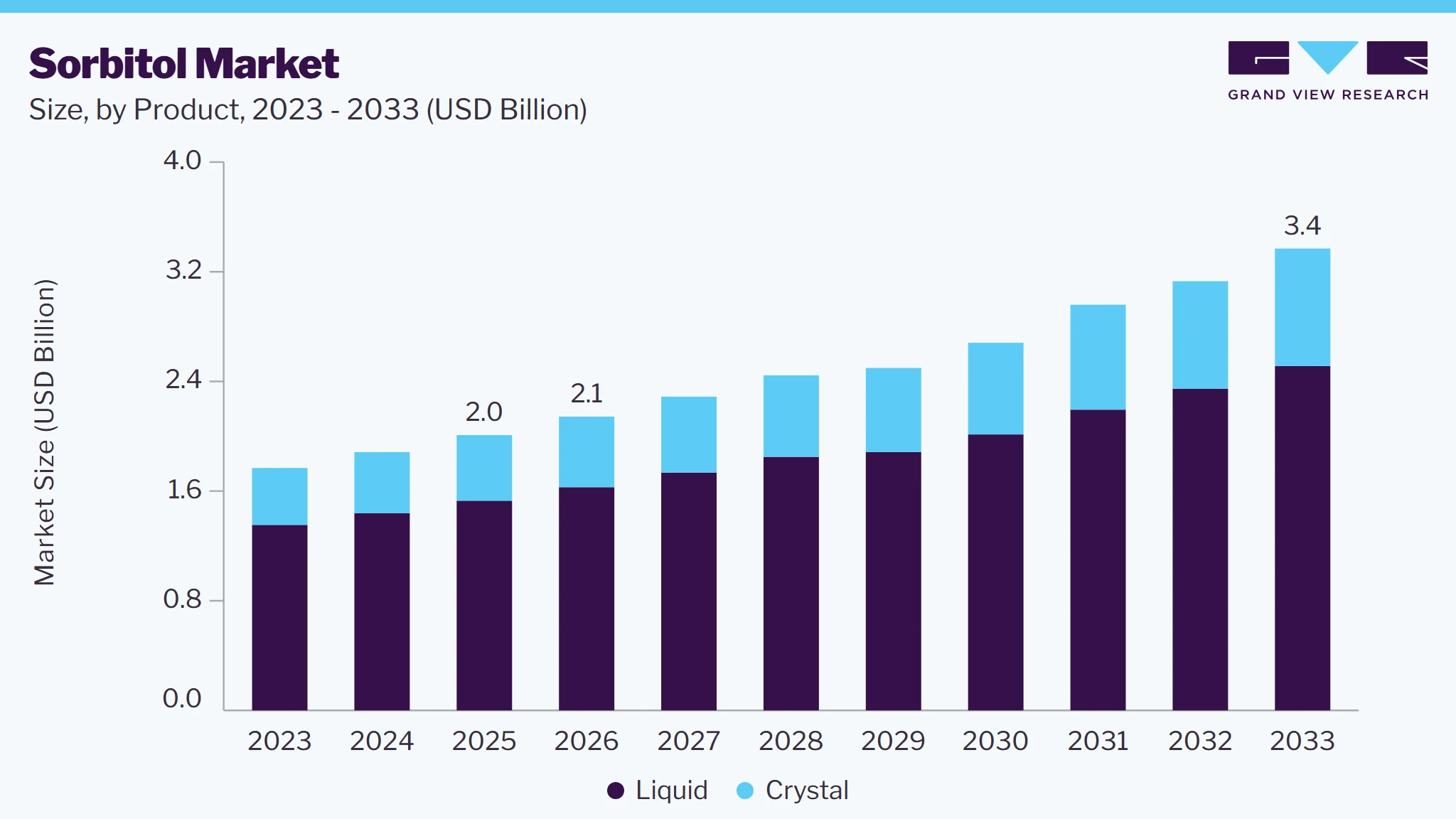 To learn more about this report, Download Free Sample Report
The major driver for the market is the growing demand from the food and beverage industry for nutritive sweeteners. Approval from safety regulatory and human health bodies such as the FDA and the U.S. Department of Agriculture (USDA) for the use of the product in medicines and bakery foods is expected to further drive the market in the U.S. In addition, sorbitol also finds application as a humectant in pharmaceutical products, thereby fueling the growth of the product in the country due to the presence of one of the biggest pharmaceutical industries. As a result, the demand for sorbitol is also anticipated to increase over the forecast period.
The increasing use of the product in chocolates and confectionary products owing to its textural, moisture-stabilizing, and non-carcinogenic properties is expected to positively affect the overall demand of the market. Sorbitol is chemically relatively inert and is a stable chemical, which is expected to result in high demand for the product as it is easy to incorporate into other food products without hampering the recipe. Due to the unique and useful texture-enhancing properties of sorbitol, it has varied applications, including the manufacturing of cosmetics.
Sorbitol is an intermediate product whose demand largely depends on the demand for end products in its application industries. Ample availability of starch sources, such as potato and corn, in India, China, and Brazil is expected to work favorably for its production over the forecast period. In addition, the number of raw material suppliers is expected to increase in China and India due to the growth of the agricultural sector, aided by the low labor costs and growing demand across the world.
Moreover, sorbitol is used in the production of biofuels. Biofuels are naturally derived fuels that are promoted by various organizations such as the European Commission or EPA through the implementation of favorable policies. The growing popularity of biofuels, coupled with the support of government organizations, is expected to result in an increased number of manufacturers over the coming years. The growing research and applications for the same, especially in developed regions like North America and Europe, are expected to drive the demand for sorbitol over the forecast period.
Market Dynamics
The sorbitol market is driven by growing demand from food and beverage, pharmaceutical, and personal care industries, where sorbitol is widely used as a low-calorie sweetener, humectant, and stabilizer. Rising consumer preference for sugar-free and reduced-calorie products, coupled with increasing pharmaceutical production and expanding oral care applications, continues to support market growth. However, fluctuations in corn and starch feedstock prices and the availability of alternative polyols may create pricing and competitive challenges. Despite these factors, ongoing product innovation, increasing adoption in emerging economies, and the expansion of functional food and personal care industries are expected to sustain long-term market growth.
The growing reformulation of food, beverage, and oral care products to reduce sugar content has become one of the strongest demand drivers for the sorbitol market. Food manufacturers are increasingly incorporating sorbitol into sugar-free confectionery, chewing gum, baked goods, and diabetic-friendly products because it delivers sweetness while also functioning as a humectant, texturizer, and stabilizer. Unlike conventional sugar, sorbitol is lower in calories, does not promote tooth decay, and results in a lower glycemic response, making it well aligned with evolving consumer preferences for healthier formulations. Regulatory bodies, including the U.S. FDA, recognize sorbitol as a widely used sugar alcohol in food applications, while the Joint FAO/WHO Expert Committee on Food Additives (JECFA) has established an "ADI not specified," reflecting its established safety for intended uses.
Beyond its sweetening properties, sorbitol provides functional performance that helps manufacturers improve product quality and processing efficiency. Its moisture-retention capability extends shelf life in bakery and confectionery products, while its non-crystallizing nature enhances texture and stability. In oral care formulations such as toothpaste and mouthwash, sorbitol is extensively used as a humectant to maintain product consistency and prevent drying, reducing the need for additional formulation ingredients. As leading food and personal care companies continue investing in sugar reduction and clean reformulation strategies to meet changing consumer expectations and regulatory requirements, sorbitol is expected to witness sustained demand across both mature and emerging markets.
Sorbitol is primarily manufactured through the hydrogenation of glucose syrup derived from corn starch, making its production costs highly sensitive to fluctuations in agricultural commodity prices and starch availability. Variations in corn harvests caused by adverse weather conditions, changing planting patterns, biofuel demand, geopolitical disruptions, and trade restrictions can significantly influence the cost of glucose syrup, the key raw material used in sorbitol production. These cost fluctuations create pricing uncertainty for manufacturers, compress profit margins, and make it challenging to maintain stable long-term supply agreements, particularly in price-sensitive end-use industries such as food processing and personal care. The U.S. Department of Agriculture (USDA) regularly reports that changes in global corn production and inventories directly influence corn prices and downstream starch-based products.
Rising energy, transportation, and hydrogen costs further increase production expenses for sorbitol manufacturers. Since many supply contracts with food and pharmaceutical companies are negotiated over extended periods, producers often have limited flexibility to immediately pass higher input costs to customers. As a result, manufacturers must absorb part of the increased costs or optimize production efficiency, which can constrain profitability and investment in capacity expansion during periods of prolonged raw material price volatility. This remains a key challenge for the global sorbitol market, particularly in regions heavily dependent on imported corn or starch derivatives.
The rapid expansion of pharmaceutical and nutraceutical manufacturing across emerging economies presents a significant growth opportunity for the sorbitol market. Sorbitol is widely used as an excipient, sweetening agent, humectant, and stabilizer in products such as syrups, chewable tablets, vitamin supplements, and oral liquid formulations. Countries including India, China, Brazil, and Indonesia are strengthening domestic pharmaceutical production through supportive government policies, rising healthcare expenditure, and increasing investments in manufacturing infrastructure. As pharmaceutical companies scale production to meet both domestic and export demand, the consumption of high-purity pharmaceutical-grade sorbitol is expected to increase steadily.
In parallel, growing consumer demand for dietary supplements, pediatric formulations, and sugar-free medicinal products is encouraging manufacturers to adopt multifunctional excipients that enhance product stability, palatability, and shelf life. Sorbitol's compatibility with a wide range of active pharmaceutical ingredients (APIs) and its established use in pharmaceutical formulations position it as a preferred ingredient for next-generation healthcare products. The continued expansion of the global nutraceutical industry, combined with increasing investments in pharmaceutical manufacturing capacity, is expected to create long-term opportunities for sorbitol suppliers to diversify their customer base and strengthen their presence in high-value applications.
Analyst Perspective
The sorbitol market is expected to witness steady growth, supported by its expanding use across food, pharmaceuticals, personal care, and chemical applications. While demand from sugar-free food products and oral care formulations remains a key growth driver, increasing utilization of sorbitol in pharmaceutical excipients and Vitamin C production is broadening its commercial potential. Market competition is likely to intensify as manufacturers focus on product quality, capacity expansion, and supply chain integration to strengthen their market position. Going forward, companies with diversified end-use exposure, reliable starch feedstock sourcing, and the capability to supply high-purity and pharmaceutical-grade sorbitol are expected to be better positioned to capture long-term growth opportunities.
Product Insights
By product, liquid held a dominant position, contributing 76.2% of total revenue in 2025. Liquid sorbitol is majorly used as a substitute for sugar in the pharmaceutical and food and beverage industries. The growing demand for low-calorie food caused by the growing number of health-conscious consumers as well as patients with obesity across the globe is expected to fuel the use of the product in these industries.
Crystal sorbitol is widely utilized as a food additive for producing frozen raw fish, shrimp balls, roasted fish fillets, dried squid thread, polydextrose (soluble dietary fiber), chewing gum, and mint tablets. It is also used in several other frozen aquatic products as well as sugar-free foodstuffs. The growing demand for application products, primarily in meat products and frozen foods, is expected to promote market growth over the forecast period.
Crystal-based product is also used as a humectant in various cosmetic products, such as moisturizers and face cream, owing to their capacity to resist bacteriological degradation and retain moisture. Other applications of crystal sorbitol include its use as a plasticizer in the production of capsule outer shell and as a filler and excipient in the production of pharmaceutical tablets. Thus, the growing demand for cosmetic products is anticipated to prove beneficial for sorbitol demand over the coming years.
Application Insights
Diabetic & diabetic food & beverage segment accounted for the largest revenue of 35.7% in 2025. The increasing global consumption of functional foods as well as economies of scale has resulted in low manufacturing costs for the major manufacturers while creating new opportunities for the growth of sorbitol in the future. However, a gradual increase in the demand for sweeteners, such as maltitol and xylitol, is expected to pose a threat to the market as they can be substituted with sorbitol.
Sorbitol finds application in surfactants as detergents, dispersants, emulsifiers, and wetting and foaming agents. Biobased surfactants are witnessing increased utilization in the food processing industry. The surfactant acts as a stabilizing agent for a variety of food products, such as bread, ice cream, and cakes. Additionally, the surfactants help in maintaining the viscosity and texture of the food products and extending shelf life. As a result, the growth of the food processing industry is expected to drive the demand for biobased surfactant products over the forecast period.
The Vitamin C application segment is expected to expand at the highest growth rate over the forecast period. Vitamin C is mainly synthesized using two manufacturing processes, namely the Reichstein Grussner process and the two-step fermentation process. Both production processes use sorbitol as a primary starting material for the production of ascorbic acid (Vitamin C). The two-step fermentation process is primarily used by Chinese manufacturers owing to its lower cost.
End-use Insights
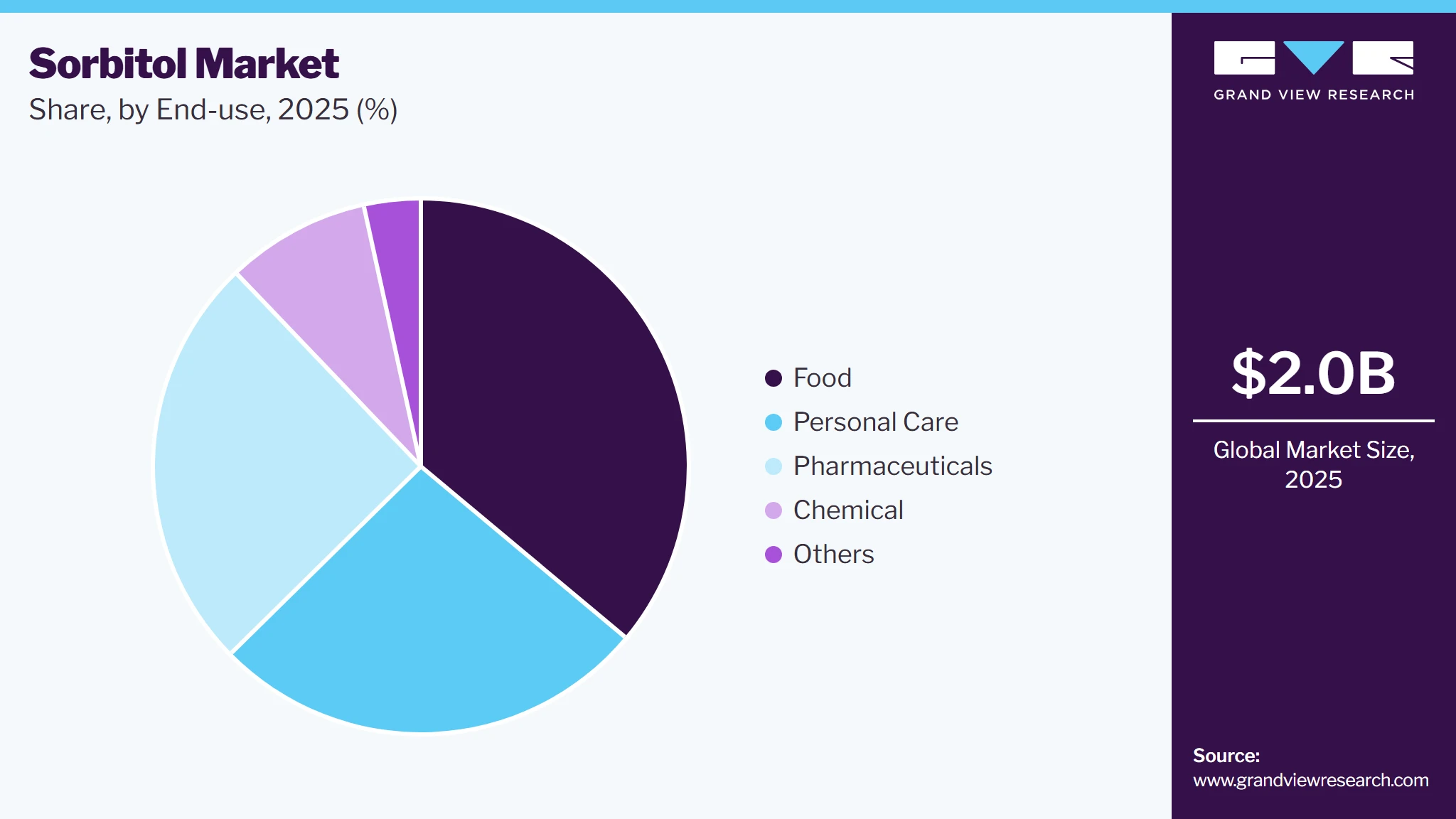
In 2025, the food segment captured the largest revenue share of 36.1% in the market. Sorbitol is generally added to food items to induce the sweetness and replace the need for refined sugar. In addition to providing sweetness, sorbitol also acts as an excellent texturizing and anti-crystallization agent in the production of ice cream and bakery products. It is widely used to increase shelf life and maintain the freshness and color of various confectionery and bakery products. Furthermore, it finds application in the production of canned fruit. The food segment is expected to dominate the market over the forecast period, tracing the growth of the food and beverages industry, as applications for the product are expanding in the industry.
Rising awareness regarding dietary supplements owing to their nutritional benefits is expected to have a positive impact on market growth in the near future. In addition, rising concern over low-calorie and sugar-free products on account of the increasing prevalence of diabetes in the world is expected to be a favorable factor for the growth of the market in the near future.
 To learn more about this report, Download Free Sample Report
Sorbitol has emerged as one of the key building blocks for the production of bio-based ethylene glycol and propylene glycol. For instance, Archer Daniels Midlands Company in partnership with Pacific Northwest National Laboratory (PNNL) began the commercial production of biobased propylene glycol (PG) from sorbitol and glycerol at its Illinois, U.S.-based manufacturing facility.
Moreover, the growing use of monoclonal antibodies in critical therapeutic areas such as oncology, tuberculosis, and autoimmune diseases is likely to drive demand for sorbitol. The increasing number of contract manufacturing organizations (CMOs) and contract research organizations (CROs) in the pharmaceutical sector is anticipated to drive product demand.
Furthermore, the ion exchange technique is one of the most creative and active fields in the food and beverages industry, which also plays a vital role in the growth of the food industry. The food & beverages end-use segment is anticipated to be the fastest-growing end-use segment owing to the increasingly strict guidelines issued by food regulatory authorities all over the world.
Regional Insights
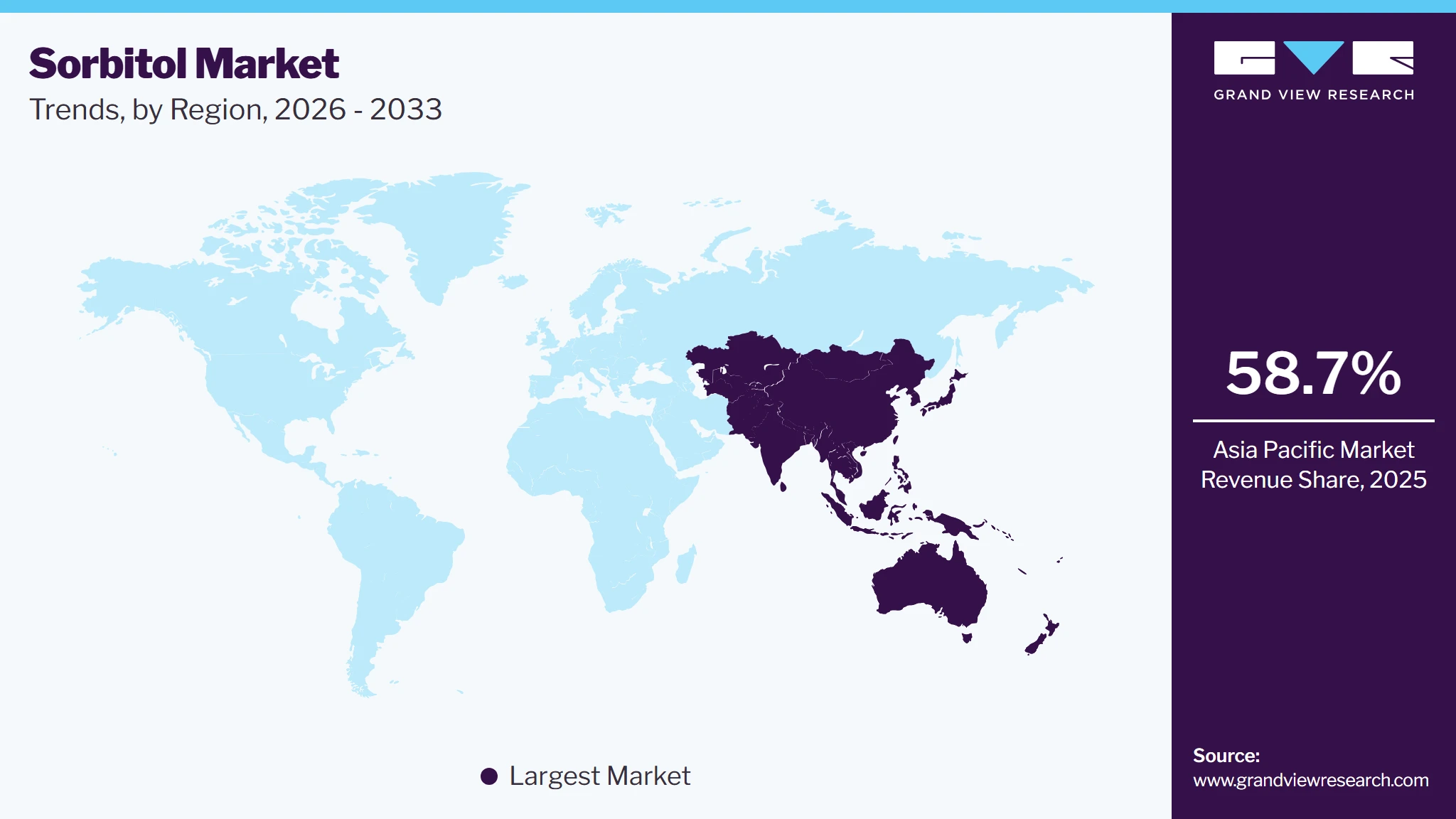
Asia Pacific dominated the sorbitol market with the highest revenue share of 58.7% in 2025. China dominated the Asia Pacific sorbitol market in 2025. Increasing health-conscious consumers, coupled with a rise in the number of consumer markets growing at a high pace, is driving the market for sorbitol in the region as it is used widely in various applications, including chocolates, baked goods, and confectionery.
 To learn more about this report, Download Free Sample Report
The changing lifestyles of the general public and urbanization in developing countries have further fueled the demand for the product as the end-users are increasingly adopting the product to fulfill the demand of the consumers. Sorbitol is extensively used for non-food applications in the Asia Pacific, for instance, Japan has been a major importer of the product for the oral care industry.
Sorbitol is penetrating the market in the European region at a high pace as the region has a well-established food and beverages industry that keeps continuously evolving and adapting to new ingredients. Meat products constitute an important part of the diet of European consumers. Processed meat products are the most consumed food products in Europe.
The European region is not only one of the largest markets for food and beverages but also the most regulated market. The market in Europe is expected to exhibit high growth opportunities owing to the role of the product as a substitute for sugar in sugar-based foods and beverages as well as meat products as sorbitol prevents the charring of meat.
Key Companies & Market Share Insights
Witnessing the growing demand for non-GMO ingredients in the food and beverage, pharmaceutical, and cosmetics industries, manufacturers are increasingly focusing on the production quantity of sorbitol obtained from non-GMO crops. For instance, multiple major players like Cargill, Incorporated, Ingredion, and CREMER OLEO GmbH & Co. KG have introduced non-GMO sorbitol in their product portfolio. Additionally, manufacturers are focusing on local sourcing key raw materials in order to reduce the transportation costs and environmental footprint of the overall manufacturing process.
PT Ecogreen Oleochemicals, Gujrat Ambuja Exports, and Gulshan Polyols are some of the companies that import sorbitol from their overseas manufacturing plants located in Turkey and India. These companies are focusing on customizing their products to match the specific requirements of the industrial and food processing players.
Key Sorbitol Companies
The following key companies have been profiled for this study on the sorbitol market:
-
American International Foods, Inc.
-
ADM
-
Cargill Incorporated
-
DuPont
-
Gulshan Polyols Ltd.
-
Merck KGaA
-
Ecogreen Oleochemicals GmbH
-
Qinhuangdao Lihua Starch Co., Ltd.
-
Roquette Frères
-
SPI Pharma
-
Tereos
-
Ingredion Incorporated
-
Kasyap Sweeteners, Ltd.
Competitive Benchmarking
Category
Operating Strategies
Competitive Edge
Weakness
Established Players (ADM, Cargill Incorporated, DuPont, Merck KGaA, Roquette Frères, SPI Pharma, Tereos, Ingredion Incorporated, Ecogreen Oleochemicals GmbH)
- Focus on expanding production capacity, strengthening global distribution networks, securing long-term supply contracts with multinational food, pharmaceutical, and personal care companies, investing in high-purity and pharmaceutical-grade sorbitol, and enhancing operational efficiency through vertical integration from starch to specialty ingredients.
- Strong global brand recognition, integrated raw material sourcing, extensive manufacturing footprint, diversified product portfolios, advanced R&D capabilities, regulatory compliance across multiple regions, and long-standing customer relationships provide a significant competitive advantage.
- Large-scale operations result in higher fixed costs, while dependence on agricultural feedstocks exposes profitability to fluctuations in corn and starch prices. Mature business structures may also limit flexibility in responding quickly to niche market opportunities.
Emerging Players (Gulshan Polyols Ltd., Qinhuangdao Lihua Starch Co., Ltd., Kasyap Sweeteners Ltd., American International Foods, Inc.)
- Focus on regional market expansion, competitive pricing, customized product offerings, investments in manufacturing upgrades, and targeting high-growth domestic markets through partnerships with local distributors and industrial customers.
- Lower operating costs, proximity to regional customers, faster response to local demand, and the ability to offer cost-effective products enable stronger competitiveness in price-sensitive markets.
- Limited international presence, comparatively lower production capacities, weaker brand recognition, and restricted R&D investments constrain their ability to compete with global manufacturers in premium and pharmaceutical-grade sorbitol segments.
Sorbitol Market Report Scope
Report Attribute
Details
Market size in 2025
USD 2.0 billion
Estimated market size in 2026
USD 2.1 billion
Projected market size by 2033
USD 3.4 billion
Growth rate
CAGR of 6.7% from 2026 to 2033
Base year for estimation
2025
Historical data
2021 - 2024
Forecast period
2026 - 2033
Quantitative units
Revenue in USD billion/million, Volume in kilotons and CAGR from 2026 to 2033
Report coverage
Revenue forecast, company ranking, competitive landscape, growth factors, and trends
Segments covered
Application and Region
Regional scope
North America; Europe; Asia Pacific; Latin America; MEA
Country scope
U.S., Canada, Mexico, Germany, UK, France, China, Japan, India, Australia, Thailand, Brazil, Saudi Arabia
Key companies profiled
Kasyap Sweeteners, Ltd.; Ingredion Incorporated; Tereos; SPI Pharma; Roquette Frères; Qinhuangdao Lihua Starch Co., Ltd.; Ecogreen Oleochemicals GmbH; Merck KGaA; Gulshan Polyols Ltd.; DuPont; Cargill Incorporated; ADM; American International Foods, Inc.
Customization scope
Free report customization (equivalent up to 8 analysts' working days) with purchase. Addition or alteration to country, regional & segment scope.
Pricing and purchase options
Avail customized purchase options to meet your exact research needs. Explore purchase options
Global Sorbitol Market Report Segmentation
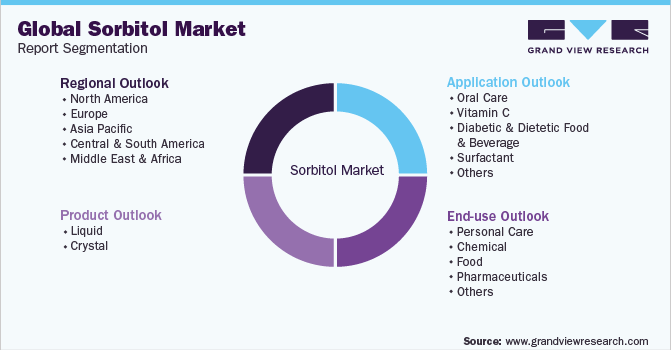
This report forecasts revenue growth at global, regional, and country levels and provides an analysis on the latest industry trends in each of the sub-segments from 2021 to 2033. For this study, Grand View Research has segmented the global sorbitol market report based on product, application, end-use, and region:
 To learn more about this report, Download Free Sample Report
-
Product Outlook (Revenue, USD Million; Volume, Kilotons, 2021 - 2033)
-
Liquid
-
Crystal
-
-
Application Outlook (Revenue, USD Million; Volume, Kilotons, 2021 - 2033)
-
Oral Care
-
Vitamin C
-
Diabetic & Dietetic Food & Beverage
-
Surfactant
-
Others
-
-
End‑use Outlook (Revenue, USD Million; Volume, Kilotons, 2021 - 2033)
-
Personal Care
-
Chemical
-
Food
-
Pharmaceuticals
-
Others
-
-
Regional Outlook (Revenue, USD Million; Volume, Kilotons, 2021 - 2033)
-
North America
-
U.S.
-
Canada
-
Mexico
-
-
Europe
-
Germany
-
U.K.
-
France
-
-
Asia Pacific
-
China
-
India
-
Japan
-
Australia
-
Thailand
-
-
Central & South America
-
Brazil
-
-
Middle East & Africa
-
Saudi Arabia
-
-
Research Methodology
The sorbitol market figures in this report are based on a proven research process that combines executive interviews with secondary research from proprietary databases, company filings, and recognized regulatory and institutional sources. Market size is built through value-chain sizing - reconciling supply-side and demand-side estimates - and triangulated with bottom-up and top-down approaches. Every estimate passes multiple levels of expert validation before publication, with each sorbitol segment quantified using the revenue-capture definitions in the table below.
Segment Definition
Segment - Product
Revenue capture definition
Liquid
Revenue generated from the sale of liquid sorbitol solutions used as sweetening, humectant, and stabilizing agents across food & beverages, pharmaceuticals, oral care, personal care, and industrial applications.
Crystal
Revenue generated from crystalline (powdered) sorbitol supplied for applications requiring high purity and controlled moisture content, including pharmaceutical formulations, confectionery, nutraceuticals, and specialty chemical products.
Segment - Application
Revenue capture definition
Oral Care
Revenue generated from sorbitol used in toothpaste, mouthwash, dental gels, and other oral hygiene products, where it functions primarily as a humectant, sweetener, and texture enhancer.
Vitamin C
Revenue generated from sorbitol supplied as a key intermediate in the production of ascorbic acid (Vitamin C), including its use by manufacturers of food, pharmaceutical, and nutraceutical ingredients.
Diabetic & Dietetic Food and Beverage
Revenue generated from sorbitol incorporated into sugar-free, low-calorie, and diabetic-friendly food and beverage products, including confectionery, bakery products, beverages, and nutritional foods.
Surfactant
Revenue generated from sorbitol utilized as a feedstock for the production of sorbitan esters and other surfactants used in detergents, emulsifiers, cosmetics, food processing, and industrial formulations.
Others
Revenue generated from sorbitol used in additional applications, including tobacco, textile processing, adhesives, paper, animal nutrition, and other niche industrial uses.
Segment - End Use
Revenue capture definition
Personal Care
Revenue generated from sorbitol supplied to manufacturers of skincare, haircare, cosmetics, and oral care products, where it is used as a humectant, moisturizer, and formulation stabilizer.
Chemical
Revenue generated from sorbitol utilized as a chemical intermediate in the production of surfactants, polyols, resins, and other specialty chemical derivatives.
Food
Revenue generated from sorbitol used by food and beverage manufacturers as a sweetener, humectant, bulking agent, and texturizing ingredient across confectionery, bakery, dairy, beverages, and processed foods.
Pharmaceuticals
Revenue generated from pharmaceutical-grade sorbitol supplied for syrups, tablets, capsules, chewable formulations, and other medicinal products, where it functions as an excipient, sweetener, and stabilizer.
Others
Revenue generated from sorbitol supplied to other end-use industries, including animal feed, tobacco, paper, textile, and various industrial manufacturing applications.
Estimation Model
Layer Name
Key Question
Description
Total Addressable Market (TAM)
What is the overall size of the global sorbitol market?
Estimated the total revenue generated from the sale of liquid and crystalline sorbitol across all regions and end-use industries based on manufacturer sales, trade statistics, production capacity, and consumption trends.
Product Segmentation
Which product forms contribute to market revenue?
Revenue was allocated between Liquid and Crystal sorbitol based on production volumes, commercial demand, application suitability, and pricing trends across key regions.
Application Analysis
Which applications generate the highest demand for sorbitol?
Market revenue was distributed across Oral Care, Vitamin C, Diabetic & Dietetic Food & Beverage, Surfactant, and Other Applications by evaluating industry consumption patterns, procurement volumes, and application-specific utilization rates.
End-use Industry Analysis
Which industries are the primary consumers of sorbitol?
Revenue was apportioned among Food, Pharmaceuticals, Personal Care, Chemical, and Other End-use Industries based on product demand, purchasing behavior, and sector-wise consumption of sorbitol.
Delivered Customizations
This report has been delivered with the following In-depth customizations
Client Request
Customization Delivered
Value Adds
Regional Segmentation
A comprehensive regional assessment of the sorbitol market was conducted across North America, Europe, Asia Pacific, Latin America, and Middle East & Africa. The study evaluated country-level demand for liquid and crystal sorbitol while examining consumption across oral care, vitamin C, diabetic & dietetic food and beverages, surfactants, and other applications. Regional manufacturing capacity, feedstock availability, and end-use industry trends were also assessed.
Provides deeper visibility into regional demand dynamics and country-specific consumption trends. Supports market expansion planning, production allocation, and prioritization of high-growth geographic markets.
Cross-Segmentation Analysis
The relationship between product type, application, and end-use industry was assessed to evaluate the adoption of liquid and crystal sorbitol across oral care, vitamin C production, diabetic & dietetic foods, surfactants, pharmaceuticals, personal care, food, and chemical industries. The analysis highlighted application-specific consumption patterns and evolving customer preferences.
Enables identification of high-value product and end-use combinations. Supports portfolio optimization, targeted product development, and commercialization strategies aligned with downstream industry requirements.
Opportunity Assessment
Growth opportunities were assessed across sugar-free confectionery, diabetic nutrition, oral care formulations, pharmaceutical excipients, vitamin C manufacturing, and bio-based chemical applications. The analysis also examined the increasing adoption of low-calorie sweeteners and functional ingredients across health-focused consumer products.
Enables identification of high-growth application areas and emerging investment opportunities. Supports innovation planning, product portfolio expansion, and long-term business growth strategies.
Frequently Asked Questions About This Report
Asia Pacific dominated with a revenue share of 56.0% in 2022, owing to the large adoption of sorbitol in a variety of foods and beverages including sports nutritional beverages and functional foods.
The global sorbitol market size was valued at USD 1.7 billion in 2022 and is estimated at USD 2.1 billion for 2026.
The global sorbitol market is expected to grow at a CAGR of 6.7% from 2023 to 2030, reaching USD 2.8 billion by 2030.
The key market players in the global sorbitol market include Ingredion Incorporated, Tereos, SPI Pharma, Roquette Frères, Qinhuangdao Lihua Starch Co., Ltd., Ecogreen Oleochemicals GmbH, Merck KGaA, Gulshan Polyols Ltd., DuPont, Cargill Incorporated, ADM, and American International Foods, Inc.
Increasing demand for nutrient-rich foods & beverages in developing as well as emerging consumer markets owing to higher consumer health awareness is expected to drive the growth of the sorbitol market. The increasing demand for sugar-free foods & beverages in developing countries is also expected to aid the market growth over the forecast period.
Liquid sorbitol dominated the global market and accounted for more than 76% share in 2022. The product is majorly used as a substitute for sugar in the pharmaceutical and food and beverage industries.
About the Author(s)
Food Additives & Nutricosmetics Research Team
Specialty & Chemicals · Food Additives & NutricosmeticsThis report was authored by the food additives & nutricosmetics research team at Grand View Research - comprising two research analysts, one senior research analyst, and one industry expert - with specialized expertise in the food additives & nutricosmetics segment of the specialty & chemicals industry. All findings are based on proprietary specialty & chemicals databases, executive interviews, and regulatory analysis, subject to internal peer review prior to publication.
Last Updated:
Speak to Analyst

Customize this report to your needs - add regions, segments, or data points, with 20% free customization.
Or view our licence options:


ISO 9001:2015 & 27001:2022 Certified
We are GDPR and CCPA compliant! Your transaction & personal information is safe and secure. For more details, please read our privacy policy.


