
- Home
- »
- Paints, Coatings & Printing Inks
- »
-
Textile Dyes And Pigments Market Size & Share Report 2033GVR Report cover

Textile Dyes And Pigments Market (2026 - 2033)
Size, Share & Trends Analysis Report By Product (Reactive Dyes, Disperse Dyes, Acid Dyes, Vat Dyes, Basic Dyes), By Fiber (Cotton, Polyester, Nylon, Viscose Rayon, Acrylic), By Region, And Segment Forecasts
Market Size, 2025
$27.9BMarket Estimate, 2026
$29.2BMarket Forecast, 2033
$41.5BCAGR, 2026–2033
5.2%Textile Dyes And Pigments Market Summary
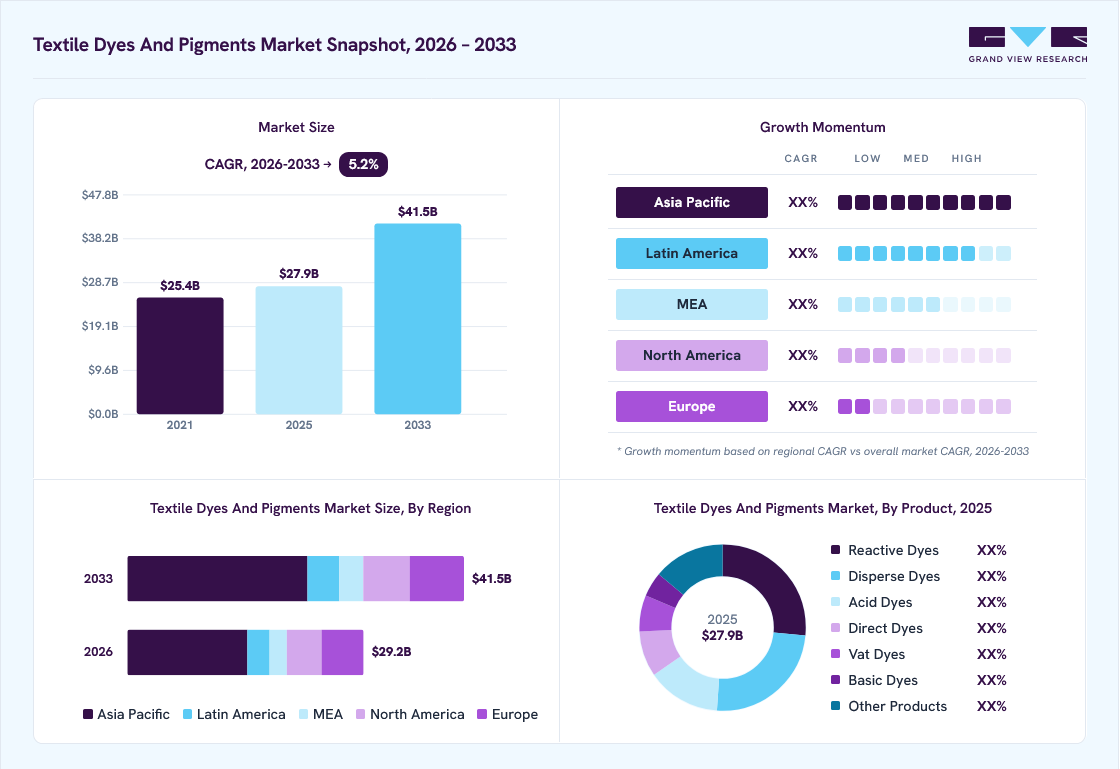
The global textile dyes and pigments market size was valued at USD 27.9 billion in 2025 and is projected to grow from USD 29.2 billion in 2026 to USD 41.5 billion by 2033, at a CAGR of 5.2% from 2026 to 2033. Asia Pacific dominated the market, accounting for a revenue share of 50.4% in 2025. Growth is supported by the increasing adoption of textile dyes and pigments across apparel, home textiles, sportswear, automotive textiles, technical fabrics, and industrial applications, particularly for delivering consistent coloration, high colorfastness, vibrant shades, and improved fabric aesthetics.
 Source: Grand View Research, IR Documents, Primary Interviews, Paid DatabasesTo learn more about this report,
 Download Free Sample Report
 Key Market Trends & Insights
- By product: Reactive dyes segment held the largest revenue share of 27.3% in 2025.
- By Fiber: Polyester segment held the largest revenue share of 29.9% in 2025.
Regional Highlights
- Largest Regional Market: Asia Pacific (50.4%, revenue share, 2025)
- By country: China held the largest market share in 2025.
Market Size & Forecast
- Market size in 2025: USD 27.9 Billion
- Estimated market size in 2026: USD 29.2 Billion
- Projected market size by 2033: USD 41.5 Billion
- CAGR (2026-2033): 5.2%
Three ways to get this report
Buy it, customize it, or ask a question.Ask an Analyst
Analyst response in 1 business day
- AccessReport author, directly
- Reply timeWithin 1 working day
- No sales callDirect answer only
- FormatEmail reply
- CostFree, no cost
Get the Full Report
What the study covers
- FormatsPDF · Excel · Dashboard
- Timeline2026–2033 annual, 2025 base
- Coverage20+ countries, 5 regions
- Companies10+ key players profiled
Customize the Report
20% free customization
- IncludeCountries, segments, points
- TailorTo your product definition
- ExtendDeeper competitor detail
- OrA fully bespoke study
- Turnaround5–10 working days
Rising demand for high-quality textiles, expanding apparel production, and increasing requirements for durable and visually consistent fabrics are driving the adoption of textile dyes and pigments.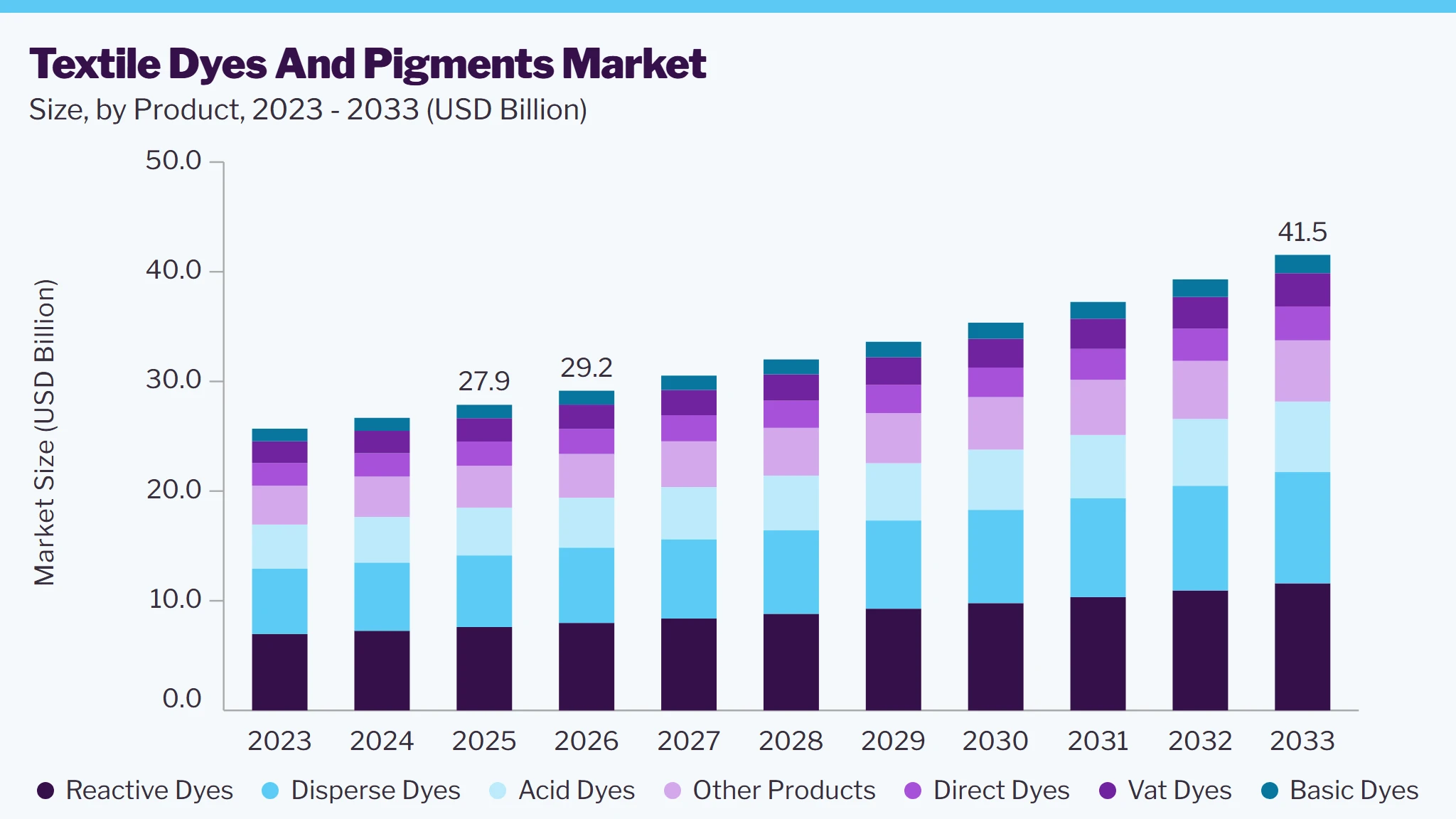 To learn more about this report, Download Free Sample Report
 Textile dyes provide coloration through chemical affinity with fibers, while pigments enable coloration across a broader range of textile materials through binder-based application systems. The expansion of textile manufacturing in Asia Pacific and other emerging production hubs, together with demand for sustainable and lower-impact coloration technologies, is further shaping market development.
Market Dynamics
The industry is gaining momentum as textile and apparel manufacturers seek reliable coloration solutions that deliver consistent shades, high colorfastness, and efficient processing. Demand is supported by the expansion of apparel, home furnishing, technical textile, and industrial textile production. Increasing use of synthetic fibers and blended fabrics is creating demand for coloration systems compatible with different fiber chemistries, while growing requirements for water and energy efficiency are encouraging the development of more concentrated, high-performance, and lower-impact products. Environmental regulations governing wastewater discharge, hazardous chemicals, and textile processing are also influencing product selection and manufacturing practices.
Growing demand for durable, consistent, and visually differentiated textiles is a key driver of the market. Textile manufacturers require coloration products that provide uniform shades, strong colorfastness, resistance to washing and light exposure, and compatibility with increasingly diverse fiber and fabric types. The growth of fashion apparel, sportswear, home textiles, automotive fabrics, and other technical textile applications is expanding the range of performance requirements for textile coloration.
Increasing adoption of synthetic fibers such as polyester and polyamide is also supporting demand for application-specific dyes, particularly disperse and other synthetic-fiber-compatible coloration systems. At the same time, manufacturers are investing in improved dye formulations, higher-strength pigments, and process technologies that reduce coloration time, chemical consumption, water use, and reprocessing requirements. These developments are strengthening the use of specialized dyes and pigments across modern textile manufacturing operations.
Fluctuations in the prices and availability of petrochemical intermediates, aromatic compounds, solvents, pigments, additives, and other chemical feedstocks can constrain market growth. Changes in crude oil and natural gas prices can influence the cost of key intermediates used in synthetic dyes and pigments, while energy, water treatment, packaging, and transportation expenses can further affect production costs. These variations can place pressure on manufacturer margins and increase selling prices, particularly in highly competitive textile-producing markets.
Stringent environmental requirements related to hazardous chemicals, wastewater treatment, effluent discharge, and dye manufacturing can also increase compliance and operating costs. Producers may need to invest in cleaner production processes, wastewater-treatment systems, reformulation, and safer chemical alternatives to meet evolving regulatory requirements. These cost pressures can be particularly challenging for smaller regional manufacturers competing with large-scale producers.
The growing focus on sustainable textile manufacturing presents significant opportunities for dyes and pigments with lower environmental impact. Textile producers are seeking coloration solutions that reduce water consumption, energy requirements, chemical loading, and wastewater generation while maintaining color quality and fastness performance. This is creating opportunities for manufacturers to develop low-salt, low-liquor, concentrated, water-efficient, and other advanced dyeing solutions, alongside pigment systems designed for more efficient textile coloration.
Demand for specialty textiles is creating another growth opportunity. Technical textiles, sportswear, automotive fabrics, protective clothing, functional apparel, and premium home textiles require coloration products with specific properties such as enhanced lightfastness, chemical resistance, heat stability, and durability. Manufacturers that can provide application-specific dyes and pigments with consistent performance and regulatory compliance can strengthen their presence across both established and emerging textile markets.
Market Concentration & Characteristics
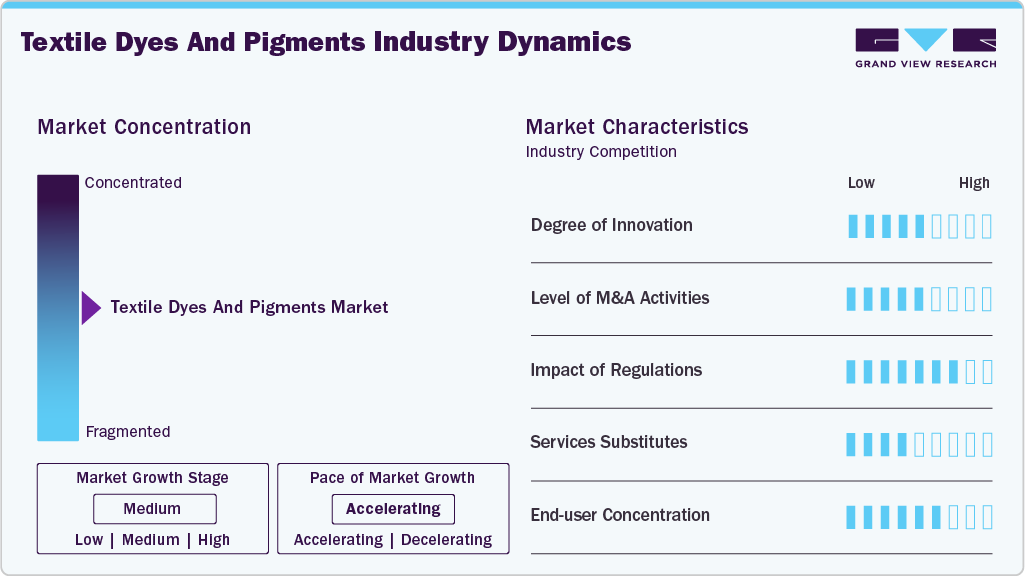
The market comprises multinational chemical manufacturers, specialty dye and pigment producers, integrated textile-chemical companies, and regional manufacturers serving major textile production clusters. Competitive positioning depends on product performance, shade consistency, colorfastness, fiber compatibility, formulation quality, production efficiency, regulatory compliance, pricing, and technical support. Companies are focusing on expanding specialty product portfolios, improving manufacturing efficiency, developing lower-impact coloration technologies, and strengthening supply chains for critical chemical intermediates.
The market remains closely linked to the geographic concentration of textile and apparel manufacturing, particularly in major Asian production hubs. Large international suppliers compete through broad product portfolios, technical expertise, application support, and sustainability-focused innovations, while regional producers often compete through localized distribution, shorter lead times, customized formulations, and competitive pricing. Increasing demand for high-performance coloration, sustainable processing, and application-specific textile solutions is expected to intensify competition and encourage continued innovation in dye and pigment formulation.
 To learn more about this report, Download Free Sample Report
 Leading companies are expanding their textile dyes and pigments portfolios through new product development, production capacity expansion, strategic collaborations, and partnerships with textile manufacturers, dyeing and finishing companies, and apparel producers. Increasing investments in high-performance dyes and pigments, improved colorfastness, fiber compatibility, formulation efficiency, and consistent shade performance are supporting product differentiation. Companies are also focusing on lower-impact coloration technologies, water- and energy-efficient dyeing solutions, and formulations designed to comply with evolving environmental and chemical regulations.
Analyst Perspective
The industry is driven by the growing emphasis on efficient textile coloration, consistent shade quality, and improved fabric performance. Rising demand for durable and visually differentiated textiles, increasing use of synthetic and blended fibers, and the expansion of apparel, home textile, technical textile, and industrial fabric production are accelerating the adoption of application-specific dyes and pigments. Advances in dye formulations, pigment dispersion, colorfastness, processing technologies, and digital textile printing are improving coloration efficiency and shade consistency while reducing reprocessing, water consumption, energy use, and chemical requirements. Increasing focus on sustainable textile manufacturing is also encouraging the development of lower-impact dyes, concentrated formulations, and coloration technologies designed to meet evolving environmental and regulatory requirements.
Product Insights
The reactive dyes segment dominated the market, accounting for 27.3% of total revenue in 2025.Demand is supported by the extensive use of reactive dyes for cotton, viscose, rayon, and other cellulosic fibers, where they provide bright shades, strong fiber affinity, and good wash fastness. Their widespread application across apparel, home textiles, denim, towels, and other cotton-based products continues to support segment growth.
The disperse dyes segment is expected to register the fastest growth, expanding at a CAGR of 5.7% during the forecast period.Growth is driven by increasing polyester and synthetic fiber production, particularly for sportswear, activewear, fashion apparel, home textiles, and automotive fabrics. Rising demand for uniform coloration, shade consistency, and good fastness properties in hydrophobic fibers is further supporting the adoption of disperse dyes.
Fiber Insights
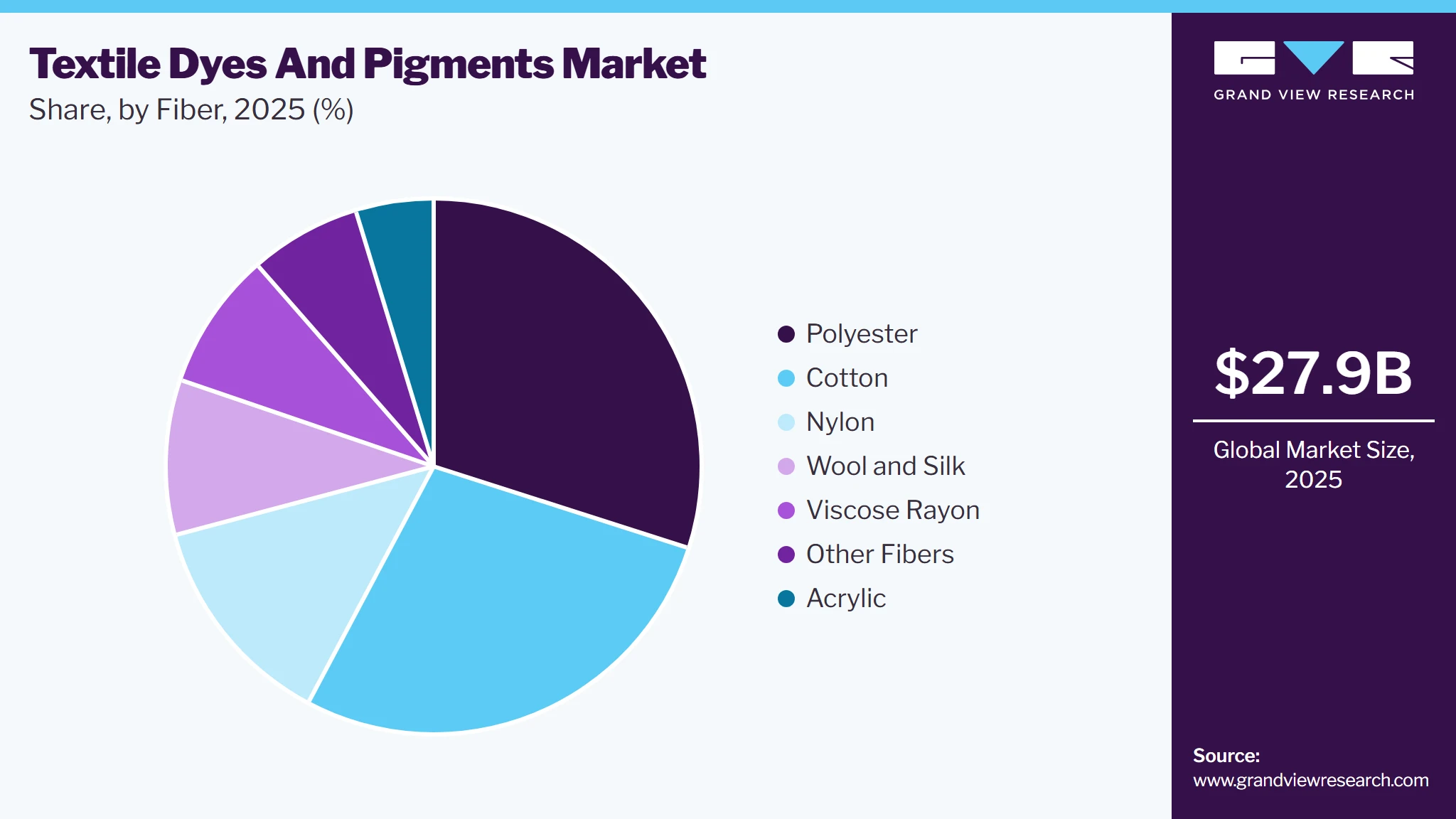
The polyester segment dominated the market, accounting for 29.9% of total revenue in 2025.Its leading position is supported by the widespread use of polyester in apparel, sportswear, home textiles, automotive fabrics, and technical textiles. The growing production of polyester and polyester blends, combined with demand for durable coloration, vibrant shades, and good resistance to washing and light, continues to drive the consumption of disperse dyes and pigment-based coloration systems.
 To learn more about this report, Download Free Sample Report
 The viscose rayon segment is expected to grow at a CAGR of 5.5% during the forecast period.Growth is supported by increasing demand for regenerated cellulosic fibers in apparel, fashion textiles, home furnishings, and blended fabrics due to their soft hand feel, drape, and cellulose-based characteristics. The expanding use of reactive and direct dyes for achieving vibrant shades, consistent coloration, and suitable fastness properties is further supporting dye consumption in viscose rayon applications.
Regional Insights
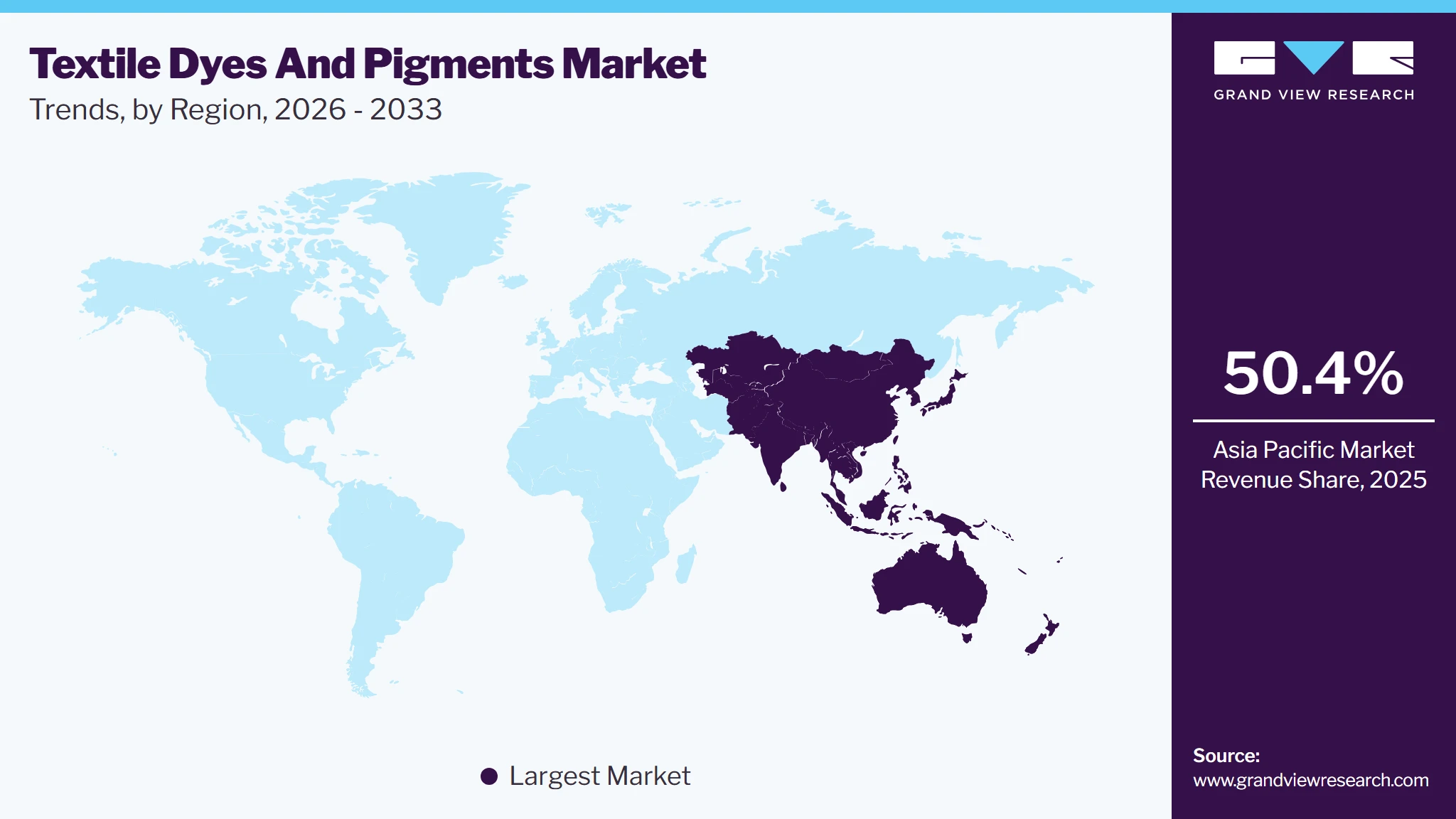
Asia Pacific textile dyes and pigments market led with a 50.4% revenue share in 2025 and is also expected to grow at the fastest CAGR from 2026 to 2033. The regional industry is supported by its large textile manufacturing base, established dyeing and printing infrastructure, and strong presence across apparel, home textiles, technical textiles, and synthetic fiber production. China, India, Bangladesh, Vietnam, and other regional manufacturing hubs continue to generate substantial demand for reactive, disperse, acid, and pigment systems. Increasing investments in textile processing efficiency, digital printing, wastewater management, and lower-impact coloration are also encouraging suppliers to develop products that balance color performance with environmental compliance.
 To learn more about this report, Download Free Sample Report
 China Textile Dyes And Pigments Market Trends
The China textile dyes and pigments market remains a major production and consumption center, benefiting from its extensive fiber, yarn, fabric, dyeing, printing, and apparel manufacturing ecosystem. Domestic producers have strong capabilities across various dye categories, supporting both domestic textile mills and export-oriented manufacturers. The market is also shifting toward higher-value coloration products as textile producers face stricter environmental requirements, prompting greater emphasis on cleaner production, wastewater treatment, process optimization, and formulations with improved fixation and reduced chemical intensity.
North America Textile Dyes And Pigments Market Trends
The textile dyes and pigments market in North America is characterized by demand for specialty coloration systems serving technical textiles, performance apparel, automotive fabrics, protective textiles, home furnishings, and premium textile products. Rather than competing primarily on high-volume commodity dye production, regional demand favors products offering application-specific performance. Sustainability requirements across textile supply chains are also increasing interest in water-efficient coloration, digital textile printing, pigment-based systems, and formulations designed to support restricted-substance compliance.
The textile dyes and pigments market in the U.S. is supported by continued demand from specialized fabric applications. Textile manufacturers and brands are placing greater emphasis on compliance with chemical restrictions, creating opportunities for specialty dye and pigment suppliers. Growth in digital textile printing and on-demand production is also encouraging the adoption of high-performance pigment inks, digital dyes, and other coloration technologies that enable shorter production runs, customized designs, and reduced inventory requirements.
Europe Textile Dyes And Pigments Market Trends
The textile dyes and pigments market in Europe is shaped by stringent environmental and chemical requirements, premium textile manufacturing, and the transition toward more sustainable production practices. Demand is shifting toward high-performance dyes, pigments, and coloration processes that support lower water consumption, reduced chemical loading, improved wastewater management, and compliance with restricted-substance standards. The region also presents opportunities for specialty coloration in luxury apparel, technical textiles, automotive fabrics, and sustainable fashion, where product traceability, material safety, durability, and environmental credentials influence purchasing decisions.
Latin America Textile Dyes And Pigments Market Trends
The textile dyes and pigments market in Latin America is supported by established textile and apparel industries in countries such as Brazil, Mexico, Colombia, and Argentina, with demand concentrated across cotton garments, denim, home textiles, sportswear, and selected industrial fabrics. Regional manufacturers require cost-effective coloration systems that provide reliable shade reproduction and adequate fastness across locally important fiber and fabric types. Increasing modernization of textile processing facilities, export-oriented apparel production, and sustainability initiatives are creating opportunities for efficient reactive and disperse dyes, pigment systems, and technologies that reduce processing losses and resource consumption.
Middle East Textile Dyes And Pigments Market Trends
The textile dyes and pigments market in the Middle East is supported by demand from growing investments in diversified manufacturing and downstream industrial activities. Carpet and furnishing applications create demand for coloration systems with strong shade depth, lightfastness, and durability, while apparel and textile processing facilities require consistent performance across cotton, polyester, and blended materials. Increasing attention to resource efficiency in water-intensive textile processes is also encouraging interest in concentrated formulations, pigment coloration, digital printing, and other technologies that can improve production efficiency and reduce environmental impact.
Key Textile Dyes And Pigments Market Company Insights
Key companies operating in the textile dyes & pigments market are strengthening their competitive positions through product development, portfolio expansion, production capacity enhancement, sustainability-focused innovations, and investments in advanced coloration technologies. Leading manufacturers are focusing on improving strength, shade consistency, compatibility, formulation efficiency, and environmental performance while developing solutions for textile applications.
-
Archroma is a prominent participant in the textile dyes and chemicals market, offering a broad portfolio of dyes, pigments, and textile chemical solutions for different fiber and fabric applications. The company focuses on coloration technologies designed to deliver consistent shades, high colorfastness, and efficient processing across textile manufacturing. Archroma is also strengthening its competitive position through sustainable coloration solutions, lower-impact chemical technologies, and products designed to help textile manufacturers reduce water, energy, and chemical consumption while meeting evolving environmental requirements.
-
DIC Corporation is a major global supplier of pigments and coloration materials, serving textile and other industrial applications through its expertise in organic pigments, colorants, and specialty chemical technologies. The company focuses on developing high-performance pigments with properties such as strong color intensity, durability, lightfastness, and processing stability. DIC is strengthening its position through continued pigment portfolio development, advanced dispersion technologies, and solutions designed to meet the performance and sustainability requirements of modern textile and printing applications.
Key Textile Dyes And Pigments Market Companies:
The following key companies have been profiled for the study on the textile dyes & pigments market.
-
Archroma
-
DIC CORPORATION
-
BASF SE
-
Zhejiang Longsheng Group
-
Zhejiang Runtu Co., Ltd.
-
Atul Ltd
-
DyStar Singapore Pte Ltd
-
Jiangsu Yabang Dyestuff Co., Ltd.
-
Bodal Chemicals Ltd.
-
Meghmani Group.
Company Categorization
Operating Strategies
Competitive Edge
Weaknesses
Mature Players: Archroma, DIC Corporation, BASF SE, Zhejiang Longsheng Group, Zhejiang Runtu Co., Ltd.
- Invest in advanced dye, pigment, dispersion, and coloration technologies to improve color strength, shade consistency, colorfastness, and processing efficiency.
- Expand portfolios across reactive, disperse, acid, direct, vat, pigment, and other application-specific coloration products for apparel, home textiles, technical textiles, and industrial fabrics.
- Strengthen manufacturing capabilities, production capacity, and global distribution networks to serve major textile-producing regions.
- Develop sustainable and lower-impact coloration solutions that reduce water, energy, chemical consumption, and wastewater generation while meeting evolving environmental requirements.
- Pursue strategic partnerships with textile manufacturers, dyeing and finishing companies, apparel producers, and printing companies to expand application reach and strengthen customer relationships.
- Strong technical expertise in dyes, pigments, color chemistry, formulation, dispersion, and textile coloration.
- Broad product portfolios covering multiple textile fibers, processing methods, and end-use applications.
- Established manufacturing infrastructure, quality-control capabilities, technical service, and international distribution networks.
- Strong relationships with textile mills, dyeing and finishing companies, apparel manufacturers, and other downstream customers.
- Greater financial and R&D resources support development of high-performance coloration products, capacity expansion, sustainability initiatives, and large-scale commercialization.
- Large-scale production and stringent quality and environmental requirements can increase manufacturing and operating costs.
- Exposure to fluctuations in petrochemical feedstocks, chemical intermediates, energy, and logistics costs can affect product economics.
- Premium and specialized coloration products may face pricing pressure from regional and lower-cost dye and pigment suppliers.
- Large organizational structures may make rapid customization and smaller-volume product development more challenging in certain regional markets.
- Increasing environmental and chemical regulations can require additional investment in cleaner production technologies, wastewater treatment, product reformulation, and compliance systems.
Emerging Players: Atul Ltd., DyStar Singapore Pte Ltd., Jiangsu Yabang Dyestuff Co., Ltd., Bodal Chemicals Ltd., Meghmani Group
- Expand dye and pigment portfolios to address growing demand for textile coloration across apparel, home textiles, synthetic fibers, technical textiles, and industrial applications.
- Focus on competitive pricing, consistent product quality, reliable supply, and application support to strengthen relationships with textile manufacturers and distributors.
- Increase production efficiency and capacity utilization to serve domestic and international textile markets.
- Develop application-specific dyes and pigments with improved color strength, shade consistency, colorfastness, fiber compatibility, and processing performance.
- Strengthen regional and international distribution networks and partnerships with textile mills, dyeing houses, apparel manufacturers, and printing companies to improve market penetration.
- Competitive manufacturing and pricing capabilities, particularly across regional textile-producing markets.
- Strong expertise in dye intermediates, textile dyes, pigments, and specialty chemical processing.
- Greater flexibility in serving regional customers and adapting formulations or product specifications to individual textile-processing requirements.
- Established relationships with local and international distributors, textile manufacturers, dyeing units, and apparel producers.
- Proximity to major textile manufacturing clusters and chemical raw-material sources can support supply-chain efficiency and shorter delivery times.
- Smaller global footprint compared with the largest multinational chemical and specialty coloration companies.
- More limited financial and R&D resources may constrain advanced product development, sustainability investments, and large-scale capacity expansion.
- Greater exposure to fluctuations in chemical feedstock, energy, transportation, and environmental compliance costs can affect margins.
- Dependence on distributors and export channels in certain markets may limit direct access to large multinational textile customers.
- Lower global brand recognition compared with leading international coloration suppliers may create challenges in securing large, long-term contracts with multinational textile and apparel manufacturers.
Recent Developments:
-
In September 2026, Archroma and Lameirinho partnered to bring InOneGO, Archroma’s single-step dyeing process, into commercial production. The process combines coloration, fixation, and softening into one pad-dry application step. Lameirinho has already launched its first InOneGO bedlinen collection worldwide. Archroma reports that the process can reduce processing steps and resource consumption while delivering wash-down effects and multiple shades for home-textile applications.
Textile Dyes And Pigments Market Report Scope
Report Attribute
Details
Market Definition
The textile dyes & pigments market comprises dyes and pigments used to impart color, shade consistency, and functional properties to textile fibers, yarns, and fabrics. It covers coloration products used across apparel, home textiles, technical textiles, automotive fabrics, and industrial textile applications.
Market size in 2025
USD 27.9 billion
Estimated market size in 2026
USD 29.2 billion
Projected market size in 2033
USD 41.5 billion
Growth rate
CAGR of 5.2% from 2026 to 2033
Base year for estimation
2025
Historical data
2021 – 2024
Forecast period
2026 – 2033
Quantitative units
Volume in kilotons; revenue in USD billion, and CAGR from 2026 to 2033
Report coverage
Volume & revenue forecast, company ranking, competitive landscape, growth factors, and trends
Segments covered
Product, fiber, region
Regional scope
North America; Europe; Asia Pacific; Latin America; Middle East & Africa
Country scope
U.S.; Canada; Mexico; Germany; UK; France; Italy; Spain; China; India; Japan; South Korea; Brazil; Argentina; Saudi Arabia; South Africa
Key companies profiled
Archroma; DIC Corporation; BASF SE; Zhejiang Longsheng Group; Zhejiang Runtu Co., Ltd.; Atul Ltd; DyStar Singapore Pte Ltd; Jiangsu Yabang Dyestuff Co., Ltd.; Bodal Chemicals Ltd.; Meghmani Group
Customization scope
Free report customization (equivalent up to 8 analysts’ working days) with purchase. Addition or alteration to country, regional & segment scope.
Pricing and purchase options
Avail customized purchase options to meet your exact research needs. Explore purchase options
Global Textile Dyes And Pigments Market Report Segmentation
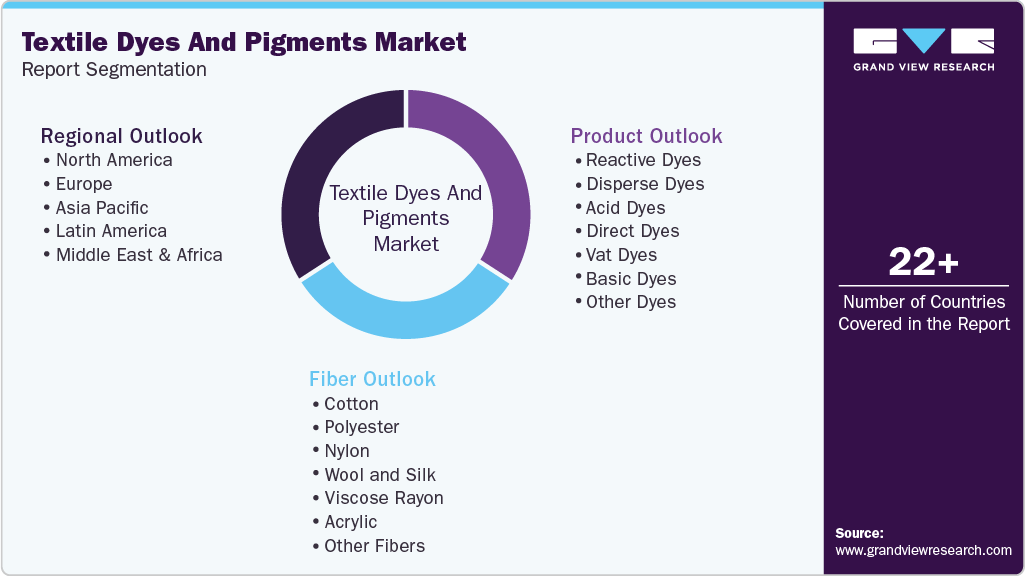
This report forecasts volume & revenue growth at the global, regional & country levels and provides an analysis of the latest industry trends & opportunities in each of the sub-segments from 2021 to 2033. For this study, Grand View Research has segmented the global textile dyes and pigments market report based on product, fiber, and region:
 To learn more about this report, Download Free Sample Report
 -
Product Outlook (Volume, Kilotons, Revenue, USD Billion, 2021 - 2033)
-
Reactive Dyes
-
Disperse Dyes
-
Acid Dyes
-
Direct Dyes
-
Vat Dyes
-
Basic Dyes
-
Other Dyes
-
-
Fiber Outlook (Volume, Kilotons, Revenue, USD Billion, 2021 - 2033)
-
Cotton
-
Polyester
-
Nylon
-
Wool and Silk
-
Viscose Rayon
-
Acrylic
-
Other Fibers
-
-
Region Outlook (Volume, Kilotons, Revenue, USD Billion, 2021 - 2033)
-
North America
-
U.S.
-
Canada
-
Mexico
-
-
Europe
-
Germany
-
UK
-
France
-
Italy
-
Spain
-
-
Asia Pacific
-
China
-
India
-
Japan
-
South Korea
-
-
Latin America
-
Brazil
-
Argentina
-
-
Middle East & Africa
-
Saudi Arabia
-
South Africa
-
-
Research Methodology
The textile dyes and pigments market figures in this report are based on a proven research process that combines executive interviews with secondary research from proprietary databases, company filings, and recognized regulatory and institutional sources. Market size is built through value-chain sizing—reconciling supply-side and demand-side estimates—and triangulated with bottom-up and top-down approaches. Every estimate passes multiple levels of expert validation before publication, with each textile dyes and pigments segment quantified using the revenue-capture definitions in the table below.
Segment Definition
Segment – Product
Revenue capture definition
Reactive Dyes
Sales are generated from reactive dyes used primarily for coloration of cotton, viscose, linen, and other cellulosic fibers. Revenue is driven by their strong fiber affinity, bright shades, and good wash fastness, making them widely used in apparel, home textiles, and other cotton-based textile applications.
Disperse Dyes
Market revenues arise from disperse dyes used mainly for polyester, acetate, and other hydrophobic synthetic fibers. Demand is supported by their ability to achieve uniform coloration and good fastness on synthetic fabrics used in apparel, sportswear, home textiles, automotive textiles, and other polyester-based applications.
Acid Dyes
Sales are generated from acid dyes used primarily for wool, silk, nylon, polyamide, and other protein- and polyamide-based fibers. Revenue is supported by demand for bright and uniform shades, good color penetration, and specialized coloration performance across apparel, carpets, upholstery, and other textile applications.
Direct Dyes
Market revenues arise from direct dyes used mainly for cotton, viscose, rayon, and other cellulosic fibers. Their relatively simple application process and broad shade range support adoption in economical textile coloration, particularly for cotton-based fabrics, home textiles, and selected industrial textile applications.
Vat Dyes
Sales are generated from vat dyes used primarily for cotton and other cellulosic fibers where high colorfastness is required. Demand is particularly associated with denim, workwear, uniforms, and other textiles requiring strong resistance to washing, light, and chemical exposure.
Basic Dyes
Revenue is captured from basic dyes used for coloration of acrylic fibers and selected synthetic, modified, and specialty textile materials. Their high color intensity and bright shades support applications in acrylic textiles, specialty fabrics, and selected blended or industrial textile products.
Other Dyes
Market revenues are generated from other textile dye categories, including specialized dye systems such as solvent, mordant, sulfur, and metal-complex dyes, depending on fiber type and processing requirements. Demand is supported by niche applications requiring specific shade, fastness, compatibility, or processing characteristics.
Segment – Fiber
Revenue capture definition
Cotton
Sales are generated from textile dyes and pigments used to color cotton and other cellulosic fabrics across apparel, home textiles, denim, towels, and industrial textile applications. Revenue is primarily supported by demand for reactive, direct, vat, and pigment coloration systems that provide consistent shades, good colorfastness, and efficient processing.
Polyester
Revenue is captured from dyes and pigments used for coloration of polyester fibers and fabrics, particularly in apparel, sportswear, home textiles, automotive textiles, and technical fabrics. Demand is largely supported by disperse dyes and pigment systems capable of delivering uniform shades, high colorfastness, and compatibility with polyester processing conditions.
Nylon
Market revenues arise from coloration products used for nylon and polyamide fibers across apparel, sportswear, hosiery, carpets, upholstery, and technical textile applications. Acid dyes, disperse dyes, and specialized coloration systems are used to achieve strong shade development, uniformity, and required wet, light, and chemical fastness.
Wool and Silk
Sales are generated from dyes and pigments used to color wool, silk, and other protein-based fibers in apparel, luxury textiles, carpets, furnishings, and specialty textile applications. Acid and other fiber-compatible dye systems are used to achieve vibrant shades, controlled penetration, softness retention, and the required level of colorfastness.
Viscose Rayon
Revenue is derived from coloration products used for viscose rayon and other regenerated cellulosic fibers in apparel, home textiles, fashion fabrics, and blended textile products. Demand is supported by reactive, direct, and pigment systems that provide consistent coloration, shade reproducibility, and compatibility with regenerated-cellulose processing.
Acrylic
Market revenues are generated from dyes and pigments used to color acrylic fibers and fabrics employed in knitwear, blankets, upholstery, carpets, outdoor textiles, and other applications. Basic dyes and selected disperse or pigment systems are used to achieve bright shades, good fiber compatibility, and the required durability.
Other Fibers
Sales are generated from textile dyes and pigments used for fibers such as linen, acetate, polypropylene, elastane, aramid, and other specialty or technical fibers. Revenue is supported by application-specific coloration requirements, including fiber compatibility, shade consistency, chemical resistance, lightfastness, heat resistance, and other performance characteristics.
Estimation Model
Layer No.
Layer Name
Key Question
Description
01
Raw Material & Production Layer
What forms is the supply base?
Examine the sourcing and manufacturing of textile dyes and pigments using dye intermediates, aromatic compounds, pigments, solvents, dispersing agents, binders, auxiliaries, and other chemical inputs. The assessment covers synthesis, reaction and purification processes, pigment dispersion, drying, grinding, filtration, formulation, blending, production capacities, quality-control practices, and raw-material availability. It also evaluates developments in dye chemistry, pigment dispersion, manufacturing efficiency, color strength, purity, fastness performance, and sustainable production technologies that influence product quality, consistency, cost, and scalability.
02
Form Adoption Layer
Where are textile dyes and pigments
utilized?
Evaluate the adoption of textile dyes and pigments across reactive, disperse, acid, direct, vat, basic, pigment, and other coloration systems and their application in textile dyeing, printing, and finishing processes. Demand is influenced by requirements for vibrant shades, consistent coloration, colorfastness, fiber compatibility, process efficiency, and fabric performance. Growing production of apparel, home textiles, sportswear, technical textiles, automotive fabrics, and industrial textiles is contributing to wider adoption of application-specific coloration solutions.
03
Consumption Intensity Layer
How much textile dyes and pigments
are consumed?
Assess consumption based on textile fiber production, fabric processing volumes, dyeing and printing requirements, and coloration intensity across cotton, polyester, viscose, nylon, wool, acrylic, and blended fibers. The analysis considers textile production volumes, fiber-specific dye affinity, coloration methods, dye and pigment dosage, liquor ratios, printing coverage, shade depth, process efficiency, reprocessing requirements, and adoption of concentrated or high-strength formulations to estimate annual consumption across major textile manufacturing markets.
04
Revenue Layer
How is market revenue generated?
Market revenue is generated through the manufacture and sale of textile dyes and pigments used for coloration across apparel, home textiles, sportswear, technical textiles, automotive fabrics, and industrial textile applications. Revenue growth is supported by increasing textile and synthetic fiber production, demand for high-performance coloration, expansion of digital textile printing, greater use of specialty and application-specific dyes and pigments, and the development of lower-impact coloration technologies designed to reduce water, energy, chemical consumption, and processing losses.
Delivered Customizations
This report has been delivered with the following In-depth customizations:
Client Request
Customization Delivered
Value Adds
Cross-segmentation
The assessment provides detailed cross-segmentation of the textile dyes & pigments market across product type, fiber type, application, and end use. The analysis evaluates demand across reactive, disperse, acid, direct, vat, basic, and other dye types, along with pigment-based coloration systems. Fiber-level analysis covers cotton, polyester, viscose rayon, nylon, wool and silk, acrylic, and other specialty fibers, while end-use assessment includes apparel, home textiles, sportswear, technical textiles, automotive textiles, and industrial applications.
Enables identification of high-growth opportunities across specific product–fiber–application combinations. Supports targeted product development, production planning, capacity expansion, distribution strategies, and market-entry decisions by highlighting applications with strong coloration requirements, specialized performance specifications, increasing synthetic and blended fiber use, and demand for efficient and lower-impact textile processing.
Opportunity Assessment
Detailed evaluation of growth opportunities arising from increasing textile and apparel production, rising demand for high-performance coloration, expansion of technical and functional textiles, growth of digital textile printing, and increasing adoption of sustainable dyeing and printing technologies. The assessment covers developments in high-fastness dyes, specialty pigments, concentrated formulations, digital coloration systems, water- and energy-efficient processing technologies, and application-specific products designed to improve shade consistency, processing efficiency, and fabric performance.
Enables identification of attractive investment opportunities across the textile dyes & pigments value chain. Supports decisions related to product development, manufacturing expansion, technology adoption, regional market entry, and distribution partnerships by highlighting high-potential fiber and application segments, evolving textile processing practices, sustainability requirements, and long-term demand drivers.
Competitive Benchmarking
Comparative assessment of leading textile dyes and pigments manufacturers based on product portfolios, dye and pigment chemistry capabilities, manufacturing capacity, product performance, geographic presence, R&D activities, quality standards, distribution networks, strategic partnerships, and application expertise. The benchmarking evaluates color strength, shade consistency, colorfastness, fiber compatibility, formulation flexibility, production efficiency, sustainability performance, application versatility, commercialization strategies, and the ability to serve diverse textile coloration requirements.
Supports benchmarking against key competitors while identifying opportunities to strengthen product differentiation, improve coloration performance, optimize manufacturing efficiency, expand distribution coverage, and develop application-specific dye and pigment solutions. The analysis assists strategic decisions concerning R&D investment, portfolio expansion, manufacturing capabilities, technology adoption, sustainability initiatives, partnerships, and long-term positioning in the textile dyes & pigments market.
Frequently Asked Questions About This Report
Key players include Archroma, DIC Corporation, BASF SE, Zhejiang Longsheng Group, Zhejiang Runtu Co., Ltd., Atul Ltd, DyStar Singapore Pte Ltd, Jiangsu Yabang Dyestuff Co., Ltd., Bodal Chemicals Ltd., Meghmani Group. These companies compete through broad product portfolios, manufacturing capabilities, coloration technologies, application expertise, sustainability-focused products, and geographic distribution networks.
Growth is supported by rising textile and apparel production, increasing demand for durable and visually differentiated fabrics, expansion of polyester and blended fibers, and growing adoption of high-performance coloration systems. Demand for improved colorfastness, shade consistency, processing efficiency, digital textile printing, and lower-impact dyeing technologies is also encouraging product development across textile manufacturing applications.
Asia Pacific dominated the market, accounting for a revenue share of 50.4% in 2025.
The textile dyes and pigments market size was valued at USD 27.9 billion in 2025 and is estimated at USD 29.2 billion in 2026.
The textile dyes and pigments market is expected to grow at a CAGR of 5.2% from 2026 to 2033, reaching USD 41.5 billion by 2033.
The reactive dyes segment dominated the market, accounting for 27.3% of total revenue in 2025, while disperse dyes segment is the fastest-growing segment.
The polyester segment dominated the market, accounting for 29.9% of total revenue in 2025, while viscose rayon is the fastest-growing segment.
About the Author(s)
Paints, Coatings & Printing Inks Research Team
Bulk Chemicals · Paints, Coatings & Printing InksThis report was authored by the paints, coatings & printing inks research team at Grand View Research - comprising two research analysts, one senior research analyst, and one industry expert - with specialized expertise in the paints, coatings & printing inks segment of the bulk chemicals industry. All findings are based on proprietary bulk chemicals databases, executive interviews, and regulatory analysis, subject to internal peer review prior to publication.
Last Updated:
Speak to Analyst

Customize this report to your needs - add regions, segments, or data points, with 20% free customization.
Or view our licence options:


ISO 9001:2015 & 27001:2022 Certified
We are GDPR and CCPA compliant! Your transaction & personal information is safe and secure. For more details, please read our privacy policy.


