
- Home
- »
- Beauty & Personal Care
- »
-
U.S. Bath And Shower Products Market Size Report, 2033GVR Report cover

U.S. Bath And Shower Products Market (2026 - 2033)
Size, Share & Trends Analysis Report By Product (Shower Gels & Liquid Soap, Body Scrubs, Solid Soap), Product by End User, Product by Price Tier, Product by Distribution Channel, And Segment Forecasts
Market Size, 2025
$9.1BMarket Estimate, 2026
$9.7BMarket Forecast, 2033
$16.4BCAGR, 2026–2033
7.8%U.S. Bath And Shower Products Market Summary
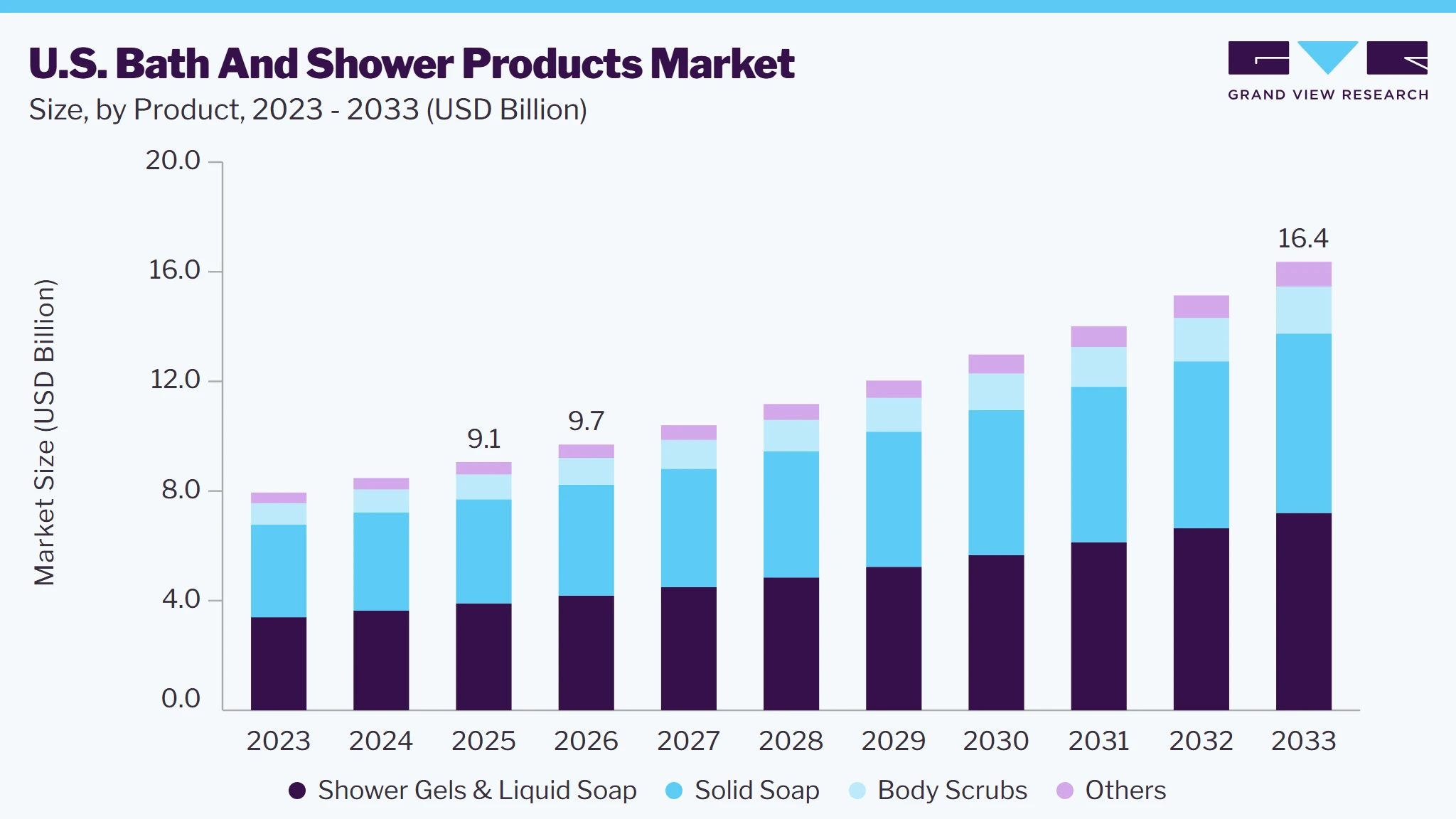
The U.S. bath and shower products market size was valued at USD 9.1 billion in 2025 and is expected to grow from USD 9.7 billion in 2026 to USD 16.4 billion by 2033, at a CAGR of 7.8% from 2026 to 2033. The market is driven by rising consumer focus on personal hygiene and skincare, increasing demand for premium and multifunctional bath and shower products, growing adoption of natural and organic formulations, and continued product innovation across body washes, shower gels, bath additives, and related personal care products.
Key Market Trends & Insights
- By product: Shower gels & liquid soap accounted for the largest revenue share of 43.0% in 2025.
- By product by end-user: Women accounted for the largest revenue share of 72.0% in 2025.
- By product by price tier: Mass/economy accounted for the largest revenue share of 68.4% in 2025.
- By product by distribution channel: Hypermarkets & supermarkets accounted for the largest revenue share of 42.0% in 2025.
Market Size & Forecast
- Market Size in 2025: USD 9.1 billion
- Estimated Market Size in 2026: USD 9.7 billion
- Projected Market Size by 2033: USD 16.4 billion
- CAGR (2026-2033): 7.8%
Prism AI by Grand View Research Free to tryAsk a question about the U.S. bath and shower products marketTry asking✓Every figure cited from GVR research Prefer the report? Download free sample →The U.S. bath and shower products market is benefiting from the increasing integration of skincare benefits into everyday cleansing routines, as consumers seek products that provide more than basic cleansing. In March 2026, Vogue highlighted that body care was increasingly adopting a skincare-first approach, with ingredients such as ceramides, peptides, beta-glucan, retinol, and other targeted actives moving into body-care formulations. The publication also identified serum body washes as an emerging product format, with brands developing cleansers that combine cleansing with hydration, barrier support, and targeted skin benefits. This convergence of skincare and body cleansing is encouraging consumers to place greater consideration on formulation, ingredients, and specific skin concerns when purchasing bath and shower products.
 Source: Grand View Research, IR Documents, Primary Interviews, Paid DatabasesTo learn more about this report,
 Download Free Sample Report
Product innovation is increasingly centered on multifunctional body washes that combine cleansing with hydration, skin nourishment, exfoliation, and sensitive-skin care. In February 2025, Henkel reported that its Dial Healthy Hydration Body Wash was recognized as the 2025 Product of the Year winner in the Body Wash category, based on a consumer study involving 40,000 American shoppers. The formulation combines deep cleansing with hydration and contains shea butter extract, coconut milk, and hyaluronic acid, while offering a pH-balanced and paraben-free formulation. This development highlights how manufacturers are extending traditional cleansing products into multifunctional solutions that address both hygiene and skin-care needs.
Demand for efficacy-led personal-care products is encouraging bath and shower brands to move beyond basic cleansing and introduce formulations with targeted benefits. Circana reported in August 2025 that only 14% of U.S. beauty buyers believed higher prices indicated better quality, highlighting that consumers are increasingly assessing products based on perceived effectiveness and value rather than price alone. At the same time, Circana noted that the prestige body segment continued to thrive, with body creams, cleansers, and hand soaps among the significant contributors to growth. This emphasis on efficacy supports the development of body washes and cleansers incorporating moisturizing, exfoliating, soothing, and other functional attributes.
Market Dynamics
Consumers are increasingly treating body cleansing as an extension of their skincare routines, creating demand for bath and shower products that deliver hydration, exfoliation, barrier support, and other skin-care benefits in addition to cleansing. A 2025 Consumer Trends Survey of 2,223 U.S. body-wash users found that 35% of Gen Z and Millennials looked for hyaluronic acid in body wash/cleansers, 30% looked for salicylic acid, 24% for retinol, and 16% for niacinamide. Among Gen X and older consumers, the corresponding shares were 22%, 11%, 20%, and 7%, respectively. The penetration of skincare-oriented ingredients into body cleansing indicates that consumers are increasingly evaluating bath and shower products based on functional skin benefits, encouraging manufacturers to launch serum-infused, exfoliating, moisturizing, and treatment-oriented formulations.
Growing scrutiny of ingredients used in body washes and other cleansing products can increase formulation and compliance pressures for manufacturers. In December 2025, Consumer Reports analyzed more than 100 body washes for health and environmental considerations; only 27 products were classified as Top Choices and 27 as Good Choices, while the majority contained ingredients associated with potential or known health or environmental concerns. The assessment highlighted concerns surrounding surfactants, fragrance ingredients, artificial colorants, and manufacturing contaminants such as 1,4-dioxane. These concerns can encourage brands to reformulate products toward safer, biodegradable, and more transparent ingredients, potentially increasing formulation, testing, sourcing, and compliance costs.
The increasing integration of skincare actives into body cleansing is creating opportunities for manufacturers to develop targeted, multifunctional, and premium bath and shower products. In March 2026, Method launched its Body Wash Tonics, with formulations featuring hyaluronic acid, AHA, PHA, salicylic acid, azelaic acid, fatty acids, and colloidal oatmeal to address moisture, exfoliation, clarification, and skin-barrier needs. The launch demonstrates how ingredient-specific positioning can expand the functional scope of body washes beyond basic cleansing and enable brands to target distinct skin concerns.
Analyst Perspective
The U.S. bath and shower products market is evolving toward skincare-oriented, multifunctional, and sensorial bath and shower products, as consumers increasingly seek everyday cleansing products that also provide hydration, nourishment, exfoliation, and other skin-health benefits. Brands are expanding body wash and body care products with active skincare ingredients, targeted formulations, and fragrance-led experiences to address changing consumer preferences. At the same time, greater attention to ingredient transparency, sensitive skin needs, and sustainable formulations is encouraging companies to differentiate through product efficacy, formulation quality, and responsible attributes. This shift is supporting premiumization and continued innovation across the U.S. bath and shower category, while established brands strengthen their portfolios through new launches and expanded product formats.
Consumer Insights
The U.S. bath and shower products market primarily serves consumers seeking everyday cleansing, hydration, skincare, grooming, and sensory benefits through bath and shower products, body wash, and other body care products.
 To learn more about this report, Download Free Sample Report
Users by Gender:
-
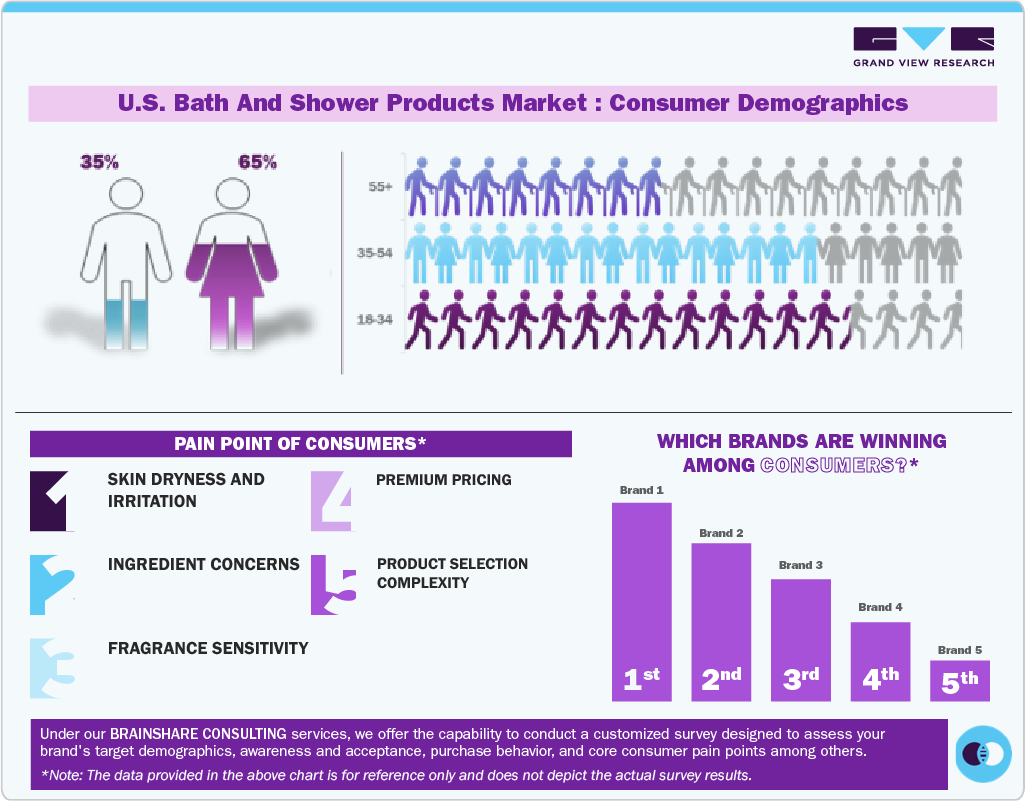
Female consumers account for an estimated 65%, reflecting stronger engagement with skincare and personal-care routines. A 2025 YouGov U.S. survey found that women were more likely than men to spend time on daily skincare and personal-care routines, supporting their larger participation in bath and shower products and body care products consumption.
-
Male consumers account for an estimated 35%, reflecting increasing participation in personal-care and grooming routines. YouGov’s 2025 U.S. Personal Care Brand Rankings found that men showed substantial consideration for personal-care brands, including Dove, Vaseline, Gillette, Head & Shoulders, and Dove Men Care, indicating continued engagement with skincare, cleansing, and grooming products.
Users by Age Group:
Consumers aged 18 -34 represent the largest user group, consisting primarily of younger adults, students, early-career professionals, and younger households who maintain regular personal-care and grooming routines. This group shows strong interest in body wash and other bath and shower products with fragrance, hydration, skincare ingredients, and multifunctional benefits, while also being more receptive to product innovation and premium body-care formats. Consumers aged 35 - 54 include established professionals, parents, and households with regular personal-care routines, with demand influenced by moisturizing, sensitive skin, cleansing, and skin-nourishing benefits. Consumers aged 55 and above primarily seek everyday cleansing and body care products that support hydration, gentle cleansing, sensitive-skin care, and comfort, with product selection increasingly influenced by formulation quality, skin needs, and ease of use.
Consumers in the U.S. bath and shower products market commonly face several challenges when selecting and using everyday bath and body-care products.
-
Skin dryness and irritation: Some cleansing products can leave skin feeling dry, tight, or irritated after frequent use. Consumers increasingly seek gentle body wash formulations with moisturizing and skin-barrier benefits.
-
Ingredient concerns: Consumers are increasingly attentive to the ingredients used in bath and shower products, particularly formulations perceived as harsh. This drives interest in transparent, gentle, and skin-friendly formulations.
-
Fragrance sensitivity: Strong fragrances can discourage consumers who prefer mild, subtle, or fragrance-free products. This creates demand for fragrance-free and lightly scented body care products.
-
Premium pricing: Premium products with specialized skincare ingredients, sophisticated fragrances, or multifunctional benefits often carry higher prices. This can limit adoption among value-conscious consumers seeking effective products at accessible price points.
-
Product selection complexity: The growing range of body washes, shower gels, scrubs, cleansing oils, and moisturizing washes can make product selection more difficult. Consumers may struggle to identify the most suitable option for their skin type and specific needs.
Product Insights
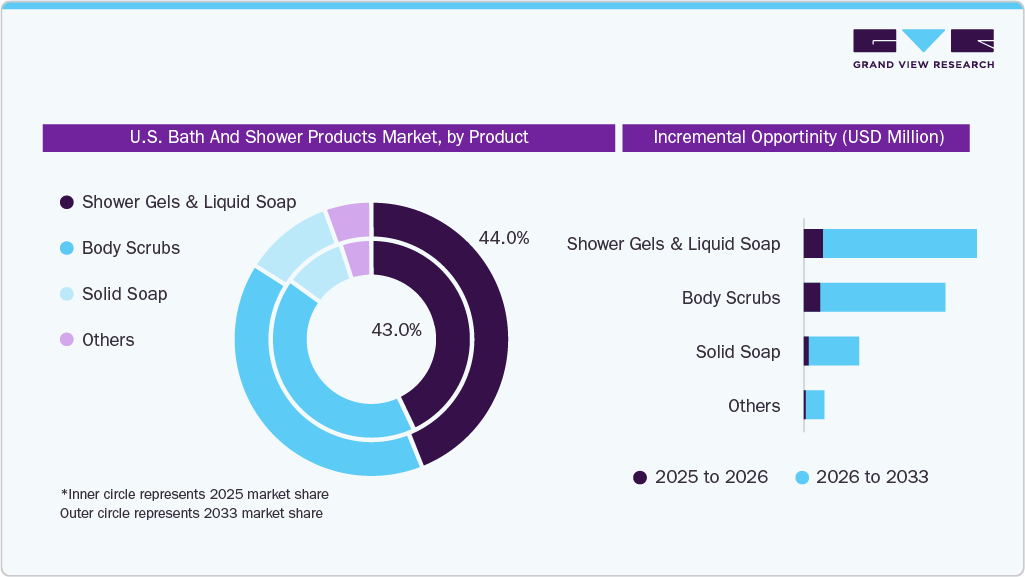
In the product segment, shower gels & liquid soap accounted for the largest revenue share of 43.0% in 2025, driven by the convenience, easy dispensing, and widespread adoption of liquid cleansing formats in daily bathing routines. Demand for bath and shower products is further supported by the growing preference for skincare-oriented cleansing solutions that combine cleansing with moisturizing, soothing, and other skin-care benefits. For instance, Dove launched its Plant Milk Cleansing Collection in April 2025 in collaboration with Chamberlain Coffee, introducing a skin-nourishing body wash range featuring plant milks, glycerin, stearic acid, and lauric acid. Available in fragrances such as Oat Milk & Berry Brûlée, Turmeric Milk & Lemon Drop, Coconut Milk & Sugar Lychee, and Almond Milk & Green Apple, the collection emphasizes hydration and fragrance-led sensorial experiences. The launch reflects brands’ focus on skincare-infused, multifunctional, and indulgent liquid cleansing formats, supporting continued demand for body wash and other body care products.
 To learn more about this report, Download Free Sample Report
In the product segment, body scrubs are expected to grow at a CAGR of 8.4% from 2026 to 2033, driven by increasing consumer interest in targeted exfoliation and specialized body-care formulations. Growth is supported by product innovation that combines exfoliating agents with moisturizing oils, botanical extracts, and distinctive sensory ingredients, enabling brands to differentiate beyond conventional scrubs. For instance, FarmHouse Fresh launched its Blood Orange Glowrita Liquor-Infused Body Polish in March 2026, combining U.S.-harvested sea salt, rice bran oil, astaxanthin, and organic lemon balm extract with tequila to create a distinctive sensorial exfoliation experience. The launch highlights the shift toward ingredient-focused, experiential, and premium body care products, supporting demand for innovative body scrubs within the U.S. bath and shower products market.
Product by End User Insights
In the product by end user segment, body scrubs for women accounted for the largest revenue share of 72.0% in 2025, supported by the increasing integration of exfoliation into regular self-care and body-care routines. This trend is reinforced by recent product innovation from Tree Hut, which launched a limited-edition Fall Collection in August 2026 featuring its Shea Sugar Scrub in dessert-inspired fragrances such as Pumpkin Roll, Apple Crumble, Fireside Maple, Pecan Brûlée, and Espresso Martini. The products combine exfoliation with moisturizing ingredients, including sugar, shea butter, and natural oils, while emphasizing fragrance and sensory appeal. First Aid Beauty’s KP Bump Eraser Body Scrub combines glycolic and lactic acids with pumice to address rough and bumpy skin, demonstrating the use of both chemical and physical exfoliation. Meanwhile, Sol de Janeiro’s Bum Bum Body Scrub incorporates cupuaçu seeds, guaraná extract, and coconut oil, linking exfoliation with skin nourishment and fragrance for the body wash market.
In the product by end user segment, shower gels & liquid soap for men are expected to grow at a CAGR of 8.1% from 2026 to 2033, driven by the growing preference for convenient liquid cleansing formats and products that combine cleansing with moisturizing and skin-care benefits. Demand for shower gels and liquid soaps is further supported by product innovation focused on gentle formulations, hydration, and targeted skin benefits. For instance, Olay launched its Repair Serum Body Wash Collection in August 2026, introducing body washes formulated with skincare ingredients such as hyaluronic acid, vitamin C, BHA, collagen peptides, and retinol to address concerns including hydration, uneven skin tone, texture, and skin renewal. The launch reflects brands’ increasing focus on skincare-infused, multifunctional, and benefit-oriented liquid body cleansers to meet evolving consumer preferences.
Product by Price Tier Insights
In the product by price tier segment, mass/economy bath and shower products accounted for a revenue share of 68.4% in the U.S. solid soaps market in 2025. Supported by consumers’ preference for affordable and frequently replenished cleansing products. High-volume categories such as body wash, liquid soaps, and other bath and shower products benefit from broad availability across supermarkets, drugstores, mass retailers, and e-commerce platforms. For instance, Dove partnered with Crumbl in February 2025 to launch a Walmart-exclusive collection featuring body washes, exfoliating body scrubs, deodorants, and hand soaps, with products offered at accessible price points, including a USD 3.97 Lemon Glaze Hand Wash. The launch illustrates how mass-market brands leverage affordable pricing, limited-edition fragrances, and broad retail distribution to encourage purchases within the mass/economy tier. The tier is further supported by promotional pricing, multipack offerings, and value-oriented product formats, enabling consumers to maintain regular personal-care routines while managing household spending.
The product by price tier, the luxury bath and shower products are expected to grow at a CAGR of 12.8% from 2026 to 2033, supported by growing consumer interest in premium formulations, sophisticated fragrances, and elevated bathing experiences in the U.S. bath and shower products market. Consumers are increasingly seeking body wash and other body care products that combine advanced skin-care ingredients, sensorial textures, distinctive fragrances, and spa-inspired benefits. For instance, VOESH expanded into Ulta Beauty in March 2026 with a premium K-beauty body-care collection featuring Gua Sha Body Cleansing Bars, Resurfacing Sugar Scrubs, Body Balms, and Massage Roller Crèmes, combining advanced actives, spa-inspired treatments, sensorial textures, and elevated fragrance profiles.
Product by Distribution Channel Insights
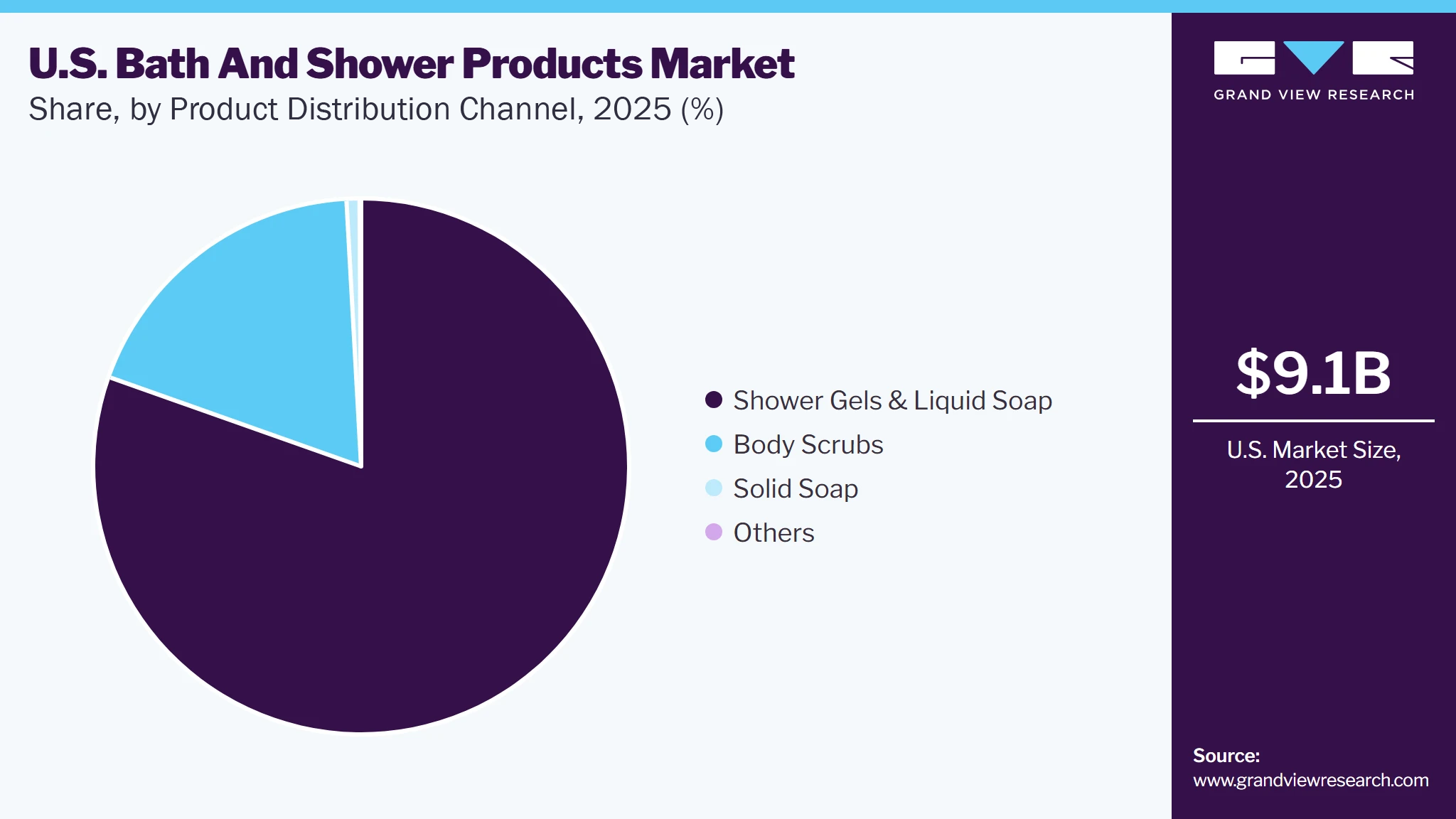
In the product by distribution channel, the sales through hypermarkets & supermarkets accounted for a revenue share of 42.0% in 2025. supported by the expansion of exclusive Bath and Shower Products across major mass-retail chains. For instance, Mr. Bubble expanded its Walmart assortment in March 2026 with a Walmart-exclusive Watermelon Bubble Bath, interactive Super Blaster Body Washes, and a Rocket Body Wash Infused Sponge.
 To learn more about this report, Download Free Sample Report
The launch demonstrates how retailers are using exclusive products, playful formats, and accessible price points to expand bath and shower products within high-volume supermarket and hypermarket channels. Additionally, Splash, a new kids’ body-care brand from the makers of Tree Hut and Baby Magic, launched its collection at Walmart stores and Walmart.com in February 2026, including a 2-in-1 Shampoo + Body Wash, Bubble Bath, and Body Lotion. The launch specifically targeted the gap between baby care and mature body care, adding a new age-focused assortment to Walmart’s bath and shower products offering.
In the product by distribution channel, the sales through online/e-commerce are expected to grow at a CAGR of 13.1% from 2026 to 2033 and are gaining traction as brands use digital platforms to introduce specialized Bath and Shower Products and reach consumers beyond traditional retail shelves. For instance, Dove launched its first Women's Wellness Range exclusively on Amazon U.S. in August 2025, featuring three body wash formats: Glycolic Serum Wash, Cleansing Oil, and Whole Body Wash, along with a leave-on balm, with products starting at USD 19.99. The Amazon-exclusive launch demonstrates how brands are using e-commerce to introduce targeted body-care formats and reach consumers seeking specialized products through digital-first purchasing.
Key U.S. Bath And Shower Products Company Insights
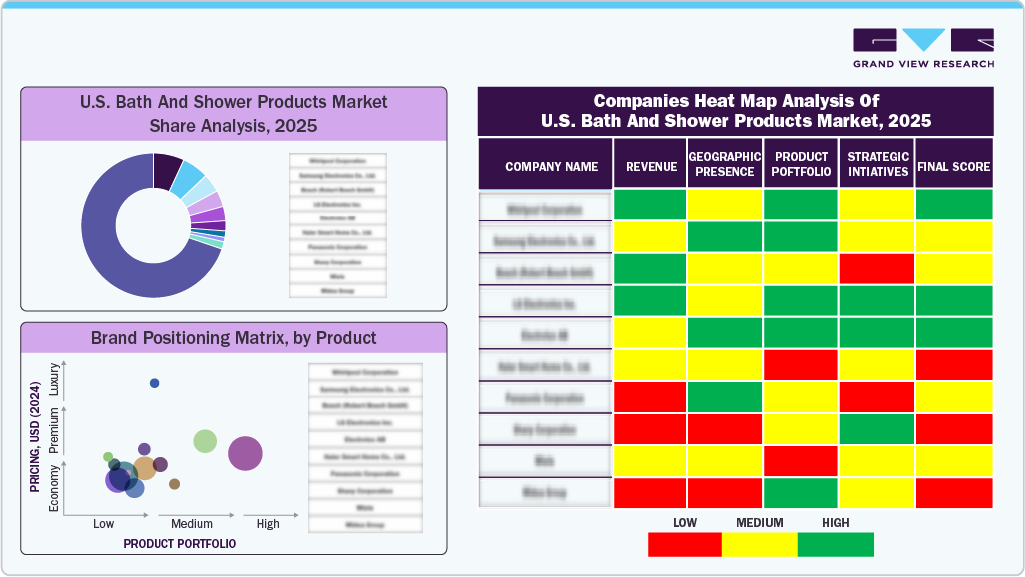
The U.S. bath and shower products market is characterized by a competitive structure comprising global consumer goods companies, diversified personal-care manufacturers, fragrance and body-care specialists, and skincare-focused beauty companies. Competition is primarily shaped by brand recognition, product variety, formulation benefits, fragrance innovation, pricing, retail presence, and the ability to address evolving consumer preferences for hydration, sensitive skin care, multifunctional body wash, and premium body care products. Major companies are strengthening their positions through product reformulation, skincare-oriented innovation, expanded retail distribution, and differentiated fragrance offerings.
-
Mass-Market Personal Care Leaders: Companies such as Unilever, Procter & Gamble (P&G), Henkel, Colgate-Palmolive, and Church & Dwight compete through extensive distribution networks, established consumer brands, broad product portfolios, and accessible price points. Unilever's Dove offers moisturizing body wash positioned around cleansing, hydration, and skin-barrier support, while P&G leverages brands such as Olay and Old Spice across body cleansing and personal care. Henkel's Dial and Colgate-Palmolive's Softsoap and Irish Spring further strengthen competition across everyday bath and shower formats.
-
Fragrance-Led & Body Care Specialists: Bath & Body Works competes through a broad portfolio of fragrance-led bath and shower products, including body washes, moisturizing body washes, shower gels, and body scrubs. The company differentiates through extensive fragrance variety, seasonal collections, and coordinated body-care routines, allowing it to compete across both functional cleansing and sensorial self-care occasions.
-
Skincare-Focused Bath & Shower Players: Kenvue, Beiersdorf, and L'Oréal strengthen competition by incorporating skincare expertise into body care products and cleansing formulations. Their portfolios benefit from established skincare brands and consumer familiarity with products positioned around hydration, sensitive skin, moisturization, and targeted skin benefits. This positioning supports the convergence of facial skincare concepts with everyday body-care routines.
-
Premium & Specialized Body Care Companies: Bath & Body Works, L'Oréal, Beiersdorf, and Kenvue also compete in higher-value segments through specialized formulations, premium ingredients, dermatologist-oriented positioning, fragrance differentiation, and enhanced sensory experiences. This segment is increasingly influenced by consumers seeking body wash and other bath and shower products that deliver benefits beyond basic cleansing.
 To learn more about this report, Download Free Sample Report
Key U.S. Bath And Shower Products Companies
-
Unilever
-
Procter & Gamble (P&G)
-
Bath & Body Works
-
Henkel
-
Colgate-Palmolive
-
Kenvue
-
Beiersdorf
-
L'Oréal
-
Church & Dwight
-
Natura &Co
Competitive Benchmarking
Category
Operating Strategies
Competitive Edge
Key Challenges
Established Players
(Unilever; Procter & Gamble (P&G); Bath & Body Works; Henkel; Colgate-Palmolive; Kenvue; Beiersdorf; L'Oréal; Church & Dwight; Natura &Co)- Focus on expanding product portfolios through premiumization, ingredient-led innovation, skin-health benefits, fragrance differentiation, and targeted consumer propositions. Companies are increasingly incorporating skincare-inspired ingredients, hydration benefits, sensorial formats, and science-backed claims into bath and shower products.
- Strong brand equity, extensive retail and e-commerce networks, established customer relationships, significant R&D capabilities, and diversified portfolios spanning body wash and broader body care products. Leading players can leverage scale to support frequent product launches, marketing campaigns, promotional activity, and retailer partnerships.
- High competitive intensity and increasing pressure to differentiate products through formulations, ingredients, fragrance, packaging, and functional benefits. Players must also manage pricing pressure, changing consumer preferences, sustainability expectations, and the rising cost of innovation and marketing.
Emerging Players
(Nécessaire; Saltair; Odele; Naturium; Native)- Focus on ingredient-led formulations, clean-label positioning, skin-care benefits, distinctive fragrances, and digitally driven brand building. These players increasingly position body wash and body care products around hydration, sensitive-skin care, exfoliation, and multifunctional benefits rather than basic cleansing.
- Greater flexibility in product development, brand positioning, digital marketing, and consumer engagement enables emerging brands to respond quickly to changing preferences. Specialized propositions around skincare ingredients, sensorial experiences, and accessible premium positioning help differentiate their bath and shower products.
- Lower brand awareness, limited distribution scale, higher customer-acquisition costs, and intense competition from established multinational companies. Emerging players also need to expand retail availability while maintaining differentiated formulations and managing pricing pressure.
Recent Developments
-
In February 2026, Bath & Body Works launched its official U.S. storefront on Amazon, making its portfolio of body wash, body creams, and other body care products available through the e-commerce platform. The expansion broadens the brand’s digital distribution reach and increases consumer access to its bath and shower products through a major online retail channel.
-
In June 2026, Native expanded its reformulated body wash portfolio with improved cleansing performance and 24-hour gentle freshness, strengthening its range of everyday bath and shower products. The reformulation reflects continued innovation toward products that combine effective cleansing with enhanced skincare and freshness benefits.
U.S. Bath And Shower Products Market Report Scope
Report Attribute
Details
Market size in 2025
USD 9.1 billion
Estimated market size in 2026
USD 9.7 billion
Projected market size by 2033
USD 16.4 billion
Growth rate
CAGR of 7.8% from 2026 to 2033
Base Year
2025
Actuals
2021 - 2025
Forecast period
2026 - 2033
Quantitative units
Revenue in USD billion/million and CAGR from 2026 to 2033
Report coverage
Revenue forecast, company ranking, competitive landscape, growth factors, and trends
Segments covered
Product, product by end user, product by price tier, product by distribution channel
Key companies profiled
Unilever; Procter & Gamble (P&G); Bath & Body Works; Henkel; Colgate-Palmolive; Kenvue; Beiersdorf; L'Oréal; Church & Dwight; Natura &Co
Customization scope
Free report customization (equivalent up to 8 analysts’ working days) with purchase. Addition or alteration to country, regional & segment scope.
Pricing and purchase options
Avail customized purchase options to meet your exact research needs. Explore purchase options
U.S. Bath And Shower Products Market Report Segmentation
This report forecasts revenue growth at country levels and provides an analysis of the latest trends and opportunities in each of the sub-segments from 2021 to 2033. For this study, Grand View Research has segmented the U.S. bath and shower products market on the basis of product, product by end user, product by price tier, and product by distribution channel.
-
Product Outlook (Revenue, USD Million, 2021 - 2033)
-
Shower Gels & Liquid Soap
-
Body Scrubs
-
Solid Soap
-
Others
-
-
Product By End User Outlook (Revenue, USD Million, 2021 - 2033)
-
Shower Gels & Liquid Soap
-
Men
-
Women
-
-
Body Scrubs
-
Men
-
Women
-
-
Solid Soap
-
Men
-
Women
-
-
Others
-
Men
-
Women
-
-
-
Product By Price Tier Outlook (Revenue, USD Million, 2021 - 2033)
-
Shower Gels & Liquid Soap
-
Mass/economy
-
Prestige/premium
-
Luxury
-
-
Body Scrubs
-
Mass/economy
-
Prestige/premium
-
Luxury
-
-
Solid Soap
-
Mass/economy
-
Prestige/premium
-
Luxury
-
-
Others
-
Mass/economy
-
Prestige/premium
-
Luxury
-
-
-
Product By Distribution Channel Outlook (Revenue, USD Million, 2021 - 2033)
-
Shower Gels & Liquid Soap
-
Hypermarkets & Supermarkets
-
Specialty Beauty Stores
-
Pharmacies & Drugstores
-
Online/E-commerce
-
Others
-
-
Body Scrubs
-
Hypermarkets & Supermarkets
-
Specialty Beauty Stores
-
Pharmacies & Drugstores
-
Online/E-commerce
-
Others
-
-
Solid Soap
-
Hypermarkets & Supermarkets
-
Specialty Beauty Stores
-
Pharmacies & Drugstores
-
Online/E-commerce
-
Others
-
-
Others
-
Hypermarkets & Supermarkets
-
Specialty Beauty Stores
-
Pharmacies & Drugstores
-
Online/E-commerce
-
Others
-
-
Research Methodology
The U.S. bath and shower products market figures in this report are based on a proven research process that combines executive interviews with secondary research from proprietary databases, company filings, and recognized regulatory and institutional sources. Market size is built through value-chain sizing-reconciling supply-side and demand-side estimates-and triangulated with bottom-up and top-down approaches. Every estimate passes multiple levels of expert validation before publication, with each U.S. bath and shower products segment quantified using the revenue-capture definitions in the table below.
Segment Definition
Segment - Product
Revenue capture definition
Shower Gels & Liquid Soap
Revenue is generated from shower gels, body washes, liquid soaps, and related liquid cleansing products used for bathing and showering. The segment includes products formulated for cleansing the body and may include moisturizing, exfoliating, fragrance, antibacterial, or skincare-oriented formulations.
Body Scrubs
Revenue generated from body scrub products designed to exfoliate the skin by removing dead skin cells and improving skin texture. The segment includes sugar scrubs, salt scrubs, coffee scrubs, exfoliating body polishes, and other physical or chemical exfoliating formulations intended for body care.
Solid Soap
Revenue generated from solid-format soap bars used for bathing and body cleansing. The segment includes conventional bath soap bars, moisturizing soap bars, antibacterial soap bars, beauty bars, and other solid cleansing products intended for personal body care.
Others
Revenue generated from other bath and shower products not classified under shower gels & liquid soap, body scrubs, or solid soap. The segment includes bath salts, bath bombs, bath oils, shower foams, bath soaks, and other specialized bathing and cleansing products.
Estimation Model
Layer
Guiding Question
Description
Consumer Base Layer
Who purchases bath and shower products?
Identifies the U.S. consumer population using personal cleansing and toiletry products, including adults, children, households, and consumers purchasing bath and shower products, body soaps, and other cleansing formats.
Bath & Shower Demand Layer
Who actively needs bath and shower products?
Captures consumers with recurring personal hygiene and body‑care needs. Focuses on consumers seeking cleansing, moisturizing, exfoliating, deodorizing, fragrance, sensitive skin, and skincare‑oriented benefits from body wash and body‑care products.
Purchase & Retail Layer
Who actively purchases bath and shower products?
Segments purchasing demand by product type, price tier, shopping occasion, and retail channel. Includes purchases through mass retailers, supermarkets, drugstores, hypermarkets, club stores, specialty stores, and direct‑to‑consumer channels.
Monetization Layer
How much revenue is generated?
Converts consumer purchase data into market revenue using metrics such as average selling prices, purchase frequency, premiumization, and private‑label penetration. Provides total revenue from bath and shower products across retail and online channels.
Delivered Customizations
This report has been delivered with the following In-depth customizations
CLIENT REQUEST
CUSTOMIZATION DELIVERED
VALUE ADDS
U.S. Bath and Shower Products Market Demand, Consumer Preferences & Buying Behavior Analysis
Conducted a detailed assessment of consumer demand and purchasing behavior across bath and shower products, including body wash and body care products, covering hygiene routines, skincare-led cleansing, fragrance preferences, wellness-oriented bathing, ingredient expectations, and premiumization trends.
Helps stakeholders identify high-value consumer segments, understand evolving hygiene and skincare priorities, and tailor product portfolios, positioning, and marketing strategies to changing U.S. consumer preferences.
U.S. Bath and Shower Products Market Product Innovation, Formulation & Experience Trends
Evaluated innovation across bath and shower products, including skincare-infused body wash, moisturizing and exfoliating formulations, sensorial fragrances, life-stage-focused products, multifunctional formats, and ingredient-led product development. Recent industry activity has increasingly linked cleansing with skincare benefits and sensorial experiences.
Provides insights into emerging formulation and product-development opportunities, supports differentiation through functional and sensorial benefits, and helps companies identify innovation spaces across body wash and body care products.
U.S. Bath and Shower Products Market Distribution & Market Opportunity Assessment
Assessed growth opportunities across mass retailers, supermarkets and hypermarkets, drugstores, specialty stores, e-commerce platforms, and direct-to-consumer channels, with a focus on product availability, brand visibility, pricing, and consumer purchasing behavior. Leading retailers such as Walmart provide extensive online bath and shower product assortments, including body wash products with pickup, delivery, shipping, and subscription options.
Supports channel-expansion and market-entry decisions by identifying high-potential retail and digital touchpoints, optimizing product accessibility, and developing distribution strategies for bath and shower products.
Frequently Asked Questions About This Report
In the product by distribution channel segment, hypermarkets & supermarkets accounted for the largest revenue share of 42.0% in 2025.
The U.S. bath and shower products market size was estimated at USD 9.1 billion in 2025 and is expected to reach USD 9.7 billion in 2026.
The U.S. bath and shower products market is expected to grow at a compound annual growth rate of 7.8% from 2026 to 2033 to reach USD 16.4 billion by 2033.
In the product segment, shower gels & liquid soap accounted for the largest revenue share of 43.0% in 2025.
The U.S. bath and shower products market is driven by rising demand for premium and multifunctional personal-care products, including body washes, scrubs, and moisturizing formulations.
Key players in the U.S. bath and shower products market include Unilever, Procter & Gamble, Bath & Body Works, Henkel, Colgate-Palmolive, Kenvue, Beiersdorf, L’Oréal, Church & Dwight, and Natura &Co.
In the product by end-user segment, women accounted for the largest revenue share of 72.0% in 2025.
In the product by price tier segment, mass/economy accounted for the largest revenue share of 68.4% in 2025.
About the Author(s)
Beauty & Personal Care Research Team
Consumer Goods · Beauty & Personal CareThis report was authored by the beauty & personal care research team at Grand View Research - comprising two research analysts, one senior research analyst, and one industry expert - with specialized expertise in the beauty & personal care segment of the consumer goods industry. All findings are based on proprietary consumer goods databases, executive interviews, and regulatory analysis, subject to internal peer review prior to publication.
Last Updated:
Speak to Analyst

Customize this report to your needs - add regions, segments, or data points, with 20% free customization.
Or view our licence options:


ISO 9001:2015 & 27001:2022 Certified
We are GDPR and CCPA compliant! Your transaction & personal information is safe and secure. For more details, please read our privacy policy.


