
- Home
- »
- Advanced Interior Materials
- »
-
Woodworking Machinery Market Size Report, 2026-2033GVR Report cover

Woodworking Machinery Market (2026 - 2033) Size, Share & Trends Analysis Report By Operation (Manual, Semi-automatic, Automatic), By Product (Saws, Planers, Routers, Drills), By End Use (Furniture, Construction), By Region, And Segment Forecasts
Market Size, 2025
$20.3BMarket Estimate, 2026
$21.0BMarket Forecast, 2033
$27.7BCAGR, 2026–2033
4.1%Woodworking Machinery Market Summary
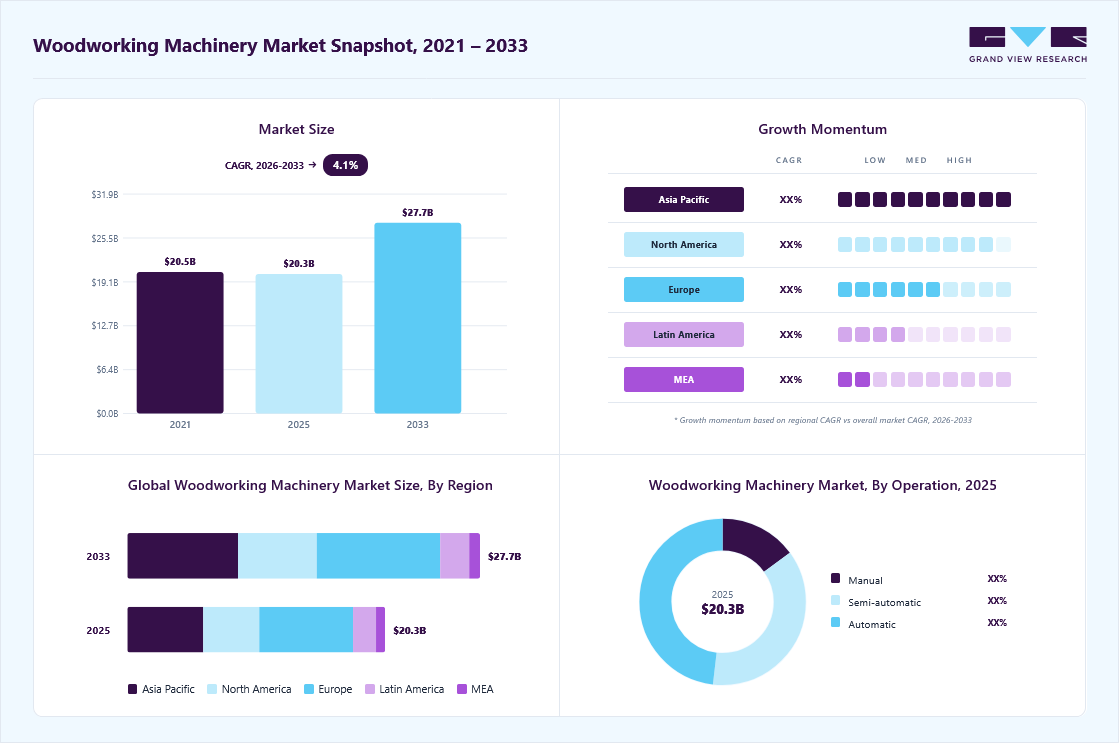
The global woodworking machinery market size was valued at USD 20.3 billion in 2025 and is projected to grow from USD 21.0 billion in 2026 to USD 27.7 billion by 2033, at a CAGR of 4.1% from 2026 to 2033. Europe dominated the global market with the largest revenue share of 36.4% in 2025. Market growth is primarily driven by the increasing demand from the growing furniture manufacturing industry, expansion of residential and commercial infrastructure, and changing consumer preferences toward customized and modular furniture products.
 Source: Grand View Research, IR Documents, Primary Interviews, Paid DatabasesTo learn more about this report,
 Download Free Sample Report
 Key Market Trends & Insights
- By operation: Automatic segment held the largest share of 48.2% in 2025.
- By product: Saws segment held the largest revenue share of 28.6% in 2025.
- By end use: Furniture segment accounted for the largest share of 47.1% in 2025
Regional Highlights
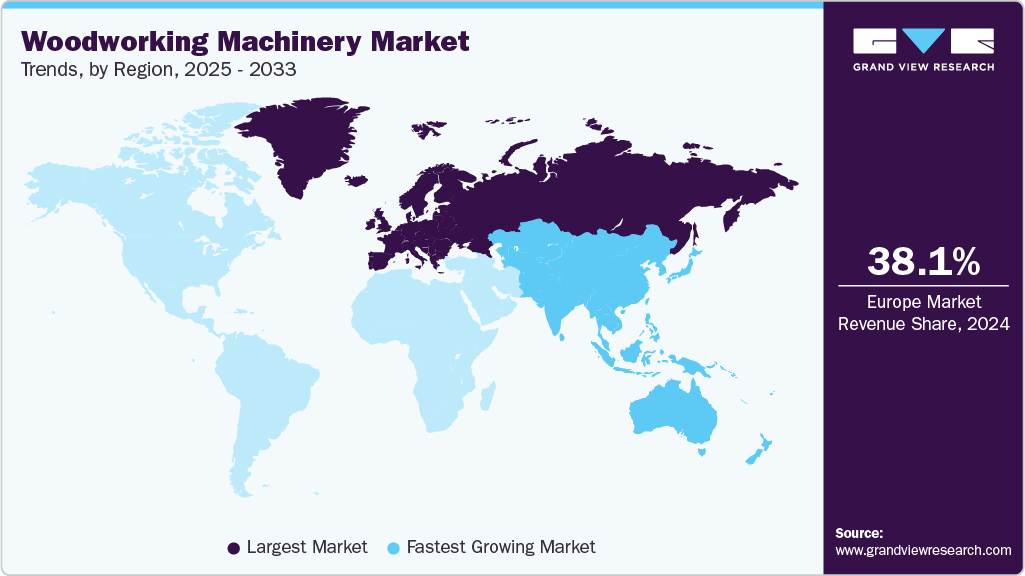
- Largest regional market: Europe (36.4% revenue share, 2025)
- Fastest-growing regional market: Asia Pacific (highest CAGR, 2026-2033)
- By country: Germany led the European market in 2025.
Market Size & Forecast
- Market size in 2025: USD 20.3 Billion
- Estimated market size in 2026: USD 21.0 Billion
- Projected market size by 2033: USD 27.7 Billion
- CAGR (2026-2033): 4.1%
Three ways to get this report
Buy it, customize it, or ask a question.Ask an Analyst
Analyst response in 1 business day
- AccessReport author, directly
- Reply timeWithin 1 working day
- No sales callDirect answer only
- FormatEmail reply
- CostFree, no cost
Get the Full Report
What the study covers
- FormatsPDF · Excel · Dashboard
- Timeline2026–2033 annual, 2025 base
- Coverage20+ countries, 5 regions
- Companies10+ key players profiled
Customize the Report
20% free customization
- IncludeCountries, segments, points
- TailorTo your product definition
- ExtendDeeper competitor detail
- OrA fully bespoke study
- Turnaround5–10 working days
 To learn more about this report, Download Free Sample Report
 Rapid expansion of residential and commercial construction activities, along with evolving interior design preferences, is increasing the use of wood-based products such as flooring, cabinets, doors, and modular furniture across global markets. Moreover, furniture manufacturers are focusing on improving production efficiency, precision, and scalability by adopting automated and CNC-enabled woodworking equipment. The industry is also witnessing stronger integration of digital technologies, smart manufacturing systems, and advanced machining solutions that support faster production cycles, reduced material wastage, and consistent product quality, contributing to the overall growth of the woodworking machine market.
Market Dynamics
The global woodworking machinery industry is growing due to the expansion of the construction and housing sectors, which has increased demand for wooden doors, windows, and architectural millwork. Demand for personalized and modular furniture is also encouraging manufacturers to adopt advanced CNC (Computer Numerical Control) machinery for precise and customized production. Moreover, rising labor costs and shortages of skilled workers are further accelerating the adoption of IoT and AI-based automation technologies to improve production efficiency and support market growth through 2026.
The market is witnessing strong opportunities from the increasing adoption of automation, digital integration, and smart manufacturing solutions across woodworking operations. Demand for precision machining, flexible production systems, and software-connected machinery is encouraging investments in CNC-based equipment, IoT-enabled monitoring systems, and AI supported production technologies. Expanding industrialization and rising furniture exports in developing economies are also creating favorable conditions for advanced woodworking machinery adoption.
High initial investment requirements for advanced woodworking machinery continue to limit adoption, particularly among small and medium sized manufacturers. Costs associated with machinery installation, software integration, tooling, and operator training create financial pressure for businesses with limited capital resources. In addition, the shortage of skilled operators and CNC programmers affects efficient machine utilization, operational productivity, and the pace of technological transition across the industry.
Market Concentration & Characteristics
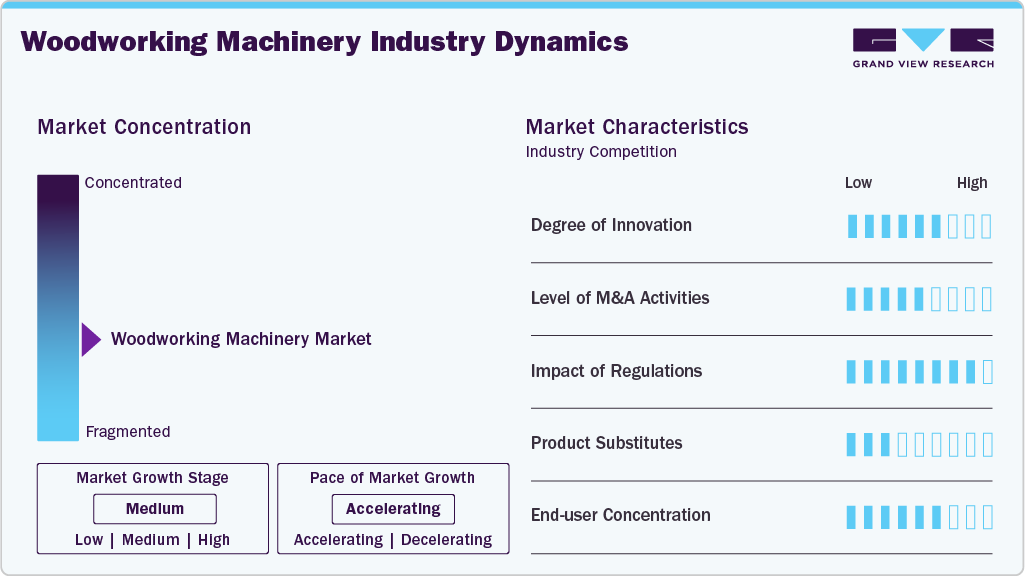
The woodworking machinery industry reflects a moderately fragmented competitive environment with the presence of global manufacturers alongside regional suppliers serving furniture, construction, and industrial wood processing industries. European companies continue to hold strong positions in advanced woodworking technologies, while Asia Pacific has emerged as an important manufacturing and consumption center supported by expanding furniture production and industrial development activities.
Technological development remains a major characteristic of the industry, with increasing preference for CNC-enabled systems, automated production equipment, and digitally connected machinery. Manufacturers are emphasizing higher precision, faster processing capabilities, and improved production flexibility to support demand for customized furniture and engineered wood products. Integration of CAD/CAM software, IoT-based monitoring solutions, and intelligent machine control systems is becoming more visible across large manufacturing facilities.
 To learn more about this report, Download Free Sample Report
 Industry participants are actively focusing on product innovation, regional expansion, partnerships, and acquisition activities to strengthen technological capabilities and market presence. Companies are also investing in energy-efficient machinery, modular production systems, and stronger after-sales service networks to improve operational performance and customer support. Small and medium enterprises continue to favor semi-automatic and cost-efficient solutions that provide better productivity while keeping investment requirements manageable.
Operation Insights
The automatic segment accounted for the largest share of 48.2% in 2025, supported by rising adoption of CNC-enabled and fully automated equipment across large-scale furniture manufacturing and industrial wood processing facilities. Growing demand for higher production efficiency, consistent product quality, reduced labor dependency, and precise machining capabilities continues to strengthen the preference for automatic woodworking machinery. Increasing production of modular and customized furniture products is also encouraging manufacturers to invest in advanced automated systems capable of handling complex operations with improved speed and accuracy.
The semi-automatic segment is projected to expand at a CAGR of 4.0% over the forecast period, driven by the increasing demand from small and medium-sized enterprises seeking cost-effective and flexible production solutions. These machines offer a practical balance between manual control and automation, allowing manufacturers to improve productivity while maintaining operational adaptability for customized woodworking applications. Rising industrialization and gradual transition toward automated manufacturing processes are further supporting adoption of semi-automatic woodworking machinery across developing markets.
Product Insights
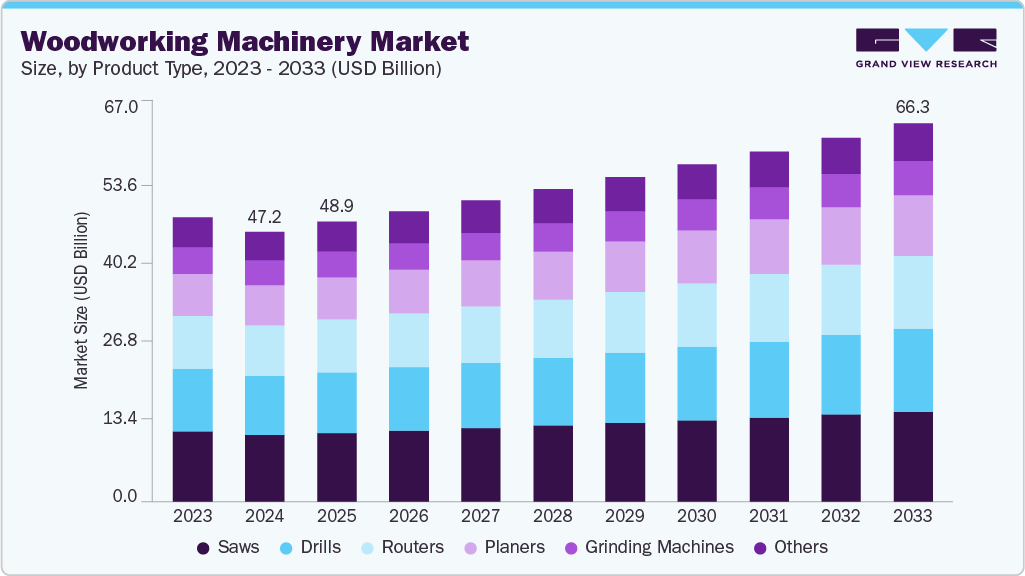
The saws segment accounted for the largest revenue share of 28.6% in 2025, supported by its extensive usage across furniture manufacturing, cabinetry, flooring, construction components, and industrial wood processing operations. Equipment such as panel saws, circular saws, and band saws remains essential for high-volume cutting and dimensioning applications, particularly with the growing use of engineered wood materials including MDF, plywood, and laminates. Increasing investments in modular furniture production and prefabricated construction components are further supporting demand for advanced saw systems with improved precision, speed, and automation capabilities.
The routers segment is expected to expand at the fastest CAGR during the forecast period due to increasing demand for precision machining, customized furniture manufacturing, decorative wood applications, and complex shaping operations. Increasing integration of advanced routing technologies and automated control systems is enabling manufacturers to achieve higher cutting accuracy, faster processing speeds, and improved efficiency in complex woodworking applications. The segment is also benefiting from rising demand for digitally integrated manufacturing systems, particularly in large-scale furniture production facilities focusing on automated and high-precision woodworking operations.
End Use Insights
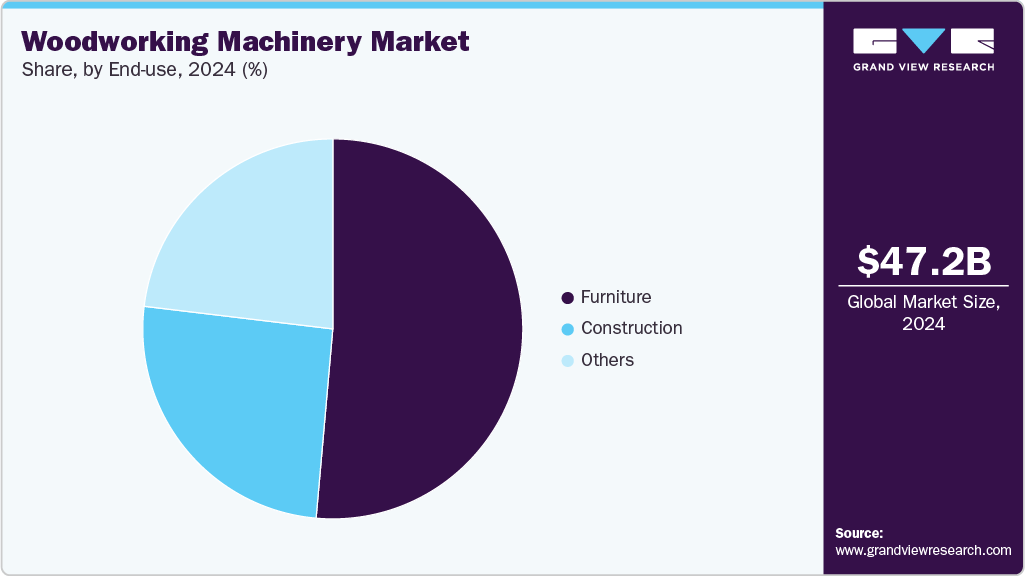
The furniture segment accounted for the largest share of 47.1% in 2025, drivenby increasing global furniture manufacturing activities and growing demand for modular, customized, and ready-to-assemble furniture products. Expanding residential and commercial infrastructure development, changing consumer interior preferences, and growing investments in automated production technologies are encouraging manufacturers to adopt advanced woodworking machinery for improved precision, efficiency, and large-scale production capabilities.
 To learn more about this report, Download Free Sample Report
 The construction segment is projected to expand at a CAGR of 3.9% during the forecast period driven by increasing residential and commercial construction activities, along with growing preference for engineered wood products and off-site construction methods, continue to support demand for woodworking machinery used in cutting, shaping, drilling, and finishing operations.
Regional Insights
North America Woodworking Machinery Market Trends
North America woodworking machinery industry represents a mature and technologically advanced market, supported by strong activity across furniture manufacturing, residential construction, commercial development, and renovation projects. The region benefits from a highly developed industrial infrastructure and increasing adoption of automated production systems, CNC-enabled equipment, and digitally integrated woodworking technologies. Growing demand for customized furniture, engineered wood products, and prefabricated construction components continues to encourage investments in advanced machinery capable of improving production efficiency, precision, and scalability across manufacturing operations.
U.S. Woodworking Machinery Market Trends
The woodworking machine market in the U.S holds a significant position within the regional market due to its large furniture manufacturing base and rising investments in modern construction activities. Demand for woodworking machinery is supported by extensive use of wood in flooring, framing, cabinetry, doors, and interior applications across residential and commercial projects. Manufacturers across the country are increasingly focusing on automation, smart manufacturing technologies, and software-integrated machinery to improve productivity, reduce operational costs, and support large-scale customized production requirements. The growing adoption of engineered wood materials and off-site construction methods is further strengthening demand for high-precision woodworking equipment.
Canada woodworking machinery industry continues to contribute steadily to regional market growth through its strong forestry industry, abundant timber resources, and well-established wood processing sector. Increasing adoption of sustainable timber-based construction methods and engineered wood applications such as cross-laminated timber is creating demand for advanced woodworking machinery capable of precision cutting, shaping, and finishing operations. In addition, the country’s focus on efficient resource utilization, sustainable manufacturing practices, and modernization of wood processing facilities is supporting investments in technologically advanced woodworking equipment across multiple industrial applications.
Europe Woodworking Machinery Market Trends
Europe dominated the woodworking machine market with the largest revenue share, holding 36.4% in 2025. Europe woodworking machinery industry represents a major market supported by advanced manufacturing capabilities, a strong furniture industry, and a well-established timber processing sector. The region has a long-standing presence in wood processing and engineered wood production, creating continuous demand for machinery used in cutting, shaping, sanding, drilling, and finishing applications. Countries such as Italy, Poland, France, Germany, Sweden, and Belgium maintain substantial production of plywood and laminated veneer lumber, supporting the need for technologically advanced woodworking equipment. Increasing adoption of automation, CNC-enabled systems, and digitally integrated production technologies is further improving manufacturing efficiency and product quality across regional woodworking facilities.
 To learn more about this report, Download Free Sample Report
 Germany woodworking machinery industry remains one of the leading markets in Europe due to its highly developed industrial ecosystem, strong engineering expertise, and significant investments in technological advancements in woodworking technologies. The country has a strong presence of woodworking machinery manufacturers and technology providers focusing on automated production systems, CNC machinery, and energy-efficient manufacturing solutions. Demand continues to be supported by furniture manufacturing, interior applications, timber processing, and construction activities involving engineered wood products. Although the industry faces pressure from rising operational costs and broader economic uncertainty across Europe, manufacturers are continuing to invest in automation and smart manufacturing technologies to improve productivity and maintain long-term competitiveness.
France woodworking machinery industry continues to strengthen its position in the regional market through growing activity in furniture manufacturing, timber-based construction, and sustainable building applications. Increasing focus on environmentally responsible construction practices and rising usage of engineered wood materials are encouraging investments in precision woodworking machinery and automated production systems. Demand is also supported by renovation activities, customized furniture production, and adoption of low-carbon construction materials across commercial and residential projects. The country’s emphasis on sustainable architecture and advanced wood processing technologies continues to support modernization of woodworking operations and long-term market growth.
Asia Pacific Woodworking Machinery Market Trends
Asia Pacific woodworking machinery industry is anticipated to be the fastest-growing market, supported by rapid urbanization, expanding furniture manufacturing, and rising construction activities across major economies. Increasing demand for modular furniture, interior wood applications, and engineered wood products is encouraging manufacturers to adopt advanced woodworking machinery with improved precision and automation capabilities. The region also benefits from strong manufacturing infrastructure and growing investments in industrial modernization and smart production technologies.
China market remains a leading market for woodworking machinery due to its large furniture manufacturing industry, extensive wood processing activities, and strong export-oriented production base. Manufacturers across the country are increasingly investing in CNC-enabled and automated machinery to improve productivity, reduce labor dependency, and maintain international quality standards. Rising timber production, residential construction, and demand for customized wood products continue to support machinery adoption across industrial woodworking operations.
India woodworking machinery industry is emerging as a strong growth market driven by expanding construction activities, rising urban housing demand, and increasing furniture production. Growing preference for modular furniture and interior décor products is creating higher demand for machinery used in cutting, shaping, drilling, and finishing applications. Increasing adoption of automated woodworking systems and continued investments in infrastructure and manufacturing development are further supporting market expansion across the country.
Latin America Woodworking Machinery Market Trends
Latin America woodworking machinery industry represents a developing market supported by expanding furniture manufacturing, construction activities, and timber processing industries across the region. Rising urbanization, increasing residential and commercial development, and growing demand for wood-based interior products are supporting the adoption of machinery used in cutting, shaping, sanding, drilling, and finishing applications. Manufacturers are gradually investing in automated and CNC-enabled woodworking systems to improve operational efficiency, product quality, and production flexibility.
Brazil woodworking machinery industry holds a significant position within the Latin America market due to its extensive forest resources and large-scale timber processing industry. The country is a major producer of furniture, plywood, and engineered wood products, creating steady demand for woodworking equipment across sawmills and manufacturing facilities. Strong domestic furniture demand, export-oriented production activities, and increasing adoption of automated woodworking technologies continue to support machinery investments.
Middle East & Africa Woodworking Machinery Market Trends
The Middle East & Africa woodworking machinery industry represents a developing market supported by increasing construction activities, expanding furniture manufacturing, and rising demand for interior wood applications. Rapid urbanization, commercial infrastructure development, hospitality projects, and residential construction are encouraging the adoption of machinery used in cutting, shaping, sanding, drilling, and finishing wood products. Demand for premium interiors, customized furniture, cabinetry, doors, and flooring solutions is also supporting investments in advanced woodworking technologies across the region.
Saudi Arabia woodworking machinery industry is emerging as a major growth market within the region due to large-scale urban development and infrastructure expansion under the Vision 2030 initiative. Ongoing investments in residential, commercial, hospitality, entertainment, and mixed-use projects are significantly increasing demand for woodworking machinery used in interior finishing, furniture production, flooring, and cabinetry applications. Major developments, including Diriyah Gate, King Salman Park, Sports Boulevard, and other large-scale urban projects, are encouraging the adoption of advanced woodworking equipment capable of precision cutting, shaping, and customized production. Growing focus on local manufacturing, high-quality interiors, and modern construction practices continues to strengthen woodworking machinery demand across the country.
Key Woodworking Machinery Company Insights
Some of the key players operating in the market include SCM Group and Oliver Machinery Company, among others.
-
SCM Group is an Italy-based company that manufactures advanced woodworking machinery and automated production systems for furniture manufacturing and industrial wood processing. Its product portfolio includes CNC machines, panel processing equipment, sanding systems, and integrated production solutions designed to improve precision, productivity, and manufacturing efficiency. The company is widely known for its focus on automation and smart manufacturing technologies across global woodworking industries.
-
Oliver Machinery Company is a U.S.-based manufacturer specializing in woodworking equipment for professional workshops and industrial applications. The company offers machinery such as saws, planers, jointers, sanders, and lathes used in cutting, shaping, and finishing wood products. It is recognized for producing durable and reliable woodworking machines that support precision processing and long-term operational performance.
Key Roadways Intelligent Transportation System Companies:
The following key companies have been profiled for this study on the woodworking machinery market.
- SCM Group
- SOCOMEC S.R.L.
- Oliver Machinery Company
- CKM (Cheng Kuang Wood Machinery Works Co., Ltd.)
- Gongyou Group Co., Ltd
- KTCC Woodworking Machinery
- RS WOOD S.R.L
- Biesse
- Solidea Srl (Salvador)
- Michael Weinig AG
- IMA Schelling Group GmbH
- HOMAG Group
- HOLYTEK INDUSTRIAL CORP
- Altendorf Group
- Striebig AG
Competitive Benchmarking
Operating Strategies
Competitive Edge
Weaknesses
Mature Players: SCM Group; Biesse; IMA Schelling Group GmbH; HOMAG; Michael Weinig AG
- These companies continuously strengthen their market position through product innovation, CNC automation upgrades, digital factory solutions, and expansion of after-sales service capabilities.
- They focus on strategic acquisitions, technology partnerships, and global production optimization to maintain leadership across premium woodworking machinery segments.
- These companies maintain strong global market presence supported by established manufacturing facilities, direct subsidiaries, and extensive dealer and service networks across major woodworking regions.
- Their advantage lies in advanced engineering, high machine precision, strong brand reputation, and the ability to offer complete production lines across multiple woodworking applications.
- High capital expenditure requirements for research, automation, and regulatory compliance increase operating costs and result in premium machine pricing.
- Their large global operations create greater exposure to economic slowdown, labor cost inflation, and strict environmental and safety regulations, particularly in Europe.
Emerging Players: Gongyou Group Co., Ltd ; Striebig AG
- These companies focus on cost-effective manufacturing, practical automation, and standardized machine designs to serve small and medium-sized enterprises (SMEs) and price-sensitive buyers.
- They emphasize regional expansion, export growth, and flexible customization for specific woodworking applications such as furniture, doors, flooring, and panel processing.
- Their ability to provide competitively priced machinery with acceptable automation levels improves accessibility for mid-range and developing markets.
- Strong domestic supply chains, faster production cycles, and localized manufacturing support quicker delivery and improved responsiveness to customer requirements.
- Limited global brand recognition and smaller international service networks reduce competitiveness against established premium manufacturers.
- Competition remains high from larger global players with stronger technological capabilities, broader product portfolios, and established customer trust.
Recent Developments
-
In April 2026, Striebig AG acquired 100% of Otto Martin Maschinenbau GmbH & Co. KG, a manufacturer of woodworking machines, as part of its strategy to expand beyond its core vertical panel saw business. The acquisition allows Striebig to strengthen its position in premium woodworking machinery by combining its expertise in vertical sawing with Otto Martin.
-
In April 2026, Oliver Machinery Company introduced the 10080 8” Benchtop Jointer as a compact surface planing solution that incorporates features from its industrial machines into a benchtop format. The machine is equipped with a 2 HP motor and an HCX helical cutterhead, delivering smooth surface finishing with reduced noise and vibration
Woodworking Machinery Market Report Scope
Report Attribute
Details
Market size in 2025
USD 20.3 billion
Estimated Market size in 2026
USD 21.0 billion
Projected Market size by 2033
USD 27.7 billion
Growth rate
CAGR of 4.1% from 2026 to 2033
Base year for estimation
2025
Historical data
2021 - 2024
Forecast period
2026 - 2033
Quantitative units
Revenue in USD billion and CAGR from 2026 to 2033
Report coverage
Revenue forecast, company market position analysis, competitive landscape, growth factors, and trends
Segments covered
Operation, product, end use, region
Regional scope
North America; Europe; Asia Pacific; Latin America; Middle East & Africa
Country Scope
U.S.; Canada; Mexico; Germany; Sweden; Italy; Poland; France; Belgium; Netherlands; Luxembourg; China; Japan; India; Australia; South Korea; Brazil; Argentina; Saudi Arabia; UAE; South Africa
Key companies profiled
SCM Group; SOCOMEC S.R.L.; Oliver Machinery Company; CKM (Cheng Kuang Wood Machinery Works Co., Ltd.); Gongyou Group Co., Ltd, KTCC Woodworking Machinery; RS WOOD S.R.L.; Biesse; Solidea Srl (Salvador); Michael Weinig AG; IMA Schelling Group GmbH; HOMAG Group; HOLYTEK INDUSTRIAL CORP; Altendorf Group; Striebig AG India
Customization scope
Free report customization (equivalent up to 8 analysts working days) with purchase. Addition or alteration to country, regional & segment scope.
Pricing and purchase options
Avail customized purchase options to meet your exact research needs. Explore purchase options
Global Woodworking Machinery Market Report Segmentation
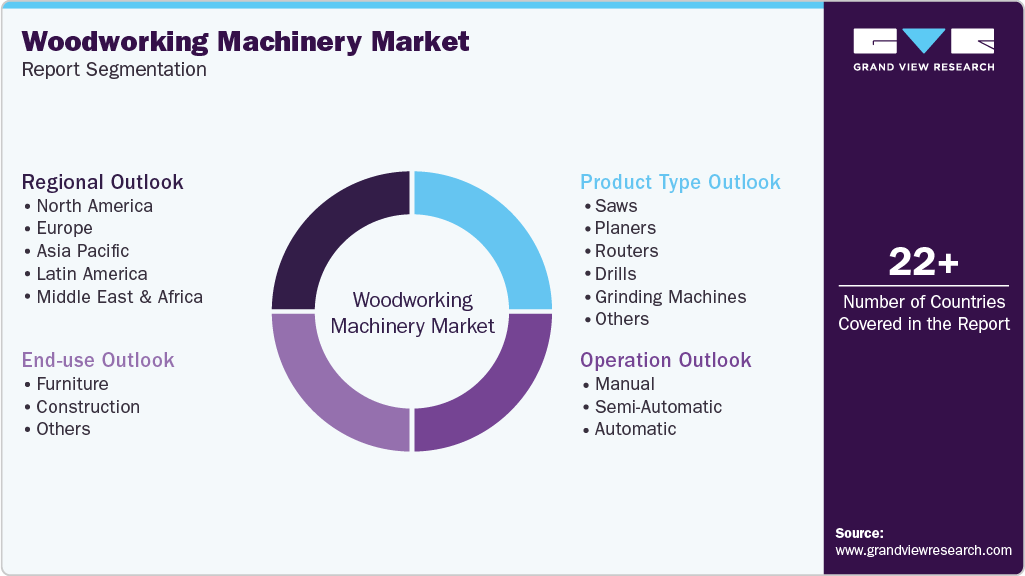
This report forecasts revenue growth at global, regional & country levels and provides an analysis on the industry trends in each of the sub-segments from 2021 to 2033. For this study, Grand View Research has segmented the woodworking machinery market report based on operation, product, end use, and region:
 To learn more about this report, Download Free Sample Report
 -
Operation Outlook (Revenue, USD Billion, 2021 - 2033)
-
Manual
-
Semi-automatic
-
Automatic
-
-
Product Outlook (Revenue, USD Billion, 2021 - 2033)
-
Saws
-
Planers
-
Routers
-
Drills
-
Grinding Machines
-
Others
-
-
End Use Outlook (Revenue, USD Billion, 2021 - 2033)
-
Furniture
-
Construction
-
Others
-
-
Regional Outlook (Revenue, USD Billion, 2021 - 2033)
-
North America
-
U.S.
-
Canada
-
Mexico
-
-
Europe
-
Germany
-
France
-
Sweden
-
Poland
-
Italy
-
Belgium
-
Netherlands
-
Luxembourg
-
-
Asia Pacific
-
China
-
India
-
Japan
-
South Korea
-
Australia
-
-
Latin America
-
Brazil
-
Argentina
-
-
Middle East & Africa
-
Saudi Arabia
-
UAE
-
South Africa
-
-
Delivered Customizations
We have successfully delivered the following deep-dive customizations
Client Request
Customization Delivered
Value Adds
Key Manufacturers Regional Positioning Analysis Europe vs Asia Pacific
Comparative assessment of leading woodworking machinery manufacturers across Europe and Asia Pacific based on pricing strategy, technology and innovation capabilities, and production scale.
Provide clients with a clear understanding of how competitive advantages differ between European and Asia Pacific manufacturers across technology leadership, pricing strategy, and production capacity. Support long-term strategic planning by helping clients assess procurement trade-offs, competitive risks, and regional opportunities based on operational priorities, investment capacity, and target customer segments.
Evaluation of Competitive Shift from Europe to Asia Pacific Manufacturers
Detailed assessment of the evolving competitive dynamics between European and Asia Pacific woodworking machinery manufacturers, focusing on the gradual shift in market influence across standard, mid-range, and premium equipment segments. The analysis evaluates regional demand patterns, cost competitiveness, production localization, regulatory impact, technology progression, and supply chain resilience to understand how sourcing preferences and manufacturer positioning are changing globally. It also highlights where competitive strength remains stable and where market share redistribution is accelerating across product categories.
Support sourcing strategy, supplier diversification, pricing decisions, and investment planning by identifying where Asia Pacific manufacturers are gaining commercial advantage and where European players continue to retain strong defensible positions. Enable better risk assessment and procurement optimization by aligning supplier selection with operational requirements, budget priorities, and future market direction.
Global Wood And Timber Products Market Analysis
Comprehensive analysis of the global wood and timber products market covering overall market size, growth outlook, demand drivers, and key structural trends influencing industry expansion.
Provide clients with broader industry context for understanding downstream demand drivers that directly influence woodworking machinery adoption and investment decisions. Support strategic planning, capacity expansion, and product portfolio alignment by linking timber market growth, material usage trends, and regulatory developments with future equipment demand potential.
Frequently Asked Questions About This Report
The global woodworking machinery market size was valued at USD 20.3 billion in 2025 and is expected to reach USD 21.0 billion in 2026
Some of the key players operating in the global woodworking machinery market include HOLYTEK INDUSTRIAL CORP., SCM Group, SOCOMEC S.R.L., Oliver Machinery Company, CKM, Gongyou Group Co., Ltd., Nihar Industries, KTCC WOODWORKING MACHINERY, RS WOOD S.R.L., Biesse Group, Dürr Group, A L Dalton Ltd., Solidea Srl, Michael Weinig AG, IMA Schelling Group GmbH.
The global woodworking machinery market, in terms of revenue, is expected to grow at a compound annual growth rate of 4.1% from 2026 to 2033 to reach USD 27.7 billion by 2033.
Europe dominated the global revenue share in 2025 holding 36.4% of the market supported by its advanced manufacturing capabilities, strong furniture production industry, and well-established timber processing sector.
Key factors include the rising furniture manufacturing activities, increasing residential and commercial construction projects, and growing demand for modular and customized wood products.
The automatic segment accounted for the largest share of 48.2% in 2025.
The saws segment held the largest revenue share of 28.6% in 2025.
The furniture segment accounted for the largest share of 47.1% in 2025.
About the Author(s)
Advanced Interior Materials Research Team
Advanced Materials · Advanced Interior MaterialsThis report was authored by the advanced interior materials research team at Grand View Research - comprising two research analysts, one senior research analyst, and one industry expert - with specialized expertise in the advanced interior materials segment of the advanced materials industry. All findings are based on proprietary advanced materials databases, executive interviews, and regulatory analysis, subject to internal peer review prior to publication.
Last Updated:
Speak to Analyst

Customize this report to your needs - add regions, segments, or data points, with 20% free customization.
Or view our licence options:


ISO 9001:2015 & 27001:2022 Certified
We are GDPR and CCPA compliant! Your transaction & personal information is safe and secure. For more details, please read our privacy policy.


