
- Home
- »
- Advanced Interior Materials
- »
-
Bio-based Textile Fibers Market Size Report, 2026-2033GVR Report cover

Bio-based Textile Fibers Market (2026 - 2033)
Size, Share & Trends Analysis Report By Fiber Type (Natural Cellulosic Fibers, Natural Protein Fibers, Regenerated Cellulosic Fibers, Bio-based Synthetic Fibers), By Fiber Form (Staple Fibers), By Application, By Region, And Segment Forecasts
Market Size, 2025
$27.2BMarket Estimate, 2026
$28.9BMarket Forecast, 2033
$44.0BCAGR, 2026–2033
6.2%Bio-based Textile Fibers Market Summary
The global bio-based textile fibers market size was valued at USD 27.2 billion in 2025 and is projected to grow from USD 28.9 billion in 2026 to USD 44.0 billion by 2033, at a CAGR of 6.2% from 2026 to 2033. Asia Pacific dominated the market, accounting for the largest revenue share of 44.0% in 2025. The market is witnessing increasing demand as textile manufacturers, apparel brands, and consumers shift toward renewable and environmentally responsible material alternatives.
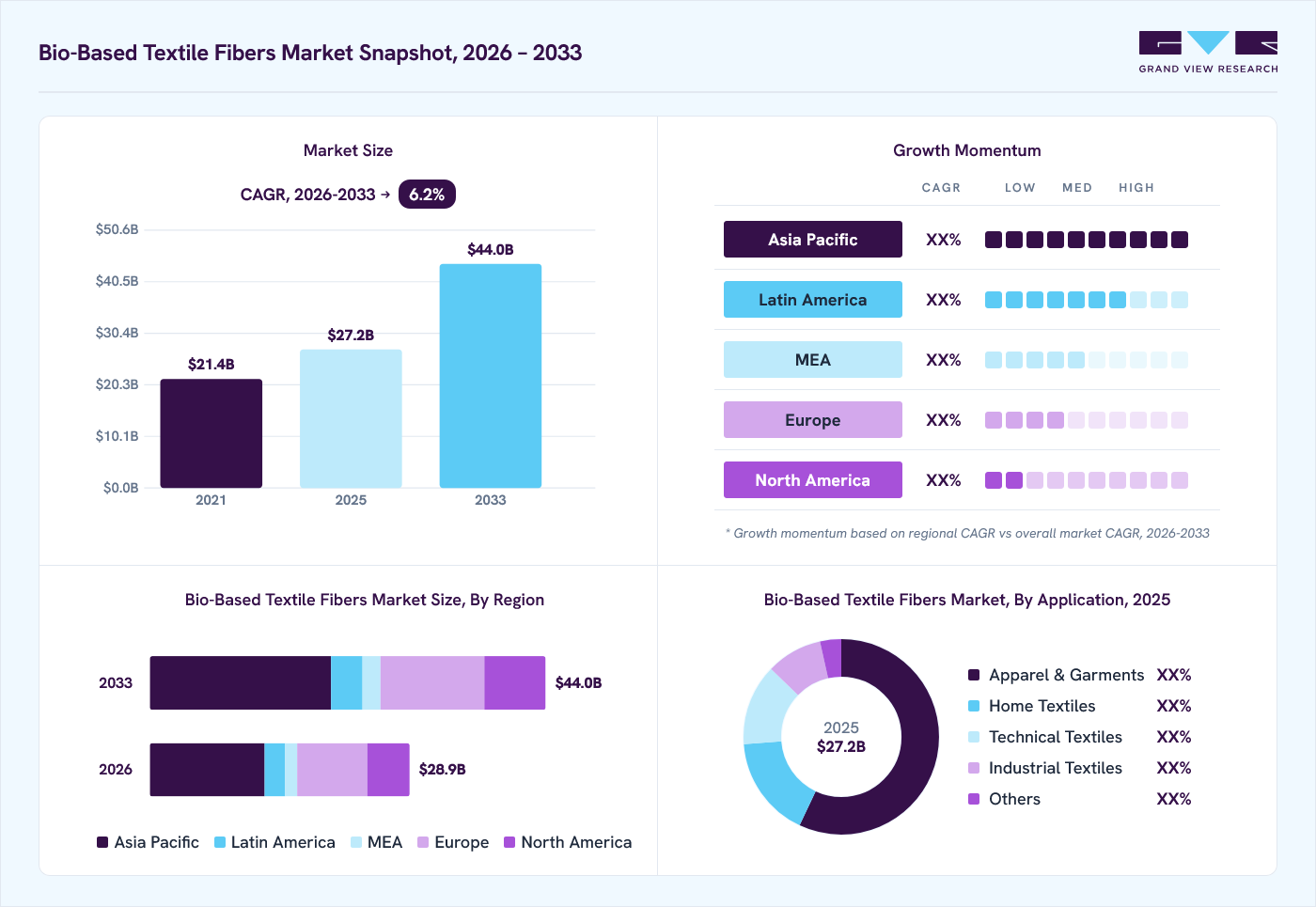 Source: Grand View Research, IR Documents, Primary Interviews, Paid DatabasesTo learn more about this report,
 Download Free Sample Report
Key Market Trends & Insights
- By fiber type: Natural cellulosic fibers segment held the largest share of 47.3% in 2025.
- By application: Apparel & garments segment dominated the market with a revenue share of 57.0% in 2025.
- By fiber form: Staple fibers segment led the market, accounting for the largest revenue share of 57.7% in 2025.
Regional Highlights
- Largest regional market: Asia Pacific (44.0% revenue share, 2025)
- By country: The China held the largest market share in 2025
Market Size & Forecast
- Market size in 2025: USD 27.2 Billion
- Estimated market size in 2026: USD 28.9 Billion
- Projected market size by 2033: USD 44.0 Billion
- CAGR (2026-2033): 6.2%
Prism AI by Grand View Research Free to tryAsk a question about the bio-based textile fibers market✓Every figure cited from GVR research Prefer the report? Download free sample →
Bio-based fibers are derived partly or entirely from renewable biological resources such as wood pulp, agricultural feedstocks, plant-based polymers, and other biomass sources. Growing concerns regarding the environmental impact of petroleum-based synthetic fibers are encouraging manufacturers to explore alternative fiber materials. The growing focus on reducing the environmental footprint of textile production is accelerating the transition toward renewable raw materials. Conventional synthetic fibers remain widely used due to their established production infrastructure, performance characteristics, and cost advantages, but concerns regarding fossil-resource dependence, production emissions, and textile waste are encouraging the development of bio-based alternatives. Apparel manufacturers are increasingly evaluating fibers based on their renewable content, biodegradability, production processes, and end-of-life characteristics.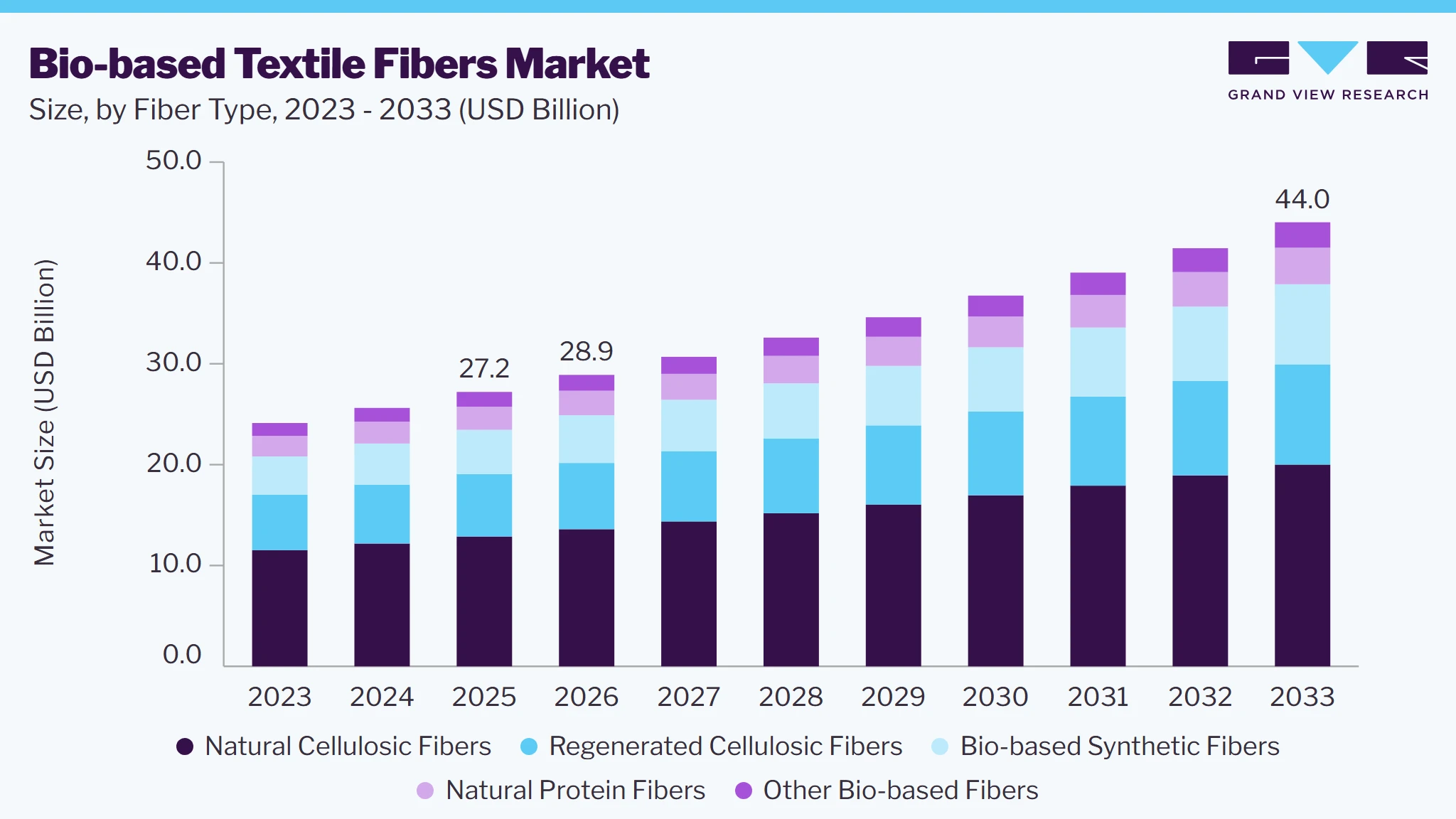 To learn more about this report, Download Free Sample Report
Technological innovation is becoming an important competitive factor in the market, particularly in the development of high-performance bio-based fibers. Manufacturers are exploring advanced regenerated cellulose fibers, bio-derived polymers, agricultural-residue feedstocks, plant-based materials, and biotechnology-enabled fiber production. Innovations are increasingly focused on improving fiber consistency, mechanical properties, processing efficiency, biodegradability, and compatibility with existing textile manufacturing equipment.
Market Dynamics
The bio-based textile fibers market is primarily influenced by the transition toward sustainable raw materials, growing environmental awareness, technological advancements, government sustainability initiatives, and increasing commitments from apparel and textile companies. Demand is being supported by the need to reduce dependence on fossil-based materials and develop more resource-efficient textile supply chains. Meanwhile, the market faces challenges related to production costs, feedstock availability, scalability, performance consistency, and competition from established natural and synthetic fibers.
The increasing emphasis on sustainable fashion and environmentally responsible textile production is a major driver for bio-based textile fibers. Apparel brands and textile manufacturers are increasingly seeking renewable alternatives to petroleum-based fibers to improve the sustainability profile of their products. Consumer awareness regarding material sourcing, environmental impact, and textile waste is also encouraging demand for fibers with renewable or bio-derived content.
In addition, companies are increasingly evaluating raw materials based on their contribution to carbon reduction, resource efficiency, and circularity objectives. Bio-based textile fibers derived from renewable feedstocks provide manufacturers with opportunities to reduce dependence on finite fossil resources. The development of improved fiber technologies is also helping address earlier limitations related to strength, durability, comfort, and processing performance. As brands increasingly integrate sustainability into product development and procurement decisions, demand for commercially scalable bio-based fibers is expected to increase.
High production costs and limited large-scale availability of certain bio-based textile fibers remain major restraints on market growth. Advanced bio-based fiber technologies often require specialized feedstocks, processing systems, chemical treatments, or biotechnology-based production processes, increasing manufacturing complexity. Compared with established synthetic fibers, some bio-based alternatives continue to face challenges in achieving competitive costs on a commercial scale. In addition, inconsistent feedstock availability and limited supply-chain infrastructure can affect production reliability. These factors can discourage manufacturers from making large-scale transitions, particularly in price-sensitive textile applications.
The development of next-generation fibers from agricultural residues, plant-based polymers, regenerated cellulose, and other renewable biological resources presents significant opportunities for market participants. Advances in biotechnology, polymer science, fiber spinning, and material processing are enabling companies to develop fibers with improved performance and sustainability characteristics. Agricultural waste and biomass residues can also provide alternative feedstock sources while supporting resource utilization and waste reduction. Increasing collaboration among biotechnology companies, fiber manufacturers, textile producers, apparel brands, and research institutions is accelerating commercialization.
Market Concentration & Characteristics
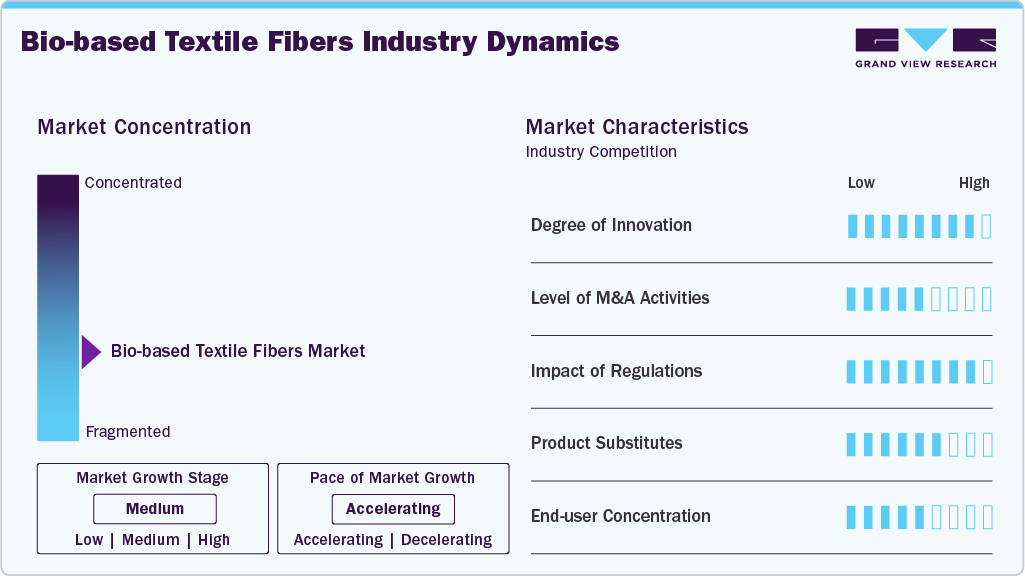
The bio-based textile fibers market is characterized by the presence of established fiber manufacturers, sustainable-material producers, biotechnology companies, and emerging technology developers. Competition is increasingly centered on fiber performance, renewable content, production scalability, environmental credentials, raw-material availability, and cost efficiency. Established textile-material companies benefit from existing manufacturing infrastructure, established customer relationships, and technical expertise, while emerging companies are introducing innovative bio-based materials and production technologies. Strategic partnerships between fiber producers, apparel brands, research institutions, and feedstock suppliers are becoming increasingly important for commercialization.
 To learn more about this report, Download Free Sample Report
Bio-based textile fibers face substitution from conventional synthetic fibers such as polyester, nylon, acrylic, and polypropylene, as well as established natural fibers such as cotton, wool, flax, and hemp. Recycled fibers also represent an important alternative as they provide sustainability benefits while utilizing existing material streams. Conventional fibers continue to benefit from mature production infrastructure, broad availability, established performance characteristics, and competitive pricing. However, growing sustainability requirements and increasing environmental concerns are improving the relative attractiveness of bio-based alternatives.
Analyst Perspective
The bio-based textile fibers market is transitioning from a niche sustainability segment toward a strategically important component of the textile industry as brands and manufacturers seek renewable alternatives to fossil-based fibers. Market growth likely to depend on the ability of fiber producers to achieve commercial-scale production, competitive costs, consistent quality, and reliable renewable feedstock supply. Regenerated cellulose, bio-based polymers, and agricultural-residue-derived fibers offer particularly strong opportunities as technology improves. From an analyst perspective, partnerships among fiber producers, textile manufacturers, apparel brands, and technology developers will be critical for accelerating commercialization and expanding adoption across mainstream textile applications.
Fiber Type Insights
The natural cellulosic fibers segment held the largest revenue share of 47.3% in 2025, supported by the widespread use of cotton, flax, hemp, jute, and other plant-derived fibers across the textile industry. These fibers benefit from established cultivation, processing, spinning, and distribution infrastructure, along with strong consumer familiarity and demand for natural materials. Their use across apparel, home textiles, and technical applications continues to support the segment's leading position.
The bio-based synthetic fibers segment is expected to grow at a CAGR of 7.7% over the forecast period, as manufacturers increasingly seek renewable alternatives to petroleum-based polyester, nylon, and elastane. Advances in bio-derived feedstocks, polymer technologies, and fiber manufacturing are improving the performance and commercial viability of these materials. Increasing sustainability commitments from apparel brands and growing demand for fibers with reduced fossil-resource dependence are expected to accelerate adoption across sportswear, apparel, automotive, and technical textile applications.
Fiber Form Insights
The staple fibers segment held the largest revenue share of 57.7% in 2025, primarily due to their extensive use in conventional yarn and fabric manufacturing. Bio-based staple fibers can be easily blended with other natural, regenerated, or recycled fibers, providing manufacturers with greater flexibility in developing sustainable textile products. Their broad application across apparel, home textiles, furnishings, and other textile products, integrated with established spinning technologies, supports strong demand for this fiber form.
The tow segment is expected to grow at a CAGR of 6.3% over the forecast period, as demand increases for continuous bio-based filament bundles used in downstream fiber processing and specialized textile applications. Bio-based tow provides manufacturers with flexibility to convert continuous filaments into staple fibers or other formats to meet application requirements. Growth in bio-based synthetic fibers and advanced regenerated fibers, particularly for performance-oriented applications, is expected to create additional opportunities for tow suppliers as textile manufacturers diversify their renewable material portfolios.
Application Insights
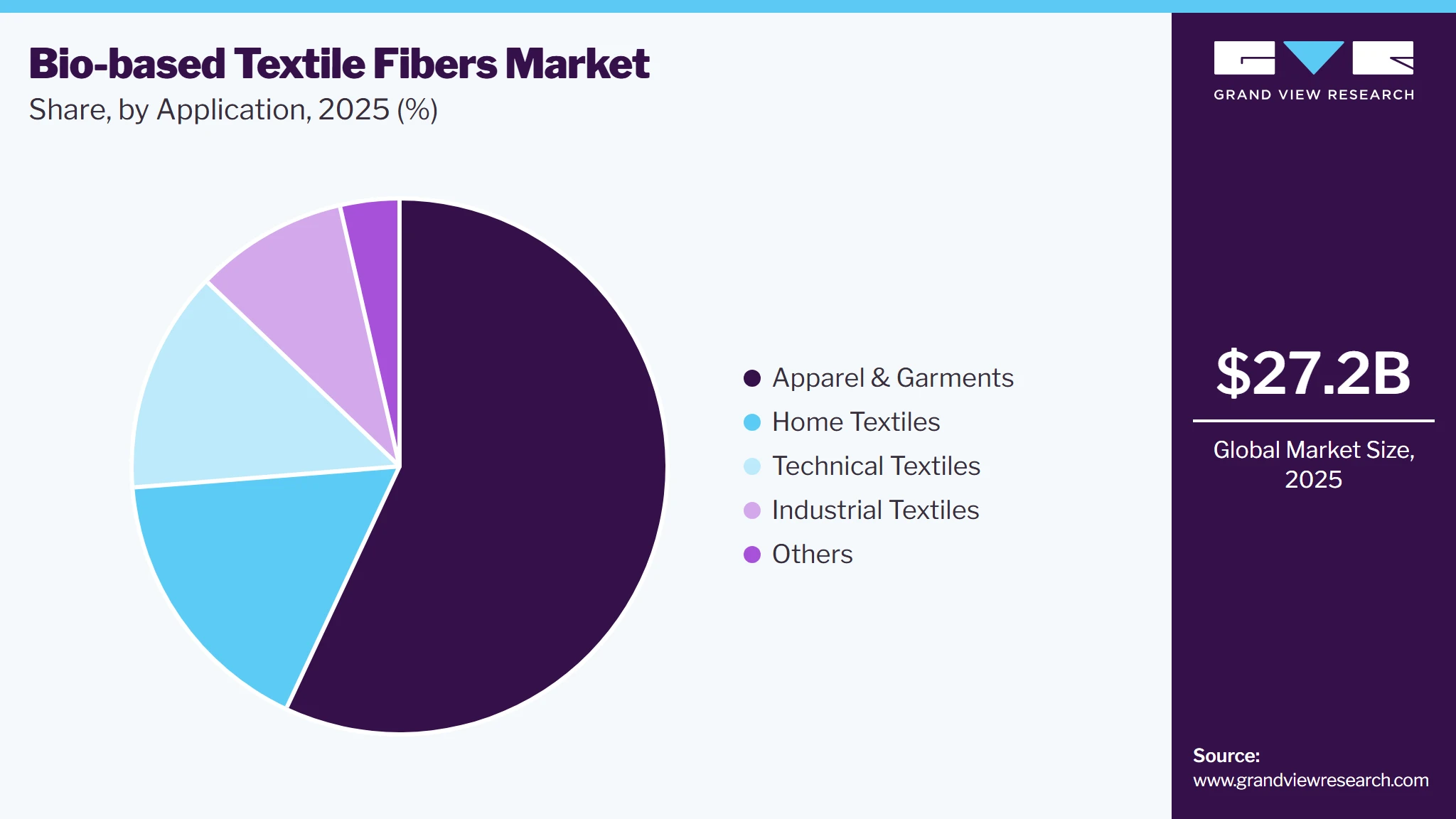
The apparel & garments segment held the largest revenue market share of 57.0% in 2025, driven by increasing adoption of sustainable fibers across clothing, sportswear, activewear, intimate apparel, and fashion products. Major apparel brands are incorporating renewable and bio-based fibers into product portfolios to address consumer sustainability preferences and corporate environmental commitments. The availability of bio-based fibers offering softness, comfort, durability, moisture management, and aesthetic properties comparable with conventional materials is further supporting their adoption in mainstream apparel manufacturing.
 To learn more about this report, Download Free Sample Report
The technical textiles segment is expected to grow at a CAGR of 7.8% over the forecast period, as bio-based fibers increasingly demonstrate potential in specialized applications requiring specific performance and environmental characteristics. Growing demand for sustainable materials in automotive textiles, filtration, medical textiles, protective products, construction textiles, and other performance-oriented applications is creating new opportunities. Advances in fiber engineering are enabling bio-based materials to deliver improved strength, durability, thermal properties, and functional performance, supporting their gradual adoption in higher-value technical textile applications.
Regional Insights
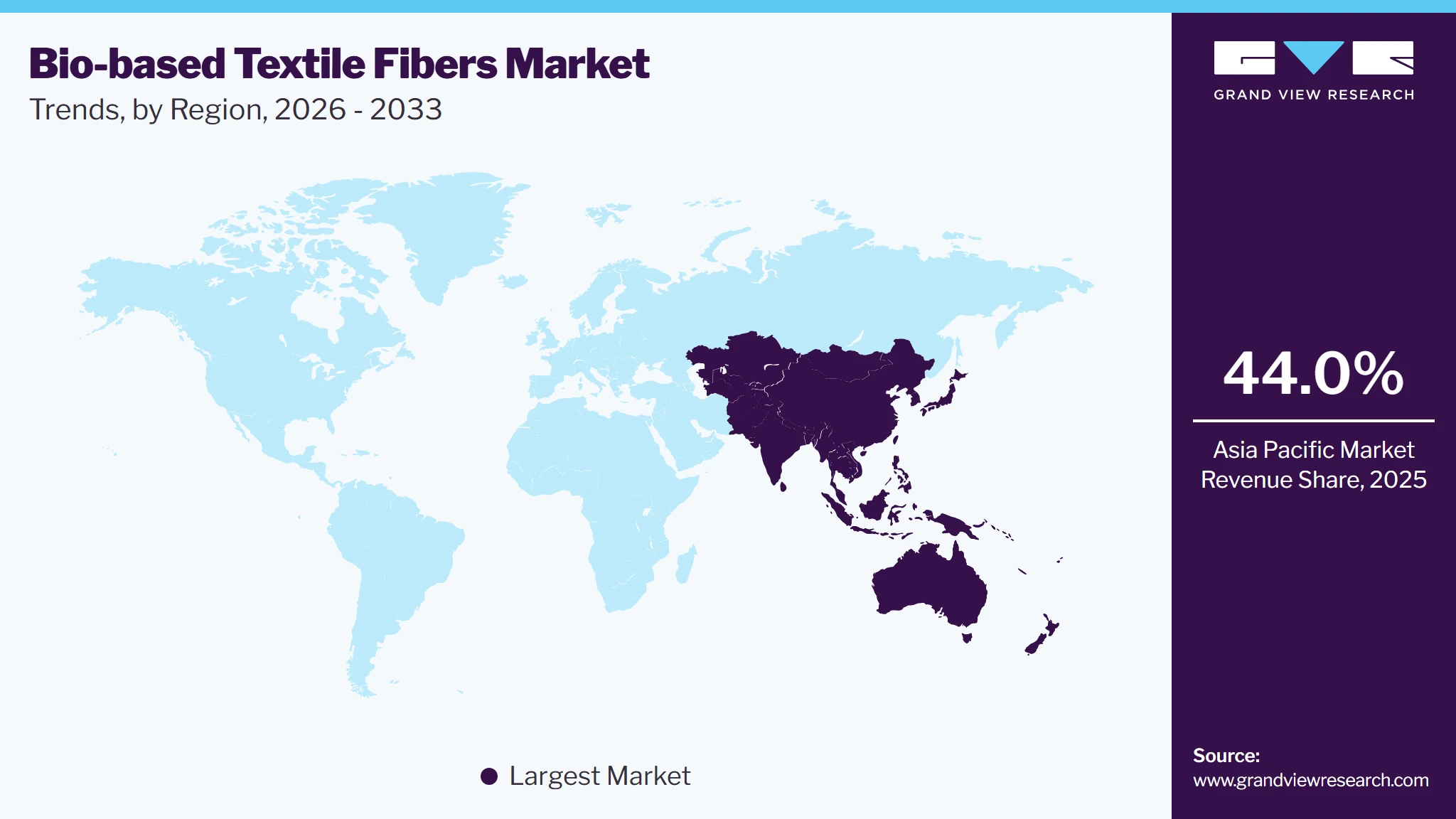
Asia Pacific bio-based textile fibers market dominated the global market and accounted for the largest revenue share of 44.0% in 2025, due to its extensive textile and apparel manufacturing base, large consumer population, and growing focus on sustainable production. The presence of major fiber, yarn, fabric, and garment manufacturing clusters provides a strong foundation for integrating bio-based materials into existing textile value chains. Countries across the region are increasingly investing in sustainable textile technologies and renewable material solutions. Growing export requirements and sustainability commitments from international apparel brands are encouraging manufacturers to adopt lower-impact fibers.
 To learn more about this report, Download Free Sample Report
China Bio-Based Textile Fibers Market Trends
Bio-based textile fibers market in China is a significant market due to its extensive textile manufacturing infrastructure and strong position across the fiber-to-apparel value chain. Manufacturers are increasingly exploring sustainable fiber technologies to meet changing environmental requirements and international brand sourcing expectations. The country has substantial capabilities in fiber production, textile processing, chemical engineering, and material development, supporting the commercialization of bio-based alternatives.
North America Bio-based Textile Fibers Market Trends
North America is experiencing growing demand for bio-based textile fibers as apparel brands, consumers, and textile manufacturers increasingly prioritize sustainable material sourcing. The region benefits from advanced research capabilities in biotechnology, polymers, materials science, and sustainable manufacturing. Companies are developing innovative fibers based on plant-derived polymers, regenerated cellulose, agricultural resources, and other renewable feedstocks. Strong sustainability commitments among apparel and consumer-product companies are supporting the integration of bio-based materials into product portfolios.
The United States is an important market for bio-based textile fibers due to its strong apparel-brand ecosystem, research capabilities, and growing demand for sustainable products. Brands and retailers are increasingly evaluating renewable materials as part of broader environmental and responsible-sourcing strategies. The country also has strong capabilities in biotechnology, advanced materials, polymer development, and textile innovation. Emerging companies are developing new bio-based fiber technologies and exploring agricultural and plant-based feedstocks.
Europe Bio-based Textile Fibers Market Trends
Europe represents a major market for bio-based textile fibers due to its strong emphasis on sustainability, circular economy principles, resource efficiency, and environmentally responsible textile production. Apparel brands and textile manufacturers are increasingly transitioning toward renewable, recycled, biodegradable, and lower-impact materials. European regulatory frameworks are encouraging greater transparency, sustainable product design, waste reduction, and responsible material sourcing. The region also has a strong ecosystem of sustainable fashion brands, fiber producers, research institutions, and textile technology companies.
Germany bio-based textile fibers market is an important European market due to its advanced manufacturing capabilities, strong research infrastructure, and emphasis on sustainable industrial development. Textile and material companies are increasingly exploring renewable fibers and resource-efficient production technologies. German research institutions and industrial organizations are contributing to innovations in bio-based polymers, regenerated fibers, sustainable processing, and textile recycling. Demand is supported by applications across apparel, automotive textiles, technical textiles, and industrial materials.
Central and South America Bio-based Textile Fibers Market Trends
Central and South America present emerging opportunities for bio-based textile fibers due to their agricultural resources, developing textile industries, and increasing interest in sustainable production. Agricultural feedstocks and residues can provide opportunities for developing renewable fiber materials while supporting resource utilization. Textile and apparel manufacturers are increasingly responding to sustainability expectations from international buyers and consumers.
Middle East & Africa Bio-based Textile Fibers Market Trends
The Middle East & Africa market is developing as textile manufacturers and brands increasingly focus on sustainable materials and resource-efficient production. Africa offers opportunities for bio-based fibers derived from locally available agricultural and plant-based resources. The Middle East is increasingly investing in advanced materials, industrial diversification, sustainability, and resource-efficiency initiatives. Textile manufacturers supplying international markets are also facing growing expectations regarding sustainable material sourcing and environmental performance.
Key Bio-based Textile Fibers Company Insights
Some of the key players operating in the market include Lenzing AG and Eastman Chemical Company
-
Lenzing AG is an Austria-based global producer of specialty fibers made from wood-based renewable raw materials. The company manufactures TENCEL Lyocell, TENCEL Modal, and LENZING ECOVERO fibers, which are widely used in apparel, home textiles, and other textile applications. Lenzing focuses strongly on sustainable fiber production, responsible wood sourcing, and resource-efficient manufacturing.
-
Eastman Chemical Company is a U.S.-based specialty materials manufacturer with a portfolio of cellulosic textile fibers under its Naia brand. Naia fibers are produced from sustainably sourced wood pulp, while Naia Renew incorporates certified recycled content. The company focuses on developing lower-impact textile materials for apparel, intimate wear, home textiles, and other applications.
Sateri and Kelheim Fibres GmbH are some of the emerging market participants in the bio-based textile fibers market.
-
Sateri is a China-based producer of regenerated cellulose fibers and is part of the RGE Group. The company manufactures fibers under brands including EcoCosy, primarily using sustainably sourced dissolving pulp. Sateri focuses on developing more sustainable viscose fibers and improving resource efficiency and traceability throughout the fiber production process.
-
Kelheim Fibres GmbH is a Germany-based manufacturer specializing in innovative regenerated cellulose fibers. The company develops specialty viscose fibers using renewable wood-based cellulose and focuses on customized fiber shapes and functionalities for applications such as apparel, hygiene products, and technical textiles.
Key Bio-based Textile Fibers Companies
The following key companies have been profiled for this study on the bio-based textile fibers market.
-
Lenzing AG
-
Eastman Chemical Company
-
Toray Industries, Inc.
-
Hyosung TNC Corporation
-
Fulgar S.p.A.
-
Liva by Birla Cellulose
-
Kelheim Fibres GmbH
-
Sateri
-
Spinnova Oy
-
Asahi Kasei Corporation
Competitive Benchmarking
Category
Operating Strategies
Competitive Edge
Weakness
Established Players (Lenzing AG, Eastman Chemical Company, Toray Industries, Inc., Hyosung TNC Corporation, Fulgar S.p.A., Liva by Birla Cellulose)
- Invest in advanced bio-based, regenerated cellulose, bio-polymer, and bio-based synthetic fiber technologies to improve performance and sustainability.
- Expand manufacturing capacity and global market presence through partnerships with textile mills, apparel brands, and downstream manufacturers.
- Strengthen sustainable sourcing, resource-efficient production, and low-carbon manufacturing practices.
- Strong R&D capabilities and established expertise in bio-based and regenerated fiber technologies.
- Established relationships with global textile manufacturers, fashion brands, and apparel companies.
- Large production capacities, established supply chains, and strong global commercialization networks.
- High capital requirements for developing and scaling advanced bio-based fiber technologies.
- Some bio-based fibers remain more expensive than conventional petroleum-based alternatives.
- Dependence on renewable feedstock availability and customer willingness to shift from established fiber materials.
Emerging Players (Kelheim Fibres GmbH, Sateri, Spinnova Oy, Asahi Kasei Corporation)
- Focus on innovative regenerated cellulose, wood-based, plant-derived, and next-generation bio-based fiber technologies.
- Build collaborations with textile manufacturers, fashion brands, research institutions, and technology partners to accelerate commercialization.
- Develop specialized fibers offering improved sustainability, functionality, comfort, and application-specific performance.
- Strong specialization in innovative and sustainable fiber technologies.
- Greater flexibility enables faster development of specialized products and responses to changing customer requirements.
- Well-positioned to benefit from increasing demand for renewable materials and sustainable textile solutions.
- Lower production scale and market presence compared with major established fiber manufacturers.
- Limited adoption in some mainstream textile applications due to commercialization and scalability challenges.
- Exposure to technology scaling, feedstock availability, production costs, and customer adoption uncertainties.
Recent Developments
-
In April 2026, Hyosung TNC commenced production and commercialization of its sugarcane-derived regen BIO Spandex through an integrated production system in Vietnam. The facility currently has an annual Bio-BDO capacity of 50,000 tons, with a planned expansion to 200,000 tons.
-
In February 2026, Lenzing announced plans to become the majority owner of TreeToTextile AB, supporting the industrialization of TreeToTextile’s new-generation cellulose fiber technology and strengthening its portfolio of renewable textile fibers.
Bio-based Textile Fibers Market Report Scope
Report Attribute
Details
Market size in 2025
USD 27.2 Billion
Estimated market size in 2026
USD 28.9 Billion
Projected market size by 2033
USD 44.0 Billion
Growth rate
CAGR of 6.2% from 2026 to 2033
Base year for estimation
2025
Actual estimates/Historical data
2021 - 2024
Forecast period
2026 - 2033
Quantitative units
Revenue in USD billion and CAGR from 2026 to 2033
Report coverage
Revenue forecast, company ranking, competitive landscape, growth factors, and trends
Segments covered
Fiber type, fiber form, application, region.
Regional scope
North America; Europe; Asia Pacific; Central & South America; Middle East & Africa
Country scope
U.S.; Canada; Mexico; Germany; UK; France; Italy; Spain; China; Japan; India; South Korea; Brazil; Saudi Arabia
Key companies profiled
Lenzing AG; Eastman Chemical Company; Toray Industries Inc.; Hyosung TNC Corporation; Fulgar S.p.A.; Liva by Birla Cellulose; Kelheim Fibres GmbH; Sateri; Spinnova Oy; Asahi Kasei Corporation
Customization scope
Free report customization (equivalent up to 8 analysts working days) with purchase. Addition or alteration to country, regional & segment scope.
Pricing and purchase options
Avail customized purchase options to meet your exact research needs. Explore purchase options
Global Bio-based Textile Fibers Market Report Segmentation
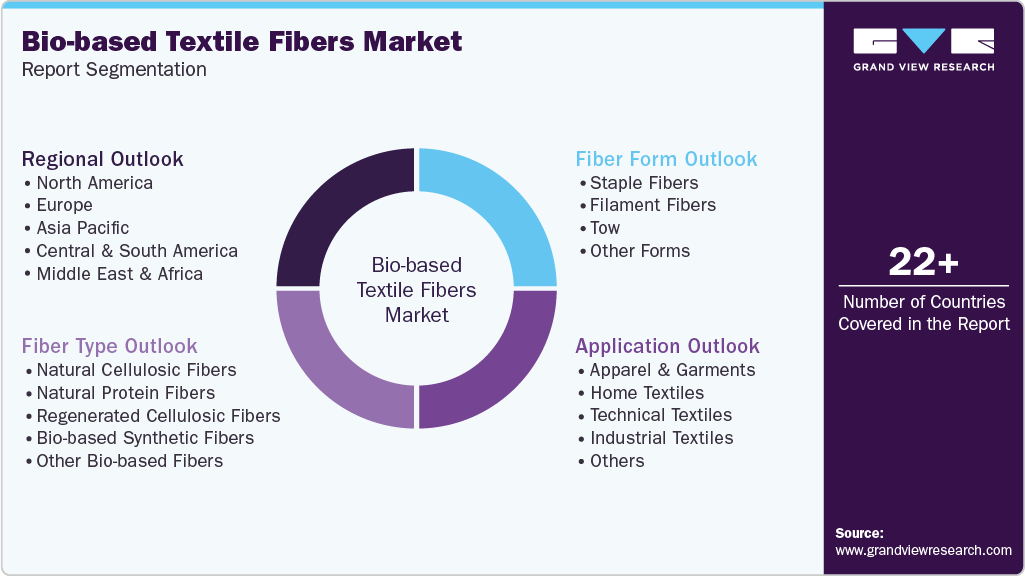
This report forecasts revenue growth at regional & country levels and provides an analysis on the industry trends in each of the sub-segments from 2021 to 2033. For this study, Grand View Research has segmented the global bio-based textile fibers market based on fiber type, fiber form, application, and region:
 To learn more about this report, Download Free Sample Report
-
Fiber Type Outlook (Revenue, USD Billion, 2021 - 2033)
-
Natural Cellulosic Fibers
-
Natural Protein Fibers
-
Regenerated Cellulosic Fibers
-
Bio-based Synthetic Fibers
-
Other Bio-based Fibers
-
-
Fiber Form Outlook (Revenue, USD Billion, 2021 - 2033)
-
Staple Fibers
-
Filament Fibers
-
Tow
-
Other Forms
-
-
Application Outlook (Revenue, USD Billion, 2021 - 2033)
-
Apparel & Garments
-
Home Textiles
-
Technical Textiles
-
Industrial Textiles
-
Others
-
-
Regional Outlook (Revenue, USD Billion, 2021 - 2033)
-
North America
-
U.S.
-
Canada
-
Mexico
-
-
Europe
-
UK
-
Germany
-
France
-
Italy
-
Spain
-
-
Asia Pacific
-
China
-
Japan
-
India
-
South Korea
-
-
Central and South America
-
Brazil
-
-
Middle East and Africa
-
Saudi Arabia
-
-
Research Methodology
The bio-based textile fibers market figures in this report are based on a proven research process that combines executive interviews with secondary research from proprietary databases, company filings, and recognized regulatory and institutional sources. Market size is built through value-chain sizing-reconciling supply-side and demand-side estimates-and triangulated with bottom-up and top-down approaches. Every estimate passes multiple levels of expert validation before publication, with each bio-based textile fibers segment quantified using the revenue-capture definitions in the table below.
Segment Definition
Segment - Fiber Type
Revenue Capture Definition
Natural Cellulosic Fibers
Revenue generated from the sale of bio-based textile fibers derived from natural cellulose sources such as cotton, flax, hemp, jute, and other plant-based materials. This includes fibers supplied for apparel, home textiles, technical textiles, industrial textiles, and other textile applications.
Natural Protein Fibers
Revenue generated from the sale of bio-based textile fibers derived from natural protein sources such as wool, silk, cashmere, and other animal- or protein-based materials. This includes fibers supplied for apparel, luxury textiles, home textiles, technical applications, and other end uses.
Regenerated Cellulosic Fibers
Revenue generated from the sale of regenerated cellulose fibers produced by chemically or mechanically processing renewable cellulose sources such as wood pulp and other biomass feedstocks. This includes viscose, modal, lyocell, cupro, and other regenerated fibers supplied for apparel, home textiles, technical textiles, and industrial applications.
Bio-based Synthetic Fibers
Revenue generated from the sale of synthetic textile fibers manufactured using renewable or bio-derived feedstocks instead of fully fossil-based raw materials. This includes bio-based polyester, polyamide, elastane, polypropylene, and other bio-derived synthetic fibers used in apparel, sportswear, automotive, technical, and industrial textile applications.
Other Bio-based Fibers
Revenue generated from the sale of other textile fibers derived from renewable biological resources that are not classified under natural cellulosic, natural protein, regenerated cellulosic, or bio-based synthetic fibers. This includes emerging fibers derived from agricultural residues, plant-based polymers, microbial sources, and other bio-based feedstocks.
Segment - Fiber Form
Revenue Capture Definition
Staple Fibers
Revenue generated from the sale of short-length bio-based textile fibers designed to be spun or blended into yarns and fabrics. This includes bio-based staple fibers used in apparel, home textiles, nonwoven materials, technical textiles, and industrial textile applications.
Filament Fibers
Revenue generated from the sale of continuous bio-based textile fibers produced as individual filaments or multifilament yarns. This includes fibers used in apparel, sportswear, hosiery, home textiles, automotive textiles, technical textiles, and other applications requiring continuous fiber structures.
Tow
Revenue generated from the sale of continuous bundles of bio-based filaments supplied in tow form for further processing, crimping, cutting, or conversion into staple fibers and other textile materials. This includes bio-based fiber tow used across textile and industrial fiber-processing applications.
Other Forms
Revenue generated from the sale of bio-based textile fibers supplied in other forms that do not fall under staple fibers, filament fibers, or tow. This includes specialized fiber forms, customized fiber structures, and other bio-based fiber formats designed for specific textile, nonwoven, technical, and industrial applications.
Segment - Application
Revenue Capture Definition
Apparel & Garments
Revenue generated from the sale of bio-based textile fibers used in apparel and garment manufacturing. This includes fibers supplied for casual wear, sportswear, activewear, luxury fashion, intimate apparel, footwear, and other clothing products.
Home Textiles
Revenue generated from the sale of bio-based textile fibers used in home and household textile products. This includes fibers used in bedding, curtains, upholstery, towels, carpets, blankets, furnishings, and other interior textile applications.
Technical Textiles
Revenue generated from the sale of bio-based textile fibers used in performance-oriented and specialized technical textile applications. This includes fibers used in filtration, medical textiles, protective textiles, geotextiles, sports and outdoor products, composites, and other high-performance applications.
Industrial Textiles
Revenue generated from the sale of bio-based textile fibers used in industrial and manufacturing applications. This includes fibers used in automotive textiles, transportation materials, industrial fabrics, conveyor materials, construction textiles, packaging, and other industrial products.
Others
Revenue generated from the sale of bio-based textile fibers used in applications outside apparel, home textiles, technical textiles, and industrial textiles. This includes fibers used in hygiene products, footwear components, accessories, specialty textiles, and other emerging applications.
Estimation ModelLayer No.
Layer Name
Key Question
Description
01
Parent Market Analysis
What is the overall size and growth outlook of the global textile fibers, sustainable fibers, and bio-based materials market?
The estimation begins by evaluating the broader textile fibers and sustainable textile materials market. Global textile fiber production, apparel manufacturing activity, demand for natural and regenerated fibers, sustainability initiatives, substitution of petroleum-based fibers, investments in renewable materials, and the development of sustainable textile supply chains are analyzed to establish the total addressable market for bio-based textile fibers.
02
Bio-Based Fiber Penetration Analysis
What proportion of the broader textile fiber market is represented by bio-based textile fibers across different fiber types and material sources?
This layer estimates the penetration of bio-based textile fibers across major fiber categories, including bio-based polyester, bio-based polyamide, regenerated cellulose fibers, bio-based acrylic, and other plant- or biomass-derived fibers. The analysis evaluates adoption based on raw-material sources, renewable content, fiber production technologies, blending with conventional and recycled fibers, and applications across apparel, home textiles, technical textiles, automotive, sportswear, and industrial textiles.
03
Regional & Application Demand Assessment
Which regions and end-use industries contribute the highest demand for bio-based textile fibers?
Market demand is evaluated across major regions based on textile manufacturing capacity, availability of renewable feedstocks, sustainability regulations, consumer preference for sustainable products, investments in bio-based material technologies, and adoption by textile and apparel manufacturers. Demand is further segmented across apparel & fashion, home textiles, sportswear, automotive, technical textiles, industrial textiles, and other end-use industries to determine regional and application-level revenue contribution.
04
Company Revenue Validation & Market Forecasting
How is the final market size validated and forecast?
The final market estimates are validated using company revenues, bio-based fiber production capacities, product portfolios, manufacturing facilities, technology developments, raw-material sourcing, strategic partnerships, investments, new product launches, and secondary research. Company-level revenue contributions are cross-checked against production volumes, application penetration, regional demand, and industry-level trends. Bottom-up and top-down approaches are triangulated to generate reliable market size estimates and long-term forecasts for the bio-based textile fibers market.
Delivered Customizations
This report has been delivered with the following In-depth customizations
Client Request
Customization Delivered
Value Adds
Technology Landscape Analysis
Comprehensive assessment of emerging bio-based textile fiber technologies, including regenerated cellulose fibers, bio-based polyester, bio-based polyamide, plant-based polymers, agricultural-residue-derived fibers, and other renewable fiber technologies. The analysis covers technology maturity, feedstock innovations, patent activity, R&D investments, commercialization status, production scalability, fiber performance, and future technology roadmaps across the textile value chain.
Enables clients to evaluate technology readiness, identify high-potential fiber technologies, benchmark emerging solutions, prioritize R&D investments, assess commercialization opportunities, and develop long-term strategies for scaling bio-based textile fiber production.
Regional Demand Assessment
Detailed evaluation of regional demand across major markets based on textile and apparel manufacturing capacity, sustainable fashion adoption, availability of renewable feedstocks, government sustainability initiatives, consumer preferences, bio-based material adoption, and investments in sustainable textile manufacturing. The analysis also identifies high-growth countries, major textile production hubs, and emerging investment hotspots.
Assist clients prioritize target markets, optimize regional expansion strategies, forecast demand, allocate production and supply-chain resources efficiently, and identify countries offering the strongest commercial opportunities for bio-based textile fibers.
Regulatory Impact Analysis
Comprehensive analysis of global and regional regulations and sustainability frameworks influencing bio-based textile fibers, including renewable material policies, textile sustainability requirements, circular economy regulations, environmental labeling and certification requirements, chemical management standards, carbon reduction initiatives, waste-management policies, and sustainable product-design guidelines.
Assists companies in ensuring regulatory compliance, reducing market-entry and investment risks, aligning bio-based fiber products with evolving sustainability requirements, strengthening environmental credentials, and developing regional market strategies that meet applicable regulatory and certification standards.
Frequently Asked Questions About This Report
The bio-based textile fibers market size was estimated at USD 27.2 billion in 2025 and is expected to reach USD 28.9 billion in 2026.
The bio-based textile fibers market is expected to grow at a compound annual growth rate of 6.2% from 2026 to 2033 to reach USD 44.0 billion by 2033.
The staple fibers segment accounted for the highest revenue share of 57.7% in 2025, driven by its widespread use in apparel, home textiles, and other fabric applications.
Asia Pacific held the highest revenue market share of 44.0% in 2025, supported by its large textile manufacturing base, growing sustainable fiber production, and increasing adoption of bio-based materials.
Growing demand for sustainable textiles, increasing use of renewable feedstocks, technological advancements in bio-based fiber production, and rising sustainability commitments from apparel brands are key factors driving the bio-based textile fibers market.
Some key players in the bio-based textile fibers market include Lenzing AG, Eastman Chemical Company, Toray Industries, Inc., Hyosung TNC Corporation, Fulgar S.p.A., Liva by Birla Cellulose, Kelheim Fibres GmbH, Sateri, Asahi Kasei Corporation, and Spinnova Oy.
The bio-based synthetic fibers segment is the fastest-growing fiber type in the bio-based textile fibers market.
The tow segment is the fastest growing application in the bio-based textile fibers market.
The apparel & garments segment accounted for the largest revenue share of 57.0% in 2025, driven by strong demand for sustainable fibers across clothing, sportswear, activewear, and fashion applications.
About the Author(s)
Advanced Interior Materials Research Team
Advanced Materials · Advanced Interior MaterialsThis report was authored by the advanced interior materials research team at Grand View Research - comprising two research analysts, one senior research analyst, and one industry expert - with specialized expertise in the advanced interior materials segment of the advanced materials industry. All findings are based on proprietary advanced materials databases, executive interviews, and regulatory analysis, subject to internal peer review prior to publication.
Last Updated:
Speak to Analyst

Customize this report to your needs - add regions, segments, or data points, with 20% free customization.
Or view our licence options:


ISO 9001:2015 & 27001:2022 Certified
We are GDPR and CCPA compliant! Your transaction & personal information is safe and secure. For more details, please read our privacy policy.


