
- Home
- »
- Organic Chemicals
- »
-
Diethylenetriamine Market Size, Share & Trends Report 2033GVR Report cover
![Diethylenetriamine Market (2026 - 2033)Report]()
Diethylenetriamine Market (2026 - 2033)
Size, Share & Trends Analysis Report By Application (Polyamide Resins, Chelating Agents, Surfactants), By End-use (Construction, Automotive, Pulp & Paper, Oil & Gas), By Region, And Segment Forecasts
Market Size, 2025
$423.7MMarket Estimate, 2026
$443.3MMarket Forecast, 2033
$639.0MCAGR, 2026–2033
5.4%Diethylenetriamine Market Summary
The global diethylenetriamine market size was valued at USD 423.7 million in 2025 and is projected to grow from USD 443.3 million in 2026 to USD 639.0 million in 2033, at a CAGR of 5.4% from 2026 to 2033. Asia Pacific dominated the market, accounting for a revenue share of 38.9% in 2025. Growth is supported by the increasing use of diethylenetriamine as a versatile chemical intermediate across epoxy curing agents, polyamide resins, chelating agents, paper wet-strength resins, lubricant and fuel additives, and surfactants.

Key Market Trends & Insights
- By application: The epoxy curing agents held the largest revenue share of 43.2% in 2025.
- By end-use: The construction segment dominated the market, accounting for 25.2% of total revenue in 2025.
Regional Highlights
- Largest Region: Asia Pacific (38.9%, revenue share, 2025)
- By country: China held the largest market share in 2025.
Market Size & Forecast
- Market size in 2025: USD 423.7 Million
- Estimated market size in 2026: USD 443.3 Million
- Projected market size by 2033: USD 639.0 Million
- CAGR (2026-2033): 5.4%

Rising demand for high-performance chemical intermediates and expanding applications across specialty chemicals are driving the adoption of diethylenetriamine. DETA serves as a versatile intermediate in the production of epoxy curing agents, polyamide resins, chelating agents, paper wet-strength resins, lubricant and fuel additives, and surfactants. Growing construction and automotive activities, increasing water and wastewater treatment requirements, expanding oil and gas operations, and rising demand for advanced coatings, adhesives, and industrial formulations are supporting market growth. Advances in amine synthesis, production efficiency, product purity, and sustainable manufacturing technologies are further strengthening the use of diethylenetriamine across diverse industrial applications.Market Dynamics
The market is supported by its expanding use as a versatile intermediate in the production of chelating agents, specialty chemicals, polyamides, surfactants, and other industrial formulations. Its strong chemical reactivity and ability to form stable complexes with metal ions make it an important raw material across applications requiring enhanced stability, corrosion control, and chemical performance. Rising demand for specialty chemicals, increasing industrialization, and the expansion of downstream applications are supporting market growth. Growing investments in chemical manufacturing capacity and increasing adoption of performance-oriented formulations are strengthening demand for diethylenetriamine across major end use industries.
Increasing demand for chelating agents is a major market driver. Diethylenetriamine is used as a building block for the production of amino polycarboxylate and other chelating compounds that bind metal ions and improve the stability and performance of formulations. These compounds are used in agriculture, water treatment, cleaning products, industrial processes, and other applications that require effective metal-ion control.
The expansion of specialty chemical manufacturing is driving this demand, as producers seek versatile intermediates that support multiple downstream formulations. Growing use of chelating agents in micronutrient fertilizers, industrial cleaning, water treatment, and process chemicals is creating a broader application base for diethylenetriamine. Increasing emphasis on formulation efficiency, product stability, and improved process performance is expected to sustain demand for diethylenetriamine-based intermediates.
Fluctuations in the prices and availability of feedstocks used in diethylenetriamine production can constrain market growth by increasing manufacturing costs and creating uncertainty for producers. Changes in energy costs, supply-chain conditions, and petrochemical feedstock prices can affect production economics and ultimately influence product pricing.
Stringent regulations governing the production, handling, transportation, and use of chemical intermediates also create challenges for manufacturers. Compliance with occupational safety, environmental, emissions, and hazardous chemical management requirements can increase operating and capital costs. These factors may be particularly challenging for smaller producers with limited resources for regulatory compliance and process upgrades.
The expansion of specialty chemical manufacturing creates significant opportunities for diethylenetriamine producers. Growing demand for high-performance chelating agents, corrosion inhibitors, surfactants, resins, and other functional chemicals is increasing the need for versatile chemical intermediates. Manufacturers are also exploring new formulations and downstream applications that can improve product performance while meeting evolving environmental and regulatory requirements.
Emerging opportunities are also associated with water treatment, agriculture, industrial cleaning, and advanced chemical formulations. Increasing investment in water management infrastructure and growing demand for efficient micronutrient delivery systems can support the use of diethylenetriamine-derived products. Development of higher-purity grades, application-specific derivatives, and more efficient production processes can further expand its market potential.
Market Concentration & Characteristics
The diethylenetriamine industry is characterized by major chemical manufacturers, integrated petrochemical companies, and regional specialty chemical producers. Competitive positioning depends on production capacity, product quality and purity, feedstock integration, manufacturing efficiency, supply reliability, geographic reach, and pricing competitiveness. Companies are focusing on expanding production capabilities, improving process efficiency, securing raw material supplies, and strengthening distribution networks to serve growing downstream demand. Grade consistency, purity levels, customized specifications, and reliable supply for specialized applications increasingly influence product differentiation. Producers with integrated manufacturing operations and established downstream relationships are better positioned to manage raw material volatility and serve large-volume customers. The expansion of specialty chemicals, chelating agents, agriculture-related formulations, and industrial applications is expected to create new opportunities for suppliers while intensifying competition across major regional markets.
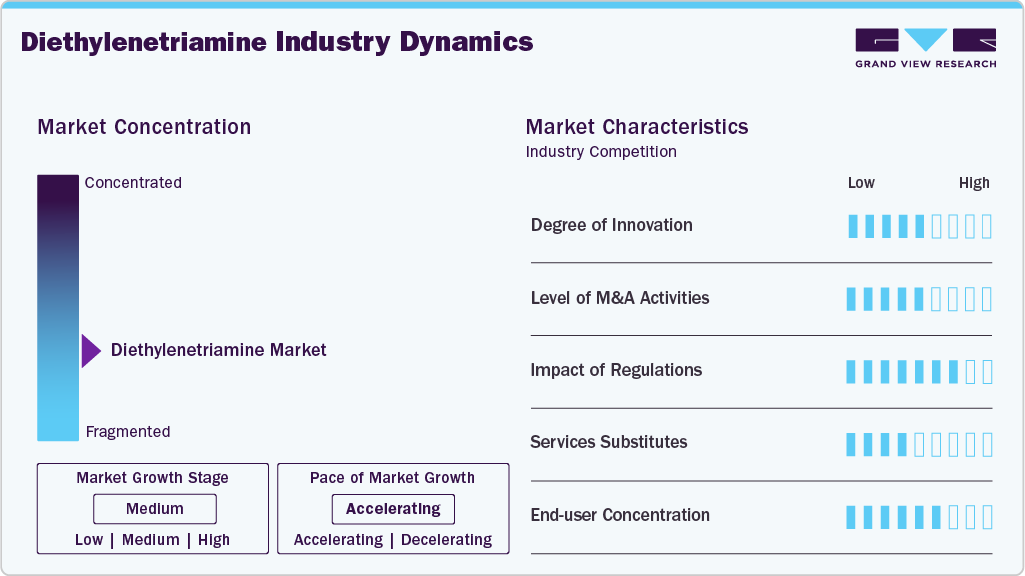
Leading companies are strengthening their diethylenetriamine offerings through capacity expansion, product development, and strategic collaborations with downstream chemical manufacturers and distributors. Increasing investments in high-purity grades, application-specific derivatives, advanced production technologies, and sustainable manufacturing processes are expected to improve product performance, broaden application opportunities, and intensify competition over the forecast period.
Analyst Perspective
The market is driven by the growing demand for versatile amine-based chemicals across agrochemicals, water treatment, lubricants, and industrial applications. Increasing requirements for agricultural productivity, rising consumption of pesticides and crop protection formulations, and the need for efficient chemical intermediates are driving demand for diethylenetriamine. Expanding industrial activities and advancements in specialty chemical formulations are further creating opportunities for diethylenetriamine, while improvements in synthesis processes, formulation technologies, and production efficiency are enhancing product performance, application versatility, and cost-effectiveness.
Application Insights
The epoxy curing agents segment dominated the market, accounting for 43.2% of total revenue in 2025. Its leading position is supported by the extensive use of DETA as an amine-based curing agent in epoxy resin systems for coatings, adhesives, composites, flooring, sealants, and protective materials. DETA promotes effective cross-linking and improves adhesion, hardness, chemical resistance, thermal stability, and mechanical strength, making it suitable for applications requiring long-lasting, high-performance materials. Growing construction activity, infrastructure development, and demand for durable industrial coatings and adhesives are supporting continued consumption of DETA in epoxy curing applications.
The paper wet-strength resins segment is expected to register the fastest growth, expanding at a CAGR of 6.7% during the forecast period. DETA is used as an intermediate in the production of resin systems that enhance the strength and durability of paper when exposed to moisture. Increasing consumption of packaging materials, tissue products, specialty papers, and other paper-based products is creating demand for wet-strength technologies that maintain product integrity during storage, transportation, and use. The shift toward lightweight yet durable paper and packaging solutions is expected to create further opportunities for DETA-based resin formulations.
End-use Insights
The construction segment dominated the market, accounting for 25.2% of total revenue in 2025. Demand is primarily associated with DETA-derived epoxy curing systems used in construction coatings, flooring, adhesives, sealants, repair materials, and protective applications. These formulations provide strong bonding, abrasion resistance, chemical resistance, and durability, making them suitable for demanding infrastructure and building environments. Expansion of residential and commercial construction, infrastructure modernization, industrial facilities, and renovation activities is supporting the consumption of epoxy-based materials and, consequently, DETA.

The agriculture segment is expected to register the fastest growth, expanding at a CAGR of 6.9% during the forecast period. DETA is increasingly used as a chemical intermediate to produce chelating agents and specialty agricultural formulations that support efficient micronutrient management. Growing pressure to improve agricultural productivity, address nutrient deficiencies, and optimize fertilizer utilization is encouraging the adoption of advanced crop-input solutions. Rising cultivation of high-value crops, expansion of precision farming and fertigation, and continued development of water-soluble and stabilized nutrient formulations are expected to strengthen demand for DETA in agricultural applications.
Region Insights
Asia Pacific dominated the market at a revenue share of 38.9% in 2025. The region benefits from a strong chemical manufacturing base, expanding construction and automotive industries, and growing demand for epoxy curing agents, polyamide resins, and specialty chemical intermediates. China, Japan, South Korea, and India remain important centers of consumption and production, supported by industrial expansion, infrastructure development, and rising investment in downstream chemical manufacturing. Growing water-treatment requirements and rising demand for advanced coatings, adhesives, and industrial additives are expected to sustain regional consumption.

China Diethylenetriamine Market Trends
The diethylenetriamine market in China is a major segment, supported by its large-scale chemical manufacturing industry and extensive downstream processing capacity. Demand is driven by epoxy resins, polyamide products, water-treatment chemicals, paper chemicals, and lubricant additives, while the country's construction, automotive, electronics, and industrial sectors provide a broad customer base. Domestic production capabilities and established chemical supply chains support product availability, while continued investments in specialty chemicals and infrastructure are expected to create further opportunities for DETA consumption.
North America Diethylenetriamine Market Trends
The diethylenetriamine market in North America is supported by established specialty chemical manufacturing, strong demand for epoxy-based products, and extensive consumption across construction, automotive, oil and gas, and water-treatment applications. The region has a mature downstream chemical industry with established demand for amine-based intermediates and performance additives. Increasing infrastructure investment, demand for protective coatings and adhesives, and the modernization of industrial and water-treatment facilities are supporting market opportunities, while manufacturers are also focusing on supply reliability and production efficiency.
The U.S. diethylenetriamine market is the leading market in North America, benefiting from a well-developed chemical manufacturing base and significant consumption of diethylenetriamine across epoxy curing agents, polyamide resins, chelating agents, lubricants, and industrial formulations. Demand is supported by construction and automotive production, oil and gas activities, and growing requirements for water and wastewater treatment chemicals. The market is also influenced by raw materials and energy costs, supply chain conditions, and investments by chemical manufacturers to maintain a reliable domestic and regional supply.
Europe Diethylenetriamine Market Trends
The diethylenetriamine market in Europe is established, with demand concentrated in specialty chemicals, coatings, adhesives, automotive materials, construction products, and industrial formulations. The region's focus on sustainability, resource efficiency, and lower-emission chemical manufacturing is encouraging producers to improve process efficiency and develop more sustainable production approaches. Strict environmental regulations are also influencing manufacturing practices and investment decisions, while demand for high-performance materials and advanced water-treatment solutions continues to support DETA consumption.
Latin America Diethylenetriamine Market Trends
The diethylenetriamine market in Latin America is supported by expanding construction, agriculture, automotive, mining, and industrial processing activities. Brazil and Mexico represent important demand centers, with consumption linked to epoxy systems, specialty chemical formulations, water treatment, lubricants, and agricultural chemicals. Infrastructure development and increasing industrialization are creating opportunities for downstream applications, while the region's growing chemical and manufacturing base is expected to support gradual expansion in DETA demand.
Middle East & Africa Diethylenetriamine Market Trends
The diethylenetriamine market in MEA is driven by the region's strong oil and gas industry, expanding petrochemical production, infrastructure development, and growing investment in water-treatment facilities. DETA is used in applications such as chemical additives, corrosion-control formulations, epoxy systems, and specialty intermediates, supporting demand across industrial sectors. Investments in downstream petrochemicals and diversification beyond crude oil production are strengthening the regional specialty chemicals industry, creating opportunities for increased consumption of ethylene amines.
Key Diethylenetriamine Company Insights
Companies operating in the market are strengthening their positions through production capacity expansion, portfolio development, process optimization, and investments in specialty amine technologies. Leading manufacturers are focusing on improving product purity, consistency, production efficiency, and application performance to meet growing demand from agrochemicals, water treatment, lubricants, epoxy curing agents, and other industrial applications.
-
Dow is a prominent market participant, supported by its broad portfolio of amine-based specialty chemicals and established manufacturing capabilities. The company leverages its expertise in chemical synthesis and formulation technologies to supply products used as intermediate and performance-enhancing components across agricultural, industrial, and specialty chemical applications. Dow’s focus on product quality, process efficiency, and application-specific solutions supports its competitive position in the global market.
-
Nouryon is a key player in the market, leveraging its expertise in specialty chemicals, amines, and performance additives. The company focuses on developing and supplying high-performance chemical solutions for applications across agriculture, coatings, adhesives, industrial formulations, and other end-use industries. Its broad technical capabilities established a global presence, and emphasis on sustainable production and application efficiency strengthen its position in the market.
Key Diethylenetriamine Companies:
The following key companies have been profiled for the study on the diethylenetriamine market.
-
Dow
-
Nouryon
-
SABIC
-
Diamines and Chemicals Ltd.
-
DELAMINE
-
Huntsman
-
BASF SE
-
Aminat
-
MUBY CHEMICALS
-
Achilles Chemical Co., Ltd.
Competitive Benchmarking
Operating Strategies
Competitive Edge
Weaknesses
Mature Players: Dow, Nouryon, SABIC, Huntsman, BASF SE
- Invest in production capacity, process optimization, and advanced amine manufacturing technologies.
- Expand specialty amine portfolios for agrochemicals, water treatment, lubricants, epoxy curing agents, and industrial applications.
- Strengthening global manufacturing and distribution networks.
- Improve product purity, consistency, production efficiency, and formulation compatibility.
- Pursue strategic partnerships, customer-specific development programs, and long-term supply agreements.
- Strong expertise in amine chemistry and specialty chemical manufacturing.
- Established production infrastructure and global distribution networks.
- Diversified product portfolios serving multiple downstream industries.
- Strong relationships with chemical manufacturers, formulators, distributors, and industrial customers.
- Greater financial and R&D resources for capacity expansion and product development.
- Strong brand recognition and regulatory capabilities.
- Large-scale manufacturing can involve high capital and operating costs.
- Exposure to fluctuations in raw material, energy, and transportation costs.
- Large organizational structures may limit rapid customization.
- Pricing pressure from regional and lower-cost producers.
- Stringent environmental and safety requirements can increase compliance costs.
Emerging Players: Diamines and Chemicals Ltd., DELAMINE, Aminat, MUBY CHEMICALS, Achilles Chemical Co., Ltd.
- Expand production and distribution capabilities for diethylenetriamine and related amine products.
- Focus on product quality, purity, consistency, and reliable supply.
- Develop regional distribution networks and strategic partnerships.
- Target application-specific requirements through customized grades and technical support.
- Improve manufacturing efficiency and optimize production processes to remain cost-competitive.
- Greater flexibility in addressing customer-specific and regional requirements.
- Competitive pricing and shorter regional supply chains.
- Specialized focus on amines and related chemical products.
- Faster commercial decision-making and product customization.
- Strong regional customer and distributor relationships.
- Smaller production capacities and geographic presence than multinational manufacturers.
- Limited financial and R&D resources for large-scale expansion.
- Lower global brand recognition.
- Greater dependence on distributors and regional customers.
- Higher exposure to fluctuations in demand, raw material availability, and pricing.
Recent Developments
-
In August 2025, BASF strengthened its DETA business through a supply agreement with Chongqing Hehui Pharmaceutical, which sources diethylenetriamine (DETA) from BASF to manufacture pentamethyl diethylenetriamine (PMDETA), a polyurethane catalyst. The collaboration highlights growing downstream demand for DETA in polyurethane applications and reinforces BASF’s position as a leading DETA manufacturer, with production facilities in Nanjing, China, and Antwerp, Belgium.
Diethylenetriamine Market Report Scope
Report Attribute
Details
Market size in 2025
USD 423.7 million
Estimated market size in 2026
USD 443.3 million
Projected market size by 2033
USD 639.0 million
Growth rate
CAGR of 5.4% from 2026 to 2033
Historical data
2021 - 2025
Forecast period
2026 - 2033
Quantitative units
Volume in kilotons, revenue in USD million, and CAGR from 2026 to 2033
Report coverage
Revenue forecast, company ranking, competitive landscape, growth factors, and trends
Segments covered
Application, end-use, region
Regional scope
North America; Europe; Asia Pacific; Latin America; MEA
Country scope
U.S.; Canada; Mexico; Germany; UK; France; Italy; Spain; China; India; Japan; South Korea; Brazil; Argentina; Saudi Arabia; South Africa
Key companies profiled
Dow; Nouryon; SABIC; Diamines and Chemicals Ltd.; DELAMINE; Huntsman; BASF SE; Aminat; MUBY CHEMICALS; Achilles Chemical Co., Ltd.
Customization scope
Free report customization (equivalent up to 8 analysts’ working days) with purchase. Addition or alteration to country, regional & segment scope.
Pricing and purchase options
Avail customized purchase options to meet your exact research needs. Explore purchase options
Global Diethylenetriamine Market Report Segmentation
This report forecasts revenue growth at regional levels and provides an analysis of the latest industry trends in each of the sub-segments from 2021 to 2033. For this study, Grand View Research has segmented the global diethylenetriamine market report based on application, end-use, and region:

-
Application Outlook (Volume, Kilotons; Revenue, USD Million, 2021 - 2033)
-
Epoxy Curing Agents
-
Polyamide Resins
-
Chelating Agents
-
Paper Wet-Strength Resins
-
Lubricant & Fuel Additives
-
Surfactants
-
Other Applications
-
-
End-use Outlook (Volume, Kilotons; Revenue, USD Million, 2021 - 2033)
-
Construction
-
Automotive
-
Pulp & Paper
-
Oil & Gas
-
Mining & Metals
-
Water & Wastewater Treatment
-
Textiles & Leather
-
Agriculture
-
Other End-use
-
-
Region Outlook (Volume, Kilotons; Revenue, USD Million, 2021 - 2033)
-
North America
-
U.S.
-
Canada
-
Mexico
-
-
Europe
-
Germany
-
UK
-
France
-
Italy
-
Spain
-
-
Asia Pacific
-
China
-
India
-
Japan
-
South Korea
-
-
Latin America
-
Brazil
-
Argentina
-
-
Middle East & Africa
-
Saudi Arabia
-
South Africa
-
-
Research Methodology
The diethylenetriamine market figures in this report are based on a proven research process that combines executive interviews with secondary research from proprietary databases, company filings, and recognized regulatory and institutional sources. Market size is built through value-chain sizing-reconciling supply-side and demand-side estimates-and triangulated with bottom-up and top-down approaches. Every estimate passes multiple levels of expert validation before publication, with each diethylenetriamine segment quantified using the revenue-capture definitions in the table below.
Segment Definition
Segment - Application
Revenue capture definition
Epoxy Curing Agents
Revenue generated from diethylenetriamine used as a curing agent or curing component in epoxy resin systems, supporting cross-linking and enhancing hardness, chemical resistance, and mechanical performance.
Polyamide Resins
Includes revenue from diethylenetriamine consumed as a raw material or intermediate in the manufacture of polyamide resins used in coatings, adhesives, inks, and other industrial formulations.
Chelating Agents
Covers sales of diethylenetriamine utilized as an intermediate in the production of chelating agents that bind metal ions for applications such as water treatment, detergents, agriculture, and industrial processing.
Paper Wet-Strength Resins
Revenue attributable to diethylenetriamine incorporated into resin systems that improve the wet strength, durability, and resistance properties of paper and paperboard products.
Lubricant & Fuel Additives
Represents diethylenetriamine used in additive formulations for lubricants and fuels to support functions such as deposit control, corrosion protection, detergency, and performance enhancement.
Surfactants
Encompasses demand for diethylenetriamine as a chemical intermediate in surfactant production, particularly for formulations requiring emulsification, wetting, dispersing, or surface-modification properties.
Other Applications
Includes diethylenetriamine consumption across miscellaneous applications not classified above, including specialty chemical intermediates, industrial formulations, and other niche uses.
Segment - End Use
Revenue capture definition
Construction
Revenue associated with diethylenetriamine used in construction-related products, particularly epoxy systems, coatings, adhesives, sealants, and concrete or surface treatment formulations.
Automotive
Captures consumption in automotive manufacturing and maintenance applications where diethylenetriamine-derived products are used in coatings, adhesives, lubricants, resins, and performance additives.
Pulp & Paper
Covers demand from paper and pulp manufacturers using diethylenetriamine-based intermediates in wet-strength resins and other paper-treatment chemicals.
Oil & Gas
Includes sales linked to oil and gas operations, where diethylenetriamine is utilized in chemical additives, corrosion-control formulations, gas-treatment chemicals, and other production and processing applications.
Mining & Metals
Represents usage across mining and metal-processing activities, including chemical formulations for mineral processing, metal treatment, and related industrial operations.
Water & Wastewater Treatment
Encompasses diethylenetriamine demand for water-treatment chemicals, chelating agents, corrosion-control products, and formulations used to manage metal ions and contaminants.
Textiles & Leather
Revenue generated from applications in textile and leather processing, including specialty chemicals, auxiliaries, coatings, and treatment formulations requiring amine-based intermediates.
Agriculture
Covers diethylenetriamine consumption in agricultural chemical formulations, particularly as an intermediate for chelating agents, crop-protection products, and specialty nutrient solutions.
Other End Use
Includes demand from sectors outside the principal end use industries, such as general manufacturing, specialty chemicals, industrial cleaning, and other niche applications.
Estimation Model
Layer Name
Key Question
Description
Raw Material & Production Layer
What forms is the supply base?
Examines the production of diethylenetriamine from key chemical feedstocks and reaction intermediates, including ethylene-based raw materials, ammonia, and other process inputs. The assessment covers synthesis routes, reaction technologies, purification, distillation, quality control, production capacities, energy requirements, and raw-material availability. It also evaluates process optimization, plant efficiency, technology upgrades, and manufacturing developments influencing product purity, consistency, cost, and scalability.
Form Adoption Layer
Where is diethylenetriamine utilized?
Evaluates the use of diethylenetriamine as a chemical intermediate across epoxy curing agents, polyamide resins, chelating agents, paper wet-strength resins, lubricant and fuel additives, surfactants, and other specialty chemical applications. Adoption is influenced by the need for high-performance intermediates, improved chemical resistance, formulation efficiency, corrosion protection, metal-ion control, and enhanced performance of downstream products.
Consumption Intensity Layer
How much diethylenetriamine is consumed?
Assesses diethylenetriamine consumption according to demand from major downstream industries, including construction, automotive, pulp and paper, oil and gas, mining and metals, water and wastewater treatment, textiles and leather, and agriculture. The analysis considers production volumes of downstream products, formulation requirements, diethylenetriamine loading levels, application frequency, manufacturing intensity, and regional industrial activity to estimate consumption across key markets.
Revenue Layer
How is market revenue generated?
Market revenue is generated through the production and sale of diethylenetriamine to manufacturers of epoxy curing agents, polyamide resins, chelating agents, paper chemicals, lubricant additives, surfactants, and other specialty chemical products. Revenue growth is supported by expanding industrial production, increasing demand for high-performance chemical intermediates, growth in epoxy and adhesive applications, rising water-treatment requirements, development of specialty formulations, and increasing consumption across emerging manufacturing markets.
Delivered Customizations
This report has been delivered with the following In-depth customizations
Client Request
Customization Delivered
Value Adds
Cross-segmentation
The assessment provides detailed cross-segmentation of the diethylenetriamine industry across application, end use, and regional markets. The analysis evaluates demand across epoxy curing agents, polyamide resins, chelating agents, paper wet-strength resins, lubricant and fuel additives, surfactants, and other applications, with end use assessment covering construction, automotive, pulp and paper, oil and gas, mining and metals, water and wastewater treatment, textiles and leather, agriculture, and other industries.
Enables identification of high-growth opportunities across specific application-end use combinations. Supports targeted product development, production planning, capacity expansion, distribution strategies, and market-entry decisions by highlighting applications with strong demand, specialized performance requirements, and expanding industrial consumption.
Opportunity Assessment
Detailed evaluation of growth opportunities arising from expanding industrial production, rising demand for high-performance chemical intermediates, growth in epoxy and adhesive applications, increasing water-treatment requirements, and broader adoption of specialty chemical formulations. The assessment also examines process advancements, product purity improvements, manufacturing efficiency, and emerging applications for diethylenetriamine.
Enables identification of attractive opportunities across the diethylenetriamine value chain. Supports decisions related to product development, manufacturing expansion, technology adoption, regional market entry, and strategic partnerships by highlighting high-potential applications, evolving customer requirements, and long-term demand drivers.
Competitive Benchmarking
Comparative assessment of key diethylenetriamine manufacturers based on product portfolios, production capabilities, manufacturing footprint, technological expertise, product quality, application coverage, geographic presence, distribution networks, R&D activities, strategic partnerships, and customer reach. The benchmarking evaluates manufacturers' ability to provide consistent product quality, reliable supply, competitive pricing, and application-specific solutions across major downstream industries.
Supports benchmarking against key competitors while identifying opportunities to strengthen product differentiation, manufacturing efficiency, supply reliability, geographic coverage, and customer engagement. The analysis assists strategic decisions concerning capacity expansion, process optimization, portfolio development, technology investments, and long-term competitive positioning.
Frequently Asked Questions About This Report
The diethylenetriamine market is expected to grow at a CAGR of 5.4% from 2026 to 2033 to reach USD 639.0 million by 2033.
The epoxy curing agents segment dominated the market, accounting for 43.2% of total revenue in 2025, while paper wet-strength resins segment is fastest growing application.
Asia Pacific dominated the market, accounting for a revenue share of 38.9% in 2025.
The construction segment dominated the market, accounting for 25.2% of total revenue in 2025, while agriculture segment is the fastest growing end-use.
The diethylenetriamine market size was valued at USD 423.7 million in 2025 and is projected to reach USD 443.3 million in 2026.
Key players include Dow, Nouryon, SABIC, Diamines and Chemicals Ltd., DELAMINE, Huntsman, BASF SE, Aminat, MUBY CHEMICALS, Achilles Chemical Co., Ltd.
Market growth is driven by increasing demand for epoxy curing agents, polyamide resins, chelating agents, lubricant and fuel additives, and specialty chemical intermediates. Expanding construction and automotive activities, rising water-treatment requirements, growth in oil and gas operations, increasing demand for high-performance coatings and adhesives, and advancements in amine synthesis and sustainable production technologies are supporting DETA consumption.
About the Author(s)
Organic Chemicals Research Team
Bulk Chemicals · Organic ChemicalsThis report was authored by the organic chemicals research team at Grand View Research - comprising two research analysts, one senior research analyst, and one industry expert - with specialized expertise in the organic chemicals segment of the bulk chemicals industry. All findings are based on proprietary bulk chemicals databases, executive interviews, and regulatory analysis, subject to internal peer review prior to publication.
Last Updated:
Speak to Analyst


Customize this report to your needs — add regions, segments, or data points, with 20% free customization.
Or view our licence options:


ISO 9001:2015 & 27001:2022 Certified
We are GDPR and CCPA compliant! Your transaction & personal information is safe and secure. For more details, please read our privacy policy.


