
- Home
- »
- Next Generation Technologies
- »
-
Electrostatic Discharge Protection Devices Market, 2033GVR Report cover
![Electrostatic Discharge Protection Devices Market Size, Share & Trends Report]()
Electrostatic Discharge Protection Devices Market (2026 - 2033) Size, Share & Trends Analysis Report By Device Type, By Material Type (Silicon, Ceramic), By Directionality (Uni-directional, Bi-directional), By Application, By Region, And Segment Forecasts
- Report ID: GVR-4-68040-892-3
- Number of Report Pages: 117
- Format: PDF
- Historical Range: 2021 - 2025
- Forecast Period: 2026 - 2033
- Industry: Technology
- Report Summary
- Table of Contents
- Segmentation
- Methodology
- Download FREE Sample
-
 Download Sample Report
Market Size, 2025 (US$B)$2.7BForecast, 2033 (US$B)$4.1BCAGR, 2026 - 20335.9%Electrostatic Discharge Protection Devices Market Summary
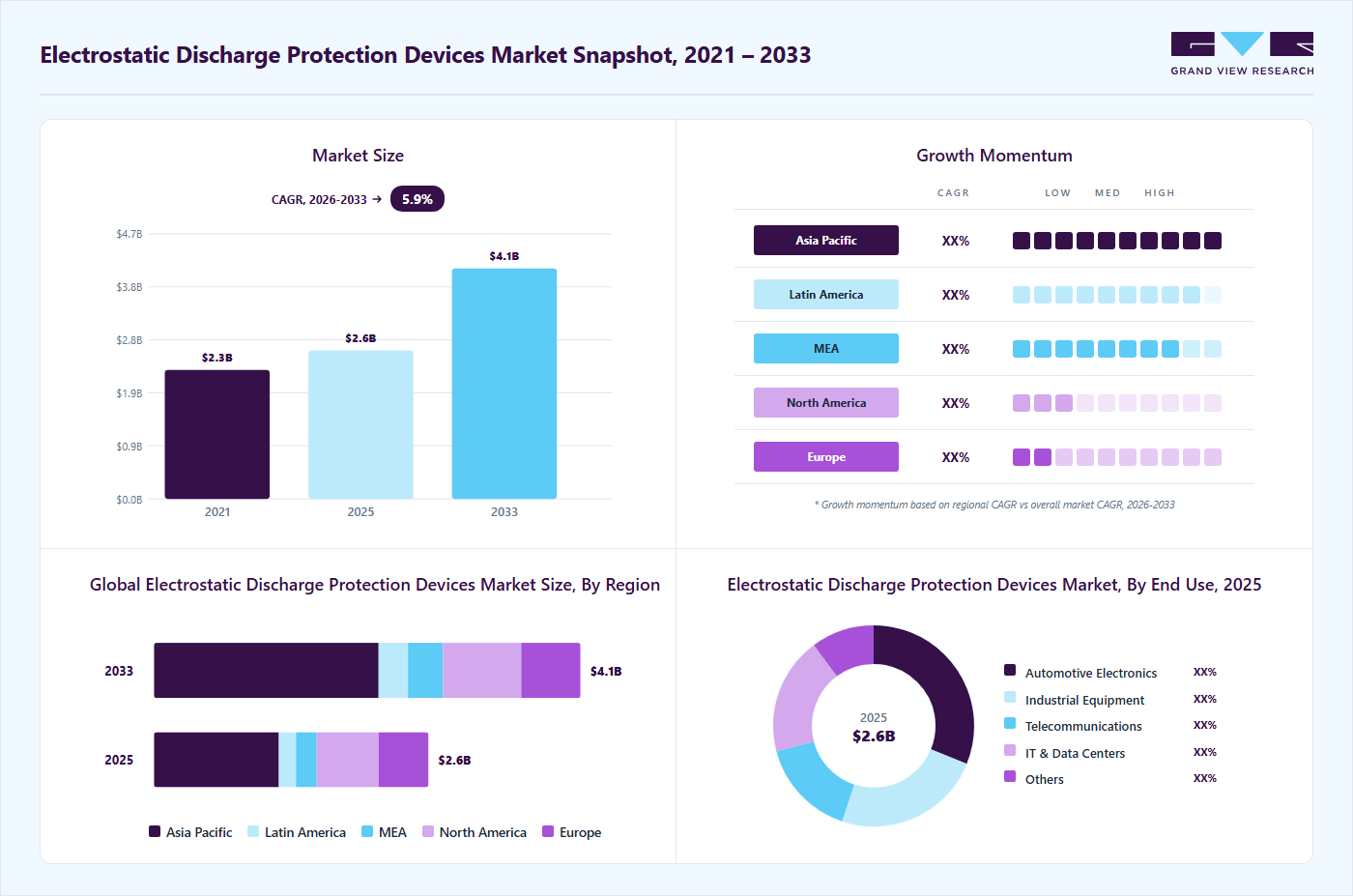
The global electrostatic discharge protection devices market size was estimated at USD 2.65 billion in 2025 and is projected to reach USD 4.11 billion by 2033, growing at a CAGR of 5.9% from 2026 to 2033. The increasing adoption of consumer electronics and high-speed communication devices is a key factor supporting the growth of the ESD protection devices market, as modern electronic components are highly sensitive to electrostatic discharge.
Key Market Trends & Insights
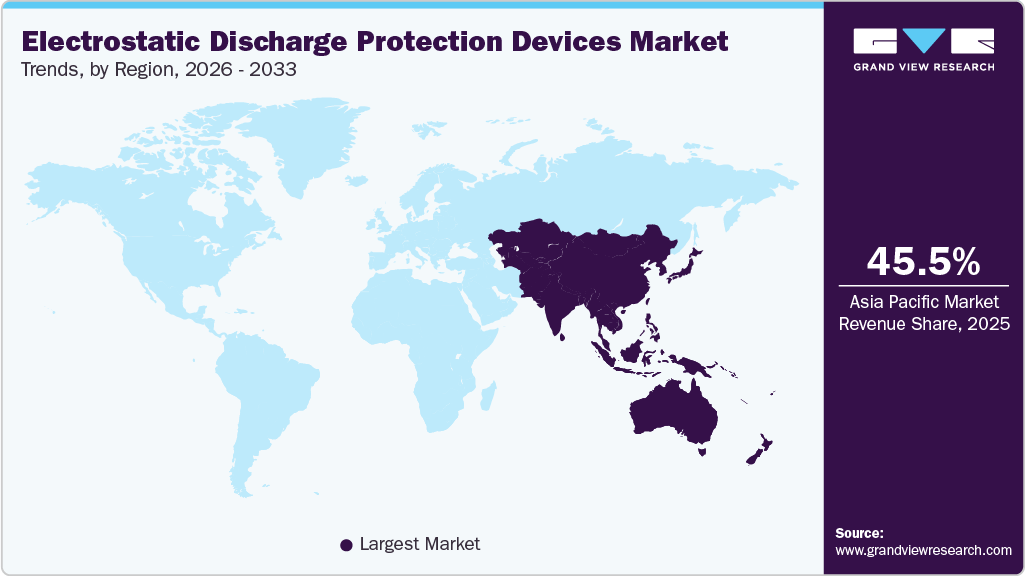
- Asia Pacific ESD protection devices market accounted for a 45.48% share of the overall market in 2025.
- The China ESD protection devices market is expected to grow rapidly over the forecast period.
- By device type, the Transient Voltage Suppression (TVS) Diodes segment accounted for the largest share of 71.95% in 2025.
- By directionality, the uni-directional segment dominated the market in 2025.
- By material type, the silicon segment held the largest market share in 2025.
Market Size & Forecast
- 2025 Market Size: USD 2.65 Billion
- 2033 Projected Market Size: USD 4.11 Billion
- CAGR (2026-2033): 5.9%
- Asia Pacific: Largest market in 2025
With the rapid miniaturization and rising complexity of devices such as smartphones, tablets, and IoT modules, integrated circuits have become more vulnerable due to lower operating voltages and higher circuit density, making ESD protection essential for ensuring device reliability and longevity. In addition, the increased demand for automotive and industrial electronics, including Advanced Driver Assistance Systems (ADAS), electric vehicles, and automation systems, has further driven the need for robust ESD solutions to maintain performance and safety in challenging environments.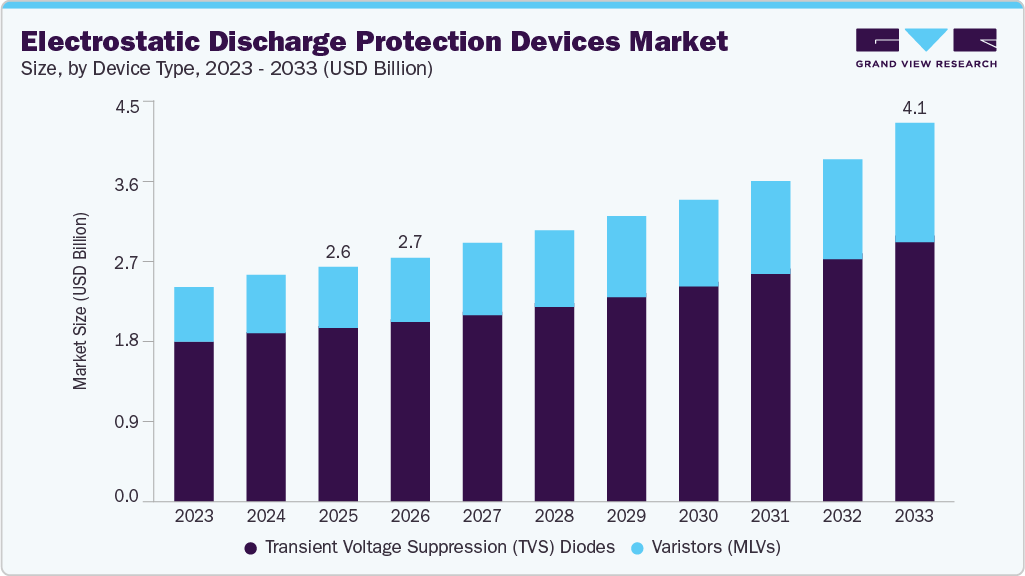
The market growth is further driven by the widespread use of wearable electronics, medical devices, and smart home systems, which require reliable, sensitive components that are vulnerable to electrostatic discharge. Thus, the manufacturers are ensuring device reliability in environments prone to ESD events, including hospitals, homes, and industrial settings. Additionally, the expansion of high-speed data networks and 5G infrastructure has increased demand for robust ESD protection to prevent signal interference and equipment failure. Collectively, these trends are driving significant growth in the ESD protection devices market across various sectors such as consumer electronics, automotive, industrial automation, healthcare, telecommunications, and IoT applications, where reliable protection against electrostatic discharge is critical for maintaining performance and device longevity.
Technological advancements in ESD protection devices emphasize ultra-low-capacitance devices for high-speed data interfaces, especially in the automotive and communication sectors, where signal integrity is essential. These solutions ensure reliable performance in high-bandwidth environments, such as automotive Ethernet networks for connected and autonomous vehicles. Automotive-grade ESD components are also being developed for durability under extreme temperature and voltage, supporting next-generation vehicle architectures. For instance, in February 2025, Semtech Corporation, a high-performance semiconductor, IoT systems, and Cloud connectivity service provider, introduced the RClamp10022PWQ, a two-line transient voltage suppressor for automotive Ethernet applications. This device supports high-speed interfaces, including 10BASE-T1S, 100BASE-T1, and 1000BASE-T1, and offers ultra-low capacitance of 0.6 pF to maintain signal integrity at data rates up to 10 Gbps. It delivers ±15 kV contact and ±25 kV air discharge protection in line with IEC 61000-4-2 standards and meets AEC-Q101 qualification for harsh automotive conditions. This development emphasizes the industry's focus on high-performance ESD protection for evolving automotive networks, including ADAS, infotainment, and autonomous driving systems.
Furthermore, technological advancements in packaging and materials are reshaping the ESD protection devices market by enabling higher performance, improved signal integrity, and greater reliability in modern electronic systems. Companies are developing advanced solutions such as flip-chip and land-grid-array (LGA) packaging to reduce parasitic elements that can degrade high-speed signals. For instance, in April 2025, Nexperia, a semiconductor company, introduced high-signal-integrity bidirectional ESD protection diodes in flip-chip land-grid-array (FC-LGA) packaging. These 2-pin and 3-pin diodes offer ultra-low capacitance (<0.25 pF), minimal insertion loss (-3 dB at 14.6 GHz), and up to 6 GHz of additional bandwidth compared to conventional DFN packages. The 3-pin devices also protect two channels simultaneously, save board space, and provide capacitance matching for improved circuit stability. This launch highlights the trend toward advanced packaging and materials, providing engineers with high-performance and reliable ESD protection for next-generation automotive, industrial, and consumer electronics.
Regulatory standards play a critical role in the ESD protection devices market by defining testing methodologies and control measures to mitigate electrostatic discharge risks across industries such as automotive, consumer electronics, industrial equipment, and telecommunications. These standards protect products from electrostatic discharge, improve durability, and support environmental and health safety. For instance, in March 2025, the International Electrotechnical Commission (IEC) released IEC 61000-4-2:2025 (Edition 3.0), the updated standard for Electrostatic Discharge (ESD) immunity testing. This revision improves test repeatability by refining calibration requirements for ESD, including air discharge tips, and introduces guidelines for specific test setups, such as wearable and compact devices. These changes help manufacturers ensure consistent and reliable immunity performance across a wide range of applications. Similarly, key standards such as ANSI/ESD S20.20 and IEC 61340-5-1 mandate the establishment of Electrostatic Protected Areas (EPAs), proper grounding of work surfaces, the use of suitable packaging materials, and personnel training to maintain low-voltage environments.
The ESD protection devices market faces several challenges that may limit adoption and profitability. High costs for advanced ESD solutions, such as ultra-low-capacitance diodes and automotive-grade components, result from significant R&D and manufacturing expenses. This creates cost pressure, particularly in high-volume and price-sensitive segments such as entry-level consumer electronics and low-margin industrial applications. Furthermore, integration complexity and rapid technological change also challenge the market. Modern systems require compact, high-speed, and multi-channel ESD solutions, which are difficult to incorporate into legacy designs without substantial planning or redesign. Ongoing advancements in packaging and embedded solutions require frequent upgrades, while the presence of low-quality or counterfeit devices in some regions undermines reliability and restricts market growth.
Device Type Insights
The Transient Voltage Suppression (TVS) diodes segment accounted for the largest share of 71.95% in 2025. The segment's growth is driven by its widespread use in protecting sensitive electronics from voltage transients and electrostatic discharge in automotive, telecom, and industrial sectors. Their fast response, low clamping voltage, and high surge current capability are critical for safeguarding high-speed data lines and power circuits. Companies across the globe are launching various ESD devices that offer reliable performance across multiple applications. For instance, in August 2025, Vishay Intertechnology, Inc. introduced new automotive-grade VGSOTxx and VGSOTxxC TVS protection diodes with peak pulse power up to 540 W and current ratings up to 44 A, designed for high-reliability. These devices were designed for a wide range of applications, including automotive electronics and controls, fuel cells, energy monitoring systems, industrial automation, telecom infrastructure, consumer electronics, medical instrumentation, and defense systems.
The Varistors (MLVs) segment is expected to grow at the fastest CAGR during the forecast period. The segment’s growth is driven by the rising demand for compact, cost-effective, multi-layer protection solutions in miniaturized electronic devices. MLVs offer bidirectional protection, require minimal PCB space, and are well-suited to high-density designs, thus making them ideal for applications such as smartphones, wearables, IoT devices, and other portable electronics. Growth is further supported by the rapid expansion of consumer electronics and the need for reliable surge and transient-voltage protection in small and densely packed circuits, both of which improve device performance and lifespan.
Material Type Insights
The silicon segment dominated the market in 2025, driven by the strong electrical performance, rapid response, and adaptability of silicon materials in automotive, industrial as well as consumer electronics. Silicon-based ESD protection devices provide high surge-handling capability, reliable operation in demanding conditions and effective protection for sensitive circuits. Their versatility enables integration into diverse electronic systems, making them the preferred choice for applications that require durability and consistent performance. These features continue to support the widespread adoption of silicon-based ESD solutions.
The ceramic segment is projected to grow at the fastest CAGR over the forecast period. Ceramic materials are widely used in multilayer varistors (MLVs), which provide bidirectional protection and effective surge and transient voltage suppression in a compact design. These features make ceramic ESD components well-suited for space-constrained applications such as smartphones, wearables, IoT devices, and portable electronics, where board space and efficiency are essential. Ceramic MLVs are also increasingly used in industrial and automotive subsystems that require reliable overvoltage protection in harsh environments. With advances in miniaturization and integration across the consumer and industrial sectors, demand for ceramic ESD protection solutions continues to grow in the forecast year.
Directionality Insights
The uni-directional segment dominated the market in 2025. The segment’s growth is attributed to its widespread use in applications where current flow occurs in a single direction. These devices are commonly used in power supply circuits, automotive electronics, and consumer devices to provide reliable protection against transient voltage events while minimizing impact on circuit performance. Therefore, companies are manufacturing ESD devices well suited for these applications. For instance, in August 2025, Vishay Intertechnology, Inc. launched the VGSOTxx series of uni-directional EDS diodes, offering peak pulse power up to 540 W and current handling up to 44 A. These diodes were specifically designed for automotive controls, industrial automation as well as high-speed telecom systems, thus reflecting the segment’s focus on robust, high-performance ESD protection.
The bi-directional segment is expected to grow at the fastest CAGR over the forecast period. The segment’s growth is attributed to the rising demand for protection across symmetric signal lines and communication interfaces that face transient events in both directions. Bi-directional devices are commonly used in USB, HDMI, PCIe, Ethernet, and other high-speed data applications to maintain signal integrity and protect sensitive components from electrostatic discharge. Various companies are actively developing products that offer ultra-low capacitance, high-speed response, and robust transient suppression to meet the growing performance requirements of these applications. For instance, in April 2025, Taiwan Semiconductor launched the TESDA24VB28P2CX, a high-performance bidirectional clamping diode tailored for modern automotive electronic systems. This bidirectional ESD-rated clamping device was designed to protect electronic system power interfaces, control lines, and low-speed data lines. The device was specifically engineered to safeguard sensitive electronic components from over-voltage damage caused by electrostatic discharge (ESD) and lightning events.This development emphasize the increasing industry focus on advanced bidirectional ESD protection solutions to support the growing complexity and performance demands of modern electronic and automotive systems.
Application Insights
The consumer electronics segment held the largest market share in 2025, driven by the adoption of high-speed, miniaturized, and portable devices. As consumer electronics become more complex and require higher data transfer rates, the demand for high-performance ESD protection devices has risen. Therefore, companies are expanding their product portfolios with advanced solutions that offer low leakage currents and high ESD robustness. For instance, in August 2025, TDK Corporation introduced three ultra-low clamping-voltage TVS diodes in the SD0201 series, designed for high-speed consumer electronics interfaces. These devices offer bidirectional protection, extremely low leakage currents, and dynamic resistance as low as 0.16 Ω, supporting robust performance in compact designs. They comply with IEC 61000-4-2 standards and provide ESD discharge robustness up to ±15 kV and surge current handling up to 7 A, depending on the variant. Thus, these innovations emphasize how manufacturers are addressing the challenges of miniaturization and high-speed data transmission in the evolving consumer electronics market.
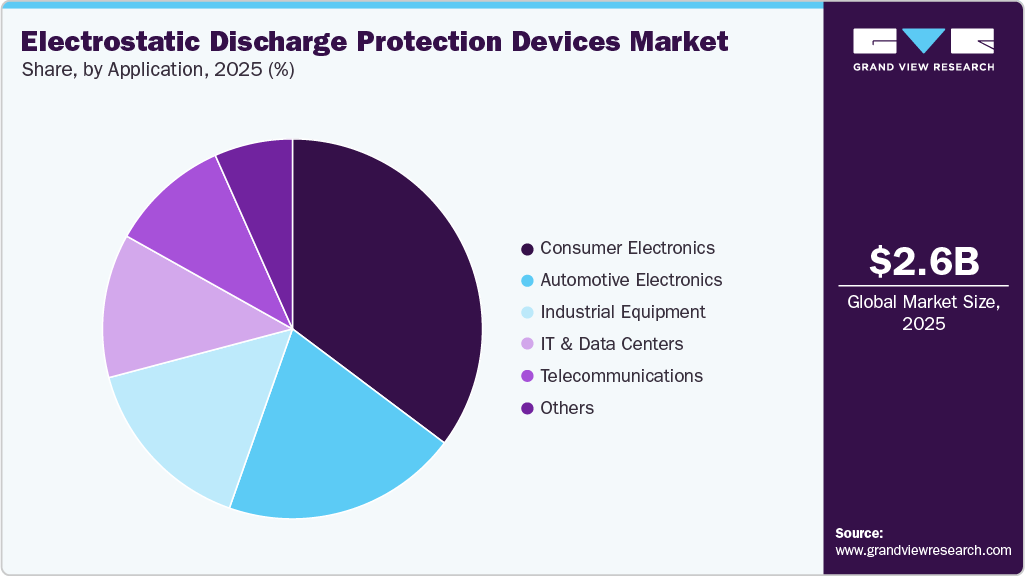
The automotive electronics segment is expected to grow at the fastest CAGR over the forecast period, driven by the rising adoption of electric and hybrid vehicles, as well as advanced driver-assistance systems (ADAS). The increasing use of electronic components, such as infotainment systems, engine control units (ECUs), battery management systems, and in-vehicle communication networks, has further increased the need for reliable ESD protection. In addition, stricter safety and reliability standards, along with the shift toward connected and autonomous vehicles, are increasing demand for high-performance and robust ESD devices. This trend reflects the growing electronic content and complexity of modern vehicles.
Regional Insights
The Asia Pacific electrostatic discharge protection devices market held the largest market share of 45.48% in 2025. This growth is supported by a robust semiconductor manufacturing sector, expanding consumer electronics production, and rapid expansion of high-speed communication infrastructure, such as 5G networks and data centers. Rising demand for advanced integrated circuits in automotive electronics, industrial automation, and IoT applications is driving the need for reliable, compact ESD protection solutions. The adoption of electric and hybrid vehicles further increases demand for high-performance ESD devices that protect sensitive electronics under high-voltage and high-frequency conditions. Manufacturers in the region are developing low-capacitance and high-speed ESD components to support dense PCB designs and emerging technologies.
China Electrostatic Discharge Protection Devices Market Trends
The China electrostatic discharge protection devicesmarket is expected to grow rapidly over the forecast period. The country's growth is attributed to the expansion in semiconductor manufacturing, consumer electronics, and high-speed communication infrastructure. Demand for advanced ICs in 5G networks, data centers, and automotive electronics is driving the need for reliable, compact ESD solutions. Chinese OEMs are prioritizing ultra-miniaturized, low-capacitance, and high-speed ESD devices to support high-frequency interfaces and dense PCB layouts. For instance, in July 2025, Shenzhen Slkor Micro Semicon Co., Ltd. introduced the SLESD12.0C bidirectional electrostatic discharge (ESD) protection diode in a compact DFN1006 package. The device offered robust ±30 kV ESD protection along with a low capacitance of 8 pF, enabling effective protection of sensitive electronic components while maintaining signal integrity. It was designed for space-constrained consumer electronic applications such as smartphones, tablets, and wearable devices, and featured an ultra-compact form factor (1.00 × 0.60 × 0.37 mm), making it suitable for modern miniaturized designs. This development highlighted China’s growing capability in developing compact, high-performance bidirectional ESD protection solutions for next-generation consumer electronics.
The electrostatic discharge protection devices market in Japan is being supported by the country’s focus on miniaturized electronics and IoT devices. Manufacturers in Japan are emphasizing the integration of multifunctional ESD protection components that combine transient voltage suppression with surge and overcurrent protection in a single package. Furthermore, the growth of robotics and smart factories, including next-generation EVs and hybrid vehicles, is driving demand for compact and high-reliability ESD solutions. Moreover, compliance with international standards such as IEC 61000-4-2 and JEITA ESD guidelines continues to influence product design and adoption of devices in both domestic and export markets.
North America Electrostatic Discharge Protection Devices Market Trends
The North America electrostatic dischargeprotection devices market is expected to grow at a significant CAGR over the forecast period. The rapid growth of automotive electronics and the increasing adoption of electric vehicles (EVs) across North America are significantly driving the demand for automotive-grade electrostatic discharge (ESD) protection solutions. These advanced devices are essential for highly sensitive electronic systems, including advanced driver-assistance systems (ADAS), infotainment units, and vehicle-to-everything (V2X) communication modules, which are critical for both safety and connected vehicle functionality. Additionally, the ongoing expansion of high-speed communication networks and nationwide 5G infrastructure is further driving the need for ultra-low-capacitance diodes and integrated circuits (ICs) that can maintain signal integrity and reliability in high-frequency telecom applications, protecting equipment from damage caused by transient electrostatic events. Moreover, the region’s well-established semiconductor and electronics manufacturing ecosystem facilitates the widespread integration of ESD devices early in product design.
The U.S. electrostatic discharge protection devices market held a dominant position in 2025, due to the increasing complexity of electronics in automotive, industrial, telecom, and consumer applications, as well as the rising demand for high-reliability protection solutions. Companies in the region are actively developing advanced ESD components to meet growing performance and reliability requirements, delivering high-current and standards-compliant solutions. For instance, in August 2025, Vishay Intertechnology introduced new Automotive Grade 3.3 V to 36 V ESD protection diodes in the SOT-23 package, featuring high current ratings up to 44 A at 8/20 µs pulses and peak power ratings up to 540 W. Moreover, in compliance with IEC 61000-4-2, ISO 10605, and AEC-Q101 standards, these diodes reflect the U.S. market’s focus on high-performance, reliable, and standards-compliant ESD protection, thus supporting system durability and signal integrity in critical electronic systems.
Europe Electrostatic Discharge Protection Devices Market Trends
The Europe electrostatic discharge protection devices market was identified as a lucrative region in 2025. The region's growth is driven by steady demand for high-performance solutions across automotive, industrial, and consumer electronics. Vehicle electrification and increasingly complex automotive data networks require robust ESD protection to ensure signal integrity and safeguard sensitive electronics. Therefore, manufacturers are developing ultra-low capacitance, high-speed components for advanced communication protocols and high-frequency interfaces. For instance, in August 2025, Nexperia launched a new series of ESD protection diodes for USB4 and Thunderbolt interfaces, featuring 0.1 pF capacitance, surge robustness up to 9.6 A, and ESD protection of ±18 kV. These diodes, housed in the DSN0603-2 package, are designed to protect high-speed AC-coupled RF transmission lines in portable electronics, computing peripherals, and communication systems. These advancements emphasize Europe’s commitment to improving the reliability and performance of electronic systems through advanced ESD protection solutions for next-generation high-speed applications.
The UK electrostatic discharge protection devices market is expected to grow rapidly in the coming years. This growth is attributed to rising demand in consumer electronics and industrial sectors. Growth is also being driven by increasing complexity in electronic system designs, where maintaining device reliability and preventing electrostatic damage is critical. Additionally, compliance with international standards such as IEC 61000-4-2 and RoHS is driving the adoption of high-quality, regulation-compliant protection solutions, thereby supporting both domestic and export-oriented manufacturing.
Electrostatic discharge protection devices market in Germany is expanding, supported by the shift towards electric mobility and the increasing complexity of advanced vehicle electronics. This trend is increasing demand for robust protection solutions that ensure reliable performance in advanced data environments. Moreover, manufacturers are also integrating ESD protection earlier in the design process to improve system reliability and reduce long-term failure risks, emphasizing the industry's focus on engineering efficiency, product durability, and lifecycle performance.
Key Electrostatic Discharge Protection Devices Company Insights
Some of the key companies in the ESD protection devices market include STMicroelectronics, Littelfuse Inc., Semtech Corporation, and others. Organizations are focusing on increasing their customer base to gain a competitive edge in the industry. Therefore, key players are taking several strategic initiatives, such as mergers and acquisitions, and partnerships with other major companies.
-
STMicroelectronics is a global semiconductor provider, serving automotive, industrial, and consumer electronics markets. The company offers a wide range of ESD protection devices, including transient voltage suppressors (TVS) and integrated protection solutions designed to safeguard sensitive electronics from electrostatic discharge. The company is known for innovation and reliability, and focuses on advanced packaging and miniaturization, making its ESD solutions ideal for compact devices such as smartphones, IoT modules, and automotive electronics systems.
-
Littelfuse Inc. is a U.S. based company specializing in circuit protection, power control, and sensing technologies. It is a provider of ESD protection devices, including TVS diodes and polymer ESD suppressors used in consumer electronics, automotive systems, and industrial applications. Littelfuse emphasizes safety, reliability, and compliance with global standards. Its products are designed to prevent damage from voltage spikes and electrostatic discharge, ensuring system longevity and performance in increasingly complex electronic environments.
Key Electrostatic Discharge Protection Devices Companies:
The following key companies have been profiled for this study on the electrostatic discharge protection devices market.
- STMicroelectronics
- Littelfuse Inc.
- Semtech Corporation
- Nexperia B.V.
- Vishay Intertechnology, Inc.
- ON Semiconductor Corporation
- Infineon Technologies
- Texas Instruments
- TDK Corporation
- Bourns Inc.
Recent Developments
-
In September 2025, Littelfuse Inc. launched the 5.0SMDJ-FB series of Transient Voltage Suppressor (TVS) diodes, incorporating advanced foldback technology. The newly introduced devices reduced clamping voltage by up to 15% compared to conventional solutions, significantly improving protection performance for sensitive electronic components. These diodes were specifically designed to safeguard DC power lines in applications such as data centers, industrial power supplies, and Power over Ethernet (PoE) systems.
-
In February 2025, Semtech Corporation announced the launch of the RClamp10022PWQ, a two-line transient voltage suppressor (TVS) designed specifically for automotive Ethernet applications. The device was fully compliant with Open Alliance specifications for 10BASE-T1S, 100BASE-T1, and 1000BASE-T1 automotive Ethernet interfaces. The RClamp10022PWQ offered robust ±15 kV contact and ±25 kV air discharge protection according to IEC 61000-4-2, exceeding automotive ESD requirements. Its ultra-low capacitance of 0.6 pF maintained signal integrity for high-speed networks up to 10 Gbps.
Electrostatic Discharge Protection Devices Market Report Scope
Report Attribute
Details
Market size value in 2026
USD 2.76 billion
Revenue forecast in 2033
USD 4.11 billion
Growth rate
CAGR of 5.9% from 2026 to 2033
Base year for estimation
2025
Historical data
2021 - 2025
Forecast period
2026 - 2033
Quantitative units
Revenue in USD million/billion and CAGR from 2026 to 2033
Report coverage
Revenue forecast, company ranking, competitive landscape, growth factors, and trends
Segments covered
Device type, material type, directionality, application, region
Regional scope
North America; Europe; Asia Pacific; Latin America; MEA
Country scope
U.S.; Canada; Mexico; Germany; UK; France; China; Japan; India; South Korea; Australia; Brazil; KSA; UAE; South Africa
Key companies profiled
STMicroelectronics; Littelfuse Inc.; Semtech Corporation; Nexperia B.V.; Vishay Intertechnology Inc.; ON Semiconductor Corporation; Infineon Technologies; Texas Instruments; TDK Corporation; Bourns Inc.
Customization scope
Free report customization (equivalent up to 8 analysts working days) with purchase. Addition or alteration to country, regional & segment scope.
Pricing and purchase options
Avail customized purchase options to meet your exact research needs. Explore purchase options
Global Electrostatic Discharge Protection Devices Market Report Segmentation
This report forecasts revenue growth at global, regional, and country levels and provides an analysis of the latest industry trends in each of the sub-segments from 2021 to 2033. For this study, Grand View Research has segmented the global ESD protection devices market report based on device type, material type, directionality, application, and region:
-
Device Type Outlook (Revenue, USD Million, 2021 - 2033)
-
Transient Voltage Suppression (TVS) Diodes
-
Varistors (MLVs )
-
-
Material Type Outlook (Revenue, USD Million, 2021 - 2033)
-
Silicon
-
Ceramic
-
-
Directionality Outlook (Revenue, USD Million, 2021 - 2033)
-
Uni-directional
-
Bi-directional
-
-
Application Outlook (Revenue, USD Million, 2021 - 2033)
-
Consumer Electronics
-
Automotive Electronics
-
Industrial Equipment
-
Telecommunications
-
IT & Data Centers
-
Others
-
-
Regional Outlook (Revenue, USD Million, 2021 - 2033)
-
North America
-
U.S.
-
Canada
-
Mexico
-
-
Europe
-
Germany
-
UK
-
France
-
-
Asia Pacific
-
China
-
Japan
-
India
-
South Korea
-
Australia
-
-
Latin America
-
Brazil
-
-
Middle East and Africa (MEA)
-
KSA
-
UAE
-
South Africa
-
-
Frequently Asked Questions About This Report
The global electrostatic discharge protection devices market size was estimated at USD 2.65 billion in 2025 and is expected to reach USD 2.76 billion in 2026.
The global electrostatic discharge protection devices market is expected to grow at a compound annual growth rate of 5.9% from 2026 to 2033 to reach USD 4.11 billion by 2033.
The Transient Voltage Suppression (TVS) diodes segment accounted for the largest share of 71.95% in 2025. The segment's growth is driven by its widespread use in protecting sensitive electronics from voltage transients and electrostatic discharge in automotive, telecom, and industrial sectors.
Some key players operating in the electrostatic discharge (ESD) protection devices market include STMicroelectronics, Littelfuse Inc., Semtech Corporation, Nexperia B.V., Vishay Intertechnology, Inc., ON Semiconductor Corporation, Infineon Technologies, Texas Instruments, TDK Corporation, Bourns Inc.
The increasing adoption of consumer electronics and high-speed communication devices is a key factor supporting the growth of the ESD protection devices market, as modern electronic components are highly sensitive to electrostatic discharge.
About the authors:
Author: GVR Next Generation Technologies Research Team | Last Updated:


Share this report with your colleague or friend.
Need a Tailored Report?
Customize this report to your needs — add regions, segments, or data points, with 20% free customization.


ISO 9001:2015 & 27001:2022 Certified
We are GDPR and CCPA compliant! Your transaction & personal information is safe and secure. For more details, please read our privacy policy.












