- Home
- »
- Next Generation Technologies
- »
-
Government & Public Sector Cybersecurity Market Report, 2033GVR Report cover
![Government & Public Sector Cybersecurity Market Size, Share & Trends Report]()
Government & Public Sector Cybersecurity Market (2026 - 2033) Size, Share & Trends Analysis Report By Component (Solution, Services), By Security Type, By Deployment, By Government Level, By End-Use Sector, By Region, And Segment Forecasts
- Report ID: GVR-4-68040-902-3
- Number of Report Pages: 120
- Format: PDF
- Historical Range: 2021 - 2024
- Forecast Period: 2026 - 2033
- Industry: Technology
- Report Summary
- Table of Contents
- Segmentation
- Methodology
- Download FREE Sample
-
 Download Sample Report
Government & Public Sector Cybersecurity Market Summary
The global government & public sector cybersecurity market size was estimated at USD 75.38 billion in 2025 and is projected to reach USD 183.91 billion by 2033, growing at a CAGR of 11.8% from 2026 to 2033. The industry continues to expand steadily as governments worldwide prioritize the protection of critical infrastructure, citizen data, and national security systems.
Key Market Trends & Insights
- North America held a 35.6% revenue share of the global government and public sector cybersecurity market in 2025.
- In the U.S., the market is driven by rising cyber threats to government systems, rapid digitization of public services, and strong regulatory and funding support for strengthening national cybersecurity and protecting critical public infrastructure.
- By component, the solution segment held the largest revenue share of 64.8% in 2025.
- By government level, the federal/national government segment held the largest revenue share in 2025.
Market Size & Forecast
- 2025 Market Size: USD 75.38 billion
- 2033 Projected Market Size: USD 183.91 billion
- CAGR (2026-2033): 11.8%
- North America: Largest market in 2025
- Asia Pacific: Fastest growing market
The market expansion is fueled by the rapid digitization of public services, widespread cloud migration, and the integration of advanced technologies such as artificial intelligence for threat detection. Public sector organizations are allocating resources to comprehensive platforms that cover network security, identity management, and incident response, ensuring resilience against both external attacks and internal vulnerabilities.Governments face mounting pressure to modernize legacy systems while maintaining compliance with evolving regulatory standards, including directives that mandate stronger cross-border collaboration and sovereign cloud solutions. These efforts are supported by federal grant programs in major economies and a shift toward managed security services, which help address the shortage of skilled cybersecurity professionals. As a result, the market is shifting from standalone software purchases to integrated, outcome-focused solutions that deliver faster detection and recovery capabilities.
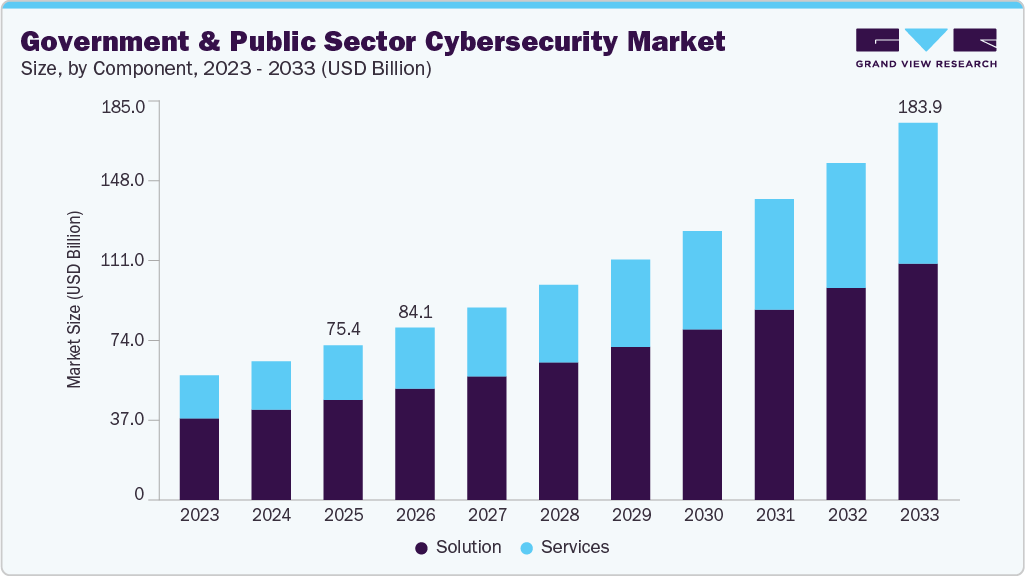
Moreover, the escalation of nation-state cyber threats targeting government infrastructure has accelerated investment in proactive defense measures. For instance, in August 2025, the State of Nevada was targeted by a sophisticated ransomware-based cyberattack that disrupted government operations. The incident affected key services, including Department of Motor Vehicles systems, law enforcement dispatch, and multiple agency websites, forcing extended closures and data exfiltration. This event underscored the real-world impact of such threats on public service delivery and prompted immediate budget reallocations toward enhanced threat intelligence, zero-trust architectures, and rapid response capabilities across other jurisdictions.
In conclusion, the government and public sector cybersecurity industry is set for sustained growth as organizations recognize cybersecurity as a core element of operational continuity and public trust. By addressing both immediate threats and long-term strategic needs, governments can safeguard essential services while supporting broader digital transformation goals. This focused investment will remain essential for maintaining national resilience in an increasingly interconnected threat landscape.
Component Insights
The solution segment dominated the market, accounting for a 64.8% revenue share in 2025. This segment includes security platforms such as identity and access management, threat intelligence, endpoint protection, and network security solutions, which are being deployed to address the rising sophistication of cyberattacks targeting public institutions. A key driving factor is the rapid digitization of government services such as e-governance platforms, digital identity programs, and smart city initiatives, which have expanded the attack surface and created urgent demand for integrated, real-time security solutions. Recent collaborative initiatives among technology providers further underscore the growing focus on strengthening cybersecurity through advanced, coordinated approaches. For instance, in April 2026, Anthropic announced Project Glasswing, led with major technology partners, which aims to secure critical software using advanced AI models capable of detecting high-severity vulnerabilities. The initiative supports government and public sector cybersecurity through collaborative defense, large-scale vulnerability scanning, and enhanced protection of critical infrastructure. This initiative is expected to accelerate the adoption of AI-driven threat detection and collaborative security frameworks in the market.
The services segment is expected to grow at the highest CAGR during the forecast period from 2026 to 2033. This segment includes consulting, integration, training, and managed security services, all of which support the effective deployment and continuous monitoring of cybersecurity frameworks. A key driving factor is the acute shortage of skilled cybersecurity professionals within government institutions, which has led to a greater dependence on third-party service providers to ensure real-time threat detection, regulatory compliance, and incident response readiness. In addition, the expansion of digital public infrastructure, such as e-governance platforms and national data repositories, has heightened the need for continuous risk assessment and system optimization services. As a result, the services segment is becoming a critical enabler of resilient cybersecurity posture in the public sector, supporting long-term operational efficiency and risk mitigation.
Security Type Insights
The cloud security segment accounted for the largest market share in 2025, driven by solutions such as data protection, workload protection, and threat detection & response, which are specifically designed to secure cloud-hosted applications, sensitive citizen data, and distributed infrastructure. Governments are focusing on data security and workload protection layers, as public sector systems now handle large volumes of classified records, digital identity data, and inter-departmental applications running across hybrid and multi-cloud environments. As a result, the segment is experiencing strong growth, supported by the need to protect high-value government data, maintain regulatory compliance, and secure rapidly expanding cloud-native public service ecosystems.
The endpoint and IoT security segment is expected to experience significant growth during the forecast period from 2026 to 2033, driven by the rapid expansion of connected devices across public infrastructure, including surveillance systems, smart city sensors, and remote workforce endpoints. Governments are increasingly prioritizing this segment as endpoints and IoT devices represent a highly vulnerable attack surface due to their distributed nature and often limited built-in security controls. As public sector organizations continue to digitize operations and adopt smart technologies, investment in endpoint and IoT security is expected to strengthen, ensuring resilience against evolving cyber threats and supporting secure infrastructure modernization.
Deployment Insights
The on-premises segment accounted for the largest market share in 2025, due to the critical need for data sovereignty, regulatory compliance, and direct control over sensitive information systems. Government agencies, particularly those handling national security, defense, and citizen identity databases, prefer on-premise deployments to ensure that confidential data remains within controlled infrastructure and is protected from external vulnerabilities associated with shared environments. As cyber threats targeting government infrastructure become more sophisticated, the segment is expected to maintain steady demand, supported by continued investments in secure, internally managed systems that offer greater customization and control.
The cloud segment is expected to be the fastest-growing during the forecast period from 2026 to 2033, supported by the increasing shift of public agencies toward cloud-first and hybrid IT strategies. Governments are rapidly migrating critical workloads such as digital identity systems, citizen service portals, and data analytics platforms to cloud environments to improve scalability, accessibility, and cost efficiency. As a result, the cloud segment is expected to witness strong and sustained growth, as governments continue to prioritize secure, compliant, and resilient digital transformation initiatives.
Government Level Insights
The federal/national government segment accounted for the largest market share in 2025, driven by its responsibility for safeguarding national infrastructure, defense systems, intelligence networks, and citizen data at scale. A key driving factor is the sharp rise in state-sponsored cyberattacks targeting critical sectors such as energy grids, defense communications, and national digital identity systems, which has compelled federal agencies to significantly increase investments in advanced threat detection, zero-trust architectures, and sovereign cybersecurity frameworks. As a result, federal governments are prioritizing long-term cybersecurity modernization programs and public-private collaborations, positioning this segment as a dominant and continuously evolving force in the overall market.
The local/municipal government segment is expected to grow at the highest CAGR during the forecast period from 2026 to 2033. driven by the increasing digitization of citizen-facing services such as property tax systems, water and utility management platforms, and smart city infrastructure. A key growth driver is the rising frequency of ransomware attacks targeting municipalities, which often operate with limited IT budgets and fragmented legacy systems, making them more vulnerable to breaches. In conclusion, the segment is expected to witness steady growth as municipalities continue to modernize digital services while addressing evolving cyber threats through scalable and cost-effective security solutions.
End-Use Sector Insights
The defense & military segment accounted for the largest market share in 2025, driven by the increasing reliance on digital warfare systems, connected battlefield technologies, and real-time intelligence networks. Armed forces are rapidly integrating advanced technologies such as unmanned systems, satellite communications, and AI-enabled surveillance, which significantly expand the attack surface and expose sensitive defense infrastructure to sophisticated cyber threats, including state-sponsored attacks and espionage. In conclusion, the segment is witnessing strong growth as governments prioritize cybersecurity as a core component of national defense strategy to ensure operational continuity and safeguard national security assets.
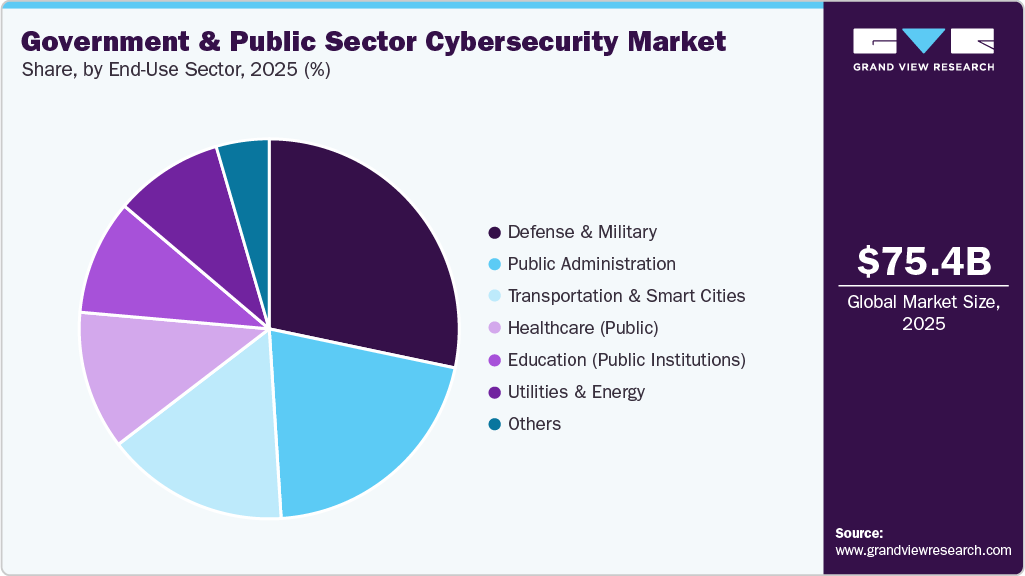
The transportation & smart cities segment is expected to register the fastest growth during the forecast period, driven by the rapid deployment of interconnected infrastructure such as intelligent traffic management systems, smart surveillance, connected public transit, and IoT-enabled utilities. As urban authorities increasingly rely on real-time data exchange across platforms to improve mobility, energy efficiency, and public safety, the attack surface has expanded significantly, making these systems vulnerable to ransomware, data breaches, and operational disruptions. In summary, the need to ensure uninterrupted city operations and protect sensitive citizen data is strongly accelerating cybersecurity investments within the transportation and smart cities segment.
Regional Insights
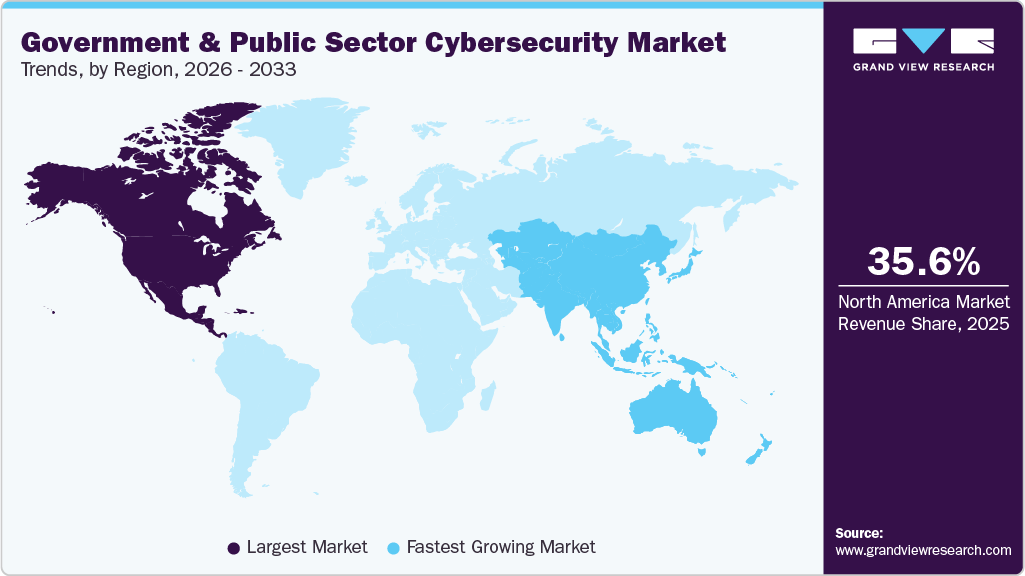
North America government and public sector cybersecurity industry accounted for the largest market share of 35.6% in 2025. Federal, state, and local agencies are prioritizing advanced security frameworks to protect critical infrastructure, sensitive citizen data, and digital public services. A key driving factor is the rising frequency and sophistication of ransomware attacks targeting government systems, particularly in the U.S., which has accelerated the adoption of zero-trust architectures, cloud security solutions, and real-time threat intelligence platforms. As a result, the market is expected to maintain steady growth, supported by sustained public funding and a proactive approach toward cyber risk management and digital transformation.
U.S. Government & Public Sector Cybersecurity Industry Trends
The government and public sector cybersecurity market in the U.S. accounted for the largest revenue share in 2025, mainly due to increasing federal mandates and funding programs. Agencies such as the Cybersecurity and Infrastructure Security Agency (CISA) are pushing institutions to upgrade outdated systems and improve identity, network, and endpoint security. In addition, in April 2026, the U.S. Department of the Treasury introduced a cybersecurity information-sharing initiative that provides real-time threat intelligence to digital asset organizations. This program helps improve threat detection, response, and communication during critical situations. As a result, it is expected to boost real-time alerting capabilities and increase demand for advanced communication solutions in the military mass notification system market.
Europe Government & Public Sector Cybersecurity Industry Trends
The government & public sector cybersecurity market in Europe is anticipated to register significant growth from 2026 to 2033, driven by a strong regulatory push and coordinated regional strategies aimed at securing critical infrastructure and digital services. The European Union’s comprehensive cybersecurity framework includes initiatives such as the NIS2 Directive, Digital Operational Resilience Act (DORA), and the Cyber Resilience Act—which has effectively made cybersecurity investments mandatory for a wide range of public institutions and essential service providers, significantly expanding the addressable market. Overall, the market is characterized by regulation-led demand, centralized policy coordination, and increasing public sector digitization, positioning Europe as one of the most structured and compliance-driven cybersecurity markets globally.
The UK government & public sector cybersecurity market is expected to witness significant growth over the forecast period, driven by the country’s strong push toward digital government transformation, increasing sophistication of cyber threats, and rising exposure of public services to ransomware and state-sponsored attacks. With the U.K. positioning itself as a global “cyber power” under its National Cyber Strategy, public institutions such as the NHS, local councils, and central government departments are prioritizing modernization of legacy IT systems, strengthening identity and access management, and adopting advanced security frameworks aligned with national guidance from the National Cyber Security Centre (NCSC). Overall, the market is expected to continue growing as cybersecurity becomes integral to safeguarding critical public services, ensuring national security, and enabling trusted digital public service delivery across the U.K.
Asia Pacific Government & Public Sector Cybersecurity Industry Trends
The government & public sector cybersecurity market in Asia Pacific is expected to register the fastest CAGR from 2026 to 2033, driven by the region’s rapid digital government transformation, increasing exposure of critical infrastructure to cyber threats, and rising geopolitical tensions that are elevating cyber risk as a national security priority. Governments across countries such as India, China, Japan, Australia, and Southeast Asian nations are aggressively investing in advanced cybersecurity frameworks, including zero-trust architectures, cloud security, and AI-driven threat detection, to secure expanding e-governance platforms and interconnected public service ecosystems. Overall, the convergence of digital transformation initiatives and evolving threat landscapes is positioning cybersecurity as a foundational pillar of governance in Asia Pacific, with sustained investment expected to drive robust long-term market growth.
China government & public sector cybersecurity market is expected to witness significant growth over the forecast period, driven primarily by the country’s strong regulatory enforcement agenda and its strategic emphasis on “cyber sovereignty” as part of national security policy. The market growth is anchored by comprehensive legal frameworks such as the Cybersecurity Law, Data Security Law, and Personal Information Protection Law, which collectively mandate stringent compliance requirements for government agencies, critical information infrastructure operators, and state-linked institutions. These regulations are further reinforced through multi-level protection schemes, cybersecurity reviews, and strict data localization requirements, compelling public sector entities to continuously upgrade network security, identity management, and data protection capabilities.
Key Government & Public Sector Cybersecurity Companies Insights
Key players operating in the government & public sector cybersecurityindustry are IBM, Fortinet, Palo Alto Networks, CyberArk Software Ltd., Sisense Ltd, and others. These companies are focusing on various strategic initiatives, including new product development, partnerships & collaborations, and agreements to gain a competitive advantage over their rivals. The following are some instances of such initiatives.
-
In April 2026, Bugcrowd partnered with Carahsoft Technology Corp. to expand proactive vulnerability detection and remediation capabilities for public sector agencies. The FedRAMP-authorized platform leverages global security researchers and AI-driven testing to strengthen system resilience and secure critical government communication environments. This development is expected to enhance proactive threat management and accelerate secure communication readiness in the military mass notification system market.
-
In March 2026, CrowdStrike expanded its GovCloud capabilities to enhance public sector cybersecurity through AI-driven automation, threat detection, and unified IT/OT protection. The upgraded platform enables faster incident response, improved visibility, and secure operational workflows for government and defense environments, strengthening mission-critical cyber defense capabilities. This development is expected to accelerate the adoption of AI-enabled security and real-time alerting solutions in the military mass notification system market.
-
In December 2025, the U.S. General Services Administration partnered with Palo Alto Networks under a OneGov agreement to strengthen federal cybersecurity through AI security, cloud protection, and zero-trust solutions. The initiative enhances secure communication, threat prevention, and operational resilience across critical government and defense infrastructure. This agreement is expected to drive wider adoption of integrated cybersecurity and secure communication platforms in the military mass notification system market.
Key Government & Public Sector Cybersecurity Companies:
The following key companies have been profiled for this study on the government & public sector cybersecurity market.
- BitSight Technologies, Inc.
- Check Point Software Technologies Ltd.
- Cisco Systems, Inc.
- Cloudflare, Inc.
- Fortinet
- CyberArk Software Ltd.
- Leidos Holdings, Inc.
- NetCentrics Corporation
- Okta, Inc.
- Palo Alto Networks
- Sangfor Technologies Inc.
- Zscaler, Inc.
- CrowdStrike Holdings, Inc.
Government & Public Sector Cybersecurity Market Report Scope
Report Attribute
Details
Market size in 2026
USD 84.07 billion
Revenue forecast in 2033
USD 183.91 billion
Growth rate
CAGR of 11.8% from 2026 to 2033
Actual data
2021 - 2024
Forecast period
2026 - 2033
Quantitative units
Revenue in USD million/billion and CAGR from 2026 to 2033
Report coverage
Revenue forecast, company share, competitive landscape, growth factors, and trends
Segments covered
Component, security type, deployment, government level, end-use sector, region
Regional scope
North America; Europe; Asia Pacific; Latin America; MEA
Country scope
U.S.; Canada; UK; Germany; France; China; India; Japan; Australia; South Korea; Brazil; Mexico; UAE; Kingdom of Saudi Arabia; South Africa
Key companies profiled
BitSight Technologies, Inc.; Check Point Software Technologies Ltd.; Cisco Systems, Inc.; Cloudflare, Inc.; Fortinet; CyberArk Software Ltd.; Leidos Holdings, Inc.; NetCentrics Corporation; Okta, Inc.; Palo Alto Networks; Sangfor Technologies Inc.; Zscaler, Inc.; CrowdStrike Holdings, Inc.
Customization scope
Free report customization (equivalent to 8 analysts working days) with purchase. Addition or alteration to country, regional & segment scope.
Pricing and purchase options
Avail customized purchase options to meet your exact research needs. Explore purchase options
Global Government & Public Sector Cybersecurity Market Report Segmentation
This report forecasts revenue growth at global, regional, and country levels and provides an analysis of the latest industry trends in each of the sub-segments from 2021 to 2033. For this study, Grand View Research has segmented the global government & public sector cybersecurity market report based on component, security type, deployment, government level, end use, and region.
-
Component Outlook (Revenue, USD Billion, 2021 - 2033)
-
Solution
-
Threat Intelligence & Analytics
-
Security Information & Event Management (SIEM)
-
Encryption
-
Firewall & Intrusion Detection/Prevention Systems (IDS/IPS)
-
Antivirus/Anti-malware
-
Risk & Compliance Management
-
-
Services
-
Professional Services
-
Consulting
-
Integration & Deployment
-
Training & Support
-
-
Managed Services
-
-
Security Type Outlook (Revenue, USD Billion, 2021 - 2033)
-
Network Security
-
Cloud Security
-
Endpoint & IoT Security
-
Application Security
-
Data Security
-
Identity & Access Management (IAM)
-
Infrastructure Protection
-
Others
-
-
Deployment Outlook (Revenue, USD Billion, 2021 - 2033)
-
Cloud
-
On-Premise
-
Hybrid
-
-
Government Level Outlook (Revenue, USD Billion, 2021 - 2033)
-
Federal/National Government
-
State/Regional Government
-
Local/Municipal Government
-
-
End-Use Sector Outlook (Revenue, USD Billion, 2021 - 2033)
-
Defense & Military
-
Public Administration
-
Healthcare (Public)
-
Education (Public Institutions)
-
Transportation & Smart Cities
-
Utilities & Energy
-
Others
-
-
Regional Outlook (Revenue, USD Billion, 2021 - 2033)
-
North America
-
U.S.
-
Canada
-
-
Europe
-
UK
-
Germany
-
France
-
-
Asia Pacific
-
China
-
India
-
Japan
-
South Korea
-
Australia
-
-
Latin America
-
Brazil
-
Mexico
-
-
Middle East & Africa
-
UAE
-
Saudi Arabia
-
South Africa
-
-
Frequently Asked Questions About This Report
b. The global government & public sector cybersecurity market size was estimated at USD 75.38 billion in 2025 and is expected to reach USD 84.07 billion in 2026.
b. The global government & public sector cybersecurity market is expected to grow at a compound annual growth rate of 11.8% from 2026 to 2033 to reach USD 183.91 billion by 2033.
b. The solution segment dominated the government & public sector cybersecurity market in 2025 driven by rising investments in advanced security to protect critical infrastructure and data.
b. Some key players operating in the market include BitSight Technologies, Inc., Check Point Software Technologies Ltd., Cisco Systems, Inc., Cloudflare, Inc., Fortinet, CyberArk Software Ltd., Fortinet, Leidos Holdings, Inc., NetCentrics Corporation, Okta, Inc., Palo Alto Networks, Sangfor Technologies Inc., Zscaler, Inc. and Others.
b. Factors such as rising nation-state and ransomware attacks, expansion of digital public services and e-governance, and strict regulatory and data protection mandates play a key role in accelerating the government & public sector cybersecurity market.


Share this report with your colleague or friend.
Need a Tailored Report?
Customize this report to your needs — add regions, segments, or data points, with 20% free customization.


ISO 9001:2015 & 27001:2022 Certified
We are GDPR and CCPA compliant! Your transaction & personal information is safe and secure. For more details, please read our privacy policy.
Trusted market insights - try a free sample
See how our reports are structured and why industry leaders rely on Grand View Research. Get a free sample or ask us to tailor this report to your needs.