
- Home
- »
- Electronic Devices
- »
-
Greenhouse Lighting Market Size & Share Report, 2026-2033GVR Report cover

Greenhouse Lighting Market (2026 - 2033)
Size, Share & Trends Analysis Report By Component (Hardware, Software, Services), By Lighting, By Greenhouse, By Installation (New Installations, Retrofit Installations), By Crop, By End Use, By Region, And Segment Forecasts
Market Size, 2025
$3.7BMarket Estimate, 2026
$4.4BMarket Forecast, 2033
$14.5BCAGR, 2026–2033
18.8%Greenhouse Lighting Market Summary
The global greenhouse lighting market size was valued at USD 3.7 billion in 2025 and is projected to grow from USD 4.4 billion in 2026 to USD 14.5 billion by 2033, at a CAGR of 18.8% from 2026 to 2033. The North America held the largest share of 36.0% of the global market in 2025. The market is experiencing strong growth driven by the rising demand for year-round crop production, increasing adoption of controlled environment agriculture (CEA), and the growing need for higher agricultural productivity amid shrinking arable land.
 Source: Grand View Research, IR Documents, Primary Interviews, Paid DatabasesTo learn more about this report,
 Download Free Sample Report
 Key Market Trends & Insights
- By component: Hardware segment held the largest market share of over 64.0% in 2025.
- By lighting: LED grow lights segment accounted for the largest share in 2025.
- By greenhouse: Glass greenhouses segment accounted for the largest share in 2025.
- By installation: New installations segment accounted for the largest revenue share in 2025.
- By crop: Fruits & vegetables segment accounted for the largest revenue share in 2025.
- By end use: Commercial growers segment accounted for the largest revenue share in 2025.
Regional Highlights
- Largest regional market: North America (36.0% revenue share, 2025)
- Fastest-growing regional market: Asia Pacific (highest CAGR, 2026-2033)
- By country: China held a significant market share in 2025.
Market Size & Forecast
- Market size in 2025: USD 3.7 Billion
- Estimated market size in 2026: USD 4.4 Billion
- Projected market size by 2033: USD 14.5 Billion
- CAGR (2026-2033): 18.8%
Three ways to get this report
Buy it, customize it, or ask a question.Ask an Analyst
Analyst response in 1 business day
- AccessReport author, directly
- Reply timeWithin 1 working day
- No sales callDirect answer only
- FormatEmail reply
- CostFree, no cost
Get the Full Report
What the study covers
- FormatsPDF · Excel · Dashboard
- Timeline2026–2033 annual, 2025 base
- Coverage20+ countries, 5 regions
- Companies10+ key players profiled
Customize the Report
20% free customization
- IncludeCountries, segments, points
- TailorTo your product definition
- ExtendDeeper competitor detail
- OrA fully bespoke study
- Turnaround5–10 working days
In addition, advancements in energy-efficient lighting technologies, particularly LED-based systems, along with supportive government initiatives promoting sustainable farming practices, are further accelerating market growth globally. The rapid expansion of controlled environment agriculture drives the market growth. Greenhouses enable growers to regulate temperature, humidity, and light conditions, ensuring consistent crop yields regardless of external climatic variations. Lighting plays a critical role in this ecosystem by supplementing natural sunlight, especially in regions with limited daylight hours. As climate change continues to impact traditional farming cycles, growers are increasingly shifting toward greenhouse-based cultivation, thereby driving demand for advanced lighting systems. To learn more about this report, Download Free Sample Report
 The growing emphasis on food security and sustainable agriculture is also contributing to the expansion of the market. With the global population continuing to rise, there is increasing pressure on agricultural systems to produce more food using fewer resources. Greenhouse lighting enables higher crop output per square meter and reduces dependency on seasonal changes, making it a crucial component in modern farming practices. Furthermore, it supports the cultivation of high-value crops such as flowers, fruits and vegetables which require precise lighting conditions for optimal growth.
Government support and favorable policies are further driving market growth. Many countries are promoting greenhouse farming and energy-efficient technologies through subsidies, tax incentives, and research funding. These initiatives are aimed at reducing carbon emissions, conserving water, and enhancing agricultural productivity. In regions such as North America and Europe, regulatory frameworks encouraging the use of sustainable lighting hardware have accelerated the adoption of LED-based greenhouse systems, thereby boosting market expansion.
In addition, technological advancements and integration with smart farming hardware are shaping the future of the market. The incorporation of IoT-enabled lighting systems, automation, and data-driven controls allows growers to monitor and optimize lighting conditions in real time. This not only improves operational efficiency but also reduces energy consumption and labor costs. As digital agriculture continues to evolve, the integration of intelligent lighting systems is expected to play a pivotal role in enhancing greenhouse productivity and supporting long-term market growth.
Market Dynamics
The expansion of controlled-environment agriculture (CEA) is a major driver of the market, as growers increasingly invest in high-tech greenhouses and indoor cultivation facilities to produce crops year-round under precisely managed conditions. These systems rely heavily on supplemental LED lighting to optimize photosynthesis, improve crop yields, and maintain consistent production regardless of seasonal sunlight availability. As demand rises for locally produced vegetables, fruits, herbs, and ornamental plants, commercial growers are expanding greenhouse capacity and adopting advanced lighting systems to enhance productivity and energy efficiency.
For instance, in February 2026, the U.S. Department of Agriculture National Agricultural Statistics Service (USDA NASS) reported that U.S. horticultural operations generated USD 18.3 billion in sales in 2024, while food crops grown under protection reached USD 1.01 billion, representing a 44% increase compared with 2019. This sharp growth in protected cultivation highlights the rapid expansion of greenhouse and controlled-environment agriculture, directly increasing demand for advanced greenhouse lighting systems.
Maintenance and replacement costs for drivers, sensors, and control systems represent an important restraint in the market. Although LED fixtures generally offer long operating lifetimes, supporting components such as power drivers, environmental sensors, dimming modules, and network controllers are subject to wear, electrical stress, humidity, and temperature fluctuations common in greenhouse environments. Over time, these components may require calibration, repair, or replacement to maintain consistent light output and proper integration with climate control systems. These ongoing costs increase the total cost of ownership beyond the initial fixture purchase.
The impact is particularly significant for large commercial greenhouse operations that deploy thousands of connected lighting units across extensive cultivation areas. Even a relatively small failure rate can result in meaningful maintenance expenses, labor requirements, and operational disruptions. Replacement of specialized components may also require technical support and software reconfiguration to restore optimal lighting schedules and crop-specific settings. For growers operating with tight margins, these recurring expenditures can lengthen payback periods and reduce the overall financial attractiveness of advanced greenhouse lighting systems.
Integration of smart controls, sensors, and data-driven lighting optimization represents a significant opportunity in the market, as growers increasingly seek automated systems that adjust light intensity and spectrum based on real-time crop and environmental conditions. These systems use sensors, climate data, and intelligent algorithms to optimize plant growth while reducing electricity consumption and labor requirements. By enabling remote monitoring, custom light recipes, and integration with greenhouse climate computers, smart lighting platforms help growers improve yields, maintain crop consistency, and enhance overall operational efficiency.
For instance, in June 2025, Signify launched the Philips GrowWise Smart Spectrum and upgraded the Philips GrowWise Control system, which automatically optimizes horticultural LED lighting using real-time sunlight data and provides centralized remote control across multiple greenhouse sites. According to Signify, the system is already installed at more than 750 horticultural locations worldwide and can improve crop growth by up to 6% while reducing energy consumption. This launch highlights the growing adoption of data-driven lighting optimization and confirms the strong market opportunity for intelligent greenhouse lighting solutions.
Market Concentration & Characteristics
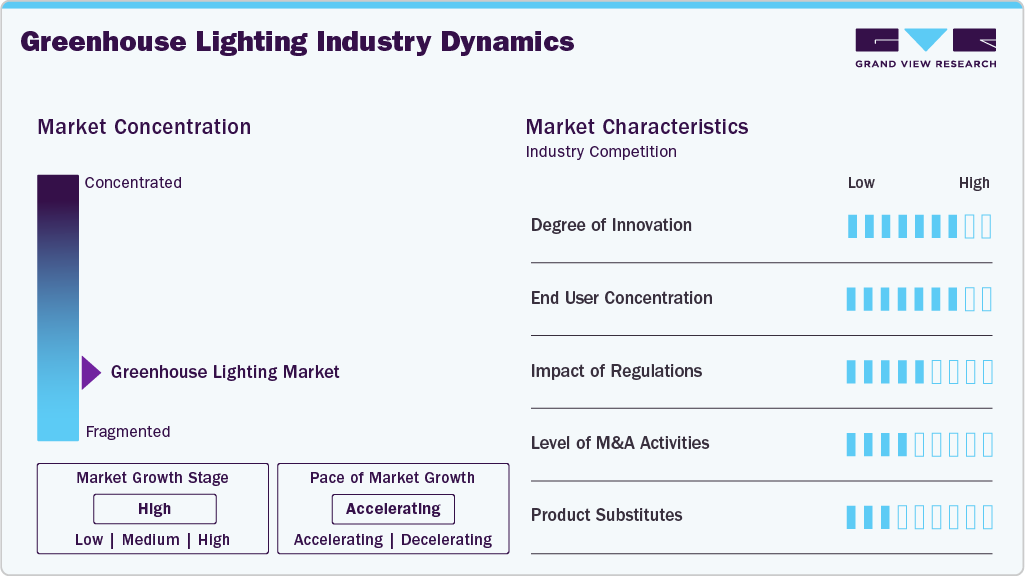
The greenhouse lighting industry is fragmented due to the presence of numerous suppliers ranging from global lighting corporations to specialized horticultural technology companies. While established players such as Signify, ams-OSRAM, Fluence Bioengineering, and Heliospectra benefit from strong R&D capabilities and extensive distribution networks, a wide range of smaller manufacturers compete through crop-specific solutions, localized service, and lower-cost offerings. Because growers evaluate suppliers based on light efficacy, spectral control, energy savings, and agronomic support, market share is distributed across many vendors rather than dominated by a few companies.
 To learn more about this report, Download Free Sample Report
 End user concentration in the market is relatively high because a significant share of demand comes from large commercial greenhouse operators, high-tech horticulture producers, and vertically integrated controlled-environment agriculture companies. These customers typically manage substantial cultivation areas dedicated to vegetables, flowers, berries, and medicinal crops, and they make large capital investments in advanced LED lighting systems. Their purchasing decisions are based on crop yield improvements, energy efficiency, and integration with climate control systems. As a result, winning contracts with a relatively small number of large-scale growers can have a meaningful impact on supplier revenues and competitive positioning.
Component Insights
The hardware segment accounted for the largest market share of over 64.0% in 2025. This dominance is primarily driven by the high demand for physical lighting systems such as LED grow lights, fixtures, ballasts, and control units that are important for the greenhouse infrastructure. The increasing shift toward energy-efficient LED lighting, driven by rising electricity costs and the need for optimized plant growth, has significantly increased hardware adoption. In addition, the expansion of commercial greenhouses and indoor farming facilities, particularly in regions focusing on food security and high-value crop production, continues to fuel investments in advanced lighting hardware. Frequent technological upgrades, including spectrum-adjustable LEDs and durable lighting systems with longer lifespans, further contribute to the segment’s leading position.
The software segment is expected to grow at the fastest CAGR from 2026 to 2033. This growth is largely attributed to the rising integration of smart farming technologies and the need for precise control over greenhouse environments. Software enables real-time monitoring, automation, and optimization of lighting conditions based on crop, growth stage, and external environmental factors. Increasing adoption of IoT-enabled systems and data analytics platforms is allowing growers to enhance productivity while reducing energy consumption and operational costs. Moreover, the growing trend toward digital agriculture and the use of AI-driven insights for predictive crop management are accelerating demand for advanced greenhouse lighting software, making it a key growth driver in the coming years.
Lighting Insights
The LED grow lights segment accounted for the largest revenue share in 2025. This dominance is primarily driven by the superior energy efficiency, longer operational lifespan, and advanced spectral control offered by LED technology compared to conventional lighting systems. LED grow lights enable precise tuning of light wavelengths to match specific plant growth stages, thereby enhancing photosynthesis, improving crop yield, and ensuring better quality produce. Government incentives promoting energy-efficient technologies and the rapid expansion of controlled environment agriculture further support the widespread adoption of LED grow lights.
The fluorescent lights segment is expected to grow at a significant CAGR from 2026 to 2033, driven by its cost-effectiveness and suitability for small-scale and early-stage plant cultivation. Fluorescent lighting systems generate lower heat output, making them ideal for seedlings, leafy greens, and crops that require moderate light intensity. Their relatively low initial investment compared to LED systems makes them attractive for small and medium-sized growers, research facilities, and educational institutions. In addition, ongoing improvements in fluorescent lighting efficiency and performance, along with increasing adoption in niche applications, are contributing to the steady growth of this segment in the greenhouse lighting industry.
Greenhouse Insights
The glass greenhouses segment dominated the market in 2025. This dominance is driven by the superior light transmission properties of glass, which allow maximum natural sunlight penetration and enhance the effectiveness of supplemental artificial lighting systems. Glass structures are widely preferred in large-scale commercial greenhouse operations due to their durability, long lifespan, and ability to support advanced climate control technologies. The increasing demand for high-value crops such as tomatoes, cucumbers, and flowers, which require stable and high-intensity lighting conditions, has further increased the adoption of glass greenhouses. In addition, the integration of energy-efficient lighting systems, particularly LEDs, in modern glass greenhouse facilities is accelerating segment growth.
The poly greenhouses segment is expected to grow at a significant CAGR from 2026 to 2033. This growth is primarily driven by its lower installation costs and flexibility compared to traditional glass structures. Poly greenhouses, typically made from polyethylene or polycarbonate materials, are gaining traction among small and medium-scale growers due to their affordability and ease of setup. These structures offer adequate light diffusion, which helps in uniform crop growth while reducing the risk of plant stress caused by excessive sunlight. Increasing adoption of protected cultivation practices in emerging economies, along with government support for cost-effective farming infrastructure, is further driving demand for poly greenhouses. Moreover, advancements in poly material durability and UV resistance are enhancing their performance, making them a viable alternative for greenhouse lighting applications.
Installation Insights
The new installations segment held the largest revenue share in 2025, primarily driven by the rapid expansion of commercial greenhouse infrastructure and increasing investments in controlled environment agriculture. As growers establish new greenhouse facilities to meet rising food demand and ensure year-round crop production, there is a strong need for advanced lighting systems to be integrated during the initial construction phase. New installations allow for the deployment of optimized, energy-efficient lighting hardware such as LED systems, along with integrated control technologies, ensuring higher productivity and long-term cost savings.
The retrofit installations segment is expected to grow at the fastest CAGR over the forecast period, driven by the increasing need to upgrade existing greenhouse infrastructure with more energy-efficient and technologically advanced lighting systems. Many older greenhouses still rely on traditional lighting technologies such as HID and fluorescent systems, which are less efficient and costlier to operate. Retrofitting enables growers to replace these systems with modern LED lighting without the need for complete infrastructure redevelopment, offering a cost-effective pathway to improve energy efficiency and crop yield.
Crop Insights
The fruits & vegetables segment held the largest revenue share in 2025, driven by the high demand for consistent, high-quality food production and the widespread cultivation of these crops in greenhouse environments. Fruits and vegetables such as tomatoes, cucumbers, lettuce, and peppers require controlled lighting conditions to optimize photosynthesis, accelerate growth cycles, and improve yield and nutritional quality. The increasing global focus on food security, coupled with rising consumer demand for fresh and locally grown produce, has significantly increased greenhouse cultivation of fruits and vegetables. In addition, the ability of advanced lighting systems, particularly LEDs, to provide crop-specific light spectra further enhances productivity, making this segment a major contributor to market growth.
The flowers & ornamentals segment is expected to grow at a significant CAGR over the forecast period. This growth is primarily driven by the increasing demand for decorative plants, cut flowers, and ornamental crops across residential, commercial, and event-based applications. Greenhouse lighting plays a crucial role in controlling flowering cycles, color development, and overall plant quality, which are critical factors in the floriculture industry. The rising popularity of landscaping, indoor gardening, and aesthetic enhancements in urban spaces is further fueling demand for ornamental plants. Moreover, growers are increasingly adopting advanced lighting technologies to ensure year-round production and meet seasonal demand peaks, thereby driving growth in the flowers & ornamentals segment.
End Use Insights
The commercial growers segment accounted for the largest revenue share in 2025.This dominance is driven by the large-scale adoption of advanced greenhouse systems for high-volume crop production. Commercial growers heavily rely on greenhouse lighting to ensure consistent yields, optimize plant growth cycles, and maintain crop quality throughout the year. The increasing demand for fresh produce, coupled with the need to maximize output per square meter, has led to significant investments in energy-efficient lighting hardware such as LEDs. In addition, the integration of automated lighting control systems and precision agriculture technologies enables commercial operators to enhance productivity while reducing operational costs, further strengthening the dominance of this segment.
 To learn more about this report, Download Free Sample Report
 The retail & small-scale growers segment is expected to grow at a significant CAGR during the forecast period. This growth is primarily driven by the rising popularity of urban farming, home gardening, and small-scale horticulture businesses. Increasing consumer interest in locally grown and organic produce is encouraging individuals and small enterprises to adopt greenhouse cultivation supported by affordable lighting systems, thereby driving demand in the horticulture lighting market. Moreover, the availability of compact, cost-effective, and easy-to-install lighting hardware is making greenhouse farming more accessible to small growers. Government initiatives supporting small farmers and the growing trend of indoor and vertical farming are also contributing to the rapid expansion of this segment in greenhouse lighting industry.
Regional Insights
North America greenhouse lighting industry held the largest share of over 36.0% in the global market in 2025. This dominance is primarily driven by the widespread adoption of advanced controlled environment agriculture (CEA) practices across North America, particularly in large-scale commercial greenhouse operations. The presence of technologically advanced farming infrastructure, coupled with high awareness regarding energy-efficient lighting hardware such as LED grow lights, has significantly contributed to market growth. In addition, rising demand for year-round production of high-quality fruits and vegetables, along with increasing investments in indoor and vertical farming, are further accelerating the adoption of greenhouse lighting systems. Supportive government initiatives promoting sustainable agriculture and energy efficiency, along with the strong presence of key market players, continue to strengthen North America’s leading position in the market.
 To learn more about this report, Download Free Sample Report
 U.S. Greenhouse Lighting Market Trends
The greenhouse lighting industry in the U.S. is expected to grow significantly from 2026 to 2033. This growth is driven by the rapid expansion of commercial greenhouse facilities and increasing adoption of precision agriculture technologies. The growing need for consistent and high-yield crop production, especially for fresh produce, is encouraging U.S. growers to invest in advanced lighting systems that enhance plant growth and optimize energy usage. In addition, rising labor costs and climate variability are pushing farmers toward automated and controlled growing environments, further boosting demand for greenhouse lighting.
Asia Pacific Greenhouse Lighting Market Trends
The greenhouse lighting industry in the Asia Pacific is growing at the fastest CAGR from 2026 to 2033. This rapid growth is primarily driven by increasing population pressure and the resulting need to enhance agricultural productivity across countries such as China, India, and Japan. The region is witnessing strong adoption of protected cultivation practices due to declining availability of arable land and increasing urbanization. In addition, favorable government initiatives supporting modern farming techniques, including subsidies for greenhouse infrastructure and lighting systems, are accelerating market expansion. The growing focus on export-oriented horticulture and the rising penetration of low-cost greenhouse technologies further contribute to the increased demand for efficient lighting hardware in the region.
China greenhouse lighting industry held a significant share in 2025. This growth is driven by the country’s large-scale greenhouse cultivation and strong focus on agricultural modernization. China has one of the largest greenhouse areas globally, with widespread use of plastic-covered greenhouses for vegetable production. The government’s push toward improving domestic food supply chains and reducing reliance on imports is encouraging the adoption of advanced agricultural inputs, including lighting systems. In addition, the availability of low-cost manufacturing capabilities and rapid technological advancements in agricultural equipment are supporting market growth. Increasing investments in smart agriculture and the expansion of high-tech greenhouse projects are further strengthening the demand for greenhouse lighting hardware in China.
Europe Greenhouse Lighting Market Trends
The Europe greenhouse lighting industry is growing at a significant CAGR from 2026 to 2033, primarily driven by the region’s strong focus on energy transition and decarbonization in agriculture. European growers are increasingly adopting low-carbon and energy-efficient lighting systems to comply with strict environmental regulations and emission reduction targets. In addition, the rising cost of conventional energy sources has accelerated the shift toward advanced lighting technologies that optimize power consumption and improve operational efficiency. The region also benefits from well-established horticulture lighting market in countries such as the Netherlands and Spain, where high-tech greenhouse farming is widely practiced.
The greenhouse lighting industry in the UK is expected to grow rapidly in the coming years. The UK’s unpredictable weather patterns and limited sunlight availability during certain seasons are encouraging growers to adopt supplemental lighting hardware to maintain consistent crop output. In addition, the expansion of high-tech greenhouse projects and controlled indoor farming facilities is supporting demand for advanced lighting systems. Rising investments in agri-tech innovation, along with growing interest in climate-resilient farming methods, are further accelerating the adoption of greenhouse lighting hardware across the UK market.
Key Greenhouse Lighting Company Insights
Some of the key companies operating in the market include ams-OSRAM AG, CALIFORNIA LIGHTWORKS, Cree LED, Heliospectra, and Gavita International B.V. among others are some of the leading participants in the market.
-
Gavita International B.V., headquartered in Oude Meer, Netherlands, specializes in providing advanced horticultural lighting solutions tailored for professional greenhouse applications. Operating under its Agrolux brand, the company offers a range of lighting systems, services, and collaborative solutions designed to enhance greenhouse performance through efficient light management. Its product portfolio includes LED luminaires, HPS lighting fixtures, and integrated systems, complemented by digital tools such as the Agrolux Operating System for monitoring, controlling, and optimizing lighting operations. With a strong international footprint, Gavita International supports professional growers across global markets with its lighting technologies and related services.
-
Heliospectra AB is a Sweden-based company founded in 2006 that specializes in intelligent horticulture lighting solutions for greenhouse and controlled plant growth environments. The company provides advanced LED grow lighting systems, light control platforms, and related technical services designed to improve crop quality, yield, and resource efficiency. Its offerings include dynamic LED lighting solutions with customizable light spectra, wireless control systems such as helioCORE for automation and optimization, and service solutions that support growers from planning to harvest. Heliospectra serves customers across multiple continents, delivering tailored lighting strategies for commercial greenhouses, research facilities, and indoor cultivation, positioning itself as a global provider of innovative greenhouse lighting technologies.
Key Greenhouse Lighting Companies:
The following key companies have been profiled for this study on the greenhouse lighting market.
- ams-OSRAM AG
- CALIFORNIA LIGHTWORKS
- Crecer Lighting
- Cree LED
- EVERLIGHT ELECTRONICS CO., LTD.
- Gavita International B.V.
- Heliospectra
- HLI Solutions, Inc.
- Hort Americas
- Hortilux Schréder
- Nanolux
- Samsung Electronics Co., Ltd.
- Senmatic
- Signify Holding
- Valoya
Competitive Benchmarking
Operating Strategies
Competitive Edge
Weakness
Mature Players: Signify Holding; ams-OSRAM AG; Gavita International B.V.; Samsung Electronics Co., Ltd.
- Invest heavily in R&D to develop high-efficacy LEDs, spectrum-tunable fixtures, and smart lighting control platforms for commercial greenhouse applications.
- Offer broad product portfolios covering top lighting, interlighting, supplemental lighting, and centralized monitoring systems.
- Strong brand recognition and proven performance in large-scale greenhouse installations.
- Global service and technical support infrastructure with agronomic expertise.
- Premium pricing can limit adoption among small and mid-sized growers.
- High dependence on commercial greenhouse investment cycles and energy economics.
Emerging Players: Heliospectra; Valoya; Senmatic; CALIFORNIA LIGHTWORKS; Crecer Lighting
- Focus on crop-specific lighting recipes, smart controls, and niche greenhouse and indoor cultivation applications.
- Collaborate with research institutions and greenhouse integrators to validate performance and accelerate adoption.
- Greater flexibility in product customization and faster response to customer requirements.
- Ability to serve niche markets with tailored solutions and close technical support.
- Limited global scale and lower brand visibility compared with multinational competitors.
- Smaller manufacturing capacity and narrower distribution reach.
Recent Developments
-
In July 2025, Heliospectra AB highlighted its ongoing lighting innovation at Tomatoworld, demonstrating the application of advanced LED grow lighting and smart control systems in greenhouse environments. The initiative focuses on showcasing how dynamic, spectrum-adjustable lighting solutions and integrated control platforms can optimize crop growth, improve energy efficiency, and support sustainable greenhouse operations.
-
In June 2025, Signify N.V. introduced the 4-channel Philips GreenPower LED toplighting force (TLF) as part of its horticulture lighting portfolio expansion. The new system, available in 800W and 1040W variants, enables precise control over red, blue, white, and far-red light channels, allowing growers to create dynamic light recipes that can adapt in real time to factors such as sunlight levels, crop growth stages, and energy conditions. This innovation enhances lighting intelligence in greenhouses by improving crop development control, energy efficiency, and operational flexibility, supporting more optimized and data-driven cultivation practices.
Greenhouse Lighting Market Report Scope
Report Attribute
Details
Market size in 2025
USD 3.7 billion
Estimated market size in 2026
USD 4.4 billion
Projected market size by 2033
USD 14.5 billion
Growth rate
CAGR of 18.8% from 2026 to 2033
Actual data
2021 - 2025
Forecast period
2026 - 2033
Quantitative units
Revenue in USD billion and CAGR from 2026 to 2033
Report coverage
Revenue forecast, company share, competitive landscape, growth factors, and trends
Segments covered
Component, lighting, greenhouse, installation, crop, end use, and region
Regional scope
North America; Europe; Asia Pacific; Latin America; MEA
Country scope
U.S.; Canada; Mexico; UK; Germany; France; China; India; Japan; Australia; South Korea; Brazil; UAE; Saudi Arabia; South Africa
Key companies profiled
ams-OSRAM AG; CALIFORNIA LIGHTWORKS; Crecer Lighting; Cree LED; EVERLIGHT ELECTRONICS CO., LTD.; Gavita International B.V.; Heliospectra; HLI Solutions, Inc.; Hort Americas; Hortilux Schréder; Nanolux; Samsung Electronics Co., Ltd.; Senmatic; Signify Holding; Valoya
Customization scope
Free report customization (equivalent to 8 analysts working days) with purchase. Addition or alteration to country, regional & segment scope.
Pricing and purchase options
Avail customized purchase options to meet your exact research needs. Explore purchase options
Global Greenhouse Lighting Market Report Segmentation
This report forecasts revenue growth at global, regional, and country levels and provides an analysis of the latest industry trends in each of the sub-segments from 2021 to 2033. For this study, Grand View Research has segmented the greenhouse lighting market report based on component, lighting, greenhouse, installation, crop, end use, and region:
-
Component Outlook (Revenue, USD Billion, 2021 - 2033)
-
Hardware
-
Software
-
Services
-
-
Lighting Outlook (Revenue, USD Billion, 2021 - 2033)
-
LED Grow Lights
-
High-Intensity Discharge (HID) Lights
-
Fluorescent Lights
-
Incandescent Lights
-
-
Greenhouse Outlook (Revenue, USD Billion, 2021 - 2033)
-
Glass Greenhouses
-
Poly Greenhouses
-
-
Installation Outlook (Revenue, USD Billion, 2021 - 2033)
-
New Installations
-
Retrofit Installations
-
-
Crop Outlook (Revenue, USD Billion, 2021 - 2033)
-
Fruits & Vegetables
-
Flowers & Ornamentals
-
Herbs & Microgreens
-
Nursery Crops
-
Others
-
-
End Use Outlook (Revenue, USD Billion, 2021 - 2033)
-
Commercial Growers
-
Research Institutions
-
Retail & Small-Scale Growers
-
Others
-
-
Regional Outlook (Revenue, USD Billion, 2021 - 2033)
-
North America
-
U.S.
-
Canada
-
Mexico
-
-
Europe
-
Germany
-
UK
-
France
-
-
Asia Pacific
-
China
-
India
-
Japan
-
South Korea
-
Australia
-
-
Latin America
-
Brazil
-
-
Middle East & Africa
-
UAE
-
Saudi Arabia
-
South Africa
-
-
Delivered Customizations
This report has been delivered with the following In-depth customizations
Client Request
Customization Delivered
Value Adds
Smart lighting and controls opportunity assessment
Evaluated adoption of connected controls, sensors, cloud-based monitoring, and AI-driven light optimization in commercial greenhouse operations.
Assessed the impact of automation on crop yields, energy savings, and labor efficiency.
Identified premium segments with higher growth and margins.
Crop-wise lighting requirement and adoption analysis
Analyzed lighting needs and adoption trends for various crops.
Compared spectrum preferences, photoperiod requirements, and return-on-investment considerations by crop.
Assessed market size and growth potential for each crop segment.
Identified high-value crop segments with the strongest demand potential.
Helped prioritize sales efforts toward the most profitable applications.
Country-level greenhouse lighting market analysis for the Netherlands, the U.S., Canada, Spain, and Japan
Delivered detailed market sizing, growth forecasts, greenhouse area expansion trends, and adoption of LED horticultural lighting across the selected countries.
Assessed regulatory incentives, protected cultivation policies, and the competitive landscape in each country.
Highlighted country-specific regulatory and energy factors affecting adoption.
Supported market entry and distribution planning.
Frequently Asked Questions About This Report
The global greenhouse lighting market size was valued at USD 3.7 billion in 2025 and is estimated at USD 4.4 billion for 2026.
Some key players operating in the market ams-OSRAM AG; CALIFORNIA LIGHTWORKS; Crecer Lighting; Cree LED; EVERLIGHT ELECTRONICS CO., LTD.; Gavita International B.V.; Heliospectra; HLI Solutions, Inc.; Hort Americas; Hortilux Schréder; Nanolux; Samsung Electronics Co., Ltd.; Senmatic; Signify Holding; Valoya, and Others.
Factors such as the increasing adoption of controlled environment agriculture, rising demand for year-round crop production, and growing use of energy-efficient LED lighting systems play a key role in accelerating the greenhouse lighting market.
The global greenhouse lighting market is expected to grow at a CAGR of 18.8% from 2026 to 2033, reaching USD 14.5 billion by 2033.
Asia Pacific is the fastest-growing region over the forecast period.
The hardware segment led with a revenue share of over 64.0% in 2025, while the software segment is the fastest-growing.
The LED grow lights segment held the largest revenue share in 2025.
The glass greenhouses segment dominated the market in 2025.
The new installations segment held the largest revenue share in 2025, while retrofit installations are expected to grow at the fastest CAGR over the forecast period.
North America dominated the market with a revenue share of over 36.0% in 2025.
About the Author(s)
Electronic Devices Research Team
Semiconductors & Electronics · Electronic DevicesThis report was authored by the electronic devices research team at Grand View Research - comprising two research analysts, one senior research analyst, and one industry expert - with specialized expertise in the electronic devices segment of the semiconductors & electronics industry. All findings are based on proprietary semiconductors & electronics databases, executive interviews, and regulatory analysis, subject to internal peer review prior to publication.
Last Updated:
Speak to Analyst

Customize this report to your needs - add regions, segments, or data points, with 20% free customization.
Or view our licence options:


ISO 9001:2015 & 27001:2022 Certified
We are GDPR and CCPA compliant! Your transaction & personal information is safe and secure. For more details, please read our privacy policy.


