
- Home
- »
- Next Generation Technologies
- »
-
Precision Irrigation Market Size & Share Report, 2026-2033GVR Report cover

Precision Irrigation Market (2026 - 2033)
Size, Share & Trends Analysis Report By Irrigation Type (Drip Irrigation, Sprinkler Irrigation), By Component (Hardware, Software, Services), By Technology (Weather-Based Systems), By Application, By Region, And Segment Forecasts
Market Size, 2025
$8.7BMarket Estimate, 2026
$9.3BMarket Forecast, 2033
$16.6BCAGR, 2026–2033
8.6%Precision Irrigation Market Summary
The global precision irrigation market size was valued at USD 8.7 billion in 2025 and is projected to grow from USD 9.3 billion in 2026 to USD 16.6 billion by 2033, at a CAGR of 8.6% from 2026 to 2033. The market in Asia Pacific dominated with a revenue share of 31.0% in 2025. The market is primarily driven by increasing water scarcity, rising demand for higher agricultural productivity, and the growing adoption of advanced farming technologies.
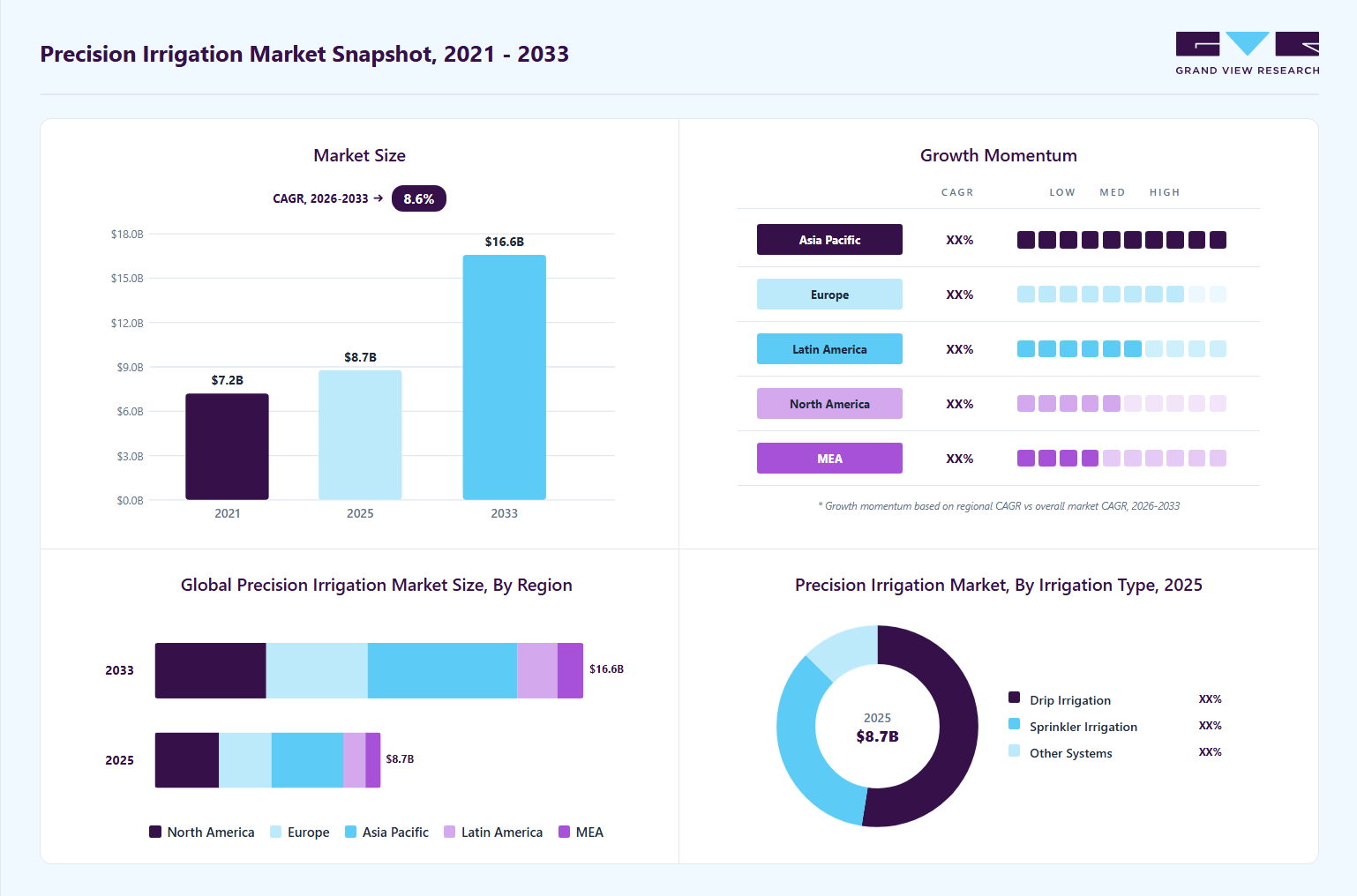 Source: Grand View Research, IR Documents, Primary Interviews, Paid DatabasesTo learn more about this report,
 Download Free Sample Report
 Key Market Trends & Insights
- By irrigation type: Drip irrigation segment held the largest market share of 52.0% in 2025.
- By component: Hardware segment held the largest market share in 2025.
- By technology: Weather-based systems segment held the largest market share in 2025.
- By application: Field crop farming segment held the largest market share in 2025.
Regional Highlights
- Largest regional market: Asia Pacific (31.0% revenue share, 2025)
- By country: China held the largest market share in 2025
Market Size & Forecast
- Market size in 2025: USD 8.7 Billion
- Estimated market size in 2026: USD 9.3 Billion
- Projected market size by 2033: USD 16.6 Billion
- CAGR (2026-2033): 8.6%
Three ways to get this report
Buy it, customize it, or ask a question.Ask an Analyst
Analyst response in 1 business day
- AccessReport author, directly
- Reply timeWithin 1 working day
- No sales callDirect answer only
- FormatEmail reply
- CostFree, no cost
Get the Full Report
What the study covers
- FormatsPDF · Excel · Dashboard
- Timeline2026–2033 annual, 2025 base
- Coverage20+ countries, 5 regions
- Companies10+ key players profiled
Customize the Report
20% free customization
- IncludeCountries, segments, points
- TailorTo your product definition
- ExtendDeeper competitor detail
- OrA fully bespoke study
- Turnaround5–10 working days
Farmers and agribusinesses are increasingly adopting efficient irrigation methods to optimize water use while maintaining crop yield and quality, making precision irrigation a critical solution in modern agriculture. One of the key drivers is the escalating global water scarcity, which is pushing governments and farmers to adopt water-efficient irrigation systems. Traditional irrigation methods often result in significant water loss due to evaporation and runoff, whereas precision irrigation systems, such as drip and sensor-based irrigation, deliver water directly to plant roots. This targeted approach conserves water and improves crop health, making it highly attractive in regions facing water stress.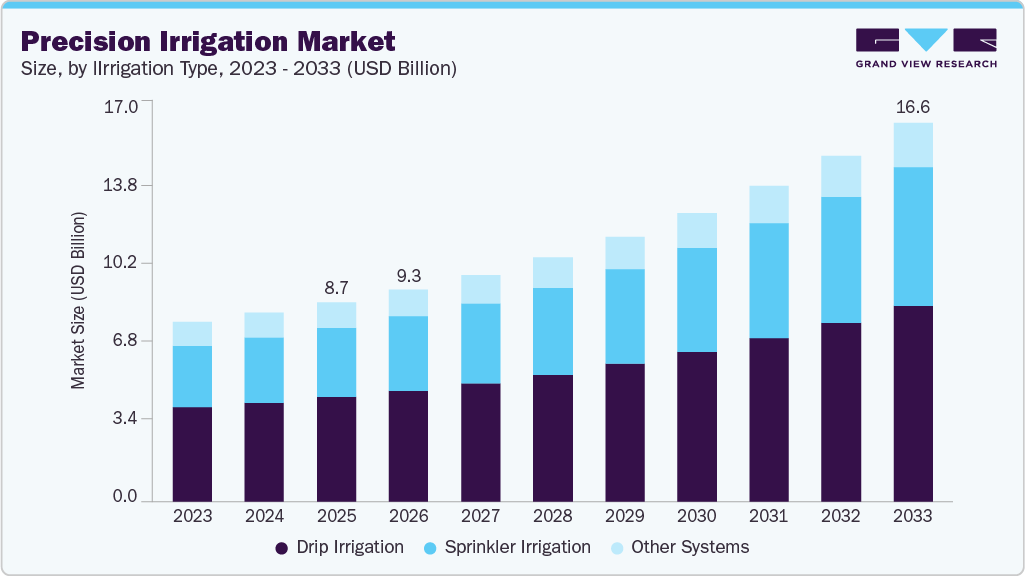 To learn more about this report, Download Free Sample Report
 The growing need to enhance agricultural productivity to meet rising food demand is driving the precision irrigation market's growth. With the global population continuing to grow, farmers are under pressure to maximize output from limited arable land. Precision irrigation enables better control over water application, ensuring crops receive the optimal amount at the right time. This leads to improved yields, reduced input costs, and more efficient resource utilization, thereby accelerating adoption across both large-scale and smallholder farms.
Technological advancements, particularly the integration of IoT, sensors, and data analytics, are further fueling market growth. Modern precision irrigation systems market leverage real-time data from soil moisture sensors, weather forecasts, and satellite imagery to automate irrigation schedules. This reduces manual intervention and enhances decision-making, allowing farmers to adopt a more data-driven approach to irrigation management and significantly improving operational efficiency.
Government initiatives and subsidies that promote sustainable agricultural practices also play a crucial role in market expansion. Many countries are encouraging the use of smart irrigation technologies through financial incentives, awareness programs, and regulatory frameworks aimed at water conservation. These initiatives lower the initial investment burden for farmers and accelerate the adoption of advanced irrigation solutions, particularly in developing regions.
In addition, the growing adoption of precision irrigation beyond traditional agriculture, such as in landscaping, golf courses, and sports grounds, is contributing to market growth. These applications require efficient water management to maintain aesthetic and functional quality while minimizing waste. As sustainability becomes a priority across sectors, the demand for precision irrigation systems in non-agricultural applications is expected to rise steadily, further supporting overall market expansion.
Market Dynamics
Increasing water scarcity is one of the most significant drivers of the precision irrigation market, as farmers are under growing pressure to maximize crop yields while reducing water consumption. Precision irrigation systems, including drip irrigation, soil moisture sensors, weather-based controllers, and automated scheduling platforms, enable growers to apply water precisely where and when it is needed. This minimizes runoff, evaporation, and overwatering, improving water-use efficiency and lowering operating costs. As drought conditions intensify and groundwater resources become increasingly stressed, adoption of precision irrigation technologies is accelerating across both developed and emerging agricultural markets.
According to the Council on Foreign Relations (CFR), in March 2026, agriculture accounted for approximately 70% of global freshwater withdrawals, making it by far the largest consumer of freshwater worldwide. The report also noted that billions of people already experience water stress and that the problem is projected to worsen due to climate change and rising demand. This growing pressure on water resources is driving farmers and governments to invest in precision irrigation systems that improve agricultural productivity while conserving increasingly scarce water supplies.
Power supply constraints in remote farming areas are a significant restraint on the precision irrigation market because many advanced irrigation systems depend on a stable power supply to operate controllers, soil moisture sensors, weather stations, communication modules, and automated valves or pumps. In regions with limited grid access, frequent voltage fluctuations, or common outages, these systems may operate unreliably or require additional investment in solar panels, batteries, or backup generators. Such added infrastructure increases upfront and maintenance costs, making precision irrigation less economically attractive for small and medium-sized farmers. As a result, inadequate and inconsistent power availability can delay adoption, reduce system performance, and limit the scalability of precision irrigation technologies in remote agricultural areas.
This challenge is particularly relevant in developing countries and isolated agricultural regions where farms are located far from reliable utility infrastructure. Even when growers recognize the water-saving and yield benefits of precision irrigation, concerns about powering the system consistently can slow purchasing decisions. Vendors often need to provide solar-powered or hybrid solutions to address this issue, but these configurations further increase project complexity and total ownership costs.
The expansion of solar-powered, off-grid precision irrigation solutions presents a significant opportunity for the precision irrigation equipment market, especially in regions where grid electricity is unreliable or unavailable. These systems combine renewable solar energy with advanced irrigation technologies, such as drip and micro-irrigation, sensors, and automated controllers, to ensure efficient water delivery without reliance on conventional power infrastructure. This makes precision irrigation more viable for farmers in remote, arid, and semi-arid regions, where water scarcity is often compounded by energy constraints.
In addition, declining solar panel costs and improvements in battery storage are making off-grid irrigation systems increasingly affordable and scalable. Governments and development agencies are also supporting solar-based agricultural solutions through subsidies and rural electrification programs, further accelerating adoption. As farmers seek to reduce operational costs and improve yield stability, solar-powered precision irrigation offers a sustainable pathway that enhances water-use efficiency while lowering long-term energy expenses and carbon emissions.
Market Concentration & Characteristics
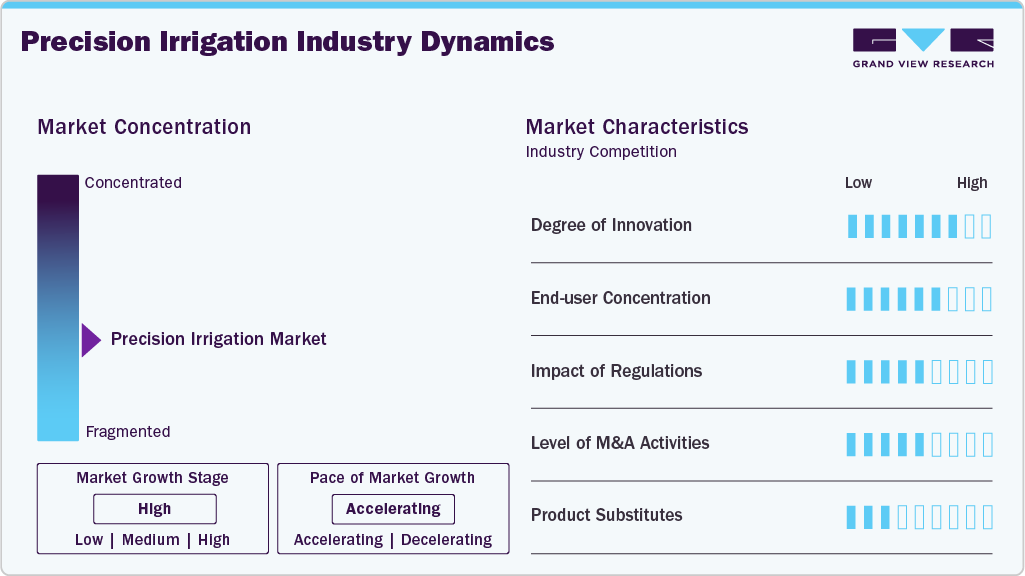
The precision irrigation market is fragmented, with a wide range of participants, from global irrigation manufacturers to local drip irrigation suppliers and software-focused agri-tech companies. Major players such as Netafim, Jain Irrigation, Smart Rain Systems, and The Toro Company benefit from extensive product portfolios, strong dealer networks, and agronomic expertise. However, regional manufacturers and specialized technology providers compete effectively by offering cost-competitive systems and crop-specific solutions, resulting in a broadly distributed competitive landscape rather than a highly concentrated market.
 To learn more about this report, Download Free Sample Report
 End-user concentration in the precision irrigation market is moderate. Demand comes from a broad range of agricultural users, including growers of field crops, fruits, vegetables, vineyards, orchards, and greenhouse produce. Large commercial farms and agribusinesses account for a substantial share of spending because they have greater financial capacity to invest in automated irrigation systems, soil moisture sensors, and data-driven decision tools. At the same time, adoption is expanding among small and medium-sized farms through government subsidy programs and affordable technologies. As a result, while larger agricultural enterprises are important customers, overall demand remains spread across a diverse and geographically dispersed grower base.
Irrigation Type Insights
The drip irrigation segment accounted for the largest market share of over 52.0% in 2025 in the precision irrigation market. This dominance is driven by its superior water-use efficiency, ability to deliver water directly to the root zone, and significant reduction in evaporation and runoff losses. The increasing prevalence of water scarcity and the need for sustainable farming practices have accelerated the adoption of drip systems, particularly in water-stressed regions. In addition, government subsidies and support programs for micro-irrigation, along with the rising cultivation of high-value crops such as fruits and vegetables, further strengthen demand. The system’s compatibility with fertigation and automation technologies also enhances nutrient efficiency and crop yield, making it a preferred choice among both commercial and smallholder farmers.
The sprinkler irrigation segment is anticipated to grow at the fastest CAGR during the forecast period. This growth is primarily driven by its versatility and suitability for large-scale field crop farming, where uniform water distribution across extensive areas is essential. Increasing mechanization in agriculture and the rising adoption of center pivot and lateral move systems are boosting demand for advanced sprinkler solutions. Furthermore, technological advancements, such as smart sprinklers integrated with weather-based controllers and sensors, are improving operational efficiency and reducing water waste. The ability of sprinkler systems to adapt to varying soil types and terrains, coupled with their lower initial installation complexity compared to drip systems, is further contributing to their rapid global adoption.
Component Insights
The hardware segment dominated the precision irrigation market in 2025. This dominance is driven by the essential role of physical components such as controllers, sensors, valves, emitters, and flow meters in enabling efficient irrigation operations. The widespread adoption of drip and sprinkler systems across agricultural fields has directly increased the demand for reliable and durable hardware infrastructure within the precision irrigation equipment market. In addition, growing investments in farm mechanization and modernization, particularly in developing regions, are fueling the installation of advanced irrigation equipment. Government subsidies for irrigation infrastructure and the need for real-time field-level monitoring further support hardware demand, as farmers prioritize systems that can deliver precise water distribution and improve crop productivity.
The software segment is expected to register the fastest CAGR from 2026 to 2033. This growth is primarily driven by the increasing integration of digital technologies such as IoT, cloud computing, and data analytics into irrigation practices. Software platforms enable farmers to monitor soil moisture, weather conditions, and crop health in real time, enabling automated, data-driven irrigation scheduling. The rising adoption of smart farming and precision agriculture solutions is accelerating the demand for advanced irrigation management software. In addition, the shift toward remote farm management, predictive analytics, and mobile-based applications is enhancing operational efficiency and reducing water wastage, making software a critical component of next-generation precision irrigation systems.
Technology Insights
The weather-based systems segment dominated the precision irrigation market in 2025. This dominance is driven by the widespread adoption of climate-responsive irrigation solutions that use real-time and forecasted weather data to optimize water application. These systems automatically adjust irrigation schedules based on parameters such as temperature, rainfall, humidity, and evapotranspiration, significantly reducing water wastage and improving crop efficiency. Increasing awareness about water conservation, coupled with the need to lower operational costs, has encouraged farmers to adopt weather-based controllers. In addition, their relatively lower complexity and ease of integration with existing irrigation infrastructure make them a preferred choice, particularly among small and mid-sized farms seeking cost-effective precision solutions.
The IoT & cloud-based systems segment is expected to register the fastest CAGR from 2026 to 2033. This growth is primarily driven by the rapid digital transformation of agriculture and the increasing demand for data-driven farm management. IoT-enabled sensors and connected devices provide real-time insights into soil moisture, crop conditions, and environmental factors, while cloud platforms enable remote monitoring, analytics, and automated irrigation control. The scalability and flexibility of cloud-based systems allow farmers to manage multiple fields efficiently and make predictive decisions using advanced analytics. Furthermore, the rising adoption of smart farming practices, the increasing penetration of smartphones, and the need for centralized farm management solutions are accelerating the deployment of IoT and cloud-based precision irrigation technologies globally.
Application Insights
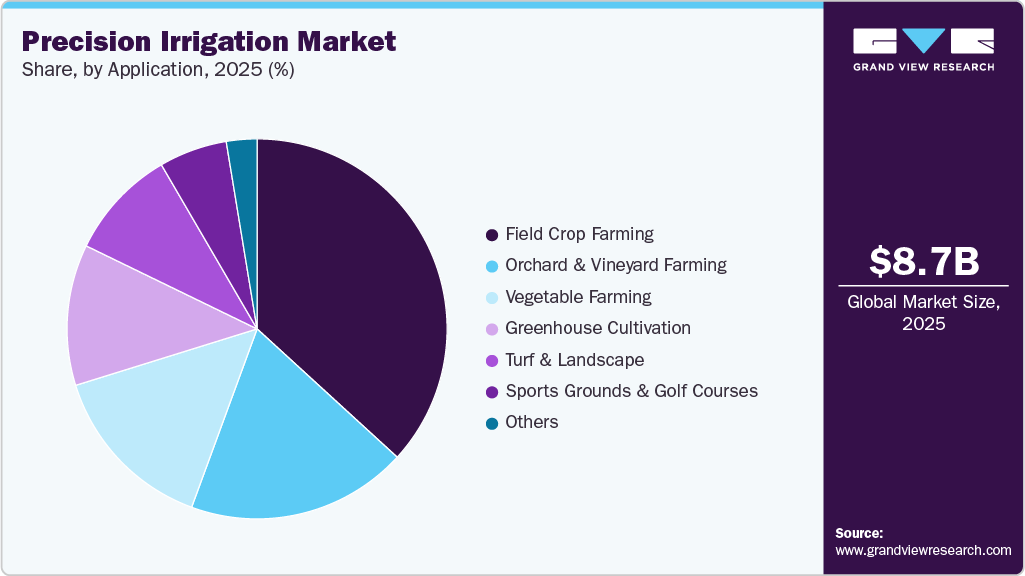
The field crop farming segment accounted for the largest market share of the precision irrigation industry in 2025. This dominance is driven by the extensive cultivation of staple crops such as wheat, rice, corn, and soybeans across large agricultural lands, where efficient water management is critical. The growing need to increase crop yields while minimizing water use has prompted farmers to adopt precision irrigation systems, particularly sprinkler and drip systems tailored for large-scale operations. In addition, rising farm mechanization, government support for modern irrigation infrastructure, and the growing pressure to ensure food security are further accelerating adoption. These systems help optimize water distribution, reduce input costs, and improve overall farm productivity, making them essential for field crop farming.
 To learn more about this report, Download Free Sample Report
 The greenhouse cultivation segment is anticipated to register the fastest CAGR during the forecast period. This growth is primarily driven by the rising demand for high-value crops, year-round production, and controlled environment agriculture. Precision irrigation plays a crucial role in greenhouses by enabling accurate control over water and nutrient delivery, which is essential for maintaining optimal growing conditions. The increasing adoption of advanced technologies, such as automated irrigation systems, integrated climate control, and sensor-based monitoring, is further boosting segment growth. In addition, the shift toward urban farming and protected cultivation, along with the need for higher yield per unit area, is accelerating the adoption of precision irrigation solutions in greenhouse environments.
Regional Insights
The Asia Pacific dominated the precision irrigation industry with a revenue share of over 31.0% in 2025 and is expected to grow at the fastest CAGR from 2026 to 2033. This growth is driven by the region’s large agricultural base, increasing pressure on water resources due to population growth, and the rapid shift toward modern farming practices. Governments across countries such as China, India, and Australia are actively promoting micro-irrigation through subsidy programs and large-scale irrigation modernization initiatives. In addition, rising awareness among farmers regarding efficient water usage, coupled with the expansion of high-value crop cultivation, is accelerating the adoption of precision irrigation systems and driving growth in the modern precision irrigation system market. The growing penetration of affordable irrigation technologies and increasing private sector participation in agri-tech solutions further strengthen the expansion of the modern precision irrigation system market in the region.
 To learn more about this report, Download Free Sample Report
 India Precision Irrigation Market Trends
The precision irrigation industry in India is projected to grow significantly during the forecast period. This growth is primarily driven by strong government-led initiatives such as micro-irrigation schemes and financial assistance programs aimed at improving farm productivity and water-use efficiency. The increasing fragmentation of agricultural land and the need to maximize yield per hectare are encouraging farmers to adopt drip and sprinkler irrigation systems. In addition, erratic monsoon patterns and dependency on rainfall are pushing the demand for reliable irrigation solutions. The rising adoption of contract farming and agri-tech start-ups offering localized irrigation solutions, along with improved access to rural financing and digital advisory services, is further supporting the growth of precision irrigation across the country.
North America Precision Irrigation Market Trends
North America accounted for a significant revenue share of the precision irrigation industry in 2025. This is primarily driven by farmers across North America are increasingly implementing precision irrigation systems to address water scarcity concerns and improve farm efficiency, particularly in drought-prone areas such as the western U.S. and parts of Mexico, further strengthening the growth of the modern precision irrigation system market. In addition, supportive government policies, subsidies for smart irrigation technologies, and rising investments in sustainable farming practices are further accelerating the growth of the precision irrigation systems market. The widespread use of data-driven agriculture, including GPS, remote sensing, and automated irrigation systems, also contributes to the region’s strong market position.
The U.S. precision irrigation market is projected to grow significantly during the forecast period. This growth is driven by the rapid adoption of smart farming technologies, including IoT-enabled irrigation systems and advanced analytics platforms that enhance decision-making and resource optimization. Increasing concerns about groundwater depletion, especially in key agricultural states such as California and Texas, are prompting farmers to shift to more efficient irrigation methods, such as drip and sensor-based systems. The presence of large-scale commercial farms and high awareness regarding sustainable agriculture practices further support the expansion of the U.S. precision irrigation market.
Europe Precision Irrigation Market Trends
The precision irrigation industry in Europe is anticipated to grow steadily from 2026 to 2033. This growth is driven by strict environmental regulations and sustainability mandates that promote efficient water usage and reduced agricultural runoff across the region. The increasing focus on climate-resilient farming practices, supported by frameworks such as the EU’s Common Agricultural Policy (CAP), is encouraging farmers to adopt advanced irrigation technologies. In addition, rising labor costs and the need for agricultural automation are accelerating the deployment of precision irrigation systems. The presence of technologically advanced farming communities and strong research and innovation ecosystems further supports the steady adoption of smart irrigation solutions across European countries.
The precision irrigation industry in the UK is expected to grow significantly during the forecast period. This growth is primarily driven by increasing regulatory pressure on water abstraction and the need to improve on-farm water storage and management practices. Farmers are increasingly adopting precision irrigation to comply with sustainability standards while maintaining crop productivity. In addition, the growing focus on high-efficiency farming, particularly in horticulture and specialty crops, is boosting demand for advanced irrigation systems.
Middle East & South Africa Precision Irrigation Market Trends
The precision irrigation industry in MEA is anticipated to grow steadily from 2026 to 2033. This growth is driven by severe water scarcity, increasing investments in desert agriculture, and government-led initiatives to improve food security across countries such as Saudi Arabia, the UAE, and South Africa. The Saudi Arabia precision irrigation market is expanding due to strong adoption of drip irrigation and smart farming technologies under Vision 2030, while the Saudi Arabia precision irrigation market is also benefiting from rising investments in greenhouse cultivation and solar-powered irrigation systems.
Key Precision Irrigation Company Insights
Some prominent players in the precision irrigation market Galcon, GroGuru, Hunter Industries, HydroPoint, Jain Irrigation Systems Ltd., among others.
-
Jain Irrigation Systems Ltd. is an India-based multinational agricultural and irrigation solutions provider headquartered in Jalgaon, Maharashtra. The company operates as a diversified agri-tech conglomerate with a strong global footprint, including over 30 manufacturing facilities across multiple continents and product distribution in more than 120 countries. Its offerings span a wide range of solutions such as drip irrigation systems, sprinkler systems, micro-irrigation components, piping solutions, fertigation equipment, and climate-resilient agricultural technologies. In addition to hardware, the company provides end-to-end services including soil analysis, irrigation system design, agronomic advisory, and turnkey irrigation project implementation.
-
Galcon is an Israel-based company specializing in smart irrigation and control systems, headquartered in Kfar Blum and established in the early 1980s. The company focuses on the development, manufacturing, and commercialization of computerized irrigation controllers and cloud-based smart irrigation solutions designed for agriculture, landscaping, municipal, and residential applications. Its product portfolio includes automatic irrigation controllers, wireless and web-based control systems, fertigation and climate control solutions, as well as IoT-enabled platforms that allow real-time monitoring and remote management of irrigation operations
Key Precision Irrigation Companies:
The following key companies have been profiled for this study on the precision irrigation market.
- Galcon
- GroGuru
- Hunter Industries
- HydroPoint
- Jain Irrigation Systems Ltd.
- Mahindra EPC Irrigation Limited
- Nelson Irrigation
- Netafim
- Rain Bird Corporation
- SENNINGER
- Smart Irrigation Company
- Smart Rain Systems, LLC
- Telit Cinterion
- The Toro Company
- WiseConn Engineering
Competitive Benchmarking
Operating Strategies
Competitive Edge
Weakness
Mature Players: Netafim, Rain Bird, Toro, Hunter Industries, Jain Irrigation, Mahindra EPC
- Expand globally through dealer and distributor networks.
- Invest in R&D to integrate drip systems, fertigation, controllers, and digital platforms.
- Pursue acquisitions, partnerships, and agronomic service expansion.
- Strong brand recognition and long-standing customer relationships.
- Comprehensive end-to-end portfolios covering hardware, software, and agronomic support.
- Large manufacturing capacity and an established after-sales service infrastructure.
- Higher organizational complexity can slow innovation cycles.
- Premium pricing may limit penetration among smallholder farmers.
- Legacy product lines may create integration and modernization challenges.
Emerging Players: GroGuru, HydroPoint, Smart Rain Systems, WiseConn Engineering
- Develop IoT-based monitoring, AI-driven analytics, and cloud irrigation platforms.
- Target niche segments such as soil sensing, landscape automation, and connectivity modules.
- Build growth through OEM partnerships, SaaS subscriptions, and pilot deployments.
- Faster innovation and agile product development.
- Flexible subscription-based business models with lower upfront costs.
- Limited global distribution and smaller sales teams.
- Lower manufacturing scale and reduced pricing leverage.
- Greater dependence on partnerships for market access and hardware integration.
Recent Developments
-
In February 2026, Orbia Netafim announced a collaboration with Amazon India to deploy advanced drip irrigation solutions across agricultural regions in Bengaluru and Hyderabad. The initiative focuses on improving water-use efficiency and supporting sustainable farming practices. Through this project, the companies aim to significantly enhance irrigation performance for farmers. The collaboration is expected to conserve around 325 million liters of water annually while boosting agricultural productivity.
-
In February 2026, Orbia Netafim announced the launch of its AI-powered Dosing 5G product range for precision fertigation management. The new solution integrates advanced AI-driven automated dosing, remote monitoring, and control capabilities to optimize water and nutrient delivery. The portfolio includes FertiKit 5G, FertiOne 5G, NetaJet 5G, and NetaFlex 5G, designed for various agricultural applications. The system leverages self-learning AI to enhance crop yield, improve resource efficiency, and reduce input costs while minimizing environmental impact.
-
In April 2025, Rain Bird Corporation acquired OtO Inc., a Toronto-based company specializing in smart, solar-powered sprinkler systems. This acquisition enhances Rain Bird’s smart irrigation portfolio by incorporating hose-end irrigation solutions for residential applications. OtO’s technology enables app-controlled, weather-responsive watering tailored for smaller and uniquely shaped landscapes. The move strengthens Rain Bird’s capabilities in delivering efficient and intelligent irrigation solutions for homeowners.
-
In February 2025, Orbia Netafim introduced the world’s first Hybrid Dripline system, a patented solution featuring an integrated built-in outlet. The system combines the advantages of both integral and on-line dripper technologies into a single design. It removes the need for manual hole punching while ensuring consistent and reliable water delivery. This innovation enhances operational efficiency and reduces labor efforts across applications such as orchards, vineyards, and greenhouse cultivation.
Precision Irrigation Market Report Scope
Report Attribute
Details
Market size in 2025
USD 8.7 billion
Estimated market size in 2026
USD 9.3 billion
Projected market size by 2033
USD 16.6 billion
Growth rate
CAGR of 8.6% from 2026 to 2033
Actual data
2021 - 2025
Forecast period
2026 - 2033
Quantitative units
Revenue in USD billion and CAGR from 2026 to 2033
Report coverage
Revenue forecast, company share, competitive landscape, growth factors, and trends
Segments covered
Irrigation type, component, technology, application, and region
Regional scope
North America; Europe; Asia Pacific; Latin America; MEA
Country scope
U.S.; Canada; Mexico; UK; Germany; France; China; India; Japan; Australia; South Korea; Brazil; UAE; Saudi Arabia; South Africa
Key companies profiled
Galcon; GroGuru; Hunter Industries; HydroPoint; Jain Irrigation Systems Ltd.; Mahindra EPC Irrigation Limited; Nelson Irrigation; Netafim; Rain Bird Corporation; SENNINGER; Smart Irrigation Company; Smart Rain Systems, LLC; Telit Cinterion; The Toro Company; WiseConn Engineering
Customization scope
Free report customization (equivalent to 8 analysts working days) with purchase. Addition or alteration to country, regional & segment scope.
Pricing and purchase options
Avail customized purchase options to meet your exact research needs. Explore purchase options
Global Precision Irrigation Market Report Segmentation
This report forecasts revenue growth at global, regional, and country levels and provides an analysis of the latest industry trends in each of the sub-segments from 2021 to 2033. For this study, Grand View Research has segmented the precision irrigation market report based on irrigation type, component, technology, application, and region:
-
Irrigation Type Outlook (Revenue, USD Million, 2021 - 2033)
-
Drip Irrigation
-
Sprinkler Irrigation
-
Other Systems
-
-
Component Outlook (Revenue, USD Million, 2021 - 2033)
-
Hardware
-
Controllers & Timers
-
Sensors
-
Valves & Flow Meters
-
Emitters & Pressure Regulators
-
Others
-
-
Software
-
Services
-
-
Technology Outlook (Revenue, USD Million, 2021 - 2033)
-
Weather-Based Systems
-
Remote Sensing & GIS-Based Systems
-
IoT & Cloud-Based Systems
-
Variable Rate Irrigation Systems
-
Others
-
-
Application Outlook (Revenue, USD Million, 2021 - 2033)
-
Field Crop Farming
-
Orchard & Vineyard Farming
-
Vegetable Farming
-
Greenhouse Cultivation
-
Turf & Landscape
-
Sports Grounds & Golf Courses
-
Others
-
-
Regional Outlook (Revenue, USD Million, 2021 - 2033)
-
North America
-
U.S.
-
Canada
-
Mexico
-
-
Europe
-
Germany
-
UK
-
France
-
-
Asia Pacific
-
China
-
India
-
Japan
-
South Korea
-
Australia
-
-
Latin America
-
Brazil
-
-
Middle East & Africa
-
UAE
-
Saudi Arabia
-
South Africa
-
-
Delivered Customizations
This report has been delivered with the following In-depth customizations
Client Request
Customization Delivered
Value Adds
Precision Irrigation Market Opportunity Assessment for an Agricultural Technology Provider
Assessment of evolving irrigation practices across water-stressed agricultural regions, with emphasis on transition from conventional flood irrigation toward sensor-based and automated irrigation systems.
Analysis of farmer pain points including water wastage, inconsistent soil moisture management, rising labor dependency, and crop yield variability.
Identified high-potential customer segments actively seeking water optimization and yield improvement solutions.
Supported development of market positioning focused on resource efficiency and operational automation.
Smart Irrigation Product Strategy for a Farm Equipment Manufacturer
Analysis of grower requirements across open-field farming, greenhouse cultivation, and horticulture applications where crop sensitivity demands precise water delivery.
Identification of operational requirements related to variable-rate irrigation, remote control functionality, fertigation compatibility, and integration with weather-based decision systems.
Identified product features with strongest adoption potential among commercial growers and progressive farming communities.
Supported product roadmap development aligned with practical field-level irrigation challenges.
Precision Irrigation Commercialization Strategy for an Agri-Input or Irrigation Solutions Company
Assessment of adoption barriers including upfront investment concerns, technology awareness gaps, fragmented farm ownership, and integration complexity
Analysis of decision-making behavior among growers regarding ROI, water savings, labor reduction, and long-term crop performance improvements
Identified commercialization pathways through ecosystem partnerships and farmer education programs.
Supported go-to-market strategy focused on outcome-based selling and demonstration-led adoption.
Frequently Asked Questions About This Report
The drip irrigation segment led with a 52.0% revenue share in 2025, while the sprinkler irrigation segment is the fastest-growing.
The hardware segment held the largest revenue share in 2025, while the software segment is the fastest-growing.
The weather-based systems segment held the largest revenue share in 2025, while the IoT & cloud-based systems segment is the fastest-growing.
Field crop farming segment held the largest share in 2025, while the greenhouse cultivation segment is the fastest-growing.
Asia Pacific dominated with a 31.0% revenue share in 2025.
The global precision irrigation market size was valued at USD 8.7 billion in 2025 and is estimated at USD 9.3 billion for 2026.
The global precision irrigation market is expected to grow at a CAGR of 8.6% from 2026 to 2033, reaching USD 16.6 billion by 2033.
Key players include Galcon; GroGuru; Hunter Industries; HydroPoint; Jain Irrigation Systems Ltd.; Mahindra EPC Irrigation Limited; Nelson Irrigation; Netafim; Rain Bird Corporation; SENNINGER; Smart Irrigation Company; Smart Rain Systems, LLC; Telit Cinterion; The Toro Company; WiseConn Engineering
Factors such as increasing water scarcity and the need for efficient water resource management, rising adoption of smart farming technologies including IoT-enabled irrigation systems, and growing government support through subsidies and sustainable agriculture initiatives play a key role in accelerating the precision irrigation market.
About the Author(s)
Next Generation Technologies Research Team
Technology · Next Generation TechnologiesThis report was authored by the next generation technologies research team at Grand View Research - comprising two research analysts, one senior research analyst, and one industry expert - with specialized expertise in the next generation technologies segment of the technology industry. All findings are based on proprietary technology databases, executive interviews, and regulatory analysis, subject to internal peer review prior to publication.
Last Updated:
Speak to Analyst

Customize this report to your needs - add regions, segments, or data points, with 20% free customization.
Or view our licence options:


ISO 9001:2015 & 27001:2022 Certified
We are GDPR and CCPA compliant! Your transaction & personal information is safe and secure. For more details, please read our privacy policy.


