
- Home
- »
- Next Generation Technologies
- »
-
Smart Tracker Market Size, Share & Trends Report, 2033GVR Report cover

Smart Tracker Market (2026 - 2033)
Size, Share, & Trends Analysis By Technology (Bluetooth, GPS, Cellular), By Application (Pet Tracking, People Tracking, Asset Tracking), By Distribution Channel (Online, Offline), By End-use, By Region, And Segment Forecasts
Market Size, 2025
$725.1MMarket Estimate, 2026
$816.5MMarket Forecast, 2033
$1,911.0MCAGR, 2026–2033
12.9%Smart Tracker Market Summary
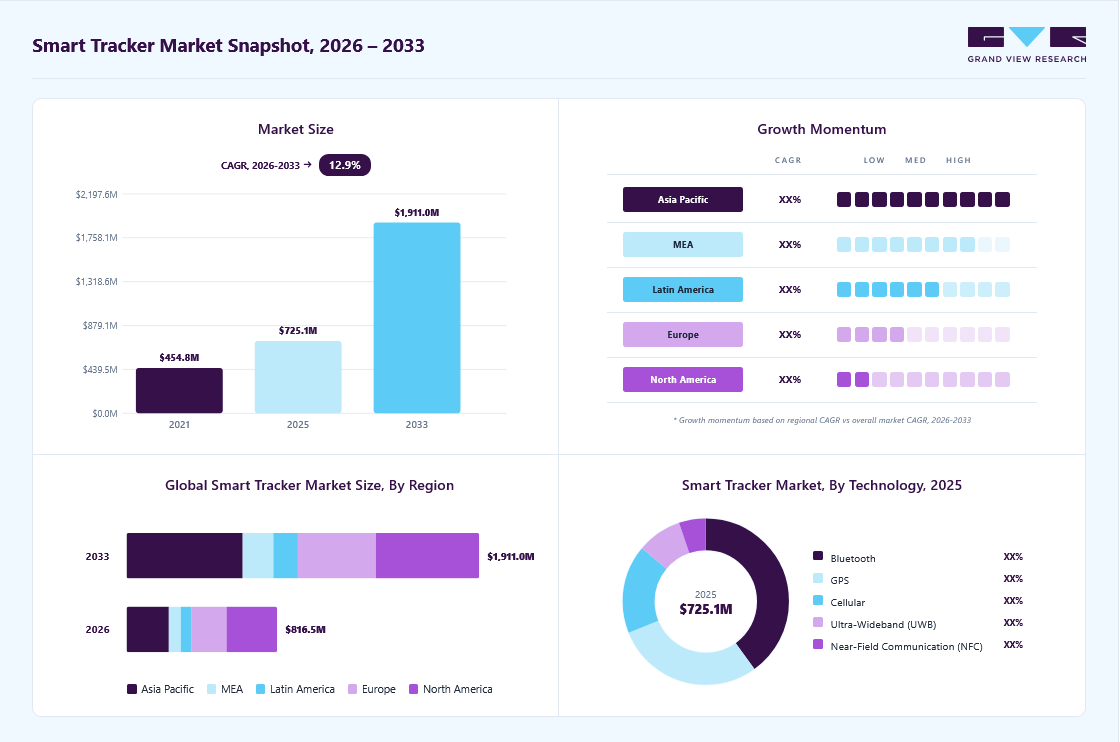
The global smart tracker market size was valued at USD 725.1 million in 2025 and is projected to grow from USD 816.5 million in 2026 to USD 1,911.0 million by 2033, at a CAGR of 12.9% from 2026 to 2033. North America dominated the market, accounting for the revenue share of 34.2% in 2025. The market growth is due to rising demand for real-time location monitoring of people, pets, luggage, and personal assets, supported by advancements in Bluetooth, GPS, and cellular tracking technologies.
 Source: Grand View Research, IR Documents, Primary Interviews, Paid DatabasesTo learn more about this report,
 Download Free Sample Report
Key Market Trends & Insights
- By technology: Bluetooth segment dominated the market, with a revenue share of 40.0% in 2025.
- By application: Personal belongings tracking segment led the market and accounted for a revenue share of 35.6% in 2025
- By distribution channel: Online segment held the largest revenue share of 64.5% in 2025
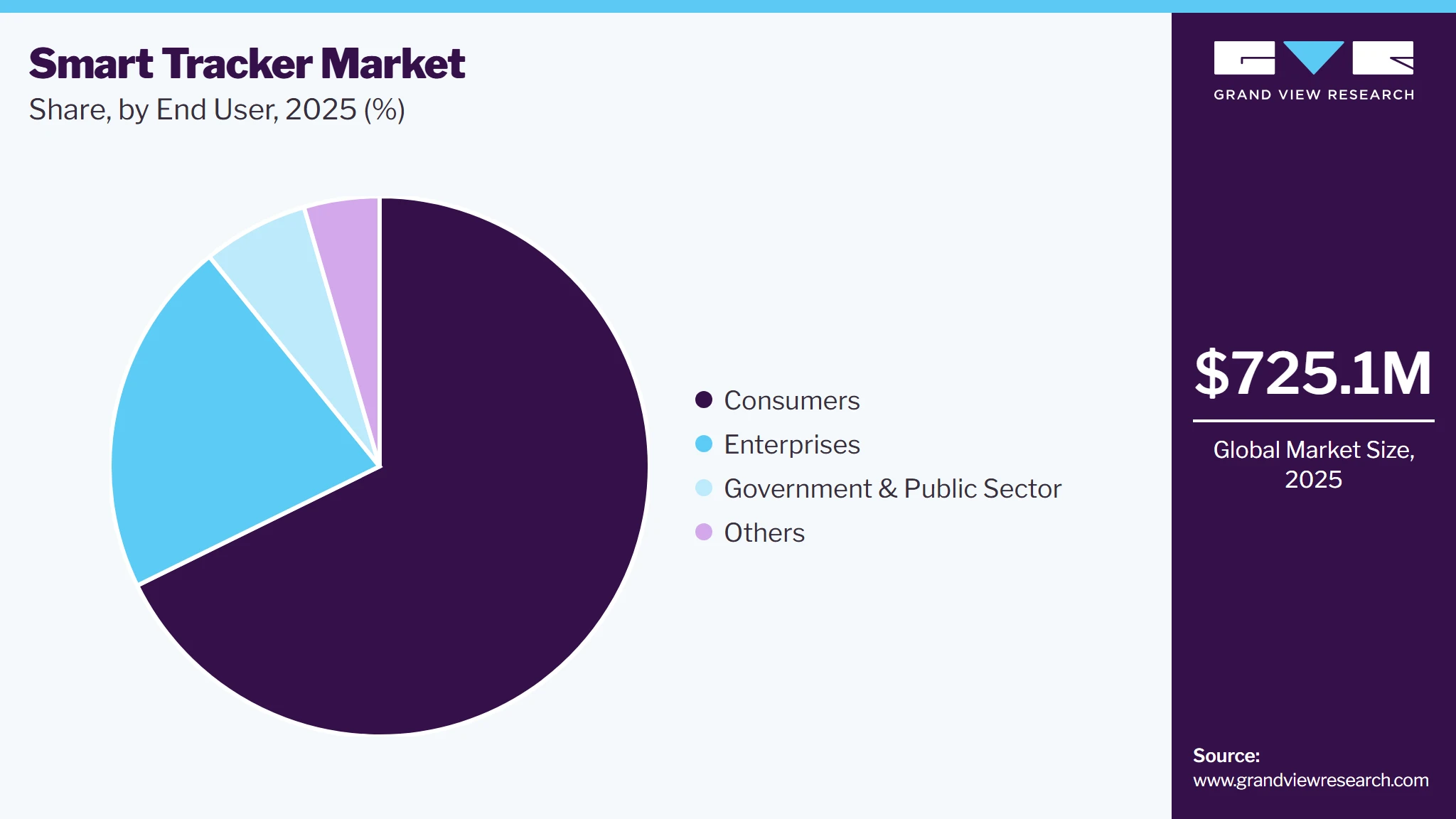
- By end-use: Consumer segment accounted for the largest market revenue share of 67.7% in 2025.
Regional Highlights
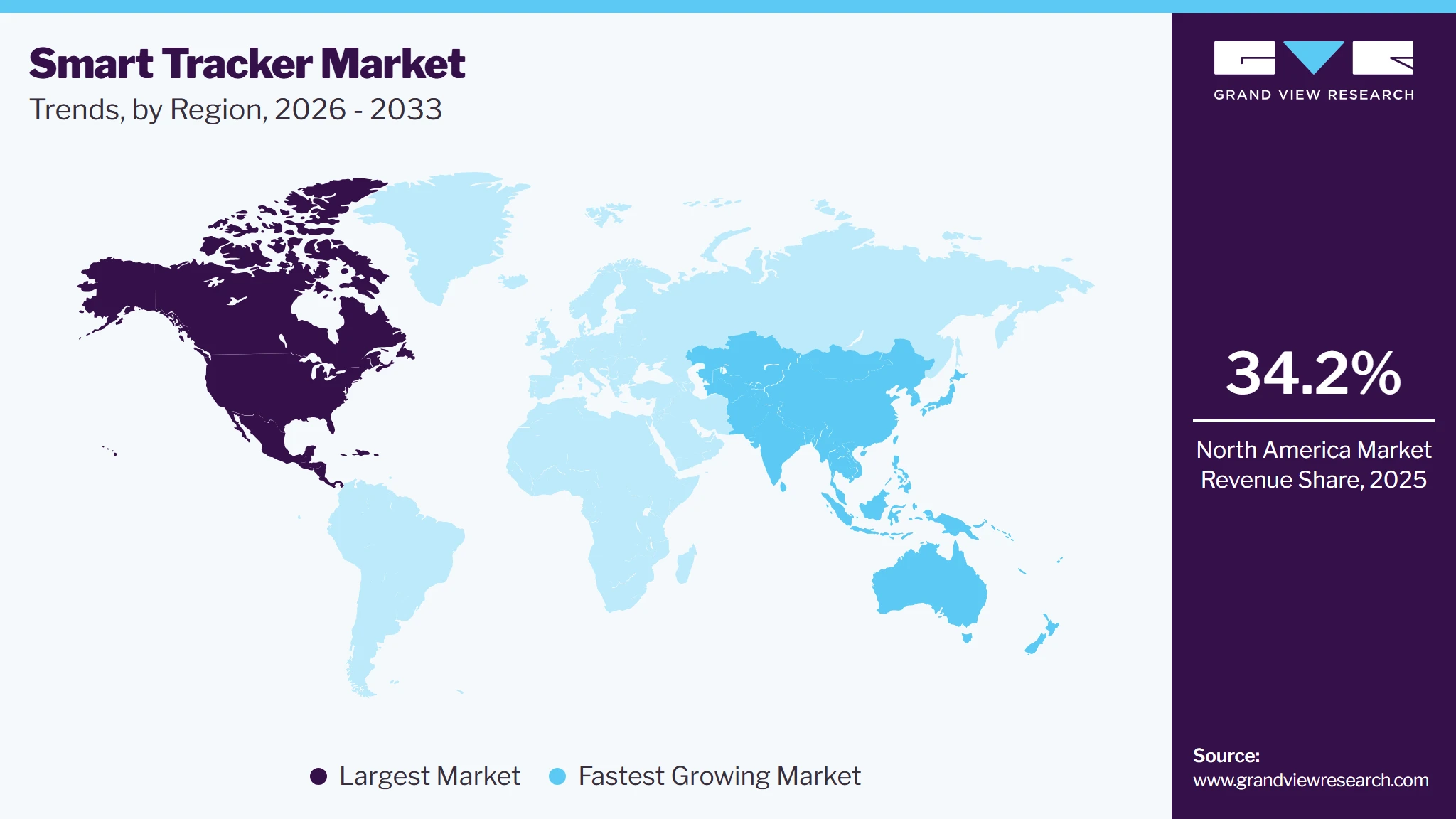
- Largest regional market: North America (34.2% revenue share, 2025)
- Fastest-growing regional market: Asia Pacific (highest CAGR, 2026-2033)
- By country: The U.S. held the largest market share in 2025.
Market Size & Forecast
- Market size in 2025: USD 725.1 Million
- Estimated market size in 2026: USD 816.5 Million
- Projected market size by 2033: USD 1,911.0 Million
- CAGR (2026-2033): 12.9%
Three ways to get this report
Buy it, customize it, or ask a question.Ask an Analyst
Analyst response in 1 business day
- AccessReport author, directly
- Reply timeWithin 1 working day
- No sales callDirect answer only
- FormatEmail reply
- CostFree, no cost
Get the Full Report
What the study covers
- FormatsPDF · Excel · Dashboard
- Timeline2026–2033 annual, 2025 base
- Coverage20+ countries, 5 regions
- Companies10+ key players profiled
Customize the Report
20% free customization
- IncludeCountries, segments, points
- TailorTo your product definition
- ExtendDeeper competitor detail
- OrA fully bespoke study
- Turnaround5–10 working days
Increasing concerns around misplaced or stolen personal belongings are driving the adoption of smart trackers for wallets, luggage, keys, bags, and other valuables. Bluetooth-based tags and GPS-enabled trackers allow users to locate items through connected mobile applications, improving convenience and reducing the likelihood of permanent loss. The growing use of trackers across personal belongings and small assets is therefore supporting market expansion.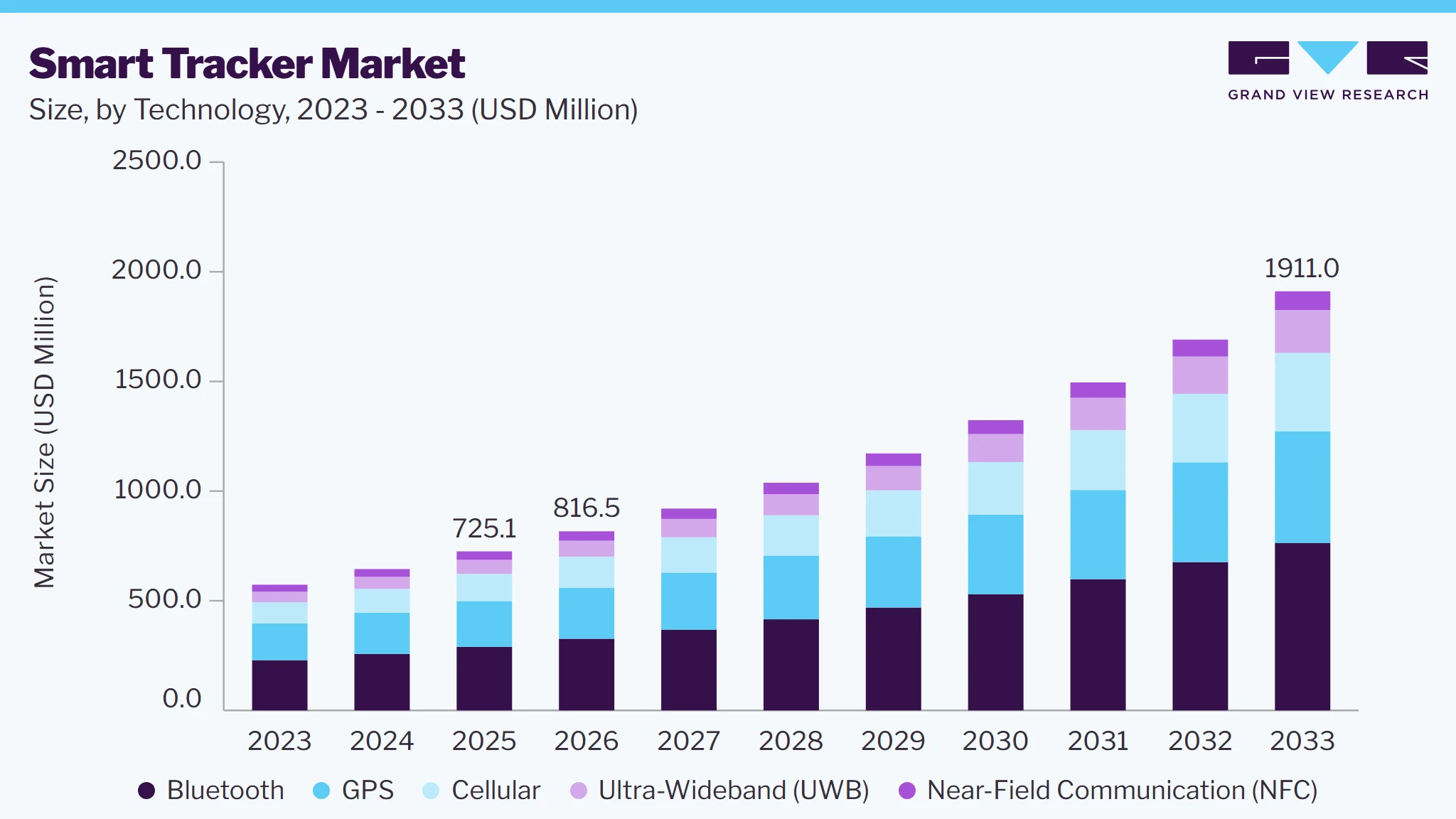 To learn more about this report, Download Free Sample Report
The growing penetration of smartphones, BT-enabled devices, and connected ecosystems is creating a favorable environment for smart tracker adoption. Modern trackers can integrate with smartphone operating systems and device-finding networks, enabling users to locate tagged objects through established connectivity infrastructure without requiring a dedicated tracking device for every asset. Compatibility with broader connected-device ecosystems is consequently increasing the practical applications of smart trackers.
Improvements in Bluetooth Low Energy (BLE), GNSS/GPS, cellular connectivity, battery efficiency, and compact electronics are enhancing tracker functionality. Manufacturers can develop smaller devices with longer battery life while supporting more accurate location information and broader connectivity. These technological improvements are enabling smart trackers to address applications ranging from personal belongings to pets and small assets. For instance, in June 2026, Motorola introduced the Moto Tag 2, incorporating Bluetooth 6.0 with Channel Sounding, Ultra Wideband (UWB) technology for more precise location tracking, and an improved battery offering more than 500 days of operation. These advancements improve location accuracy and battery life, supporting wider adoption of smart trackers for personal belongings and small assets.
Market Dynamics
The smart tracker market is supported by increasing demand for connected solutions across pets, luggage, wallets, personal safety, and small assets. Improvements in smartphone ecosystems, wireless connectivity, miniaturized electronics, and location technologies are expanding tracker applications beyond conventional item-finding use cases. Growing consumer awareness of connected tracking and the availability of subscription-based tracking services are also broadening adoption.
The growing demand for remote monitoring of pets, children, elderly individuals, and other vulnerable users is driving the smart tracker industry as consumers seek greater visibility over their location and movement. GPS- and cellular-enabled trackers can support real-time location monitoring, geofencing, movement alerts, and location history, allowing users to respond more quickly when a tracked individual or pet moves outside a predefined area. In June 2026, Fi launched Fi Ultra, a dog tracker incorporating T-Satellite with Starlink connectivity, expanding tracking capabilities beyond conventional cellular coverage. Such developments are broadening the application of smart trackers from personal belongings toward safety and continuous monitoring.
Battery dependence and recurring connectivity costs can constrain market growth, particularly for GPS- and cellular-enabled devices that require continuous location updates. Unlike basic Bluetooth tags, advanced trackers may require frequent charging or battery replacement to maintain uninterrupted tracking functionality. Cellular-enabled devices can also involve subscription fees for connectivity and location services, increasing the total cost of ownership. These requirements may affect adoption among price-sensitive consumers and limit the practicality of continuous tracking for certain applications.
The increasing need for visibility of tools, equipment, inventory, rental assets, and other movable items creates opportunities for smart trackers in commercial and small-asset monitoring. Compact tracking devices can help businesses identify asset locations, monitor movement, reduce misplacement, and improve utilization without requiring complex tracking infrastructure. The expansion of smart tracking into logistics, field services, retail, construction, and other asset-intensive industries can therefore broaden the addressable market beyond conventional consumer applications.
Market Concentration & Characteristics
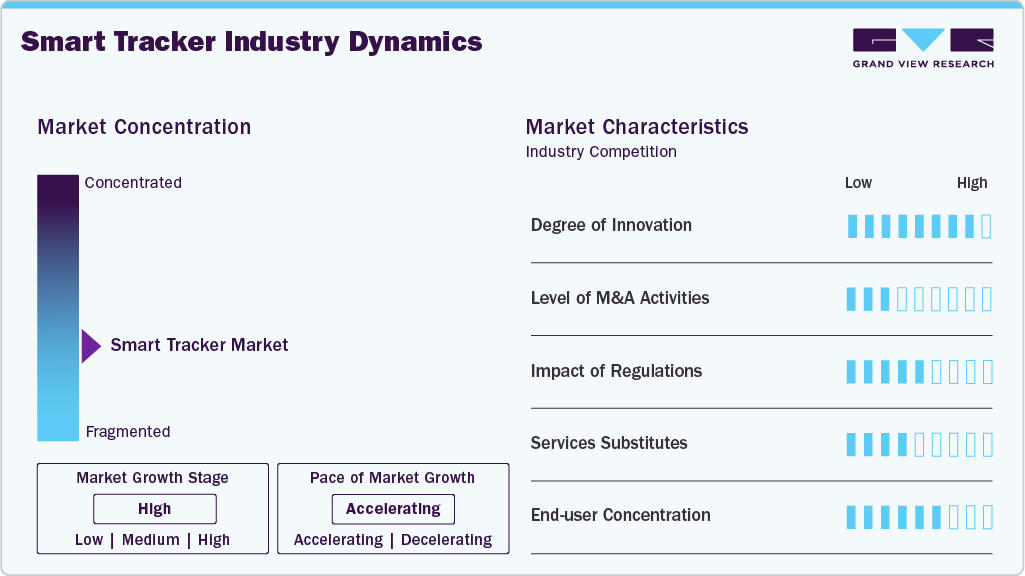
The smart tracker industry is moderately fragmented, with competition among global consumer electronics companies, location technology providers, wearable device manufacturers, and specialized tracking solution providers. Major participants include Apple, Samsung, Tile, Motorola, Chipolo, Garmin, Jiobit, and other regional and specialized providers. Entry barriers are moderate because competitive offerings require compact hardware design, Bluetooth and/or GPS connectivity, mobile application development, location-platform integration, battery optimization, device-network compatibility, and established consumer or enterprise distribution channels.
 To learn more about this report, Download Free Sample Report
The market is in an expansion stage, supported by increasing adoption of tracking devices for personal belongings, pets, luggage, personal safety, and small assets. Adoption is expanding from basic Bluetooth item trackers toward GPS- and cellular-enabled devices incorporating geofencing, location alerts, UWB-based precision finding, cloud connectivity, and subscription-based services. Competitive differentiation is increasingly shifting from basic location identification toward tracking accuracy, connectivity coverage, battery life, ecosystem compatibility, application functionality, privacy and security features, and integration with broader connected-device platforms.
Analyst Perspective
The convergence of location technologies, connected devices, mobile ecosystems, cloud platforms, and advanced wireless connectivity is expected to increasingly shape the global market. Consumers and businesses are moving from basic item-finding devices to integrated tracking solutions that monitor belongings, pets, luggage, personal safety devices, and small assets through centralized applications. Smart trackers are also expected to evolve beyond simple location identification toward various features. At the same time, adoption is likely to expand with greater emphasis on battery efficiency, connectivity coverage, privacy, data security, and seamless integration with broader smartphone and connected-device ecosystems.
Technology Insights
The bluetooth segment led the market with the largest revenue share of 40.0% in 2025, driven by the widespread availability of Bluetooth-enabled smartphones and the low-power characteristics of Bluetooth Low Energy (BLE), which allow trackers to communicate with nearby devices while consuming relatively little energy. Its compatibility with existing mobile ecosystems and relatively simple hardware architecture make bluetooth suitable for everyday tracking applications where users primarily need proximity-based finding rather than continuous wide-area positioning.
The Ultra-Wideband (UWB) segment is anticipated to grow at the fastest CAGR during the forecast period, driven by demand for highly precise short-range positioning and directional finding. UWB can determine relative distance and direction with greater precision than conventional Bluetooth-based proximity detection, supporting applications where users need to locate an object within a room, building, or other defined area. The increasing integration of UWB capabilities into premium smartphones and connected devices is strengthening compatibility between trackers and host devices, thereby supporting the adoption of UWB-enabled smart trackers for precision-finding applications.
Application Insights
The personal belongings tracking segment led the market with the largest revenue share of 35.6% in 2025, driven by the increasing number and variety of everyday items consumers carry or regularly use, including keys, wallets, bags, backpacks, and other valuables. Smart trackers provide a practical way to link these items to smartphone-based identification and notification systems, helping users organize and monitor multiple belongings through a single application.
The asset tracking segment is anticipated to grow at the fastest CAGR during the forecast period, supported by businesses' increasing need to improve visibility and utilization of movable equipment, tools, inventory, and other low-value or distributed assets. Smart trackers offer a relatively lightweight tracking option for organizations that may not require the infrastructure of dedicated industrial tracking systems.
Distribution Channel Insights
The online segment led the market with the largest revenue share of 64.5% in 2025 and is projected to grow at the fastest CAGR during the forecast period, as consumers increasingly research and purchase connected electronics through e-commerce marketplaces and manufacturer websites. Online channels allow customers to compare tracker specifications, compatibility, battery characteristics, subscription requirements, and user reviews before purchase. Direct-to-consumer sales also enable manufacturers to bundle hardware with digital services or subscriptions, while broad geographic reach allows smart tracker brands to access customers beyond their physical retail footprint.
The offline segment is expected to grow at a significant CAGR during the forecast period, driven by consumers' preference for physically evaluating electronic devices and seeking assistance when selecting trackers, particularly regarding device compatibility, functionality, and intended use. Electronics retailers, mobile phone stores, supermarkets, and specialty outlets offer immediate product availability and facilitate accessory purchases alongside smartphones and other connected devices.
End-use Insights
The consumer segment led the market with the largest revenue share of 67.7% in 2025, driven by the growing integration of smart trackers into everyday routines for belongings, pets, travel items, and other personally valuable objects. Consumers can deploy multiple trackers across different items and manage them through smartphone applications, creating recurring use rather than one-time adoption.
 To learn more about this report, Download Free Sample Report
The enterprises segment is expected to grow the fastest CAGR over the forecast period, driven by the need to improve operational visibility over distributed equipment, tools, inventory, and other movable assets. Organizations can use compact trackers to complement existing asset-management processes and obtain location information without deploying expensive dedicated tracking infrastructure for every asset.
Regional Insights
The North American smart tracker market held the largest revenue share of 34.2% in 2025, driven by the strong integration of connected-device ecosystems across smartphones, wearables, and smart-home products, enabling trackers to function as part of broader digital platforms. High consumer familiarity with app-based connected services and established technology ecosystems support the adoption of trackers for personal belongings, pets, luggage, and small assets.
 To learn more about this report, Download Free Sample Report
U.S. Smart Tracker Market Trends
The smart tracker market in the U.S. accounted for the largest revenue share in North America in 2025, driven by the growing use of trackers for pet monitoring and personal safety applications. Consumers increasingly use GPS- and cellular-enabled devices to establish geofences, receive location alerts, and monitor movement remotely.
Europe Smart Tracker Market Trends
The smart tracker market in Europe is anticipated to grow at a considerable CAGR from 2026 to 2033, driven by increasing emphasis on digital privacy, responsible use of connected devices, and secure handling of location data. Consumers and enterprises are placing greater importance on how tracking information is collected, processed, and shared, encouraging providers to incorporate privacy controls, user permissions, and security mechanisms into tracking solutions.
The UK smart tracker market is expanding rapidly, owing to the expansion of connected pet-care and animal-monitoring solutions. Increasing consumer spending on pet technology is driving demand for trackers that provide location monitoring, geofencing, activity data, and alerts via mobile applications.
The smart tracker market in Germany held a substantial revenue share in Europe in 2025, driven by the growing adoption of digital asset-management practices among industrial and logistics businesses. Manufacturers, warehouses, and service organizations require greater visibility over tools, equipment, containers, and movable assets distributed across facilities.
Asia Pacific Smart Tracker Market Trends
The smart tracker market in the Asia Pacific is anticipated to grow at the fastest CAGR during the forecast period, due to the rapid expansion of smartphone ownership and digital consumer ecosystems across emerging and developed economies. A large connected-device user base provides a substantial installed ecosystem with which smart trackers can communicate through mobile applications and device-finding networks.
The Japan smart tracker market is expected to grow rapidly during the forecast period, driven by the increasing application of compact connected technologies in an aging society, particularly for monitoring belongings and supporting location awareness for older individuals. The country's high adoption of consumer electronics and preference for compact, technologically integrated products provide a favorable environment for small-form-factor tracking devices and location-enabled wearables.
The smart tracker market in China held a substantial share of the Asia Pacific market in 2025, driven by the rapid development of domestic consumer electronics and IoT ecosystems, with manufacturers increasingly integrating tracking capabilities into smartphones, wearables, smart devices, and other connected products. A large domestic electronics manufacturing base also supports the development of compact hardware at different price points, enabling trackers to reach mass-market consumers and specialized applications.
Key Smart Tracker Company Insights
Key players operating in the smart tracker industry are Life360, Tractive, Apple Inc., SAMSUNG, Garmin Ltd., and Motorola. The companies are focusing on various strategic initiatives, including new product development, partnerships & collaborations, and agreements to gain a competitive advantage over their rivals.
Key Smart Tracker Companies
The following key companies have been profiled for this study on the smart tracker market.
-
Apple Inc.
-
Beijing Zizai Technology Co., Ltd.
-
Chipolo
-
Cube Tracker
-
Garmin Ltd.
-
Invoxia
-
Kaltio Technologies Oy
-
Life360
-
Minew
-
Motorola
-
Pebblebee
-
PitPat
-
SAMSUNG
-
Trackimo Inc.
-
Tractive
Competitive Benchmarking
Category
Operating Strategies
Competitive Edge
Weakness
Established Players (Life360, Tractive, Apple Inc., SAMSUNG, Garmin Ltd., Motorola)
- Invest in Bluetooth, GPS, cellular, UWB, precision-finding, geofencing, location alerts, pet monitoring, personal safety, and connected-device ecosystems.
- Expand smart-tracker portfolios through new product development, strategic partnerships, acquisitions, mobile-platform integration, and subscription-based services.
- Strong consumer brands, large installed bases of smartphones and connected devices, established mobile applications, and extensive retail and online distribution networks.
- Broad technology capabilities spanning Bluetooth, GPS, cellular connectivity, UWB, cloud platforms, mobile applications, location services, and connected-device ecosystems.
- Higher product-development and ecosystem-integration costs can increase device prices, particularly for trackers incorporating GPS, cellular, UWB, or advanced location technologies.
- Dependence on smartphone platforms, wireless networks, and cloud services can affect functionality and operating costs.
Emerging Players (Kaltio Technologies Oy, Cube Tracker, Trackimo, Minew)
- Focus on specialized Bluetooth, GPS, cellular, pet, personal, luggage, wallet, and small-asset tracking solutions.
- Expand product capabilities through partnerships with connectivity providers, mobile platforms, retailers, distributors, and technology companies.
- Greater flexibility in developing specialized tracker products and responding to specific consumer or small-asset tracking requirements.
- Focused product portfolios can support faster product adaptation, compact form factors, competitive pricing, and specialized features.
- Smaller customer bases and lower brand recognition compared with major technology and consumer-electronics companies.
- Limited ownership of smartphone operating systems, wireless networks, or large location ecosystems can increase reliance on third-party platforms and connectivity providers.
Recent Developments
-
In July 2026, Life360 business partnered with Disney to launch a limited-edition collection of Bluetooth trackers featuring Mickey Mouse and Minnie Mouse designs. The collaboration includes three tracker products: Mickey and Minnie Mouse starter packs and a standalone Mickey Mouse Tile, designed to track everyday belongings such as wallets, backpacks, luggage, passports, and keys. The trackers support Bluetooth connectivity with Apple and Android devices through the Life360 app, with the Mickey Mouse Tile offering a range of up to 350 feet and a battery life of up to three years.
-
In March 2026, Tractive announced that it had entered into a definitive agreement to be acquired by European technology company Bending Spoons, with the transaction expected to close in the second quarter of 2026, subject to customary conditions and regulatory approvals. The acquisition is intended to support Tractive’s expansion in pet technology by combining its expertise in GPS-based location tracking and pet health monitoring with Bending Spoons’ AI infrastructure and global scaling capabilities. Bending Spoons also stated that it plans to invest in next-generation devices and expand Tractive’s health and safety features to support the continued development of its pet-tracking product portfolio.
-
In January 2026, Apple Inc. introduced its next-generation AirTag with enhanced location-tracking capabilities, including an upgraded Bluetooth chip and Apple’s second-generation Ultra Wideband chip. The new AirTag provides up to 50% greater Precision Finding range than the previous generation and features a speaker that is 50% louder, enabling users to locate tagged belongings at greater distances. The device integrates with Apple’s Find My network and is designed for tracking items such as keys, wallets, bags, and luggage.
Smart Tracker Report Scope
Report Attribute
Details
Market size in 2025
USD 725.1 million
Estimated market size in 2026
USD 816.5 million
Projected market size by 2033
USD 1,911.0 million
Growth rate
CAGR of 12.9% from 2026 to 2033
Base year for estimation
2025
Historical data
2021 - 2024
Forecast period
2025 - 2033
Quantitative units
Revenue in USD million and CAGR from 2026 to 2033
Report coverage
Revenue forecast, company share, competitive landscape, growth factors, and trends
Segments covered
Technology, application, distribution channel, end-use, region
Regional scope
North America; Europe; Asia Pacific; Latin America; Middle East & Africa
Country scope
U.S.; Canada; Mexico; UK; Germany; France; China; India; Japan; Australia; South Korea; Brazil; UAE; Kingdom of Saudi Arabia; South Africa
Key companies profiled
Apple Inc.; Beijing Zizai Technology Co., Ltd.; Chipolo; Cube Tracker; Garmin Ltd.; Invoxia; Kaltio Technologies Oy; Life360; Minew; Motorola; Pebblebee; PitPat; SAMSUNG; Trackimo Inc.; Tractive
Customization scope
Free report customization (equivalent to 8 analysts working days) with purchase. Addition or alteration to country, regional & segment scope.
Pricing and purchase options
Avail customized purchase options to meet your exact research needs. Explore purchase options
Global Smart Tracker Market Report Segmentation
This report forecasts revenue growth at the global, regional, and country levels and provides an analysis of the latest industry trends in each of the sub-segments from 2021 to 2033. For this study, Grand View Research has segmented the global smart tracker market report based on technology, application, distribution channel, end-use, and region:
-
Technology Outlook (Revenue, USD Million, 2021 - 2033)
-
Bluetooth
-
GPS
-
Cellular
-
Ultra-Wideband (UWB)
-
Near-Field Communication (NFC)
-
-
Application Outlook (Revenue, USD Million, 2021 - 2033)
-
Personal Belongings Tracking
-
Pet Tracking
-
People Tracking
-
Asset Tracking
-
Vehicle Tracking
-
Others
-
-
Distribution Channel Outlook (Revenue, USD Million, 2021 - 2033)
-
Online
-
Offline
-
-
End-use Outlook (Revenue, USD Million, 2021 - 2033)
-
Consumers
-
Enterprises
-
Government & Public Sector
-
Others
-
-
Regional Outlook (Revenue, USD Million, 2021 - 2033)
-
North America
-
U.S.
-
Canada
-
Mexico
-
-
Europe
-
UK
-
Germany
-
France
-
-
Asia Pacific
-
China
-
India
-
Japan
-
South Korea
-
Australia
-
-
Latin America
-
Brazil
-
-
Middle East & Africa
-
UAE
-
Saudi Arabia
-
South Africa
-
-
Research Methodology
The smart tracker market figures in this report are based on a proven research process that combines executive interviews with secondary research from proprietary databases, company filings, and recognized regulatory and institutional sources. Market size is built through value-chain sizing - reconciling supply-side and demand-side estimates - and triangulated with bottom-up and top-down approaches. Every estimate passes multiple levels of expert validation before publication, with each smart tracker segment quantified using the revenue-capture definitions in the table below.
Segment Definition
Segment - Technology
Revenue capture definition
Bluetooth
Market value is captured through Bluetooth-enabled smart trackers that use Bluetooth or Bluetooth Low Energy (BLE) to identify, locate, and monitor personal belongings, pets, luggage, wallets, people, and small assets. Revenue includes tracker hardware and directly attributable tracker-specific software or subscription revenue.
GPS
Market value is captured through GPS-enabled trackers that determine the location of people, pets, belongings, and small assets using satellite positioning. Revenue includes GPS tracker hardware and directly attributable software or subscription services.
Cellular
Market value is captured through trackers that incorporate cellular connectivity to transmit location and tracking data over mobile networks, particularly for pet, personal safety, people, and small-asset tracking applications. Revenue includes hardware and directly attributable connectivity or subscription revenue.
Ultra-Wideband (UWB)
Market value is captured through UWB-enabled smart trackers that provide precise short-range positioning and directional finding for tagged belongings and other compact tracked items. Revenue includes UWB tracker hardware and directly attributable tracker-specific software or services.
Near-Field Communication (NFC)
Market value is captured through smart trackers that incorporate NFC for identification, device interaction, or contact-based access to information. Revenue includes NFC-enabled tracker hardware and directly attributable tracker-specific software or services.
Segment - Application
Revenue capture definition
Personal Belongings Tracking
Market value is captured by trackers that locate everyday personal belongings such as keys, wallets, bags, backpacks, clothing, and other frequently misplaced items. Revenue includes tracker hardware and directly attributable software or subscription services.
Pet Tracking
Market value is captured through dedicated trackers that monitor and locate pets, including GPS and cellular models that provide location information, geo-fencing, alerts, and other tracking functions. Revenue includes hardware and directly attributable subscription or software revenue.
People Tracking
Market value is captured through compact personal trackers used to locate or monitor individuals, including personal safety and location-monitoring devices. Revenue includes tracker hardware and directly attributable connectivity, software, or subscription revenue.
Asset Tracking
Market value is captured using compact trackers to locate small, movable assets such as tools, equipment, cases, inventory items, and other valuable belongings. Large-scale industrial IoT asset-tracking systems and fleet-management platforms are excluded.
Vehicle Tracking
Market value is captured through compact tracker devices specifically designed to provide location information for individual vehicles, including portable or dedicated GPS/cellular vehicle trackers. Fleet-management platforms, telematics systems, and large commercial fleet solutions are excluded.
Others
The other segment includes document & parcel tracking, sports & recreational equipment tracking, musical instruments, cameras, hobby equipment, and others
Segment - Distribution Channel
Revenue capture definition
Online
Market value is captured through smart trackers sold through manufacturer websites, e-commerce platforms, online marketplaces, and other digital retail channels. Revenue includes hardware sales and directly attributable tracker-specific subscriptions purchased through online channels.
Offline
Market value is captured through smart trackers sold via physical retail stores, electronics stores, mobile device retailers, specialty stores, supermarkets, distributors, and other brick-and-mortar channels. Revenue includes hardware sales and services directly attributable to these channels.
Segment - End Use
Revenue capture definition
Consumers
Market value is captured through smart trackers purchased by individual consumers or households for personal belongings, pets, luggage, wallets, personal safety, vehicles, and other small tracked items.
Enterprises
Market value is captured through smart trackers purchased or deployed by businesses to track small assets, tools, equipment, inventory, employee-related personal safety applications, and other compact, movable items. Large-scale industrial IoT tracking and fleet-management solutions are excluded.
Government & Public Sector
Market value is captured through smart trackers purchased or deployed by government departments and public-sector organizations for compact asset, equipment, personnel-safety, or other eligible tracking applications within the defined market scope.
Others
The others segment includes NGOs, educational & research institutions, sports & recreation organizations, and others
Estimation Model
Layer No.
Layer
Question
Analysis
01
Tracking Need & User Environment Layer
Where are smart trackers required?
Identify consumer and small-asset environments where users require location awareness, loss prevention, safety monitoring, or item recovery. This layer evaluates personal belongings, pets, luggage, wallets, people, vehicles, and small movable assets that use compact tracking devices. The analysis considers the frequency of misplaced or lost items, pet and personal-safety requirements, travel activity, small-asset usage, and the need for location alerts and recovery support.
02
Smart Tracker Technology & Connectivity Layer
What enables smart-tracker implementation?
Assess the technologies supporting smart trackers, including Bluetooth/BLE, GPS, cellular connectivity, UWB, NFC, low-power components, positioning technologies, sensors, batteries, mobile applications, cloud platforms, and smartphone ecosystem integration. The analysis evaluates how these technologies support proximity finding, precise location identification, real-time tracking, geofencing, alerts, location history, and device-to-smartphone communication while considering battery life, connectivity coverage, positioning accuracy, interoperability, and data privacy.
03
Tracker Application & Distribution Layer
How are smart-tracker capabilities delivered to users?
Analyze the applications and channels through which smart trackers are deployed, including personal belongings tracking, pet tracking, people tracking, asset tracking, vehicle tracking, and other eligible compact-tracking applications. Providers deliver capabilities through Bluetooth tags, GPS/cellular trackers, mobile applications, location dashboards, alerts, geofencing, subscription services, and connected-device ecosystems. The layer also evaluates online and offline distribution channels, including manufacturer websites, e-commerce platforms, electronics retailers, mobile-device stores, specialty retailers, and other physical channels.
04
Smart Tracker Revenue & End-User Economics Layer
How is value generated within the smart-tracker ecosystem?
Evaluate revenue generated through smart tracker hardware sales, tracker-specific software, subscriptions, cellular connectivity fees, replacement devices, accessories, and other directly attributable services. The analysis considers revenue across consumer, enterprise, government, public-sector, and other eligible users. Additional value is generated through reduced loss and replacement costs, faster recovery of belongings, improved monitoring of pet and personal safety, better visibility of small assets, reduced search time, location alerts, and recurring subscription relationships associated with GPS, cellular, and other connected tracking services.
Delivered Customizations
This report has been delivered with the following In-depth customizations
Client Request
Customization Delivered
Value Adds
Smart Tracker Technology Integration & Connected Tracking Trends
Analyzed smart-tracker technologies including Bluetooth/BLE, GPS, cellular connectivity, UWB, NFC, low-power components, mobile applications, cloud platforms, and smartphone ecosystem integration.
Evaluated advancements in precision finding, geo-fencing, real-time location tracking, location alerts, battery efficiency, and multi-device connectivity.
Helps identify technology opportunities across the smart tracker ecosystem.
Provides insights into connectivity, positioning accuracy, battery efficiency, device interoperability, and smartphone integration trends.
Smart Tracker, AI-Enabled Tracking & Connected-Device Trends
Evaluated adoption of location tracking, personal safety, pet monitoring, belongings tracking, small-asset tracking, and real-time tracking applications.
Assessed the integration of AI, UWB, GPS, cellular connectivity, mobile applications, cloud platforms, and intelligent location services across smart trackers.
Highlights emerging smart-tracker technologies and connected-device opportunities.
Enables understanding of the convergence of AI, location technologies, mobile ecosystems, Bluetooth, GPS, cellular connectivity, and UWB in compact tracking devices.
Smart Tracker Application & Market Opportunity Assessment
Assessed key applications across personal belongings, pet tracking, people tracking, asset tracking, vehicle tracking, and other compact tracking applications.
Evaluated online vs. offline distribution, consumer vs. enterprise adoption, and hardware vs. tracker-specific software/subscription revenue.
Supports identification of high-growth applications, distribution channels, and end-user opportunities.
Helps prioritize opportunities for smart tracker manufacturers, technology providers, connectivity providers, retailers, and ecosystem partners.
Frequently Asked Questions About This Report
Key factors include rising demand for real-time location monitoring of people, pets, luggage, and personal assets, supported by advancements in Bluetooth, GPS, and cellular tracking technologies.
Asia Pacific is the fastest-growing region over the forecast period.
The online segment held the largest share of 64.5% in 2025, while the offline segment is the fastest-growing segment.
Key players operating in the smart tracker market include Apple Inc., Beijing Zizai Technology Co., Ltd., Chipolo, Cube Tracker, Garmin Ltd., Invoxia, Kaltio Technologies Oy, Life360, Minew, Motorola, Pebblebee, PitPat, SAMSUNG, Trackimo Inc., Tractive
The global smart tracker market size was valued at USD 725.1 million in 2025 and is estimated at USD 816.5 million in 2026.
The global smart tracker market is expected to grow at a CAGR of 12.9% from 2026 to 2033 to reach USD 1,911.0 million by 2033.
North America dominated the market, accounting for the revenue share of 34.2% in 2025.
The bluetooth segment led with a 40.0% revenue share in 2025, while the ultra-wideband (UWB) segment is the fastest-growing segment.
The personal belongings tracking segment led with a 35.6% revenue share in 2025, while asset tracking segment is the fastest-growing segment.
About the Author(s)
Next Generation Technologies Research Team
Technology · Next Generation TechnologiesThis report was authored by the next generation technologies research team at Grand View Research - comprising two research analysts, one senior research analyst, and one industry expert - with specialized expertise in the next generation technologies segment of the technology industry. All findings are based on proprietary technology databases, executive interviews, and regulatory analysis, subject to internal peer review prior to publication.
Last Updated:
Speak to Analyst

Customize this report to your needs - add regions, segments, or data points, with 20% free customization.
Or view our licence options:


ISO 9001:2015 & 27001:2022 Certified
We are GDPR and CCPA compliant! Your transaction & personal information is safe and secure. For more details, please read our privacy policy.


