
- Home
- »
- Communications Infrastructure
- »
-
Wireless Connectivity Market Size And Share Report, 2033GVR Report cover

Wireless Connectivity Market (2026 - 2033)
Size, Share & Trends Analysis Report By Technology (Wi-Fi, Bluetooth, Zigbee, NFC, Z-Wave), By Network Type (WWAN, WLAN, WPAN), By End-use (Consumer Electronics, Smart Home & Building), By Region, And Segment Forecasts
Market Size, 2025
$110.2BMarket Estimate, 2026
$121.2BMarket Forecast, 2033
$307.9BCAGR, 2026–2033
14.2%Wireless Connectivity Market Summary
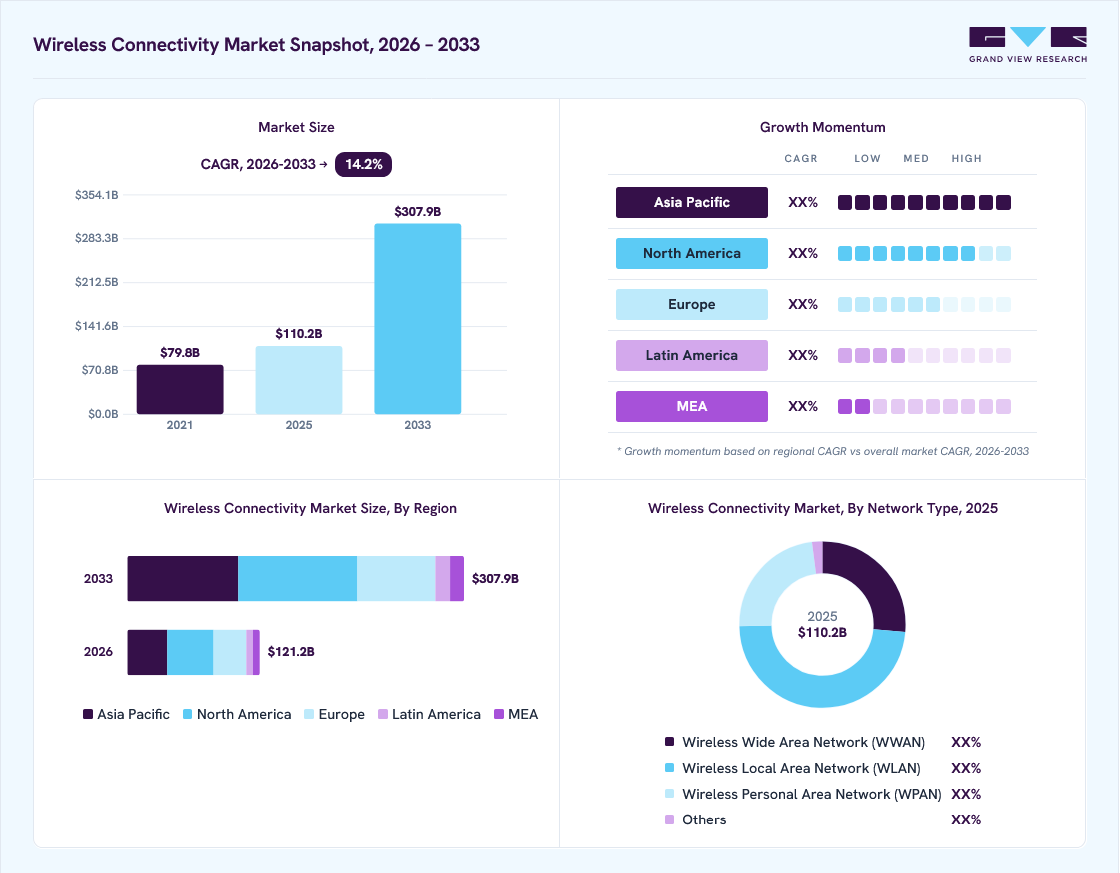
The global wireless connectivity market size was valued at USD 110.2 billion in 2025 and is projected to grow from USD 121.2 billion in 2026 to reach USD 307.9 billion by 2033, at a CAGR of 14.2% from 2026 to 2033. North America dominated the market, accounting for the largest revenue share of 34.9% in 2025. The growth can be attributed to the rapid adoption of IoT devices, smart technologies, connected vehicles, and wireless-enabled consumer electronics across industries.
 Source: Grand View Research, IR Documents, Primary Interviews, Paid DatabasesTo learn more about this report,
 Download Free Sample Report
Key Market Trends & Insights
- By technology: Wi-Fi segment dominated the market with a revenue share of 32.6% in 2025.
- By network type: Wireless Local Area Network (WLAN) led the market and accounted for a share of 48.2% in 2025.
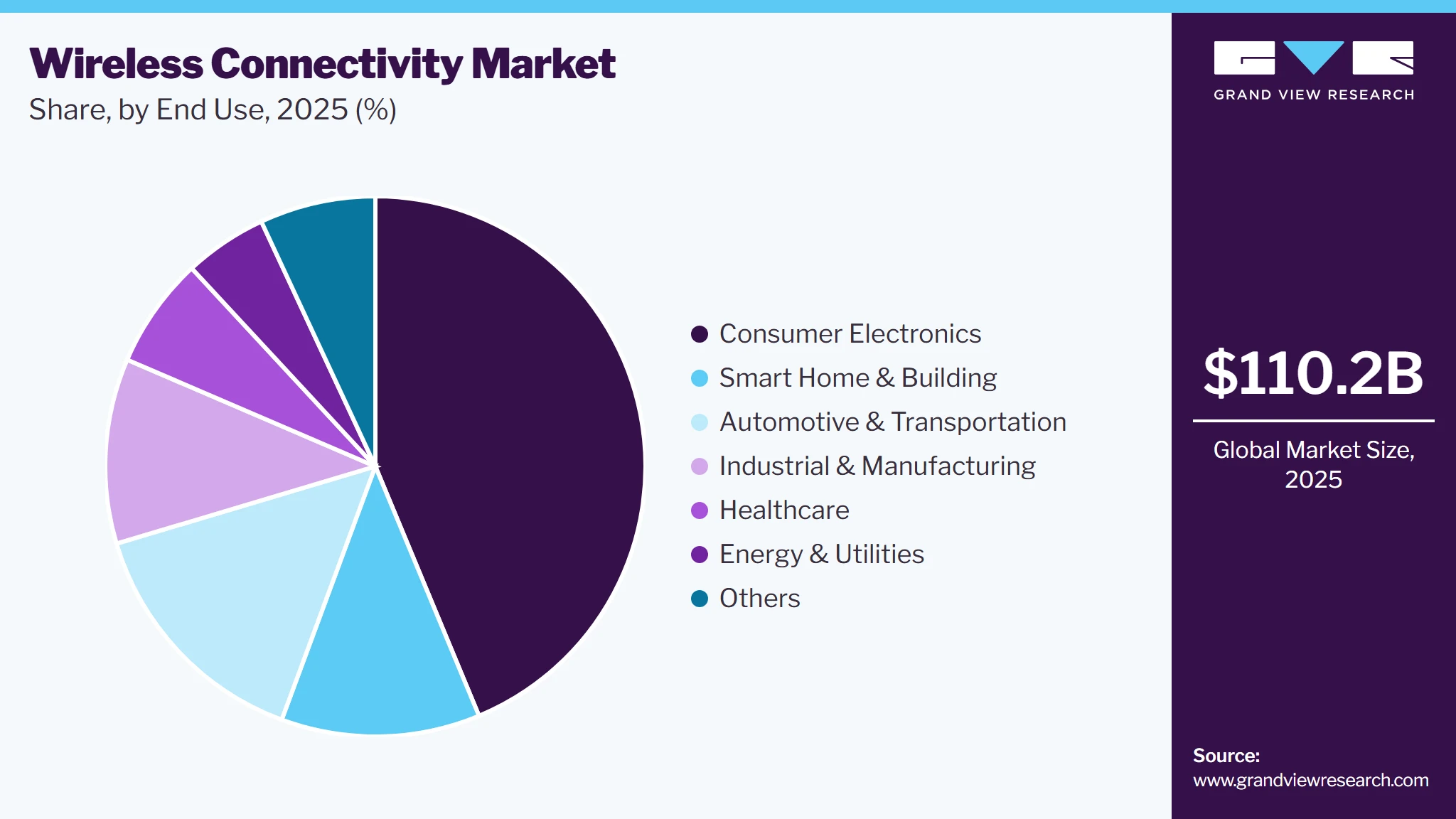
- By end-use: Consumer electronics segment held the largest revenue share of 43.7% in 2025.
Regional Highlights
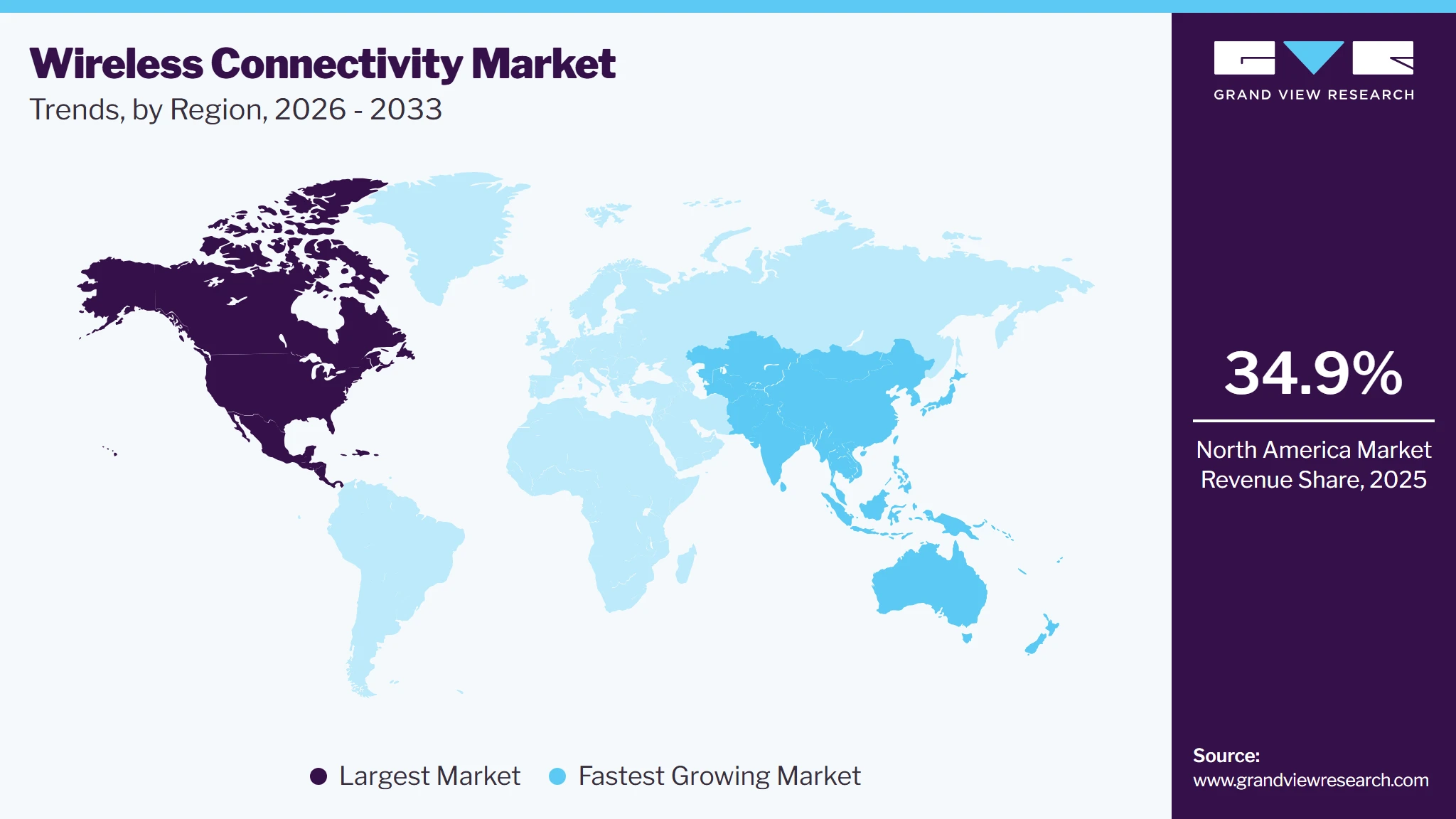
- Largest regional market: North America (34.9% revenue share, 2025)
- Fastest-growing regional market: Asia Pacific (highest CAGR, 2026-2033)
- By country: The U.S. held the largest market share in 2025.
Market Size & Forecast
- Market size in 2025: USD 110.2 Billion
- Estimated market size in 2026: USD 121.2 Billion
- Projected market size by 2033: USD 307.9 Billion
- CAGR (2026-2033): 14.2%
Prism AI by Grand View Research Free to tryAsk a question about the wireless connectivity marketTry asking✓Every figure cited from GVR research Prefer the report? Download free sample →
The rapid expansion of connected devices across consumer electronics, smart homes, industrial facilities, healthcare, automotive, and energy applications is a significant driver of the global wireless connectivity market. The growing deployment of sensors, wearables, connected appliances, industrial equipment, and IoT endpoints is increasing demand for connectivity technologies such as Wi-Fi, Bluetooth, Zigbee, Thread, NFC, and cellular connectivity. As organizations increasingly connect physical assets to collect real-time data and enable remote monitoring, the need for reliable, low-power, and scalable wireless connectivity solutions continues to expand.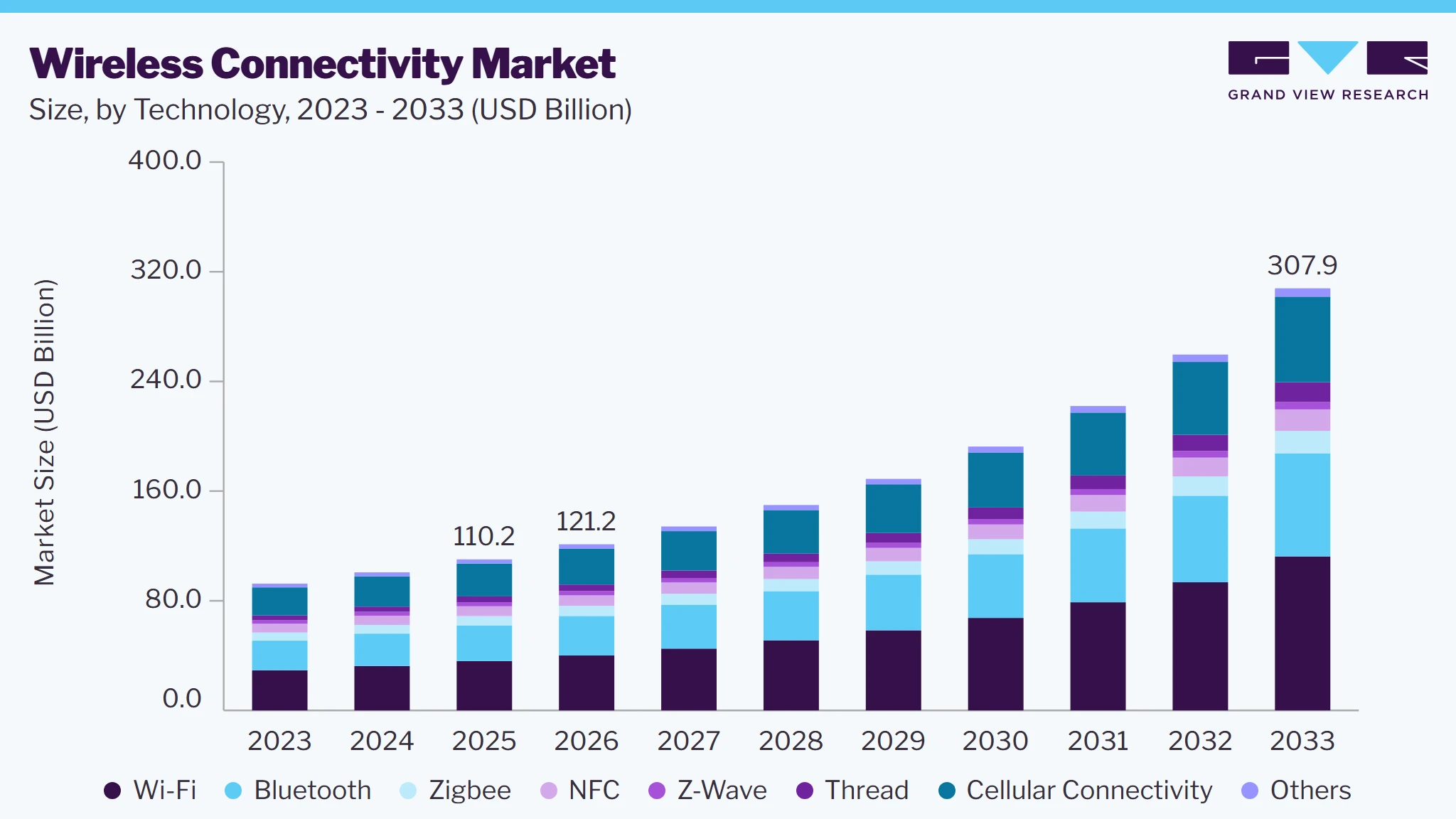 To learn more about this report, Download Free Sample Report
Increasing adoption of smart home and building technologies is creating sustained demand for wireless connectivity components and modules. Smart lighting, security systems, thermostats, appliances, access-control systems, energy-management equipment, and entertainment devices increasingly rely on wireless communication to provide centralized control and interoperability. The growing emphasis on energy efficiency, automation, and remote management is also encouraging businesses and consumers to deploy connected building infrastructure, supporting demand for Bluetooth, Wi-Fi, Zigbee, Z-Wave, Thread, and other short-range wireless technologies.
Market Dynamics
The global wireless connectivity market is driven by the rapid proliferation of connected devices and the increasing need for seamless, high-speed, low-power communication across consumer, industrial, automotive, healthcare, and smart infrastructure applications. The expansion of IoT, smart homes, connected vehicles, industrial automation, wearable devices, edge computing, and cloud-connected systems is significantly increasing the number of devices requiring wireless communication. Moreover, advancements in Wi-Fi, Bluetooth, cellular connectivity, Thread, Zigbee, NFC, and other wireless technologies are improving data rates, range, reliability, energy efficiency, and interoperability, creating broader opportunities for connectivity ICs, modules, adapters, and device-side connectivity components.
The rapid expansion of IoT and connected devices is a significant driver of the wireless connectivity market as businesses and consumers increasingly deploy devices that require continuous communication with smartphones, gateways, edge systems, and cloud platforms. Smart appliances, wearable devices, industrial sensors, connected lighting, security systems, healthcare devices, and asset-tracking solutions increasingly rely on wireless technologies to exchange data without extensive physical cabling.For instance, in February 2026, Telenor IoT announced that it had surpassed 30 million connected IoT units deployed worldwide, highlighting the continued expansion of connected devices across industries and geographies. It demonstrates the growing need for reliable wireless connectivity to connect, manage, and transmit data from large and increasingly distributed IoT device networks, supporting demand for cellular, Wi-Fi, Bluetooth, and other wireless connectivity technologies.
Fragmentation across wireless standards, protocols, device ecosystems, and network architectures can restrain market growth by increasing the complexity of designing and deploying connected systems. Devices from different manufacturers may rely on different communication protocols, frequency bands, security mechanisms, and application-layer standards, creating interoperability challenges and increasing integration requirements. In addition, the growing number of connected endpoints expands the potential attack surface, requiring manufacturers and network operators to incorporate stronger authentication, encryption, firmware protection, and device-management capabilities.
The transition toward higher-performance wireless standards creates significant opportunities for connectivity component manufacturers as users increasingly demand greater throughput, lower latency, improved reliability, and support for higher device densities. Wi-Fi 7, advanced Bluetooth technologies, Thread, and next-generation cellular connectivity are expanding wireless capabilities across consumer electronics, industrial automation, automotive, healthcare, and smart-building applications. Wi-Fi 7, for example, is designed to support higher throughput and lower latency through capabilities including wider channels, multi-link operation, and improved spectrum utilization.
Analyst Perspective
The convergence of IoT, edge computing, AI, smart infrastructure, and connected mobility is expected to increasingly shape the global wireless connectivity market. Wireless connectivity is evolving from a supporting communication function into a foundational infrastructure layer connecting devices, machines, vehicles, sensors, and digital platforms. The market is also shifting toward more intelligent, low-power, interoperable, and application-specific connectivity architectures as manufacturers seek to support increasingly dense device environments. The growing deployment of edge intelligence is further increasing the importance of reliable low-latency wireless communication, particularly in industrial automation, robotics, autonomous systems, healthcare monitoring, and connected vehicles.
Technology Insights
The Wi-Fi segment dominated the market and accounted for the revenue share of 32.6% in 2025, driven by the growing demand for high-bandwidth, low-latency wireless networks that support data-intensive applications and dense device environments. The increasing use of 4K/8K streaming, cloud applications, augmented and virtual reality, AI-enabled devices, enterprise collaboration platforms, and high-performance industrial applications is placing greater demands on network capacity and responsiveness. Newer Wi-Fi generations, particularly Wi-Fi 6E and Wi-Fi 7, address these requirements through wider channels, improved spectrum utilization, multi-link operation, and higher throughput.
The thread segment is anticipated to grow at the fastest CAGR during the forecast period, owing to the increasing emphasis on interoperable, IP-based connectivity for multi-vendor smart home and building ecosystems. Unlike proprietary wireless protocols, Thread uses IPv6-based networking and is designed to enable direct communication among compatible devices while supporting low-power operation and mesh networking. Its integration with the Matter smart-home standard is further strengthening its relevance by enabling devices from different manufacturers to work within a common application ecosystem.
Network Type Insights
The Wireless Local Area Network (WLAN) segment dominated the market and accounted for the revenue share of 48.2% in 2025, driven by the increasing need for flexible and scalable network infrastructure across enterprises, educational institutions, healthcare facilities, hospitality venues, and public spaces. Organizations are increasingly replacing or supplementing fixed Ethernet connections with WLAN infrastructure to enable employee mobility, simplify network deployment, support bring-your-own-device (BYOD) policies, and accommodate hybrid work environments.
The Wireless Personal Area Network (WPAN) segment is expected to grow at a significant CAGR during the forecast period due to the rising adoption of short-range device-to-device connectivity for personal electronics, peripherals, wearables, and proximity-based applications. Consumers increasingly use wireless keyboards, mice, headphones, earbuds, smartwatches, fitness trackers, gaming controllers, and other peripherals that rely on low-power, short-range communication, reducing dependence on physical cables. The growing integration of Bluetooth-based connectivity into smartphones, laptops, tablets, automotive infotainment systems, and wearable devices is further expanding WPAN applications.
End-use Insights
The consumer electronics segment dominated the market with the largest revenue share of 43.7% in 2025, driven by the increasing integration of wireless functionality as a core feature of next-generation electronic products, as manufacturers seek to deliver seamless device interoperability and richer user experiences. Smartphones, tablets, PCs, wearables, TVs, gaming devices, and cameras are increasingly designed to support wireless audio, screen sharing, content synchronization, peripheral connectivity, device-to-device transfers, and smart accessory integration without physical interfaces.
 To learn more about this report, Download Free Sample Report
The smart home & building segment is expected to grow at the fastest CAGR from 2026 to 2033, driven by the growing emphasis on energy efficiency, automated building management, and remote control of residential and commercial infrastructure. Property owners and facility managers are increasingly deploying connected lighting, HVAC systems, security equipment, access controls, and appliances to monitor energy consumption, automate operating schedules, and optimize building performance. Wireless connectivity enables these systems to be installed and retrofitted with less disruption than wired infrastructure, particularly in existing buildings where extensive cabling can be costly and difficult to implement.
Regional Insights
North America dominated the global market with the largest revenue share of 34.9% in 2025, driven by the rapid modernization of enterprise and telecommunications infrastructure and continued investment in high-performance digital networks. Enterprises across the region are upgrading connectivity infrastructure to support distributed workforces, cloud applications, advanced data services, and increasingly demanding network environments.
 To learn more about this report, Download Free Sample Report
U.S. Wireless Connectivity Industry Trends
The wireless connectivity market in the U.S. is expected to grow significantly at a CAGR of 14.4% from 2026 to 2033, due to large-scale investment in next-generation communications infrastructure and the increasing integration of wireless technologies into enterprise and consumer environments. U.S. technology providers and network operators continued investing in higher-capacity wireless infrastructure to support bandwidth-intensive applications, cloud services, connected devices, and distributed computing.
Europe Wireless Connectivity Industry Trends
The wireless connectivity market in Europe is anticipated to register considerable growth from 2026 to 2033 due to region’s digital transformation initiatives and efforts to strengthen resilient, high-capacity communications infrastructure. Governments and enterprises are investing in modern digital networks to improve connectivity, support industrial digitalization, and enhance the competitiveness of businesses.
The UK wireless connectivity market is expected to grow rapidly in the coming years, owing continued nationwide modernization of digital infrastructure and efforts to extend reliable high-speed connectivity to underserved locations. In May 2026, Ofcom reported that full-fiber broadband was available to 24.9 million residential premises, representing 82% of the UK's 30.5 million homes, while gigabit-capable broadband availability reached 89% of homes.
Wireless connectivity market in Germany held a substantial market share in 2025 due to digital transformation of its industrial base and the modernization of national telecommunications infrastructure. The country's manufacturing-intensive economy is increasingly incorporating digital communication into factories, logistics operations, machinery, and industrial facilities, creating demand for reliable wireless networks capable of supporting connected production environments
Asia Pacific Wireless Connectivity Industry Trends
Asia Pacific wireless connectivity held a significant share in the global market in 2025, due to large-scale digital infrastructure development, manufacturing digitalization, and the region’s role as a major production base for connected electronics and networking equipment. Countries across the region are investing heavily in telecommunications networks, smart infrastructure, connected mobility, and industrial automation, while the concentration of electronics manufacturers creates a strong ecosystem for incorporating wireless connectivity directly into devices.
The Japan wireless connectivity market is expected to grow rapidly in the coming years, driven by the integration of advanced connectivity with highly automated industrial, enterprise, and telecommunications systems. The country’s emphasis on network reliability, automation, and digital transformation is encouraging the deployment of sophisticated wireless infrastructure across manufacturing, logistics, mobility, and enterprise applications.
Wireless connectivity market in China held a substantial market share in 2025, due to rapid deployment of advanced wireless infrastructure across transportation, smart cities, industrial facilities, and digital services. The country’s large-scale technology ecosystem and emphasis on next-generation communications are accelerating adoption of newer wireless standards. For instance, in June 2026, Huawei announced a USD 0.50-per-unit royalty rate for Wi-Fi 7-compliant devices, highlighting the growing commercialization of Wi-Fi 7 technology.
Key Wireless Connectivity Company Insights
Key players operating in the wireless connectivity industry are Qualcomm Technologies, Inc. Broadcom Inc., MediaTek Inc., Intel Corporation, and Realtek Semiconductor. The companies are focusing on various strategic initiatives, including new product development, partnerships & collaborations, and agreements to gain a competitive advantage over their rivals. The following are some instances of such initiatives.
Key Wireless Connectivity Companies:
The following key companies have been profiled for this study on the wireless connectivity market.
-
Qualcomm Technologies, Inc.
-
Broadcom Inc.
-
MediaTek Inc.
-
Intel Corporation
-
NXP Semiconductors
-
Texas Instruments
-
Realtek Semiconductor
-
STMicroelectronics
-
Microchip Technology
-
Infineon Technologies
-
Skyworks Solutions
-
Murata Manufacturing
-
Nordic Semiconductor
-
Renesas Electronics
-
Semtech
Competitive Benchmarking
Category
Operating Strategies
Competitive Edge
Weakness
Established Players (Qualcomm Technologies, Inc. Broadcom Inc., MediaTek Inc., Intel Corporation, and Realtek Semiconductor)
- Focus on developing advanced Wi-Fi, Bluetooth, cellular, RF, and multi-protocol connectivity chipsets for smartphones, PCs, consumer electronics, automotive, enterprise networking, and IoT applications.
- Invest heavily in next-generation standards such as Wi-Fi 7/8, Bluetooth 6.x, and advanced cellular connectivity, while integrating AI, power management, security, and edge-processing capabilities into connectivity platforms.
- Strong global brands, extensive semiconductor R&D capabilities, and established relationships with major OEMs and electronics manufacturers.
- Broad product portfolios spanning connectivity ICs, chipsets, adapters, networking platforms, RF solutions, and device-side connectivity components enable these companies to address multiple applications.
- High R&D expenditure and semiconductor development costs can increase product-development and commercialization risks.
- Dependence on major OEM customers can expose companies to fluctuations in consumer-electronics and PC demand. Increasing technological complexity, intense competition, and rapid evolution of wireless standards require continuous investment in new architectures and backward compatibility.
Emerging Players (Renesas Electronics, Nordic Semiconductor, Microchip Technology, Semtech,)
- Concentrate on application-specific wireless connectivity solutions for industrial IoT, automotive, smart home and building, healthcare, energy, asset tracking, and embedded systems.
- Develop specialized Bluetooth, Wi-Fi, NFC, Thread, Zigbee, LoRa, cellular IoT, RF, and wireless MCU solutions, with increasing emphasis on low-power operation, miniaturization, security, interoperability, and edge intelligence.
- Strong expertise in specialized connectivity technologies and application-specific semiconductor solutions.
- Many have established positions in automotive, industrial, embedded, RF, and IoT markets, allowing them to address use cases that require long product lifecycles, low power consumption, high reliability, or specialized wireless protocols.
- Their modular and application-focused offerings can provide greater flexibility for OEMs compared with broad consumer-oriented platforms.
- Compared with the largest semiconductor connectivity suppliers, these companies generally have smaller consumer-device footprints and lower economies of scale in high-volume wireless chipsets.
- Some depend on partnerships and third-party ecosystems for complete connectivity platforms, while specialized portfolios may limit their ability to compete for large multi-technology design wins. Rapid changes in wireless standards can also require substantial investment to maintain interoperability and certification across multiple ecosystems.
Recent Developments
-
In March 2026, Qualcomm Technologies, Inc. introduced its Wi-Fi 8 portfolio, including the FastConnect 8800 Mobile Connectivity System and five Dragonwing Networking Platforms. FastConnect 8800 features a 4×4 radio configuration and supports peak speeds above 10 Gbps, while the portfolio spans mobile devices, access points, gateways, and networking applications
-
In February 2026, Broadcom announced what it described as the enterprise Wi-Fi 8 access point and switch solution, using a unified architecture designed for AI-ready enterprise networks. The solution combines Wi-Fi 8 connectivity with switching capabilities to improve enterprise network performance and reliability.
Wireless Connectivity Market Report Scope
Report Attribute
Details
Market size in 2026
USD 110.2 billion
Estimated market size in 2026
USD 121.2 billion
Projected market size by 2033
USD 307.9 billion
Growth rate
CAGR of 14.2% from 2026 to 2033
Actual data
2021 - 2025
Forecast period
2025 - 2033
Quantitative units
Revenue in USD billion and CAGR from 2026 to 2033
Report coverage
Revenue forecast, company share, competitive landscape, growth factors, and trends
Segments covered
Technology, network type, end-use, region
Regional scope
North America; Europe; Asia Pacific; Latin America; MEA
Country scope
U.S.; Canada; Mexico; UK; Germany; France; China; India; Japan; Australia; South Korea; Brazil; UAE; Kingdom of Saudi Arabia; South Africa
Key companies profiled
Qualcomm Technologies, Inc.; Broadcom Inc.; MediaTek Inc.; Intel Corporation; NXP Semiconductors; Texas Instruments; Realtek Semiconductor; STMicroelectronics; Microchip Technology; Infineon Technologies; Skyworks Solutions; Murata Manufacturing; Nordic Semiconductor; Renesas Electronics; Semtech
Customization scope
Free report customization (equivalent to 8 analysts working days) with purchase. Addition or alteration to country, regional & segment scope.
Pricing and purchase options
Avail customized purchase options to meet your exact research needs. Explore purchase options
Global Wireless Connectivity Market Report Segmentation
This report forecasts revenue growth at the global, regional, and country levels and provides an analysis of the latest industry trends in each of the sub-segments from 2021 to 2033. For this study, Grand View Research has segmented the wireless connectivity market report based on technology, network type, end-use, and region.
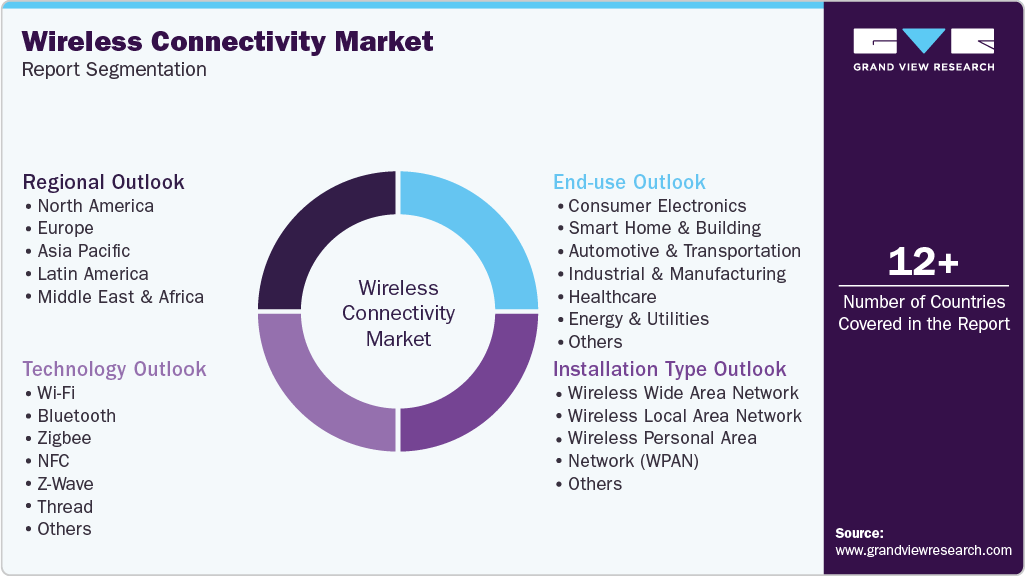 To learn more about this report, Download Free Sample Report
-
Technology Outlook (Revenue, USD Billion, 2021 - 2033)
-
Wi-Fi
-
Bluetooth
-
Zigbee
-
NFC
-
Z-Wave
-
Thread
-
Cellular Connectivity
-
Others
-
-
Network Type Outlook (Revenue, USD Billion, 2021 - 2033)
-
Wireless Wide Area Network (WWAN)
-
Wireless Local Area Network (WLAN)
-
Wireless Personal Area Network (WPAN)
-
Others
-
-
End-use Outlook (Revenue, USD Billion, 2021 - 2033)
-
Consumer Electronics
-
Smart Home & Building
-
Automotive & Transportation
-
Industrial & Manufacturing
-
Healthcare
-
Energy & Utilities
-
Others
-
-
Regional Outlook (Revenue, USD Billion, 2021 - 2033)
-
North America
-
U.S.
-
Canada
-
Mexico
-
-
Europe
-
UK
-
Germany
-
France
-
-
Asia Pacific
-
China
-
India
-
Japan
-
South Korea
-
Australia
-
-
Latin America
-
Brazil
-
-
Middle East & Africa
-
UAE
-
Saudi Arabia
-
South Africa
-
-
Research Methodology
The wireless connectivity market figures in this report are based on a proven research process that combines executive interviews with secondary research from proprietary databases, company filings, and recognized regulatory and institutional sources. Market size is built through value-chain sizing-reconciling supply-side and demand-side estimates-and triangulated with bottom-up and top-down approaches. Every estimate passes multiple levels of expert validation before publication, with each wireless connectivity segment quantified using the revenue-capture definitions in the table below.
Segment Definition
Technology
Revenue capture definition
Wi-Fi
Market value is captured through wireless connectivity products and solutions based on Wi-Fi standards, including Wi-Fi chipsets, ICs, modules, adapters, and device-side connectivity components used for wireless networking in consumer, enterprise, industrial, automotive, and other applications. Revenue includes product sales attributable to Wi-Fi connectivity functionality.
Bluetooth
Market value is captured through Bluetooth-enabled connectivity ICs, chipsets, modules, adapters, and embedded device-side components supporting short-range wireless communication. Revenue includes products supporting Bluetooth Classic, Bluetooth Low Energy (BLE), and advanced Bluetooth standards used across consumer electronics, automotive, healthcare, industrial, and other applications.
Zigbee
Market value is captured through Zigbee-based connectivity ICs, modules, adapters, and embedded components used for low-power wireless mesh communication. Revenue includes connectivity products deployed primarily in smart home, building automation, lighting, security, energy management, and industrial applications.
NFC
Market value is captured through NFC connectivity ICs, controllers, modules, and embedded components enabling short-range proximity communication. Revenue includes NFC solutions used in contactless payments, access control, authentication, device pairing, digital keys, consumer electronics, and other applications.
Z-Wave
Market value is captured through Z-Wave-enabled connectivity chipsets, modules, controllers, and device-side components supporting low-power wireless communication and mesh networking. Revenue includes products used primarily in smart home and building automation applications, including security, lighting, access control, and energy management.
Thread
Market value is captured through Thread-compatible connectivity ICs, modules, radio components, and embedded device-side solutions supporting low-power, IP-based mesh networking. Revenue includes Thread connectivity products used in smart homes, buildings, appliances, lighting, security, sensors, and other connected-device applications.
Cellular Connectivity
Market value is captured through cellular connectivity chipsets, modems, modules, adapters, and embedded components supporting wireless communication over cellular networks, including 4G LTE, LTE-M, NB-IoT, 5G, and other cellular technologies. Revenue includes connectivity products used in smartphones, connected vehicles, industrial IoT, asset tracking, healthcare, energy, and other applications.
Other
Market value is captured through connectivity ICs, modules, adapters, and device-side components based on wireless technologies not separately classified above, including technologies such as LoRa/LoRaWAN, UWB, DECT, and other specialized wireless communication technologies.
Network Type
Revenue capture definition
Wireless Wide Area Network (WWAN)
Market value is captured through connectivity products designed to provide wireless communication across geographically distributed or wide-area networks, including cellular and other long-range wireless technologies. Revenue includes WWAN chipsets, modules, modems, adapters, and device-side connectivity components used in connected vehicles, industrial IoT, asset tracking, telecommunications, logistics, and other applications.
Wireless Local Area Network (WLAN)
Market value is captured through connectivity products enabling wireless networking within localized environments such as homes, offices, campuses, factories, retail facilities, and public venues. Revenue includes Wi-Fi chipsets, access-point components, wireless adapters, modules, and embedded connectivity solutions used to connect computers, consumer electronics, industrial equipment, and other devices to local networks.
Wireless Personal Area Network (WPAN)
Market value is captured through short-range wireless connectivity products designed for communication among devices within an individual's immediate operating environment. Revenue includes Bluetooth, Zigbee, Thread, NFC, and other WPAN chipsets, modules, adapters, and embedded components used in wearables, peripherals, smartphones, personal electronics, smart devices, and proximity-based applications.
Others
Market value is captured through wireless connectivity products that operate outside the defined WWAN, WLAN, and WPAN classifications, including specialized wireless networking architectures and application-specific connectivity solutions. Revenue includes relevant chipsets, modules, adapters, and device-side connectivity components.
Application
Revenue capture definition
Consumer Electronics
Market value is captured through wireless connectivity components incorporated into smartphones, tablets, PCs, wearables, TVs, gaming devices, cameras, audio equipment, and other consumer electronics. Revenue includes connectivity ICs, chipsets, modules, adapters, and embedded wireless components attributable to these devices.
Smart Home & Building
Market value is captured through wireless connectivity products used in connected home appliances, lighting, security systems, HVAC equipment, access-control systems, sensors, and building automation platforms. Revenue includes connectivity chipsets, modules, adapters, and device-side components incorporated into residential and commercial smart-building equipment.
Automotive & Transportation
Market value is captured through wireless connectivity components used in passenger vehicles, commercial vehicles, public transportation, fleet-management systems, and transportation infrastructure. Revenue includes connectivity ICs, modules, adapters, and embedded components supporting infotainment, telematics, vehicle-to-device communication, connected services, navigation, diagnostics, and other wireless functions.
Industrial & Manufacturing
Market value is captured through wireless connectivity products deployed in factories, machinery, robotics, industrial sensors, asset-tracking systems, warehouse equipment, and industrial automation infrastructure. Revenue includes connectivity chipsets, modules, adapters, and device-side components supporting machine communication, monitoring, automation, and industrial IoT applications.
Healthcare
Market value is captured through wireless connectivity components incorporated into medical devices, patient-monitoring equipment, diagnostic devices, healthcare wearables, fitness devices, and connected healthcare infrastructure. Revenue includes connectivity ICs, modules, adapters, and embedded components enabling wireless transmission of patient, diagnostic, and device data.
Energy & Utilities
Market value is captured through wireless connectivity products used in smart meters, grid infrastructure, renewable-energy systems, energy-management equipment, utility monitoring, and connected power assets. Revenue includes connectivity chipsets, modules, adapters, and device-side components supporting remote monitoring, metering, asset management, and communications across energy networks.
Others
Market value is captured through wireless connectivity products used in applications not separately classified above, including retail, agriculture, logistics, aerospace & defense, education, hospitality, and public infrastructure. Revenue includes relevant connectivity ICs, chipsets, modules, adapters, and embedded device-side components attributable to these applications.
Estimation Model
Layer
Question
Analysis
Connected Device & Communication Demand Layer
Where is wireless connectivity required?
Identify device and infrastructure environments where wireless communication is required to connect electronics, machines, vehicles, sensors, networks, and digital systems. This layer evaluates consumer electronics, smart homes and buildings, automotive and transportation, industrial and manufacturing facilities, healthcare devices, energy and utility infrastructure, and other connected environments requiring short-, medium-, or long-range wireless communication. The analysis considers applications using Wi-Fi, Bluetooth, Zigbee, NFC, Z-Wave, Thread, cellular connectivity, and other wireless technologies across smartphones, PCs, wearables, connected appliances, vehicles, industrial equipment, medical devices, smart meters, and network infrastructure.
Wireless Connectivity Technology & Component Layer
What enables wireless connectivity implementation?
Assess the technologies and hardware components that enable wireless communication, including connectivity ICs, chipsets, modules, adapters, modems, RF components, antennas, and device-side connectivity components. The layer evaluates Wi-Fi, Bluetooth, Zigbee, NFC, Z-Wave, Thread, cellular connectivity, and other wireless technologies across WWAN, WLAN, WPAN, and other network types. Assessment includes transmission performance, bandwidth, latency, range, power consumption, spectrum utilization, interoperability, security, protocol compatibility, miniaturization, and integration with processors, microcontrollers, and other device components.
Connectivity Integration & Deployment Layer
How are wireless connectivity capabilities delivered to devices and networks?
Analyze the deployment models and integration approaches through which wireless connectivity is incorporated into end devices, networking equipment, and communication infrastructure. This includes embedded connectivity, standalone modules, adapters, modems, development platforms, reference designs, and integrated connectivity solutions. The analysis considers connectivity integration across consumer devices, smart-building systems, vehicles, industrial equipment, healthcare devices, and energy infrastructure, including OEM integration, device certification, software and firmware support, protocol stacks, network management, security, and interoperability requirements.
Wireless Connectivity Commercial & Ecosystem Economics Layer
How is value generated within the wireless connectivity ecosystem?
Evaluate revenue generated through the sale of connectivity ICs and chipsets, modules, adapters, modems, and device-side connectivity components, together with associated licensing, software, development tools, technical support, and connectivity-related services where applicable. Additional ecosystem value is generated through wireless technology licensing, semiconductor IP, design wins, OEM partnerships, reference platforms, network infrastructure deployment, and recurring connectivity services.
Delivered Customizations
This report has been delivered with the following In-depth customizations
CLIENT REQUEST
CUSTOMIZATION DELIVERED
VALUE ADDS
Wireless Connectivity Technology & Standards Trends
Conducted a focused analysis of wireless connectivity technologies, including Wi-Fi, Bluetooth, Zigbee, NFC, Z-Wave, Thread, Cellular Connectivity, and other emerging wireless technologies.
Evaluated developments in next-generation standards such as Wi-Fi 7/8, Bluetooth advancements, Thread, and 5G/advanced cellular connectivity, including improvements in bandwidth, latency, range, power efficiency, interoperability, and security.
Helps stakeholders identify high-potential wireless technologies and connectivity standards and assess their adoption across different applications.
Enables understanding of how technology evolution, interoperability requirements, and performance improvements are influencing connectivity component demand and competitive positioning.
Wireless Connectivity Component & Ecosystem Trends
Evaluated demand and technology developments across connectivity ICs/chipsets, connectivity modules, connectivity adapters, and device-side connectivity components.
Assessed the integration of wireless connectivity into semiconductors, modules, embedded systems, networking equipment, and end devices, including the role of multi-protocol connectivity
Provides insights into emerging connectivity component technologies, integration trends, and commercially attractive opportunities for semiconductor, module, and wireless technology providers.
Helps stakeholders understand the convergence of wireless connectivity with AI, edge computing, IoT, semiconductor integration, and intelligent device architectures.
Wireless Connectivity Application & End-Use Opportunity Assessment
Assessed demand for wireless connectivity across Consumer Electronics; Smart Home & Building; Automotive & Transportation; Industrial & Manufacturing; Healthcare; Energy & Utilities; and Other applications.
Evaluated technology requirements, connectivity architectures, deployment environments, device density, performance requirements, power consumption, and adoption trends across major end-use industries.
Supports investment and expansion strategies by identifying high-growth application areas and connectivity opportunities across end-use industries.
Enables stakeholders to prioritize attractive application segments, technology categories, and device ecosystems based on connectivity requirements and adoption potential.
Frequently Asked Questions About This Report
The global wireless connectivity market size was valued at USD 110.2 billion in 2025 and is expected to reach USD 121.2 billion in 2026.
Key factors include the rapid adoption of IoT devices, smart technologies, connected vehicles, and wireless-enabled consumer electronics across industries
North America dominated with 34.9% revenue share in 2025.
Asia Pacific is the fastest-growing region over the forecast period.
The Wi-Fi segment led with a 32.6% revenue share in 2025, while the thread segment is the fastest-growing segment.
The Wireless Local Area Network (WLAN) segment led with a 48.2% revenue share in 2025, while the Wireless Personal Area Network (WPAN) segment is the fastest-growing segment.
The consumer electronics segment held the largest share of 43.7% in 2025, while smart home & building segment is the fastest-growing segment.
Key players operating in the wireless connectivity market include Broadcom Inc., Infineon Technologies, Intel Corporation, MediaTek Inc., Microchip Technology, Murata Manufacturing, Nordic Semiconductor, NXP Semiconductors, Qualcomm Technologies, Inc., Realtek Semiconductor, Renesas Electronics, Semtech, Skyworks Solutions, STMicroelectronics, Texas Instruments
The global wireless connectivity market is expected to grow at a CAGR of 14.2% from 2026 to 2033 to reach USD 307.9 billion by 2033.
About the Author(s)
Communications Infrastructure Research Team
Technology · Communications InfrastructureThis report was authored by the communications infrastructure research team at Grand View Research - comprising two research analysts, one senior research analyst, and one industry expert - with specialized expertise in the communications infrastructure segment of the technology industry. All findings are based on proprietary technology databases, executive interviews, and regulatory analysis, subject to internal peer review prior to publication.
Last Updated:
Speak to Analyst

Customize this report to your needs - add regions, segments, or data points, with 20% free customization.
Or view our licence options:


ISO 9001:2015 & 27001:2022 Certified
We are GDPR and CCPA compliant! Your transaction & personal information is safe and secure. For more details, please read our privacy policy.


