
- Home
- »
- Next Generation Technologies
- »
-
5G New Radio Market Size, Share & Trends Report, 2026-2033GVR Report cover

5G New Radio Market (2026 - 2033)
Size, Share & Trends Analysis Report By Offering, By Operating Frequency (Sub-6 GHz, mmWave), By Architecture (Non-Standalone, Standalone), By Application, By Industry (Telecom & IT, Automotive, Healthcare), By Region, And Segment Forecasts
Market Size, 2025
$70.3BMarket Estimate, 2026
$89.8BMarket Forecast, 2033
$421.6BCAGR, 2026–2033
24.7%5G New Radio Market Summary
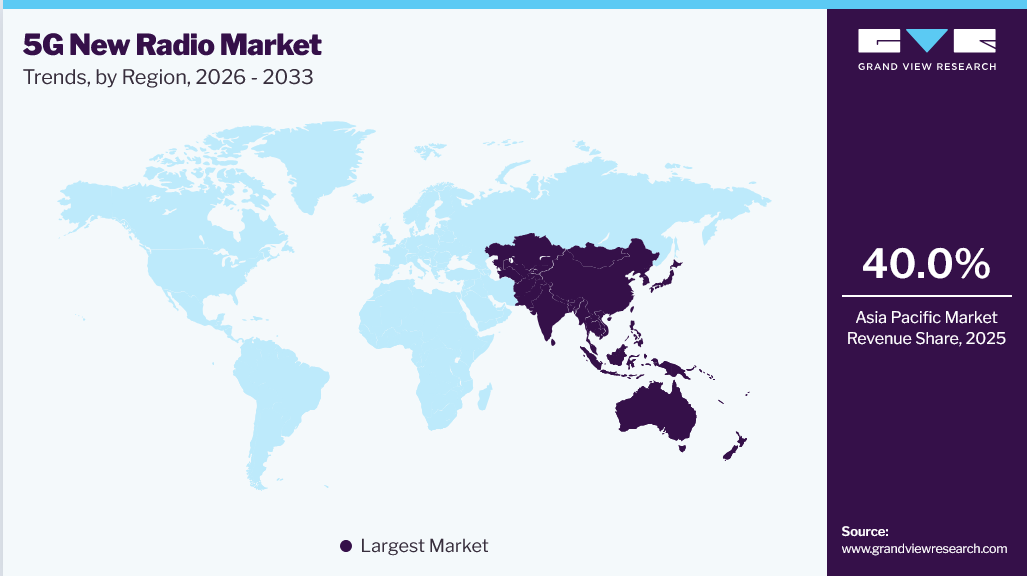
The global 5G new radio market size was valued at USD 70.3 billion in 2025 and is projected to grow from USD 89.8 billion in 2026 to USD 421.6 billion by 2033, at a CAGR of 24.7% from 2026 to 2033. Asia Pacific dominated the market, accounting for a revenue share of 40.0% in 2025. The increased demand for high-speed data services and an increase in the number of customers using the internet globally are key factors driving the growth of the 5G new radio market.
Key Market Trends & Insights
- By offering: The hardware segment dominated the market in 2025 with a share of over 53.5%.
- By operating frequency: The Sub-6 GHz segment dominated the market in 2025 and accounted for a revenue share of more than 62.0%.
- By architecture: The non-standalone (NSA) architecture segment dominated the market in 2025 and accounted for a revenue share of approximately 57.0%.
- By application: The enhanced mobile broadband application segment held the largest market share of around 40.0% in 2025.
- By industry: The telecom and IT segment dominated the market in 2025 and accounted for a revenue share of more than 32.0%.
Regional Highlights
- Largest regional market: Asia Pacific (40.0% revenue share, 2025)
- Fastest-growing regional market: North America (highest CAGR, 2026-2033)
Market Size & Forecast
- Market size in 2025: USD 70.3 Billion
- Estimated market size in 2026: USD 89.8 Billion
- Projected market size by 2033: USD 421.6 Billion
- CAGR (2026-2033): 24.7%
Three ways to get this report
Buy it, customize it, or ask a question.Ask an Analyst
Analyst response in 1 business day
- AccessReport author, directly
- Reply timeWithin 1 working day
- No sales callDirect answer only
- FormatEmail reply
- CostFree, no cost
Get the Full Report
What the study covers
- FormatsPDF · Excel · Dashboard
- Timeline2026–2033 annual, 2025 base
- Coverage20+ countries, 5 regions
- Companies10+ key players profiled
Customize the Report
20% free customization
- IncludeCountries, segments, points
- TailorTo your product definition
- ExtendDeeper competitor detail
- OrA fully bespoke study
- Turnaround5–10 working days
The increased use of industrial automation and organizations shifting their preferences toward cloud services are important factors driving the growth of the 5G new radio (NR) market. The worldwide aggressive rollout of a 5G Radio Access Network (RAN) with numerous small cells and macrocell base stations is fueling market expansion. Several 5G RAN providers across the globe are focusing on developing solutions to support performance verification, along with the evaluation of new solutions. For instance, in March 2025, Fujitsu Limited launched its next-generation, O-RAN-compliant 5G Sub6 Radio Unit (RU) model 44R21 to accelerate open infrastructure deployments. Moreover, Rakuten Mobile will begin delivering the new solution across its commercial network from 2025 to rapidly expand its 5G network footprint. Through this launch, Fujitsu hopes to contribute to the global growth of the open 5G network in collaboration with telecom carriers such as Rakuten Mobile.The development of open RAN solutions, which offer a more flexible and cost-effective alternative to traditional proprietary RAN systems, is also a significant factor driving the growth of the market. Open RAN enables the integration of software and hardware components from multiple vendors, helping reduce the cost of deploying and operating a 5G network.
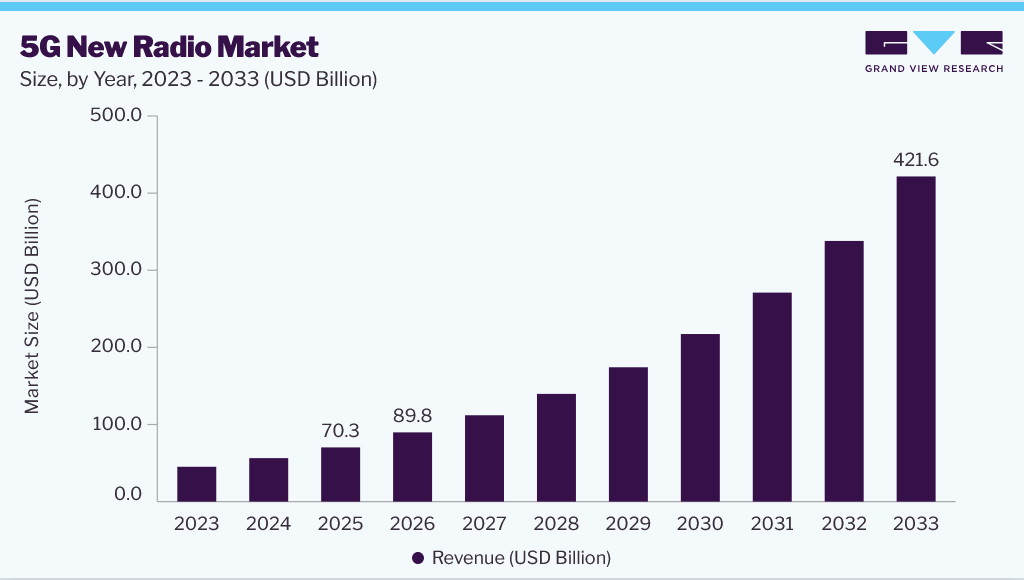 Source: Grand View Research, IR Documents, Primary Interviews, Paid DatabasesTo learn more about this report,
 Download Free Sample Report
The use of virtualization and cloud-native architectures enables network operators to deliver services more efficiently and at a lower cost. These technologies enable network operators to deliver services more efficiently and at a lower cost by leveraging the benefits of cloud computing. Virtualization involves the separation of hardware and software, allowing multiple virtual instances to run on the same physical infrastructure.
There is a growing focus on automation and Artificial Intelligence (AI) in the 5G New Radio (NR) market, as operators seek to improve network performance, optimize resource allocation, and reduce operating costs. Automation and AI can help network operators improve network performance, optimize resource allocation, and reduce operating costs.
For instance, automation can simplify and accelerate network configuration, management, and maintenance. AI can analyze network data in real time and provide insights into network performance, traffic patterns, and user behavior. This can enable operators to identify and resolve network issues more quickly and allocate network resources more efficiently based on real-time demand.
The increasing use of advanced radio units, such as massive MIMO and beamforming, which offer better coverage and capacity, and help in optimizing resource allocation are also driving the market growth. These technologies enable better coverage and capacity in the network, which is crucial for supporting the increasing demand for data-intensive applications. Massive MIMO, which stands for Multiple Input Multiple Output, uses multiple antennas on both the transmitter and receiver sides to improve signal quality and reduce interference. This technology allows multiple devices to transmit and receive data simultaneously, thereby increasing network capacity. Beamforming uses algorithms to direct radio signals in specific directions, improving network coverage and enabling more efficient use of radio resources.
Market Dynamics
With telecom operators adopting Open Radio Access Network (O-RAN) specifications, the 5G New Radio market is currently exhibiting swift expansion. Traditional cellular networks use vertically integrated and closed hardware systems where telecom operators are locked to a single vendor's infrastructure.
However, O-RAN specifications have standardized open interfaces, which facilitate integration of various hardware/software vendors' RUs, DUs, and CUs seamlessly, a transition leading to greater supply chain diversity and vendor innovation as well as long-term reduced CAPEX costs. Telecom carriers are building this open network using a flexible multi-vendor macro network design that scales data throughput at reduced cost in city centers and industrial areas.
The complicated engineering challenges associated with scaling new high-performance antenna systems are among the most significant barriers preventing the widespread availability of 5G new radio around the world. The deployment of massive Multiple Input Multiple Output (MIMO) technology, which relies on hundreds of antenna elements operating simultaneously, significantly increases signal-processing complexity, power consumption, cooling requirements, and infrastructure costs, posing a challenge for operators seeking to expand 5G coverage cost-effectively.
The highly advanced beamforming systems required to properly focus massive radio arrays to continuously track users and optimize the spectrum used for that specific area make it difficult to address the high-power computing resource demands of several multi-antenna arrays at the base stations. Because of the high OpEx for base stations and the new structural support required to mount the new radio equipment on existing radio towers, most of the resource-constrained telecom companies are likely to postpone the operational rollouts of 5G New Radio for a long period.
With the worldwide shift to 5G-Advanced (3GPP Release 18+), there is a remarkable opportunity to profit from the deployment of equipment specifically tailored to meet the demands of the modern era. Unlike conventional mobile broadband services, which cater only to consumers, 5G-A includes features such as side-link communication capabilities, position tracking, and a low-latency channel designed exclusively for the enterprise market. The benefit of this upgraded radio design is that it enables service providers to offer performance-based assurance for mission-critical industrial services, including synchronized industrial robots in smart factories, autonomous mining machines, and grid automation.
Analyst Perspective
The global 5G New Radio market is expected to grow at a fast pace as mobile operators worldwide expand their network capacity and enterprises increasingly adopt 5G-enabled digital transformation initiatives. Ongoing industrial automation, smart manufacturing, connected mobility, rising data consumption, and emerging edge computing applications will further support market expansion. The gradual transition toward standalone 5G networks will enable enhanced performance and new service opportunities. Competitive advantage will significantly depend on innovations focused on radio technologies, energy-efficient network infrastructure, and software-driven network management. Players with the ability to deliver scalable, cost-effective solutions tailored to both telecom operators and enterprise customers will lead the market.
Offering Insights
The hardware segment dominated the market in 2025, accounting for over 53.5%. The increasing demand for advanced radio units, such as massive MIMO and beamforming, which offer better coverage and capacity and help in optimizing resource allocation, is a significant factor contributing to the segment growth. At the same time, the rising adoption of cloud-native architectures and virtualization enables network operators to deliver services more efficiently and at a lower cost. Furthermore, the growing popularity of Internet-of-Things (IoT) and edge computing is driving the demand for specialized hardware such as IoT gateways, edge servers, and routers, thereby contributing to the growth of the segment.
The services segment is projected to witness remarkable growth over the forecast period, driven by the increasing adoption of managed services as operators seek to outsource non-core activities, such as network management and maintenance. This allows them to focus on their core business and achieve cost savings. Additionally, the rise of network slicing allows operators to create multiple virtual networks within a single physical network. This enables them to offer customized services for specific use cases and industries and to optimize network resources. Moreover, with the deployment of 5G networks, there is a growing demand for value-added services, such as edge computing, which enable faster processing and lower latency for data-intensive applications. The emergence of 5G-enabled applications, such as augmented and virtual reality and autonomous vehicles, is expected to drive demand for specialized services, including network testing and optimization, as well as security and privacy services.
Operating Frequency Insights
The Sub-6 GHz segment dominated the market in 2025 and accounted for more than 62.0% share of the global revenue. The ability of Sub-6 GHz spectrum bands to offer a good balance between coverage and capacity, making them suitable for providing high-speed connectivity to large numbers of users, is a major factor contributing to the segment growth. With the growth in data traffic, there is a need for higher data rates, lower latency, and improved network efficiency. Additionally, the growing adoption of Massive MIMO technology, which uses many antennas to improve spectral efficiency and increase capacity, is also driving segment growth. This technology can be deployed in the sub-6 GHz spectrum bands to improve network performance and coverage.
The mmWave segment is projected to grow significantly over the forecast period. With the expansion of 5G networks, the mmWave segment is likely to become increasingly important in the coming years, particularly in urban areas with high demand for high-speed data services. To meet the growing demand for mmWave technology, companies are investing in research and development to improve the performance and reliability of mmWave equipment. The integration of mmWave technology with other technologies, such as sub-6 GHz, which allows for more comprehensive 5G coverage, is also driving the segment growth. Additionally, there is a growing focus on improving the energy efficiency of mmWave equipment, which can help reduce the overall operating costs of 5G networks.
Architecture Insights
The non-standalone (NSA) architecture segment dominated the market in 2025, accounting for approximately 57.0% of revenue. The ability of 5G NR NSA solutions to allow operators to deploy 5G radio access technology using the existing 4G LTE core network, enabling faster time-to-market and cost savings, is a major factor contributing to the growth of the segment. With NSA solutions, operators can offer Enhanced Mobile Broadband (eMBB) services and improved network performance while paving the way for future standalone (SA) 5G deployments. Moreover, NSA solutions can support advanced features such as massive MIMO, beamforming, and carrier aggregation. Such factors are further expected to drive the adoption of 5G NR technology and accelerate the deployment of next-generation networks.
The Standalone (SA) segment is projected to expand at the highest CAGR over the forecast period. The deployment of 5G new radio in standalone mode is gaining popularity in the industry, and it is projected to fuel growth over the coming years. Standalone mode offers several advantages over non-standalone mode, including higher network speeds and lower latency. The standalone mode enables network operators to deliver end-to-end 5G services that are not available in the non-standalone mode. The standalone mode also enables the implementation of sophisticated services, such as network slicing and edge computing, which can be used for applications such as autonomous driving and smart cities. Furthermore, the growing demand for high-speed internet and the increasing number of connected devices are expected to further drive the adoption of standalone mode over the coming years.
Application Insights
The Enhanced Mobile Broadband (eMBB) segment dominated the market in 2025 and accounted for around 40.0% share of the global revenue. The segment growth can be attributed to the increasing demand for high-speed internet connectivity and data-intensive applications, such as Virtual Reality (VR), Augmented Reality (AR), and high-definition video streaming. To cater to this growing demand, network operators are deploying advanced 5G new radio infrastructure to support higher data rates, lower latency, and improved spectral efficiency. Additionally, there is a growing focus on improving the user experience by optimizing network coverage, capacity, and reliability through the use of advanced technologies such as massive MIMO and beamforming.
The Ultra-Reliable Low-Latency Communications (URLLC) segment is expected to grow significantly over the forecast period. The increasing demand for mission-critical applications that require high reliability and low latency is driving the growth of the URLLC segment in the 5G New Radio (NR) market. For instance, remote surgery and telemedicine require minimal latency and high reliability to ensure patient safety. Similarly, the use of robots and autonomous systems in manufacturing requires a reliable, low-latency connection to enable seamless operations. Such factors are expected to favor the growth of the segment over the coming years.
Industry Insights
The telecom and IT segment dominated the market, accounting for more than 32.0% in 2025. The growing adoption of cloud-native technologies, which allow operators to virtualize network functions and deploy them on cloud infrastructure, is a significant factor contributing to segment growth. With the increased speed, bandwidth, and capacity of 5G, telecommunications companies can offer faster, more reliable mobile connectivity to their customers, enabling new applications and services that were not possible with previous generations of wireless technology. This includes things like virtual and augmented reality, high-definition video streaming, and real-time gaming. Additionally, 5G networks are highly customizable, allowing telecommunication and IT companies to tailor their services to meet the specific needs of different industries and use cases.
The manufacturing segment is projected to expand at the fastest rate over the forecast period. The ability of 5G NR technology to enable real-time monitoring and control of manufacturing processes, leading to greater efficiency and productivity, is a significant factor contributing to the segment growth. For instance, 5G NR can facilitate the use of Industrial Internet of Things (IIoT) sensors and devices, which can provide real-time data on machine performance, production line throughput, and other critical metrics. This data can be used to optimize processes, reduce downtime, and improve quality control. Moreover, 5G NR can enable remote access and control of manufacturing equipment, allowing for greater flexibility and responsiveness in managing production processes. These benefits can lead to increased profitability and competitiveness for manufacturers, driving the adoption of 5G NR solutions in the manufacturing industry.
Regional Insights
The Asia Pacific 5G new radio market held the largest share of over 40.0% in 2025. The increasing adoption of 5G technology in countries such as China, Japan, South Korea, and India is a major driver of regional growth. The region has a large population and a growing number of mobile subscribers, which is driving the demand for high-speed internet services and advanced applications. The governments in these countries are also investing heavily in the development of 5G infrastructure, which is expected to provide significant opportunities for telecom companies and network equipment providers in the region. Moreover, the region is witnessing a significant increase in the use of smartphones and other mobile devices, which is driving the demand for 5G-enabled devices and services.
 To learn more about this report, Download Free Sample Report
North America 5G New Radio Market Trends
The North America region is projected to grow at the fastest CAGR over the forecast period. Significant investments are made for the development and implementation of 5G infrastructure in the area, owing to the growing demand for high-speed internet access, IoT applications, and cloud services, which are expected to favor market growth over the coming years. Furthermore, the use of technologies such as artificial intelligence, edge computing, and big data analytics is increasing, which is pushing the demand for high-performance 5G networks. Collaborations between telecom firms and technological leaders to build and implement 5G networks and services are also developing in the area. In addition, the area has been an early adopter of 5G-enabled smartphones and other devices, which is projected to boost market growth in the coming years. Furthermore, the region has been an early adopter of 5G-enabled smartphones and other devices, which is expected to drive the growth of the market in the coming years.
Key 5G New Radio Company Insights
Leading industry players are investing heavily in R&D to expand their product lines, which will help the 5G New Radio (NR) market thrive. Participants in the market are also expanding their global presence through a variety of strategic initiatives such as new product launches, collaborations, mergers and acquisitions, and cooperation. Competitors in the 5G New Radio (NR) industry must provide cost-effective solutions in order to thrive and grow in a more competitive and evolving market environment.
Many companies are involved in forming partnerships and working together with other market participants. To expand into new areas and attract more customers, businesses are also expanding their geographic presence. Collaborations with regional players, investments in network infrastructure, and targeted marketing initiatives are likely to benefit the expansion goals.
Key 5G New Radio Companies:
The following key companies have been profiled for this study on the 5G new radio market
-
Huawei Technologies Co., Ltd.
-
Qualcomm Technologies, Inc
-
Telefonaktiebolaget LM Ericsson
-
Samsung
-
Intel Corporation
-
Cisco Systems Inc.
-
Fujitsu
-
NEC Corporation
-
Verizon Communications Inc.
-
Keysight Technologies
Recent Developments
-
In January 2026, NEC Corporation announced the engineering development of its next-generation 5G Sub-6GHz Massive MIMO Radio Unit (RU) optimized for high-capacity O-RAN infrastructures. The updated hardware reduces standard power usage by up to 42% compared to predecessor models while integrating optical path flexibility to significantly streamline capital and operational expenditures for telecom carriers.
-
In March 2026, Samsung Electronics Co., Ltd. was officially selected by Rakuten Mobile as a primary nationwide 5G Open RAN hardware provider in Japan. Under the terms of the network expansion agreement, Samsung is deploying a comprehensive suite of O-RAN compliant low-band (700MHz), mid-band (1.7GHz), and high-capacity 3.8GHz Massive MIMO radio units to increase dense urban data throughput and streamline structural building installations across major Japanese metropolitan areas.
5G New Radio Market Report Scope
Report Attribute
Details
Market size in 2025
USD 70.3 billion
Estimated market size in 2026
USD 89.8 billion
Projected market size by 2033
USD 421.6 billion
Growth rate
CAGR of 24.7% from 2026 to 2033
Base year for estimation
2025
Historical data
2021 - 2024
Forecast period
2026 - 2033
Quantitative units
Revenue in USD million, and CAGR from 2026 to 2033
Report coverage
Revenue forecast, company ranking, competitive landscape, growth factors, and trends
Segments covered
Technology, network architecture, spectrum, application, region
Regional Scope
North America; Europe; Asia Pacific; Latin America; MEA
Key companies profiled
Huawei Technologies Co., Ltd.; Qualcomm Technologies, Inc; Telefonaktiebolaget LM Ericsson; Samsung; Intel Corporation; Cisco Systems Inc.; Fujitsu; NEC Corporation; Verizon Communications Inc.; Keysight Technologies.
Customization scope
Free report customization (equivalent up to 8 analysts working days) with purchase. Addition or alteration to country, regional & segment scope.
Pricing and purchase options
Avail of customized purchase options to meet your exact research needs. Explore purchase options
Global 5G New Radio Market Report Segmentation
This report forecasts revenue growth at the global, regional, and country levels and provides an analysis on the latest industry trends and opportunities in each of the sub-segments from 2021 to 2033. For the purpose of this study, Grand View Research has segmented the global 5G new radio market report on the basis of offering, operating frequency, architecture, application, industry, and region:
-
Offering Outlook (Revenue, USD Billion, 2021 - 2033)
-
Hardware
-
Base Stations
-
Customer Premises Equipment (CPE)
-
Radio Units
-
Antennas
-
Others
-
-
Software
-
Services
-
-
Operating Frequency Outlook (Revenue, USD Billion, 2021 - 2033)
-
Sub-6 GHz
-
mmWave
-
-
Architecture Outlook (Revenue, USD Billion, 2021 - 2033)
-
Non-Standalone (NSA)
-
Standalone (SA)
-
-
Application Outlook (Revenue, USD Billion, 2021 - 2033)
-
Enhanced Mobile Broadband (eMBB)
-
Ultra-reliable Low-Latency Communications (URLLC)
-
Massive Machine-type Communications (mMTC).
-
-
Industry Outlook (Revenue, USD Billion, 2021 - 2033)
-
Telecom & IT
-
Manufacturing
-
Automotive
-
Healthcare
-
Retail
-
Others
-
-
Regional Outlook (Revenue, USD Billion, 2021 - 2033)
-
North America
-
U.S.
-
Canada
-
-
Europe
-
UK
-
Germany
-
Spain
-
-
Asia Pacific
-
China
-
India
-
Japan
-
South Korea
-
Australia
-
-
Latin America
-
Brazil
-
Mexico
-
-
Middle East & Africa
-
Kingdom of Saudi Arabia (KSA)
-
UAE
-
South Africa
-
-
Frequently Asked Questions About This Report
The global 5G new radio market size was valued at USD 70.3 billion in 2025 and is estimated at USD 421.6 billion for 2026.
The global 5G new radio market is expected to grow at a CAGR of 40.0% from 2026 to 2033, reaching USD 421.6 billion by 2033.
Asia Pacific dominated with a revenue share of 40.0% in 2025.
Key players include Huawei Technologies Co., Ltd.; Qualcomm Technologies, Inc; Telefonaktiebolaget LM Ericsson; Samsung; Intel Corporation; Cisco Systems Inc.; Fujitsu; NEC Corporation; Verizon Communications Inc, and Keysight Technologies
operating frequency dominated the 5G new radio market with a share of 62.0% in 2025, while standalone is the fastest-growing segment.
About the Author(s)
Next Generation Technologies Research Team
Technology · Next Generation TechnologiesThis report was authored by the next generation technologies research team at Grand View Research - comprising two research analysts, one senior research analyst, and one industry expert - with specialized expertise in the next generation technologies segment of the technology industry. All findings are based on proprietary technology databases, executive interviews, and regulatory analysis, subject to internal peer review prior to publication.
Last Updated:
Speak to Analyst

Customize this report to your needs - add regions, segments, or data points, with 20% free customization.
Or view our licence options:


ISO 9001:2015 & 27001:2022 Certified
We are GDPR and CCPA compliant! Your transaction & personal information is safe and secure. For more details, please read our privacy policy.


