
- Home
- »
- Biotechnology
- »
-
Cell Identification Technology Market Growth Report, 2026-2033GVR Report cover
![Cell Identification Technology Market (2026 - 2033)Report]()
Cell Identification Technology Market (2026 - 2033)
Size, Share & Trends Analysis Report By Product & Service (Reagents & Consumables, Instruments), By Technology (PCR, Microscopy), By Application, By End-use, By Region, And Segment Forecasts
Market Size, 2025
$5.6BMarket Estimate, 2026
$6.0BMarket Forecast, 2033
$12.4BCAGR, 2026–2033
10.9%Cell Identification Technology Market Summary
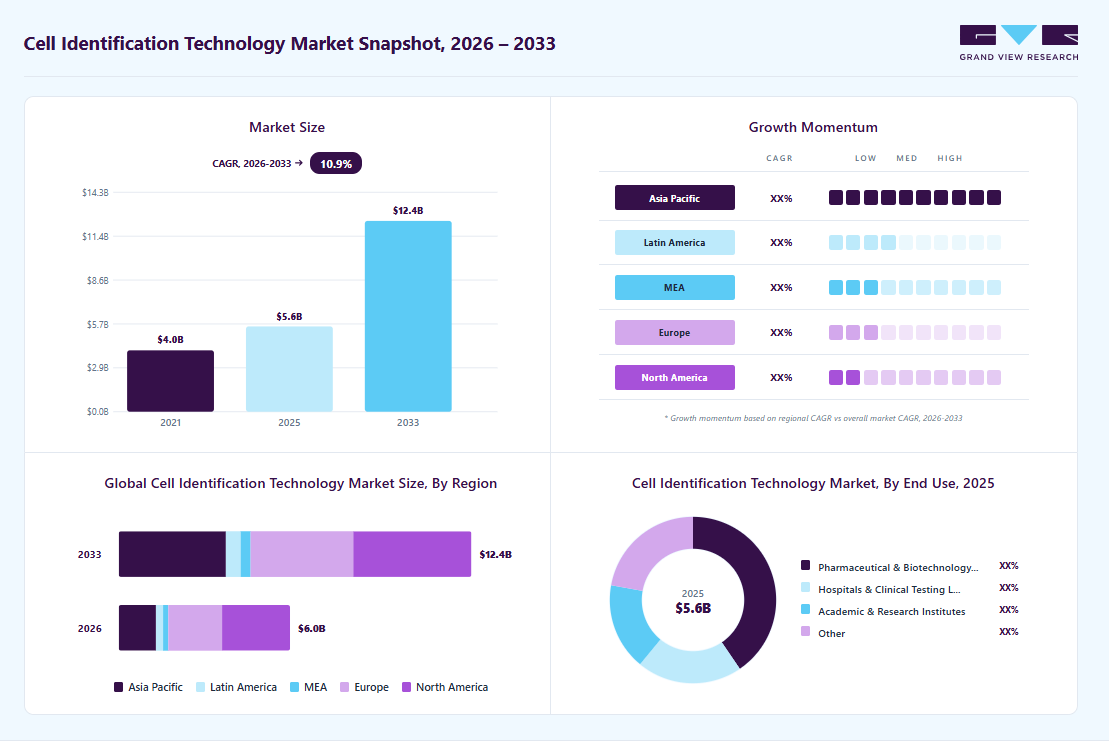
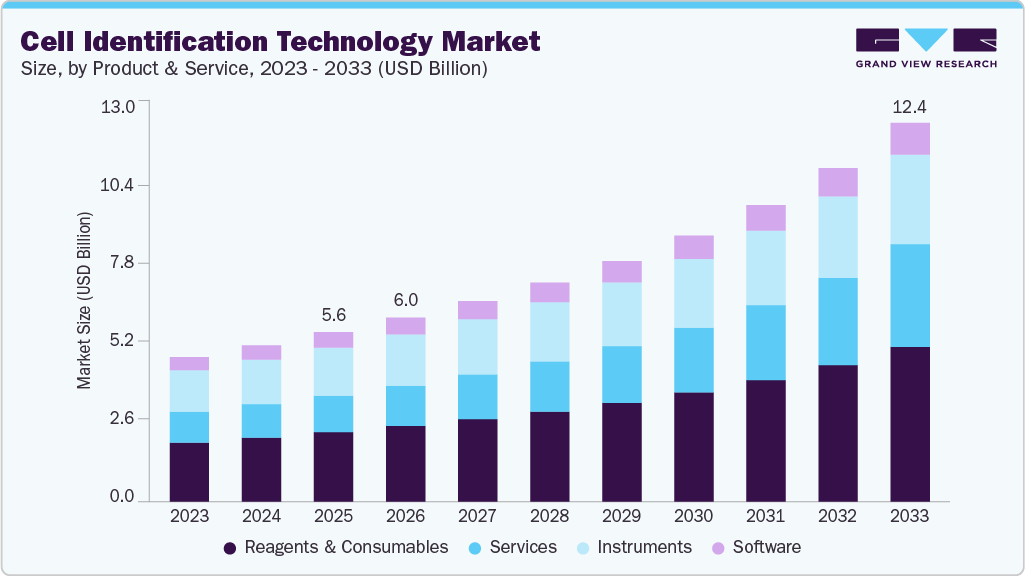
The global cell identification technology market size was valued at USD 5.6 billion in 2025 and is projected to grow from USD 6.0 billion in 2026 to USD 12.4 billion by 2033, at a CAGR of 10.9% from 2026 to 2033. The market in North America dominated with a revenue share of 40.2% in 2025. The market growth is primarily driven by increasing adoption of advanced cell analysis techniques in biomedical research, rising demand for precision medicine, and expanding applications in diagnostics, drug discovery, and regenerative medicine.
Key Market Trends & Insights
- By product & services: Reagents & consumables segment held the largest market share of 41.1% in 2025.
- By technology: Flow cytometry segment held the largest market share of 36.2% in 2025.
- By application: Disease diagnosis segment held the largest market share of 35.9% in 2025.
- By end-user: Pharmaceutical & biotechnology companies segment held the largest market share of 40.5% in 2025.
Regional Highlights
- Largest regional market: North America (40.2% revenue share, 2025)
- Fastest-growing regional market: Asia Pacific (highest CAGR, 2026-2033)
- By country: U.S. held the largest market share in 2025
Market Size & Forecast
- Market size in 2025: USD 5.6 Billion
- Estimated market size in 2026: USD 6.0 Billion
- Projected market size by 2033: USD 12.4 Billion
- CAGR (2026-2033): 10.9%
Technological Advancements in Cell Analysis
Advancements in cell analysis technologies are a key driver of the Cell Identification Technology Market. Innovations such as next-generation sequencing (NGS), advanced flow cytometry, and high-throughput screening have significantly improved the accuracy and speed of identifying different cell types. These technologies enable researchers to analyze cellular markers, genetic variations, and protein expression more precisely, supporting research in areas such as oncology, immunology, and molecular biology.
Key Technological Advancements In Cell Identification Technologies
Technological Advancement
Impact on Cell Identification Technology Market
Next-Generation Sequencing (NGS)
Enables precise identification of genetic variations and cellular markers.
Advanced Flow Cytometry
Allows rapid and accurate analysis of multiple cell populations simultaneously.
High-Throughput Screening
Facilitates large-scale cell analysis for drug discovery and research.
Imaging-Based Cell Analysis
Provides detailed visualization and characterization of cell structures and behavior.
Automation & AI Integration
Improves analysis speed, reduces human error, and increases research efficiency.
Source: Secondary Research, Primary Interviews, Grand View Research
In addition, the integration of automation, artificial intelligence, and high-content analysis platforms is improving the efficiency of cell identification processes. Modern systems can analyze large sample volumes while minimizing errors and variability. This capability is particularly important in drug discovery, clinical diagnostics, and cell-based therapy development, encouraging broader adoption of advanced cell identification technologies across research and biopharmaceutical organizations.
Increasing Drug Discovery and Biopharmaceutical R&D
The growing focus on drug discovery and biopharmaceutical research is a major driver of the cell identification technology market. Pharmaceutical and biotechnology companies rely on cell identification technologies to authenticate cell lines, study cellular behavior, and ensure accuracy in research. The increasing development of biologics, monoclonal antibodies, and cell-based therapies has further increased the need for precise cell characterization.
In addition, these technologies play an important role in drug screening, toxicity testing, and therapeutic development. Accurate cell identification enables researchers evaluate drug responses and improve the efficiency of preclinical and clinical studies. Rising investments in biotechnology and life sciences research are therefore increasing the adoption of advanced cell identification solutions.
Market Concentration & Characteristics
The degree of innovation in the cell identification technology industry is high, supported by advancements in next-generation sequencing, multi-parameter flow cytometry, and high-content imaging technologies. Integration of automation, microfluidics, and AI-driven analysis is improving the accuracy and efficiency of identifying complex and rare cell populations, expanding applications in precision medicine, oncology, and immunology.
The level of M&A activities in the cell identification technology industry is moderate to high, as biotechnology and life sciences companies pursue acquisitions and partnerships to expand technological capabilities and product portfolios. These deals mainly focus on advanced cell analysis, AI-based analytics, and single-cell technologies to strengthen their position in research and diagnostics.
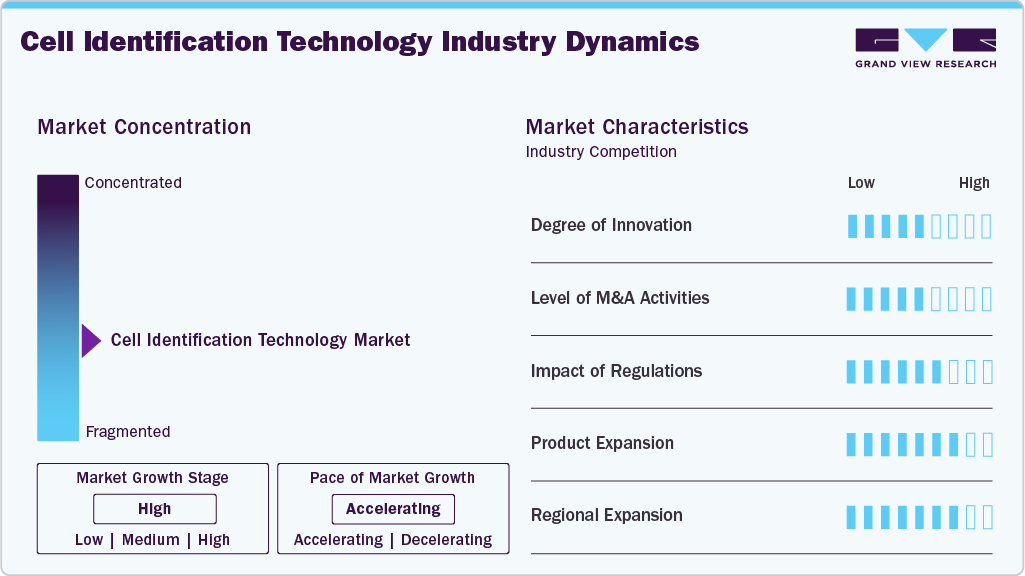
The impact of regulations in the cell identification technology industry is moderate to high, as regulatory requirements for diagnostics and cell-based research influence product development and commercialization. Compliance with standards from the U.S. Food and Drug Administration and European Medicines Agency ensures safety and quality but can extend approval timelines and increase costs.
Product expansion in the cell identification technology industry is high, as companies continuously introduce advanced instruments, reagents, and software solutions to enhance cell analysis capabilities. Expanding product portfolios, particularly in single-cell analysis, flow cytometry, and AI-based cell analysis tools, assists companies address growing research and clinical demands.
Regional expansion in the cell identification technology industry is growing, as companies expand into emerging regions such as Asia-Pacific and Latin America to tap increasing biotechnology research, healthcare investments, and demand for advanced cell analysis technologies.
Product & Services Insights
In 2025, the reagents & consumables segment led the cell identification technology industry with a share of 41.06%, driven by the recurring demand for antibodies, assay kits, staining reagents, and other laboratory consumables used in routine cell analysis. These products are essential for techniques such as flow cytometry, PCR, and immunoassays, resulting in consistent usage across research laboratories, clinical diagnostics, and biotechnology companies.
The services segment is the fastest-growing segment in the cell identification technology market over the forecast period, driven by the increasing demand for specialized testing, data analysis, and technical support services across research and clinical laboratories.
Technology Insights
The flow cytometry segment dominated the market with the largest revenue share of 36.17% in 2025, driven by its widespread use in cell analysis, immunophenotyping, and clinical diagnostics, along with increasing adoption in research laboratories and pharmaceutical development.
The High-Content Screening (HCS) segment is expected to grow at the fastest CAGR over the forecast period, driven by its ability to provide detailed cellular analysis and support high-throughput applications in drug discovery and biomedical research. Its growing adoption in pharmaceutical and biotechnology companies further contributes to segment growth.
Application Insights
The disease diagnosis segment dominated the market, with the largest revenue share of 35.89% in 2025, driven by the growing need for early disease detection, personalized medicine, and advancements in biomarker-based research and diagnostic technologies, along with increasing global demand.
Cancer research is expected to witness the fastest growth over the forecast period, driven by the rising global burden of cancer and increasing investments in oncology research. Growing adoption of advanced cell identification technologies for tumor profiling, biomarker discovery, and drug development is further supporting market expansion. Moreover, increasing collaborations between research institutes and pharmaceutical companies are accelerating innovation in cancer diagnostics and therapeutics.
End-user Insights
The pharmaceutical & biotechnology companies segment dominated the market with the largest share of 40.49% in 2025, driven by the increasing focus on drug discovery, development of targeted therapies, and adoption of advanced cell identification technologies. Growing investments in R&D and expansion of personalized medicine initiatives further contribute to the segment’s market leadership.
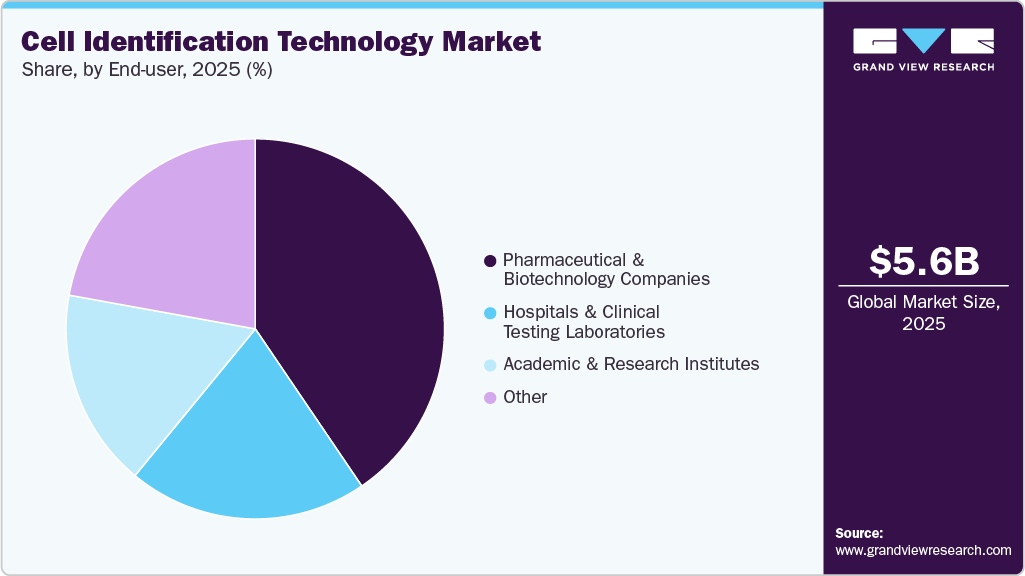
Hospitals & clinical testing laboratories are expected to witness the fastest growth from 2026 to 2033, driven by rising demand for accurate diagnostics, increasing prevalence of chronic and infectious diseases, and expanding adoption of advanced cell identification technologies. Growing healthcare infrastructure and government initiatives further support market expansion in this segment.
Regional Insights
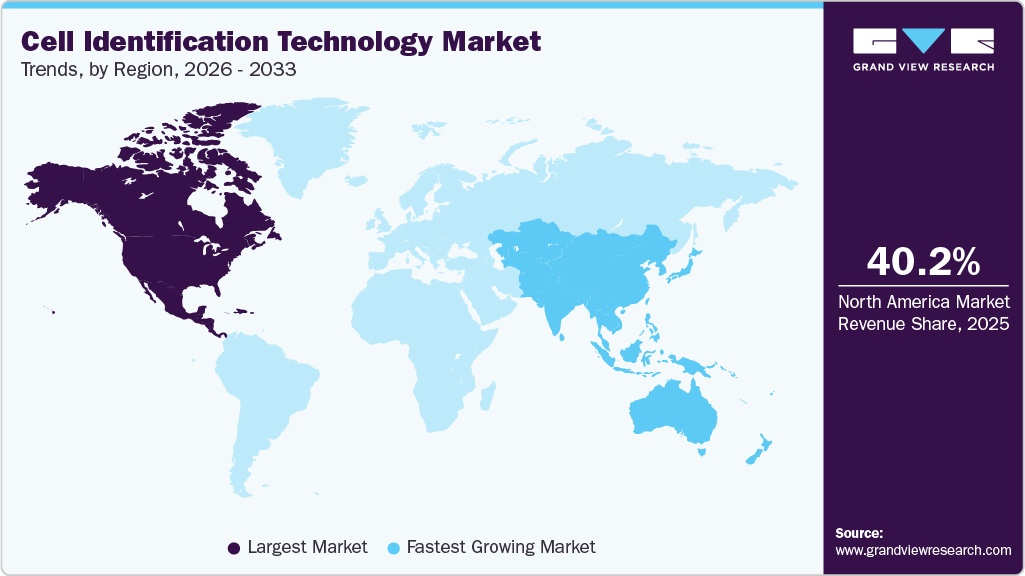
North America cell identification technology market dominated the global market and accounted for a 40.16% share in 2025, supported by strong biotechnology and pharmaceutical industries, advanced research infrastructure, and substantial funding for life science research. The presence of major industry players and increasing adoption of advanced technologies such as single-cell analysis and high-parameter flow cytometry further drives regional market growth.
U.S Cell Identification Technology Market Trends
The U.S. cell identification technology market is expected to experience strong growth, driven by the presence of major market players, supportive regulations, and increasing R&D investments by pharmaceutical and biotechnology companies. The availability of advanced technologies and frequent product launches by leading companies further supports the adoption of cell identification technology solutions and market expansion.
Europe Cell Identification Technology Market Trends
Europe represents a mature market driven by strong academic research, government support for biotechnology innovation, and expanding applications in clinical diagnostics and immunology research. Collaborative research programs and the presence of well-established pharmaceutical companies contribute to the steady adoption of advanced cell identification technologies.
The UK cell identification technology industry is driven by strong academic research, biotechnology innovation, and government-supported life science initiatives. Increasing focus on immunology, cancer research, and precision medicine is accelerating the adoption of advanced cell analysis and identification technologies across research institutions and clinical laboratories
Cell identification technology market in Germany growth is supported by its well-established biotechnology and pharmaceutical sectors, along with strong investment in biomedical research. The demand for high-precision cell analysis tools and advanced flow cytometry systems is increasing, particularly in drug development and translational research.
Asia Pacific Cell Identification Technology Market Trends
The cell identification technology industry in Asia Pacific is anticipated to witness the fastest growth at a CAGR of 16.3% from 2026 to 2033, due to expanding biotechnology sectors, rising healthcare investments, and increasing research activities in countries such as China, Japan, and India. Growing focus on precision medicine, stem cell research, and biopharmaceutical development is accelerating the demand for cell identification technologies.
Cell identification technology market in China is growing rapidly due to increasing biotechnology investments, expanding research infrastructure, and a strong focus on biopharmaceutical development and precision medicine, which is driving demand for advanced cell identification solutions.
Japan cell identification technology market is growing due to a strong focus on regenerative medicine, stem cell research, and advanced diagnostics. Collaboration between research institutions and biotechnology companies is supporting the adoption of advanced cell analysis technologies.
Middle East & Africa Cell Identification Technology Market Trends
The MEA market is gradually developing, supported by improving healthcare infrastructure and increasing investments in biomedical research. Growing interest in advanced diagnostic technologies and research collaborations is expected to support the gradual adoption of cell identification solutions across the region.
Cell identification technology industry in Kuwait is gradually developing due to increasing healthcare investments and growing adoption of advanced diagnostic technologies in biomedical research.
Key Cell Identification Technology Company Insights
The cell identification technology market is moderately consolidated, with key players such as Thermo Fisher Scientific, Danaher Corporation, Becton, Dickinson and Company, and Merck KGaA leading through broad portfolios of instruments, reagents, and cell analysis platforms, supported by strong R&D investments.
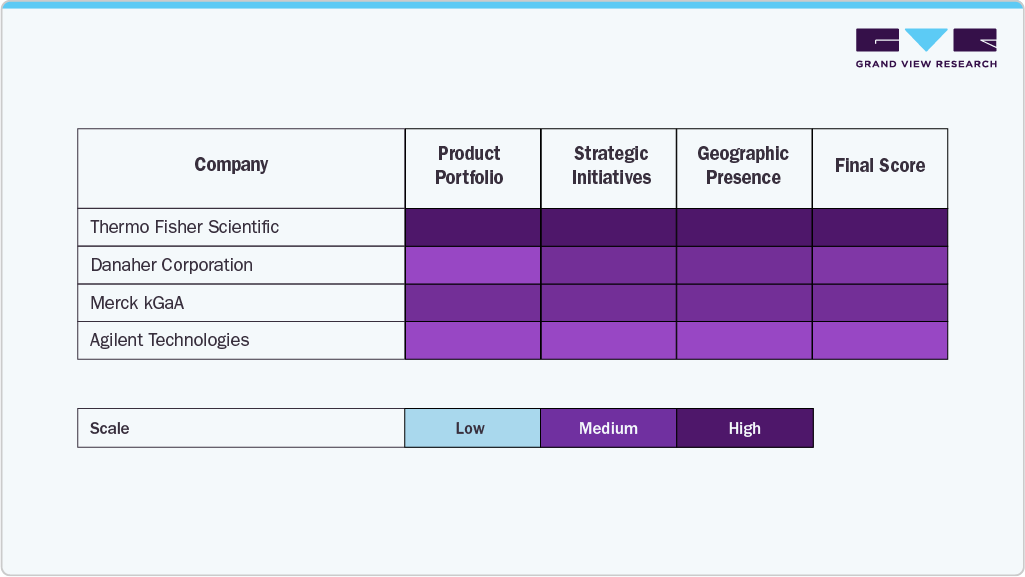
Other notable companies including Agilent Technologies, Bio-Rad Laboratories, Miltenyi Biotec, Illumina, QIAGEN, and Sartorius AG compete through product innovation, single-cell technologies, and collaborations with research institutions.
Key Cell Identification Technology Companies:
The following key companies have been profiled for this study on the cell identification technology market.
- Thermo Fisher Scientific
- Danaher Corporation
- Becton, Dickinson and Company
- Merck KGaA
- Agilent Technologies
- Bio-Rad Laboratories
- Miltenyi Biotec
- Illumina
- QIAGEN
- Sartorius AG
Recent Developments
-
In November 2025, QIAGEN agreed to acquire Parse Biosciences for USD 225 million, expanding scalable single-cell solutions and strengthening its presence in the global cell identification technology market.
-
In May 2025, U.S.-based Becton, Dickinson and Company launched the BD FACSDiscover A8 Cell Analyzer globally, introducing spectral and real-time imaging technologies to enhance high-throughput cellular analysis in the cell identification technology market.
Cell Identification Technology Market Report Scope
Report Attribute
Details
Market size in 2025
USD 5.6 billion
Estimated market size in 2026
USD 6.0 billion
Projected market size by 2033
USD 12.4 billion
Growth rate
CAGR of 10.9% from 2026 to 2033
Base year for estimation
2025
Historical data
2021 - 2024
Forecast period
2026 - 2033
Quantitative units
Revenue in USD million/billion, and CAGR from 2026 to 2033
Report coverage
Revenue forecast, company ranking, competitive landscape, growth factors, and trends
Segments covered
Product & service, technology, application, end-use, region
Regional scope
North America; Europe; Asia Pacific; Latin America; MEA
Country scope
U.S.; Canada; Mexico; UK; Germany; France; Italy; Spain; Denmark; Sweden; Norway; Japan; China; India; Australia; Thailand; South Korea; Brazil; Argentina; South Africa; Saudi Arabia, UAE; Kuwait
Key companies profiled
Thermo Fisher Scientific; Danaher Corporation; Becton; Dickinson and Company; Merck KGaA; Agilent Technologies; Bio-Rad Laboratories; Miltenyi Biotec; Illumina; QIAGEN; Sartorius AG
Customization scope
Free report customization (equivalent up to 8 analyst’s working days) with purchase. Addition or alteration to country, regional & segment scope.
Pricing and purchase options
Avail customized purchase options to meet your exact research needs. Explore purchase options
Global Cell Identification Technology Market Report Segmentation
This report forecasts revenue growth and provides an analysis on the latest trends in each of the sub-segments from 2021 to 2033. For this report, Grand View Research has segmented the global cell identification technology market report based on product & service, technology, application, end-use, and region:
-
Product & Service Outlook (Revenue, USD Million, 2021 - 2033)
-
Instruments
-
Reagents & Consumables
-
Software
-
Services
-
-
Technology Outlook (Revenue, USD Million, 2021 - 2033)
-
Flow Cytometry
-
PCR
-
Microscopy
-
High-Content Screening (HCS)
-
Immunohistochemistry (IHC)
-
Others
-
-
Application Outlook (Revenue, USD Million, 2021 - 2033)
-
Disease Diagnosis
-
Drug Discovery & Development
-
Stem Cell Research
-
Immunology Research
-
Cancer Research
-
Others
-
-
End-use Outlook (Revenue, USD Million, 2021 - 2033)
-
Pharmaceutical & Biotechnology Companies
-
Hospitals & Clinical Testing Laboratories
-
Academic & Research Institutes
-
Other
-
-
Regional Outlook (Revenue, USD Million, 2021 - 2033)
-
North America
-
U.S.
-
Canada
-
Mexico
-
-
Europe
-
Germany
-
UK
-
France
-
Italy
-
Spain
-
Denmark
-
Sweden
-
Norway
-
-
Asia Pacific
-
China
-
Japan
-
India
-
South Korea
-
Australia
-
Thailand
-
-
Latin America
-
Brazil
-
Argentina
-
-
MEA
-
South Africa
-
Saudi Arabia
-
UAE
-
Kuwait
-
-
Frequently Asked Questions About This Report
Asia Pacific is the fastest-growing region over the forecast period.
The reagents & consumables segment led with a 41.1% revenue share in 2025, while the services segment is the fastest-growing.
The flow cytometry segment led with a 36.2% revenue share in 2025, while the High-Content screening (HCS) segment is the fastest-growing.
The disease diagnosis segment led with a 35.9% revenue share in 2025, while the cancer research segment is the fastest-growing.
The global cell identification technology market size was estimated at USD 5.6 billion in 2025 and is expected to reach USD 6.0 billion in 2026.
North America cell identification technology market dominated the global market and accounted for a 40.2% share in 2025, supported by strong biotechnology and pharmaceutical industries, advanced research infrastructure, and substantial funding for life science research
Some key players operating in the cell identification technology market include Thermo Fisher Scientific; Danaher Corporation; Becton, Dickinson and Company; Merck KGaA; Agilent Technologies; Bio-Rad Laboratories; Miltenyi Biotec; Illumina; QIAGEN; Sartorius AG
The market growth is primarily driven by increasing adoption of advanced cell analysis techniques in biomedical research, rising demand for precision medicine, and expanding applications in diagnostics, drug discovery, and regenerative medicine
The global cell identification technology market is expected to grow at a compound annual growth rate of 10.9% from 2026 to 2033 to reach USD 12.4 billion by 2033.
About the Author(s)
Biotechnology Research Team
Healthcare · BiotechnologyThis report was authored by the biotechnology research team at Grand View Research - comprising two research analysts, one senior research analyst, and one industry expert - with specialized expertise in the biotechnology segment of the healthcare industry. All findings are based on proprietary healthcare databases, executive interviews, and regulatory analysis, subject to internal peer review prior to publication.
Last Updated:
Speak to Analyst


Customize this report to your needs — add regions, segments, or data points, with 20% free customization.
Or view our licence options:


ISO 9001:2015 & 27001:2022 Certified
We are GDPR and CCPA compliant! Your transaction & personal information is safe and secure. For more details, please read our privacy policy.


