
- Home
- »
- Next Generation Technologies
- »
-
Farm Management Software Market Size Report, 2026-2033GVR Report cover
![Farm Management Software Market (2026 - 2033)Report]()
Farm Management Software Market (2026 - 2033)
Size, Share & Trends Analysis Report By Agriculture Type (Precision Farming, Livestock Monitoring, Smart Greenhouse), By Component (Software, Services), By Deployment, By Region, And Segment Forecasts
Market Size, 2025
$4.8BMarket Estimate, 2026
$5.5BMarket Forecast, 2033
$19.7BCAGR, 2026–2033
20.1%Farm Management Software Market Summary
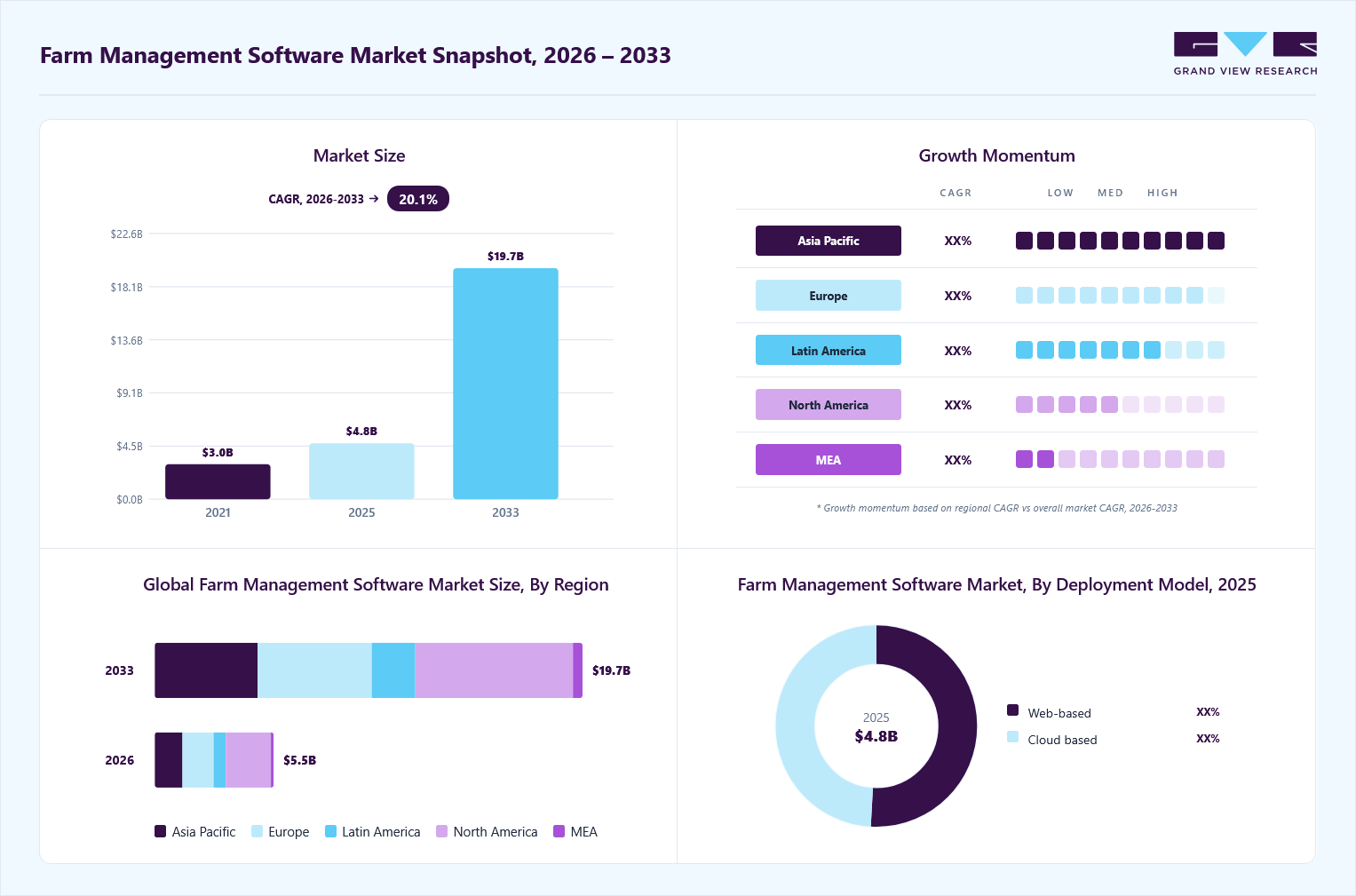
The global farm management software market size was valued at USD 4.8 billion in 2025 and is projected to grow from USD 5.5 billion in 2026 to USD 19.7 billion by 2033, at a CAGR of 20.1% from 2026 to 2033. The market in North America dominated with a revenue share of 38.1% in 2025. This growth is driven by increasing adoption of precision agriculture, boosting demand for software that optimizes inputs, crop monitoring, and yields.
Key Market Trends & Insights
- By component: Software segment dominated the market, with a revenue share of 64.6% in 2025.
- By agriculture type: Precision farming segment held the largest market share of 43.3% in 2025.
- By deployment: Web-based segment held the largest revenue share of 50.8% in 2025.
Regional Highlights
- Largest regional market: North America (38.1% revenue share, 2025)
- Fastest-growing regional market: Asia Pacific (highest CAGR, 2026-2033)
- By country: The U.S. held the largest market share in 2025.
Market Size & Forecast
- Market size in 2025: USD 4.8 Billion
- Estimated market size in 2026: USD 5.5 Billion
- Projected market size by 2033: USD 19.7 Billion
- CAGR (2026-2033): 20.1%
The market growth can be attributed to the increasing implementation of cloud computing for real-time farm data management. Farm Management Software (FMS) involves the use of Information Communication Technology (ICT), particularly IoT and big data analytics, to address resource constraints such as shortage of energy, water, and labor and social issues such as environment, animal welfare and use of fertilizers, which negatively influence agricultural production.The adoption of remote sensing technology in the agriculture industry has increased due to the emergence of drones and GIS. Images captured through a device featuring remote sensing technology can be used to detect cop water stress, monitor weeds and crop diseases, classify crop species, and map soil properties. Some open-source remote sensing software includes Quantum GIS Semi-Automatic Classification Plugin (SCP), Optical and Radar Federated Earth Observation (ORFEO) toolbox, Opticks, and PolSARPro, among others.

In addition, increasing site-specific crop management is expected to reduce pesticide use, increase crop yields, and provide greater insight for farm management decisions. Farm management software equipped with advanced data analytics capabilities can process historical and real-time data to generate predictive models, enabling farmers to forecast crop performance under different environmental conditions. By analyzing factors like weather patterns, soil quality, and crop health, the software can offer valuable insights to make informed decisions regarding fertilization, pest control, and irrigation. Forecasting crop performance under various environmental situations can assist farmers in boosting their yield. Phenotyping aids in the understanding of several elements affecting crop growth, such as nitrogen depletion and soil pH levels. It is used to determine crop growth under various situations.
Furthermore, the rising popularity of integrated farm management systems, which provide end-to-end solutions for crop planning, field monitoring, livestock management, and supply chain optimization, is transforming traditional farming methods. Mobile applications and remote sensing technologies have made it easier for farmers to monitor their operations in real-time, even in remote areas. However, challenges such as high initial investment costs, lack of digital literacy among small-scale farmers, and concerns regarding data security remain barriers to widespread adoption. Despite these challenges, the market outlook remains promising, with continuous advancements in AI-powered analytics, automation, and machine learning expected to further enhance the capabilities and accessibility of farm management software. Farm management solutions will play a crucial role in ensuring sustainable and efficient food production worldwide as the agriculture sector continues to modernize.
Market Dynamics
The farm management software market is experiencing strong growth as agricultural producers increasingly adopt digital technologies to improve productivity, optimize resource utilization, and enhance decision-making across farming operations. Farm management software enables farmers to monitor crop performance, manage field activities, track input usage, analyze farm data, automate record-keeping, and improve overall operational efficiency. The growing need to address food security challenges, labor shortages, climate variability, and rising production costs is accelerating the adoption of data-driven farming solutions. Furthermore, increasing integration of precision agriculture technologies, IoT sensors, drones, satellite imagery, artificial intelligence (AI), and cloud-based platforms is strengthening the role of farm management software in modern agricultural ecosystems.
The increasing adoption of precision agriculture practices is a significant driver of the farm management software market. Farmers are increasingly leveraging digital tools to optimize irrigation schedules, fertilizer application, pest management, crop monitoring, and yield forecasting. Farm management software consolidates data from multiple sources, including IoT devices, drones, weather stations, machinery, and satellite imagery, enabling real-time insights and evidence-based decision-making. Rising pressure to improve farm productivity while minimizing resource consumption and environmental impact is encouraging growers to invest in advanced software solutions. Additionally, government initiatives promoting smart farming technologies and sustainable agricultural practices are further supporting market growth.
For instance, in February 2026, DTN announced the launch of DTN Ag Hub, a connected agricultural intelligence platform designed to integrate farm intelligence, grain market data, and agribusiness workflows. The platform reduces reliance on fragmented systems and manual processes while providing connected insights to support smarter operational and purchasing decisions across the agricultural value chain. Such developments demonstrate how increasing demand for precision farming and digital agriculture solutions is driving investment in farm management software, supporting the market's long-term expansion.
High implementation costs and limited digital infrastructure in rural regions remain significant restraints for the farm management software market. The adoption of advanced farm management platforms often requires investments in sensors, connected equipment, GPS-enabled machinery, drones, internet connectivity, and employee training. Small and medium-sized farms, particularly in developing economies, may face budget constraints that limit technology adoption. Additionally, inadequate broadband connectivity and low digital literacy levels in certain agricultural regions can hinder effective software deployment and utilization.
Moreover, concerns regarding data privacy, cybersecurity, interoperability among different agricultural technologies, and integration with legacy farming equipment may create additional barriers for users. These challenges can slow adoption rates, particularly among traditional farming communities and resource-constrained agricultural enterprises.
The rapid advancement of artificial intelligence, Internet of Things (IoT), and climate-smart agriculture is creating substantial opportunities for the farm management software market. AI-powered analytics are enabling predictive insights related to crop health, disease outbreaks, yield forecasting, and resource optimization, helping farmers improve productivity and profitability. At the same time, IoT-enabled sensors and connected farm equipment are generating large volumes of real-time operational data that can be effectively managed through integrated farm management platforms.
In addition, growing concerns regarding climate change, water scarcity, soil degradation, and sustainable food production are increasing demand for software solutions that support precision irrigation, carbon footprint monitoring, regenerative farming practices, and environmental compliance. Governments, agribusinesses, and agricultural cooperatives are also investing in digital agriculture initiatives to enhance food security and farm resilience. These trends are expected to create significant long-term growth opportunities for farm management software providers worldwide.
Analyst Perspective
The farm management software market sits at the intersection of several powerful structural growth drivers, including the increasing adoption of precision agriculture, rising demand for data-driven farming practices, growing integration of IoT and connected farm equipment, and the need to improve agricultural productivity amid resource constraints and climate variability. As farmers and agribusinesses increasingly prioritize operational efficiency, sustainability, and profitability, farm management software has emerged as a critical tool for optimizing crop planning, resource allocation, field operations, livestock management, and financial performance. The market also benefits from long-term demand generated by digital agriculture initiatives, expanding use of satellite imagery and drone technologies, increasing government support for smart farming, and the growing need for traceability and regulatory compliance across agricultural value chains.
Component Insights
Based on component, the software segment led the market with the largest revenue share of 64.6% in 2025. Integrating IoT and cloud-based solutions has revolutionized FMS by offering real-time monitoring, remote access, and automated data processing. IoT-enabled sensors collect critical field data such as soil moisture, temperature, and nutrient levels, which FMS then analyzes to provide actionable insights. Cloud-based computing allows farmers to access their data from anywhere, improving convenience and collaboration among stakeholders in the agricultural supply chain.
The services segment is expected to grow at a CAGR of 16.6% over the forecast period. The rise of subscription-based and cloud-based FMS models is driving segment growth. Many FMS providers offer solutions, such as Software-as-a-Service (SaaS), which requires ongoing support, updates, and maintenance. Farmers subscribing to these services often rely on customer support teams for troubleshooting, software updates, and cybersecurity measures to protect their farm data.
Agriculture Type Insights
The market is segmented into precision farming, livestock monitoring, smart greenhouse, and others based on agriculture type. Based on agriculture type, the precision farming segment led the market with the largest revenue share of 43.3% in 2025. The growing trend of data-driven farming drives the expansion of the precision farming market. With the increasing availability of big data, farmers can make informed decisions based on comprehensive data analysis rather than relying on traditional farming methods. This includes utilizing weather data, soil conditions, and crop health reports collected through sensors and remote sensing technologies. Integrating big data analytics with FMS allows farmers to identify patterns, predict outcomes, and fine-tune their practices to maximize efficiency and yield. As data-driven farming becomes more mainstream, the reliance on advanced farm management software systems is intensifying, thereby propelling the growth of the precision farming market.
The smart greenhouse segment is anticipated to grow at the fastest CAGR of 17.8% over the forecast period. Consumer demand for fresh, locally grown produce is driving the adoption of smart greenhouses. With the increasing interest in sustainable and organic farming, consumers are looking for ways to access fresh, high-quality produce grown without harmful chemicals. Smart greenhouses allow for year-round production of fruits, vegetables, and herbs in controlled environments, reducing reliance on traditional farming methods and long supply chains. FMS helps streamline operations, ensuring that crops are produced efficiently and at high standards, thus meeting consumer expectations for freshness and sustainability.
Deployment Insights
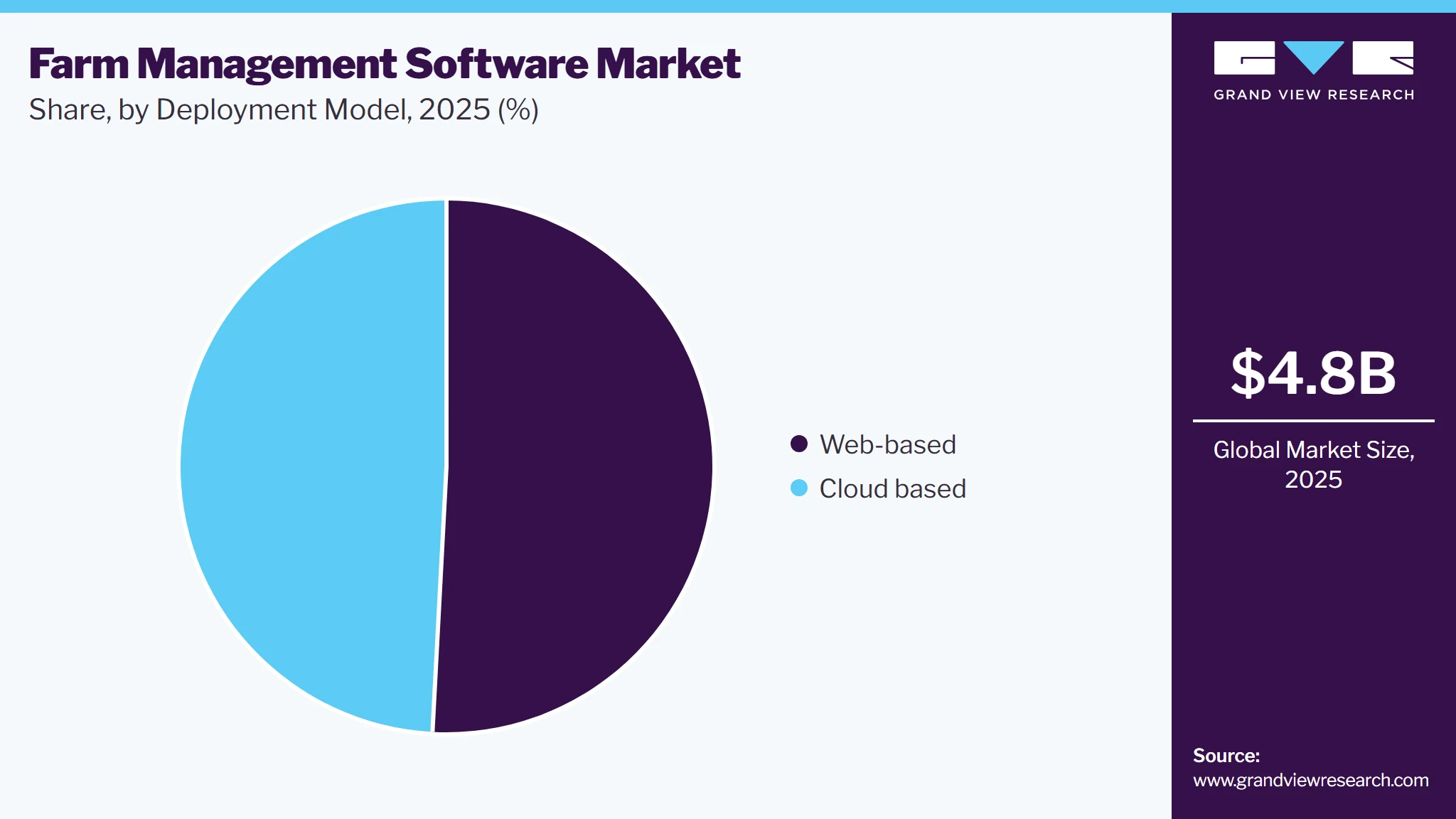
Based on deployment, the web-based segment led the market with the largest revenue share of 50.8% in 2025. The growing focus on data security and cloud computing played a pivotal role in the web-based FMS market’s expansion. Many farmers are more comfortable with cloud technology due to data encryption advancements and cybersecurity protocols protecting their sensitive farm data. As trust in cloud-based services increases, farmers are more willing to adopt these solutions to enhance operational efficiency without compromising data security.
The cloud-based segment is anticipated to grow fastest from 2026 to 2033. The advancement of precision agriculture technologies is driving the growth of cloud-based FMS. Precision farming relies heavily on data-driven insights to make real-time crop and resource management decisions. Cloud-based FMS supports precision agriculture by enabling seamless integration with GPS technology, remote sensing devices, drones, and other IoT tools that collect data about soil health, crop growth, and environmental conditions. These technologies enable farmers to tailor their practices to specific areas within a field, improving efficiency and sustainability while reducing waste and resource consumption. The ability to process large amounts of data from these advanced tools in the cloud makes it easier for farmers to implement large-scale precision farming strategies.
Regional Insights
North America dominated the global farm management software market with the largest revenue share of 38.1% in 2025. The consolidation of farms and the rise of large agribusinesses in North America are driving the demand for more advanced and comprehensive farm management software solutions. As farms grow larger and more complex, there is a need for more sophisticated software to manage various aspects of farm operations, from crop production to financial management. FMS platforms provide agribusinesses with the tools to streamline operations, track inventory, monitor labor, and manage finances in one integrated system. This efficiency level is critical for large-scale farming operations, and as the consolidation trend continues, the demand for comprehensive FMS solutions is expected to rise.

U.S. Farm Management Software Market Trends
The farm management software market in the U.S. held the largest share in the North America region in 2025. Government policies and initiatives play a significant role in driving the adoption of FMS in the U.S. The U.S. government has implemented several programs incentivizing farmers to adopt digital technologies to improve farm efficiency and sustainability. For example, programs from the U.S. Department of Agriculture (USDA) provide farmers with financial assistance and technical support to adopt precision agriculture tools and software solutions. In addition, implementing environmental regulations and sustainability goals, such as those aimed at reducing water usage and minimizing chemical inputs, encourages farmers to adopt FMS, which helps them meet compliance standards. These government-backed initiatives provide farmers with the necessary resources to integrate advanced technologies into their operations.
Europe Farm Management Software Market Trends
The farm management software industry in Europe is anticipated to register considerable growth from 2026 to 2033. The growing demand for organic and sustainably produced food drives European market growth. Consumers across the region are increasingly concerned about food safety, environmental impact, and the ethical treatment of animals, which has led to a rise in the demand for organic, locally sourced, and sustainably produced agricultural products. As a result, European farmers are under pressure to adopt farming practices that minimize the use of chemicals, reduce waste, and protect the environment. Farm management software plays a key role in enabling farmers to meet these consumer demands by providing tools for better resource management, waste reduction, and traceability.
The UK farm management software industry held a substantial market share in 2025. The growing consumer demand for traceability and transparency in food production is influencing the FMS market in the UK. Consumers are increasingly concerned about the origins of their food and the practices used to produce it. This trend is especially prominent in the UK, where consumers demand more information about food production's sustainability, quality, and ethical practices. Farm management software enables farmers to track and document various aspects of their farming practices, such as crop rotations, pesticide use, and harvest records. This level of transparency can help farmers demonstrate compliance with sustainability certifications and provide consumers with the information they need to make informed purchasing decisions.
The farm management software industry in Germany is expected to grow rapidly during the forecast period. Germany’s export-oriented industrial base, especially in automotive, machinery, and electronics, also drives the adoption of LCA. International markets increasingly demand sustainable, transparent supply chains and products with documented environmental performance. German manufacturers use LCA to generate Environmental Product Declarations (EPDs) and carbon footprint analyses that meet EU and global standards, enabling them to maintain competitiveness and meet customer expectations. Automakers, in particular, leverage LCA to assess the full lifecycle impact of vehicles, including electric vehicles (EVs), as part of their commitments to sustainable mobility.
Asia Pacific Farm Management Software Industry Trends
The farm management software market in Asia Pacific is expected to achieve the fastest CAGR of 17.8% during the forecast period. The growing concern over environmental sustainability and the impact of climate change on agriculture drives the market growth in the region. With extreme weather events such as droughts, floods, and storms becoming more frequent and severe, farmers are increasingly looking for ways to adapt to changing climatic conditions. Farm management software plays a critical role in this context by helping farmers manage their resources more efficiently and make data-driven decisions to mitigate the risks of climate change. As environmental sustainability becomes a priority for governments and consumers, FMS solutions are seen as an important tool for achieving more sustainable agricultural practices in the APAC region.
China farm management software industry held a substantial market share in 2025. The increasing availability of mobile technology is a key factor driving the growth of the FMS market in China. With the widespread use of smartphones and mobile internet, farmers in China can access mobile applications that enable them to manage their farm operations remotely. This is particularly important in rural areas, where farmers may have limited access to traditional infrastructure but have a high mobile phone penetration rate. Mobile farm management software allows farmers to monitor their crops, track inputs and outputs, access weather data, and receive updates on market prices, all from the palm of their hands. The accessibility and convenience of mobile-based FMS solutions are making them more appealing to farmers in China, especially as mobile technology continues to improve and become more affordable.
The farm management software market in India is expected to grow rapidly during the forecast period. The rise of e-commerce platforms and digital marketplaces in India is contributing to the growth of the FMS market. As more farmers look to sell their produce directly to consumers through online platforms, they need digital tools to manage inventory, track sales, and analyze market trends. Farm management software can help farmers integrate with e-commerce platforms, manage their supply chains, and set competitive prices based on real-time market data. This is particularly important in India, where traditional supply chains often involve intermediaries that reduce the farmer’s income. By enabling farmers to bypass intermediaries and directly reach consumers, FMS can help improve profitability and market access for Indian farmers.
Bottom of Form Key Farm Management Software Company Insights
Some key players operating in the market include Conservis, Agworld Pty Ltd, and Croptracker.
-
Conservis is a technology company specializing in providing software solutions tailored to the agricultural industry. Founded with the vision of helping farmers increase operational efficiency and profitability, Conservis offers a comprehensive farm management platform. The platform enables farmers to capture, manage, and analyze data across all aspects of their farming operations, from planting and harvesting to financial and inventory management. The company’s key product is its farm management software, which is designed to streamline farm operations, reduce waste, and enhance decision-making. Farmers can monitor and optimize the use of resources such as labor, machinery, and inputs through data-driven insights. This allows them to make informed decisions that improve yields, reduce costs, and contribute to sustainable farming practices.
Farmbrite and AGRIVI are some of the emerging market participants in the target market.
-
Farmbrite is a technology company that offers a comprehensive farm management software platform designed to help farmers and agricultural businesses streamline operations and increase productivity. The platform is tailored for small to mid-sized farms. It provides a user-friendly solution for managing various aspects of farming, including crop planning, livestock tracking, financial management, and inventory control. By consolidating farm data into a centralized platform, Farmbrite enables farmers to make more informed decisions and enhance overall farm efficiency. The software supports crop and livestock operations, making it versatile for various farming practices. Farmbrite also offers tools for budgeting, invoicing, and reporting, helping farmers manage finances and stay on top of expenses, revenues, and profitability.
Key Farm Management Software Companies:
The following key companies have been profiled for this study on the farm management software market.
-
Bushel Inc.
-
Conservis
-
Agworld Pty Ltd
-
Farmbrite
-
AGRIVI
-
Croptracker
-
AgriWebb
-
Aegro
-
xFarm Technologies
-
AgriERP
-
eAgronom
-
Navfarm
Competitive Benchmarking
Category
Operating Strategies
Competitive Edge
Weakness
Established Players (Bushel Inc., Conservis, AGRIVI, AgriWebb, xFarm Technologies, eAgronom)
- Expand platform capabilities through AI, precision agriculture, carbon farming, sustainability management, and farm analytics.
- Invest in integrations with IoT devices, machinery, satellite imagery, weather data, and agribusiness ecosystems while expanding into new geographic markets through partnerships and acquisitions.
- Strong brand recognition, extensive customer bases, and comprehensive product portfolios covering crop, livestock, financial, and operational management.
- Broad partner ecosystems and advanced analytics capabilities support large-scale agricultural enterprises and multi-farm operations.
- Higher operating and product development costs due to continuous platform enhancement and technology integration requirements.
- Complex solutions may require significant onboarding, training, and implementation efforts for smaller farms.
Emerging Players (Agworld Pty Ltd, Croptracker, Aegro)
- Focus on regional expansion and niche agricultural segments through specialized farm management solutions.
- Differentiate through user-friendly platforms, crop-specific functionalities, mobile-first applications, and localized agronomic support.
- Greater flexibility in adapting products to local farming practices and customer requirements.
- Strong regional relationships and faster innovation cycles enable rapid feature development and market responsiveness.
- Smaller customer bases and more limited geographic reach compared to established vendors.
- Lower financial resources may constrain investment in advanced AI capabilities, large-scale R&D, and international expansion initiatives.
Recent Developments
-
In May 2025, xFarm Technologies partnered with Checkplant, an AgTech company based in Brazil specializing in agricultural field management and monitoring solutions. This collaboration allows xFarm Technologies to expand its presence in Latin America, positioning itself as a more reliable partner for companies seeking to digitalize their global supply chains. In turn, Checkplant gains the opportunity to broaden its reach and enhance its services. The two companies complement each other well, with a combined global coverage of over 12 million hectares.
-
In December 2024, Syngenta France, a key innovator in agriculture, partnered with xFarm Technologies on a geospatial AI project focused on crop detection in France. This collaboration merges the expertise of Syngenta France with the advanced knowledge of xFarm Technologies. The company assists over 450,000 farms across 7 million hectares in more than 100 countries via its Farm Management Information System on the xFarm digital platform. The project is designed to provide enhanced support for farmers in France, where certain phytosanitary products are tightly regulated, especially when non-target crops are nearby.
-
In September 2024, AGRIVI partnered with the Barbados Agricultural Development and Marketing Corporation (BADMC) to launch the world’s first national AI Agronomic Advisor. This innovative AI-driven platform, accessible through WhatsApp, will provide Barbadian farmers with 24/7 real-time agricultural advice, enhancing productivity and sustainability across the island’s farming community. The partnership highlights Barbados’ dedication to digitizing its agricultural sector. The AI platform will function as a virtual agronomy expert, offering essential support to farmers of all scales. It serves as a direct communication channel between BADMC and farmers, offering guidance on various agricultural issues such as financing, subsidies, and government assistance.
Farm Management Software Market Report Scope
Report Attribute
Details
Market size in 2025
USD 4.8 billion
Estimated market size in 2026
USD 5.5 billion
Projected market size by 2033
USD 19.7 billion
Growth rate
CAGR of 20.1% from 2026 to 2033
Base year for estimation
2025
Historical data
2021 - 2024
Forecast period
2026 - 2033
Quantitative units
Revenue in USD million/billion and CAGR from 2026 to 2033
Report coverage
Revenue forecast, company market share, competitive landscape, growth factors, and trends
Segments covered
Component, agriculture type, deployment, region
Regional scope
North America; Europe; Asia Pacific; Latin America; MEA
Country scope
U.S.; Canada; Mexico; U.K.; Germany; France; China; India; Japan; Australia; South Korea; Brazil; UAE; Kingdom of Saudi Arabia; South Africa
Key companies profiled
Bushel Inc.; Conservis; Agworld Pty Ltd; Farmbrite; AGRIVI; Croptracker; AgriWebb; Aegro; xFarm Technologies; AgriERP; eAgronom; Navfarm
Customization scope
Free report customization (equivalent up to 8 analysts' working days) with purchase. Addition or alteration to country, regional & segment scope.
Pricing and purchase options
Avail customized purchase options to meet your exact research needs. Explore purchase options
Global Farm Management Software Market Report Segmentation
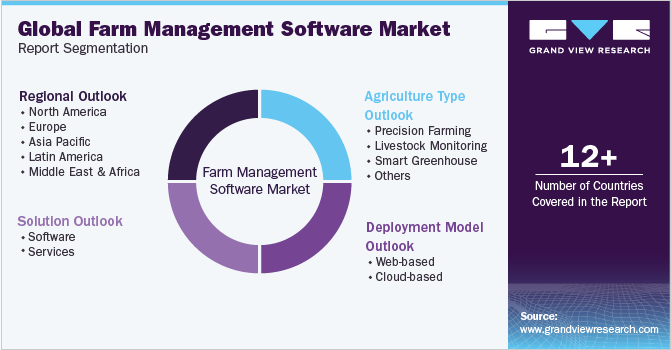
This report forecasts revenue growths at global, regional, as well as at country levels and offers qualitative and quantitative analysis of the market trends for each of the segments and sub-segments from 2021 to 2033. For this study, Grand View Research has segmented the global farm management software market based on component, agriculture type, deployment, and region:
-
Component Outlook (Revenue, USD Million, 2021 - 2033)
-
Software
-
Services
-
System Integration & Consulting
-
Maintenance & Support
-
Managed Services
-
Data Services
-
Analytic Services
-
Farm Operation Services
-
-
Assisted Professional Services
-
Supply Chain Management Services
-
Climate Information Services
-
-
-
-
Agriculture Type Outlook (Revenue, USD Million, 2021 - 2033)
-
Precision Farming
-
Livestock Monitoring
-
Smart Greenhouse
-
Others
-
-
Deployment Outlook (Revenue, USD Million, 2021 - 2033)
-
Web-based
-
Cloud-based
-
-
Regional Outlook (Revenue, USD Million, 2021 - 2033)
-
North America
-
U.S.
-
Canada
-
Mexico
-
-
Europe
-
UK
-
Germany
-
France
-
-
Asia Pacific
-
China
-
India
-
Japan
-
Australia
-
South Korea
-
-
Latin America
-
Brazil
-
-
Middle East & Africa
-
UAE
-
Saudi Arabia
-
South Africa
-
-
Research Methodology
The farm management software market figures in this report are based on a proven research process that combines executive interviews with secondary research from proprietary databases, company filings, and recognized regulatory and institutional sources. Market size is built through value-chain sizing - reconciling supply-side and demand-side estimates - and triangulated with bottom-up and top-down approaches. Every estimate passes multiple levels of expert validation before publication, with each farm management software segment quantified using the revenue-capture definitions in the table below.
Segment Definition
Segment - Component
Revenue capture definition
Software
As the largest component segment, revenue is primarily generated through subscription-based licensing fees, software-as-a-service (SaaS) plans, user-based access charges, and feature-based pricing models. Farm management software platforms provide capabilities such as crop planning, field mapping, farm record management, yield monitoring, inventory tracking, financial management, analytics, and decision-support tools for agricultural operations.
Services
Revenue is generated through implementation, system integration, customization, consulting, training, technical support, maintenance, and managed services. Service providers assist agricultural enterprises in deploying farm management platforms, integrating IoT devices and farm equipment, migrating data, and optimizing software utilization to improve operational efficiency and productivity.
Segment - Agriculture Type
Revenue capture definition
Precision Farming
As the largest agriculture type segment, revenue is primarily generated through software subscriptions and platform fees associated with precision agriculture applications such as field mapping, variable rate application, yield monitoring, crop health assessment, irrigation management, and data analytics. These solutions enable farmers to optimize input utilization, improve productivity, and support data-driven decision-making.
Livestock Monitoring
Revenue is generated through software platforms that facilitate livestock tracking, herd health monitoring, breeding management, feed optimization, animal welfare assessment, and performance analytics. Solutions often integrate with wearable sensors, RFID tags, and connected monitoring devices to support efficient livestock management.
Smart Greenhouse
Revenue is generated through software solutions that manage and automate greenhouse operations, including climate control, irrigation scheduling, nutrient management, environmental monitoring, crop tracking, and predictive analytics. These platforms help growers maximize yield, improve resource efficiency, and maintain optimal growing conditions.
Others
Revenue is generated from software applications supporting specialty farming activities such as aquaculture, horticulture, vertical farming, orchard management, plantation agriculture, and mixed farming operations. These solutions provide tailored management, monitoring, and analytics capabilities for specific agricultural environments and production systems.
Segment - Deployment
Revenue capture definition
Web-based
As the largest deployment segment, revenue is primarily generated through subscription fees for browser-accessible farm management platforms hosted on centralized servers. These solutions enable users to access farm records, operational data, reporting tools, and analytics dashboards from any internet-connected device without requiring extensive local infrastructure.
Cloud-based
Revenue is generated through SaaS subscriptions and usage-based pricing models for cloud-hosted farm management platforms. Cloud-based solutions provide scalable storage, real-time data synchronization, remote accessibility, integration with IoT devices and precision agriculture technologies, advanced analytics, and collaborative functionality across multiple users and locations.
Estimation Model
Layer
Question
Analysis
Farm Management Software Opportunity Layer
Who can benefit from farm management software solutions?
Identify crop farms, livestock operations, agribusinesses, cooperatives, plantations, and agricultural enterprises that can leverage farm management software to improve planning, resource utilization, operational efficiency, compliance, and profitability.
Digital Farm Readiness Layer
Who can access farm management software solutions?
Assess internet connectivity, smartphone penetration, digital literacy, cloud infrastructure availability, and smart farming technology adoption to determine the addressable market for farm management software.
Adoption & Utilization Layer
Who actively uses farm management software?
Analyze adoption of farm planning tools, field mapping, crop monitoring, livestock management, inventory tracking, financial management, workforce scheduling, and decision-support applications to identify active software users.
Monetization Layer
How much revenue is generated?
Evaluate revenue potential by analyzing spending on farm management software licenses, SaaS subscriptions, implementation services, training, maintenance, consulting, and integration with precision agriculture and analytics platforms.
Delivered Customizations
This report has been delivered with the following In-depth customizations
Client Request
Customization Delivered
Value Adds
Precision Agriculture & Digital Farming Adoption Trends
Conducted a focused analysis of farm management software applications across crop planning, field mapping, precision irrigation, yield monitoring, input optimization, and AI-driven agronomic decision support across key agricultural regions.
Helps stakeholders identify high-growth software applications, evaluate digital farming adoption trends, and assess revenue opportunities in precision agriculture and farm digitization initiatives.
AI, IoT & Smart Agriculture Platform Opportunity Assessment
Assessed demand for AI-powered farm analytics, IoT-enabled monitoring solutions, satellite imagery integration, predictive agriculture platforms, and connected farm ecosystems, along with technology adoption challenges and implementation barriers.
Helps stakeholders evaluate emerging growth opportunities, identify innovation priorities, and understand the evolving role of connected technologies in modern farm management systems.
Digital Agriculture Policy & Government Program Assessment
Evaluated the impact of government smart farming programs, agricultural digitization initiatives, subsidies, and technology adoption incentives.
Provides insights into policy-driven growth opportunities and regional demand accelerators for farm management software providers.
Frequently Asked Questions About This Report
Asia Pacific is the fastest-growing region over the forecast period.
The precision farming segment led with a 43.3% revenue share in 2025, while the smart greenhouse segment is the fastest-growing segment.
The web-based segment led with a 50.8% revenue share in 2025, while the cloud-based segment is the fastest-growing segment.
The software segment accounted for the largest share, with 64.6% of revenue in 2025, while services segment is the fastest-growing segment.
North America dominated the global farm management software market with the largest revenue share of 38.1% in 2025.
The global farm management software market size was estimated at USD 4.8 billion in 2025 and is expected to reach USD 5.5 billion in 2026.
The global farm management software market is expected to grow at a compound annual growth rate of 20.1% from 2026 to 2033 to reach USD 19.7 billion by 2033.
Some key players operating in the farm management software market include Bushel Inc.; Conservis; Agworld Pty Ltd; Farmbrite; AGRIVI; Croptracker; AgriWebb; Aegro; xFarm Technologies; AgriERP; eAgronom; Navfarm
Key factors driving market growth include the increasing adoption of precision agriculture, boosting demand for software that optimizes inputs, crop monitoring, and yields.
About the Author(s)
Next Generation Technologies Research Team
Technology · Next Generation TechnologiesThis report was authored by the next generation technologies research team at Grand View Research - comprising two research analysts, one senior research analyst, and one industry expert - with specialized expertise in the next generation technologies segment of the technology industry. All findings are based on proprietary technology databases, executive interviews, and regulatory analysis, subject to internal peer review prior to publication.
Last Updated:
Speak to Analyst

Need a Tailored Report?
Customize this report to your needs — add regions, segments, or data points, with 20% free customization.
Or view our licence options:


ISO 9001:2015 & 27001:2022 Certified
We are GDPR and CCPA compliant! Your transaction & personal information is safe and secure. For more details, please read our privacy policy.












