
- Home
- »
- Next Generation Technologies
- »
-
Fashion Technology Market Size & Share Report, 2025-2030GVR Report cover

Fashion Technology Market (2025 - 2030)
Size, Share & Trends Analysis Report By Product Type (Smart Apparel, Smart Footwear), By Technology Type (Wearable Technology, Artificial Intelligence, IoT, Blockchain), By End-use, By Region, And Segment Forecasts
Market Size, 2024
$239.6BMarket Estimate, 2026
$269.4BMarket Forecast, 2030
$345.4BCAGR, 2025–2030
6.3%Fashion Technology Market Summary
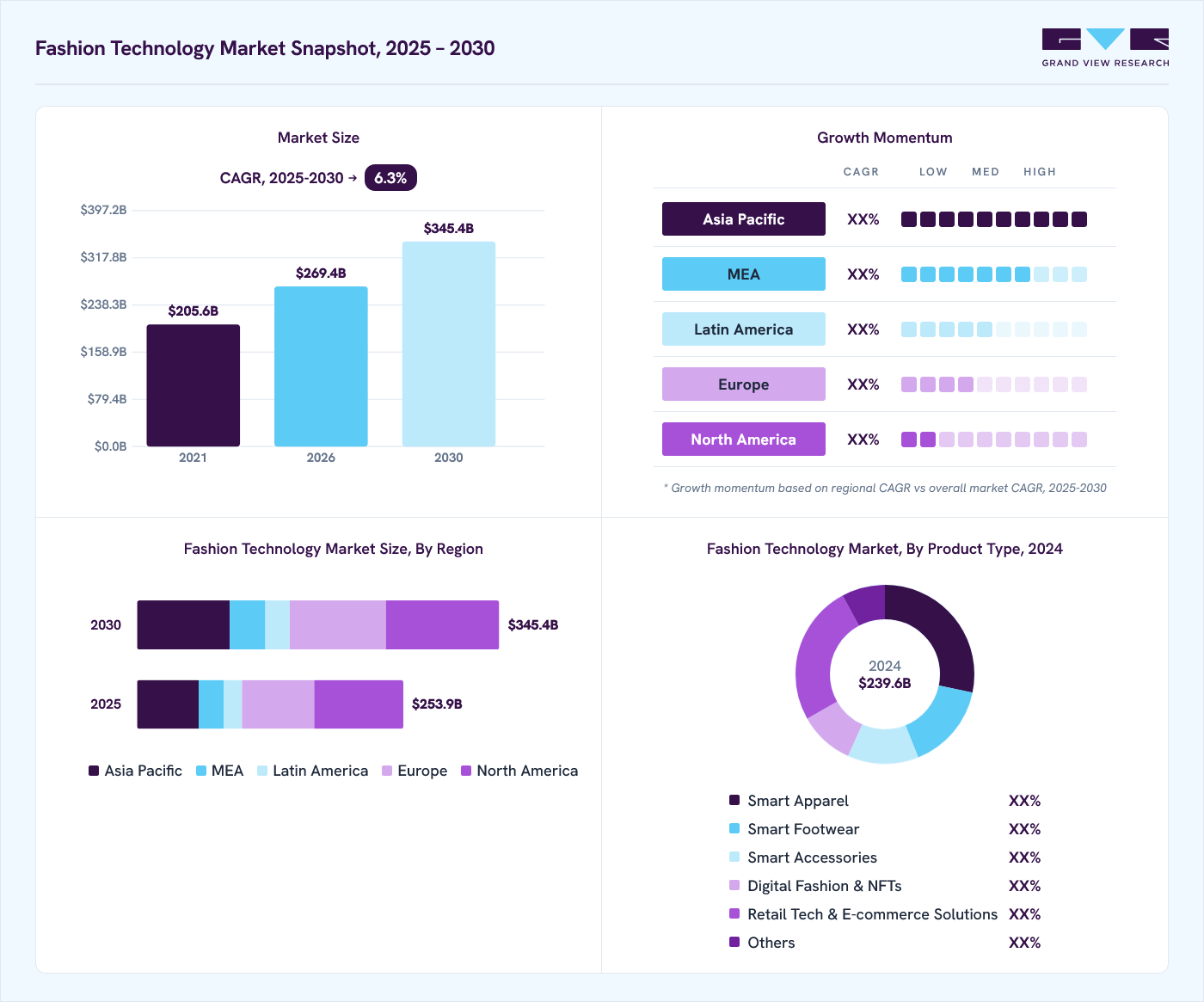
The global fashion technology market size was valued at USD 239.6 billion in 2024 and is projected to grow from USD 269.4 billion in 2026 to USD 345.4 billion by 2030, at a CAGR of 6.3% from 2025 to 2030. North America dominated the market, accounting for a revenue share of 33.9% in 2024. The growth of the market is driven by the rapid adoption of AI-powered design and virtual try-on solutions and the growing popularity of sustainable and smart fabrics.
 Source: Grand View Research, IR Documents, Primary Interviews, Paid DatabasesTo learn more about this report,
 Download Free Sample Report
 Key Market Trends & Insights
- U.S. is expected to grow significantly at a CAGR of 4.5% from 2025 to 2030.
- By product type, the smart apparel segment accounted for the largest market share of over 28.0% in 2024.
- By technology type, the wearable technology segment dominated the market and accounted for a revenue share of over 26.0% in 2024.
- By end-use, the retail & e-commerce segment dominated the market and accounted for the revenue share of over 32.0% in 2024.
Market Size & Forecast
- Market size in 2024: USD 239.6 Billion
- Projected market size by 2030: USD 345.4 Billion
- CAGR (2025-2030): 6.3%
- North America: Largest market in 2024
- Asia Pacific: Fastest growing market
Three ways to get this report
Buy it, customize it, or ask a question.Ask an Analyst
Analyst response in 1 business day
- AccessReport author, directly
- Reply timeWithin 1 working day
- No sales callDirect answer only
- FormatEmail reply
- CostFree, no cost
Get the Full Report
What the study covers
- FormatsPDF · Excel · Dashboard
- Timeline2025–2030 annual, 2024 base
- Coverage20+ countries, 5 regions
- Companies10+ key players profiled
Customize the Report
20% free customization
- IncludeCountries, segments, points
- TailorTo your product definition
- ExtendDeeper competitor detail
- OrA fully bespoke study
- Turnaround5–10 working days
AI and machine learning algorithms are transforming fashion design, trend forecasting, and personalized shopping experiences, enhancing customer engagement and operational efficiency. In addition, the demand for eco-friendly fashion has accelerated innovations in smart fabrics embedded with sensors and sustainable materials, supporting brands in meeting environmental goals.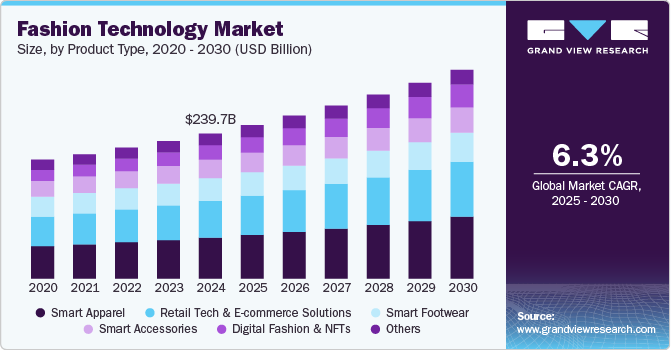 To learn more about this report, Download Free Sample Report
 The rise of e-commerce platforms and digital transformation has significantly accelerated the growth of the fashion technology industry. Online retailers leverage advanced technologies such as augmented reality (AR), virtual reality (VR), and AI-powered recommendation systems to enhance the customer shopping experience. Virtual fitting rooms, personalized style suggestions, and real-time product visualization enable consumers to make informed purchasing decisions, driving sales and customer satisfaction.
Consumers increasingly seek personalized shopping experiences, driving the adoption of fashion technology solutions that offer customization. AI algorithms analyze consumer preferences and past purchases to recommend personalized designs, colors, and sizes. For instance, in March 2025, Google introduced AI-powered shopping tools, including Virtual Try-On for makeup and AI Vision Search to help users find clothing based on uploaded images. The tools enhance the shopping experience by providing personalized recommendations and realistic visualizations. These innovations aim to make online shopping more interactive and user-friendly.
The rise of rental fashion, resale platforms, and clothing subscription services is also driving demand for technology-enabled solutions that facilitate product tracking, authentication, and seamless logistics. AI-driven inventory management and blockchain authentication for second-hand luxury goods are ensuring trust and convenience in the circular fashion economy. Moreover, 3D printing and on-demand manufacturing enable brands to offer custom-made garments, reducing excess inventory and promoting sustainable consumption.
Product Type Insights
The smart apparel segment accounted for the largest market share of over 28.0% in 2024, driven by the increasing demand for wearable technology that enhances convenience, health monitoring, and performance tracking. Smart apparel incorporates sensors and advanced fabrics that can monitor vital signs, body movements, and posture, offering significant applications in sports, fitness, and healthcare. Athletes and fitness enthusiasts are particularly drawn to these products for real-time feedback on their performance, encouraging further innovation in the segment.
The digital fashion & NFTs segment is anticipated to grow at a CAGR of 8.2% during the forecast period, driven by the increasing convergence of fashion, blockchain technology, and the metaverse. Digital fashion, consisting of virtual clothing and accessories, allows consumers to dress their avatars in online environments and social media platforms. Brands are capitalizing on this trend by launching exclusive digital collections, collaborating with virtual influencers, and creating immersive experiences through augmented reality (AR) and virtual reality (VR). The desire for self-expression in digital spaces and the rise of virtual worlds such as Decentraland and Roblox have further accelerated the demand for digital fashion.
Technology Type Insights
The wearable technology segment dominated the market and accounted for a revenue share of over 26.0% in 2024, driven by increasing consumer demand for connected devices that offer both functionality and style. Wearables such as smartwatches, fitness trackers, and smart glasses have gained widespread popularity, particularly for health and fitness monitoring. Features like heart rate monitoring, sleep tracking, and activity recognition provide users with real-time health insights, driving the adoption of wearable technology.
The blockchain segment is expected to grow at a significant CAGR over the forecast period. Blockchain technology offers a decentralized and tamper-proof ledger that enables brands to track products from raw materials to final delivery, ensuring transparency at every stage. This is particularly beneficial for luxury fashion, where counterfeit goods remain a significant challenge. By leveraging blockchain, brands can provide consumers with verifiable information about product authenticity, origin, and sustainability practices through digital certificates and smart contracts, enhancing brand credibility and customer trust.
End-use Insights
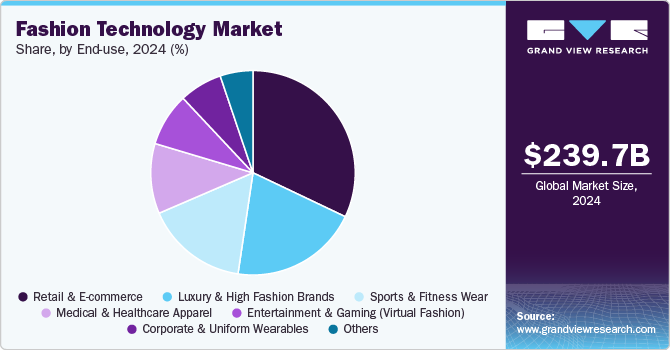
The retail & e-commerce segment dominated the market and accounted for the revenue share of over 32.0% in 2024, driven by the increasing adoption of digital solutions that enhance the shopping experience and streamline operations. Fashion retailers are leveraging technologies such as augmented reality (AR), virtual reality (VR), and artificial intelligence (AI) to offer immersive and personalized shopping experiences. Virtual try-on solutions, digital fitting rooms, and 3D product visualization enable customers to explore and try clothing virtually, reducing return rates and boosting customer satisfaction.
 To learn more about this report, Download Free Sample Report
 The entertainment & gaming (virtual fashion) segment is expected to grow at a significant CAGR over the forecast period. The growing appeal of virtual influencers and fashion shows in the metaverse is fueling demand for virtual fashion experiences. Brands are hosting immersive events and creating digital pop-up stores where users can explore and purchase virtual apparel. Blockchain technology ensures the authenticity and ownership of these digital assets, adding value for collectors and enthusiasts.
Regional Insights
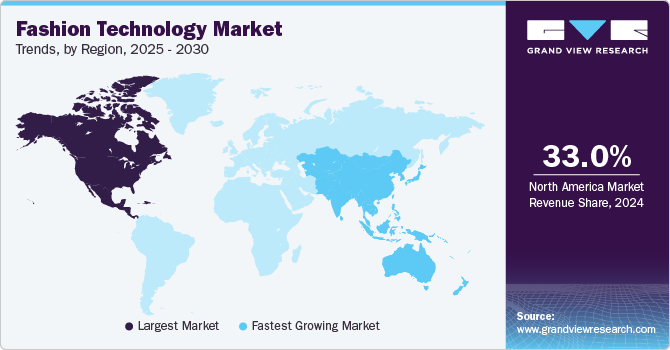
The fashion technology market in North America held the largest share of over 33.0% in 2024. The North America fashion technology industry is witnessing significant growth, driven by the increasing adoption of digital solutions to enhance design, production, and retail operations. Technologies such as artificial intelligence (AI), augmented reality (AR), virtual reality (VR), and 3D printing are transforming the fashion landscape. AI-powered tools assist in trend forecasting, inventory management, and personalized shopping experiences, while AR and VR provide immersive shopping experiences through virtual try-ons and interactive product displays. Brands are leveraging these innovations to engage consumers more effectively and reduce return rates, contributing to operational efficiency.
 To learn more about this report, Download Free Sample Report
 The fashion technology market in the U.S. is expected to grow significantly at a CAGR of 4.5% from 2025 to 2030. The U.S. fashion technology market is primarily driven by the rapid digital transformation of retail and the growing e-commerce sector. Consumers increasingly prefer online shopping, encouraging brands to adopt AI-powered personalization tools, virtual try-ons using augmented reality (AR), and chatbot-based customer support.
Europe Fashion Technology Industry Trends
The fashion technology market in Europe is anticipated to register considerable growth from 2025 to 2030. Brands are adopting AI-driven material selection, digital fabric printing, and virtual prototyping to reduce waste. The region’s stringent regulations on sustainability also push companies to invest in traceability solutions through blockchain technology. Furthermore, the popularity of luxury fashion brands and their willingness to experiment with immersive experiences using AR and VR enhances consumer engagement. Digital marketplaces and fashion-as-a-service models are also gaining traction, supporting market expansion.
The U.K. fashion technology market is expected to grow rapidly in the coming years. The rise of digital fashion and virtual influencers is transforming how brands engage with younger audiences in the metaverse. Sustainability is also a major focus, with brands using blockchain for supply chain transparency and digital twins for waste reduction in production. The presence of numerous fashion-tech startups and partnerships with fintech companies offering buy-now-pay-later (BNPL) solutions further fuels market growth.
Fashion technology market in Germany held a substantial market share in 2024. The country’s focus on sustainability has led to the adoption of digital fabric printing, eco-friendly material selection using AI, and blockchain-based transparency solutions. Virtual reality (VR) and AR are increasingly used in immersive shopping experiences, both online and in physical stores. The robust presence of fashion retailers and tech innovators in Germany, coupled with government support for digital transformation, further accelerates market growth.
Asia Pacific Fashion Technology Market Trends
Asia Pacific is expected to register the highest CAGR of 8.5% from 2025 to 2030. Asia Pacific’s fashion technology market is experiencing rapid growth due to the booming e-commerce, especially in countries like India, South Korea, and Australia. Mobile commerce and digital payments are widely adopted, leading brands to integrate AI-powered recommendation engines and virtual try-on technology. Social commerce platforms, where influencers drive purchasing decisions, are further propelling the market.
The Japan fashion technology market is expected to grow rapidly in the coming years. Japan’s fashion technology market is driven by its technological advancements and consumer affinity for innovative experiences. Japanese brands are at the forefront of implementing smart textiles and wearable technology for both fashion and functional use. Robotics and AI are increasingly used in retail for inventory management and personalized shopping experiences
The fashion technology market in China held a substantial market share in 2024. China’s fashion technology market is propelled by the country’s dominance in e-commerce and mobile-first consumer behavior. Platforms like Alibaba and JD.com have pioneered the use of AI and big data to deliver personalized recommendations and optimize logistics. Livestream shopping, where influencers showcase products in real-time, has become a powerful marketing tool.
Key Fashion Technology Company Insights
Key players operating in the fashion technology industry are Amazon Web Services, Inc, IBM Corporation, Oracle, and Vue.ai. The companies are focusing on various strategic initiatives, including new product development, partnerships & collaborations, and agreements to gain a competitive advantage over their rivals. The following are some instances of such initiatives.
-
In January 2025, Perfect Corp., a Taiwan-based beauty and fashion tech solutions provider, has completed its acquisition of U.S.-based Wannaby Inc., a company known for its virtual try-on technology for luxury brands. This move strengthens Perfect Corp.'s leadership in beauty and fashion technology, expanding its product portfolio and customer base. The integration of Wannaby will commence immediately, ensuring a smooth transition for customers and employees. By combining their expertise and resources, Perfect Corp. aims to drive innovation and enhance its commitment to delivering high-quality solutions and exceptional customer experiences.
-
In September 2024, Lole, athletic wear and outerwear producer, acquired Louis Garneau Sports in the field of cycling and sports equipment with three brands such as Garneau, Sugoi and Sombrio. The acquisition aims allow Lole to broaden its product range and strengthen its focus on innovation and quality, resulting in a more varied selection of sports apparel and equipment for customers.
Key Fashion Technology Companies:
The following are the leading companies in the fashion technology market. These companies collectively hold the largest market share and dictate industry trends.
- Adobe
- Amazon Web Services, Inc
- Catchoom
- Heuritech
- Huawei Device Co., Ltd.
- IBM Corporation
- Microsoft
- Oracle
- SAP
- Vue.ai
Fashion Technology Market Report Scope
Report Attribute
Details
Market size in 2024
USD 239.6 billion
Estimated market size in 2026
USD 269.4 billion
Projected market size by 2030
USD 345.4 billion
Growth Rate
CAGR of 6.3% from 2025 to 2030
Actual data
2018 - 2023
Base year for estimation
2024
Forecast period
2025 - 2030
Quantitative units
Revenue in USD billion and CAGR from 2025 to 2030
Report services
Revenue forecast, company share, competitive landscape, growth factors, and trends
Segments covered
Product type, technology type, end-use, region
Regional scope
North America; Europe; Asia Pacific; Latin America; MEA
Country scope
U.S.; Canada; Mexico; U.K.; Germany; France; China; India; Japan; Australia; South Korea; Brazil; UAE; Kingdom of Saudi Arabia; South Africa
Key companies profiled
Adobe; Amazon Web Services, Inc; Catchoom; Facebook; Google; Heuritech; Huawei Device Co., Ltd.; IBM Corporation; Microsoft; Oracle; SAP; Vue.ai
Customization scope
Free report customization (equivalent up to 8 analysts working days) with purchase. Addition or alteration to country, regional & segment scope.
Pricing and purchase options
Avail customized purchase options to meet your exact research needs. Explore purchase options
Global Fashion Technology Market Report Segmentation
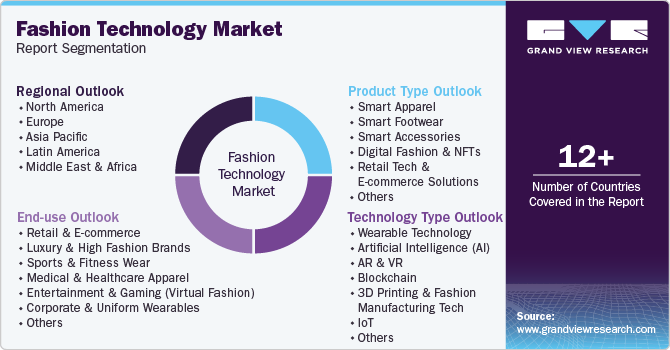
This report forecasts revenue growth at global, regional, and country levels and provides an analysis of the latest industry trends in each of the sub-segments from 2018 to 2030. For this study, Grand View Research has segmented the fashion technology market report based on product type, technology type, end-use, and region:
 To learn more about this report, Download Free Sample Report
 -
Product Type Outlook (Revenue, USD Billion, 2018 - 2030)
-
Smart Apparel
-
Smart Footwear
-
Smart Accessories
-
Digital Fashion & NFTs
-
Retail Tech & E-commerce Solutions
-
Others
-
-
Technology Type Outlook (Revenue, USD Billion, 2018 - 2030)
-
Wearable Technology
-
Artificial Intelligence (AI)
-
AR & VR
-
Blockchain
-
3D Printing & Fashion Manufacturing Tech
-
IoT
-
Big Data & Analytics
-
Others
-
-
End-use Outlook (Revenue, USD Billion, 2018 - 2030)
-
Retail & E-commerce
-
Luxury & High Fashion Brands
-
Sports & Fitness Wear
-
Medical & Healthcare Apparel
-
Entertainment & Gaming (Virtual Fashion)
-
Corporate & Uniform Wearables
-
Others
-
-
Regional Outlook (Revenue, USD Billion, 2018 - 2030)
-
North America
-
U.S.
-
Canada
-
Mexico
-
-
Europe
-
U.K.
-
Germany
-
France
-
-
Asia Pacific
-
China
-
India
-
Japan
-
South Korea
-
Australia
-
-
Latin America
-
Brazil
-
-
Middle East & Africa
-
UAE
-
Saudi Arabia
-
South Africa
-
-
Frequently Asked Questions About This Report
The rapid adoption of AI-powered design and virtual try-on solutions and the growing popularity of sustainable and smart fabrics drive the growth of the market. AI and machine learning algorithms are transforming fashion design, trend forecasting, and personalized shopping experiences, enhancing customer engagement and operational efficiency.
The global fashion technology market size was valued at USD 239.6 billion in 2024 and is estimated at USD 269.4 billion for 2026.
The global fashion technology market is expected to grow at a CAGR of 6.3% from 2025 to 2030, reaching USD 345.4 billion by 2030
The fashion technology market in North America held the largest share of over 33.0% in 2024. The North America fashion technology industry is witnessing significant growth, driven by the increasing adoption of digital solutions to enhance design, production, and retail operations. Technologies such as artificial intelligence (AI), augmented reality (AR), virtual reality (VR), and 3D printing are transforming the fashion landscape
Some key players operating in the fashion technology market include Adobe, Amazon Web Services, Inc, Catchoom, Facebook, Google, Heuritech, Huawei Device Co., Ltd., IBM Corporation, Microsoft, Oracle, SAP, and Vue.ai
About the Author(s)
Next Generation Technologies Research Team
Technology · Next Generation TechnologiesThis report was authored by the next generation technologies research team at Grand View Research - comprising two research analysts, one senior research analyst, and one industry expert - with specialized expertise in the next generation technologies segment of the technology industry. All findings are based on proprietary technology databases, executive interviews, and regulatory analysis, subject to internal peer review prior to publication.
Last Updated:
Speak to Analyst

Customize this report to your needs - add regions, segments, or data points, with 20% free customization.
Or view our licence options:


ISO 9001:2015 & 27001:2022 Certified
We are GDPR and CCPA compliant! Your transaction & personal information is safe and secure. For more details, please read our privacy policy.


