
- Home
- »
- Plastics, Polymers & Resins
- »
-
Humidity-responsive Polymers Market, Industry Report, 2033GVR Report cover
![Humidity-responsive Polymers Market Size, Share & Trends Report]()
Humidity-responsive Polymers Market (2025 - 2033) Size, Share & Trends Analysis Report By Product (Films/Coatings, Bulk Polymers/Hydrogels, Fibers, Additives/Masterbatches), By End-use (Packaging Films, Building Materials, Textiles, Agriculture, Biomedical), By Region (North America, Europe, Asia Pacific), And Segment Forecasts
Market Size, 2024
$352.0MMarket Estimate, 2026
$388.5MMarket Forecast, 2033
$904.5MCAGR, 2025–2033
11.1%Humidity-responsive Polymers Market Summary
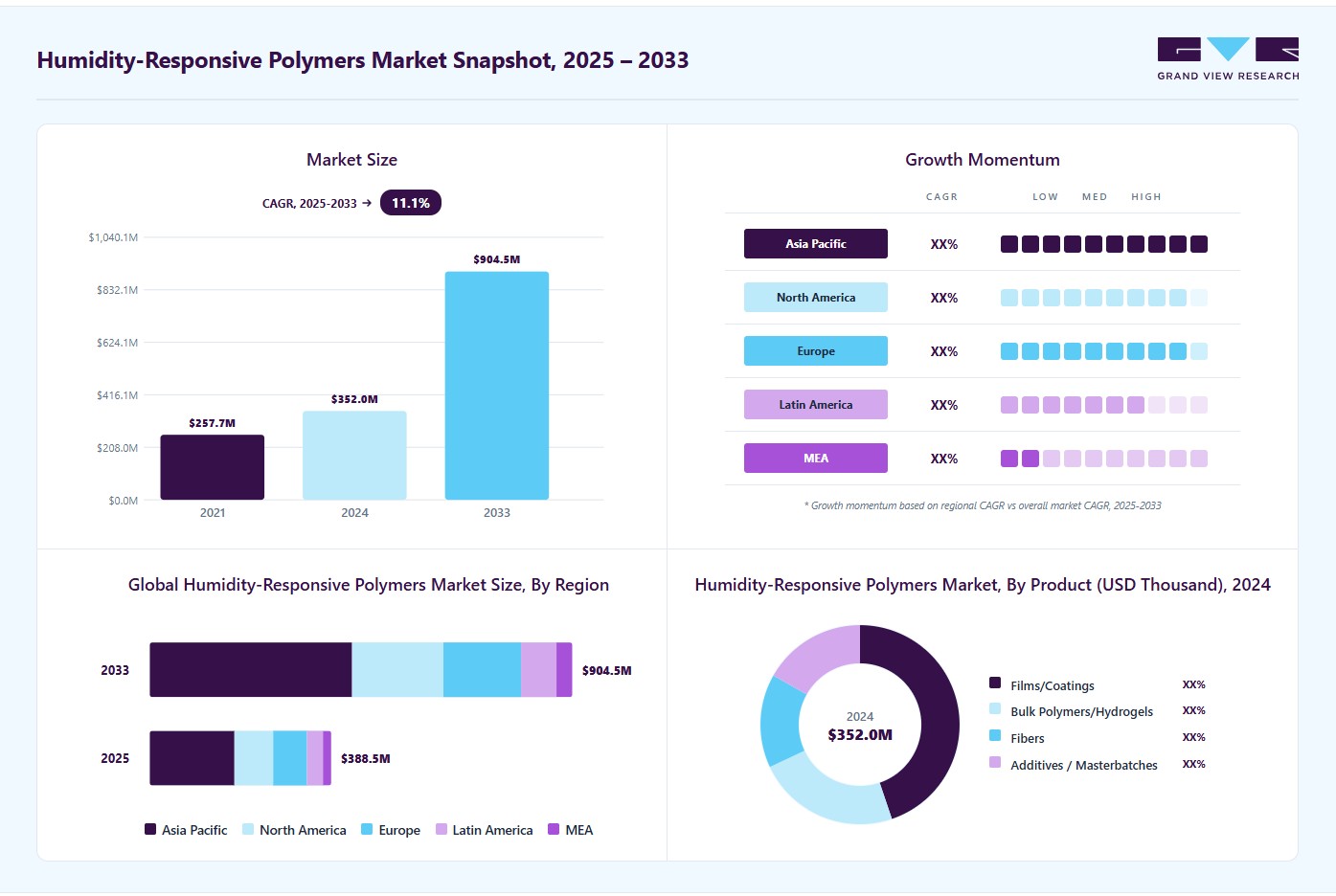
The global humidity-responsive polymers market size was estimated at USD 352.0 million in 2024 and is projected to reach USD 904.5 million by 2033, growing at a CAGR of 11.1% from 2025 to 2033. Growing demand for smart packaging and responsive coatings is driving the adoption of humidity-responsive polymers, as businesses seek materials that can enhance product protection and shelf life. Increasing awareness of sustainable and adaptive materials further boosts market growth.
Key Market Trends & Insights
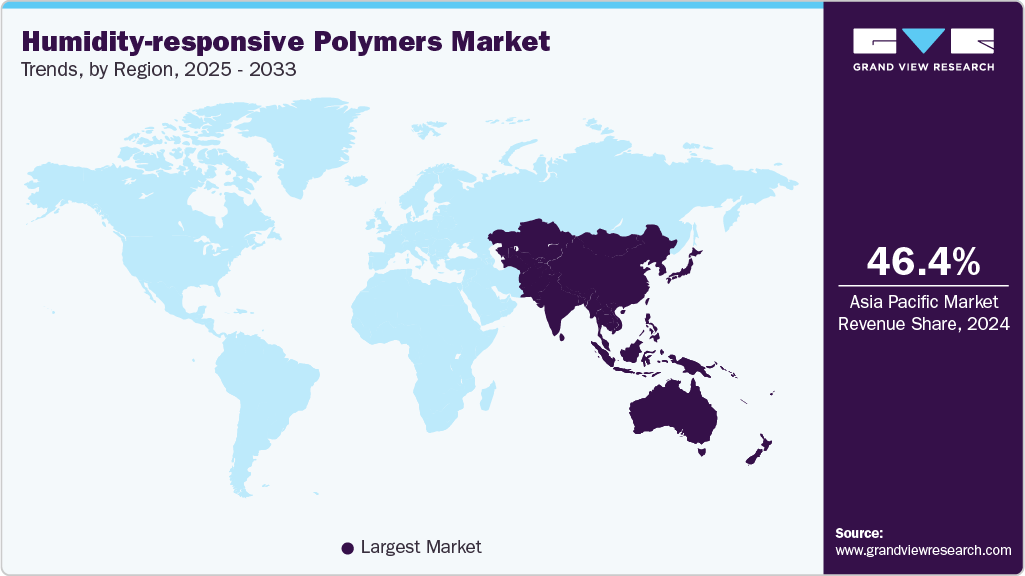
- Asia Pacific dominated the humidity-responsive polymers market with the largest revenue share of 46.43% in 2024.
- China led Asia Pacific and captured around 55% of the revenue market share in 2024.
- By product, the films/coatings dominated the humidity-responsive polymers market in terms of revenue, accounting for a market share of 44.81% in 2024.
- By end-use, the packaging films segment dominated the humidity-responsive polymers industry, accounting for a revenue share of 38.90% in 2024.
Market Size & Forecast
- 2024 Market Size: USD 352.0 Million
- 2033 Projected Market Size: USD 904.5 Million
- CAGR (2025-2033): 11.1%
- Asia Pacific: Largest Market in 2024
The convergence of artificial intelligence (AI) and the Internet of Things (IoT) with humidity-responsive polymers is reshaping the landscape of environmental monitoring and adaptive materials. This integration enables real-time data collection and analysis, facilitating predictive maintenance and dynamic system adjustments in applications such as HVAC systems and smart textiles.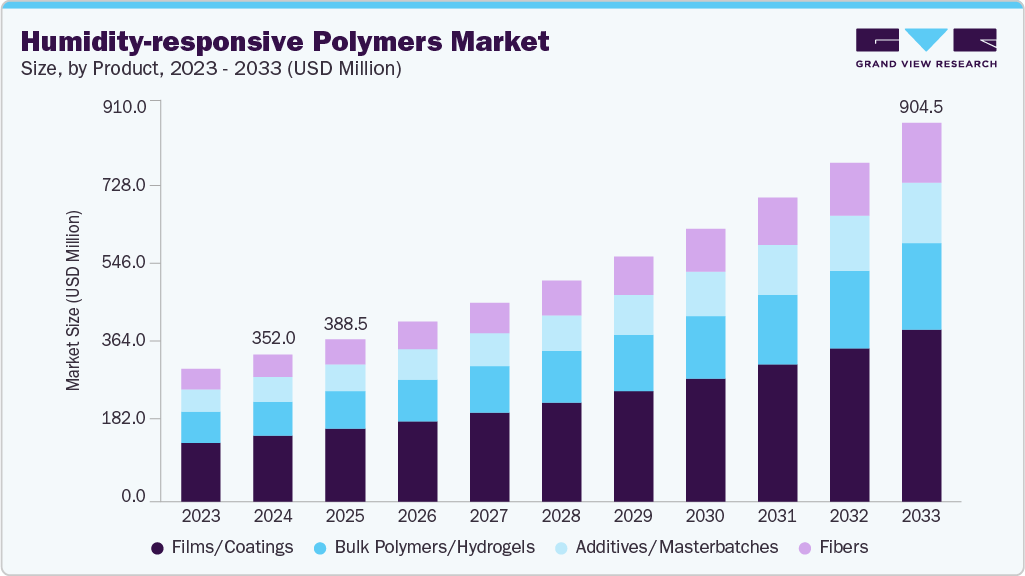
The synergy between AI algorithms and IoT sensors enhances the responsiveness and efficiency of polymer-based systems, driving innovation in sectors like healthcare, automotive, and consumer electronics. As digital transformation accelerates, the demand for intelligent, self-regulating materials is poised to expand, positioning AI and IoT integration as a pivotal trend in the evolution of humidity-responsive polymers.
Drivers, Opportunities & Restraints
Recent breakthroughs in material science and nanotechnology are propelling the development of high-performance humidity-responsive polymers. Innovations such as nanocomposite hydrogels and hybrid polymer systems are enhancing the sensitivity, stability, and functionality of these materials.
These advancements enable the creation of polymers that can undergo reversible structural changes in response to humidity variations, offering precise control in applications like drug delivery systems, flexible sensors, and adaptive coatings. The continuous evolution of nanomaterials and their integration into polymer matrices are critical drivers, expanding the scope and applicability of humidity-responsive polymers across diverse industries.
The burgeoning field of wearable and flexible electronics presents significant opportunities for humidity-responsive polymers. These materials can be engineered to monitor and respond to physiological parameters such as skin moisture and respiration rates, paving the way for advanced health-monitoring devices.
Additionally, their application in flexible displays and sensors can lead to the development of more efficient and responsive electronic systems. As consumer demand for health-centric and adaptable electronic products grows, the integration of humidity-responsive polymers offers a strategic avenue for innovation, positioning companies to capitalize on the expanding market for wearable technology.
Despite their promising applications, the widespread adoption of humidity-responsive polymers faces challenges related to scalability and manufacturing consistency. The intricate processes involved in synthesizing these advanced materials can lead to variability in performance, affecting their reliability and commercial viability.
Moreover, the integration of nanomaterials and the need for precise control over polymer structures complicate large-scale production. These manufacturing challenges necessitate significant investment in research and development to standardize production methods and ensure the consistent quality of humidity-responsive polymers. This remains a critical restraint to their broader implementation in industrial applications.
Market Concentration & Characteristics
The humidity-responsive polymers market growth stage is high, and the pace of growth is accelerating. The market exhibits slight consolidation, with key players dominating the industry landscape. Major companies like The Lubrizol Corporation, BASF SE, Covestro AG, Huntsman International LLC.; DuPont; Evonik Industries AG; SMP Technologies Inc.; Merck KGaA; and Akina, Inc.
Autonomic Materials, NIPPON SHOKUBAI CO., LTD., and others play a significant role in shaping the market dynamics. These leading players often drive innovation within the market, introducing new products, technologies, and applications to meet evolving industry demands.
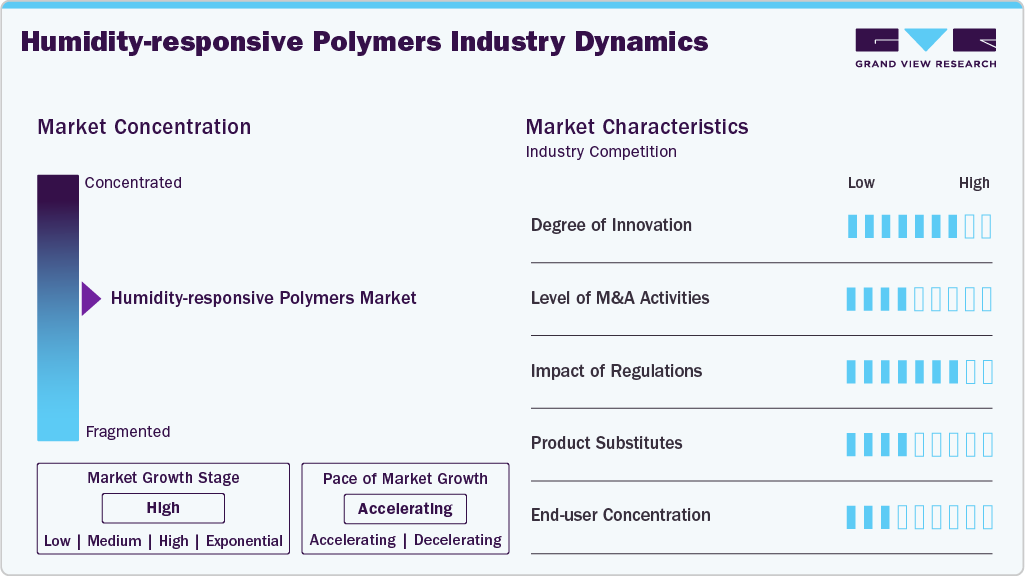
The degree of innovation in the humidity-responsive polymers industry is advancing rapidly, driven by interdisciplinary research and technological convergence. Recent developments include the creation of bioinspired actuators that mimic natural moisture-responsive behaviors, such as pinecone-inspired actuators and cellulose-based fiber actuators, which exhibit reversible shape changes in response to humidity fluctuations. These innovations are expanding the functional applications of humidity-responsive polymers beyond traditional uses, opening new avenues in fields like soft robotics, smart textiles, and adaptive building materials.
The integration of advanced manufacturing techniques, such as 3D and 4D printing, further enhances the customization and scalability of these materials, positioning them at the forefront of next-generation smart materials.
In terms of product substitutes, while traditional materials like hydrogels and natural polymers have been utilized for moisture-sensitive applications, they often face limitations in terms of mechanical strength, response time, and environmental stability. Humidity-responsive polymers offer significant advantages over these alternatives, including enhanced durability, faster response rates, and the ability to undergo reversible structural changes without external stimuli.
Product Insights
Films/coatings dominated the humidity-responsive polymers market in terms of revenue, accounting for a market share of 44.81% in 2024, and is expected to grow at a significant CAGR from 2025 to 2033. The growing emphasis on sustainability and environmental responsibility is propelling the demand for eco-friendly coatings and films. Humidity-responsive polymers, derived from renewable sources and offering biodegradability, align with these market trends.
Their application in protective coatings for electronics and infrastructure not only enhances durability but also supports green building certifications and eco-labeling initiatives. This convergence of performance and environmental consciousness is driving innovation and adoption in the films and coatings sector.
The fibers segment is anticipated to grow at a substantial CAGR of 11.6% through the forecast period. Advancements in textile engineering are steering the fibers segment towards multifunctional materials. Humidity-responsive fibers, capable of adapting to environmental moisture, are gaining traction in applications requiring dynamic comfort control.
Their integration into smart textiles enables garments that respond to varying humidity levels, offering personalized comfort and contributing to the growing trend of wearable technology. This technological synergy is fueling the expansion of the fibers market in the textile industry.
End-use Insights
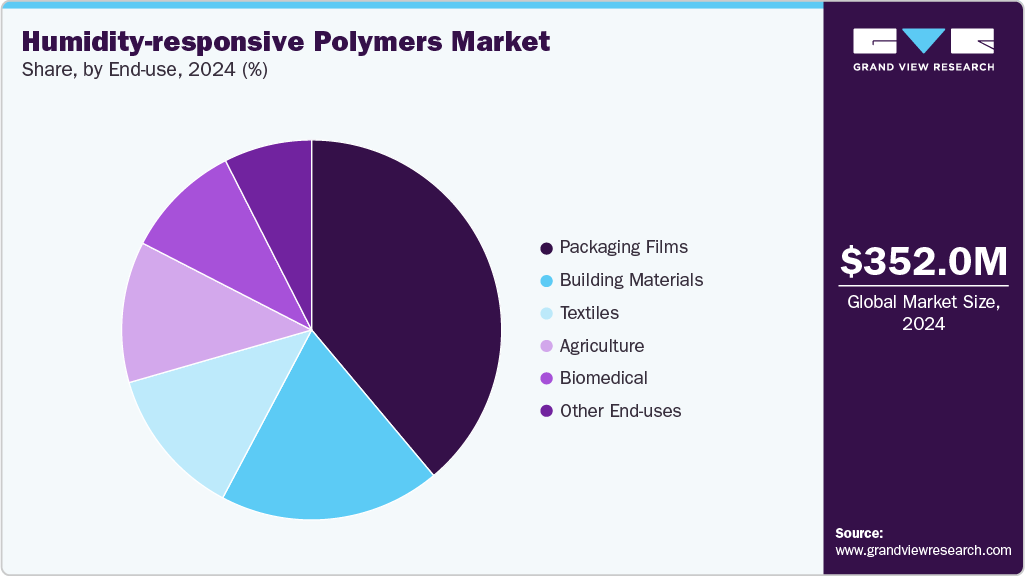
The packaging films segment dominated the humidity-responsive polymers industry, accounting for a revenue share of 38.90% in 2024, and is forecasted to grow at a considerable CAGR from 2025 to 2033. In the packaging industry, the need for enhanced product preservation is driving the adoption of humidity-responsive films.
These films regulate moisture levels within packaging, extending shelf life and maintaining product integrity. Their application is particularly significant in the food and pharmaceutical sectors, where moisture control is critical. The increasing consumer demand for fresh and safe products is propelling the growth of humidity-responsive packaging solutions.
The automotive segment is expected to grow at a substantial CAGR of 11.9% through the forecast period. The textiles sector is experiencing a shift towards adaptive materials that respond to environmental stimuli. Humidity-responsive polymers are at the forefront of this transformation, enabling the development of fabrics that adjust to moisture levels, enhancing wearer comfort. This innovation is particularly relevant in activewear and outdoor apparel, where moisture management is crucial. The growing consumer preference for functional and responsive textiles is driving the incorporation of humidity-responsive polymers into textile products.
Regional Insights
The Asia Pacific humidity-responsive polymers market held the largest global revenue share of 46.43% in 2024 and is expected to grow at the fastest CAGR over the forecast period. The region is witnessing rapid growth, driven by industrialization and technological advancements. Countries such as Japan, South Korea, and India are investing heavily in smart manufacturing and automation, leading to increased demand for responsive materials in robotics, electronics, and automotive sectors. The region's robust infrastructure development and focus on innovation are fostering a conducive environment for the proliferation of humidity-responsive polymers. This dynamic landscape positions the Asia Pacific as a significant contributor to the global market.
China's humidity-responsive polymers market is expanding rapidly, fueled by the government's strategic initiatives to enhance technological capabilities and domestic production. The "Made in China 2025" plan emphasizes the development of advanced materials, including smart polymers, to bolster the country's manufacturing sector. Additionally, China's burgeoning consumer electronics industry is driving the demand for adaptive materials in devices such as wearables and flexible displays. These factors, combined with substantial investments in research and development, are propelling China's prominence in the global market for humidity-responsive polymers.
North America Humidity-responsive Polymers Market Trends
North America is experiencing robust growth in the humidity-responsive polymers industry, primarily driven by the region's strong emphasis on technological innovation and sustainability. The integration of smart materials into building infrastructure, particularly in HVAC systems, is enhancing energy efficiency and indoor air quality. Additionally, the healthcare sector's increasing demand for adaptive materials in medical devices and wound care applications is propelling market expansion. The convergence of these factors positions North America as a leader in the adoption of humidity-responsive polymers.
U.S. Humidity-responsive Polymers Market Trends
The U.S. stands at the forefront of the humidity-responsive polymers industry, propelled by significant investments in research and development across various industries. The aerospace and automotive sectors are increasingly incorporating these advanced materials to develop lightweight, adaptive components that respond to environmental stimuli. Furthermore, the growing trend towards personalized healthcare solutions is driving the demand for smart polymers in drug delivery systems and diagnostic devices. This multifaceted adoption underscores the U.S.'s pivotal role in advancing the utilization of humidity-responsive polymers.
Europe Humidity-responsive Polymers Market Trends
Europe's humidity-responsive polymers industry is expanding due to stringent environmental regulations and a strong focus on sustainable materials. The European Union's commitment to reducing carbon emissions and promoting circular economy principles is encouraging the development and adoption of smart polymers in various applications, including construction, packaging, and automotive industries. Countries like Germany and France are leading in integrating these materials into energy-efficient building designs and eco-friendly product packaging. The alignment of regulatory frameworks with sustainability goals is a key driver of market growth in Europe.
Key Humidity-responsive Polymers Company Insights
The humidity-responsive polymers market is highly competitive, with several key players dominating the landscape. Major companies include The Lubrizol Corporation, BASF SE, Covestro AG, Huntsman International LLC., DuPont, Evonik Industries AG, SMP Technologies Inc., Merck KGaA, Akina, Inc., Autonomic Materials, and NIPPON SHOKUBAI CO., LTD. The market is characterized by a competitive landscape with several key players driving innovation and market growth. Major companies in this sector are investing heavily in research and development to enhance the performance, cost-effectiveness, and sustainability of their products.
Key Humidity-responsive Polymers Companies:
The following are the leading companies in the humidity-responsive polymers market. These companies collectively hold the largest market share and dictate industry trends.
- The Lubrizol Corporation
- BASF SE
- Covestro AG
- Huntsman International LLC.
- DuPont
- Evonik Industries AG
- SMP Technologies Inc.
- Merck KGaA
- Akina, Inc.
- Autonomic Materials
- NIPPON SHOKUBAI CO., LTD.
Recent Developments
-
In July 2025, Adept Materials completed pilot testing of its innovative moisture control paint and primer technology, which reduced peak bathroom humidity levels by 15 percentage points compared to conventional paint in controlled tests. The Lilypad brand products are designed to combat mold growth and moisture damage in high-humidity areas such as bathrooms and kitchens. The year-long pilot at Greentown Labs showed the paint maintained humidity below 80% where conventional paint allowed spikes up to 95%, demonstrating durability after 150 hours of high humidity exposure.
Humidity-responsive Polymers Market Report Scope
Report Attribute
Details
Market size value in 2025
USD 388.5 million
Revenue forecast in 2033
USD 904.5 million
Growth rate
CAGR of 11.1% from 2024 to 2033
Historical data
2021 - 2023
Forecast period
2025 - 2033
Quantitative units
Revenue in USD million, volume in tons, and CAGR from 2025 to 2033
Report coverage
Revenue forecast, volume forecast, competitive landscape, growth factors, and trends
Segments covered
Product, end-use, region
Regional scope
North America; Europe; Asia Pacific; Latin America; Middle East & Africa
Country Scope
U.S.; Canada; Mexico; Germany; France; UK; Spain; Italy; China; Japan; India; South Korea; Brazil; Argentina; Saudi Arabia; South Africa; UAE
Key companies profiled
The Lubrizol Corporation; BASF SE; Covestro AG; Huntsman International LLC; DuPont; Evonik Industries AG; SMP Technologies Inc.; Merck KGaA; Akina, Inc.; Autonomic Materials; NIPPON SHOKUBAI CO., LTD.
Customization scope
Free report customization (equivalent up to 8 analyst’s working days) with purchase. Addition or alteration to country, regional & segment scope
Pricing and purchase options
Avail customized purchase options to meet your exact research needs. Explore purchase options
Global Humidity-responsive Polymers Market Report Segmentation
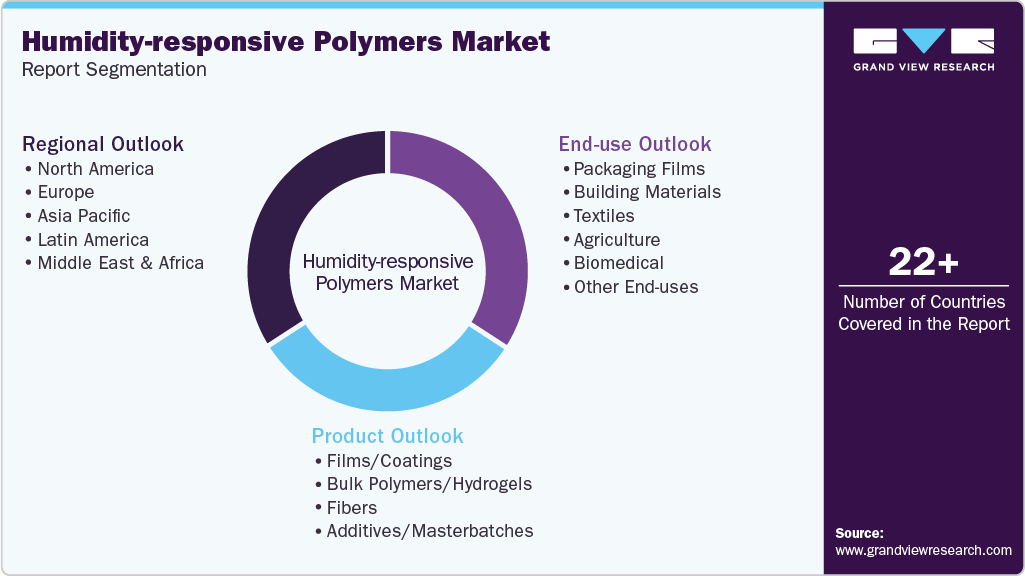
This report forecasts volume & revenue growth at the global, regional, and country levels and provides an analysis of the latest industry trends in each of the sub-segments from 2021 to 2033. For this study, Grand View Research has segmented the humidity-responsive polymers market report based on product, end-use, and region:
-
Product Outlook (Volume, Tons; Revenue, USD Million, 2021 - 2033)
-
Films/Coatings
-
Bulk Polymers/Hydrogels
-
Fibers
-
Additives / Masterbatches
-
-
End-use Outlook (Volume, Tons; Revenue, USD Million, 2021 - 2033)
-
Packaging Films
-
Building Materials
-
Textiles
-
Agriculture
-
Biomedical
-
Other End-uses
-
-
Regional Outlook (Volume, Tons; Revenue, USD Million, 2021 - 2033)
-
North America
-
U.S.
-
Canada
-
Mexico
-
-
Europe
-
Germany
-
UK
-
France
-
Italy
-
Spain
-
-
Asia Pacific
-
China
-
India
-
Japan
-
South Korea
-
-
Latin America
-
Brazil
-
Argentina
-
-
Middle East & Africa
-
Saudi Arabia
-
South Africa
-
UAE
-
-
Frequently Asked Questions About This Report
The global humidity-responsive polymers market was estimated at USD 352.0 million in 2024 and is expected to reach USD 388.5 million by 2025.
The global humidity-responsive polymers market is expected to witness growth of 11.1% from 2025 to 2030 to reach USD 904.5 million by 2033.
Films/coatings dominated the humidity-responsive polymers market across the product segmentation in terms of revenue, accounting for a market share of 44.81% in 2024 owing to the growing emphasis on sustainability and environmental responsibility.
Some key players operating in the humidity-responsive polymers market include The Lubrizol Corporation, BASF SE, Covestro AG, Huntsman International LLC., DuPont, Evonik Industries AG, SMP Technologies Inc., Merck KGaA, Akina, Inc., Autonomic Materials, and NIPPON SHOKUBAI CO., LTD.
The factors driving the humidity-responsive polymers market include growing demand for smart packaging and responsive coatings, as businesses seek materials that can enhance product protection and shelf life.
About the Author(s)
Plastics, Polymers & Resins Research Team
Bulk Chemicals · Plastics, Polymers & ResinsThis report was authored by the plastics, polymers & resins research team at Grand View Research - comprising two research analysts, one senior research analyst, and one industry expert - with specialized expertise in the plastics, polymers & resins segment of the bulk chemicals industry. All findings are based on proprietary bulk chemicals databases, executive interviews, and regulatory analysis, subject to internal peer review prior to publication.
Last Updated:
Speak to Analyst

Customize this report to your needs — add regions, segments, or data points, with 20% free customization.
Or view our licence options:


ISO 9001:2015 & 27001:2022 Certified
We are GDPR and CCPA compliant! Your transaction & personal information is safe and secure. For more details, please read our privacy policy.












